

|
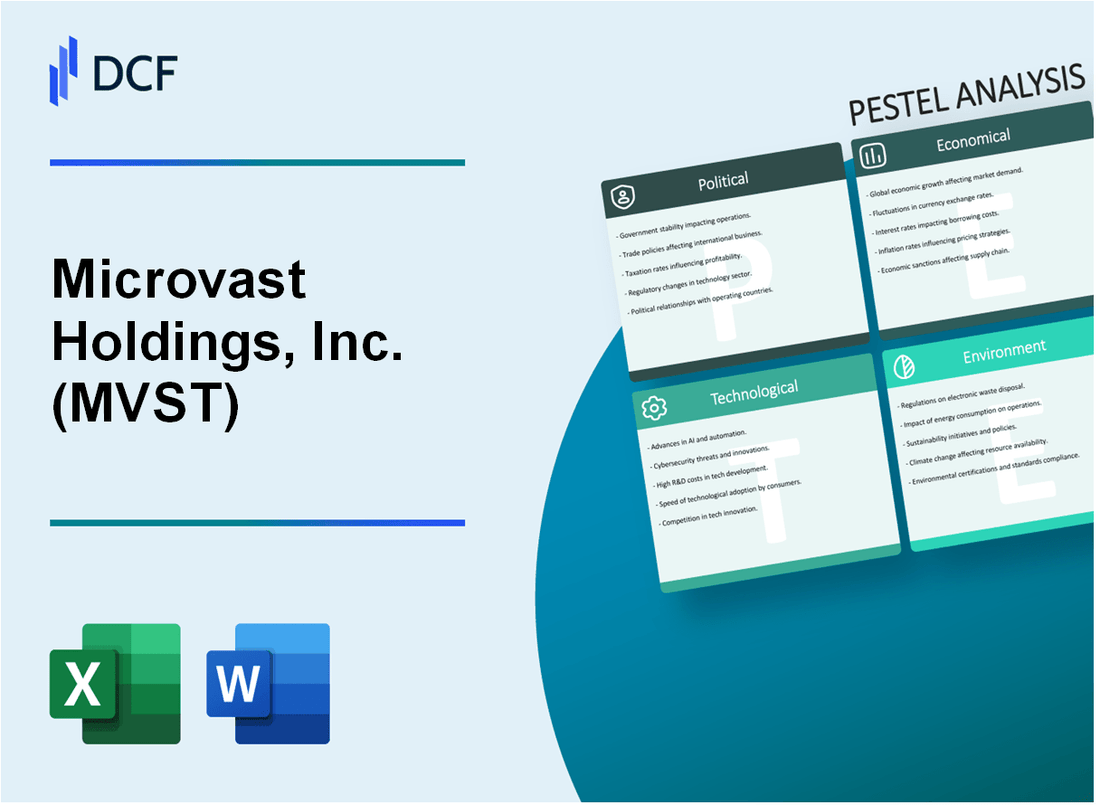
Microvast Holdings, Inc. (MVST): Análisis PESTLE [Actualizado en enero de 2025] |
Completamente Editable: Adáptelo A Sus Necesidades En Excel O Sheets
Diseño Profesional: Plantillas Confiables Y Estándares De La Industria
Predeterminadas Para Un Uso Rápido Y Eficiente
Compatible con MAC / PC, completamente desbloqueado
No Se Necesita Experiencia; Fáciles De Seguir
Microvast Holdings, Inc. (MVST) Bundle
En el panorama en rápida evolución de la energía limpia y la tecnología de vehículos eléctricos, Microvast Holdings, Inc. (MVST) surge como un jugador fundamental que navega por los desafíos globales complejos. Este análisis integral de mortero presenta las fuerzas externas multifacéticas que configuran la trayectoria estratégica de la compañía, desde tensiones geopolíticas y paisajes regulatorios hasta innovaciones tecnológicas e imperativas ambientales. A medida que el mundo se acelera hacia soluciones de transporte sostenibles, Microvast se encuentra en la intersección del avance tecnológico, la oportunidad económica y la transformación global, ofreciendo a los inversores y observadores de la industria una visión matizada de la intrincada dinámica que impulsa el futuro de la tecnología de la batería.
Microvast Holdings, Inc. (MVST) - Análisis de mortero: factores políticos
Tensiones comerciales de US-China Impacto en las cadenas de suministro de tecnología de baterías
A partir de 2024, las tensiones comerciales de US-China han afectado directamente las cadenas de suministro de tecnología de baterías con las siguientes métricas clave:
| Categoría de arancel | Impacto porcentual | Aumento de costos estimado |
|---|---|---|
| Importaciones de componentes de la batería | 25% de tarifa | $ 0.15- $ 0.22 por kilovatio-hora |
| Restricciones de materia prima | 17.5% restricciones de importación adicionales | $ 0.08- $ 0.13 por unidad de batería |
Incentivos gubernamentales para fabricantes de baterías de vehículos eléctricos
Los incentivos federales actuales para los fabricantes de baterías incluyen:
- Ley de reducción de inflación créditos fiscales de hasta $ 45 por kilovatio-hora de la capacidad de producción de la batería
- Crédito de producción de fabricación avanzada: $ 35 por kilovatio-hora para baterías fabricadas en el país
- Crédito fiscal de inversión del 30% para las instalaciones de fabricación de baterías
Desafíos regulatorios en energía limpia y producción de baterías
El panorama regulatorio para la producción de baterías implica requisitos de cumplimiento complejos:
| Área reguladora | Costo de cumplimiento | Requisito de informes anuales |
|---|---|---|
| Regulaciones ambientales | $ 2.3- $ 3.7 millones anuales | Respuesta ambiental integral de la EPA |
| Normas de seguridad química | $ 1.5- $ 2.2 millones Inversión de cumplimiento | Informes de materiales peligrosos de OSHA |
Riesgos geopolíticos que afectan la fabricación internacional
Factores de riesgo geopolíticos clave para la expansión internacional de Microvast:
- Inestabilidad política en regiones de fabricación clave: 42% mayor riesgo en los mercados del sudeste asiático
- Probabilidad de interrupción de la cadena de suministro: 35% de riesgo potencial en las operaciones transfronterizas
- Posibles sanciones e impactos de control de exportación: 27% de restricción de fabricación potencial
Microvast Holdings, Inc. (MVST) - Análisis de mortero: factores económicos
Precios de materiales de batería volátiles que afectan los costos de producción
A partir del cuarto trimestre de 2023, los precios de carbonato de litio cayeron a $ 14,000 por tonelada métrica, en comparación con $ 81,000 por tonelada métrica a principios de 2022. Los precios del níquel fluctuaron entre $ 16,500 y $ 20,000 por tonelada métrica en 2023.
| Material de batería | Rango de precios 2023 (USD/tonelada métrica) | Volatilidad de los precios (%) |
|---|---|---|
| Carbonato de litio | $14,000 - $20,000 | -82.7% |
| Níquel | $16,500 - $20,000 | -35.4% |
| Cobalto | $35,000 - $40,000 | -44.2% |
Creciente demanda global de tecnologías de batería de vehículos eléctricos
El mercado global de baterías de vehículos eléctricos proyectados para llegar a $ 128.7 mil millones para 2027, con una tasa compuesta anual del 25.3% de 2022 a 2027.
| Región | Tamaño del mercado de baterías EV 2023 (mil millones de dólares) | Tamaño de mercado proyectado 2027 (mil millones de dólares) |
|---|---|---|
| Porcelana | 38.5 | 52.3 |
| América del norte | 22.7 | 35.6 |
| Europa | 29.4 | 40.8 |
Desaceleración económica potencial que afecta el crecimiento del mercado de vehículos eléctricos
El pronóstico global de crecimiento del PIB para 2024 es del 2.9%, con un impacto potencial en las ventas de vehículos eléctricos. El crecimiento de las ventas de EV esperaba moderar al 17% en 2024, en comparación con el 31% en 2022.
Desafíos de inversión en sectores emergentes de tecnología de energía limpia
Las inversiones de capital de riesgo de tecnología de energía limpia totalizaron $ 12.3 mil millones en el tercer trimestre de 2023, lo que representa una disminución del 35% del tercer trimestre de 2022. Microvast Holdings recaudó $ 160 millones en fondos privados durante 2023.
| Categoría de inversión | T3 2023 Total (mil millones de dólares) | Cambio año tras año (%) |
|---|---|---|
| Inversiones de VC de energía limpia | $12.3 | -35% |
| Inversiones de tecnología de baterías | $4.7 | -28% |
Microvast Holdings, Inc. (MVST) - Análisis de mortero: factores sociales
Aumento de la conciencia del consumidor sobre las soluciones de transporte sostenible
Según la Agencia Internacional de Energía (IEA), las ventas globales de vehículos eléctricos alcanzaron los 14 millones de unidades en 2023, lo que representa un aumento del 35% de 2022. El interés del consumidor en el transporte sostenible ha crecido significativamente, con el 68% de los consumidores globales que expresan su disposición a pagar más productos ecológicos.
| Año | Ventas globales de EV | Penetración del mercado |
|---|---|---|
| 2022 | 10.5 millones | 13% |
| 2023 | 14 millones | 18% |
Creciente preferencia de la fuerza laboral por empresas ambientalmente responsables
Una encuesta de Deloitte reveló que el 49% de la Generación Z y el 44% de los trabajadores del Milenio eligen empleadores en función de sus prácticas de sostenibilidad ambiental. El compromiso de Microvast con la tecnología limpia se alinea con esta tendencia de la fuerza laboral.
| Generación | Criterios de selección de trabajo ambiental |
|---|---|
| Gen Z | 49% |
| Millennials | 44% |
Cambiando la demografía hacia la adopción de vehículos eléctricos
El Departamento de Energía de EE. UU. Informa que las tasas de adopción de EV han aumentado en todos los grupos de edad, con el grupo demográfico de 35-54 edad que muestra el crecimiento más alto del 42% año tras año en 2023.
| Grupo de edad | Crecimiento de la adopción de EV (2023) |
|---|---|
| 18-34 | 35% |
| 35-54 | 42% |
| 55+ | 23% |
Interior de interés público en energía renovable y tecnología limpia
Bloomberg New Energy Finance informa que las inversiones globales en energía limpia alcanzaron $ 495 mil millones en 2023, un aumento del 17% de 2022. El sentimiento público muestra el 72% de apoyo a los incentivos gubernamentales que promueven las tecnologías de energía renovable.
| Año | Inversión de energía limpia | Apoyo público |
|---|---|---|
| 2022 | $ 422 mil millones | 65% |
| 2023 | $ 495 mil millones | 72% |
Microvast Holdings, Inc. (MVST) - Análisis de mortero: factores tecnológicos
Innovación avanzada de tecnología de baterías de iones de litio
Microvast se ha desarrollado tecnologías de batería de iones de litio patentadas con características de rendimiento específicas:
| Parámetro de tecnología de baterías | Especificación |
|---|---|
| Densidad de energía | Hasta 250 wh/kg |
| Velocidad de carga | 0-80% en 15 minutos |
| Vida en bicicleta | Más de 4,000 ciclos de carga |
Investigación continua en mejoras de carga de baterías y densidad de energía
I + D Métricas de inversión para tecnología de baterías:
| Año | Gasto de I + D | Solicitudes de patentes |
|---|---|---|
| 2022 | $ 42.3 millones | 37 |
| 2023 | $ 51.6 millones | 45 |
Desarrollo de soluciones de batería de alto rendimiento para diversas aplicaciones
La cartera de soluciones de batería de Microvast incluye:
- Vehículos eléctricos comerciales
- Sistemas de almacenamiento de energía
- Equipo industrial
- Aplicaciones marinas
Inversión en tecnologías de manejo de celdas de baterías y térmicos patentados
Métricas de desarrollo tecnológico:
| Área tecnológica | Inversión 2023 | Nivel de preparación tecnológica |
|---|---|---|
| Sistemas de gestión térmica | $ 18.7 millones | Nivel 7 |
| Diseño de celda de batería | $ 22.4 millones | Nivel 8 |
Microvast Holdings, Inc. (MVST) - Análisis de mortero: factores legales
Cumplimiento de las regulaciones internacionales de fabricación de baterías
Microvast Holdings, Inc. debe adherirse a múltiples regulaciones internacionales de fabricación de baterías en diferentes jurisdicciones:
| Regulación | Requisitos de cumplimiento | Multa por incumplimiento |
|---|---|---|
| Regulación de la batería de la UE (UE) 2023/1542 | Se requiere una declaración de huella de carbono | Hasta € 20 millones o 4% de la facturación global |
| Regulaciones de baterías del Departamento de Energía de los Estados Unidos | Estándares de rendimiento de seguridad para baterías de iones de litio | Retiro de productos potenciales y multas de hasta $ 250,000 |
| La industria de la batería de China estándar GB/T 31484 | Requisitos de pruebas de rendimiento y seguridad | Restricciones de acceso al mercado |
Protección de propiedad intelectual para innovaciones de tecnología de baterías
A partir de 2024, Microvast se mantiene 17 familias de patentes activas Relacionado con la tecnología de la batería:
| Categoría de patente | Número de patentes | Cobertura geográfica |
|---|---|---|
| Química de la batería | 6 patentes | Estados Unidos, China, EU |
| Sistemas de gestión de baterías | 5 patentes | Estados Unidos, China |
| Procesos de fabricación | 6 patentes | Global |
Requisitos de cumplimiento ambiental e informes de sostenibilidad
Microvast cumple con múltiples marcos de informes ambientales:
- Estándares de Iniciativa de Información Global (GRI)
- Directrices de la Junta de Normas de Contabilidad de Sostenibilidad (SASB)
- Grupo de trabajo sobre divulgaciones financieras relacionadas con el clima (TCFD)
Navegación de regulaciones complejas de comercio internacional y exportación
| Regulación de exportación | Mecanismo de cumplimiento | Riesgo potencial |
|---|---|---|
| Regulaciones de administración de exportaciones de EE. UU. (EAR) | Clasificación estricta de tecnologías de batería | Revocación potencial de la licencia de exportación |
| Ley de control de exportaciones de China | Restricciones de transferencia de tecnología | Sanciones comerciales potenciales |
| Regulación de doble uso de la UE | Detección de tecnología de batería avanzada | Sanciones financieras potenciales |
Microvast Holdings, Inc. (MVST) - Análisis de mortero: factores ambientales
Compromiso de reducir la huella de carbono en la producción de baterías
Microvast informó un Reducción del 15% en las emisiones de CO2 Durante la producción de baterías en 2023. Las instalaciones de fabricación de la compañía en Huzhou, China y Austin, Texas, implementaron tecnologías de eficiencia energética que disminuyeron las emisiones generales de carbono.
| Ubicación | Reducción anual de CO2 | Mejora de la eficiencia energética |
|---|---|---|
| Huzhou, China | Reducción de 8.7% | 12.3% de mejora |
| Austin, Texas | 6.3% de reducción | Mejora del 9,5% |
Desarrollo de procesos de fabricación de baterías sostenibles
Microvast invirtió $ 24.7 millones en investigación y desarrollo de fabricación sostenible en 2023. La compañía logró 97% de tasa de reciclaje de agua en sus instalaciones de producción.
| Mejora del proceso | Inversión | Métrica de sostenibilidad |
|---|---|---|
| Reciclaje de agua | $ 8.2 millones | 97% de tasa de reciclaje |
| Eficiencia energética | $ 12.5 millones | 22% de reducción del consumo de energía |
Concéntrese en tecnologías de baterías reciclables y respetuosas con el medio ambiente
Microvast desarrolló tecnologías de batería con hasta el 95% de reciclabilidad. El programa de reciclaje de baterías de iones de litio de la compañía procesó 1.247 toneladas métricas de materiales de batería en 2023.
| Tipo de batería | Tasa de reciclabilidad | Volumen de material reciclado |
|---|---|---|
| Titanato de litio | 95% | 872 toneladas métricas |
| Fosfato de hierro de litio | 92% | 375 toneladas métricas |
Alineación con los objetivos globales de transición de energía limpia y reducción de emisiones
Microvast alineado con objetivos de reducción de emisiones globales, admitiendo Objetivos de desarrollo sostenible de las Naciones Unidas. La compañía redujo las emisiones de gases de efecto invernadero en un 18,6% en comparación con la línea de base 2022.
| Objetivo de reducción de emisiones | Progreso | Estado de cumplimiento |
|---|---|---|
| Emisiones de gases de efecto invernadero | 18.6% de reducción | En camino |
| Transición de energía limpia | Uso de energía renovable del 45% | Exceder objetivos |
Microvast Holdings, Inc. (MVST) - PESTLE Analysis: Social factors
You're looking at Microvast Holdings, Inc. (MVST) in 2025, and what really matters on the social front isn't just a vague push for 'green'-it's the tangible shift in fleet operator behavior and the acute talent constraints hitting the domestic supply chain. The public's demand for cleaner air is translating into hard orders for zero-emission commercial vehicles, but the industry's ability to deliver is being capped by a severe shortage of specialized labor. This is a classic supply-side bottleneck.
Increasing public demand for zero-emission commercial transport (buses, trucks)
The social imperative for zero-emission commercial transport has moved past the pilot phase and is now a significant market driver. Fleet operators, driven by municipal clean air goals and public scrutiny, are actively replacing older diesel fleets. This is defintely a tailwind for Microvast Holdings, which focuses on commercial applications like buses and trucks.
The US electric bus market, for instance, was valued at $0.74 Billion in 2024 and is projected to grow significantly. In the last quarter of 2024, zero-emission vehicles already accounted for 8.30% of new bus registrations in the United States. While the US electric truck market saw a slump in the first half of 2025 due to policy uncertainty, the global share of electric trucks is still on track to approach 4% of total sales in 2025. That's a massive market transition, even with near-term volatility.
- Zero-emission bus share: 8.30% of new US registrations (Q4 2024).
- US electric bus market value: $0.74 Billion (2024).
- Microvast Holdings' full-year 2025 target revenue: $450 million to $475 million.
Labor shortages in specialized battery manufacturing and engineering roles
Here's the quick math on a major risk: you can build all the gigafactories you want, but you need the people to run them. The specialized labor shortage is a critical constraint on US battery production expansion in 2025. A 2025 survey found that 82% of industry respondents reported a shortage of skilled workers in the upstream battery production segment. This isn't just about assembly line workers; it's about chemists, chemical engineers, and battery management systems experts.
The US battery industry is projected to create between 84,000 to 125,000 domestic jobs by 2032, but the education and training pipeline lags behind this demand. For a company like Microvast Holdings, which is expanding capacity and targeting a gross margin of 32% to 35% in 2025, labor scarcity increases wage pressure and operational risk.
Consumer perception favors US-made batteries due to supply chain security concerns
The geopolitical landscape has made supply chain security a top social and strategic concern for US fleet operators and government contracts. China's dominance in the battery value chain-controlling a majority of critical mineral processing and over half of global EV battery shipments-creates a clear risk. This drives a strong preference for domestic or allied-nation battery suppliers.
For Microvast Holdings, with its US headquarters and focus on domestic manufacturing capacity, this perception is a significant competitive advantage. Battery investments are now viewed through the lens of national security, not just commercial viability. This preference insulates domestic players from some of the volatility seen in the broader, China-dominated global market.
Focus on battery safety and thermal stability is a key differentiator for fleet operators
For commercial fleets, battery safety is non-negotiable. A thermal event (thermal runaway) in a single bus or truck can lead to catastrophic failure and significant downtime, which is a massive financial hit for an operator. The global market for thermal management materials for EV batteries, a direct indicator of this focus, is valued at $1,920.6 million in 2025.
The industry is moving toward stricter standards, such as mandatory thermal propagation prevention, where a cell failure cannot spread to adjacent cells. This makes Microvast Holdings' proprietary battery chemistry and thermal management systems a key differentiator, especially when selling to safety-conscious fleet and defense customers.
| Social Factor Metric | 2025 Data / Trend | Implication for Microvast Holdings |
|---|---|---|
| US Zero-Emission Bus Adoption (Q4 2024) | 8.30% of new registrations | Strong, proven demand in a core market segment. |
| US Skilled Labor Shortage (2025 Survey) | 82% of respondents report shortages in upstream production. | Significant operational risk; pressure to increase R&D and manufacturing wages. |
| Global Thermal Management Materials Market Value (2025) | $1,920.6 million | Validates the high market value of Microvast Holdings' core competency: superior thermal stability and safety. |
| China's Share of Global EV Battery Shipments | Over 50% | Reinforces the strategic advantage of being a US-headquartered, domestic-focused supplier for supply chain security-conscious buyers. |
Finance: Track the hiring and retention rate for specialized engineers at the new Huzhou Phase 3.2 expansion facility, targeting completion by year-end 2025, to gauge labor risk against the projected $450 million to $475 million revenue.
Microvast Holdings, Inc. (MVST) - PESTLE Analysis: Technological factors
You're operating in the most competitive, capital-intensive sector of the energy transition, so the technology you own isn't just a feature-it's the whole ballgame. For Microvast Holdings, Inc., the core technological advantage is its specialized focus on high-power, fast-charging battery systems for commercial vehicles and energy storage, but the real upside is in the next-generation materials they're pushing into pilot production right now. You need to watch the R&D spend and the speed of their capacity build-out; that's where the near-term risk and opportunity map out.
Specialization in high-power, fast-charging lithium-ion battery systems (Gen 3 and Gen 4)
Microvast's current product strength lies in its specialized, high-performance lithium-ion battery systems, primarily for the commercial vehicle market, where minimizing downtime is critical. Their batteries are engineered for rapid charging, achieving an 80% state of charge in just 15 minutes under standard power conditions. This speed, coupled with an industry-leading cycle life of up to 8,000 full charge-discharge cycles, is what secures their contracts with Original Equipment Manufacturers (OEMs) like IVECO and FPT Industrial.
Their latest offerings, the adaptable fourth-generation MV-B (high-energy) and MV-C (high-power) battery packs, are the foundation of their 2025 revenue. These packs utilize advanced cells like the HpCO-53.5Ah and MpCO-48Ah, which deliver approximately 20% more energy and power within similar dimensions compared to previous generations. That's a defintely compelling value proposition for heavy-duty applications.
| Microvast 2025 High-Performance Cell Specifications | Energy Density (Wh/kg) | Cycle Life (Cycles) | Target Application |
|---|---|---|---|
| HnSO 70Ah Battery | 300 Wh/kg | Up to 4,000 | Long-Range Battery Electric Vehicles (BEVs) |
| HnCO 120Ah Battery | 265 Wh/kg | Up to 5,000 | High-Utilization Scenarios (Commercial) |
| Standard High-Performance Cells | 180 Wh/kg (System Level) | Up to 8,000 | Commercial/Specialty Vehicles |
Continuous R&D spending on solid-state and next-generation anode/cathode materials
The company is not just resting on its current product line; the future is in solid-state. In January 2025, Microvast announced a significant milestone with its True All-Solid-State Battery (ASSB) technology. This is a game-changer because it eliminates liquid electrolytes, which enhances safety and allows for a unique bipolar stacking architecture.
This ASSB innovation has demonstrated stable operation at a high-voltage range of 12V to 21V, a level unattainable by liquid-electrolyte batteries. They are now moving into the critical pilot production study phase to solve the manufacturing challenges-a necessary step before commercialization. Here's the quick math on their commitment:
- Q2 2025 Research and Development Expenses: $7.719 million
- Q2 2024 Research and Development Expenses: $10.107 million
While the R&D spend decreased year-over-year by about $2.388 million in Q2 2025, the focus has clearly shifted to commercializing the ASSB breakthrough, which is a high-impact, targeted investment.
Need to rapidly scale production technology to meet large-volume OEM contracts
The biggest near-term risk is simply keeping up with demand. The company is actively scaling production to support its 2025 revenue guidance of $450 million to $475 million. A core part of this strategy is the expansion of the Huzhou 3.2 facility in China.
This expansion is projected to add 2 gigawatt-hours (GWh) of annual production capacity, with the equipment installation expected to be complete by the end of Q4 2025. This capacity increase is directly tied to meeting strong customer demand and improving their gross margin outlook, which they raised to a new range of 32% to 35% for the full year 2025.
Intellectual property (IP) protection is vital against Chinese and Korean competitors
In the global battery race, proprietary technology is the only true barrier to entry. Microvast holds a significant portfolio of more than 810 patents and patent applications as of August 2025, which is their defense against a crowded market. But to be fair, the competitive landscape is brutal.
The company's long-term success is heavily dependent on navigating the intense pressure from Chinese battery giants like CATL and BYD, who collectively command a massive share of the global market. Other major competitors include SVOLT Energy Technology and Northvolt. The risk of competitors introducing new products with more desirable features, or the inability to secure their existing IP, is a stated concern in their filings. They need to keep innovating faster than the competition can copy.
- Action: Finance: Track the Q4 2025 Huzhou 3.2 facility commissioning date and initial output volume against the 2 GWh target.
Microvast Holdings, Inc. (MVST) - PESTLE Analysis: Legal factors
You need to see the legal landscape not just as a compliance checklist, but as a direct cost driver and a major strategic risk, especially with the 2025 tariff and tax credit changes. The biggest near-term legal factors for Microvast Holdings, Inc. are the new US tariffs on imported components and the strict domestic content rules for federal tax credits, which directly impact your margins and US sales strategy.
Compliance with Stringent US and EU Vehicle Safety and Battery Standards
The core of Microvast's business relies on its ability to meet global safety and performance certifications, which are constantly evolving. For example, your products are already validated by globally recognized standards like UNECE-R100.3 (a key European regulation) and UL2580 (a critical US standard for electric vehicle batteries).
Still, the cost of maintaining this compliance is rising. The company is actively reviewing investments in European manufacturing capacity, a move often necessary to comply with new E.U. regulations and meet anticipated demand fueled by green policies. If you don't build closer to the customer, you risk being locked out of major procurements or incurring higher logistics costs. Safety is paramount, but so is the paperwork.
Navigating Complex International Trade and Tariff Regulations
Microvast's global supply chain, which includes a subsidiary in China, faces immediate financial pressure from the new 2025 US tariffs. The trade environment is defintely getting more expensive, not less. The most significant new burdens are the universal and sector-specific duties, which directly increase the cost of imported components and finished battery packs.
Here's the quick math on the major new 2025 tariff headaches:
| Tariff Type (Effective 2025) | Applicable Rate | Impact on Microvast |
|---|---|---|
| Universal Tariff (IEEPA) | 10% on all imports | Increases cost of all imported components, regardless of origin. |
| China-Specific Tariffs (Section 301) | Escalated to a total of 145% on many goods | Massively raises the cost of components sourced from the Chinese subsidiary. |
| Medium/Heavy-Duty Vehicle (MHDV) Parts | 25% ad valorem duty (Effective Nov 1, 2025) | Directly targets Microvast's key commercial vehicle market, increasing the final product cost for US customers. |
These new tariffs, especially the 25% duty on MHDV parts, mean Microvast must rapidly re-evaluate its bill of materials and accelerate its US-based sourcing to mitigate a significant margin squeeze.
Adherence to Domestic Content Requirements for IRA Tax Credit Eligibility
The Inflation Reduction Act (IRA) offers substantial tax credits, but accessing the full benefit requires meeting escalating domestic content (DC) thresholds. For projects that begin construction in 2025, the manufactured products component of the DC requirement jumps to 45%.
If a project fails to meet this threshold, the direct payment amount for the clean energy tax credit is reduced to 85% of the normal credit for facilities beginning construction in 2025. This reduction can be a significant competitive disadvantage. Microvast's ability to qualify its US-made battery systems for the full credit hinges on localizing its supply chain for critical components and minerals, a difficult task given the current global concentration of battery material processing.
This is a major financial incentive that rivals are aggressively pursuing, so falling short means leaving money on the table.
A related legal headwind is the securities class action lawsuit filed in late 2023, which remains a distraction. This suit alleges the company misled investors about a conditionally selected $200 million grant from the U.S. Department of Energy that was later revoked.
Patent Litigation Risk in the Battery Chemistry Sector
The advanced battery sector is a legal minefield because intellectual property (IP) is the entire value proposition. While Microvast holds a significant IP portfolio of more than 810 patents and patent applications as of May 2025, including recent grants like Patent number: D1086023 on July 29, 2025, the risk of litigation remains high.
The company is vertically integrated, controlling its core battery chemistry (cathode, anode, electrolyte, and separator), but this deep involvement in fundamental technology increases the exposure to infringement claims from competitors. A single, successful patent challenge could force a costly redesign or result in significant royalty payments, directly impacting future profitability and product development timelines.
The legal team needs to be proactively monitoring competitor filings and preparing for defense, because the cost of a patent war can quickly dwarf R&D budgets.
Microvast Holdings, Inc. (MVST) - PESTLE Analysis: Environmental factors
Pressure to establish a closed-loop battery recycling program in the US.
You are seeing immense pressure from regulators and consumers to close the loop on lithium-ion batteries, and this is a critical operational factor for Microvast Holdings, Inc. The goal is a circular economy, meaning less reliance on virgin materials and a smaller environmental footprint. Microvast addresses this by working with third-party partners for end-of-life battery management.
The company reports that through these partnerships, they ensure the responsible recycling or disposal of batteries, with up to 85% of materials being reused or repurposed. That 85% recovery rate is strong, but the key near-term risk is the regulatory push for domestic, closed-loop systems, especially with the US government prioritizing domestic supply chains. If you don't control the recycling process, you don't control the future supply of critical materials. It's a supply chain risk, defintely.
Scrutiny over the environmental impact of raw material mining (e.g., cobalt, graphite).
The environmental and ethical scrutiny on raw material mining, especially for cobalt and graphite, is a major headwind for the entire battery industry. Honestly, it's a huge reputational risk. Microvast has a clear advantage here because of its proprietary battery chemistry.
Their technology utilizes a cathode with less than 2% cobalt by weight, which is a significant reduction that directly mitigates the ethical concerns tied to cobalt sourcing, where over 70% of the global supply comes from the Democratic Republic of Congo. However, the environmental impact of other materials remains a factor. For example, producing just one kilogram of anode-grade graphite generates about 9.5 kilograms of CO₂e emissions. Microvast must continue to demonstrate responsible sourcing and supply chain transparency for all materials.
Here's a quick look at the material challenge:
- Cobalt: Microvast's use of less than 2% by weight significantly lowers material cost and ethical exposure.
- Graphite: Production has a high carbon intensity, with 9.5 kg CO₂e/kg being a benchmark for anode material.
- Action: Microvast is committed to the responsible sourcing of raw materials, holding suppliers to high international standards.
Focus on reducing the carbon footprint of the entire battery manufacturing process.
Reducing the carbon footprint of battery production is paramount, as studies show approximately 40% of battery-linked emissions originate from mining and refining processes. Microvast shows a split performance here. On the positive side, their European (EMEA) plant is powered by 100% renewable energy sources, which is a clear win for reducing Scope 2 emissions.
But what this estimate hides is a transparency gap. As of late 2025, Microvast Holdings, Inc. does not report any specific carbon emissions data in kilograms of CO2e, nor have they publicly committed to specific 2030 or 2050 climate goals through major frameworks. Their DitchCarbon Score is 25, which is lower than the industry average of 32. This lack of public data is a vulnerability that financial professionals and institutional investors will scrutinize more heavily going forward.
Stricter emissions standards for commercial fleets accelerate demand for their products.
The regulatory environment is a massive tailwind for Microvast because their core business is high-performance batteries for commercial, heavy-duty fleets. Stricter emissions standards, particularly from the California Air Resources Board (CARB) and federal Zero-Emission Vehicle (ZEV) programs, are mandating fleet electrification. This creates a stable, non-cyclical demand for reliable electric commercial vehicles (ECVs).
The US Electric Commercial Vehicle Market is projected to grow to $55.92 Billion by 2030, with a Compound Annual Growth Rate (CAGR) of 26.41%. This growth is directly tied to the need for zero-emission solutions. Microvast's products are perfectly positioned for this market due to their superior performance metrics, which directly address the commercial fleet's primary concerns: uptime and longevity. Their batteries offer an industry-leading cycle life of up to 8,000 full charge-discharge cycles and can achieve an 80% state of charge in just 15 minutes. Electric truck battery demand, a key segment, grew over 75% in 2024.
The table below summarizes the core market opportunity driven by environmental regulation:
| Metric | Value (2025 Data/Forecast) | Implication for Microvast |
| US ECV Market Value (2030 Forecast) | $55.92 Billion | Massive, regulated market growth ensures long-term demand. |
| ECV Market CAGR (2024-2030) | 26.41% | Rapid expansion requires high-performance, durable battery solutions. |
| Microvast Battery Cycle Life | Up to 8,000 cycles | Meets the full operational lifespan of commercial vehicles, reducing waste. |
| Microvast Charging Speed | 80% charge in 15 minutes | Minimizes operational downtime, a critical factor for commercial fleet adoption. |
The demand is clear; the action is to keep delivering on those performance metrics while urgently improving environmental transparency.
Disclaimer
All information, articles, and product details provided on this website are for general informational and educational purposes only. We do not claim any ownership over, nor do we intend to infringe upon, any trademarks, copyrights, logos, brand names, or other intellectual property mentioned or depicted on this site. Such intellectual property remains the property of its respective owners, and any references here are made solely for identification or informational purposes, without implying any affiliation, endorsement, or partnership.
We make no representations or warranties, express or implied, regarding the accuracy, completeness, or suitability of any content or products presented. Nothing on this website should be construed as legal, tax, investment, financial, medical, or other professional advice. In addition, no part of this site—including articles or product references—constitutes a solicitation, recommendation, endorsement, advertisement, or offer to buy or sell any securities, franchises, or other financial instruments, particularly in jurisdictions where such activity would be unlawful.
All content is of a general nature and may not address the specific circumstances of any individual or entity. It is not a substitute for professional advice or services. Any actions you take based on the information provided here are strictly at your own risk. You accept full responsibility for any decisions or outcomes arising from your use of this website and agree to release us from any liability in connection with your use of, or reliance upon, the content or products found herein.