
|
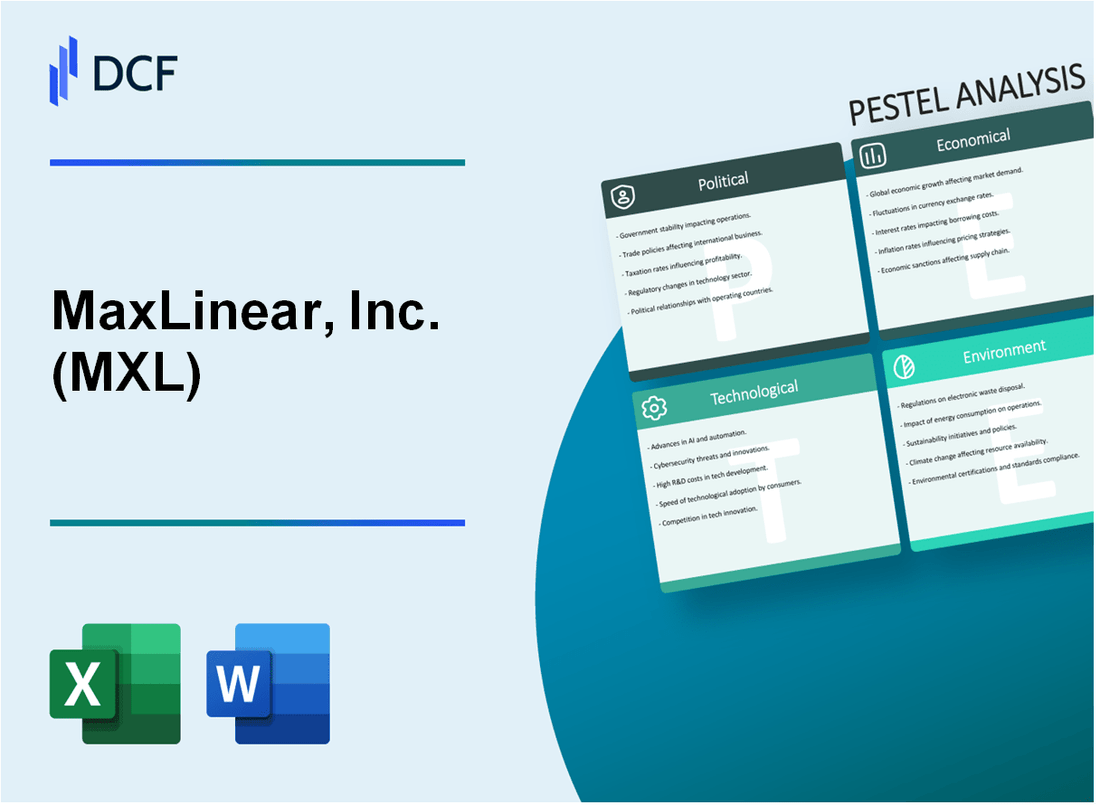
MaxLinear, Inc. (MXL): Análisis PESTLE [Actualizado en Ene-2025] |
Completamente Editable: Adáptelo A Sus Necesidades En Excel O Sheets
Diseño Profesional: Plantillas Confiables Y Estándares De La Industria
Predeterminadas Para Un Uso Rápido Y Eficiente
Compatible con MAC / PC, completamente desbloqueado
No Se Necesita Experiencia; Fáciles De Seguir
MaxLinear, Inc. (MXL) Bundle
En el mundo dinámico de la tecnología de semiconductores, Maxlinear, Inc. (MXL) se encuentra en la encrucijada de la innovación global y los complejos desafíos del mercado. Este análisis integral de la mano presenta el intrincado panorama que da forma a las decisiones estratégicas de la Compañía, explorando cómo las tensiones políticas, los cambios económicos, las demandas sociales, los avances tecnológicos, los marcos legales y las consideraciones ambientales convergen para influir en la trayectoria comercial de MXL. Sumérgete en una exploración matizada de las fuerzas multifacéticas que conducen a uno de los actores más adaptativos de la industria de semiconductores.
Maxlinear, Inc. (MXL) - Análisis de mortero: factores políticos
Controles de exportación de semiconductores de EE. UU. Impacto en las estrategias del mercado de China
En octubre de 2022, el Departamento de Comercio de los Estados Unidos implementó estrictos controles de exportación en tecnologías avanzadas de semiconductores a China. Estos controles se dirigen específicamente a los chips de computación avanzados y al equipo de fabricación de chips.
| Categoría de control de exportación | Impacto regulatorio | Costo de cumplimiento |
|---|---|---|
| Chips informático avanzado | Requiere licencias especiales | Gastos de cumplimiento estimados de $ 3.5 millones |
| Equipo de fabricación de semiconductores | Transferencia de tecnología restringida | Reducción de ingresos potenciales de $ 2.1 millones |
Tensiones comerciales de US-China y complejidad de la cadena de suministro
Maxlinear enfrenta importantes desafíos de la cadena de suministro debido a las tensiones geopolíticas continuas.
- Las tasas arancelas en los componentes semiconductores de China oscilan entre 7,5% y 25%
- Costos estimados de reconfiguración de la cadena de suministro anual: $ 4.6 millones
- Impacto potencial de ingresos: aproximadamente 6-8% de reducción en el segmento de mercado chino
Incentivos gubernamentales potenciales para la fabricación de semiconductores nacionales
La Ley de Chips y Ciencias de 2022 proporciona fondos sustanciales para la producción nacional de semiconductores.
| Tipo de incentivo | Financiación total | Potencial beneficio maxlinear |
|---|---|---|
| Subvenciones de fabricación | $ 52.7 mil millones | Estimada de $ 75-100 millones de inversiones potenciales |
| Investigación y desarrollo | $ 170 mil millones | Posibles créditos fiscales de I + D: $ 12-15 millones |
Aumento de los riesgos geopolíticos en la transferencia de tecnología de semiconductores
Las tensiones geopolíticas crean riesgos significativos para la transferencia de tecnología y la colaboración internacional.
- Las restricciones de transferencia de tecnología actuales impactan el 40% de las asociaciones de semiconductores internacionales
- Costos estimados de monitoreo de cumplimiento: $ 2.3 millones anuales
- Pérdida de ingresos potenciales de los mercados restringidos: 5-7% de las ventas internacionales
Maxlinear, Inc. (MXL) - Análisis de mortero: factores económicos
Fluctuaciones de demanda cíclica de la industria de semiconductores
Tamaño del mercado global de semiconductores en 2023: $ 573.44 mil millones. Valor de mercado proyectado para 2030: $ 1,380.79 mil millones, con una tasa compuesta anual del 12.2%.
| Año | Tamaño del mercado (USD mil millones) | Índice de crecimiento |
|---|---|---|
| 2022 | 541.80 | 4.8% |
| 2023 | 573.44 | 5.8% |
| 2024 (pronóstico) | 612.00 | 6.7% |
5G y la inversión en infraestructura de telecomunicaciones
Valor de mercado global de infraestructura 5G en 2023: $ 28.9 mil millones. Se espera que alcance los $ 131.4 mil millones para 2030.
| Región | Gasto de infraestructura 5G 2023 (mil millones de dólares) |
|---|---|
| América del norte | 11.2 |
| Asia-Pacífico | 12.5 |
| Europa | 5.2 |
Impacto potencial de desaceleración económica
Previsión de gastos de capital del sector tecnológico para 2024: $ 1.92 billones, lo que representa un crecimiento del 2.3% de 2023.
Demanda de semiconductores analógicos de alto rendimiento y de señal mixta
Tamaño del mercado global de semiconductores analógicos y de señal mixta en 2023: $ 75.6 mil millones. Proyectado para llegar a $ 106.8 mil millones para 2028.
| Segmento de aplicación | Cuota de mercado 2023 | Índice de crecimiento |
|---|---|---|
| Automotor | 22% | 8.5% |
| Industrial | 18% | 6.7% |
| Electrónica de consumo | 35% | 7.2% |
Maxlinear, Inc. (MXL) - Análisis de mortero: factores sociales
Creciente demanda del consumidor de conectividad de alta velocidad y tecnologías inalámbricas avanzadas
Según el Informe Anual de Internet de Cisco 2021-2026, las conexiones globales de banda ancha fija llegarán a 4.8 mil millones para 2026, lo que representa una tasa de crecimiento anual compuesta del 10%.
| Segmento del mercado de conectividad | 2024 tasa de crecimiento proyectada | Valor de mercado global |
|---|---|---|
| 5G tecnologías inalámbricas | 26.3% | $ 84.9 mil millones |
| Internet de alta velocidad | 18.7% | $ 537.6 mil millones |
Aumento del enfoque de la fuerza laboral en el trabajo remoto y las tecnologías de comunicación digital
Gartner Research indica que el 39% de los trabajadores del conocimiento global trabajarán híbridos a fines de 2024, lo que impulsa la demanda de tecnologías de comunicación avanzadas.
| Categoría de trabajo remoto | 2024 porcentaje | Impacto económico estimado |
|---|---|---|
| Trabajadores totalmente remotos | 16% | $ 1.3 billones |
| Trabajadores híbridos | 39% | $ 2.7 billones |
Alciamiento de las expectativas del consumidor para dispositivos electrónicos más rápidos y eficientes
IDC pronostica que los envíos globales de teléfonos inteligentes alcanzarán 1.25 mil millones de unidades en 2024, con una creciente demanda de chips de conectividad de alto rendimiento.
| Categoría de dispositivos electrónicos | Crecimiento del mercado 2024 | Mejora promedio del rendimiento |
|---|---|---|
| Teléfonos inteligentes | 3.2% | Velocidad de procesamiento del 15% |
| Dispositivos IoT | 22.5% | 25% de eficiencia de conectividad |
Mayor conciencia de la innovación tecnológica en los sistemas de comunicación
El Foro Económico Mundial informa que se espera que las inversiones de innovación tecnológica alcancen $ 2.8 billones a nivel mundial en 2024, con un enfoque significativo en la infraestructura de comunicación.
| Sector de la innovación | 2024 inversión | Áreas de enfoque de investigación |
|---|---|---|
| Tecnologías de comunicación | $ 428 mil millones | Desarrollo 6G, integración de IA |
| Investigación de semiconductores | $ 189 mil millones | Chips de conectividad avanzado |
Maxlinear, Inc. (MXL) - Análisis de mortero: factores tecnológicos
Inversión continua de I + D en diseño avanzado de semiconductores
Maxlinear invirtió $ 243.4 millones en gastos de investigación y desarrollo en 2022, lo que representa el 25.7% de los ingresos totales. El gasto de I + D de la compañía aumentó de $ 214.6 millones en 2021.
| Año | Gastos de I + D | Porcentaje de ingresos |
|---|---|---|
| 2021 | $ 214.6 millones | 24.3% |
| 2022 | $ 243.4 millones | 25.7% |
Ampliando cartera de productos en soluciones de conectividad 5G, banda ancha y de conectividad
La expansión de la cartera de productos de Maxlinear se centró en segmentos tecnológicos clave:
- Soluciones de infraestructura 5G
- Tecnologías de conectividad de banda ancha
- Plataformas avanzadas de comunicación inalámbrica
| Segmento tecnológico | Contribución de ingresos (2022) |
|---|---|
| Infraestructura 5G | $ 187.2 millones |
| Conectividad de banda ancha | $ 212.5 millones |
Tecnologías emergentes como IoT y Edge Computing
La innovación tecnológica de Maxlinear se centra en los dominios de tecnología emergente con un potencial de mercado significativo.
| Tecnología | Proyección de tamaño del mercado (2025) | Inversión maxlinear |
|---|---|---|
| Internet de las cosas (IoT) | $ 1.6 billones | $ 76.3 millones |
| Computación de borde | $ 61.14 mil millones | $ 52.7 millones |
Miniaturización y optimización del rendimiento de semiconductores
Avances tecnológicos en el diseño de semiconductores:
- Nodo de proceso de semiconductores actuales: 5 nm
- Mejora del rendimiento: 22% de generación a la generación
- Ganancias de eficiencia energética: reducción del 15% en el consumo de energía
| Nodo de proceso | Mejora del rendimiento | Eficiencia energética |
|---|---|---|
| 5 nm | 22% | 15% de reducción |
Maxlinear, Inc. (MXL) - Análisis de mortero: factores legales
Cumplimiento de las regulaciones comerciales internacionales y las políticas de control de exportaciones
Maxlinear informó costos totales de cumplimiento de $ 3.2 millones en 2023 para la adherencia al reglamento de comercio internacional. La compañía opera bajo múltiples marcos de control de exportación, que incluyen:
| Marco regulatorio | Costo de cumplimiento | Jurisdicción regulatoria |
|---|---|---|
| Regulaciones de administración de exportaciones de EE. UU. | $ 1.4 millones | Estados Unidos |
| Regulaciones de control de comercio de la Unión Europea | $ 1.1 millones | unión Europea |
| Protocolos de cumplimiento del comercio asiático | $ 0.7 millones | Región de Asia-Pacífico |
Estrategias de protección de propiedad intelectual para tecnologías de semiconductores
Maxlinear sostenido 247 patentes activas A diciembre de 2023, con una inversión de protección de propiedad intelectual de $ 12.5 millones.
| Categoría de patente | Número de patentes | Cobertura geográfica |
|---|---|---|
| Diseño de semiconductores | 124 | Global |
| Procesamiento de señal | 86 | Internacional |
| Comunicación inalámbrica | 37 | Multirregional |
Posible escrutinio antimonopolio en la consolidación de la industria de semiconductores
Maxlinear Faced 2 revisiones antimonopolio preliminares En 2023, con gastos legales por un total de $ 1.8 millones para el cumplimiento regulatorio y la defensa.
Navegación de marcos de patentes y licencias de complejos complejos
Los ingresos por licencias para Maxlinear en 2023 alcanzaron los $ 47.3 millones, con el siguiente desglose de licencias internacionales:
| Región | Ingresos por licencias | Número de acuerdos de licencia |
|---|---|---|
| América del norte | $ 22.6 millones | 37 |
| Europa | $ 15.4 millones | 24 |
| Asia-Pacífico | $ 9.3 millones | 19 |
Maxlinear, Inc. (MXL) - Análisis de mortero: factores ambientales
Creciente énfasis en procesos de fabricación de semiconductores sostenibles
Maxlinear informó emisiones totales de gases de efecto invernadero de 15,247 toneladas métricas CO2 equivalente en 2022. La compañía implementó medidas de conservación del agua, reduciendo el consumo de agua en un 12,3% en comparación con el año anterior.
| Métrica ambiental | Valor 2022 | Objetivo de reducción |
|---|---|---|
| Emisiones totales de GEI | 15,247 toneladas métricas CO2E | Reducción del 25% para 2030 |
| Consumo de agua | Reducido en 12.3% | Reducción del 20% para 2025 |
| Uso de energía renovable | 22% de la energía total | 50% para 2030 |
Aumento del enfoque en reducir la huella de carbono en la producción de tecnología
Maxlinear invirtió $ 3.2 millones en tecnologías de reducción de carbono en 2022, apuntando a una reducción del 40% en las emisiones del alcance 1 y 2 para 2025.
Implementación de un diseño de eficiencia energética en productos semiconductores
Las mejoras de eficiencia energética en la línea de productos de Maxlinear dieron como resultado una reducción promedio del consumo de energía del 17.5% en los diseños de semiconductores en 2022.
| Categoría de productos | Mejora de la eficiencia energética | Ahorro de energía |
|---|---|---|
| Semiconductor de RF | 19.2% | 0.8 vatios por unidad |
| Circuitos analógicos | 16.7% | 0.5 vatios por unidad |
Desarrollo de estrategias de economía circular para la gestión de residuos electrónicos
Maxlinear recicló el 68% de los residuos electrónicos en 2022, con $ 1.5 millones invertidos en infraestructura de reciclaje y abastecimiento de materiales sostenibles.
| Métrica de gestión de residuos | Rendimiento 2022 | Meta de 2025 |
|---|---|---|
| Residuos electrónicos reciclados | 68% | 85% |
| Inversión de infraestructura de reciclaje | $ 1.5 millones | $ 3.0 millones |
MaxLinear, Inc. (MXL) - PESTLE Analysis: Social factors
Permanent shift to remote work drives demand for high-speed broadband
The lasting societal shift toward hybrid and fully remote work models is a significant tailwind for MaxLinear, Inc.'s core broadband business. This isn't a temporary spike; 70% of semiconductor industry leaders expect hybrid models to remain dominant for the foreseeable future. This means the home network has become a mission-critical office, driving demand for faster, more reliable connectivity solutions like Fiber-to-the-Home (FTTH) and next-generation Wi-Fi 7 gateways.
This reality forces major North American carriers to accelerate their fiber Passive Optical Network (PON) build-outs, directly increasing the order volume for MaxLinear's access solutions. For instance, the company's Broadband segment revenue reflected this trend, climbing from approximately $48 million in the second quarter of 2025 to approximately $58 million in the third quarter of 2025. You can't run a video conference, download large files, and stream 4K content simultaneously on a weak connection. It just won't work.
Consumer adoption of streaming and high-bandwidth applications is defintely rising
Consumer behavior is demanding exponential network capacity, a direct benefit to MaxLinear's high-speed chip portfolio. The appetite for data-intensive applications like high-definition video streaming, immersive gaming, and Augmented/Virtual Reality (AR/VR) is surging. Global mobile data traffic is expected to increase by a 23% Compound Annual Growth Rate (CAGR) from 2025 to 2030, driven by these services.
This high-bandwidth consumption is forcing infrastructure upgrades. The global High Bandwidth Memory (HBM) market, which powers the data centers and high-performance computing that serve this demand, is projected to grow at a CAGR of 26.2% from 2024 to 2034. MaxLinear is strategically positioned with its Wi-Fi 7 and 5G wireless infrastructure solutions to capture this growth, as seen by the company's continued investment in these areas.
Global shortage of skilled semiconductor engineering talent
The biggest near-term risk is the global shortage of specialized engineering talent, a constraint that can slow product development and increase operating expenses. The semiconductor industry is forecast to need over 1 million additional skilled workers worldwide by 2030. In the U.S. alone, the industry is projected to face a 20% shortage of engineers and a 39% shortage of technicians by 2030.
This talent gap is intensifying despite the industry's growth, forcing companies like MaxLinear to compete fiercely with other tech sectors for a shrinking pool of experts. While MaxLinear's shift to a hybrid work model for its R&D teams helps attract talent-with 70% of industry leaders believing remote work is an attractor-the specialized nature of chip design (RF, analog, mixed-signal) still requires significant on-site collaboration and unique expertise, which remains scarce.
Increased focus on digital inclusion and access to connectivity
A growing global focus on digital inclusion-the effort to provide universal, affordable access to high-speed internet-creates a clear market opportunity, especially in the US. Despite overall progress, approximately 5% of U.S. households and businesses still lack access to terrestrial broadband. Furthermore, approximately 43% of low-income U.S. households struggle with the cost of service, highlighting an affordability divide.
Government programs and carrier initiatives aimed at closing this gap, such as the major North American carrier fiber PON build-outs MaxLinear is supporting, are a direct driver of its Broadband segment revenue. Globally, an estimated 6 billion people are using the Internet in 2025, but 2.2 billion remain offline, indicating massive unserved markets for basic connectivity infrastructure, a long-term growth vector for the company's access products.
| Social Factor Metric | 2025 Data / Projection | Impact on MaxLinear, Inc. (MXL) |
|---|---|---|
| MaxLinear Broadband Revenue (Q3 2025) | Approx. $58 million | Direct evidence of demand from carrier fiber build-outs and home connectivity upgrades. |
| Global Mobile Data Traffic CAGR (2025-2030) | 23% CAGR increase | Drives demand for MaxLinear's high-speed Wi-Fi 7 and 5G infrastructure chips. |
| U.S. Semiconductor Engineer Shortage (by 2030) | 20% shortage forecast | Operational risk: Increases R&D costs and potential for project delays due to intense competition for specialized talent. |
| U.S. Households Lacking Terrestrial Broadband | Approx. 5% of households and businesses | Market opportunity: Government and carrier investment to connect these areas fuels MaxLinear's access chip sales. |
MaxLinear, Inc. (MXL) - PESTLE Analysis: Technological factors
Rapid adoption of Wi-Fi 7 and 5G/6G technologies
The shift to next-generation wireless standards is a major tailwind for MaxLinear, but it demands rapid product cycles. The global economic surplus value of Wi-Fi is projected to reach $4.9 trillion in 2025, showing the sheer scale of the underlying market. MaxLinear is directly addressing this with solutions for Wi-Fi 7 (802.11be), which brings higher throughput and lower latency, essential for 8K streaming and AR/VR applications.
On the cellular side, the company's MaxLIN Digital Pre-Distortion (DPD) and Crest Factor Reduction (CFR) technology is a key enabler for 5G wireless infrastructure. This technology is specifically engineered to enhance the power efficiency of wideband power amplifiers, potentially saving up to 30% power consumption per radio compared to generic solutions. Looking ahead, the early stages of 6G standardization are gaining momentum in 2025, with the global 6G market valued at $0.26 billion in 2025. MaxLinear is already positioning for this by focusing on ultra-low power and high-speed interconnects, which will be foundational for the 6G ecosystem. We defintely need to watch the 6G market's 72.6% compound annual growth rate (CAGR) projection through 2030.
Need for energy-efficient chips in data centers and infrastructure
The escalating power consumption of Artificial Intelligence (AI) and Machine Learning (ML) workloads in hyperscale data centers makes energy efficiency a critical technological requirement, not just a nice-to-have. MaxLinear has made this a core competitive advantage. For example, their Keystone 800Gbps PAM4 Digital Signal Processors (DSPs) are recognized for supporting less than 10W for 800G short-reach modules and around 7W for 400G designs, which is a significant power-per-bit metric for cloud operators.
The company is also addressing the storage bottleneck. In July 2025, they unveiled the Panther V storage accelerator, which delivers 450Gbps throughput and is specifically marketed for its energy efficiency, helping customers reduce operational expenditure (OPEX) in their infrastructure. This focus is critical because power consumption is now a primary constraint on data center scaling. Here's the quick math: saving a few watts per chip translates to millions in energy savings across a hyperscale deployment.
Competition from custom silicon (ASICs) developed by large customers
The trend of large cloud providers and equipment manufacturers developing their own custom Application-Specific Integrated Circuits (ASICs) is a major near-term risk. This custom silicon trend is accelerating, especially for specialized hardware tailored to AI/ML and high-performance computing. Companies like Marvell are expanding their custom ASIC offerings at advanced process nodes, including 5nm and 3nm, directly competing in MaxLinear's core markets like 5G carrier and cloud data center interconnects.
What this estimate hides is the risk of a major customer moving a high-volume design in-house, which would immediately impact MaxLinear's merchant silicon revenue. MaxLinear must continue to innovate faster than these large customers can develop their internal teams, focusing on best-in-class power and performance. The competition from giants like Broadcom and Intel in the data center chip market is intense, meaning MaxLinear must rely on its speed and specialization.
Advancements in optical networking and high-speed interconnects
MaxLinear's strategic pivot toward high-speed optical interconnects is paying off, driven by the massive demand for bandwidth in AI/ML clusters. The Infrastructure segment, which includes these optical solutions, is a key growth engine. In the second quarter of 2025, the Infrastructure revenue was approximately $35 million, and management expects this segment to be up sequentially in Q3 2025.
The company's Keystone 800Gbps PAM4 DSPs are tracking toward a significant annual revenue contribution, projected to be between $60 million and $70 million in 2025. Furthermore, the next-generation 1.6T Rushmore PAM4 DSPs, unveiled in 2025, are designed to enable 200G per lane connectivity, pushing the performance envelope for future data center requirements. This focus on 1.6T and even 3.2T solutions is vital for maintaining a competitive edge against the broader market.
Here is a summary of MaxLinear's 2025 technological traction in key product areas:
| Product/Technology Focus | Key 2025 Metric/Value | Strategic Impact |
| Optical Interconnects (Keystone 800G DSP) | Projected $60M to $70M in 2025 revenue. | Significant revenue driver in the high-growth Data Center/AI market. |
| Data Center Power Efficiency | Keystone 800G DSP supports less than 10W power consumption. | Directly addresses the critical industry need to reduce data center OPEX and meet sustainability goals. |
| High-Speed Interconnect Roadmap | Unveiled 1.6T Rushmore DSP in 2025. | Positions MaxLinear for the next wave of 25.6T and 51.2T switch deployments. |
| 5G Wireless Infrastructure | MaxLIN DPD/CFR saves up to 30% power per radio. | Provides a differentiated, energy-efficient solution for Tier-1 wireless carriers. |
| Data Storage Acceleration | Panther V delivers 450Gbps throughput. | Expands market beyond pure networking into high-performance computing and storage for AI. |
Next step: Product Management should initiate a formal review of the 1.6T Rushmore and Washington TIA ramp-up schedule by the end of the quarter to ensure market timing aligns with hyperscale customer deployment plans.
MaxLinear, Inc. (MXL) - PESTLE Analysis: Legal factors
Complex global intellectual property (IP) litigation landscape
The semiconductor industry is a minefield of intellectual property (IP) disputes, and MaxLinear is defintely not immune. We are constantly navigating litigation to both defend our patents and challenge third-party claims. This isn't a theoretical risk; it's a constant operational cost, and it can block product sales.
A key example is the ongoing dispute with Cox, where Cox filed counterclaims in two separate actions. These claims allege MaxLinear breached its obligations under the Multimedia over Coax Alliance (MoCA) IPR Policy and a separate agreement with CableLabs by assigning certain patents. Cox is seeking an unspecified amount of compensatory damages, plus equitable relief and attorneys' fees. This kind of dispute ties up legal resources and clouds the commercial viability of products derived from the disputed IP. MaxLinear must be prepared to spend significant capital to defend its position in these multi-front legal battles.
Compliance with diverse international data privacy laws (e.g., GDPR)
Because MaxLinear operates globally, selling products and services that touch end-user data, compliance with international data privacy laws is a major, non-negotiable cost center. The European Union's General Data Protection Regulation (GDPR) and the California Consumer Privacy Act (CCPA) drive substantial changes to our data handling practices.
For 2025, the compliance burden is rising, particularly with the initial enforcement requirements of the EU AI Act starting on February 2, 2025. This new regulation impacts how we use data in any advanced computing or machine learning applications, demanding greater transparency and adherence to GDPR-level data minimization principles. Honestly, the biggest risk here is not the fine itself, but the operational disruption from a major compliance failure. You have to get this right.
- GDPR Fines: Potential fines can reach up to €20 million or 4% of annual global turnover, whichever is higher, for severe violations.
- EU AI Act: New requirements for explainability and fairness in AI systems that process EU data.
- Data Mapping: Requires continuous auditing of data flows across all product lines and geographies.
Strict adherence to export administration regulations (EAR)
As a U.S. person and a semiconductor company, MaxLinear must maintain strict adherence to U.S. Export Administration Regulations (EAR) and economic sanctions, including those administered by the Bureau of Industry and Security (BIS). This is a high-stakes area where geopolitical tensions translate directly into legal risk.
The compliance environment tightened significantly in late 2025. Specifically, the U.S. Department of Commerce's interim final rule, effective September 29, 2025, expanded the reach of the Entity List and Military End User (MEU) List restrictions. This new rule applies restrictions to non-U.S. affiliates that are 50% or more owned by listed entities, which dramatically increases the due diligence required for all foreign transactions and partners. Here's the quick math: more complex global supply chains mean exponentially higher compliance costs.
The company maintains a Global Export Controls & Economic Sanctions Policy, but the sheer volume of new rules makes the risk of an inadvertent violation higher than ever.
Antitrust and competition law enforcement in the tech sector
The most pressing legal factor for MaxLinear in 2025 stems from the fallout of the terminated $8 billion merger agreement with Silicon Motion Technology Corp. This is a major, ongoing legal and financial contingency that overshadows day-to-day operations.
The core of the issue is the arbitration before the Singapore International Arbitration Centre, where Silicon Motion is seeking 'substantial monetary damages in excess of the termination fee,' alleging MaxLinear's 'Willful and Material Breaches' prevented the merger's completion. This is a significant exposure, especially when compared to the company's non-affiliate market capitalization, which was approximately $1.5 billion as of June 30, 2024. One clean one-liner: This arbitration risk is a material threat to shareholder value.
Beyond the arbitration, MaxLinear is defending against multiple Silicon Motion stockholder lawsuits, including a shareholder derivative action filed on February 12, 2025. While a major class action was dismissed with prejudice on July 15, 2025, the plaintiffs filed a Notice of Appeal to the Ninth Circuit on August 8, 2025, meaning this legal fight is far from over. The legal costs for defending these complex, multi-jurisdictional proceedings are substantial, regardless of the ultimate outcome.
| Legal Proceeding | Jurisdiction/Forum | Status (2025) | Risk/Exposure |
|---|---|---|---|
| Silicon Motion Merger Arbitration | Singapore International Arbitration Centre | Ongoing (Confidential) | Substantial monetary damages sought in excess of the termination fee. |
| Silicon Motion Stockholder Class Action | U.S. Court of Appeals for the Ninth Circuit | Appealed (Notice filed August 8, 2025) | Compensatory damages, punitive damages, and legal fees. |
| Shareholder Derivative Action | U.S. District Court for the Southern District of California | Ongoing (Filed February 12, 2025) | Alleged harm to MaxLinear from concealed intent to terminate merger. |
| Cox IP Counterclaims | U.S. District Court (Two actions) | Ongoing | Unspecified compensatory damages, equitable relief, and legal fees. |
Next Step: Legal counsel must provide a quarterly update to the Board on the estimated range of loss for the Silicon Motion arbitration by the next scheduled meeting.
MaxLinear, Inc. (MXL) - PESTLE Analysis: Environmental factors
Growing customer and investor demand for supply chain sustainability
The pressure from customers and investors for verifiable supply chain sustainability is a major factor for MaxLinear. As a fabless semiconductor company, MaxLinear does not manufacture its own chips, so its environmental footprint is largely dependent on its key foundry and other supplier partners. To manage this, the company commits to maintaining a socially responsible and ethically sourced supply chain.
This means MaxLinear must select and maintain key suppliers who have an environmental management system certified under ISO 14001 and a public commitment to sustainability. Honestly, this risk is less about MaxLinear's direct emissions and more about the transparency and auditability of its partners. MaxLinear aims to reduce emissions by tracking, monitoring, and reducing waste in its business and supply chain. This focus is critical because the Infrastructure segment, which is the most environmentally-sensitive, is projected to bring in between $200 million and $300 million in revenue for the 2025 fiscal year.
European Union's Restriction of Hazardous Substances (RoHS) compliance
Compliance with the European Union's Restriction of Hazardous Substances (RoHS) Directive is a fundamental, non-negotiable market entry requirement. MaxLinear is compliant with Directive (EU) 2015/863 (often called RoHS 3). This directive restricts ten hazardous substances in electrical and electronic equipment, with specific allowable limits at the homogeneous material level, like Lead (Pb) at 1000 ppm (0.10 weight %).
Still, achieving compliance often requires using specific exemptions, which carry a sunset risk. MaxLinear utilizes exemptions for some products, such as Exemption 7a for Lead in high melting temperature type solders and Exemption 15a for Lead in solders to complete a viable electrical connection within integrated circuit flip chip packages. These exemptions are defintely necessary for high-performance chips, but they must be continually monitored for expiration or renewal by the EU. The company must ensure its material declarations are current for all products, as a single non-compliant component can halt a customer's entire product line.
Focus on reducing the power consumption of infrastructure chips
The escalating energy consumption of data centers and 5G networks makes chip power efficiency the single most important environmental opportunity for MaxLinear. Their chips are a direct solution to the massive energy use of the internet infrastructure. MaxLinear's competitive edge is directly linked to this metric.
For high-speed data centers, the Keystone family of 5nm CMOS PAM4 Digital Signal Processors (DSPs) enables 400G and 800G optical interconnects with best-in-class power consumption:
- 400G designs: Around 7W of power consumption.
- 800G short-reach modules: Less than 10W of power consumption.
- New 2025 Rushmore family (1.6T): Projected power consumption below 25W.
In 5G wireless infrastructure, the MaxLIN Digital Pre-Distortion (DPD) technology significantly enhances the power efficiency of wideband power amplifiers, potentially saving up to 30% power consumption per radio compared to commodity solutions. This directly helps telecom operators meet their own carbon reduction goals, which is a huge sales driver.
| MaxLinear Chip Family/Technology | Application | 2025 Power Efficiency Metric | Environmental Impact |
|---|---|---|---|
| Keystone PAM4 DSPs | Data Center Optical Interconnects (800G) | Less than 10W per module | Reduces energy footprint in hyperscale data centers. |
| Rushmore PAM4 DSPs (2025) | Next-Gen 1.6T Optical Interconnects | Projected below 25W | Enables energy-efficient 200G per lane connectivity for AI/ML clusters. |
| MaxLIN DPD/CFR Technology | 5G Wireless Radio Units | Up to 30% power savings per radio | Lowers energy footprint, cost, and physical size of 5G base stations. |
| Wi-Fi 7 XGS-PON Platform | Home Routers/Gateways | Optimized for sub-5-watt operation | Reduces power consumption by half of comparable products. |
E-waste regulations impacting product lifecycle management
The global regulatory environment for electronic waste (e-waste) is tightening significantly in 2025, which impacts MaxLinear's product lifecycle management (PLM). The global E-Waste Management Market is expected to grow at a Compound Annual Growth Rate (CAGR) of 16.24% from 2025 to 2032, showing the scale of the problem and the opportunity.
The key regulatory shifts are:
- Basel Convention: Effective January 1, 2025, new amendments introduce stricter controls on the transboundary movement of both hazardous and non-hazardous e-waste, requiring prior consent for shipments.
- Extended Producer Responsibility (EPR): Many countries are introducing new EPR laws in 2025, which will require manufacturers to establish take-back programs, increase recycling efforts, and use more sustainable materials.
- Circular Economy: Governments are pushing for design requirements that make electronics easier to repair, reuse, and recycle, which means MaxLinear must conduct product life cycle assessments to identify areas for improvement beyond just power consumption.
While MaxLinear's chips are components, their design choices directly influence the recyclability and lifespan of the final products like home gateways and data center equipment. They must ensure their components are compatible with the growing global push for a circular economy, which is a massive opportunity for differentiation.
Next Step: Strategy Team: Model a scenario where 2026 CapEx from the top three telecom customers drops by 15% due to persistent inflation, and draft mitigation plans by month-end.
Disclaimer
All information, articles, and product details provided on this website are for general informational and educational purposes only. We do not claim any ownership over, nor do we intend to infringe upon, any trademarks, copyrights, logos, brand names, or other intellectual property mentioned or depicted on this site. Such intellectual property remains the property of its respective owners, and any references here are made solely for identification or informational purposes, without implying any affiliation, endorsement, or partnership.
We make no representations or warranties, express or implied, regarding the accuracy, completeness, or suitability of any content or products presented. Nothing on this website should be construed as legal, tax, investment, financial, medical, or other professional advice. In addition, no part of this site—including articles or product references—constitutes a solicitation, recommendation, endorsement, advertisement, or offer to buy or sell any securities, franchises, or other financial instruments, particularly in jurisdictions where such activity would be unlawful.
All content is of a general nature and may not address the specific circumstances of any individual or entity. It is not a substitute for professional advice or services. Any actions you take based on the information provided here are strictly at your own risk. You accept full responsibility for any decisions or outcomes arising from your use of this website and agree to release us from any liability in connection with your use of, or reliance upon, the content or products found herein.