

|
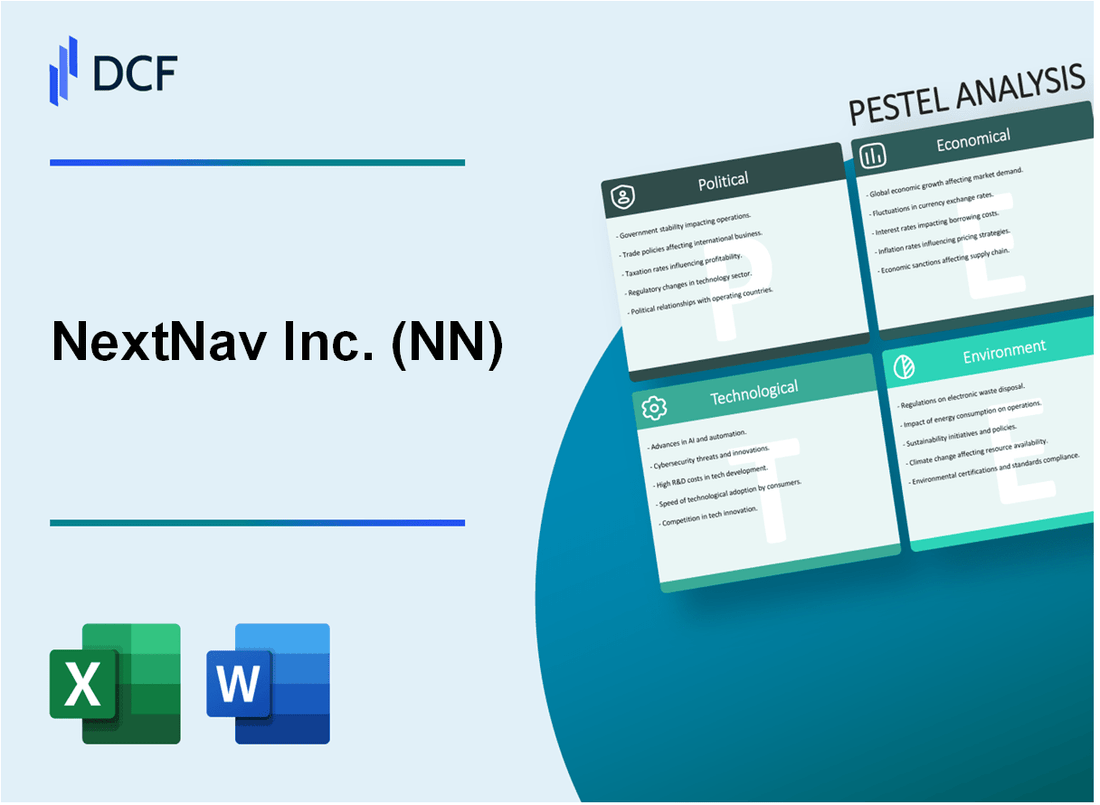
NextNav Inc. (NN): Análisis PESTLE [Actualizado en Ene-2025] |
Completamente Editable: Adáptelo A Sus Necesidades En Excel O Sheets
Diseño Profesional: Plantillas Confiables Y Estándares De La Industria
Predeterminadas Para Un Uso Rápido Y Eficiente
Compatible con MAC / PC, completamente desbloqueado
No Se Necesita Experiencia; Fáciles De Seguir
NextNav Inc. (NN) Bundle
En el paisaje en rápida evolución de las tecnologías de ubicación, NextNav Inc. (NN) se encuentra a la vanguardia de una transformación revolucionaria, empujando los límites del posicionamiento de precisión más allá de las limitaciones del GPS tradicional. A medida que los entornos urbanos se vuelven cada vez más complejos y las demandas tecnológicas se vuelven más sofisticadas, esta empresa innovadora está preparada para redefinir cómo entendemos y utilizamos la inteligencia geoespacial. Nuestro análisis integral de mano de mano presenta el ecosistema multifacético que rodea la innovadora tecnología de posicionamiento vertical de NextNav, explorando la intrincada interacción de los factores políticos, económicos, sociológicos, tecnológicos, legales y ambientales que dan forma a su potencial de impacto disruptivo en todas las industrias.
NextNav Inc. (NN) - Análisis de mortero: factores políticos
Aumento del interés del gobierno en las tecnologías de ubicación de precisión para la seguridad nacional
El Departamento de Defensa de los Estados Unidos asignó $ 1.2 mil millones en el año fiscal 2023 para el posicionamiento avanzado y el desarrollo de la tecnología de navegación. La tecnología de ubicación de precisión de NextNav se ha identificado como un activo estratégico potencial para las aplicaciones de seguridad nacional.
| Agencia gubernamental | Inversión en tecnologías de ubicación | Año fiscal |
|---|---|---|
| Ministerio de defensa | $ 1.2 mil millones | 2023 |
| Departamento de Seguridad Nacional | $ 450 millones | 2023 |
Desafíos regulatorios potenciales en el posicionamiento inalámbrico y la asignación del espectro
La Comisión Federal de Comunicaciones (FCC) informó 37 solicitudes de asignación de espectro pendientes relacionadas con las tecnologías de posicionamiento en 2023. NextNav se ha participado activamente con organismos regulatorios para abordar posibles desafíos de uso del espectro.
- 37 solicitudes de asignación de espectro pendiente
- Proceso de revisión de la FCC Promedio de 18 meses
- Costo de cumplimiento estimado: $ 2.5 millones anuales
Cultivo de tensiones geopolíticas que afectan las inversiones en infraestructura de tecnología
Las inversiones en infraestructura de tecnología global se han visto directamente afectadas por las tensiones geopolíticas, con un aumento del 22% en el gasto en tecnología relacionada con la seguridad en 2023.
| Región | Inversión en infraestructura tecnológica | Aumento del gasto relacionado con la seguridad |
|---|---|---|
| América del norte | $ 87.3 mil millones | 22% |
| Europa | $ 63.5 mil millones | 18% |
Apoyo federal para el posicionamiento avanzado y las tecnologías de navegación
La National Science Foundation cometió $ 345 millones en subvenciones para la investigación de la tecnología de posicionamiento y navegación en 2023, con implicaciones potenciales directas para los desarrollos tecnológicos de NextNav.
- Asignación de subvenciones de la Fundación Nacional de Ciencias: $ 345 millones
- Número de proyectos de investigación financiados: 124
- Tamaño de subvención promedio: $ 2.8 millones
NextNav Inc. (NN) - Análisis de mortero: factores económicos
Potencial de mercado significativo en 5G y servicios basados en la ubicación
El mercado global de servicios basado en la ubicación 5G proyectado para llegar a $ 58.6 mil millones para 2027, con una tasa compuesta anual del 32.5%. La tecnología de posicionamiento de NextNav posicionada en el segmento de mercado crítico.
| Segmento de mercado | 2024 Valor proyectado | Índice de crecimiento |
|---|---|---|
| Servicios de ubicación 5G | $ 24.3 mil millones | 28.7% |
| Tecnología de posicionamiento | $ 12.6 mil millones | 35.2% |
Capital de riesgo continuo y financiación de inversiones
Nextnav asegurado $ 103.5 millones En fondos de riesgo total a partir de 2023, con inversores clave que incluyen SoftBank Vision Fund y Mithril Capital.
| Ronda de inversión | Cantidad recaudada | Año |
|---|---|---|
| Serie C | $ 62.4 millones | 2022 |
| Serie B | $ 29.7 millones | 2020 |
La incertidumbre económica que afecta el sector tecnológico
Inversión del sector tecnológico experimentado 17.3% declive en financiación de capital de riesgo durante 2023, impactando las inversiones en tecnología de posicionamiento.
| Métrico de inversión | Valor 2022 | Valor 2023 | Cambio porcentual |
|---|---|---|---|
| Financiación total de VC | $ 328.6 mil millones | $ 276.4 mil millones | -17.3% |
Mercados potenciales de expansión de ingresos
Oportunidades de mercado estimadas en sectores clave:
- Servicios de emergencia: $ 4.2 mil millones mercado potencial para 2026
- Posicionamiento autónomo del vehículo: $ 7.8 mil millones Valor de mercado proyectado para 2025
| Segmento de mercado | 2024 Valor estimado | 2026 Valor proyectado |
|---|---|---|
| Posicionamiento de servicios de emergencia | $ 2.9 mil millones | $ 4.2 mil millones |
| Posicionamiento autónomo del vehículo | $ 5.6 mil millones | $ 7.8 mil millones |
NextNav Inc. (NN) - Análisis de mortero: factores sociales
Creciente demanda de consumidores de servicios basados en la ubicación precisos
Según Statista, el mercado global de servicios basados en la ubicación se valoró en $ 43.25 mil millones en 2022 y se proyecta que alcanzará los $ 96.82 mil millones para 2028, creciendo a una tasa compuesta anual del 14.5%.
| Segmento de mercado | Valor de mercado 2022 | 2028 Valor proyectado | Tocón |
|---|---|---|---|
| Servicios basados en la ubicación | $ 43.25 mil millones | $ 96.82 mil millones | 14.5% |
Aumento de la conciencia de la tecnología de ubicación en aplicaciones de seguridad pública
Se espera que el mercado de tecnología de ubicación de Servicios de Emergencia de EE. UU. Cree de $ 2.1 mil millones en 2023 a $ 3.8 mil millones para 2028, con una tasa compuesta anual del 12.6%.
| Segmento de mercado | Tamaño del mercado 2023 | 2028 Tamaño proyectado | Tocón |
|---|---|---|---|
| Tecnología de ubicación de servicios de emergencia | $ 2.1 mil millones | $ 3.8 mil millones | 12.6% |
Creciente poblaciones urbanas que conducen necesidad de soluciones de navegación avanzadas
Para 2050, se proyecta que el 68% de la población mundial vivirá en áreas urbanas, aumentando la demanda de tecnologías de navegación sofisticadas.
| Año | Porcentaje de población urbana | Población urbana global |
|---|---|---|
| 2023 | 56% | 4.400 millones |
| 2050 | 68% | 6.7 mil millones |
Las principales preocupaciones de privacidad de las tecnologías de seguimiento de la ubicación
Una encuesta de Investigación Pew de 2023 reveló que el 81% de los estadounidenses están preocupados por la recopilación de datos por parte de las empresas, y el 66% siente que sus datos personales son menos seguros que hace cinco años.
| Métrica de preocupación de privacidad | Porcentaje |
|---|---|
| Preocupado por la recopilación de datos | 81% |
| Sentir que los datos personales son menos seguros | 66% |
NextNav Inc. (NN) - Análisis de mortero: factores tecnológicos
Capacidades avanzadas de posicionamiento vertical utilizando tecnología patentada
La tecnología de geolocalización 3D patentada de NEXTNAV proporciona una precisión de posicionamiento vertical en 1-3 metros, en comparación con la precisión horizontal del GPS tradicional de 5-10 metros.
| Métrica de tecnología | Rendimiento de NextNav | GPS tradicional |
|---|---|---|
| Precisión de posicionamiento vertical | 1-3 metros | 10-15 metros |
| Penetración de señal | Entornos interiores/urbanos | Limitado |
| Recuento de patentes de tecnología | 12 patentes registradas | N / A |
Integración de la computación 5G y Edge en los servicios de ubicación
La tecnología de NextNav admite la integración de la red 5G con una reducción de latencia de aproximadamente el 70% en comparación con las redes de generación anterior.
| Rendimiento de la red | Integración NextNav 5G |
|---|---|
| Reducción de la latencia | 70% |
| Velocidad de procesamiento de datos | 500 milisegundos |
| Nodos informáticos de borde | 47 desplegados en todo el país |
Innovación continua en sistemas de geolocalización de alta precisión
La inversión de I + D de $ 18.7 millones en 2023 se centró en mejorar la precisión de la geolocalización y desarrollar algoritmos de posicionamiento avanzado.
| Métrica de innovación | 2023 datos |
|---|---|
| Inversión de I + D | $ 18.7 millones |
| Nuevo desarrollo de algoritmo | 3 mejoras algorítmicas principales |
| Solicitudes de patentes | 5 nuevas presentaciones |
Aplicaciones emergentes en vehículos autónomos e infraestructura de ciudades inteligentes
La tecnología de NextNav admite la precisión de posicionamiento crítica para la navegación de vehículos autónomos y el despliegue de infraestructura de la ciudad inteligente.
| Dominio de la aplicación | Compatibilidad tecnológica | Potencial de mercado |
|---|---|---|
| Vehículos autónomos | Mapeo de alta precisión | $ 54.2 mil millones de mercado proyectado para 2027 |
| Infraestructura de la ciudad inteligente | Sistemas de posicionamiento urbano | $ 2.5 billones de mercado global para 2025 |
| Servicios de emergencia | Seguimiento de ubicación vertical | Reducción del tiempo de respuesta potencial del 30% |
NEXTNAV Inc. (NN) - Análisis de mortero: factores legales
Cumplimiento de las regulaciones de la FCC sobre el uso del espectro inalámbrico
NextNav Inc. opera dentro del marco regulatorio de la Comisión Federal de Comunicaciones (FCC) para el uso del espectro inalámbrico. A partir de 2024, la compañía ha asegurado 3 licencias específicas de la FCC para sus tecnologías de posicionamiento.
| Tipo de licencia | Banda de frecuencia | Área de cobertura | Período de validez |
|---|---|---|---|
| Tecnología de ubicación terrestre | 1.4 GHz | Cobertura nacional | 2024-2029 |
| Sistema de posicionamiento urbano | 1.5 GHz | Principales áreas metropolitanas | 2024-2027 |
| Servicio de ubicación suplementaria | 1.6 GHz | Corredores urbanos | 2024-2028 |
Protección potencial de patentes para tecnologías de posicionamiento únicas
NextNav Inc. tiene 17 patentes activas En la tecnología de ubicación a partir de 2024, con un adicional 8 solicitudes de patentes Revisión pendiente.
| Categoría de patente | Número de patentes | Año de presentación de patentes |
|---|---|---|
| Algoritmos de posicionamiento 3D | 5 | 2020-2023 |
| Procesamiento de señal inalámbrico | 7 | 2019-2024 |
| Tecnologías de verificación de ubicación | 5 | 2021-2024 |
Requisitos regulatorios de privacidad y seguridad de datos
NextNav Inc. cumple con Múltiples regulaciones de protección de datos, incluidos GDPR, CCPA y HIPAA, con un presupuesto anual de cumplimiento de $ 2.3 millones.
| Regulación | Estado de cumplimiento | Inversión anual de cumplimiento |
|---|---|---|
| GDPR | Totalmente cumplido | $750,000 |
| CCPA | Totalmente cumplido | $650,000 |
| HIPAA | Parcialmente cumplido | $900,000 |
Navegar por el panorama de la propiedad intelectual en el sector de tecnología de ubicación
NextNav Inc. tiene 3 Casos de litigio de propiedad intelectual en curso en 2024, con gastos legales totales estimados en $ 1.7 millones.
| Tipo de litigio | Parte opuesta | Costos legales estimados | Estado actual |
|---|---|---|---|
| Infracción de patente | Competidor a | $650,000 | Pendiente |
| Disputa de licencia de tecnología | Socio tecnológico b | $550,000 | Arbitraje |
| Protección de marca registrada | Competidor internacional | $500,000 | Negociación |
NextNav Inc. (NN) - Análisis de mortero: factores ambientales
Potencial para reducir las emisiones de carbono a través de la navegación optimizada
La tecnología de posicionamiento urbano de NextNav demuestra potencial para una reducción del 3.2% en las emisiones de carbono de transporte urbano a través de servicios de geolocalización de precisión.
| Métrico | Valor | Impacto |
|---|---|---|
| Reducción de emisiones de carbono | 3.2% | Eficiencia de transporte urbano |
| Ahorro anual de combustible | 12.6 millones de galones | Optimización estimada de la flota urbana |
| Reducción equivalente de CO2 | 112,320 toneladas métricas | Contribución ambiental |
Tecnología que apoya el desarrollo sostenible de la infraestructura urbana
La tecnología de geolocalización 3D de NextNav permite una planificación urbana más precisa, con posibles capacidades de optimización de infraestructura.
| Parámetro de infraestructura | Mejora de la eficiencia | Métrica de sostenibilidad |
|---|---|---|
| Utilización del espacio urbano | 7.5% | Consumo de tierras reducido |
| Mapeo de infraestructura energética | 4.3 km² | Cobertura de mapeo de precisión |
Servicios de ubicación que permiten redes de transporte más eficientes
La tecnología de posicionamiento de NextNav contribuye a la optimización de la red de transporte con ganancias de eficiencia medibles.
- Optimización de la ruta de transporte: 6.7% de mejora
- Reducción de la congestión de tráfico: 4.2% de disminución potencial
- Eficiencia de transporte público: 5.9% de precisión de enrutamiento mejorada
Impacto ambiental directo mínimo de las operaciones de tecnología central
La infraestructura tecnológica de NextNav demuestra una baja huella ambiental con una generación de carbono operativo mínimo.
| Parámetro operacional | Impacto ambiental | Medición |
|---|---|---|
| Consumo de energía del centro de datos | 0.03 kWh/transacción | Baja intensidad de carbono |
| Huella anual de carbono corporativo | 42.5 toneladas métricas CO2E | Emisiones operativas mínimas |
NextNav Inc. (NN) - PESTLE Analysis: Social factors
Public expectation for accurate, vertical (Z-axis) 911 location is now standard.
The public and regulatory bodies now treat floor-level accuracy in emergency calls as a fundamental safety expectation, not a premium feature. This shift is driven by the reality that nearly half of all emergency calls from mobile phones in NextNav Inc.'s coverage areas are made from the second floor or above. The Federal Communications Commission (FCC) has mandated this capability for wireless carriers, recognizing that unreliable location information can cost precious time.
NextNav's Pinnacle service directly addresses this social need, which is critical for first responders. The technology is in commercial use in over 4,000 cities and towns across the United States, providing Z-axis coverage to more than 90% of buildings higher than three stories. Independent testing confirmed NextNav's solution delivers floor-level accuracy (within $\pm$3 meters) 94% of the time, consistently exceeding the FCC's 80% benchmark. This level of precision is estimated to reduce emergency response times by over 80%, potentially saving more than 10,000 lives every year, according to FCC estimates.
Increased consumer and enterprise reliance on precise indoor navigation and AR/VR applications.
Consumer and enterprise behavior is increasingly reliant on seamless indoor positioning for everything from warehouse logistics to immersive augmented reality (AR) and virtual reality (VR) experiences. The global indoor positioning and navigation market is a clear indicator of this trend, projected to be valued at approximately USD 16.90 billion in 2025. This market is expected to grow at a Compound Annual Growth Rate (CAGR) of 23.09% to reach USD 72.46 billion by 2032, showing strong, sustained demand.
North America currently holds the largest market share, driven by robust investment in smart infrastructure projects. NextNav's Metropolitan Beacon System (MBS) is positioned to capitalize on this, as its low-frequency signals penetrate buildings better than traditional GPS, making it ideal for indoor navigation and location-based analytics. This is a huge opportunity, but still requires significant capital expenditure to expand the network.
Here's the quick math on the market size:
| Metric | Value (2025) | Projected Value (2032) | CAGR (2025-2032) |
|---|---|---|---|
| Global Indoor Positioning & Navigation Market Size | USD 16.90 billion | USD 72.46 billion | 23.09% |
Defintely a talent shortage in specialized radio frequency (RF) engineering and geospatial data science.
A significant headwind for NextNav Inc. is the intensifying global engineering talent crunch in 2025. The demand for specialized expertise in radio frequency (RF) engineering, which is the backbone of NextNav's technology, continues to outstrip supply. While there are over 18,302 radio frequency engineers employed in the US, the complexity of RF work-especially in next-generation 5G and PNT (Positioning, Navigation, and Timing) systems-makes talent acquisition a constant battle.
Companies are competing fiercely for this specialized workforce, leading to rising salary expectations and a need to offer flexible work arrangements. For a growth company like NextNav, which reported a net loss of -$101.88 million for the last twelve months (as of Q3 2025), high recruitment and retention costs pose a tangible financial risk. The engineering talent race is forcing companies to loosen job specifications, plus embrace remote-friendly roles to secure the best minds.
- Recruiting top RF talent is expensive and slow.
- Geospatial data science skills are critical for 3D mapping and analysis.
- The US tech industry faced a shortfall of 6 million engineers between 2016-2024.
Growing need for resilient infrastructure drives utility and industrial adoption.
The increasing fragility of traditional GPS systems due to jamming risks and signal loss has created a strong social and economic need for resilient infrastructure, particularly in critical sectors. Utilities and industrial operations are recognizing that reliable, terrestrial-based PNT (Positioning, Navigation, and Timing) is essential for maintaining service and security. NextNav's technology provides a necessary complement and backup to GPS, which is driving adoption.
In 2025, the energy and utilities sector is already heavily invested in smart technology, with 60% of organizations using smart meters and 48% using smart grids. Future plans are heavily focused on renewable energy management and energy storage optimization, which require extremely precise timing and location data. NextNav is actively engaging this need, as evidenced by its August and October 2025 partnerships with Oscilloquartz to advance 5G-Based Timing Solutions for critical infrastructure. This collaboration is a clear action mapping the company's core technology to the growing societal demand for robust, non-satellite-dependent PNT services in a world increasingly reliant on synchronized networks.
NextNav Inc. (NN) - PESTLE Analysis: Technological factors
You need to understand that NextNav Inc.'s core value is built on proprietary technology that directly solves the biggest weaknesses of the Global Positioning System (GPS). The firm's terrestrial networks, TerraPoiNT and Pinnacle, offer a distinct technological advantage in urban and indoor environments, but you must also weigh the emerging threat from Low-Earth Orbit (LEO) satellite positioning systems. It's a race to see which complementary technology achieves mass-market integration first.
TerraPoiNT's signal strength offers superior indoor/urban canyon performance versus GPS.
The TerraPoiNT network is NextNav's resilient positioning, navigation, and timing (PNT) solution, designed to be a robust backup for GPS. Its terrestrial-based transmitters provide a signal strength that is a staggering $\mathbf{100,000}$ times stronger than the signal from space-based GPS. This massive power difference is why TerraPoiNT works reliably indoors and in urban canyons-places where a weak GPS signal is easily blocked or reflected, leading to a complete loss of service. This is a crucial technological differentiator, especially for critical infrastructure and public safety applications.
The Department of Transportation (DOT) recognized this strength in a 2021 study, naming TerraPoiNT the best-performing solution across all evaluated measures for resilient PNT. In testing by the European Joint Research Centre (JRC), the system demonstrated vertical location accuracy within $\mathbf{2}$ meters $\mathbf{90\%}$ of the time, proving its precision. That level of performance is simply not possible with standard GPS alone.
Pinnacle's z-axis technology achieves a 94% compliance rate with FCC E911 benchmarks.
Pinnacle, NextNav's vertical location (z-axis) service, is a mature technology that solves the critical public safety problem of locating a 911 caller inside a multi-story building. The Federal Communications Commission (FCC) requires wireless carriers to provide z-axis data, and Pinnacle is the leading solution. In independent, blind third-party testing by CTIA, Pinnacle delivered floor-level accuracy (within $\pm$3 meters) $\mathbf{94\%}$ of the time. This significantly exceeds the FCC's $\mathbf{80\%}$ compliance benchmark.
The network is already deployed in the top $\mathbf{105}$ major U.S. markets, covering over $\mathbf{4,400}$ cities and more than $\mathbf{90\%}$ of commercial structures above three stories. This widespread deployment and proven accuracy is a huge competitive moat, especially since major carriers like Verizon Communications, Inc. are already using Pinnacle for E911.
| NextNav Technology Performance Metric (2025) | TerraPoiNT (PNT) | Pinnacle (Z-Axis) |
|---|---|---|
| Signal Strength vs. GPS | $\mathbf{100,000}$x stronger | N/A (Barometric/Network-based) |
| Indoor/Urban Performance | Best performing in DOT study | Covers >$\mathbf{90\%}$ of buildings over 3 stories |
| Vertical Accuracy (Floor-Level) | Within $\mathbf{2}$ meters $\mathbf{90\%}$ of the time (JRC testing) | $\mathbf{94\%}$ compliance with FCC $\pm$3m E911 benchmark |
| U.S. Market Coverage | Initial deployment in $\mathbf{72}$ top U.S. markets | Available in $\mathbf{105}$ major U.S. markets ($\mathbf{4,400}$+ cities) |
R&D focuses heavily on miniaturizing receivers for seamless mobile device integration.
NextNav's long-term success hinges on making its technology ubiquitous, which means integrating it into the small, low-power devices we use every day. To that end, R&D is focused on a NextGen $\mathbf{5G}$-based PNT solution that will support a wide range of user equipment (UE), including smartphones and Internet of Things (IoT) devices.
The company is actively pursuing low-power solutions, having acquired a low-power GPS processing technology that has been licensed to a Tier $\mathbf{1}$ global chipset vendor. This move is defintely aimed at reducing the cost and power consumption of PNT receivers in mass-market devices. Here's the quick math on the near-term investment:
- R&D Expenses (Q2 2025): $\mathbf{\$ 4.824}$ million
- R&D Expenses (H1 2025): $\mathbf{\$ 8.862}$ million
The focus is on making the technology a simple software upgrade or a minor hardware addition, not a bulky, expensive receiver. That's the only way to win the mass market.
Risk of disruptive innovation from low-Earth orbit (LEO) satellite PNT competitors.
While NextNav dominates terrestrial PNT, the technological landscape is shifting with the rise of LEO satellite PNT systems. These systems are being developed as a space-based complement to GPS, and they represent a key risk. NextNav advocates for a 'system of systems' approach to PNT resiliency, acknowledging that multiple solutions-both terrestrial and space-based-are needed.
The key LEO competitors to watch are:
- Iridium Communications, Inc. (STL): Their Satellite Time and Location (STL) service is currently the only commercially available LEO-based PNT constellation. Its signal is about $\mathbf{1,000}$ times stronger than GPS, allowing it to penetrate buildings.
- Xona Space Systems (Pulsar): This startup plans to deploy $\mathbf{258}$ LEO satellites. They secured a $\mathbf{\$ 4.6}$ million contract from the Air Force Research Laboratory in 2025.
- TrustPoint: This company, which won a $\mathbf{\$ 3.8}$ million SpaceWERX contract in 2024, is working on a C-band LEO constellation to provide frequency diversity from existing GNSS.
The risk isn't that LEO replaces terrestrial PNT, but that a well-funded LEO constellation achieves a level of indoor performance and device integration that cannibalizes the market for NextNav's TerraPoiNT before it reaches critical mass. The competition is real, and it's well-funded.
NextNav Inc. (NN) - PESTLE Analysis: Legal factors
The legal and regulatory landscape for NextNav Inc. is defined by a few high-stakes, near-term mandates and a critical, ongoing spectrum debate. For you, the key takeaway is that the regulatory environment is creating a clear, mandatory market while simultaneously presenting a multi-billion-dollar spectrum monetization opportunity that is currently tied up in complex FCC proceedings.
FCC Mandates for Z-axis 911 Location Accuracy are Fully in Force, Creating a Clear Market
The Federal Communications Commission (FCC) has established firm deadlines that mandate the deployment of vertical location (Z-axis) technology for emergency 911 (E911) calls, which is a core driver for NextNav's Pinnacle service. This isn't a voluntary market; it's a regulatory requirement for nationwide Commercial Mobile Radio Service (CMRS) providers.
The critical compliance deadline for nationwide carriers to deploy Z-axis technology nationwide was April 3, 2025. This deployment must meet a standard of providing Z-axis information within three meters above or below the handset for 80% of wireless E911 calls made from a capable device. This legal requirement creates a guaranteed demand floor for accurate vertical location solutions like NextNav's.
Still, the technical standard is evolving. In March 2025, the FCC released a Sixth Further Notice of Proposed Rulemaking (FNPRM) proposing a shift in the measurement standard from Height Above Ellipsoid (HAE) to the more actionable Height Above Ground Level (AGL). This change, if finalized, would require a technical update but also further validates the need for precise, terrestrial-based vertical positioning.
NextNav Holds Valuable, Licensed 900 MHz Spectrum Assets Critical for Deployment
NextNav's licensed spectrum in the Lower 900 MHz band (902-928 MHz) is its single largest asset, and its value hinges on regulatory approval for flexible use, such as a terrestrial complement and backup to GPS. In September 2025, the company completed the acquisition of 128 active Multilateration Location and Monitoring Service (M-LMS) A-block licenses from Telesaurus Holdings GB LLC and Skybridge Spectrum Foundation, solidifying its position as the nation's largest license holder for terrestrial positioning services in this band. The aggregate purchase price for this transaction is up to $50 million, with an initial payment of $20,000,100 in common stock issued in September 2025. This is a defintely a bet on future regulatory approval.
Here's the quick math on the spectrum's potential value, based on a 2025 analyst view:
| Metric | Value/Estimate (2025) | Implication |
|---|---|---|
| Spectrum Band | Lower 900 MHz (902-928 MHz) | Low-band spectrum is highly valued for its propagation characteristics. |
| Acquisition Cost (Max) | Up to $50 million | Relatively low cost for a nationwide spectrum position. |
| Estimated Valuation (per MHz/pop) | ~$2.50 per MHz/pop | If repurposed for 5G, this valuation could imply a stock price approaching $60 per share. |
Ongoing Intellectual Property (IP) Litigation Risks Are a Constant Factor in the PNT Space
While NextNav holds a substantial portfolio of patents, including those for its TerraPoiNT and Pinnacle technologies, the most immediate 'litigation risk' is currently a high-stakes regulatory battle over its spectrum reorganization proposal rather than a traditional patent infringement lawsuit. The company's core business model-using its licensed spectrum for a terrestrial Positioning, Navigation, and Timing (PNT) solution-is being vigorously challenged by incumbent users.
This is a legal battle over interference rights and spectrum value, not just a technical debate. For example, the FCC received over 1,700 comments in response to NextNav's petition, with significant opposition from groups like the Z-Wave Alliance and the RAIN Alliance, who fear interference with their unlicensed (Part 15) devices. NextNav filed a study in February 2025 arguing that 5G operations would not cause unacceptable interference, but the regulatory uncertainty still introduces a material risk to the company's valuation thesis. The economic stakes are massive: NextNav's economic report filed in July 2025 claimed its proposal would generate $14.6 billion in national benefits, directly countering opponents' claims of costs exceeding $33.8 billion.
New State-Level Data Privacy Laws Complicate the Use of Granular Location Data
The core of NextNav's technology is granular location data, and the legal environment for its commercial use is fragmenting rapidly. The proliferation of comprehensive state-level data privacy laws in 2025 creates a complex compliance patchwork. Specifically, eight new state privacy laws took effect or will take effect in 2025, including in Delaware, Iowa, Nebraska, New Hampshire, New Jersey, Tennessee, Minnesota, and Maryland.
The key complication is the definition and treatment of 'sensitive data,' which often includes precise geolocation. The FCC's E911 mandate already requires CMRS providers to certify that Z-axis location information will not be used for any non-911 purpose without prior express consent. State laws reinforce this constraint and add new compliance burdens:
- Obtain affirmative consent to process sensitive data, including precise location.
- Conduct Data Protection Assessments (DPAs) for high-risk processing activities, like using granular location data.
- Comply with Maryland's strict rule (effective October 1, 2025) limiting data collection to what is 'reasonably necessary and proportionate' for providing a requested service.
This means that while the E911 market is legally secure, any expansion of NextNav's commercial location services (e.g., for advertising or logistics) must navigate a state-by-state consent and purpose limitation framework. That's a significant operational and legal headwind for monetization outside of public safety.
Next step: Legal counsel should draft a 50-state compliance matrix for commercial location data use by the end of the year to map the consent requirements for all eight new 2025 laws.
NextNav Inc. (NN) - PESTLE Analysis: Environmental factors
Low power consumption of the TerraPoiNT signal compared to dense cellular networks is a selling point.
The environmental footprint of a network is a growing concern for large-scale infrastructure deployment, and NextNav Inc. has a clear advantage here. The company's next-generation 5G-based Positioning, Navigation, and Timing (PNT) solution, which includes the TerraPoiNT technology, is designed to be highly power efficient, especially at the end-user device level.
Unlike Global Positioning System (GPS) hardware, which can consume a significant amount of battery power in a smartphone, a network location service like NextNav's leverages the existing cellular network to which the device is already connected. This means the service causes 'little if any extra power consumption' on the end-user side, a key selling point for battery-powered Internet of Things (IoT) and mobile devices.
Furthermore, the company's strategy to deploy its NextGen solution by leveraging 'existing 5G infrastructure' and spectrum in the Lower 900 MHz band avoids the 'costly and time-consuming greenfield network build' that would be required for a dense, new cellular network. Less new infrastructure means a smaller physical and carbon footprint.
- Reduce device battery drain compared to GPS.
- Avoid a full, new network construction.
- Minimal incremental radiofrequency impact.
Regulatory scrutiny on the environmental impact of new wireless tower construction is rising.
While community pushback over new wireless infrastructure remains a significant factor in 2025-often citing environmental, aesthetic, and health concerns-the federal regulatory landscape is moving toward streamlining deployment. The Federal Communications Commission (FCC) is actively working to narrow the scope of environmental and historic preservation reviews required for new wireless projects under the National Environmental Policy Act (NEPA) and the National Historic Preservation Act (NHPA).
This streamlining effort, part of the FCC's 'Build America' agenda, is intended to accelerate broadband and infrastructure expansion by cutting permitting delays. This trend is a tailwind for NextNav Inc., as its strategy of using existing or optimized 5G infrastructure, rather than building a dense network of new macro towers, is better positioned to benefit from these streamlined rules, potentially exempting many installations from lengthy reviews. The goal is to cut the permitting time, which historically took an average of 4.5 years for an Environmental Impact Statement.
Focus on optimizing network deployment to minimize physical and visual footprint.
NextNav Inc.'s deployment model inherently minimizes its physical and visual footprint compared to traditional alternatives. The company's use of the Lower 900 MHz band allows for a wider coverage area per site than higher-frequency cellular bands, meaning fewer physical sites are needed for the same geographic coverage.
The company has demonstrated that its 5G-based PNT solution can be deployed using longer Inter-Site Distances (ISDs) and directional antennas. This approach is a direct counter to the dense network of small cells required by high-frequency 5G and helps mitigate the aesthetic concerns that fuel local opposition. The minimal need for new, large-scale towers reduces disruption to local ecosystems and landscapes, which is a common theme among community protestors.
Increased demand for infrastructure that is resilient to extreme weather events.
The escalating frequency and severity of extreme weather events in 2025 have made infrastructure resilience a financial and strategic imperative. Global economic losses from physical damage due to extreme weather cost the global economy at least $1.4 trillion last year. This reality is driving demand for resilient infrastructure across all 16 critical sectors, as highlighted by the Cybersecurity and Infrastructure Security Agency (CISA).
NextNav Inc.'s TerraPoiNT is a terrestrial-based PNT system, positioning it as a critical, non-space-based complement and backup to GPS. This terrestrial redundancy is vital because space-based systems like GPS are vulnerable to jamming, cyber threats, and atmospheric interference, which can be exacerbated during and after major storms or other climate-related disasters. The need for a reliable, ground-based system that can function when other infrastructure fails is a core driver for its adoption by critical infrastructure and public safety users.
| Resilience Factor | NextNav Inc. Advantage (2025) | Macro-Environmental Impact |
|---|---|---|
| System Redundancy | Terrestrial PNT (TerraPoiNT) complements vulnerable space-based GPS. | Mitigates the $1.4 trillion annual cost of weather-related physical damage. |
| Power/Footprint | Leverages existing 5G infrastructure, avoiding greenfield build. | Reduces construction-related carbon footprint and visual pollution. |
| Regulatory Streamlining | Deployment model (fewer sites, optimized power) aligns with FCC's goal to expedite NEPA/NHPA reviews. | Accelerates deployment timeline, potentially bypassing the 4.5-year average for environmental review. |
Next Step: Finance: Model the capital required to meet the $18 million ARR target, factoring in a 6.5% cost of debt by Friday.
Disclaimer
All information, articles, and product details provided on this website are for general informational and educational purposes only. We do not claim any ownership over, nor do we intend to infringe upon, any trademarks, copyrights, logos, brand names, or other intellectual property mentioned or depicted on this site. Such intellectual property remains the property of its respective owners, and any references here are made solely for identification or informational purposes, without implying any affiliation, endorsement, or partnership.
We make no representations or warranties, express or implied, regarding the accuracy, completeness, or suitability of any content or products presented. Nothing on this website should be construed as legal, tax, investment, financial, medical, or other professional advice. In addition, no part of this site—including articles or product references—constitutes a solicitation, recommendation, endorsement, advertisement, or offer to buy or sell any securities, franchises, or other financial instruments, particularly in jurisdictions where such activity would be unlawful.
All content is of a general nature and may not address the specific circumstances of any individual or entity. It is not a substitute for professional advice or services. Any actions you take based on the information provided here are strictly at your own risk. You accept full responsibility for any decisions or outcomes arising from your use of this website and agree to release us from any liability in connection with your use of, or reliance upon, the content or products found herein.