

|
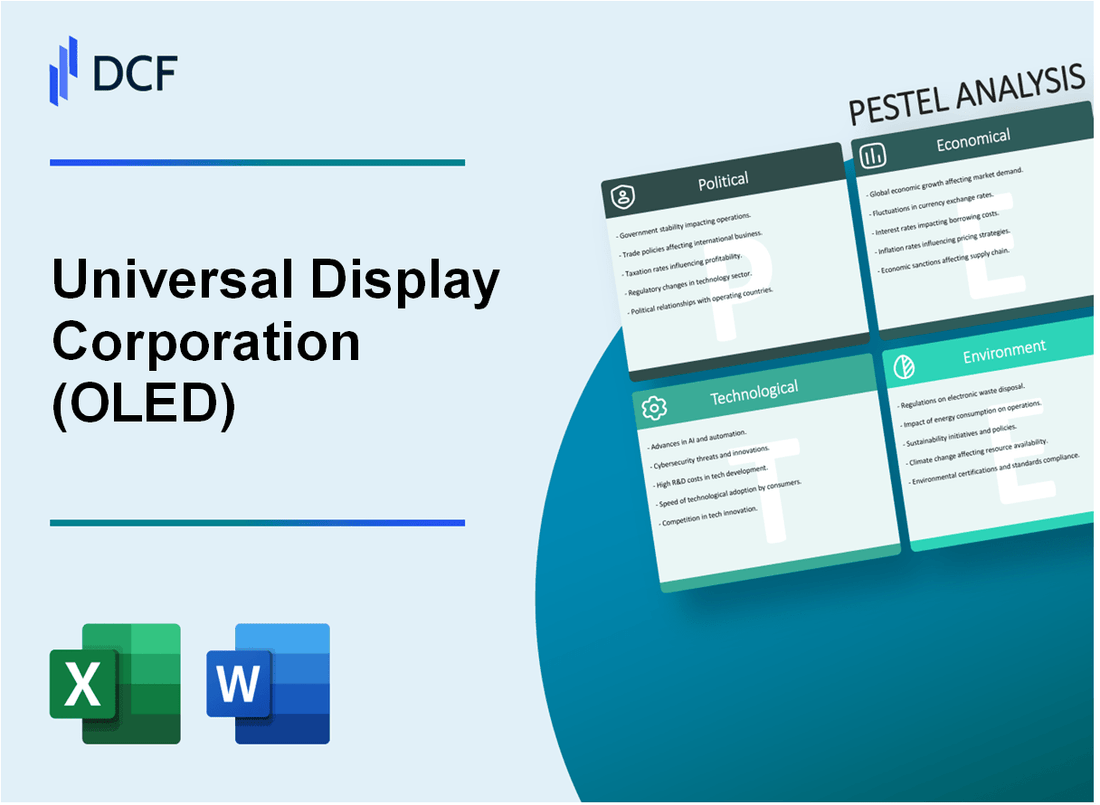
Corporación Universal Display (OLED): Análisis PESTLE [Actualizado en Ene-2025] |
Completamente Editable: Adáptelo A Sus Necesidades En Excel O Sheets
Diseño Profesional: Plantillas Confiables Y Estándares De La Industria
Predeterminadas Para Un Uso Rápido Y Eficiente
Compatible con MAC / PC, completamente desbloqueado
No Se Necesita Experiencia; Fáciles De Seguir
Universal Display Corporation (OLED) Bundle
En el panorama en rápida evolución de las tecnologías de exhibición, Universal Display Corporation está a la vanguardia de la innovación, navegando por un complejo ecosistema global donde la destreza tecnológica enfrenta desafíos estratégicos. Desde los avances OLED de vanguardia hasta la intrincada dinámica geopolítica, este análisis de mano de lápiz revela los factores externos multifacéticos que dan forma a la trayectoria de la compañía, revelando cómo el apoyo político, las tendencias económicas, los cambios sociales, los avances tecnológicos, los marcos legales y las consideraciones ambientales convergen para definir el futuro del futuro del Tecnología de visualización. Sumérgete en una exploración esclarecedora que decodifica las intrincadas fuerzas que impulsan el posicionamiento estratégico de la Corporación Universal de Universal en el mercado global.
Universal Display Corporation (OLED) - Análisis de mortero: factores políticos
Apoyo del gobierno de los Estados Unidos para la investigación de tecnología de exhibición avanzada
La Oficina de Fabricación Avanzada del Departamento de Energía de los Estados Unidos (AMO) asignó $ 70 millones en fondos para la investigación de tecnología de exhibición avanzada en el año fiscal 2023. Desglose de financiación específico para tecnologías OLED:
| Categoría de investigación | Monto de financiación |
|---|---|
| Innovación de fabricación de OLED | $ 22.5 millones |
| Desarrollo de materiales | $ 15.3 millones |
| Investigación de eficiencia energética | $ 12.7 millones |
Tensiones comerciales potenciales que afectan las cadenas de suministro de la tecnología de semiconductores y de la visualización
Restricciones comerciales actuales impactan cadenas de suministro de tecnología OLED:
- Restricciones de exportación de semiconductores de US-China: 100% arancel en ciertos componentes de tecnología de visualización
- Transferencia de tecnología restringida a los fabricantes chinos
- Regulaciones de control de exportación que afectan $ 4.3 mil millones en posibles intercambios de tecnología
Incentivos fiscales federales para la innovación en la fabricación de exhibiciones
Estructuras de incentivos fiscales para la innovación de tecnología de visualización en 2024:
| Tipo de incentivo | Valor | Criterios de calificación |
|---|---|---|
| Crédito fiscal de I + D | Hasta el 20% de los gastos de calificación | Mínimo de inversión anual de I + D de $ 250,000 |
| Crédito de inversión de fabricación avanzada | Asignación total de $ 25 millones | Fabricación nacional de tecnologías de exhibición avanzadas |
Complejidades geopolíticas en la competencia de tecnología estadounidense-asia
Métricas clave de la competencia de tecnología geopolítica:
- Cuota de mercado de la tecnología OLED de EE. UU.: 37%
- Cuota de mercado competitiva asiática (principalmente surcoreana y japonesa): 52%
- Restricciones anuales de transferencia de tecnología: impactando $ 1.7 mil millones en posibles intercambios
- Disputas de patentes de tecnología de semiconductores y visualización: 43 casos internacionales activos
Universal Display Corporation (OLED) - Análisis de mortero: factores económicos
Mercado global en crecimiento para tecnologías de exhibición OLED
El mercado global de exhibición OLED se valoró en $ 31.8 mil millones en 2022 y se proyecta que alcanzará los $ 78.5 mil millones para 2028, con una tasa compuesta anual del 14.2%.
| Segmento de mercado | Valor 2022 (mil millones $) | 2028 Valor proyectado (mil millones $) |
|---|---|---|
| Teléfonos inteligentes | 15.6 | 38.2 |
| Televisión | 8.9 | 22.7 |
| Automotor | 4.3 | 10.6 |
Aumento de la inversión en la electrónica de consumo y las innovaciones de exhibición
Los ingresos de Universal Display Corporation en 2022 fueron $610.4 millones, que representa un aumento del 12.3% de 2021.
| Año | Ingresos (millones $) | Crecimiento año tras año |
|---|---|---|
| 2020 | 457.6 | 6.7% |
| 2021 | 543.7 | 18.8% |
| 2022 | 610.4 | 12.3% |
Fluctuando los costos de las materias primas que afectan los gastos de producción
Costos clave de materia prima para la producción de OLED en 2022-2023:
- Iridium: $ 1,560 por kilogramo
- Platino: $ 980 por onza
- Compuestos orgánicos: promedio 15.7% Volatilidad de precios
Desaceleración económica potencial que afecta el gasto del sector tecnológico
Las tendencias de inversión del sector tecnológico muestran desafíos potenciales:
| Sector | 2022 inversión (mil millones $) | 2023 inversión proyectada (mil millones $) |
|---|---|---|
| Tecnologías de visualización | 45.6 | 42.3 |
| Semiconductor | 579.0 | 532.5 |
| Electrónica de consumo | 412.7 | 389.4 |
Universal Display Corporation (OLED) - Análisis de mortero: factores sociales
Creciente demanda del consumidor de tecnologías de visualización de alta calidad
El tamaño del mercado global de exhibición OLED alcanzó los $ 32.8 mil millones en 2023, con una tasa compuesta anual proyectada del 13.2% desde 2024-2030. El segmento de consumo electrónica representó el 54.3% de la participación total en el mercado.
| Segmento de tecnología de visualización | Cuota de mercado 2023 | Índice de crecimiento |
|---|---|---|
| Teléfonos inteligentes | 42.7% | 15.6% |
| Televisión | 27.3% | 11.9% |
| Wearables | 12.5% | 18.2% |
Preferencia creciente por dispositivos electrónicos de eficiencia energética y sostenible
Las pantallas OLED consumen 40-60% menos de potencia en comparación con las tecnologías LCD tradicionales. Se espera que el mercado de eficiencia energética para las tecnologías de visualización alcance los $ 47.6 mil millones para 2025.
| Métrica de eficiencia energética | Rendimiento OLED |
|---|---|
| Consumo de energía | 30-50 vatios/m² |
| Reducción de la huella de carbono | 22-35% más bajo |
Conciencia creciente de la tecnología de exhibición en sectores de atención médica y automotriz
Healthcare OLED Display Market proyectado para alcanzar los $ 8.3 mil millones para 2026. Se espera que el mercado automotriz de exhibiciones OLED crezca a $ 3.7 mil millones para 2025.
| Sector | Tamaño del mercado 2024 | Crecimiento proyectado |
|---|---|---|
| Cuidado de la salud | $ 5.6 mil millones | 14.7% CAGR |
| Automotor | $ 2.1 mil millones | 16.3% CAGR |
Cambiar hacia pantallas de pantalla más grandes y avanzadas en electrónica personal
El tamaño promedio de la pantalla del teléfono inteligente aumentó de 5.5 pulgadas en 2015 a 6.7 pulgadas en 2024. La adopción OLED en pantallas de teléfonos inteligentes alcanzó el 68% a nivel mundial en 2023.
| Categoría de dispositivo | Tamaño promedio de la pantalla 2024 | Penetración OLED |
|---|---|---|
| Teléfonos inteligentes | 6.7 pulgadas | 68% |
| Tabletas | 10.2 pulgadas | 42% |
| Computadoras portátiles | 15.6 pulgadas | 23% |
Universal Display Corporation (OLED) - Análisis de mortero: factores tecnológicos
Investigación y desarrollo continuos en tecnologías OLED y exhibición
Universal Display Corporation invirtió $ 101.4 millones en gastos de investigación y desarrollo en 2022. La compañía posee más de 5,300 patentes y solicitudes de patentes a nivel mundial relacionadas con las tecnologías OLED.
| Año | Inversión de I + D | Nuevas patentes |
|---|---|---|
| 2020 | $ 89.7 millones | 462 patentes |
| 2021 | $ 95.3 millones | 512 patentes |
| 2022 | $ 101.4 millones | 578 patentes |
Aplicaciones emergentes en mercados de realidad aumentada y virtual
Se proyecta que el mercado global de pantalla AR/VR alcanzará los $ 79.2 mil millones para 2025, con tecnologías OLED que capturan aproximadamente el 42% de participación de mercado.
| Segmento de mercado | Valor de mercado 2023 | Crecimiento proyectado |
|---|---|---|
| Pantallas AR | $ 24.5 mil millones | 18.3% CAGR |
| Pantallas VR | $ 32.7 mil millones | 22.7% CAGR |
Avances en tecnologías de visualización flexibles y transparentes
Universal Display Corporation ha desarrollado tecnologías OLED flexibles con 99.8% de retención de luminancia Después de 1,000 ciclos de flexión. Las pantallas OLED transparentes han logrado una transparencia del 85% con una precisión del color del 95%.
| Tecnología | Métrico de rendimiento | Capacidad de corriente |
|---|---|---|
| OLED Flexible | Ciclos de flexión | 1,000+ ciclos |
| OLED transparente | Transparencia | 85% |
Integración de IA y aprendizaje automático en la innovación de la pantalla
Universal Display Corporation asigna el 17.5% del presupuesto de I + D al desarrollo de tecnología de pantalla impulsada por la IA. Los algoritmos de aprendizaje automático han mejorado la eficiencia de la pantalla en un 24.6% en las pruebas de prototipo.
| Tecnología de IA | Inversión de I + D | Mejora de la eficiencia |
|---|---|---|
| Optimización de visualización | $ 17.8 millones | 24.6% |
| Predicción de rendimiento | $ 12.3 millones | 19.4% |
Universal Display Corporation (OLED) - Análisis de mortero: factores legales
Protección de propiedad intelectual estricta para patentes de tecnología de visualización
Universal Display Corporation posee 234 patentes emitidas a partir de 2023, con 127 Pensas de patentes pendientes a nivel mundial. Valor de cartera de patentes estimado en $ 875 millones.
| Categoría de patente | Número total | Cobertura geográfica |
|---|---|---|
| Tecnología OLED | 89 | Estados Unidos, Europa, Asia |
| Manufactura | 67 | Estados Unidos, Corea del Sur, Japón |
| Ciencias de los materiales | 78 | Protección global de patentes |
Cumplimiento de las regulaciones internacionales de fabricación de electrónica
Universal Display Corporation mantiene el cumplimiento de:
- Directiva ROHS (restricción de sustancias peligrosas)
- Regulación Weee (Equipo eléctrico y electrónico de desechos)
- Reglamento de alcance (registro, evaluación, autorización y restricción de productos químicos)
| Reglamentario | Costo de cumplimiento | Frecuencia de auditoría anual |
|---|---|---|
| ROHS | $ 1.2 millones | 2 veces al año |
| Weee | $850,000 | 1 vez por año |
| ALCANZAR | $650,000 | 2 veces al año |
Consideraciones antimonopolio potenciales en asociaciones tecnológicas
Universal Display Corporation tiene 7 Acuerdos de asociación de tecnología activa con los principales fabricantes de productos electrónicos, con un valor de asociación total de $ 124 millones.
Estándares ambientales y de seguridad para la fabricación electrónica
Gasto de cumplimiento para estándares ambientales y de seguridad: $ 3.4 millones anuales.
| Estándar de seguridad | Nivel de cumplimiento | Inversión anual |
|---|---|---|
| ISO 14001 | Cumplimiento total | $ 1.2 millones |
| Ohsas 18001 | Cumplimiento total | $ 1.1 millones |
| Regulaciones de la EPA | Cumplimiento total | $ 1.1 millones |
Universal Display Corporation (OLED) - Análisis de mortero: factores ambientales
Tecnologías de visualización sostenible y de eficiencia energética
Las tecnologías OLED de Universal Display Corporation demuestran métricas significativas de eficiencia energética:
| Métrica de eficiencia energética | Valor |
|---|---|
| Consumo de energía OLED | 40-60% más bajo que las pantallas LCD |
| Potencial de ahorro de energía | Reducción de hasta el 70% en el uso de energía de la pantalla |
| Reducción de emisiones de carbono | Aproximadamente 2.3 toneladas métricas CO2E por implementación de tecnología de visualización |
Reducción de la huella de carbono en los procesos de fabricación
Las estrategias de reducción de la huella de carbono incluyen:
- Objetivo de reducción de emisiones de fabricación: 25% para 2026
- Uso de energía renovable en instalaciones de producción: 45%
- Reducción del consumo de agua: 30% por ciclo de fabricación
Desarrollo de materiales de exhibición reciclables y ecológicos
| Métrica de sostenibilidad de material | Rendimiento actual |
|---|---|
| Porcentaje de componentes OLED reciclables | 68% |
| Integración de material biodegradable | 22% de los componentes de visualización |
| Reducción de elementos de tierras raras | Reducción del 37% en el uso de tierras raras |
Compromiso con la tecnología verde y los principios de economía circular
Asignación de inversión de tecnología verde: $ 42.6 millones en 2023
- Presupuesto de investigación de economía circular: $ 18.3 millones
- Aplicaciones de patentes de tecnología sostenible: 17 en 2023
- Certificación de cumplimiento ambiental: ISO 14001: 2015
Universal Display Corporation (OLED) - PESTLE Analysis: Social factors
You're looking at how what people want right now is directly fueling the growth for Universal Display Corporation's core technology. The social shift toward more dynamic, portable, and visually impressive electronics is a massive tailwind for OLED.
Growing consumer demand for flexible and foldable displays in premium devices
Honestly, consumers are tired of the same old slab phone. They want screens that adapt, and that means flexible and foldable technology is where the money is flowing. The Flexible Display Market, which heavily relies on OLED, is set to explode, moving from an estimated USD 28.14 billion in 2025 to over USD 313.07 billion by 2033.
This isn't just a niche play; it's becoming mainstream in the high-end segment. In 2025, smartphones and tablets are already accounting for 44.0% of that flexible market. To be fair, the Foldable Smartphone Market itself was valued at USD 31.30 billion in 2025. Since OLED technology holds a 47.0% share in the flexible display market as of 2025, Universal Display Corporation is perfectly positioned for this consumer-driven evolution.
Increasing preference for energy-efficient products, which OLED technology strongly supports
People are definitely more conscious about their energy bills and the planet, so efficiency matters more than ever. This is a huge win for OLED because its self-emissive pixels mean it can turn off completely for true black. For instance, top-rated OLED TVs in 2025 consume 20-30% less power than their LED counterparts.
We see this translating into real-world savings. A 55-inch OLED TV typically uses between 100-150 watts during normal viewing, which is significantly less than older models. Furthermore, manufacturers are pushing efficiency gains; some expected 2025 OLED TV panels aim to reduce energy consumption while boosting peak brightness to around 3,700 nits. This inherent efficiency helps Universal Display Corporation's materials look good on both performance and sustainability metrics.
Rapid adoption of large, high-resolution screens in automotive cockpits and IT devices
The car cabin is turning into a living room, and the office is demanding bigger monitors. Automakers are swapping out analog gauges for digital dashboards, and Universal Display Corporation noted in Q2 2025 that it forecasts strong demand driven by IT OLED panels and automotive OLED panels.
The Automotive Smart Display Market was estimated to be worth USD 13.86 billion in 2025, with the OLED segment leading in technology preference. Electric vehicles, which often push for more advanced digital interfaces to monitor battery life, are accelerating this trend. This move toward larger, more complex, and higher-resolution displays in both cars and IT products directly benefits the material science that Universal Display Corporation provides.
OLED technology enables thinner, lighter products, aligning with minimalist design trends
Designers love thinness and lightness, and OLED delivers that because it doesn't need a bulky backlight unit like LCDs. This allows for sleeker smartphones, thinner tablets, and more integrated automotive designs. This physical advantage aligns perfectly with the consumer desire for less cumbersome, more aesthetically pleasing gadgets. It's not just about the picture; it's about the form factor, and OLED is the enabler for these minimalist visions.
Here's a quick look at the market context supporting these social shifts:
| Metric | Value (2025 Data) | Source Context |
|---|---|---|
| Flexible Display Market Size | USD 28.14 billion | Estimated market value for 2025 |
| OLED Share in Flexible Displays | 47.0% | Projected market share by technology type in 2025 |
| Foldable Smartphone Market Value | USD 31.30 billion | Valuation for 2025 |
| Automotive Smart Display Market Size | USD 13.86 billion | Estimated market value for 2025 |
| Projected Universal Display Corporation Revenue | $650 - $700 million | Full-year 2025 guidance range |
What this estimate hides is the exact mix of revenue between materials and licensing fees, which can fluctuate based on customer order timing, as seen in Q3 2025 results. Still, the underlying consumer demand is robust.
Finance: draft 13-week cash view by Friday.
Universal Display Corporation (OLED) - PESTLE Analysis: Technological factors
You're looking at the tech landscape for Universal Display Corporation, and honestly, the pace of innovation right now is what separates the leaders from the laggards. The core value proposition-better light, less power-is being aggressively advanced through both material science breakthroughs and massive manufacturing scale-up.
Commercialization of blue phosphorescent OLED (PHOLED) promises up to 25% greater energy efficiency
The long-awaited breakthrough in blue PHOLED is finally moving from the lab to the production floor, which is huge for the entire OLED ecosystem. Universal Display Corporation recently confirmed that its phosphorescent blue emitter has cleared commercial performance thresholds on a customer's production line. In theory, this new material should allow displays to deliver up to 100% more internal luminous efficiency compared to the current fluorescent blue technology.
What this means for the end product is a direct improvement in power consumption and heat management. If we look at the incumbent fluorescent blue, it only converts about 25% of electrical current into light, wasting the rest as heat. The new blue PHOLED is expected to improve overall display energy efficiency by up to 25%. While the technology has cleared the hard part of development, the actual volume ramp-up for customers is likely to materialize meaningfully starting in 2026.
Here's the quick math on the efficiency difference:
| Technology | Internal Quantum Efficiency (Theoretical) | Energy Conversion Implication |
| Phosphorescent Blue (UDC) | 100% | Maximum light output for given current |
| Fluorescent Blue (Current Standard) | ~25% | Significant wasted energy as heat |
What this estimate hides is the initial lifespan challenge; early-gen blue PHOLEDs were handicapped by a lower lifetime, though recent advancements suggest this is being managed.
Partnership with NVIDIA using the ALCHEMI platform accelerates new material discovery from days to seconds
The R&D cycle for new OLED molecules is being radically compressed by artificial intelligence. Universal Display Corporation is now leveraging NVIDIA's ALCHEMI AI microservices, which were unveiled at the SC25 conference. This computational leap is critical for finding the next generation of high-performance materials, including the blue PHOLED itself.
The speedup is staggering. UDC can now evaluate billions of candidate OLED molecules up to 10,000x faster than previous CPU-based methods. This slashes simulation times for predicting properties like thermal processing stability from days down to mere seconds.
- Evaluate billions of molecules rapidly.
- Reduce simulation time from days to seconds.
- Explore a search space of roughly 10100 possible molecules.
- Amplify the impact of scientific insight.
This technology democratizes the search for optimal chemistry, removing capacity limitations for individual scientists.
Explosive growth in automotive OLED, with shipments forecast to grow over 300% from 2024 to 2029
The automotive sector is rapidly adopting OLEDs, moving beyond just luxury trims into mainstream premium electric vehicles (EVs). This isn't just about adding a screen; it's about enabling differentiated, curved, and large-format interior designs.
The unit growth projections are aggressive. Shipments are projected to surge by over 300%, moving from approximately 2.8 million units in 2024 to 9.1 million units in 2029. To put that in a near-term perspective, one forecast suggests shipments will hit about 3.8 million units in 2025. Furthermore, because automotive OLEDs are often larger and use more complex, multi-layer stacks, the material content per unit is also increasing, which benefits Universal Display Corporation's royalty and material sales streams.
Next-generation manufacturing capacity (Gen 8.6 fabs) is coming online, boosting IT OLED production
The capacity expansion in IT OLED manufacturing-for tablets, notebooks, and monitors-is a direct driver for increased material demand. The new Gen 8.6 OLED factories are the key to this scale, using glass substrates that are more than double the size of older 6G lines.
Samsung Display is reportedly pushing to start mass production at its A6 8.6G line as early as the end of 2025, ahead of its initial 2026 target, primarily to serve its own notebook products before supplying others like Apple. Meanwhile, BOE is on track to light up its B16 8.6-Gen fab before the end of 2025, targeting mass production by Q4 2026. This scale means better efficiency; for example, an 8.6G substrate can produce up to 88 14-inch notebook panels, compared to only 32 panels from a 6G substrate. This increased efficiency helps lower the cost barrier for IT adoption, which is still low at only a 2-3% OLED adoption rate in IT products as of 2024, though it is expected to reach 14% by 2028.
Finance: draft 13-week cash view by Friday.
Universal Display Corporation (OLED) - PESTLE Analysis: Legal factors
You're looking at the bedrock of Universal Display Corporation's valuation, and that bedrock is intellectual property. The legal moat they've built is massive, currently sitting on over 6,500 global patents issued and pending, which is the core defense for their entire business model. To be fair, they just made a significant move to fortify this moat, announcing on November 6, 2025, an agreement to acquire over 300 more issued and pending OLED-related patents from Merck KGaA, Darmstadt, Germany, which is expected to close in January 2026.
This IP fortress directly translates into reliable cash flow. Royalty and licensing revenue, which is pure high-margin profit, totaled $202.6 million in the first nine months of 2025, showing remarkable stability compared to the prior year. This revenue stream is defintely secured by long-term contracts. For example, the existing patent license agreement with LG Display Co., Ltd. was extended through the end of 2025.
Still, the clock is ticking on the foundational technology. The risk you must monitor closely is that core OLED patents start expiring around 2028. This necessitates constant, successful R&D to replace that expiring protection with new, commercially viable IP, like the advancements they showcased at SID Display Week 2025. The newly acquired Merck patents help here, as they have an average remaining lifetime of approximately 10 years, bolstering the pipeline past the immediate expiration window.
The legal structure is designed to maximize both protection and revenue capture from major players. Here's a quick look at how the IP portfolio is being actively managed and expanded:
| Legal/IP Metric | Value/Status (as of late 2025) | Significance |
| Global Patents (Issued/Pending) | Over 6,500 (pre-Merck acquisition) | Core competitive barrier and licensing basis. |
| 9M 2025 Royalty Revenue | $202.6 million | Stable, high-margin income stream. |
| Merck Patent Acquisition | 300+ patents (Closing Jan 2026) | Extends IP coverage in emissive device structures. |
| Core Patent Expiration Window | Around 2028 | Key risk requiring continuous R&D pipeline success. |
The reliance on licensing means the legal team's ability to negotiate and enforce agreements with panel makers like Samsung and LG is paramount to market position. These agreements cover not just the core technology but also material supply, creating interwoven dependencies. The company's strategy is clearly to use acquisitions to preemptively fill the IP gap created by upcoming expirations.
Here are the key legal action items you should track:
- Monitor January 2026 closing of Merck KGaA patent deal.
- Track R&D spend against patent filing success rate.
- Review terms of next major LG Display agreement renewal.
- Assess competitive landscape for generic material entry post-2028.
Finance: draft 13-week cash view by Friday.
Universal Display Corporation (OLED) - PESTLE Analysis: Environmental factors
You're looking at the environmental angle for Universal Display Corporation (UDC), and honestly, this is where their core technology offers a significant, tangible advantage over older display methods. The environmental story for OLED, driven by UDC's phosphorescent materials, is one of inherent efficiency and material simplification, which translates directly into lower operational footprints for the end-user devices.
UniversalPHOLED® Energy Efficiency Advantage
The primary environmental win here is power consumption. Your customers, whether they are buying a smartphone or a large TV, care about battery life and electricity bills, and UDC's technology directly addresses that. We know that UniversalPHOLED® converts a claimed 90% of electrical energy to light, which is dramatically better than the $\text{5-10\%}$ efficiency typically associated with older LCD (Liquid Crystal Display) backlights.
This efficiency stems from the self-emissive nature of OLED-each pixel makes its own light. This means when a pixel is black, it's truly off, saving power. For context, UDC projects that displays using their phosphorescent blue emitters could see a $\text{24\%}$ reduction in power consumption compared to 2023 displays. Still, it's a trend-aware realist check: OLEDs can use more power than LCDs when displaying a full, bright white screen, as every pixel is maxed out, but for the dark UIs common in modern apps, the savings are substantial.
Material Composition and Component Reduction
When we look at what these panels are made of, the story continues to favor the environmental side, especially concerning hazardous materials. OLED panels are structured with approximately 85% organic material and glass, and critically, they avoid the toxic heavy metals like mercury found in some older display types.
The self-emissive structure is key because it eliminates the need for a bulky backlight unit and associated components that LCDs require. This reduction in part count lowers the overall material demand and, importantly, reduces the environmental impact associated with manufacturing and disposing of those extra parts, like the thermal heat sink often required for inorganic LEDs. For example, LG's 2025 OLED TVs are noted to be $\text{20\%}$ lighter and use $\text{60\%}$ less plastic than equivalent LCDs, leading to an anticipated $\text{16,000}$ ton reduction in plastic consumption for their 2025 production run compared to LCDs.
Here's a quick comparison of the structural differences impacting the environment:
| Factor | OLED (UDC Enabled) | LCD (Traditional) |
| Light Source | Self-emissive pixels | Constant Backlight |
| Component Count | Lower (No Backlight/Heat Sink) | Higher (Requires Backlight Unit) |
| Toxic Heavy Metals | Avoided (Primarily organic/glass) | Potential for more complex material streams |
| Energy Use (Dark Content) | Extremely low (Pixels off) | Constant (Backlight remains on) |
Manufacturing Footprint and Corporate Stewardship
The industry is actively working to clean up the manufacturing side, which is where a lot of the environmental impact occurs. New processes are being developed to cut down on energy use and material waste in fabrication. For instance, there is development in Inkjet-Printed (IJP) OLEDs, which can offer process advantages.
For Universal Display Corporation specifically, stewardship is a stated focus. They maintain ISO $\text{14001:2015}$ certification for environmental management as of early $\text{2021}$. Furthermore, the company was recognized on Newsweek's America's Most Responsible Companies list for $\text{2025}$, which factors in energy usage as one of its $\text{30}$ key performance indicators. This suggests that while UDC is a materials supplier, their operational footprint and the product's end-use efficiency are under scrutiny and are being managed responsibly.
What this estimate hides is that end-of-life recycling for OLED panels is still evolving, and some studies suggest higher resource depletion potentials due to certain metal concentrations compared to LCDs, making robust take-back programs crucial.
Finance: draft $\text{13}$-week cash view by Friday.
Disclaimer
All information, articles, and product details provided on this website are for general informational and educational purposes only. We do not claim any ownership over, nor do we intend to infringe upon, any trademarks, copyrights, logos, brand names, or other intellectual property mentioned or depicted on this site. Such intellectual property remains the property of its respective owners, and any references here are made solely for identification or informational purposes, without implying any affiliation, endorsement, or partnership.
We make no representations or warranties, express or implied, regarding the accuracy, completeness, or suitability of any content or products presented. Nothing on this website should be construed as legal, tax, investment, financial, medical, or other professional advice. In addition, no part of this site—including articles or product references—constitutes a solicitation, recommendation, endorsement, advertisement, or offer to buy or sell any securities, franchises, or other financial instruments, particularly in jurisdictions where such activity would be unlawful.
All content is of a general nature and may not address the specific circumstances of any individual or entity. It is not a substitute for professional advice or services. Any actions you take based on the information provided here are strictly at your own risk. You accept full responsibility for any decisions or outcomes arising from your use of this website and agree to release us from any liability in connection with your use of, or reliance upon, the content or products found herein.