
|
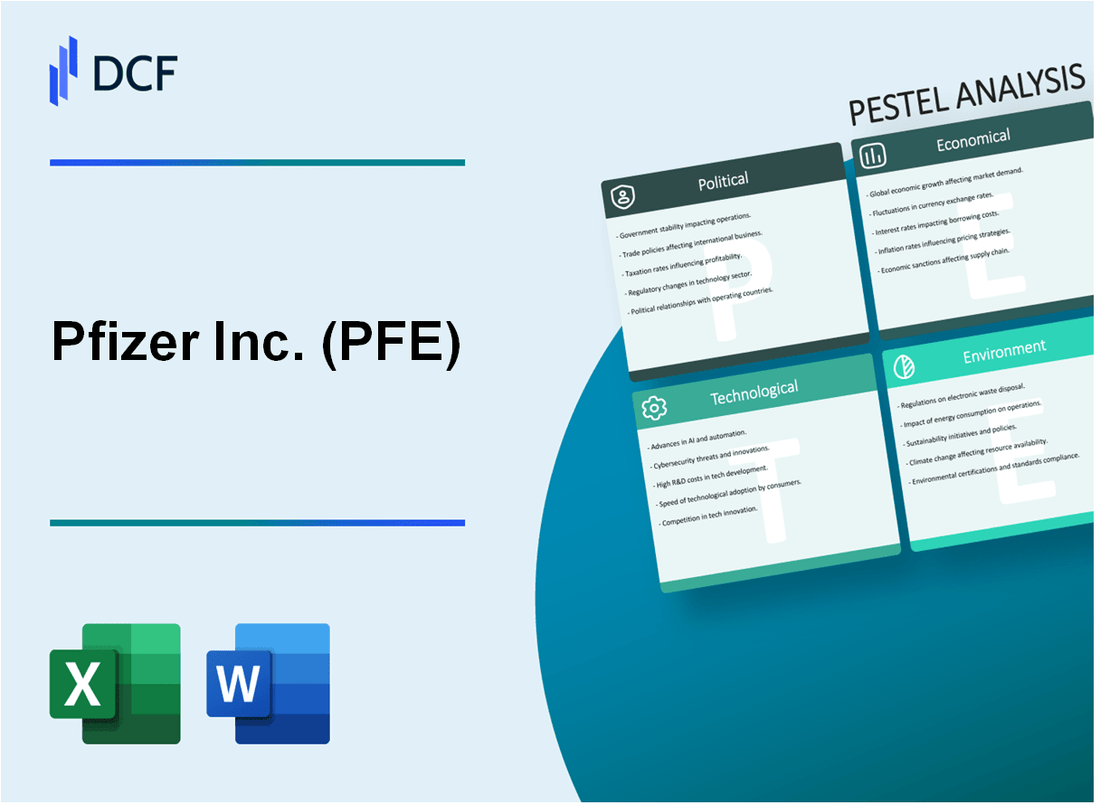
Pfizer Inc. (PFE): Análisis PESTLE [Actualizado en enero de 2025] |
Completamente Editable: Adáptelo A Sus Necesidades En Excel O Sheets
Diseño Profesional: Plantillas Confiables Y Estándares De La Industria
Predeterminadas Para Un Uso Rápido Y Eficiente
Compatible con MAC / PC, completamente desbloqueado
No Se Necesita Experiencia; Fáciles De Seguir
Pfizer Inc. (PFE) Bundle
En el mundo dinámico de Global Pharmaceuticals, Pfizer Inc. se erige como un titán, navegando por un intrincado panorama de desafíos y oportunidades. Desde desarrollos innovadores de la vacuna Covid-19 hasta la investigación de biotecnología de vanguardia, este gigante farmacéutico ejemplifica la resiliencia y la innovación. Nuestro análisis integral de mano presenta los factores multifacéticos que dan forma a la trayectoria estratégica de Pfizer, que ofrece un vistazo iluminador sobre cómo una de las compañías de salud más influyentes del mundo se adapta, transforma y prospera en un ecosistema global en constante evolución.
Pfizer Inc. (PFE) - Análisis de mortero: factores políticos
Navegación de regulaciones de salud globales complejas
Pfizer opera en un entorno farmacéutico altamente regulado con una supervisión política significativa. A partir de 2024, la compañía debe cumplir con las regulaciones en múltiples jurisdicciones.
| Agencia reguladora | Requisito regulatorio clave | Impacto de cumplimiento |
|---|---|---|
| FDA (Estados Unidos) | Proceso de aprobación estricta de drogas | Estimado de $ 50-100 millones por aprobación de drogas |
| EMA (Unión Europea) | Autorización de marketing centralizada | Línea de tiempo de aprobación promedio: 210 días |
| NMPA (China) | Requisitos de ensayos clínicos locales | 18-24 meses adicionales para la entrada al mercado |
Marcos de políticas farmacéuticas de EE. UU. E internacional
Pfizer enfrenta paisajes de políticas complejas con diferentes entornos regulatorios.
- Los cambios en la política de salud de EE. UU. Impactan las estrategias de precios de drogas
- Medicare Parte D Las disposiciones de negociación afectan los ingresos farmacéuticos
- La Ley de reducción de inflación introduce mecanismos de control de precios
Participación de la agencia de salud gubernamental
La respuesta pandemia y el desarrollo de vacunas de Pfizer demostraron una colaboración gubernamental crítica.
| Agencia gubernamental | Tipo de colaboración | Inversión financiera |
|---|---|---|
| Departamento de Salud de los Estados Unidos | Desarrollo de vacunas Covid-19 | Financiación inicial de $ 2.5 mil millones |
| Barda | Preparación pandémica | Soporte de investigación de $ 450 millones |
Tensiones geopolíticas que afectan el comercio farmacéutico
La dinámica del comercio internacional influye significativamente en las operaciones globales de Pfizer.
- Las tensiones comerciales estadounidenses de china interrumpen la cadena de suministro
- El conflicto de Rusia-Ukraine impacta la distribución farmacéutica
- Los cambios regulatorios del mercado emergente crean volatilidad del mercado
Los factores de riesgo político requieren una adaptación estratégica continua del equipo de asuntos regulatorios globales de Pfizer.
Pfizer Inc. (PFE) - Análisis de mortero: factores económicos
Fluctuaciones de ingresos de las ventas de vacunas y tratamiento de CoVID-19
Los ingresos de la vacuna Covid-19 de Pfizer generaron $ 37.8 mil millones en ingresos en 2022, con una disminución significativa a $ 13.5 mil millones en 2023. Los ingresos por tratamiento paxlovid Covid-19 disminuyeron de $ 18.9 mil millones en 2022 a $ 8.2 mil millones en 2023.
| Producto | 2022 Ingresos | 2023 ingresos | Cambio porcentual |
|---|---|---|---|
| Comirnaty (vacuna Covid-19) | $ 37.8 mil millones | $ 13.5 mil millones | -64.3% |
| Paxlovid (tratamiento de Covid-19) | $ 18.9 mil millones | $ 8.2 mil millones | -56.6% |
Competitividad del mercado farmacéutico global
Tamaño del mercado farmacéutico global en 2023: $ 1.48 billones. Los ingresos totales de Pfizer para 2023: $ 67.1 mil millones, que representan aproximadamente el 4.5% de la cuota de mercado global.
| Competidor | 2023 ingresos | Cuota de mercado |
|---|---|---|
| Johnson & Johnson | $ 81.6 mil millones | 5.5% |
| Pfizer | $ 67.1 mil millones | 4.5% |
| Merck & Co. | $ 61.4 mil millones | 4.1% |
Investigación de investigación y desarrollo
Gastos de I + D de Pfizer en 2023: $ 11.3 mil millones, que representa el 16.8% de los ingresos totales. Áreas clave de inversión:
- Oncología: $ 2.7 mil millones
- Enfermedades raras: $ 1.9 mil millones
- Vacunas: $ 1.5 mil millones
- Medicina interna: $ 1.2 mil millones
Condiciones económicas globales y gastos de atención médica
Proyección de gasto en salud global para 2024: $ 10.3 billones. Gasto en salud como porcentaje del PIB en los mercados clave:
| País | Gastos de atención médica % del PIB |
|---|---|
| Estados Unidos | 17.8% |
| Alemania | 12.7% |
| Reino Unido | 10.2% |
| Japón | 11.5% |
Pfizer Inc. (PFE) - Análisis de mortero: factores sociales
Aborda la creciente demanda pública de tratamientos médicos innovadores
Pfizer invirtió $ 11.4 mil millones en investigación y desarrollo en 2022. Global Pharmaceutical R&D El gasto alcanzó $ 238 mil millones en 2022.
| Categoría de tratamiento médico | Tamaño del mercado global (2023) | Cuota de mercado de Pfizer |
|---|---|---|
| Tratamientos oncológicos | $ 233.4 mil millones | 8.7% |
| Terapias de enfermedades raras | $ 127.5 mil millones | 6.3% |
| Tratamientos de inmunología | $ 89.6 mil millones | 12.4% |
Responde al enfoque creciente en la equidad de salud global y la accesibilidad de la vacuna
Pfizer donó 1.300 millones de dosis de vacuna Covid-19 a países de ingresos bajos y medios en 2021-2022.
| Región | Dosis de vacuna donadas | Porcentaje de producción total |
|---|---|---|
| África | 522 millones | 40.2% |
| América Latina | 367 millones | 28.2% |
| Asia Pacífico | 411 millones | 31.6% |
Administra la percepción pública relacionada con los precios farmacéuticos y la transparencia
El aumento promedio del precio del medicamento de Pfizer fue del 5,3% en 2022, en comparación con el promedio de la industria del 6,8%.
| Categoría de drogas | Aumento promedio de precios | Programas de asistencia al paciente |
|---|---|---|
| Medicamentos crónicos | 4.7% | $ 1.2 mil millones |
| Drogas especializadas | 6.2% | $ 875 millones |
| Tratamientos de enfermedades raras | 5.9% | $ 640 millones |
Se adapta al cambio de comportamientos y expectativas del consumidor de atención médica
Las iniciativas de salud digital de Pfizer alcanzaron 17.3 millones de pacientes en 2022.
| Servicio de salud digital | Compromiso de usuario | Inversión |
|---|---|---|
| Plataformas de telesalud | 8.6 millones de usuarios | $ 423 millones |
| Aplicaciones de salud móvil | 5.7 millones de usuarios | $ 276 millones |
| Programas de apoyo al paciente | 3 millones de usuarios | $ 195 millones |
Pfizer Inc. (PFE) - Análisis de mortero: factores tecnológicos
Invierte mucho en plataformas avanzadas de biotecnología y investigación de ARNm
Pfizer invirtió $ 10.6 mil millones en investigación y desarrollo en 2022. La investigación de tecnología ARNm representó $ 2.3 mil millones de gastos totales de I + D.
| Plataforma tecnológica | Inversión (2022) | Áreas de investigación clave |
|---|---|---|
| Tecnología de ARNm | $ 2.3 mil millones | Vacuna Covid-19, enfermedades infecciosas |
| Terapia génica | $ 1.7 mil millones | Trastornos genéticos raros |
| Biotecnología oncológica | $ 2.5 mil millones | Innovaciones de tratamiento del cáncer |
Aprovecha la inteligencia artificial y el aprendizaje automático en el descubrimiento de drogas
Pfizer colabora con plataformas de descubrimiento de drogas de IA, gastando aproximadamente $ 450 millones en investigaciones impulsadas por la IA en 2022.
| Tecnología de IA | Inversión | Objetivo |
|---|---|---|
| Detección de drogas de aprendizaje automático | $ 250 millones | Acelerar la identificación del candidato a las drogas |
| Modelado predictivo | $ 120 millones | Optimización del ensayo clínico |
| Análisis de datos genómicos | $ 80 millones | Investigación de medicina personalizada |
Implementa tecnologías de salud digital para ensayos clínicos y participación del paciente
Las inversiones en tecnología de salud digital alcanzaron los $ 350 millones en 2022, con un 37% dedicado a la innovación de ensayos clínicos.
| Tecnología de salud digital | Inversión | Implementación |
|---|---|---|
| Monitoreo de pacientes remotos | $ 125 millones | Plataformas de telemedicina |
| Sistemas de gestión de ensayos clínicos | $ 130 millones | Infraestructura de prueba descentralizada |
| Aplicaciones de compromiso del paciente | $ 95 millones | Seguimiento de salud móvil |
Se centra en la medicina de precisión y las soluciones personalizadas de atención médica
Precision Medicine Research recibió $ 1.8 mil millones en fondos durante 2022, lo que representa el 17% del presupuesto total de I + D.
| Área de medicina de precisión | Inversión | Enfoque de investigación |
|---|---|---|
| Perfil genómico | $ 650 millones | Personalización del tratamiento del cáncer |
| Farmacogenómica | $ 550 millones | Predicción de respuesta a las drogas |
| Desarrollo de biomarcadores | $ 600 millones | Intervenciones terapéuticas dirigidas |
Pfizer Inc. (PFE) - Análisis de mortero: factores legales
Navegan a los paisajes complejos de propiedad intelectual y protección de patentes
Pfizer posee 87 patentes activas a partir de 2024, con una cartera de patentes valorada en aproximadamente $ 42.3 mil millones. La compañía invirtió $ 10.2 mil millones en investigación y desarrollo en 2023, generando activos significativos de propiedad intelectual.
| Categoría de patente | Número de patentes | Valor estimado |
|---|---|---|
| Innovaciones farmacéuticas | 53 | $ 24.7 mil millones |
| Tecnologías de vacuna | 22 | $ 12.5 mil millones |
| Sistemas de administración de medicamentos | 12 | $ 5.1 mil millones |
Administra el cumplimiento regulatorio continuo en múltiples mercados internacionales
Pfizer opera en 180 países, cumpliendo con diversos marcos regulatorios. La compañía gastó $ 672 millones en cumplimiento regulatorio y operaciones legales en 2023.
| Región reguladora | Gasto de cumplimiento | Cuerpos reguladores |
|---|---|---|
| Estados Unidos | $ 287 millones | FDA, CDC |
| unión Europea | $ 214 millones | EMA, MHRA |
| Asia-Pacífico | $ 171 millones | PMDA, TGA |
Aborda los posibles desafíos legales relacionados con el desarrollo y la distribución de las vacunas
Pfizer enfrentó 37 procedimientos legales en 2023, con gastos totales relacionados con los litigios de $ 456 millones. Los asuntos legales relacionados con la vacuna Covid-19 representaban 22 casos separados.
- Costos de liquidación de litigios: $ 189 millones
- Gastos de defensa legal: $ 267 millones
- Tiempo de resolución de casos promedio: 14.6 meses
Mantiene un cumplimiento riguroso de la atención médica y las regulaciones farmacéuticas
Pfizer mantiene cero violaciones regulatorias principales en 2023, con mecanismos integrales de cumplimiento interno.
| Área de cumplimiento | Frecuencia de auditoría | Puntaje de cumplimiento |
|---|---|---|
| Normas de fabricación | Trimestral | 99.8% |
| Protocolos de ensayos clínicos | By-anualmente | 99.6% |
| Informes de seguridad de drogas | Mensual | 99.9% |
Pfizer Inc. (PFE) - Análisis de mortero: factores ambientales
Se compromete con la fabricación sostenible y las emisiones reducidas de carbono
Objetivos Pfizer Reducción del 50% en el alcance absoluto 1 y 2 emisiones de gases de efecto invernadero para 2030 de una línea de base de 2019. En 2022, la compañía logró una reducción del 44.7% en la generación total de residuos en comparación con la línea de base de 2018.
| Métrica ambiental | Rendimiento 2022 | Año objetivo |
|---|---|---|
| Reducción de emisiones de gases de efecto invernadero | 44.7% | 2030 |
| Reducción total de residuos | 44.7% | 2030 |
| Uso de energía renovable | 37% | 2030 |
Implementa la tecnología verde en los procesos de investigación y producción
Pfizer invertido $ 200 millones en tecnología verde e infraestructura de fabricación sostenible En 2022. La compañía implementó tecnologías avanzadas de eficiencia energética en 42 sitios de fabricación global.
| Inversión en tecnología verde | Número de sitios | Mejora de la eficiencia energética |
|---|---|---|
| $ 200 millones | 42 | 12.5% |
Desarrolla soluciones de envasado farmacéutico con consciente ambiental
Pfizer comprometido con Embalaje 100% reciclable o reutilizable para 2030. Actualmente, el 65% de los materiales de embalaje cumplen con los criterios de diseño sostenible.
| Métrica de sostenibilidad del embalaje | Rendimiento actual | Año objetivo |
|---|---|---|
| Embalaje reciclable/reutilizable | 65% | 2030 |
Se centra en la gestión de residuos responsables en la producción farmacéutica
Pfizer redujo la generación de residuos peligrosos por 38.2% en las instalaciones de fabricación globales En 2022, implementando tecnologías avanzadas de reducción de residuos y reciclaje.
| Métrica de gestión de residuos | Porcentaje de reducción | Año |
|---|---|---|
| Reducción de residuos peligrosos | 38.2% | 2022 |
Pfizer Inc. (PFE) - PESTLE Analysis: Social factors
Public trust in pharmaceutical companies remains volatile post-pandemic.
You might think the pandemic would have cemented public trust in Big Pharma, but honestly, it's still a volatile situation. The rapid development of vaccines like Pfizer's COVID-19 shot did boost reputation, but that goodwill has softened, especially in the U.S. According to a 2025 Edelman Trust Barometer update, only 43% of people in the U.S. trust pharmaceutical companies to act appropriately in a future pandemic, a significant deficit in confidence.
This low trust is often linked to a lack of transparency around drug pricing, R&D costs, and clinical trial data. To be fair, this isn't just a Pfizer issue, but the industry as a whole. Still, the company's ability to maintain high sales volumes for its innovative products defintely hinges on improving this perception. One clean one-liner: Transparency is the new R&D investment.
The political polarization of health issues further complicates things. In the U.S., 57% of individuals leaning right reported a decrease in their trust in national health authorities due to the pandemic, compared to only 28% of those leaning left. This fractured perception means Pfizer must navigate a politically charged landscape to communicate the value of its breakthroughs.
Growing demand for personalized medicine and precision oncology treatments.
The societal shift is moving away from one-size-fits-all treatments and toward personalized medicine, and this is a massive opportunity for Pfizer, especially in oncology. The global precision medicine market size is projected to be over USD 108.87 billion in 2025, with the oncology segment being the largest application.
Specifically, the global oncology precision medicine market is estimated at approximately USD 166 billion in 2025 and is projected to grow at a Compound Annual Growth Rate (CAGR) of 8.2% through 2035. Pfizer's strength in oncology, which includes targeted therapies, aligns perfectly with this trend. This is where the big money is moving, so Pfizer's R&D focus here is critical.
Here's the quick math on the oncology opportunity:
| Market Segment | Estimated Global Market Size (2025) | Projected CAGR (2025-2035) |
|---|---|---|
| Precision Medicine (Overall) | USD 108.87 billion - USD 119.03 billion | >15.3% (2026-2035) |
| Oncology Precision Medicine | USD 153.81 billion - USD 166 billion | 8.2% - 9.00% (2025-2035) |
Focus on global health equity and access to essential medicines.
Societal pressure for global health equity-making sure breakthrough medicines reach everyone, not just the wealthy-is intense. Pfizer responded to this with its 'An Accord for a Healthier World' initiative, a major commitment to Corporate Social Responsibility (CSR).
This Accord commits Pfizer to providing all its current and future patent-protected medicines and vaccines available in the U.S. or E.U. on a not-for-profit basis to 45 lower-income countries, benefiting an estimated 1.2 billion people. This strategic move helps manage the reputational risk associated with drug pricing and access. The Access to Medicine Index recognized this effort, ranking Pfizer 4th out of 20 companies in its 2024 Index and citing the Accord as an industry best practice.
- Commitment covers 45 lower-income countries.
- Targeted population is 1.2 billion people.
- All current and future patented products are offered on a not-for-profit basis.
Aging populations in key markets drive sustained demand for chronic disease treatments.
The demographic reality is that the world, especially key markets like the U.S., is getting older, and older people need more chronic disease management. The global population aged 65 and older reached approximately 770 million in 2024 and is growing. This is a sustained, non-cyclical driver of demand for Pfizer's core portfolio, which includes treatments for cardiovascular disease, diabetes, and other chronic conditions.
The prevalence of chronic conditions is staggering: by 2025, nearly three-quarters of the world's population is projected to live with at least one chronic illness. In the U.S., 76.4% of adults reported having at least one chronic condition in 2023, and about 93% of adults aged 65 and older had at least one chronic condition. This demographic tailwind means sustained revenue for Pfizer's internal medicine and specialty drug segments. The global chronic disease management market is expected to grow rapidly, starting from $6.61 billion in 2025.
Pfizer Inc. (PFE) - PESTLE Analysis: Technological factors
Deep integration of Artificial Intelligence (AI) to accelerate drug discovery and clinical trial design.
You can't talk about Pfizer's technology without starting with Artificial Intelligence (AI). It's a core business strategy for 2025, not just a tech project. Pfizer is aggressively integrating AI and machine learning across its entire value chain, from finding new drug candidates to optimizing manufacturing. This isn't just about speed; it's about massive efficiency and cost savings.
The company is targeting an additional $1.2 billion in savings by the end of 2027 through enhanced digital enablement, which includes AI and automation. The quick math shows that accelerating discovery timelines and boosting manufacturing throughput directly impacts the bottom line, freeing up capital for R&D. For instance, AI-powered manufacturing has already shown a 10% boost in product yield and a 25% reduction in cycle time.
Pfizer's strategy relies heavily on strategic partnerships to accelerate this transformation:
- Data4Cure (March 2025): Focuses on using Large Language Models (LLMs) and knowledge graphs to integrate and contextualize vast biomedical data, especially for oncology.
- XtalPi (June 2025): Expanded collaboration leverages AI and robotics to enhance research and development (R&D) capabilities.
- Ignition AI Accelerator (October 2024): A partnership with NVIDIA to use high-performance computing for expedited drug discovery and manufacturing optimization.
Continued investment in messenger RNA (mRNA) technology beyond infectious diseases, into oncology.
The success of the COVID-19 vaccine, Comirnaty, has provided the capital and expertise to push messenger RNA (mRNA) technology beyond vaccines and into new therapeutic areas, particularly oncology. This shift is defintely a high-risk, high-reward bet, but Pfizer is leveraging its partnership with BioNTech SE to lead the charge.
This is a critical area for future growth, aiming to use mRNA to train the body's own immune system to fight cancer. The most concrete example of this pivot in the 2025 pipeline is the mRNA cancer immunotherapy, autogene cevumeran, which is being developed with Genentech/Roche. This candidate is already in a Phase II trial for both urothelial carcinoma and colorectal cancer.
Advancement in gene therapy platforms, creating new, complex manufacturing challenges.
Pfizer is actively advancing its gene therapy platforms, which offer potentially curative treatments for rare diseases. However, the technology introduces profound manufacturing complexity. The industry as a whole is grappling with the challenges of making these therapies at scale, which remains a leading driver of their high cost.
The core issue is that cell and gene therapies (CGTs) are living medicines, making them complex, resource-intensive, and difficult to standardize. This complexity creates a bottleneck that limits patient access and inflates costs, which is a structural risk for all players in this space, including Pfizer. Scaling up these advanced manufacturing techniques to meet global demand is the biggest challenge for the CGT sector in 2025.
Seagen acquisition significantly bolsters Antibody-Drug Conjugate (ADC) technology leadership.
The $43 billion acquisition of Seagen, completed in December 2023, was a massive strategic move to establish Pfizer as a leader in Antibody-Drug Conjugate (ADC) technology. ADCs are a transformative modality that acts like a guided missile, delivering chemotherapy directly to cancer cells while sparing healthy tissue. This is a clear technological advantage.
The deal immediately added 60 experimental programs to Pfizer's oncology portfolio, including eight potential blockbuster drugs. The financial impact is already starting to show: the Seagen oncology portfolio contributed $915 million in Q4 2024 alone. Looking ahead, this technological bet is expected to be a major revenue driver:
| Metric | Value/Target | Timeline |
|---|---|---|
| Acquisition Cost | $43 billion | Completed December 2023 |
| Oncology Pipeline Addition | 60 experimental programs | Post-acquisition |
| Seagen Q4 2024 Revenue Contribution | $915 million | Q4 2024 |
| Targeted Annual Cost Synergies | Nearly $1 billion | Third full year (2026/2027) |
| Projected 2030 Oncology Revenue (Biologics) | 65% of total oncology revenue | By 2030 |
To be fair, the acquisition was financed substantially through $31 billion of new long-term debt, so the company needs to realize these synergies and clinical successes to manage the increased leverage. The strategic bet is coherent: scale in ADCs can deliver multi-billion dollar revenue tails if clinical success and commercial execution follow.
Pfizer Inc. (PFE) - PESTLE Analysis: Legal factors
Ongoing litigation risk related to product liability and intellectual property (IP) disputes.
You need to be clear-eyed about the constant legal friction in Big Pharma; it's a cost of doing business, but the stakes are massive. Pfizer is managing a complex web of litigation, especially around its most valuable intellectual property (IP) and product liability claims.
In the IP space, the battle over mRNA technology is a key near-term risk. For instance, Pfizer and BioNTech are currently involved in a significant patent dispute with ModernaTX, Inc. regarding their COVID-19 vaccine, Comirnaty. This dispute is active in multiple jurisdictions, including an appeal before the UK Supreme Court as of September 2025. Also, in May 2025, Pfizer successfully navigated a patent infringement case brought by Alnylam Pharmaceuticals, Inc. over lipid nanoparticles (LNP) used in the vaccine, with the court entering a final judgment of non-infringement.
On the product liability and compliance front, settlements in 2025 highlight the ongoing risk of False Claims Act (FCA) violations and product quality issues. These settlements, while not admitting liability, are a direct financial hit and a reputational drain. Here's the quick math on two recent compliance settlements:
| Legal Matter | Date of Resolution (2025) | Settlement Amount | Focus of Allegation |
|---|---|---|---|
| Biohaven Subsidiary Kickbacks (Nurtec ODT) | January 2025 | $59,746,277 | Anti-Kickback Statute and False Claims Act violations via improper speaker honoraria. |
| Adulterated ADHD Drug Claims (Quillivant XR) | November 2025 | $41.5 million | Settlement with Texas over alleged adulterated drugs provided to children on Medicaid. |
The total cost of these two settlements alone is over $101 million in 2025, and honestly, you have to factor in legal defense costs and contingencies, which is a constant drag on profitability. This risk is defintely not going away.
Patent cliff exposure on several key products necessitates aggressive pipeline execution.
The biggest legal-financial challenge for Pfizer remains the looming Loss of Exclusivity (LOE) wave, or the patent cliff. This isn't a future problem; it's a current one that peaks in the near-term.
Pfizer's CEO stated in January 2025 that the LOE wave is expected to cost the company an estimated $17 billion to $18 billion in annual revenues between 2026 and 2028. This revenue hemorrhage is driven by the expiration of patents on several blockbuster drugs. That's a massive hole to fill. The entire pharmaceutical industry faces a patent cliff that could wipe out between $236 billion and $400 billion in revenue globally by 2030.
The key products facing patent expiration include:
- Ibrance (Breast Cancer)
- Eliquis (Anticoagulant)
- Xeljanz (Rheumatoid Arthritis)
- Xtandi (Prostate Cancer)
- Inlyta (Kidney Cancer)
To mitigate this, Pfizer has been aggressively executing its pipeline and M&A strategy. The company anticipates that acquired assets, including those from the Seagen purchase, will contribute $20 billion in annual revenues by 2030, which is the direct countermeasure to the LOE losses. This is a clear, actionable strategy to offset the legal risk of patent expiration.
Increased global regulatory harmonization efforts, but local compliance remains complex.
There's a push for global regulatory harmonization, which should theoretically simplify things, but local compliance is still a minefield. The International Council for Harmonization (ICH) is driving this, notably adopting the ICH E6(R3) guideline on Good Clinical Practice (GCP) in January 2025, which modernizes the framework for clinical trials and promotes a risk-based approach. This is great for streamlining submissions across borders.
But the biggest near-term legal and economic complexity is domestic. The U.S. Inflation Reduction Act (IRA) is a major legal headwind for Pfizer's high-priced products. For the 2025 fiscal year, the company anticipates a $1 billion revenue impact, or headwind, directly attributable to the IRA's drug pricing reforms.
So, while global bodies try to align standards, the U.S. government is simultaneously introducing profound, market-specific legislation that requires a completely different compliance and pricing strategy. You must manage both the global harmonization opportunity and the local legislative risk simultaneously.
Data privacy regulations (e.g., GDPR, CCPA) impact clinical trial data management.
Data privacy is no longer just an IT issue; it's a core legal and operational risk, especially for clinical trial data. The sheer volume and sensitivity of patient health data (PHD) means Pfizer must invest heavily in compliance with regulations like the EU's General Data Protection Regulation (GDPR) and the U.S.'s California Consumer Privacy Act (CCPA) and its update, the CPRA.
The penalty for a major GDPR breach can be up to €20 million or 4% of global annual revenue, whichever is higher. For a company of Pfizer's size, that's a catastrophic financial risk. The challenge is particularly acute in clinical research because reusing clinical data for secondary research purposes requires a proper legal basis, often involving specific patient consent or a public interest justification reviewed by an ethics committee.
Pfizer has updated its internal framework, with a new Privacy Policy effective March 10, 2025, to address these evolving requirements, including specific disclosures for Washington and California residents.
Furthermore, the introduction of the EU AI Act in 2025 adds a new layer of legal scrutiny, requiring pharmaceutical companies to ensure AI models used in R&D and regulatory submissions are trustworthy, transparent, and compliant with new AI literacy and risk-management standards. This means your data governance framework has to be robust enough to handle both patient privacy and AI model validation.
Pfizer Inc. (PFE) - PESTLE Analysis: Environmental factors
Aggressive corporate goal to achieve net-zero greenhouse gas (GHG) emissions by 2040
You're seeing the global push for decarbonization hit every major industry, and Pfizer is defintely not sitting on the sidelines. The company has set an ambitious target to achieve the Net-Zero Standard for its entire value chain by 2040, a full decade ahead of many corporate peers.
This commitment is backed by concrete near-term targets for the 2025 fiscal year, focusing heavily on reducing operational emissions (Scope 1 and 2) and the much larger value chain emissions (Scope 3). Scope 3 emissions account for roughly 80% of Pfizer's total Greenhouse Gas (GHG) footprint, so that's where the real work is.
A key lever for operational reduction is renewable energy. Pfizer aims to source 80% of its electricity from renewable sources by the end of 2025, moving toward 100% by 2030. For the massive Scope 3 challenge, they are tackling two major categories with specific 2025 goals from a 2019 baseline:
- Reduce business travel GHG emissions by 25%.
- Reduce upstream transportation and distribution GHG emissions by 10%.
Here's the quick math on their progress toward these critical 2025 Scope 3 targets, based on 2024 performance data:
| Scope 3 Target Category | 2019 Baseline (thousand metric tons CO2e) | 2024 Performance (thousand metric tons CO2e) | 2025 Target | Status (as of 2024) |
|---|---|---|---|---|
| Business Travel | 421 | 188 | -25% (315.75 target) | Target surpassed ahead of schedule |
| Upstream Transportation & Distribution | 201 | 181 | -10% (180.9 target) | Effectively met/on track |
Increased stakeholder pressure on sustainable sourcing and waste reduction in manufacturing
Stakeholder pressure isn't just about Pfizer's own factories; it extends deep into the supply chain. You need to know that your suppliers are also cleaning up their act, and Pfizer is pushing hard on this front. Their 2025 goal is to catalyze 64% of suppliers, measured by spend, to set their own science-based GHG reduction targets (SBTs). The good news is that they already surpassed this, with 65% of suppliers by spend having committed to or set SBTs as of the end of 2024.
In manufacturing, waste reduction is a constant battle. The focus is on source reduction, minimizing waste, and improving recycling, guided by a hierarchy of control principles. This includes applying green chemistry principles in R&D to reduce waste before it's even generated. To give you a sense of the scale, in 2024, Pfizer generated 79.9 thousand metric tons of hazardous waste and 35.1 thousand metric tons of non-hazardous waste. That's a significant volume that requires a disciplined, site-level strategy to manage responsibly.
Climate change impacting clinical trial sites and supply chain logistics
The physical risks of climate change-like severe weather events-are a direct threat to the pharmaceutical business model. It's not just an abstract risk; it's a tangible threat to getting life-saving medicines to patients. For a company like Pfizer, which operates globally, climate change can disrupt the entire value chain, from raw material sourcing to the delicate logistics of clinical trials.
The company recognizes the potential for disruption of supply chains essential to provide medicines and vaccines. My advice: track their progress on their commitment to conduct robust risk assessments to safeguard the resiliency of their research, manufacturing, and commercial activities. If a major manufacturing site in a climate-vulnerable region faces a shutdown, the financial and patient impact is immediate and severe. This is a crucial risk to factor into your long-term model.
Focus on reducing water usage in water-stressed regions where manufacturing occurs
Water scarcity is a growing financial and operational risk, especially since pharmaceutical manufacturing is often water-intensive. Pfizer has a specific focus on water stewardship, particularly in areas under high water stress. A substantial 44% of the company's annual water consumption occurs in regions classified as high or extremely high water-stressed areas.
The goal is to reduce water withdrawal (excluding non-contact cooling water) by 5% by 2030 from a 2019 baseline. This is a great example of a target already being met early: in 2024, water withdrawal was already 9% lower than the 2019 baseline. This is a solid win, but still, the total water withdrawal in 2024 was 30.9 million cubic meters, with consumption at 3.3 million cubic meters. The sheer volume means continuous vigilance is necessary, especially as production expands, which Pfizer anticipates will increase water withdrawal in the near-term.
Finance: Track the IRA negotiation list updates quarterly to model the exact revenue impact by product.
Disclaimer
All information, articles, and product details provided on this website are for general informational and educational purposes only. We do not claim any ownership over, nor do we intend to infringe upon, any trademarks, copyrights, logos, brand names, or other intellectual property mentioned or depicted on this site. Such intellectual property remains the property of its respective owners, and any references here are made solely for identification or informational purposes, without implying any affiliation, endorsement, or partnership.
We make no representations or warranties, express or implied, regarding the accuracy, completeness, or suitability of any content or products presented. Nothing on this website should be construed as legal, tax, investment, financial, medical, or other professional advice. In addition, no part of this site—including articles or product references—constitutes a solicitation, recommendation, endorsement, advertisement, or offer to buy or sell any securities, franchises, or other financial instruments, particularly in jurisdictions where such activity would be unlawful.
All content is of a general nature and may not address the specific circumstances of any individual or entity. It is not a substitute for professional advice or services. Any actions you take based on the information provided here are strictly at your own risk. You accept full responsibility for any decisions or outcomes arising from your use of this website and agree to release us from any liability in connection with your use of, or reliance upon, the content or products found herein.