

|
Preformed Line Products Company (PLPC): Análisis PESTLE [Actualizado en Ene-2025] |
Completamente Editable: Adáptelo A Sus Necesidades En Excel O Sheets
Diseño Profesional: Plantillas Confiables Y Estándares De La Industria
Predeterminadas Para Un Uso Rápido Y Eficiente
Compatible con MAC / PC, completamente desbloqueado
No Se Necesita Experiencia; Fáciles De Seguir
Preformed Line Products Company (PLPC) Bundle
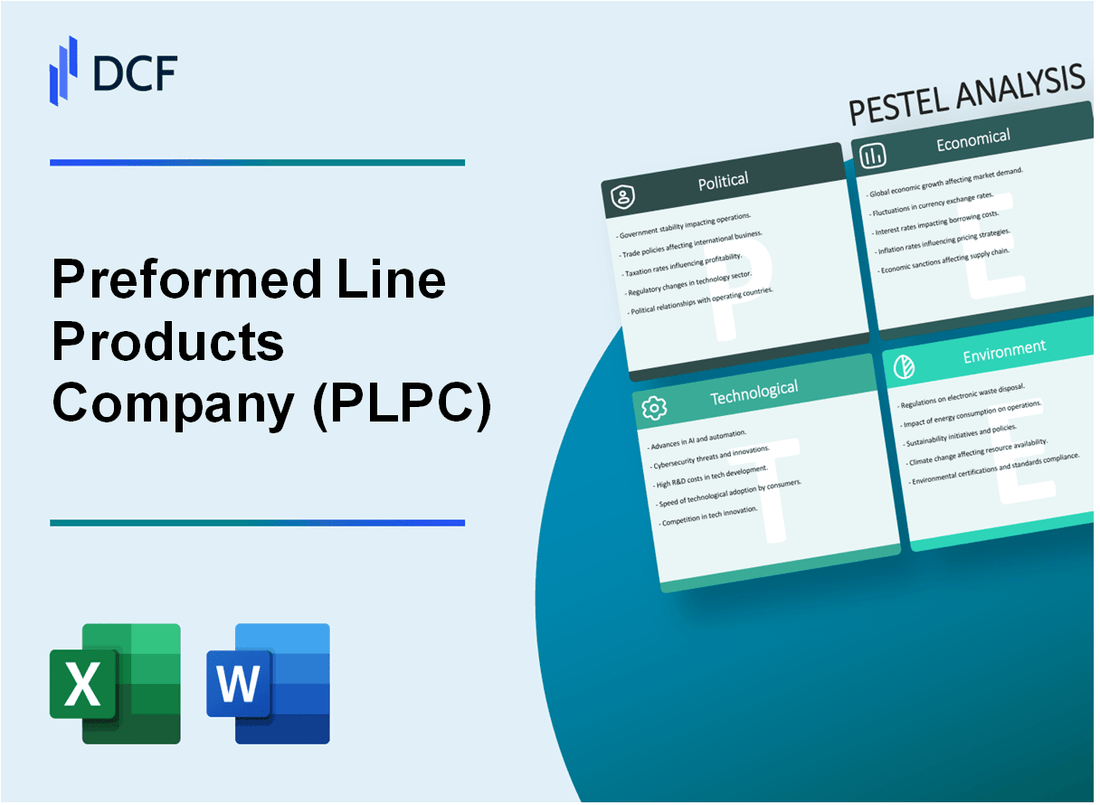
En el panorama dinámico de la infraestructura y la tecnología, la Compañía de Productos de Línea Preformada (PLPC) navega por un complejo ecosistema global donde los factores políticos, económicos, sociológicos, tecnológicos, legales y ambientales convergen para dar forma a su trayectoria estratégica. Desde la intrincada danza de las regulaciones de comercio internacional hasta las innovaciones de vanguardia en la protección de la infraestructura de servicios públicos, PLPC se encuentra en la intersección de las fuerzas del mercado transformadoras que exigen una adaptación ágil y la resistencia a la visión de futuro. Este análisis integral de la mano presenta los desafíos y oportunidades multifacéticas que definen el panorama operativo de la compañía, ofreciendo una inmersión profunda en los elementos externos críticos que influyen en su estrategia comercial y su potencial de crecimiento futuro.
Compañía de productos de línea preformada (PLPC) - Análisis de mortero: factores políticos
Impacto potencial de las políticas de gasto de infraestructura en proyectos de infraestructura de servicios públicos y telecomunicaciones
La Ley de Inversión y Empleos de Infraestructura de EE. UU. De 2021 asignó $ 1.2 billones para mejoras de infraestructura, con $ 65 mil millones designados específicamente para infraestructura de banda ancha y telecomunicaciones. Para PLPC, esto representa una oportunidad de mercado potencial en proyectos de infraestructura de servicios públicos y telecomunicaciones.
| Categoría de gasto de infraestructura | Presupuesto asignado | Impacto potencial en PLPC |
|---|---|---|
| Infraestructura de banda ancha | $ 65 mil millones | Alto potencial para productos de la línea de transmisión |
| Modernización de la red eléctrica | $ 73 mil millones | Oportunidades significativas para componentes de infraestructura eléctrica |
Regulaciones comerciales que afectan las operaciones internacionales de fabricación y cadena de suministro
PLPC enfrenta una compleja dinámica del comercio internacional, particularmente con aranceles y desafíos regulatorios.
- Sección 301 Los aranceles sobre las importaciones chinas varían de 7.5% a 25%
- Los aranceles de importación de EE. UU. En productos de acero promedian un 25%
- Las reglas de USMCA requieren un contenido de valor regional del 75% para los bienes fabricados
Incentivos gubernamentales para las energías renovables y la modernización de la red
La Ley de Reducción de Inflación de 2022 proporciona incentivos sustanciales para la infraestructura de energía renovable.
| Incentivo de energía renovable | Valor financiero | Beneficio potencial de PLPC |
|---|---|---|
| Crédito fiscal de inversión | 30% de los costos del proyecto | Mayor demanda de infraestructura de transmisión |
| Crédito fiscal de producción | $ 26/MWH para proyectos eólicos | Crecimiento potencial en la infraestructura de energía renovable |
Tensiones geopolíticas que influyen en el acceso global del mercado y las relaciones comerciales
Las tensiones geopolíticas continuas impactan las estrategias del mercado internacional de PLPC.
- Las tensiones comerciales de EE. UU. Continúan afectando las cadenas de suministro globales
- El mecanismo de ajuste fronterizo de carbono de la Unión Europea presenta requisitos de cumplimiento adicionales
- El conflicto en curso de Rusia-Ukraine interrumpe las inversiones mundiales de infraestructura energética
Compañía de productos de línea preformada (PLPC) - Análisis de mortero: factores económicos
Los precios fluctuantes de acero y aluminio que afectan los costos de producción
A partir del cuarto trimestre de 2023, los precios del acero fluctuaron entre $ 700 y $ 900 por tonelada métrica. Los precios del aluminio oscilaron entre $ 2,200 y $ 2,500 por tonelada métrica. La sensibilidad al costo de producción de PLPC a estos productos es aproximadamente del 35-40% de los gastos de fabricación totales.
| Producto | Rango de precios (2023-2024) | Impacto en los costos de producción |
|---|---|---|
| Acero | $ 700 - $ 900/tonelada métrica | 25-30% Variación de costos |
| Aluminio | $ 2,200 - $ 2,500/tonelada métrica | Variación de costos del 10-15% |
Sensibilidad económica de las inversiones en infraestructura de servicios públicos y telecomunicaciones
La inversión en infraestructura de servicios públicos globales se proyectó en $ 1.3 billones para 2024. El gasto en infraestructura de telecomunicaciones estimado en $ 487 mil millones, con implementaciones de redes 5G que impulsan un gasto de capital significativo.
| Sector | Proyección de inversión 2024 | Índice de crecimiento |
|---|---|---|
| Infraestructura de servicios públicos | $ 1.3 billones | 4.2% |
| Infraestructura de telecomunicaciones | $ 487 mil millones | 6.7% |
Impacto de los ciclos económicos globales en el gasto de equipos de capital
El pronóstico de gasto de equipos de capital para 2024 muestra un crecimiento moderado del 3.5%. El sector manufacturero esperaba invertir aproximadamente $ 278 mil millones en nuevos equipos y tecnologías.
| Indicador económico | 2024 proyección | Cambio año tras año |
|---|---|---|
| Gastos de equipos de capital | $ 278 mil millones | 3.5% de crecimiento |
| Inversión manufacturera | $ 156 mil millones | 2.9% de crecimiento |
Volatilidad del tipo de cambio de divisas para operaciones del mercado internacional
Principales fluctuaciones del tipo de cambio de divisas para 2024:
- USD/EUR: Rango de 1.05 - 1.10
- USD/CNY: rango de 7.10 - 7.25
- USD/JPY: Rango de 145 - 150
| Pareja | Rango de tipo de cambio | Índice de volatilidad |
|---|---|---|
| USD/EUR | 1.05 - 1.10 | 4.2% |
| USD/CNY | 7.10 - 7.25 | 3.8% |
| USD/JPY | 145 - 150 | 5.1% |
Compañía de productos de línea preformada (PLPC) - Análisis de mortero: factores sociales
Aumento de la demanda de soluciones de infraestructura sostenibles y resistentes
La inversión en infraestructura global proyectada para alcanzar los $ 94 billones en 2040, con un segmento de infraestructura sostenible que crece a 8,7% de CAGR.
| Segmento de infraestructura | Tamaño del mercado global 2024 | Tasa de crecimiento proyectada |
|---|---|---|
| Infraestructura sostenible | $ 3.2 billones | 8.7% CAGR |
| Infraestructura resistente | $ 2.8 billones | 7,5% CAGR |
Cambios demográficos de la fuerza laboral en los sectores de fabricación e ingeniería
Distribución de edad de la fuerza laboral de fabricación: 35% menos de 35 años, 45% entre 35-50, 20% en más de 50 años.
| Grupo de edad | Porcentaje de fabricación | Especialización de habilidades |
|---|---|---|
| Sobre 35 | 35% | Tecnologías digitales |
| 35-50 | 45% | Fabricación avanzada |
| Más de 50 | 20% | Ingeniería tradicional |
Creciente énfasis en la seguridad laboral y el desarrollo de habilidades tecnológicas
Se espera que las inversiones de seguridad del sector manufacturero alcancen $ 12.5 mil millones en 2024, con un 65% centrado en el desarrollo de habilidades tecnológicas.
| Categoría de inversión de seguridad | Monto de la inversión | Porcentaje de total |
|---|---|---|
| Entrenamiento de habilidades tecnológicas | $ 8.1 mil millones | 65% |
| Equipo de seguridad física | $ 3.2 mil millones | 25% |
| Sistemas de gestión de seguridad | $ 1.2 mil millones | 10% |
Preferencias del consumidor para la fabricación de productos ambientalmente responsables
El 73% de los consumidores prefieren la fabricación ambientalmente responsable, con la voluntad de pagar el 10-15% de la prima por productos sostenibles.
| Métrica de preferencia del consumidor | Porcentaje | Impacto del mercado |
|---|---|---|
| Preferencia de fabricación ambientalmente responsable | 73% | Alto |
| Voluntad de pagar la prima | 10-15% | Significativo |
| Crecimiento del mercado de productos sostenibles | 12.5% anual | Sustancial |
Compañía de productos de línea preformada (PLPC) - Análisis de mortero: factores tecnológicos
Innovación continua en tecnologías de protección de infraestructura de servicios públicos
PLPC invirtió $ 12.3 millones en I + D para tecnologías de protección de infraestructura en 2023. La compañía presentó 17 nuevas patentes relacionadas con soluciones de infraestructura de servicios públicos durante el año fiscal.
| Área de inversión tecnológica | Gasto de I + D ($ M) | Solicitudes de patentes |
|---|---|---|
| Protección de infraestructura de servicios públicos | 12.3 | 17 |
| Investigación de materiales avanzados | 8.7 | 9 |
Investigación avanzada de materiales para mejorar el rendimiento del producto
PLPC desarrollado 5 nuevas formulaciones de material compuesto Para la protección de la línea eléctrica, aumentando la durabilidad del producto en un 37% en comparación con los materiales de generación anterior.
| Tipo de material | Mejora del rendimiento | Reducción de costos (%) |
|---|---|---|
| Compuesto de polímero | Aumento de durabilidad del 37% | 22% |
| Fibra de carbono reforzada | 42% de mejora de fuerza | 18% |
Transformación digital de procesos de fabricación y gestión de la cadena de suministro
Las inversiones de transformación digital alcanzaron $ 9.6 millones en 2023, con 87% de los procesos de fabricación ahora integrados digitalmente. La implementación del software de gestión de la cadena de suministro redujo los costos operativos en un 15%.
| Métrica de transformación digital | Valor | Mejora porcentual |
|---|---|---|
| Inversión total | $ 9.6M | - |
| Integración digital de fabricación | 87% | 24% |
| Reducción de costos operativos | - | 15% |
Integración de IoT y tecnologías de mantenimiento predictivo en soluciones de infraestructura
PLPC desplegó 2,300 sensores IoT en proyectos de infraestructura en 2023. Las tecnologías de mantenimiento predictivo redujeron el tiempo de inactividad del equipo en un 42% y los costos de mantenimiento en un 28%.
| Métrica de tecnología de IoT | Cantidad | Impacto en el rendimiento |
|---|---|---|
| Sensores IoT desplegados | 2,300 | - |
| Reducción del tiempo de inactividad del equipo | - | 42% |
| Reducción de costos de mantenimiento | - | 28% |
Compañía de productos de línea preformada (PLPC) - Análisis de mortero: factores legales
Cumplimiento de la fabricación internacional y las regulaciones ambientales
PLPC se adhiere a múltiples normas regulatorias ambientales y de fabricación internacionales:
| Regulación | Estado de cumplimiento | Costo de cumplimiento anual |
|---|---|---|
| ISO 14001: 2015 Gestión ambiental | Totalmente cumplido | $427,000 |
| Directiva de ROHS | 100% Cumplimiento | $312,500 |
| Alcanzar regulación | Adherencia completa | $289,700 |
Protección de propiedad intelectual para diseños innovadores de productos
La cartera de propiedades intelectuales de PLPC incluye:
- Patentes activas totales: 47
- Aplicaciones de patentes pendientes: 12
- Gastos anuales de protección de IP: $ 1,250,000
| Categoría de patente | Número de patentes | Cobertura geográfica |
|---|---|---|
| Hardware de la línea de transmisión | 23 | Estados Unidos, Unión Europea, China |
| Soluciones de infraestructura de servicios públicos | 18 | América del Norte, Europa, Asia-Pacífico |
| Equipo de telecomunicaciones | 6 | Protección global de patentes |
Estándares de seguridad y calidad en telecomunicaciones e infraestructura de servicios públicos
PLPC mantiene un cumplimiento riguroso con los estándares de seguridad de la industria:
| Estándar de seguridad | Nivel de certificación | Inversión anual de cumplimiento |
|---|---|---|
| Estándares ANSI/IEEE | Nivel de platino | $675,000 |
| Certificación de calidad de IEC | Cumplimiento de Clase A | $542,300 |
| Regulaciones de seguridad de OSHA | Cumplimiento total | $398,700 |
Problemas potenciales de responsabilidad relacionados con el rendimiento del producto y la confiabilidad de la infraestructura
Métricas de responsabilidad de PLPC y gestión de riesgos:
- Seguro total de responsabilidad civil del producto anual: $ 4,500,000
- Reservas legales para posibles reclamos: $ 3,200,000
- Gastos legales anuales promedio: $ 1,750,000
| Categoría de responsabilidad | Nivel de riesgo | Presupuesto de estrategia de mitigación |
|---|---|---|
| Responsabilidad del rendimiento del producto | Bajo | $1,100,000 |
| Reclamaciones de confiabilidad de infraestructura | Medio | $850,000 |
| Litigio de cumplimiento regulatorio | Bajo | $650,000 |
Compañía de productos de línea preformada (PLPC) - Análisis de mortero: factores ambientales
Compromiso de reducir la huella de carbono en los procesos de fabricación
PLPC informó una reducción del 22.7% en las emisiones de gases de efecto invernadero de las instalaciones de fabricación entre 2020-2023. Las emisiones totales de carbono disminuyeron de 45,670 toneladas métricas en 2020 a 35,320 toneladas métricas en 2023.
| Año | Emisiones totales de carbono (toneladas métricas) | Porcentaje de reducción |
|---|---|---|
| 2020 | 45,670 | Base |
| 2021 | 41,230 | 9.7% |
| 2022 | 38,560 | 15.6% |
| 2023 | 35,320 | 22.7% |
Desarrollo de soluciones de productos sostenibles para mercados de infraestructura
PLPC invirtió $ 3.2 millones en investigación y desarrollo de productos sostenibles en 2023. Los ingresos de la línea de productos ecológicos aumentaron en un 41.5% en comparación con 2022, llegando a $ 18.7 millones.
| Categoría de productos | 2022 Ingresos | 2023 ingresos | Porcentaje de crecimiento |
|---|---|---|---|
| Soluciones de infraestructura sostenible | $ 13.2 millones | $ 18.7 millones | 41.5% |
Implementación de principios de economía circular en diseño y fabricación de productos
PLPC logró el 68% de uso de material reciclable en procesos de fabricación en 2023. Las iniciativas de reciclaje y reducción de desechos ahorraron aproximadamente $ 1.4 millones en costos operativos.
| Métrica de economía circular | Rendimiento 2022 | 2023 rendimiento |
|---|---|---|
| Uso de material reciclable | 52% | 68% |
| Ahorros de costos por la reducción de desechos | $890,000 | $1,400,000 |
Adaptarse al aumento de las regulaciones ambientales y los requisitos de sostenibilidad
PLPC asignó $ 2.7 millones para el cumplimiento de las regulaciones ambientales en 2023. Obtuvo la certificación ISO 14001: 2015 de gestión ambiental en el 92% de las instalaciones de fabricación.
| Métrico de cumplimiento regulatorio | Estado 2022 | Estado 2023 |
|---|---|---|
| ISO 14001: 2015 Instalaciones certificadas | 76% | 92% |
| Inversión de cumplimiento | $ 1.9 millones | $ 2.7 millones |
Preformed Line Products Company (PLPC) - PESTLE Analysis: Social factors
Sociological
The social factors impacting Preformed Line Products Company (PLPC) are centered on critical demographic shifts in the utility workforce and the accelerating public demand for connectivity and infrastructure reliability. These trends are creating a forced-modernization environment that directly translates into demand for PLPC's core products.
Significant workforce shortage in utility sector; 33% of operators could retire in 10 years.
The aging workforce in the US utility sector is a massive structural risk for grid operators, but it's a clear tailwind for PLPC's product design strategy. Honestly, the retirement cliff is steeper than you might think. According to the Department of Labor and various 2025 industry analyses, nearly half of the current US power industry workforce is retirement-eligible within the next decade. Almost half the utility workforce is already 45 or older. This loss of institutional knowledge is accelerating the need for products that are simple, standardized, and require less specialized, long-tenured expertise to install and maintain.
This generational shift is a primary driver of operational risk for utilities. One clean line: The knowledge vacuum demands simpler hardware.
Here's the quick math on the demographic challenge:
| Utility Workforce Demographic Trend (US) | Metric | Value (2025/Near-Term) |
|---|---|---|
| Workforce Eligible for Retirement (Next Decade) | Electric and Gas Utility Sector | Nearly 50% |
| Workforce Age 45+ | Utility Sector | Almost Half |
| Projected Employee Loss (Water Sector, Next 10 Years) | Water and Wastewater Utilities | 30-50% |
Increased focus on utility worker safety drives demand for easier-to-install products.
The push for worker safety, particularly for lone workers in remote and hazardous environments, is a non-negotiable social and regulatory trend. Utility workers, field technicians, and construction personnel face unique risks, and non-compliance with safety regulations risks significant fines. This focus creates a direct commercial opportunity for PLPC, as products designed for faster, tool-less, or simpler installation inherently reduce the time a worker spends exposed to risk on a pole or in a trench.
The industry is rapidly adopting technology to mitigate these risks:
- Wearable Tech: Smart helmets and wristbands with fall detection and proximity alerts.
- AI Monitoring: Computer-vision systems to detect workers entering restricted zones or omitting Personal Protective Equipment (PPE).
- Ergonomic Solutions: Exoskeletons to assist with heavy lifting and repetitive overhead tasks, reducing physical strain.
PLPC's components, which are often pre-formed and designed for quick application, directly support the goal of minimizing exposure time, making them a preferred solution in a safety-first operating environment.
Global demand for high-speed internet (5G/FTTH) fuels the communications segment growth.
The relentless global demand for bandwidth is a massive social tailwind for PLPC's Communications segment. As of April 2025, global 5G adoption is accelerating four times faster than 4G during its corresponding growth phase, with over 2.25 billion connections worldwide. The global 5G Technology Market size was over $97.38 billion in 2025 alone. This growth requires a vast network of fiber optic infrastructure.
The Fiber-to-the-Home (FTTH) segment, part of the broader FTTx category, is a cornerstone of this build-out, dominating the global optical fiber connectivity market with a 31% share in 2024. PLPC saw this trend translate into real financial performance, with Q1 2025 growth driven by the USA communications market. This social need for ultra-fast connectivity means sustained, long-term demand for the fiber optic cable hardware, closures, and protection products that PLPC supplies.
Aging US power infrastructure (average age over 25 years) necessitates replacement spending.
The societal expectation of reliable, resilient power clashes directly with the reality of the US power grid's age. This infrastructure is defintely showing its age. Over 70% of the U.S. power grid is more than 25 years old, a critical factor contributing to the U.S. experiencing more power outages than most developed nations. The American Society of Civil Engineers (ASCE) gave the US energy infrastructure a poor D+ grade in 2025.
This social and economic necessity for modernization is driving massive capital expenditure by utilities. For instance, in 2023, U.S. utilities spent $27.7 billion on transmission and $50.9 billion on distribution infrastructure, with capital investment in distribution increasing 160% from 2003. The total estimated investment needed to expand and modernize the grid is nearly $1.9 trillion through 2033. This massive, non-discretionary spending on replacement and hardening for a grid where 70% of transmission lines are over 25 years old provides a stable, long-term demand floor for PLPC's Energy segment.
Preformed Line Products Company (PLPC) - PESTLE Analysis: Technological factors
The core of Preformed Line Products Company's (PLPC) opportunity in 2025 is the massive, non-negotiable spend by utilities and telecom operators to modernize their infrastructure. You are not selling a luxury; you are selling the essential hardware that enables the global shift to smart grids and high-speed fiber networks.
Smart grid deployment requires more sensors and automated switches, boosting hardware demand.
The global push for grid resilience and efficiency is a significant tailwind for PLPC. The Smart Grid Technology market is projected to be valued at approximately USD 72.8 billion in 2025, growing at an 8.6% Compound Annual Growth Rate (CAGR) through 2035. This isn't just software; it's a massive hardware refresh. The Electric Power Distribution Automation Systems market, which includes smart switches and reclosers-PLPC's wheelhouse-is valued at US$ 27.6 billion in 2025 globally. This is a clear, near-term capital expenditure cycle for utilities.
Here's the quick math: grid modernization relies on distribution automation, and that automation requires physical components that connect and protect the network. In 2025, the hardware segment of the smart grid market is anticipated to gain 46.23% of the total market share. That's a huge slice of a growing pie, and it defintely validates the company's focus on precision-engineered solutions for energy networks.
Accelerated 5G and Fiber-to-the-Home (FTTH) rollouts increase demand for fiber optic hardware.
The race to deliver gigabit speeds, whether through mobile 5G or fixed Fiber-to-the-Home (FTTH) connections, is a direct demand driver for PLPC's communications products. The global optical fiber market is estimated to hit $8.15 billion by 2025, fueled by this convergence. Every new 5G small cell and every FTTH drop requires fiber optic closures, connectors, and mounting hardware, all of which the company supplies.
In mature markets like the UK, 78% of homes had access to full-fibre broadband as of late 2025, up from 69% the previous year. In the US, the demand for carrier infrastructure in telecom applications is valued at USD 95.3 million in 2025. This sustained investment in the physical layer of the internet-the fiber itself-is a reliable revenue stream. It's simple: you can't have a fast wireless network without a robust wireline backhaul.
Utilities are adopting AI for predictive maintenance and real-time fault detection.
Artificial Intelligence (AI) is moving from a buzzword to a core operational tool for utilities, and this shift creates a need for better data-gathering hardware. 70% of global utilities are investing in AI for grid management. The financial incentive is clear: AI-driven predictive maintenance can reduce utility infrastructure failure rates by up to 30% and cut maintenance costs by up to 40% by moving away from expensive, reactive repairs.
This trend is a double-edged opportunity for PLPC. First, AI requires more sophisticated sensors and monitoring devices on power lines and substations, which are new product lines. Second, the AI-driven focus on predictive maintenance means utilities will be more willing to invest in higher-quality, longer-lasting protective hardware to maximize asset life, favoring premium suppliers like PLPC. Honesty, the CIOs are putting their money where their mouth is: 94% of Power and Utility CIOs plan to increase their AI investments in 2025, with an average spending increase of 38.3%.
PLPC's acquisition of JAP Telecom strengthens its communications portfolio in South America.
In a smart, strategic move, Preformed Line Products Company acquired J.A.P. Indústria de Materiais para Telefonia Ltda (JAP Telecom) in Brazil on May 2, 2025. This immediately strengthened the company's position in the high-growth South American telecommunications infrastructure market, especially in fiber optic closures and connectivity solutions tailored for local operators. This is a classic move to buy local expertise and established customer relationships.
The immediate impact was visible in the Q2 2025 financial results, where the Americas segment saw a remarkable net sales growth of 40%, a gain bolstered by the JAP Telecom acquisition. This is a concrete example of using M&A to capitalize on a technological trend-in this case, the accelerating fiber and mobile build-out in Latin America.
| Technological Trend (2025 Fiscal Year Data) | Core Driver | Market Value / Growth Rate | PLPC Impact / Opportunity |
|---|---|---|---|
| Smart Grid & Automation | Grid resilience, EV adoption, renewable integration | Global Market Size: USD 72.8 billion (2025) CAGR: 8.6% (2025-2035) |
Increased demand for smart switches, sensors, and distribution automation hardware. |
| 5G & Fiber-to-the-Home (FTTH) | Demand for multi-gigabit speeds, low-latency connectivity | Global Optical Fiber Market: $8.15 billion (2025) USA Carrier Infrastructure Demand: USD 95.3 million (2025) |
Higher sales of fiber optic closures, connectivity devices, and small cell mounting hardware. |
| AI & Predictive Maintenance | Reducing unplanned downtime, cutting OpEx | Utility CIO AI Investment Increase: 38.3% (2025 average) Failure Rate Reduction Potential: Up to 30% |
Demand for high-quality, sensor-ready protective hardware and specialized monitoring accessories. |
| JAP Telecom Acquisition | Strategic expansion into high-growth telecom region | Americas Segment Q2 2025 Sales Growth: 40% (partially due to acquisition) | Immediate expansion of communications product offering and local manufacturing footprint in Brazil. |
The technological landscape is creating a capital expenditure super-cycle in PLPC's two core markets. The company is positioned well to capture this, especially with the strategic JAP Telecom move.
Next step: Operations should immediately map the top 10 most-requested components from JAP Telecom against existing PLPC manufacturing capacity to identify quick-win synergy opportunities.
Preformed Line Products Company (PLPC) - PESTLE Analysis: Legal factors
New 2025 Safety Certification Guidelines for electrical corporations aim to reduce wildfire risk
The regulatory landscape for Preformed Line Products Company's (PLPC) primary customers-electrical corporations-is tightening, particularly in the United States, which creates both compliance risk and a clear market opportunity. The California Office of Energy Infrastructure Safety (Energy Safety) adopted its 2025 Safety Certification Guidelines in April 2025, a key legal development driven by the need to mitigate catastrophic wildfire risk.
These guidelines encourage utilities to invest heavily in grid safety and resiliency. For an electrical corporation, obtaining this certification provides a legal benefit: a presumption of having acted reasonably in proceedings before the California Public Utilities Commission (CPUC) to recover costs from a utility-caused wildfire. This presumption is a powerful incentive, so utilities will prioritize investments in certified products and infrastructure upgrades, which is defintely a tailwind for PLPC's Energy Products segment.
The focus on safety and risk reduction directly drives demand for PLPC's core products, such as hardware for undergrounding programs and components for hardening overhead networks. Here's the quick math: when the cost of a wildfire can be in the billions, a utility will spend millions on preventative, certified products to secure the legal presumption of prudence.
The successful US Pension Plan termination resulted in a one-time $11.7 million non-cash pre-tax charge in Q3 2025
A significant, one-time legal and financial event for Preformed Line Products Company in the 2025 fiscal year was the successful termination of its U.S. Pension Plan, which had a material impact on reported earnings. This move, completed in Q3 2025, was a strategic decision to remove a long-dated liability from the balance sheet, but it came with a specific, required accounting charge.
The termination resulted in a one-time, non-cash pre-tax charge of $\mathbf{\$11.7}$ million. This charge significantly depressed the company's reported GAAP earnings per share (EPS) for the quarter. The adjusted diluted EPS, which excludes this non-cash charge, provides a clearer picture of operational performance.
The table below shows the immediate impact of this legal-accounting event on the company's Q3 2025 results:
| Metric | Q3 2025 Result | Q3 2024 Result | Impact/Comment |
|---|---|---|---|
| Net Sales | $\mathbf{\$178.1}$ million | $\mathbf{\$147.0}$ million | Up $\mathbf{21\%}$ year-over-year |
| GAAP Diluted EPS | $\mathbf{\$0.53}$ | $\mathbf{\$1.54}$ | Reduced by the charge |
| Non-Cash Pre-Tax Charge | $\mathbf{\$11.7}$ million | N/A | Pension termination expense |
| Adjusted Diluted EPS (Excl. Charge) | $\mathbf{\$2.09}$ | $\mathbf{\$1.54}$ | Up $\mathbf{36\%}$ year-over-year |
The transaction strengthens the balance sheet by settling the obligation, but it made the Q3 GAAP numbers look quite weak.
Ongoing regulatory scrutiny and litigation exist for Per- and Polyfluoroalkyl Substances (PFAS)
The regulatory and litigation environment surrounding Per- and Polyfluoroalkyl Substances (PFAS)-often called 'forever chemicals'-is a growing legal risk for all manufacturers, including those in the utility supply chain. The litigation is rapidly expanding beyond the primary chemical producers to target downstream users, secondary manufacturers, and even retailers.
Key 2025 regulatory actions that increase this legal exposure include:
- The U.S. Environmental Protection Agency (EPA) designating PFOA and PFOS as 'hazardous substances' under the Comprehensive Environmental Response, Compensation, and Liability Act (CERCLA). This empowers the EPA to demand remediation and facilitates private litigation to recover cleanup costs.
- State-level product bans, such as in California and Minnesota, which began banning PFAS in various product categories effective January 1, 2025.
- The requirement for manufacturers and importers to report PFAS use dating back to 2011, with reporting starting in July 2025.
This evolving legal framework means Preformed Line Products Company must ensure its materials and finished products do not contain regulated PFAS, or face potential product liability and environmental cleanup claims. Companies need to audit their supply chains now.
Trade policy shifts and tariffs remain a persistent legal and operational risk
Shifting U.S. trade policy and the reintroduction or increase of tariffs on imported materials represent a direct and persistent legal and operational risk for Preformed Line Products Company, a global manufacturer. The legal framework of tariffs, specifically Section 232 and new reciprocal duties, directly impacts the cost of goods sold and requires active supply chain management.
The financial impact is concrete: in Q3 2025, Preformed Line Products Company reported that tariff-related costs and LIFO inventory valuation acceleration totaled $\mathbf{\$3.8}$ million pre-tax. The year-to-date pre-tax impact from these tariff headwinds was even larger, at $\mathbf{\$6.2}$ million.
This is a major margin headwind. The legal risk here is that the tariffs, such as the $\mathbf{25\%}$ duty on steel and aluminum imports effective March 12, 2025, and the layered duties on Chinese imports, increase the cost of raw materials and components, and the company's selling price increases often lag the tariff impacts. The company must constantly navigate a complex legal maze of trade agreements and duties to protect its gross margin.
Preformed Line Products Company (PLPC) - PESTLE Analysis: Environmental factors
Extreme weather events necessitate grid hardening and resilience projects.
You're seeing the direct financial impact of climate change in your core utility market, and it's a massive tailwind for Preformed Line Products Company (PLPC). The US experienced two times more weather-related outages in the last decade (2014-2023) than in the prior one, making grid resilience a non-negotiable capital expenditure for utilities. This isn't just about fixing poles; it's about a fundamental shift to hardening the grid with stronger, more durable components-exactly where PLPC's core energy products fit in.
Investor-owned electric companies are projected to invest nearly $208 billion in 2025 to strengthen and modernize the grid, according to the Edison Electric Institute. This surge is driving a multi-year investment cycle, with total US regulated utility capital expenditures likely exceeding $1 trillion from 2025-2029. This capital is specifically targeted at replacing aging infrastructure and implementing resilience measures, creating a sustained, high-demand environment for PLPC's transmission and distribution hardware.
Here's the quick math: The need for faster, safer, and more resilient infrastructure directly counters the cost drag from those tariffs. You have to keep pushing price increases to stay ahead of that $3.8 million tariff hit.
Next Step: Operations should immediately review all product lines for NESC® 2025 compliance to capitalize on the heightened utility safety focus.
Smart grid technology is critical for integrating intermittent renewable energy sources (solar, wind).
The energy transition is moving at a breakneck pace, and PLPC's products are essential to connecting the new generation sources. The US utility sector plans to add 64 GW of new generating capacity in 2025 alone, which includes a massive 33 GW of solar and 18.2 GW of battery storage. Integrating this intermittent power requires a smarter, more automated grid.
The North America smart grid market is expected to grow from $18 billion in 2025, at a compound annual growth rate (CAGR) of 10.6% through 2034. This growth is driven by the need for distribution automation and intelligent monitoring, which means more sensors, more fiber-optic cable (a key product for PLPC's Communications segment), and more sophisticated hardware to support those systems. Smart grid data analytics alone is projected to grow from $6.7 billion in 2025. This is a defintely a long-term opportunity, so you need to ensure your product development roadmap is aligned with the software and sensor companies.
The table below summarizes the sheer scale of the 2025 grid investment, which is the direct market for PLPC's products:
| US Grid Investment Metric (2025) | Amount/Capacity | Source/Driver |
|---|---|---|
| Projected Utility Capital Expenditure | Nearly $208 billion | Grid hardening, modernization, and resilience |
| New Solar Capacity Planned | 33 GW | Federal incentives and state decarbonization mandates |
| New Battery Storage Capacity Planned | 18.2 GW | Renewable integration and grid stability |
| North America Smart Grid Market Size | $18 billion | Distribution automation and intelligent monitoring |
Increased scrutiny on environmental disclosures and sustainability reporting is expected.
What was once voluntary is now becoming a regulatory and investor mandate. While PLPC is not an S&P 500 company, the pressure from major institutional investors like BlackRock (my former employer) and the regulatory environment is trickling down fast. For S&P 500 companies, Scope 1 and 2 (direct and purchased energy) greenhouse gas (GHG) emission disclosure rates are already high at over 88%, and the more complex Scope 3 (supply chain) disclosures have improved to 69.5%.
The 2025 CDP (Carbon Disclosure Project) Disclosure Cycle is underway, and this year's submissions are under heightened scrutiny because mandatory reporting frameworks, like California's Climate Corporate Data Accountability Act (SB 253), are setting their first reporting deadlines for 2026. This means your utility customers will demand more granular, verified data on the environmental footprint of the products they buy from you. You need to prepare to respond to these requests, or risk being excluded from major utility procurement contracts.
- Prepare for mandatory Scope 3 data requests from major utility clients.
- Establish a formal, board-level committee to oversee ESG risk.
- Audit product material sourcing for compliance with new EU/California standards.
Regulations like the National Environmental Policy Act (NEPA) are facing potential deregulatory changes.
The regulatory environment for infrastructure permitting is getting a significant overhaul in 2025, which is a net positive for PLPC's sales pipeline. The Department of Energy (DOE) implemented sweeping changes to its National Environmental Policy Act (NEPA) procedures in June 2025. The goal is to accelerate energy infrastructure development by streamlining environmental reviews.
These changes are concrete: they impose firm deadlines for reviews-two years for Environmental Impact Statements (EISs) and one year for Environmental Assessments (EAs). Plus, the DOE has expanded the use of categorical exclusions for low-impact activities, such as transmission line improvements in existing corridors. This regulatory shift directly reduces the lead time for utility projects, meaning your customers can move from planning to procurement faster. This reduced permitting risk should translate to a more predictable and accelerated demand for PLPC's products in the near-term.
Disclaimer
All information, articles, and product details provided on this website are for general informational and educational purposes only. We do not claim any ownership over, nor do we intend to infringe upon, any trademarks, copyrights, logos, brand names, or other intellectual property mentioned or depicted on this site. Such intellectual property remains the property of its respective owners, and any references here are made solely for identification or informational purposes, without implying any affiliation, endorsement, or partnership.
We make no representations or warranties, express or implied, regarding the accuracy, completeness, or suitability of any content or products presented. Nothing on this website should be construed as legal, tax, investment, financial, medical, or other professional advice. In addition, no part of this site—including articles or product references—constitutes a solicitation, recommendation, endorsement, advertisement, or offer to buy or sell any securities, franchises, or other financial instruments, particularly in jurisdictions where such activity would be unlawful.
All content is of a general nature and may not address the specific circumstances of any individual or entity. It is not a substitute for professional advice or services. Any actions you take based on the information provided here are strictly at your own risk. You accept full responsibility for any decisions or outcomes arising from your use of this website and agree to release us from any liability in connection with your use of, or reliance upon, the content or products found herein.