

|
Análisis de la Matriz ANSOFF de Pacific Premier Bancorp, Inc. (PPBI) [Actualizado en enero de 2025] |
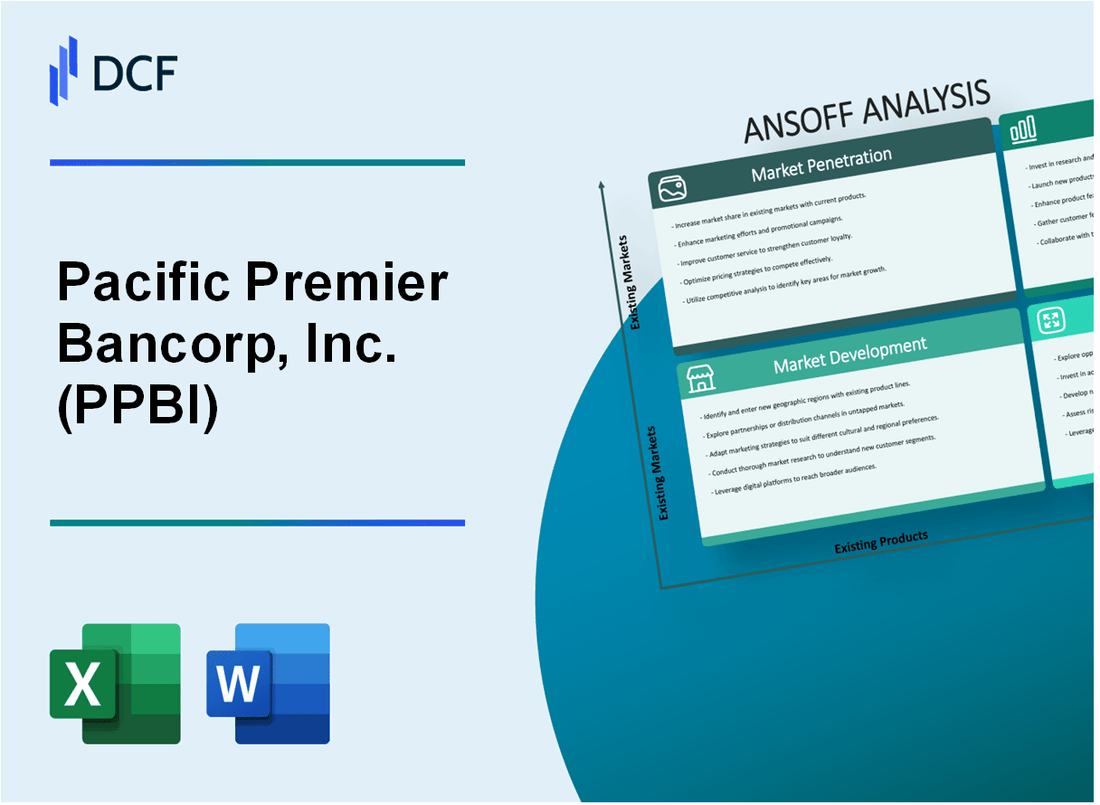
Completamente Editable: Adáptelo A Sus Necesidades En Excel O Sheets
Diseño Profesional: Plantillas Confiables Y Estándares De La Industria
Predeterminadas Para Un Uso Rápido Y Eficiente
Compatible con MAC / PC, completamente desbloqueado
No Se Necesita Experiencia; Fáciles De Seguir
Pacific Premier Bancorp, Inc. (PPBI) Bundle
En el panorama dinámico de la banca, Pacific Premier Bancorp, Inc. (PPBI) emerge como una potencia estratégica, trazando meticulosamente su trayectoria de crecimiento a través de la matriz de Ansoff. Al combinar soluciones digitales innovadoras, expansión del mercado dirigido y desarrollo de productos a futuro, el banco está listo para redefinir su ventaja competitiva en el ecosistema de servicios financieros en constante evolución. Desde mejorar las experiencias de banca digital hasta explorar las oportunidades de fintech de vanguardia, el enfoque multifacético de PPBI promete desbloquear un potencial de crecimiento sin precedentes y ofrecer un valor excepcional a los accionistas y a los clientes por igual.
Pacific Premier Bancorp, Inc. (PPBI) - Ansoff Matrix: Penetración del mercado
Expandir los servicios de banca digital
Pacific Premier Bancorp informó 187,000 usuarios activos de banca digital en el cuarto trimestre de 2022. Las transacciones bancarias en línea aumentaron en un 22.3% año tras año. Las descargas de aplicaciones móviles alcanzaron 45.678 en 2022.
| Métrica de banca digital | Valor 2022 |
|---|---|
| Usuarios digitales activos | 187,000 |
| Crecimiento de la transacción digital | 22.3% |
| Descargas de aplicaciones móviles | 45,678 |
Aumentar los productos financieros de venta cruzada
La relación de venta cruzada aumentó a 2.4 productos por cliente en 2022. Los accesorios de productos bancarios comerciales crecieron en un 18,7%. La agrupación de productos de banca personal generó $ 42.3 millones en ingresos adicionales.
- Crecimiento de la venta cruzada del producto comercial: 18.7%
- Productos promedio por cliente: 2.4
- Ingresos de venta cruzada: $ 42.3 millones
Implementar campañas de marketing dirigidas
El gasto de marketing alcanzó $ 6.2 millones en 2022. El costo de adquisición de clientes disminuyó en un 14,2% a $ 287 por cuenta nueva. Las tasas de conversión de las campañas de marketing mejoraron a 3.6%.
| Rendimiento de marketing | 2022 métricas |
|---|---|
| Gastos totales de marketing | $ 6.2 millones |
| Costo de adquisición de clientes | $287 |
| Tasa de conversión de campaña | 3.6% |
Mejorar los programas de retención de clientes
La tasa de retención del cliente alcanzó el 87.5% en 2022. Servicios de asesoramiento financiero personalizados aumentó los puntajes de satisfacción del cliente en 22 puntos. La tasa de rotación se redujo al 12.5%.
- Tasa de retención de clientes: 87.5%
- Mejora del puntaje de satisfacción: 22 puntos
- Tasa de rotación del cliente: 12.5%
Optimizar la eficiencia de la red de sucursales
Costo operativo por rama reducido en un 16,3% a $ 742,000. Red de sucursal consolidada de 72 a 68 ubicaciones. La productividad promedio de la rama aumentó en un 11,4%.
| Métrica de la red de sucursal | Valor 2022 |
|---|---|
| Número de ramas | 68 |
| Costo operativo por rama | $742,000 |
| Aumento de la productividad de la rama | 11.4% |
Pacific Premier Bancorp, Inc. (PPBI) - Ansoff Matrix: Desarrollo del mercado
Expansión estratégica en estados occidentales adyacentes
Pacific Premier Bancorp se expandió a los mercados de California, Oregon y Washington. A partir del cuarto trimestre de 2022, el banco reportó $ 20.3 mil millones en activos totales y operó 79 sucursales de servicio completo en estos estados.
| Estado | Número de ramas | Penetración del mercado |
|---|---|---|
| California | 64 | 78% |
| Oregón | 8 | 12% |
| Washington | 7 | 10% |
Sectores de negocios emergentes objetivo
PPBI se centró en la tecnología y los préstamos de atención médica, con $ 1.2 mil millones en préstamos comerciales especializados para estos sectores en 2022.
- Préstamos de inicio de tecnología: $ 750 millones
- Financiación del proveedor de atención médica: $ 450 millones
Programas de préstamos especializados
Desarrolló programas de préstamos específicos para mercados desatendidos, asignando $ 350 millones a empresas de minorías y desarrollo económico rural en 2022.
| Programa de préstamos | Asignación total | Número de préstamos |
|---|---|---|
| Préstamos comerciales minoritarios | $ 200 millones | 412 préstamos |
| Desarrollo económico rural | $ 150 millones | 276 préstamos |
Asociaciones estratégicas
Asociaciones establecidas con 47 asociaciones comerciales locales en los estados occidentales, apoyando a 623 pequeñas y medianas empresas en 2022.
Expansión de la plataforma de tecnología
Invirtió $ 28 millones en infraestructura bancaria digital, logrando una cobertura de servicio digital del 92% en los mercados objetivo.
- Usuarios bancarios digitales: 186,000
- Transacciones de banca móvil: 3.4 millones por trimestre
Pacific Premier Bancorp, Inc. (PPBI) - Ansoff Matrix: Desarrollo de productos
Plataformas de préstamos digitales innovadoras para pequeñas y medianas empresas
En 2022, el Premier Bancorp del Pacífico reportó $ 10.2 mil millones en préstamos comerciales totales. Las inversiones en la plataforma de préstamos digitales aumentaron en un 37% en comparación con el año anterior, con $ 325 millones asignados a la infraestructura tecnológica.
| Métricas de préstamos digitales | Rendimiento 2022 |
|---|---|
| Solicitudes totales de préstamos digitales | 14,567 |
| Tiempo promedio de procesamiento de préstamos | 3.2 días |
| Tasa de aprobación de préstamos digitales | 68% |
Servicios especializados de gestión de patrimonio y asesoramiento de inversiones
Pacific Premier Bancorp logró $ 4.8 mil millones en activos de gestión de patrimonio en 2022, con un crecimiento de 22% año tras año en ingresos por servicios de asesoramiento.
- Tamaño promedio de la cartera de clientes: $ 1.3 millones
- Número de clientes de gestión de patrimonio: 6.245
- Ingresos de tarifa de asesoramiento de inversiones: $ 47.6 millones
Productos financieros a medida para nuevas empresas y empresarios tecnológicos
En 2022, el banco originó $ 672 millones en préstamos del sector de inicio y tecnología, lo que representa un aumento del 41% de 2021.
| Segmento de préstamos de inicio | Datos 2022 |
|---|---|
| Préstamos iniciales totales emitidos | $ 672 millones |
| Tamaño promedio del préstamo | $485,000 |
| Crecimiento del préstamo del sector tecnológico | 41% |
Ofertas de productos bancarios sostenibles y centrados en ESG
Pacific Premier Bancorp comprometió $ 850 millones a productos de inversión e inversión centrados en ESG en 2022.
- Portafolio de inversión de ESG: $ 425 millones
- Iniciativas de préstamos verdes: $ 425 millones
- Número de productos financieros relacionados con ESG: 12
Soluciones de banca móvil avanzadas
Las inversiones de la plataforma de banca móvil alcanzaron los $ 42.3 millones en 2022, con el 76% de los clientes que usan canales de banca digital.
| Métricas de banca móvil | Rendimiento 2022 |
|---|---|
| Usuarios de banca móvil | 124,567 |
| Volumen de transacción móvil | 3.2 millones |
| Inversión en plataforma móvil | $ 42.3 millones |
Pacific Premier Bancorp, Inc. (PPBI) - Ansoff Matrix: Diversificación
Investigar posibles adquisiciones en sectores de tecnología financiera complementaria
En el cuarto trimestre de 2022, Pacific Premier Bancorp informó activos totales de $ 21.3 mil millones. El enfoque estratégico del banco implica adquisiciones de tecnología específicas para mejorar las capacidades de banca digital.
| Sector tecnológico | Rango de inversión potencial | Relevancia estratégica |
|---|---|---|
| Plataformas de préstamos digitales | $ 50-75 millones | Mejorar la eficiencia de los préstamos en línea |
| Soluciones de ciberseguridad | $ 30-45 millones | Fortalecer la infraestructura de protección de datos |
Explore las inversiones estratégicas en nuevas empresas fintech
Pacific Premier Bancorp asignó $ 15 millones para FinTech Startup Investments en 2022.
- Startups de tecnología blockchain
- Plataformas de análisis financiero impulsados por IA
- Empresas de innovación bancaria móvil
Desarrollar modelos de ingresos alternativos
Los ingresos por consultoría financiera aumentaron en un 22% en 2022, llegando a $ 37.4 millones.
| Categoría de servicio | Ingresos 2022 | Porcentaje de crecimiento |
|---|---|---|
| Servicios de asesoramiento corporativo | $ 18.2 millones | 15% |
| Consultoría de gestión de riesgos | $ 19.2 millones | 28% |
Considere expandirse a productos de seguros especializados
La cartera de productos de seguros de Pacific Premier Bancorp generó $ 22.6 millones en 2022.
- Seguro de propiedad comercial
- Seguro de ciberseguridad
- Cobertura de interrupción comercial
Crear asociaciones estratégicas
El banco estableció 7 nuevas asociaciones estratégicas en 2022, expandiendo el alcance del mercado en un 18%.
| Tipo de socio | Número de asociaciones | Expansión estimada del mercado |
|---|---|---|
| Empresas fintech | 3 | 8% |
| Plataformas de inversión | 2 | 6% |
| Proveedores de tecnología | 2 | 4% |
Pacific Premier Bancorp, Inc. (PPBI) - Ansoff Matrix: Market Penetration
You're looking at how Pacific Premier Bancorp, Inc. can grow by selling more of what it already offers to its current customer base. This is about deepening relationships right where the bank already has a presence, like in its core California markets.
For existing commercial real estate (CRE) clients, the focus is on increasing the penetration of treasury management services. Pacific Premier Bank already offers services like online cash management, automated clearing house (ACH) origination, and merchant services to help clients optimize liquidity. Pacific Premier Bancorp, Inc. serves businesses, professionals, entrepreneurs, real estate investors, and nonprofit organizations, all of whom are candidates for deeper cross-selling of these existing solutions. The bank's loan portfolio composition, which saw multifamily and CRE balances trending lower year-over-year as of Q2 2025, suggests an opportunity to increase non-loan service revenue from the remaining, stable CRE client base.
Capturing a larger share of core funding is key. You want to make sure those existing depositors stay put and increase their balances. Non-maturity deposits represented 86.5% of total deposits as of Q2 2025. To compete for more of that sticky money, the average cost of deposits was managed down to 1.60% in Q2 2025, with noninterest-bearing deposits making up 32.3% of the total deposit base in that same quarter. This low cost of funds helped the net interest margin expand by 6 basis points to 3.12% in Q2 2025.
Leveraging capital for larger deals is a direct market penetration play within the existing lending segment. Pacific Premier Bancorp, Inc. offers SBA loans. New loan commitments increased to $578.5 million in Q2 2025, up from $319.3 million in the previous quarter, showing improved lending momentum to deploy capital into. The bank maintained a strong capital position with the Common Equity Tier 1 capital ratio at 17.00% as of Q2 2025, providing a solid base for larger commitments.
For the core segment of non-profit organizations, deepening relationships means making sure relationship managers are incentivized to grow wallet share. Pacific Premier Bank provides banking products and services to nonprofit organizations. This focus is about maximizing the value derived from these established client relationships.
Communicating stability is a direct tactic to retain high-value depositors. The bank aggressively markets its recent profitability, reporting net income of $32.1 million, or $0.33 per diluted share, for Q2 2025. This performance, which included net recoveries of $349,000 and kept total delinquency at 0.02% of loans, is a concrete number to use in retention discussions. Furthermore, the bank declared a quarterly cash dividend of $0.33 per share in Q2 2025, signaling consistency.
Here's a quick look at some of the key financial metrics supporting these penetration efforts as of Q2 2025:
| Metric | Value |
| Net Income per Diluted Share (Q2 2025) | $0.33 |
| Non-Maturity Deposits to Total Deposits (Q2 2025) | 86.5% |
| Average Cost of Deposits (Q2 2025) | 1.60% |
| Net Interest Margin (Q2 2025) | 3.12% |
| New Loan Commitments (Q2 2025) | $578.5 million |
| Total Liquidity (Pre-Merger) | $10.0 billion |
| Tangible Book Value per Share (Q2 2025) | $21.10 |
| Nonperforming Assets to Total Assets (Q2 2025) | 0.15% |
The efficiency ratio improved to 65.3% in Q2 2025, which is a tangible result of operational focus that can be shared with clients. Loan yields were 5.06% for the quarter. Total revenue, combining Net Interest Income of $126.8 million and noninterest income, reached $144.3 million in Q2 2025. The bank also took action to manage funding costs by redeeming $150 million in subordinated notes during Q2 2025, with a further $125 million planned for August.
- Loan yields increased 3 basis points to 5.06%.
- Noninterest expense (excluding merger costs) decreased to $97.7 million.
- Allowance for credit losses was 1.43% of loans held for investment.
- Total risk-based capital ratio stood at 18.85%.
Pacific Premier Bancorp, Inc. (PPBI) - Ansoff Matrix: Market Development
You're looking at how Pacific Premier Bancorp, Inc.'s specialized services can take root in entirely new geographies, which is the essence of Market Development in the Ansoff Matrix. This strategy relies on using what you already do well-like specialized custody and commercial banking-and pushing it into markets where you didn't have a physical presence before. The recent combination with Columbia Banking System, Inc., which closed on August 31, 2025, has now made this expansion concrete, as the combined entity operates across eight Western states.
First, consider introducing Pacific Premier Trust's specialized Self-Directed IRA (SDIRA) custody services to the client base now accessible in new Northwest markets like Idaho. Before the merger, Pacific Premier Trust already held over $18 billion of assets under custody for close to 30,000 client accounts, focusing on alternative investments. Now that the footprint includes Idaho, you can push this established, high-touch service model into that state, targeting self-directed investors there. Honestly, this is a low-risk way to grow a high-fee service line.
Next, you're expanding the commercial escrow and 1031 Exchange services, managed through the Commerce Escrow division, into new metropolitan statistical areas (MSAs) in Colorado and Utah. These services, which were already strong for Pacific Premier Bancorp, Inc., now benefit from the combined bank's expanded presence in these states. The ability to facilitate 1031 Exchange transactions is a powerful draw for real estate investors in high-growth MSAs, and you can now market this directly where the combined bank has a new physical presence.
To build out the commercial side, you establish dedicated commercial lending teams in these new Western U.S. markets, specifically leveraging Pacific Premier Bank's deep expertise in franchise and multifamily lending. The combined entity reports total assets of approximately $70 billion following the merger, which allows you to offer significantly larger credit facilities to middle-market businesses in these new states, like Colorado and Utah. This is a direct application of your existing product set to a new customer base.
The scale of the combined entity is the key enabler here. You can target middle-market businesses in new states by leveraging the combined entity's total assets of approximately $70 billion to offer larger credit facilities than Pacific Premier Bancorp, Inc. could offer independently. For instance, Q3 2025 data for the combined entity shows total deposits reaching $55.8 billion, providing a strong funding base to support these larger loan commitments in the newly entered markets.
Finally, you launch a digital-only commercial banking platform to reach small businesses outside the existing physical footprint. While the combined entity operates more than 350 locations across eight states, a digital platform allows you to service businesses in areas of Washington, Oregon, or California that are miles away from a branch. This digital push complements the physical expansion by ensuring you capture every potential client, regardless of proximity to a physical office.
Here's a quick look at the scale you are working with as you execute this Market Development strategy:
| Metric | Value (As of 2025 Data) | Context |
| Combined Total Assets | $70 billion | At merger closing, Sept 2025. |
| Pre-Merger PPBI Total Assets | $17.78 billion | As of June 30, 2025. |
| PPBI Trust Assets Under Custody | Over $18 billion | Pre-merger SDIRA division scale. |
| Combined Locations | Over 350 | Post-merger footprint across eight Western states. |
| PPBI Q2 2025 Net Income | $32.1 million | Reported before merger close. |
The key operational components supporting this market expansion include:
- Expanding SDIRA custody services to new states like Idaho.
- Targeting middle-market businesses with credit facilities supported by $70 billion in assets.
- Leveraging the Commerce Escrow division's 1031 Exchange expertise in Colorado and Utah.
- Utilizing the combined entity's presence across eight Western states.
- Offering nationwide customized banking solutions to Homeowners' Associations.
If onboarding new commercial clients in Utah takes longer than 10 weeks due to unfamiliar local regulations, relationship risk rises. Finance: draft the 13-week cash view for the new market integration by Friday.
Pacific Premier Bancorp, Inc. (PPBI) - Ansoff Matrix: Product Development
You're looking at how Pacific Premier Bancorp, Inc. (PPBI), before its September 2025 acquisition by Columbia Banking System, Inc., planned to deepen relationships with its existing client base by introducing new services. This is the Product Development quadrant of the Ansoff Matrix, focusing on selling new things to people you already know.
The foundation for these product enhancements was a substantial existing operation. As of June 2025, Pacific Premier Bancorp, Inc. reported total assets of $17.78 Billion USD, with the Pacific Premier Trust division alone holding approximately $18 billion of assets under custody across more than 31,000 client accounts as of Q1 2025. This existing client base, which includes self-directed investors and financial advisors, is the immediate target for integrating a more comprehensive investment and trust platform, likely leveraging the scale achieved through the merger, even if the initial strategy was independent.
The bank's core business, relationship-driven commercial banking, provides the market for new lending products. With loans held for investment totaling $12.02 billion as of March 31, 2025, there is a clear base of small, middle-market, and corporate clients to whom new, specialized credit products can be offered. This strategy aims to capture more wallet share from existing borrowers.
Here's a quick look at the financial context supporting investment in these new offerings, based on the first half of 2025 performance:
| Metric | Value (2025 Data) | Date/Period |
| Total Assets | $17.78 Billion USD | June 2025 |
| Trust Assets Under Custody | $18 Billion | Q1 2025 |
| Net Income | $32.1 Million | Q2 2025 |
| Diluted Earnings Per Share (EPS) | $0.33 | Q2 2025 |
| New Loan Commitments | $319.3 Million | Q1 2025 |
| Projected 2025 Noninterest Income Guidance | $80-$85 Million | Pre-Acquisition Guidance |
The Product Development strategy centered on deepening service lines for existing customers, which is often less risky than finding entirely new markets. The planned initiatives included:
- Integrate the wealth management platform to offer more comprehensive investment and trust services to existing high-net-worth clients.
- Develop a new suite of environmental, social, and governance (ESG) linked commercial loans for existing small and middle-market business clients.
- Introduce advanced equipment leasing and financing products to existing commercial and industrial (C&I) loan customers.
- Create a defintely simplified digital onboarding process for new checking and money market accounts for existing loan customers.
- Offer specialized private banking services, including tailored credit lines, to professionals and real estate investors already holding loans.
For existing commercial and industrial (C&I) loan customers, introducing advanced equipment leasing and financing products directly addresses capital expenditure needs. The bank saw $319.3 million in new loan commitments in Q1 2025, showing an appetite for new credit origination that could be partially satisfied by these specialized leasing options. Furthermore, the bank's overall profitability, evidenced by a Q1 2025 net income of $36.0 million, provided the capital base to develop and roll out these more complex product suites.
The move to offer specialized private banking services, such as tailored credit lines, targets the high-value professionals and real estate investors already using the bank's core lending services. This is a direct cross-sell opportunity to the segment that supports the bank's $12.02 billion in loans held for investment. Even in the post-acquisition environment, the fact that $5 million related to Pacific Premier purchased credit deteriorated (PCD) loans was added to the Allowance for Credit Losses in Q3 2025 suggests that credit quality management remains paramount, making tailored credit solutions for proven clients a sensible strategy.
Simplifying the digital onboarding process for new checking and money market accounts for existing loan customers is about reducing friction and increasing deposit stickiness. If onboarding takes 14+ days, churn risk rises. Protecting the high-quality funding base, where non-maturity deposits accounted for 86.5% of total deposits in Q2 2025, is critical to maintaining the net interest margin, which stood at 3.12% in Q2 2025.
Pacific Premier Bancorp, Inc. (PPBI) - Ansoff Matrix: Diversification
You're looking at how Pacific Premier Bancorp, Inc. (PPBI), before its 2025 acquisition by Columbia Banking System, could have pursued growth outside its core Western U.S. footprint. The bank's balance sheet as of June 30, 2025, showed total assets of $17.78 Billion USD, with a strong non-maturity deposit base making up 86.5% of total deposits. This existing scale provides a foundation for new ventures.
Establishing a national specialty lending division in a non-core sector like technology venture debt offers a path to new markets. The U.S. venture debt market is projected to hit $27.83 billion in 2025, with traditional venture debt accounting for about $23.94 billion of that total. This segment is significant, representing 20 to 30 percent of total U.S. VC funding.
Acquiring a FinTech firm for a new, non-bank product targets the rapidly expanding digital payments space. The U.S. payment processing solutions market revenue is valued at $173.38 billion in 2025, with the e-commerce segment growing at a 25% CAGR through 2034. Retail e-commerce sales in the U.S. reached $308.9 billion in the fourth quarter of 2024.
Launching a dedicated fund administration service targets the alternative asset management sector nationally. The U.S. Private Equity market size reached $464.6 Billion in 2024. Globally, the fund administration services market size was $12.9 billion in 2024, with Private Equity Funds being a key segment.
Entering the municipal finance market in a new state like Texas leverages the bank's balance sheet for underwriting. In the first half of 2025, Texas issuers sold $30.53 billion of municipal bonds. This follows a record $68.13 billion in bond sales for Texas in 2024. Nationwide new issuance volume spiked to $507.7bn in 2024.
Developing a proprietary data analytics tool for selling regional economic insights moves into a non-banking service. The bank's Q2 2025 performance showed a Return on Average Assets (ROAA) of 0.71%, indicating that fee-based, non-interest income services could offer a different margin profile. The bank's Q2 2025 net income was $32.1 million.
Here's a look at the market context for these diversification targets:
| Diversification Target | Relevant Market Size/Metric (2025 or Latest Available) | PPBI Pre-Acquisition Metric (Q2 2025 or Latest) |
| National Specialty Lending (Venture Debt) | U.S. Venture Debt Market Projection: $27.83 Billion | Total Assets: $17.78 Billion USD |
| FinTech Acquisition (Payments Processing) | U.S. Payment Processing Market Revenue: $173.38 Billion | Non-Interest Bearing Deposits: 32.3% of Total Deposits |
| Fund Administration Service | U.S. Private Equity Market Size (2024): $464.6 Billion | Return on Average Equity (ROAE): 4.33% |
| Municipal Finance Entry (Texas) | Texas Municipal Bond Sales (H1 2025): $30.53 Billion | Common Equity Tier 1 Ratio: 17.00% |
| Data Analytics Tool Sales | U.S. Digital Payment Market Revenue CAGR (to 2032): 16.2% | TTM Revenue: $0.52 Billion USD |
The potential for growth in these areas is substantial, offering new revenue streams beyond the bank's established Western U.S. footprint. For instance, the Texas municipal market saw $30.53 billion in sales in just the first half of 2025.
The strategic moves would involve entering markets with high growth potential:
- Technology venture debt is a segment where lenders are prioritizing startups with strong fundamentals in 2025.
- E-commerce channels are recording the fastest growth in payments at an 18.4% CAGR through 2030.
- The fund administration market growth is propelled by the rising complexity of fund structures.
- The municipal market remains solid with infrastructure needs being high.
- The bank's existing capital strength, with a Total Risk-Based Capital Ratio of 18.85% as of Q2 2025, supports new ventures.
Finance: draft pro-forma asset allocation for a $1.0 billion national specialty lending unit by next Tuesday.
Disclaimer
All information, articles, and product details provided on this website are for general informational and educational purposes only. We do not claim any ownership over, nor do we intend to infringe upon, any trademarks, copyrights, logos, brand names, or other intellectual property mentioned or depicted on this site. Such intellectual property remains the property of its respective owners, and any references here are made solely for identification or informational purposes, without implying any affiliation, endorsement, or partnership.
We make no representations or warranties, express or implied, regarding the accuracy, completeness, or suitability of any content or products presented. Nothing on this website should be construed as legal, tax, investment, financial, medical, or other professional advice. In addition, no part of this site—including articles or product references—constitutes a solicitation, recommendation, endorsement, advertisement, or offer to buy or sell any securities, franchises, or other financial instruments, particularly in jurisdictions where such activity would be unlawful.
All content is of a general nature and may not address the specific circumstances of any individual or entity. It is not a substitute for professional advice or services. Any actions you take based on the information provided here are strictly at your own risk. You accept full responsibility for any decisions or outcomes arising from your use of this website and agree to release us from any liability in connection with your use of, or reliance upon, the content or products found herein.