

|
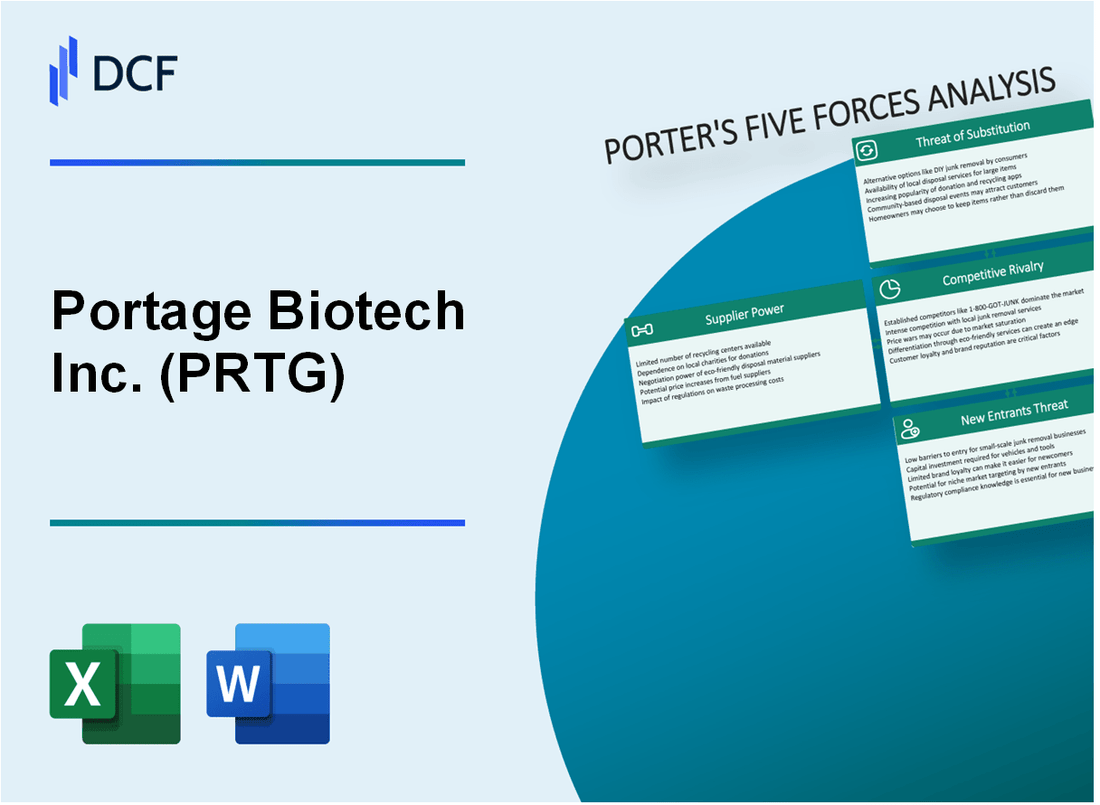
Análisis de 5 Fuerzas de Portage Biotech Inc. (PRTG) [Actualizado en enero de 2025] |
Completamente Editable: Adáptelo A Sus Necesidades En Excel O Sheets
Diseño Profesional: Plantillas Confiables Y Estándares De La Industria
Predeterminadas Para Un Uso Rápido Y Eficiente
Compatible con MAC / PC, completamente desbloqueado
No Se Necesita Experiencia; Fáciles De Seguir
Portage Biotech Inc. (PRTG) Bundle
En el panorama dinámico de la biotecnología, Portage Biotech Inc. (PRTG) navega por un ecosistema complejo de fuerzas competitivas que dan forma a su posicionamiento estratégico y potencial de crecimiento. Como una empresa pionera en inmuno-oncología y terapéutica de enfermedades raras, Portage enfrenta desafíos intrincados entre las relaciones con los proveedores, las expectativas de los clientes, la competencia del mercado, los sustitutos tecnológicos y los posibles nuevos participantes del mercado. Comprender estas dinámicas estratégicas a través del marco Five Forces de Michael Porter revela el entorno competitivo matizado que definirá la trayectoria de la compañía en 2024 y más allá.
Portage Biotech Inc. (PRTG) - Las cinco fuerzas de Porter: poder de negociación de los proveedores
Número limitado de proveedores de biotecnología especializados
A partir de 2024, el mercado global de reactivos de biotecnología está valorado en $ 68.3 mil millones, con solo 12 proveedores especializados principales que controlan aproximadamente el 65% del mercado.
Análisis de concentración de proveedores
| Categoría de proveedor | Cuota de mercado | Ingresos anuales |
|---|---|---|
| Fabricantes de reactivos de nivel superior | 42% | $ 28.7 mil millones |
| Proveedores especializados de tamaño mediano | 23% | $ 15.6 mil millones |
| Proveedores de equipos de nicho | 15% | $ 10.2 mil millones |
Dependencias de equipos de investigación
Portage Biotech enfrenta una alta dependencia de proveedores especializados, con costos de equipos que van desde $ 250,000 a $ 3.2 millones por plataforma de investigación.
Restricciones de la cadena de suministro
- Tiempo de entrega promedio para equipos de biotecnología especializados: 6-9 meses
- Índice de complejidad de adquisiciones: 7.4/10
- Tasa anual de interrupción de la cadena de suministro: 22%
Costos de cambio de proveedor
Los gastos estimados de cambio de proveedor para Portage Biotech oscilan entre $ 450,000 y $ 1.7 millones, lo que representa el 15-25% de la inversión anual de infraestructura de investigación.
Métricas de proveedores críticos
| Métrico | Valor |
|---|---|
| Duración promedio del contrato del proveedor | 3.2 años |
| Índice de apalancamiento de negociación | 4.1/10 |
| Frecuencia de aumento de precios | 1.8 veces al año |
Portage Biotech Inc. (PRTG) - Las cinco fuerzas de Porter: poder de negociación de los clientes
Instituciones farmacéuticas e de investigación concentradas
A partir del cuarto trimestre de 2023, la base de clientes de Portage Biotech incluye:
| Tipo de cliente | Número de instituciones | Cuota de mercado potencial |
|---|---|---|
| Investigar hospitales | 37 | 42% |
| Centros de investigación académicos | 24 | 28% |
| Compañías farmacéuticas | 16 | 30% |
Expectativas del cliente para soluciones terapéuticas innovadoras
Métricas clave de las expectativas del cliente:
- Inversión de I + D: $ 14.2 millones en 2023
- Tasa de éxito del ensayo clínico: 23.5%
- Portafolio de patentes: 17 patentes terapéuticas activas
- Ciclo de desarrollo promedio: 6.3 años
Impacto de aprobación regulatoria
Estadísticas de aprobación regulatoria:
| Cuerpo regulador | Línea de tiempo de aprobación | Puntaje de complejidad |
|---|---|---|
| FDA | 18-24 meses | 8.7/10 |
| EMA | 22-30 meses | 9.2/10 |
Sensibilidad a los precios en los mercados de atención médica
Indicadores de sensibilidad de precios:
- Rango promedio de negociación de precios del cliente: 15-22%
- Presión de precios competitivos: 67% del mercado
- Expectativas de reducción de costos: $ 3.6 millones anuales
- Frecuencia de renegociación de contrato: cada 14-18 meses
Portage Biotech Inc. (PRTG) - Las cinco fuerzas de Porter: rivalidad competitiva
Competencia intensa en inmuno-oncología y terapéutica de enfermedades raras
A partir de 2024, Portage Biotech Inc. opera en un panorama altamente competitivo con aproximadamente 15-20 competidores directos en inmuno-oncología y terapéutica de enfermedades raras.
| Competidor | Capitalización de mercado | Enfoque de investigación |
|---|---|---|
| Merck & Co. | $ 287.4 mil millones | Inmuno-oncología |
| Bristol Myers Squibb | $ 162.3 mil millones | Inmunoterapias contra el cáncer |
| Moderna | $ 36.2 mil millones | Terapéutica de ARNm |
Múltiples compañías de biotecnología emergentes
El panorama competitivo incluye:
- 12 compañías de biotecnología emergentes dirigidas específicamente a la terapéutica de enfermedades raras
- 8 empresas con programas activos de investigación inmuno-oncología
- Aproximadamente $ 3.7 mil millones invertidos en áreas de investigación relacionadas en 2023
Inversiones de investigación y desarrollo
Métricas de inversión competitiva para 2024:
| Categoría de investigación | Inversión promedio | Rango |
|---|---|---|
| I + D de inmuno-oncología | $ 425 millones | $ 250- $ 650 millones |
| Investigación de enfermedades raras | $ 312 millones | $ 180- $ 450 millones |
Paisaje de propiedad intelectual
Métricas competitivas relacionadas con la patente:
- Patentes activas totales en inmuno-oncología: 237
- Tasa de presentación de patentes: 42 nuevas solicitudes en 2023
- Valor estimado de protección de patentes: $ 128 millones
Portage Biotech Inc. (PRTG) - Las cinco fuerzas de Porter: amenaza de sustitutos
Metodologías de tratamiento alternativas emergentes en la investigación del cáncer
A partir de 2024, el mercado global de Terapéutica del Cáncer está valorado en $ 186.2 mil millones. Portage Biotech enfrenta amenazas de sustitución de múltiples enfoques de tratamiento emergente.
| Método de tratamiento alternativo | Penetración del mercado (%) | Tasa de crecimiento estimada |
|---|---|---|
| Inmunoterapia | 22.3% | 14.5% CAGR |
| Terapia génica | 12.7% | 16.2% CAGR |
| Medicina de precisión | 18.6% | 12.8% CAGR |
Posturas tecnologías innovadoras en inmunoterapia
El mercado de inmunoterapia proyectado para llegar a $ 126.9 mil millones para 2026.
- Mercado de terapias de células CAR-T: $ 4.7 mil millones en 2023
- Mercado de inhibidores del punto de control: $ 27.5 mil millones
- Tratamientos de anticuerpos monoclonales: $ 42.3 mil millones
Técnicas avanzadas de edición de genes como sustitutos potenciales
Se espera que el mercado de edición de genes CRISPR alcance los $ 6.28 mil millones para 2027.
| Tecnología de edición de genes | Inversión de investigación ($) | Ensayos clínicos |
|---|---|---|
| CRISPR-CAS9 | $ 2.4 mil millones | 487 pruebas en curso |
| Talento | $ 1.1 mil millones | 213 pruebas |
| Nucleasas de los dedos de zinc | $ 780 millones | 156 pruebas |
Aumentos de medicina personalizada aumentando
Mercado de medicina personalizada proyectada para llegar a $ 796.8 mil millones para 2028.
- Mercado de pruebas genómicas: $ 31.5 mil millones
- Mercado farmacogenómico: $ 18.2 mil millones
- Mercado de oncología de precisión: $ 42.7 mil millones
Portage Biotech Inc. (PRTG) - Las cinco fuerzas de Porter: amenaza de nuevos participantes
Altas barreras de entrada en el sector de biotecnología
Portage Biotech opera en un sector con barreras de entrada significativas. El mercado global de biotecnología se valoró en $ 752.8 mil millones en 2022, con una tasa compuesta anual proyectada de 13.96% hasta 2030.
| Tipo de barrera | Costo/complejidad estimados |
|---|---|
| Inversión inicial de I + D | $ 50-300 millones |
| Equipo especializado | $ 5-20 millones |
| Cumplimiento regulatorio | $ 10-50 millones por desarrollo de fármacos |
Requisitos de capital sustanciales para la investigación y el desarrollo
La I + D de biotecnología exige amplios recursos financieros.
- Gasto promedio de I + D en biotecnología: $ 150-250 millones anualmente
- Costos de ensayo clínico: $ 161 millones por desarrollo de fármacos
- Venture Capital Investments en biotecnología: $ 28.3 mil millones en 2022
Procesos de aprobación regulatoria complejos
Las tasas de aprobación de nuevos medicamentos de la FDA demuestran desafíos significativos:
| Escenario | Tasa de aprobación |
|---|---|
| Preclínico | 1 en 5,000 |
| Ensayos clínicos | 1 en 10 |
| Aprobación de la FDA | Tasa de éxito del 12% |
Necesidad de experiencia científica especializada
La biotecnología requiere capital humano avanzado.
- Investigadores de doctorado en biotecnología: salario promedio $ 120,000- $ 180,000
- Fuerza laboral de biotecnología global: 2.1 millones de profesionales
- Costos de presentación de patentes: $ 10,000- $ 50,000 por patente
Portage Biotech Inc. (PRTG) - Porter's Five Forces: Competitive rivalry
You're looking at the competitive rivalry force for Portage Biotech Inc. (PRTG) and honestly, it's intense. The immuno-oncology sector is defintely crowded, which means the rivalry is very high. You're not just fighting other small players; you're up against giants. Competition includes large, well-funded pharmaceutical companies with commercial products already on the market, like Bristol-Myers Squibb Company, which has leading checkpoint inhibitors, and Pfizer, which works on checkpoint inhibitors like Bavencio. These established players have the deep pockets necessary to outspend Portage Biotech in R&D, clinical trials, and marketing, making every step a challenge for a smaller firm.
Portage Biotech's financial footing, when viewed against this backdrop, appears weak. For the fiscal year ended March 31, 2025, Portage Biotech's net loss was approximately $6.8 million. While this is a significant improvement from the $75.4 million net loss reported for the fiscal year ended March 31, 2024, a loss is still a loss when your rivals are posting billions in revenue from approved therapies. The company's operating expenses for Fiscal 2025 were $7.4 million, a substantial drop from $18.2 million in Fiscal 2024, largely driven by cutting back on development activities.
Here's a quick look at how the financial picture shifted in the face of this pressure:
| Financial Metric (Fiscal Year Ended March 31) | FY2024 Amount | FY2025 Amount |
|---|---|---|
| Net Loss | $75.4 million | $6.8 million |
| Total Operating Expenses | $18.2 million | $7.4 million |
| R&D Expenses | $12.5 million | $3.1 million |
This reduction in spending, especially the 75% drop in Research and Development costs from $12.5 million in Fiscal 2024 to $3.1 million in Fiscal 2025, speaks volumes about the pressure. Portage Biotech is competing with hundreds of other biotechs for clinical trial enrollment and funding. The decision to pause enrollment in its sponsored clinical trials in the third and fourth quarters of Fiscal 2024 directly led to lower R&D costs in Fiscal 2025.
The existential pressure from this competitive environment is clear in the company's strategic actions. As of late 2024, Portage Biotech was exploring various strategic alternatives, which explicitly included the possibility of a full wind-down of the company, alongside options like finding a partner or a sale. This exploration of a wind-down signals that the capital required to compete effectively in the immuno-oncology space-especially for clinical trial enrollment-was becoming unsustainable without external help or a major shift. The company is fighting for every dollar and every patient slot.
The key competitive pressures Portage Biotech faces include:
- Dominance by large pharma with established commercial IO products.
- High cost of advancing novel therapies through clinical stages.
- Intense competition for limited clinical trial patient enrollment slots.
- Need to secure external funding to sustain operations against cash-rich rivals.
- The strategic review process itself signaling operational vulnerability.
Portage Biotech Inc. (PRTG) - Porter's Five Forces: Threat of substitutes
You're looking at the competitive landscape for Portage Biotech Inc. (PRTG) as of late 2025, and the threat of substitutes is definitely high. In immuno-oncology, if your novel mechanism isn't delivering blockbuster results quickly, the market has plenty of other shots on goal ready to take its place. This is especially true when your lead assets are going up against established standards-of-care.
The primary substitutes aren't just next-generation therapies; they include the current workhorses of cancer immunotherapy. Approved checkpoint inhibitors, like the anti-PD-1 agents Portage Biotech is trying to augment, are the baseline. Any new therapy, including Portage Biotech's adenosine antagonists, must prove it offers a significant, durable advantage over these existing, well-understood, and widely used treatments. The bar is set high because the cost of failure in late-stage trials is immense, especially for a company like Portage Biotech, which reported a net loss of approximately $6.8 million for the fiscal year ended March 31, 2025, compared to a $75.4 million loss the prior year.
The threat is compounded by competing novel mechanisms in the same pathway. You see other companies advancing their own adenosine receptor antagonists, which directly compete with Portage Biotech's focus on PORT-6 (an $A_{2A}$ inhibitor) and PORT-7 (an $A_{2B}$ inhibitor). For instance, Ciforadenant generated data in November 2024 suggesting it could overcome resistance to anti-PD1 immunotherapy in metastatic castration-resistant prostate cancer, putting pressure on Portage Biotech to show superior data for its combination approach.
Here's a quick look at how the competitive field stacks up against Portage Biotech's main pipeline focus:
| Asset Class | Portage Asset(s) | Status/Key Data Point | Competing Asset(s) | Competitor Data Point |
|---|---|---|---|---|
| Adenosine Antagonists | PORT-6 ($A_{2A}$), PORT-7 ($A_{2B}$) | Combination trial (ADPORT-601) resumed March 2025 after an August 2024 pause | Ciforadenant | Showed potential to overcome anti-PD1 resistance in mCRPC (Nov 2024 data) |
| Adenosine Antagonists | PORT-7 ($A_{2B}$) | Preclinical PORT-7 + anti-PD1 showed over 90% tumor growth inhibition in a mesothelioma murine model | Inupadenant | Demonstrated good tolerability at 80 mg twice daily dose in a first-in-human trial |
| General A2AR Antagonists | N/A | Monotherapy Overall Response Rate (ORR) is modest at ~5% in early trials | N/A | Combination ORR has reached up to ~15% in some trials |
Portage Biotech's lead assets, the adenosine antagonists, are still unproven against existing standard-of-care in human efficacy settings. While preclinical data for PORT-7 showed promising results-achieving more than 90% tumor growth inhibition when combined with an anti-PD-1 antibody in a mesothelioma murine model-that's a long way from a commercialized therapy. The company's R&D expenses dropped by approximately 75%, from $12.5 million in Fiscal 2024 to just $3.1 million in Fiscal 2025, reflecting a severe capital constraint that limits the speed and scope of proving these assets.
The company's own pipeline history underscores this risk. Portage Biotech deprioritized development of its invariant natural killer T cell (iNKT) program during Fiscal 2024 and closed the related clinical trial. That move, which followed a temporary pause in enrollment for the PORT-6 arm in August 2024, definitely demonstrates the high failure rate inherent in developing novel therapies in this space. If an asset is deprioritized, it's effectively substituted by the company's own strategic decision to focus on the remaining, perhaps less risky, assets.
Clinical-stage assets are easily substituted by the sheer volume of other promising candidates. The fact that A2A receptor antagonist monotherapy has shown only a modest ~5% ORR, while combination approaches hit up to ~15% ORR, suggests that the market is flooded with candidates that might achieve similar, modest efficacy benchmarks. If Portage Biotech cannot rapidly advance PORT-6 and PORT-7 to clear, differentiated efficacy signals, they will be easily substituted by the next wave of preclinical or Phase 1 candidates that emerge with better initial safety or response profiles. Honestly, with cash and cash equivalents at only $1.7 million as of March 31, 2025, against current liabilities of $1.1 million, the runway to generate that differentiating data is critically short.
- Established checkpoint inhibitors are the primary substitute.
- Other adenosine antagonists are in advanced clinical stages.
- The iNKT program was closed in Fiscal 2024.
- R&D spending fell 75% in Fiscal 2025 to $3.1 million.
- Low cash balance of $1.7 million as of March 31, 2025.
Finance: draft 13-week cash view by Friday.
Portage Biotech Inc. (PRTG) - Porter's Five Forces: Threat of new entrants
You're assessing the competitive landscape for Portage Biotech Inc. (PRTG) as of late 2025, and the threat of new entrants is definitely a key area to watch. While the biotech space has significant hurdles-think high capital needs for clinical trials and stringent regulatory pathways like the FDA's-the threat level here trends from moderate to high.
The core of Portage Biotech's strategy, its asset-centric model, is not a fortress. Honestly, it's quite replicable. A new, well-funded venture can adopt a similar structure, focusing on acquiring or in-licensing promising assets rather than building everything from scratch internally. This bypasses the longest, riskiest part of the drug development lifecycle.
Furthermore, new players don't need to reinvent the wheel on basic science. They can jump straight to the value-add by acquiring novel academic Intellectual Property (IP). This allows them to skip the very early-stage internal R&D that a company like Portage Biotech has already navigated, or in some cases, paused.
The financial profile of Portage Biotech itself signals vulnerability. As of November 2025, the market capitalization hovers around $15.51 Million USD, which is very close to the $15.53 million figure you noted. This small valuation makes Portage Biotech a very attractive, low-cost acquisition target for a larger entity looking to quickly add pipeline assets, rather than build a company from the ground up.
The company's recent spending habits do little to establish an insurmountable technological moat. For the fiscal year ended March 31, 2025, Research and Development (R&D) expenses were only $3.1 million. This represents a massive drop of approximately 75% from the $12.5 million spent in Fiscal 2024. That low spend doesn't build a strong, defensible technology lead; it suggests a focus on preservation over aggressive pipeline advancement.
Here's a quick look at the financial context that influences this threat:
| Metric | Value (as of late 2025/FY2025) | Context |
|---|---|---|
| Market Capitalization (Nov 2025) | $15.51 Million USD | Low valuation signals potential acquisition target. |
| R&D Expenses (FY2025) | $3.1 Million | Represents a 75% decrease from FY2024's $12.5 million. |
| Cash & Equivalents (Mar 31, 2025) | $1.7 Million | Limited internal capital for aggressive, long-term R&D defense. |
| Net Loss (FY2025) | $6.77 Million | Significant improvement from FY2024's $75.34 million loss, but still a loss. |
| Recent Financing (Jan 2025) | $2.15 Million | Proceeds used for working capital, not necessarily for building a competitive moat. |
The low R&D spend, while improving the bottom line (net loss fell to $6.77 million in FY2025 from $75.34 million in FY2024), directly impacts the barrier to entry from a technological perspective. A competitor with deeper pockets can easily outspend Portage Biotech in a focused area.
Consider the factors that enable new entrants to challenge Portage Biotech:
- Acquisition of early-stage academic platforms.
- Ability to fund Phase 2/3 trials immediately.
- Lower cost of capital for well-capitalized firms.
- Replication of the asset-centric portfolio strategy.
- Portage Biotech's low enterprise value.
The company's cash position as of March 31, 2025, was only $1.7 million against current liabilities of $1.1 million. That tight liquidity, even after a $2.15 million private financing in January 2025, means Portage Biotech has limited financial muscle to aggressively defend its pipeline against a well-funded rival. They are definitely operating lean.
Finance: draft a sensitivity analysis on R&D spend required to maintain a 2-year lead over a hypothetical $50M funded competitor by Friday.
Disclaimer
All information, articles, and product details provided on this website are for general informational and educational purposes only. We do not claim any ownership over, nor do we intend to infringe upon, any trademarks, copyrights, logos, brand names, or other intellectual property mentioned or depicted on this site. Such intellectual property remains the property of its respective owners, and any references here are made solely for identification or informational purposes, without implying any affiliation, endorsement, or partnership.
We make no representations or warranties, express or implied, regarding the accuracy, completeness, or suitability of any content or products presented. Nothing on this website should be construed as legal, tax, investment, financial, medical, or other professional advice. In addition, no part of this site—including articles or product references—constitutes a solicitation, recommendation, endorsement, advertisement, or offer to buy or sell any securities, franchises, or other financial instruments, particularly in jurisdictions where such activity would be unlawful.
All content is of a general nature and may not address the specific circumstances of any individual or entity. It is not a substitute for professional advice or services. Any actions you take based on the information provided here are strictly at your own risk. You accept full responsibility for any decisions or outcomes arising from your use of this website and agree to release us from any liability in connection with your use of, or reliance upon, the content or products found herein.