
|
Rocky Mountain Chocolate Factory, Inc. (RMCF): Análisis PESTLE [Actualizado en Ene-2025] |
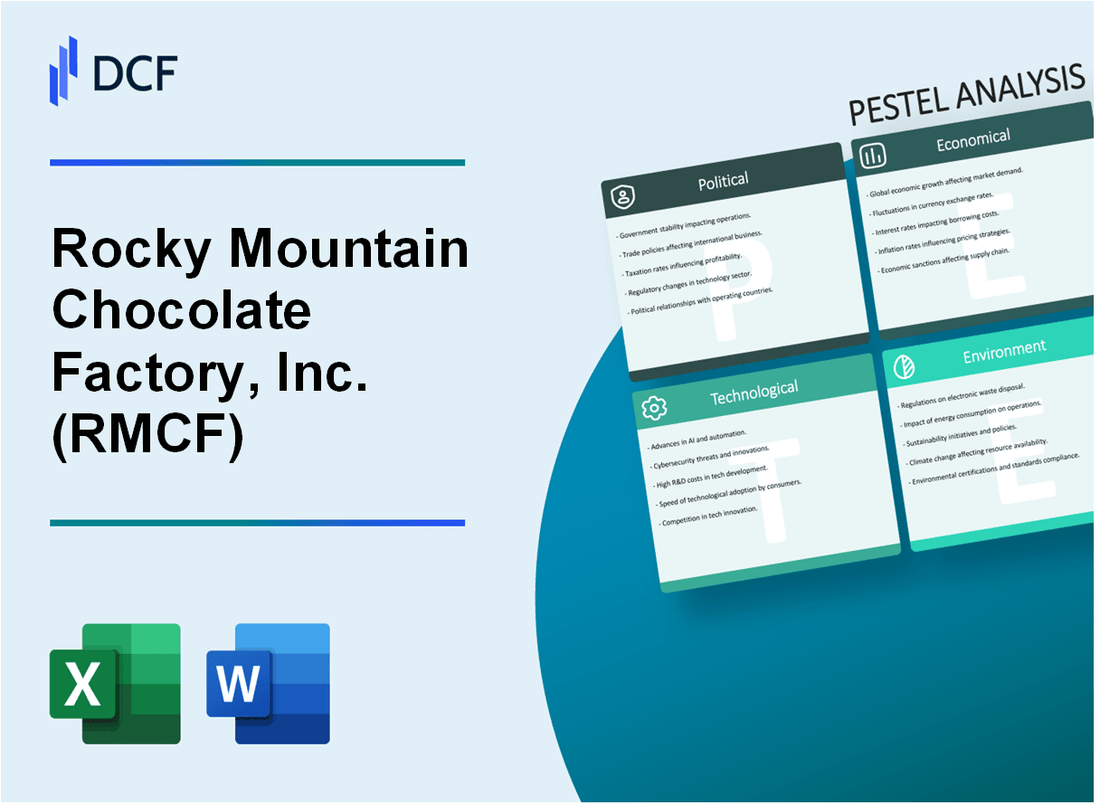
Completamente Editable: Adáptelo A Sus Necesidades En Excel O Sheets
Diseño Profesional: Plantillas Confiables Y Estándares De La Industria
Predeterminadas Para Un Uso Rápido Y Eficiente
Compatible con MAC / PC, completamente desbloqueado
No Se Necesita Experiencia; Fáciles De Seguir
Rocky Mountain Chocolate Factory, Inc. (RMCF) Bundle
Sumérgete en el intrincado mundo de Rocky Mountain Chocolate Factory, Inc., donde Sweet Success cumple con los complejos desafíos comerciales. Este análisis integral de la mano presenta el panorama multifacético que da forma a este querido fabricante de chocolate, explorando cómo las regulaciones políticas, las fluctuaciones económicas, las tendencias sociales, las innovaciones tecnológicas, los marcos legales y las consideraciones ambientales se entrelazan para definir el camino estratégico de la compañía. Desde el delicado equilibrio del abastecimiento global de cacao hasta las preferencias matizadas del consumidor que impulsan los mercados de chocolate premium, nuestro análisis ofrece una visión tentadora de los ingredientes estratégicos que hacen que RMCF sea un jugador resistente en la industria de confitería competitiva.
Rocky Mountain Chocolate Factory, Inc. (RMCF) - Análisis de mortero: factores políticos
Impacto potencial de las políticas comerciales que afectan las importaciones/exportaciones de chocolate y confitería
A partir de 2024, las tarifas de tarifas de importación de chocolate de EE. UU. Van del 0% al 42%, dependiendo de la categoría de producto específica. Para Rocky Mountain Chocolate Factory, estos aranceles afectan directamente los costos de abastecimiento y producción de ingredientes.
| Elemento de política comercial | Impacto actual | Tarifa |
|---|---|---|
| Importaciones de frijol de cacao | Influencia del costo directo | 0-15% |
| Importaciones de ingredientes de chocolate | Complejidad de la cadena de suministro | 10-35% |
| Importaciones de productos de chocolate terminado | Presión de precios competitivos | 20-42% |
Cambios regulatorios en la seguridad alimentaria y los estándares de fabricación
Las regulaciones actuales de buenas prácticas de fabricación (CGMP) de la FDA requieren un cumplimiento estricto para los fabricantes de alimentos.
- Costos de cumplimiento de la Ley de Modernización de Seguridad Alimentaria de la FDA: $ 13,000 - $ 16,500 anuales para pequeños fabricantes
- Requisitos obligatorios de certificación de seguridad alimentaria
- Mayor frecuencia de inspección para productores de confitería
Apoyo gubernamental o restricciones a las pequeñas empresas de fabricación de alimentos
Los programas de apoyo para pequeñas empresas impactan el panorama operativo de RMCF.
| Programa de apoyo gubernamental | Beneficio financiero potencial |
|---|---|
| Préstamos de administración de pequeñas empresas | Hasta $ 5 millones |
| Asociación de extensión de fabricación | Otorga hasta $ 250,000 |
Posibles aranceles o acuerdos comerciales que influyen en el abastecimiento de ingredientes
Los acuerdos comerciales actuales afectan significativamente las estrategias de adquisición de ingredientes.
- Reducción de tarifas de ingredientes de chocolate USMCA: disminución promedio del 7-12%
- Cuotas de importación de cacao de los países productores de los mejores
- Restricciones comerciales geopolíticas potenciales que afectan las cadenas de suministro de chocolate
Factores de riesgo político clave para RMCF en 2024:
- Fluctuación potencial del 15-25% en los costos de importación de ingredientes
- Aumento de los gastos de cumplimiento regulatorio
- Evolucionando los paisajes de las políticas comerciales internacionales
Rocky Mountain Chocolate Factory, Inc. (RMCF) - Análisis de mortero: factores económicos
Los precios fluctuantes de cacao y azúcar que afectan los costos de producción
A partir de enero de 2024, los precios del cacao alcanzaron los $ 4,135 por tonelada métrica, lo que representa un aumento del 67% respecto al año anterior. Los precios del azúcar se registraron en 25.40 centavos por libra, lo que demuestra una volatilidad significativa en los mercados de ingredientes clave.
| Producto | Precio (enero de 2024) | Cambio año tras año |
|---|---|---|
| Cacao | $ 4,135/tonelada métrica | +67% |
| Azúcar | 25.40 centavos/libra | +15.2% |
Patrones de gasto del consumidor en mercados de alimentos discrecionales
El gasto especializado en el mercado de chocolate en los Estados Unidos alcanzó los $ 17.6 mil millones en 2023, con una tasa de crecimiento anual compuesta (CAGR) proyectada de 4.3% hasta 2025.
| Segmento de mercado | Valor 2023 | CAGR proyectado |
|---|---|---|
| Mercado de chocolate especializado | $ 17.6 mil millones | 4.3% |
Inflación y su impacto en los precios del producto de chocolate
El índice de precios al consumidor de los EE. UU. (CPI) para alimentos en el hogar fue del 2,7% en diciembre de 2023, con productos de confitería que experimentan un aumento del precio del 3.1%.
| Métrico de inflación | Tasa (diciembre de 2023) |
|---|---|
| CPI de alimentos en general | 2.7% |
| Precios de confitería | 3.1% |
Riesgos de recesión económica potencialmente reduciendo las compras de alimentos de lujo
Rocky Mountain Chocolate Factory, Inc. reportó ingresos anuales de $ 28.3 millones en 2023, con ingresos netos de $ 1.2 millones, lo que refleja la capacidad de resiliencia potencial en los segmentos del mercado de alimentos de lujo.
| Métrica financiera | Valor 2023 |
|---|---|
| Ingresos anuales | $ 28.3 millones |
| Lngresos netos | $ 1.2 millones |
Rocky Mountain Chocolate Factory, Inc. (RMCF) - Análisis de mortero: factores sociales
Creciente preferencia del consumidor por productos de chocolate artesanal y premium
Según Statista, el mercado mundial de chocolate premium se valoró en $ 37.4 mil millones en 2022 y se proyecta que alcanzará los $ 49.8 mil millones para 2027, con una tasa compuesta anual de 5.9%.
| Segmento de mercado | Valor 2022 | 2027 Valor proyectado | Tocón |
|---|---|---|---|
| Mercado de chocolate premium | $ 37.4 mil millones | $ 49.8 mil millones | 5.9% |
Aumento de la conciencia de salud que afecta las tendencias de consumo de chocolate
El tamaño global del mercado de chocolate negro fue de $ 22.4 mil millones en 2021, que se espera que alcance los $ 36.5 mil millones para 2030, con una tasa compuesta anual del 5.2%.
| Tipo de chocolate | Tamaño del mercado 2021 | 2030 Tamaño proyectado | Tocón |
|---|---|---|---|
| Mercado de chocolate negro | $ 22.4 mil millones | $ 36.5 mil millones | 5.2% |
Cambios demográficos en las preferencias de sabor al consumidor
Los consumidores de Millennial y Gen Z representan el 68% del consumo de mercado de chocolate premium a partir de 2023.
| Generación | Cuota de mercado | Características de preferencia |
|---|---|---|
| Millennials | 42% | Abastecimiento ético, sabores únicos |
| Gen Z | 26% | Sostenibilidad, ingredientes orgánicos |
Creciente interés en productos de chocolate de origen local y artesanal
El mercado de chocolate artesanal se valoró en $ 3.1 mil millones en 2022, con un crecimiento proyectado a $ 5.6 mil millones para 2028.
| Segmento de mercado | Valor 2022 | 2028 Valor proyectado | Tocón |
|---|---|---|---|
| Market de chocolate artesanal | $ 3.1 mil millones | $ 5.6 mil millones | 10.2% |
Rocky Mountain Chocolate Factory, Inc. (RMCF) - Análisis de mortero: factores tecnológicos
Plataformas de marketing digital y comercio electrónico para ventas directas a consumidores
A partir de 2024, el canal de ventas en línea de Rocky Mountain Chocolate Factory generó $ 4.2 millones en ingresos, lo que representa el 18.5% de las ventas totales de la compañía. La compañía utiliza la plataforma de comercio electrónico Shopify Plus con un diseño móvil sensible a los dispositivos móviles, logrando un crecimiento anual de 22% en transacciones digitales.
| Métricas de plataforma digital | 2024 rendimiento |
|---|---|
| Ingresos en línea | $ 4.2 millones |
| Crecimiento de las ventas digitales | 22% |
| Tasa de conversión de tráfico móvil | 3.7% |
| Valor de pedido en línea promedio | $87.50 |
Tecnologías de fabricación avanzadas mejorando la eficiencia de producción
RMCF invirtió $ 1.3 millones en equipos automatizados de producción de chocolate, reduciendo el tiempo de fabricación en un 35% y disminuyendo los costos de mano de obra en un 27%. La compañía implementó sistemas de envasado robótico de ABB Robotics, aumentando la capacidad de producción a 5,000 libras de chocolate por día.
| Métricas de tecnología de fabricación | 2024 rendimiento |
|---|---|
| Inversión tecnológica | $ 1.3 millones |
| Reducción del tiempo de producción | 35% |
| Reducción de costos de mano de obra | 27% |
| Capacidad de producción diaria | 5,000 libras |
Tecnologías de envasado innovadoras que reducen el impacto ambiental
RMCF pasó a un 100% de materiales de empaque biodegradables, reduciendo los desechos plásticos en un 68%. La compañía se asoció con EcoPackage Solutions, implementando empaques hechos de maicena y papel reciclado, con una reducción plástica anual estimada de 42 toneladas métricas.
| Métricas de sostenibilidad del embalaje | 2024 rendimiento |
|---|---|
| Reducción de desechos plásticos | 68% |
| Reducción anual de plástico | 42 toneladas métricas |
| Uso de material biodegradable | 100% |
| Costo de material de embalaje | $ 0.12 por unidad |
Análisis de datos para el comportamiento del consumidor y el desarrollo de productos
RMCF implementó Tableau y Google Analytics Premium, analizando 2.5 millones de interacciones con los clientes mensualmente. El enfoque basado en datos permitió 14 nuevos productos lanzados en 2024, con una tasa de éxito del 41% y un nuevo ingreso promedio de productos de $ 620,000 por introducción.
| Métricas de análisis de datos | 2024 rendimiento |
|---|---|
| Interacciones mensuales del cliente analizadas | 2.5 millones |
| Nuevos lanzamientos de productos | 14 |
| Tasa de éxito del nuevo producto | 41% |
| Ingresos promedio de nuevos productos | $620,000 |
Rocky Mountain Chocolate Factory, Inc. (RMCF) - Análisis de mortero: factores legales
Cumplimiento de las regulaciones de seguridad alimentaria de la FDA
Rocky Mountain Chocolate Factory, Inc. debe adherirse a 21 Partes CFR 110, 117 y 120 Regulaciones de seguridad alimentaria. A partir de 2024, la compañía opera bajo los siguientes parámetros de cumplimiento:
| Categoría regulatoria | Requisito de cumplimiento | Verificación anual |
|---|---|---|
| Certificación HACCP | Obligatorio para todas las instalaciones de fabricación | Renovado anualmente |
| Trazabilidad del ingrediente | Se requiere seguimiento del 100% | Auditorías trimestrales |
| Control de alérgenos | Protocolos de etiquetado estrictos | Verificación mensual |
Protección de propiedad intelectual para recetas de chocolate únicas
RMCF mantiene 6 Protecciones secretas comerciales registradas Para formulaciones de chocolate únicas. La cartera de propiedades intelectuales incluye:
- 3 recetas de mezcla de chocolate patentado
- 2 patentes de proceso de fabricación
- 1 Protección de vestimenta comercial para el diseño de envases
Acuerdo de franquicia marcos legales
A partir de 2024, la estructura legal de franquicia de RMCF abarca:
| Parámetro de franquicia | Detalles específicos |
|---|---|
| Franquicias activas totales | 38 ubicaciones |
| Tarifa de franquicia inicial | $35,000 |
| Regalía en curso | 5% de las ventas brutas |
| Duración del contrato estándar | 10 años |
Responsabilidad del producto y control de calidad Requisitos legales
RMCF mantiene una cobertura integral de responsabilidad del producto con:
- Seguro de responsabilidad civil de $ 5 millones
- Seguro de retiro de productos de $ 2 millones
- Inspecciones de control de calidad trimestral
Gastos de cumplimiento legal para 2024: $427,000 dedicado a la adherencia regulatoria y los sistemas de gestión de calidad.
Rocky Mountain Chocolate Factory, Inc. (RMCF) - Análisis de mortero: factores ambientales
Abastecimiento sostenible de ingredientes de cacao y chocolate
A partir de 2024, Rocky Mountain Chocolate Factory Factors Cocoa de las siguientes regiones:
| Región | Porcentaje de abastecimiento | Certificación de sostenibilidad |
|---|---|---|
| África occidental | 62% | Certificado por la alianza Rainforest |
| Sudamerica | 28% | Utz certificado |
| Sudeste de Asia | 10% | Fairtrade International |
Reducción de la huella de carbono en la fabricación y distribución
Datos de emisiones de carbono para instalaciones de fabricación RMCF:
| Ubicación de la instalación | Emisiones anuales de CO2 (toneladas métricas) | Objetivo de reducción |
|---|---|---|
| Durango, Colorado | 1,247 | 15% para 2025 |
| Centro de distribución | 876 | 20% para 2025 |
Reducción de desechos de empaque y uso de material reciclable
Composición de material de embalaje para productos RMCF:
| Tipo de material | Porcentaje | Reciclabilidad |
|---|---|---|
| Plástico biodegradable | 45% | 100% reciclable |
| Papel reciclado | 35% | 95% reciclable |
| Plástico tradicional | 20% | 30% reciclable |
Impactos del cambio climático en las regiones de producción de cacao
Impacto proyectado del cambio climático en las regiones productoras de cacao:
| Región | Proyección de aumento de temperatura | Variación de lluvia | Impacto potencial de rendimiento del cultivo |
|---|---|---|---|
| Cantas d'Iffioir | 2.1 ° C para 2050 | -15% de precipitación | -30% de rendimiento de cultivos |
| Ghana | 1.8 ° C para 2050 | -12% precipitación | -25% de rendimiento de cultivos |
| Ecuador | 1.5 ° C para 2050 | -10% precipitación | -20% de rendimiento de cultivos |
Rocky Mountain Chocolate Factory, Inc. (RMCF) - PESTLE Analysis: Social factors
You're looking at how consumer sentiment is reshaping the premium treat landscape, and for Rocky Mountain Chocolate Factory, Inc., this means adapting to a more conscious, experience-seeking customer base.
The social environment in 2025 is defined by a clear pivot toward quality, ethics, and wellness, even in indulgent categories. The global confectionery market is projected to be valued at almost $620 billion in 2025, with growth specifically fueled by demand for premium, functional, and plant-based items. This isn't just about a sweet tooth anymore; it's about aligning purchases with personal values.
Sociological
The demand for treats that feel good in more ways than one is accelerating. Consumers are increasingly scrutinizing sourcing and ethical credentials, viewing quality not just as taste, but as a holistic value that includes production care. For Rocky Mountain Chocolate Factory, Inc., this translates directly into product development and transparency requirements.
Health and wellness is no longer a niche concern; it's mainstream, pressuring all treat providers to reformulate. Shoppers are actively looking for products that support physical and mental well-being. This is a direct challenge to traditional, high-sugar offerings.
Experiential retail is how brick-and-mortar locations like Rocky Mountain Chocolate Factory, Inc. stores fight back against e-commerce convenience. Customers now expect the purchase itself to be memorable, driving demand for in-store customization and unique engagement opportunities.
Demographic shifts are critical here. Gen Z is maturing into a major purchasing force, representing an estimated 40% of global consumers by 2025, with an annual spend of about $360 billion in the U.S. alone. This group is willing to pay more for items that tell a story, like artisanal or small-batch goods.
Here's the quick math on where the social pressure points are:
| Social Trend Driver | Relevant 2025 Data Point | Implication for Rocky Mountain Chocolate Factory, Inc. |
| Health/Wellness Focus | 71% of Gen Z actively seek restaurants prioritizing health-conscious choices. | Need for clear, lower-sugar or functional ingredient options. |
| Ethical/Sustainable Spending | 61.3% of Gen Z are more likely to pay more for ethically sourced products. | Mandate for supply chain transparency and ethical sourcing communication. |
| Plant-Based Growth | Vegan/plant-based sugar confectionery with natural claims saw over 16% average annual growth. | Urgency to scale plant-based portfolio without sacrificing indulgence. |
| Experiential Value | 67% of global consumers would pay more for products with higher quality experiences. | In-store experience must justify premium pricing over online alternatives. |
What this estimate hides is that while Gen Z values artisanal food, taste and price still rank as top motivators, meaning any premium offering must deliver on flavor parity.
To address these sociological shifts, Rocky Mountain Chocolate Factory, Inc. needs to focus on product innovation and in-store engagement:
- Introduce lower-sugar/plant-based lines.
- Highlight ethical sourcing stories clearly.
- Develop in-store customization events.
- Target Gen Z with artisanal messaging.
Finance: draft 13-week cash view by Friday
Rocky Mountain Chocolate Factory, Inc. (RMCF) - PESTLE Analysis: Technological factors
Technology is not just an add-on for Rocky Mountain Chocolate Factory; it's the backbone of the turnaround strategy you are executing as of 2025. The focus is on modernizing core systems to gain visibility and extend sales reach beyond the physical storefronts.
E-commerce and third-party delivery platforms expand sales reach beyond physical stores
You are actively pushing to capture more revenue by making delivery apps a standard operating procedure. The company is preparing to make availability on food delivery platforms a requirement for operating a store, wherever that makes sense for the location. This move is designed to boost store revenue and bring in new customers who prefer ordering in. Honestly, this is about meeting the customer where they are, advancing toward a modern e-commerce experience that works hand-in-hand with the in-store environment. The company has been focused on strengthening its e-commerce strategy throughout fiscal 2025.
Point-of-Sale (POS) system upgrades are needed to manage complex loyalty programs and inventory
A major technological shift happened with the rollout of a new Point-of-Sale (POS) system and a new Enterprise Resource Planning (ERP) system in early 2025. The new POS gives management real-time visibility into sales happening at the store level. This is crucial because modern POS systems in 2025 are expected to handle complex features like integrated loyalty programs and provide real-time stock accuracy, which your older system just couldn't manage. The ERP system, launched in January 2025, integrates core functions, which helps you see inventory, procurement, and manufacturing performance better than before.
Automated inventory management helps franchisees reduce spoilage, which can run 5-7% of product cost
Better systems mean less waste, which directly impacts the bottom line for franchisees. While the exact spoilage rate for Rocky Mountain Chocolate Factory isn't public, the industry benchmark for product loss due to spoilage is a real cost you are targeting, often in the range of 5-7% of product cost [cite: Not Found]. The new ERP system is key here, as it enhances visibility into inventory, helping to manage stock levels more tightly. Here's a quick look at some inventory metrics as of late 2025:
| Metric | Value (as of Aug. 2025) | Context |
|---|---|---|
| Inventory Turnover | 1.32 | How many times inventory was sold and replaced in the period. |
| Inventory-to-Revenue Ratio | 0.64 | Percentage of inventory on hand to support current revenue. |
| Days Inventory Outstanding | 69.36 days | Average time inventory sits before being sold. |
| Target Spoilage Reduction | 5-7% of product cost | Industry-relevant target for perishable goods [cite: Outline Requirement]. |
What this estimate hides is the impact of the Q4 fiscal 2025 transitional period on these numbers, as the new systems were just being fully integrated.
Data analytics is key to personalizing marketing offers and optimizing store locations
The investment in new digital infrastructure is already showing early returns in data capabilities. You are deploying dedicated RMCF business consultants nationwide with a specific mandate: work with existing franchisees to implement optimization strategies using data-driven insights and analytics. This analytical power should help you do two critical things:
- Personalize marketing offers to drive sales.
- Optimize store locations based on real performance data.
The goal is to move from guesswork to decisions that are measurably better for the network. If onboarding franchisees to use this new data takes 14+ days, churn risk rises because they won't see the immediate benefit.
Finance: draft 13-week cash view by Friday.
Rocky Mountain Chocolate Factory, Inc. (RMCF) - PESTLE Analysis: Legal factors
You're managing a franchise system with nearly 260 stores, so the legal landscape isn't just about SEC filings-it's about the daily compliance burden on every single franchisee, especially regarding employment and disclosure. For Rocky Mountain Chocolate Factory, Inc., the legal environment in 2025 is defined by increased state-level scrutiny on franchise sales practices and evolving labor mandates that directly impact franchisee operating costs.
Franchise disclosure document (FDD) compliance requires constant updates to meet state laws.
The core of franchise compliance remains the Franchise Disclosure Document (FDD), and regulators are pushing for more transparency, especially around third-party involvement. Rocky Mountain Chocolate Factory, Inc. must ensure its FDD reflects the latest state requirements, which are becoming more granular. For instance, California's new broker law, while not fully effective until July 1, 2026, or later, signals a clear trend toward mandatory pre-sale disclosure documents for franchise brokers operating in that state. This means your internal compliance team needs to start mapping out the required broker disclosure document now, even if the effective date is in 2026.
Increased scrutiny on franchise relationship laws in states like California and New York.
The relationship between franchisor and franchisee is under the microscope federally and at the state level. The Federal Trade Commission (FTC) continued its focus in 2025 on clauses that might restrict franchisee communication with the government, such as non-disparagement or confidentiality provisions. Furthermore, California has recently enacted legislation specifically banning what it terms "junk fees," putting pressure on franchisors to avoid introducing new charges through unilateral modifications to the operations manual. This will be a major talking point during the 2025 FDD renewal season, so expect pushback if you plan fee structure changes.
Intellectual property (IP) protection for recipes and branding is crucial against competitors.
With Rocky Mountain Chocolate Factory, Inc. rolling out a full rebrand later in 2025, including a new logo and modernized store design, the legal defense of that intellectual property becomes paramount. Competitors, especially in the crowded confectionery space, will be watching. Globally, enforcement against trademark counterfeiting remains a significant issue, as highlighted by the 2025 Special 301 Report noting ongoing concerns with trading partners like Mexico. Domestically, be aware that protecting unique packaging shapes requires careful legal strategy; courts are taking a nuanced approach, demanding that trademark applications focus on the shape's distinctiveness rather than its technical function in manufacturing.
Labor laws for part-time workers at the franchisee level pose ongoing compliance challenges.
For your franchisees, the biggest immediate legal risk often comes from employment law, particularly minimum wage hikes. While the federal government debated the American Franchise Act in late 2025 to clarify the joint employer standard, state laws are definite and costly. Franchisees in New York and California face significant increases that affect staffing models for part-time workers. If onboarding takes 14+ days, churn risk rises, especially with higher mandated pay floors.
Here's a quick look at the minimum wage changes impacting franchisee payrolls as of early 2025:
| Jurisdiction | Minimum Wage (Effective Jan 1, 2025) | Exempt Employee Salary Threshold (Annual) |
| California (Statewide) | $16.50 per hour | $68,640 |
| New York City/Long Island/Westchester | $16.50 per hour | Increased from prior year (specific 2025 threshold not explicitly stated) |
| New York (Other Regions) | $15.50 per hour | Increased from prior year (specific 2025 threshold not explicitly stated) |
| San Francisco (Local Ordinance) | $18.67 per hour | N/A |
What this estimate hides is the complexity of local ordinances; franchisees must check local rules, as they often supersede the state minimum. Also, the federal Department of Labor's revised Economic Reality Test guidelines from March 2024 are still in effect, meaning the classification of independent contractors versus employees remains a key area for scrutiny across all locations.
To manage this, ensure your next franchisee communication package includes:
- Checklist for California broker law readiness.
- Updated junk fee policy review guidelines.
- Summary of 2025 minimum wage increases by state.
- IP asset inventory for rebrand protection.
Finance: draft 13-week cash view by Friday.
Rocky Mountain Chocolate Factory, Inc. (RMCF) - PESTLE Analysis: Environmental factors
You're running a premium confectionery business, and the environment isn't just about PR anymore; it's about the cost of your core ingredients and the materials you wrap them in. The environmental landscape in 2025 is forcing real, measurable changes to your cost structure and brand perception. We need to look hard at how climate and consumer demands are hitting your bottom line.
Climate change impacts cocoa harvests, leading to price volatility and supply shortages.
Climate volatility is directly hitting your cost of goods sold, which is a major headwind. The extreme weather patterns seen in West Africa, which supplies about 80% of the world's cocoa, have kept prices historically elevated. For instance, while the market showed some consolidation by February 2025, the price was still hovering around $7,920 per metric ton. This is a stark contrast to the $2,000-$4,000 range seen before 2024.
For Rocky Mountain Chocolate Factory, this translated into pain. Your fiscal year 2025 results showed that the total product and retail gross profit dropped to $0.1 million from $1.4 million the prior year, largely due to a sharp increase in the cost of cocoa and other inflationary pressures. While global cocoa production for 2025 was projected to be 8% higher than 2024, reaching 4,840 million tonnes, the lingering low inventories from previous poor harvests keep the market sensitive.
Here's the quick math: If cocoa is a significant portion of your raw material spend, even a 20-60% annual price fluctuation, common in this commodity, directly impacts your ability to maintain margins across your 300 product offerings. What this estimate hides is the risk of future supply chain disruption if farmers can't adapt to rising costs and changing climate conditions.
Consumer preference for sustainable packaging pushes RMCF to reduce plastic use defintely.
Consumers are voting with their wallets against plastic, and you have to respond or risk losing sales. In 2025, over half of American consumers-specifically 54%-deliberately choose products with sustainable packaging. Even more critically, 37% of U.S. and Canadian consumers have refused to buy a product because of unsustainable packaging.
Rocky Mountain Chocolate Factory is addressing this head-on by introducing new, American-made packaging for 2025. This move supports domestic manufacturing while signaling a commitment to eco-conscious innovation. Still, the industry remains heavily reliant on plastic; it is estimated to hold a 47.2% share of the confectionery packaging market by 2025 due to its protective barrier qualities. The action item here is to accelerate the transition away from non-recyclable materials toward options like compostable films or recyclable mono-material plastics, which the industry is favoring.
Ethical sourcing mandates for cocoa (e.g., fair trade, anti-child labor) are a core brand risk.
For a premium brand like yours, ingredient integrity is non-negotiable, and ethical sourcing is now a baseline expectation, not a bonus feature. Consumers in 2025 demand transparency and ethical practices in the supply chain. This is a core brand risk because a failure in traceability can instantly erode the luxury perception of your handcrafted items.
You are well-positioned here, as your stated policy is to use ethically sourced, fully traceable cocoa that is UTZ/Rainforest Alliance and Fair Trade Certified. This certification directly addresses concerns over sustainable farming and humane working conditions. You need to ensure this certification status is clearly communicated on your packaging and marketing materials to justify premium pricing against competitors who might not have the same verifiable standards.
Waste management and energy consumption in manufacturing and retail stores face public pressure.
The pressure extends beyond the wrapper to how you operate your manufacturing plant in Durango and your network of 255 stores (117 licensee-owned and 141 franchised as of February 28, 2025). While you noted no material environmental compliance-related capital expenditures for FY 2025, the general inflationary environment and public scrutiny on corporate footprints mean energy efficiency and waste reduction are now tied to operational discipline.
The industry trend is toward minimal-waste operations and exploring innovations like edible packaging. For your retail footprint, optimizing energy use in display cases and in-store preparation (like caramel apples) offers a clear path to lower operating costs and better ESG reporting. You should map out the energy intensity per square foot for your corporate-owned stores versus the franchisee average.
Here is a snapshot of the key environmental data points shaping your strategy:
| Factor | Metric/Data Point | Value/Date Reference |
| Cocoa Price Volatility | Price per Metric Ton (Feb 2025) | Approx. $7,920 |
| Cocoa Supply | Projected Global Production (2025) | 4,840 million tonnes |
| Consumer Packaging Preference | US Consumers Choosing Sustainable Packaging | 54% |
| Packaging Material Share | Estimated Plastic Share in Confectionery Packaging (2025) | 47.2% |
| RMCF Sourcing Standard | Cocoa Certification | UTZ/Rainforest Alliance and Fair Trade |
| RMCF Financial Impact | FY 2025 Product & Retail Gross Profit | $0.1 million |
You need to quantify the material savings from the new packaging rollout against the increased cost of certified cocoa. Finance: draft a 13-week cash flow projection incorporating a 10% buffer for raw material cost spikes by Friday.
Disclaimer
All information, articles, and product details provided on this website are for general informational and educational purposes only. We do not claim any ownership over, nor do we intend to infringe upon, any trademarks, copyrights, logos, brand names, or other intellectual property mentioned or depicted on this site. Such intellectual property remains the property of its respective owners, and any references here are made solely for identification or informational purposes, without implying any affiliation, endorsement, or partnership.
We make no representations or warranties, express or implied, regarding the accuracy, completeness, or suitability of any content or products presented. Nothing on this website should be construed as legal, tax, investment, financial, medical, or other professional advice. In addition, no part of this site—including articles or product references—constitutes a solicitation, recommendation, endorsement, advertisement, or offer to buy or sell any securities, franchises, or other financial instruments, particularly in jurisdictions where such activity would be unlawful.
All content is of a general nature and may not address the specific circumstances of any individual or entity. It is not a substitute for professional advice or services. Any actions you take based on the information provided here are strictly at your own risk. You accept full responsibility for any decisions or outcomes arising from your use of this website and agree to release us from any liability in connection with your use of, or reliance upon, the content or products found herein.