
|
Sigma Lithium Corporation (SGML): Análisis PESTLE [Actualizado en Ene-2025] |
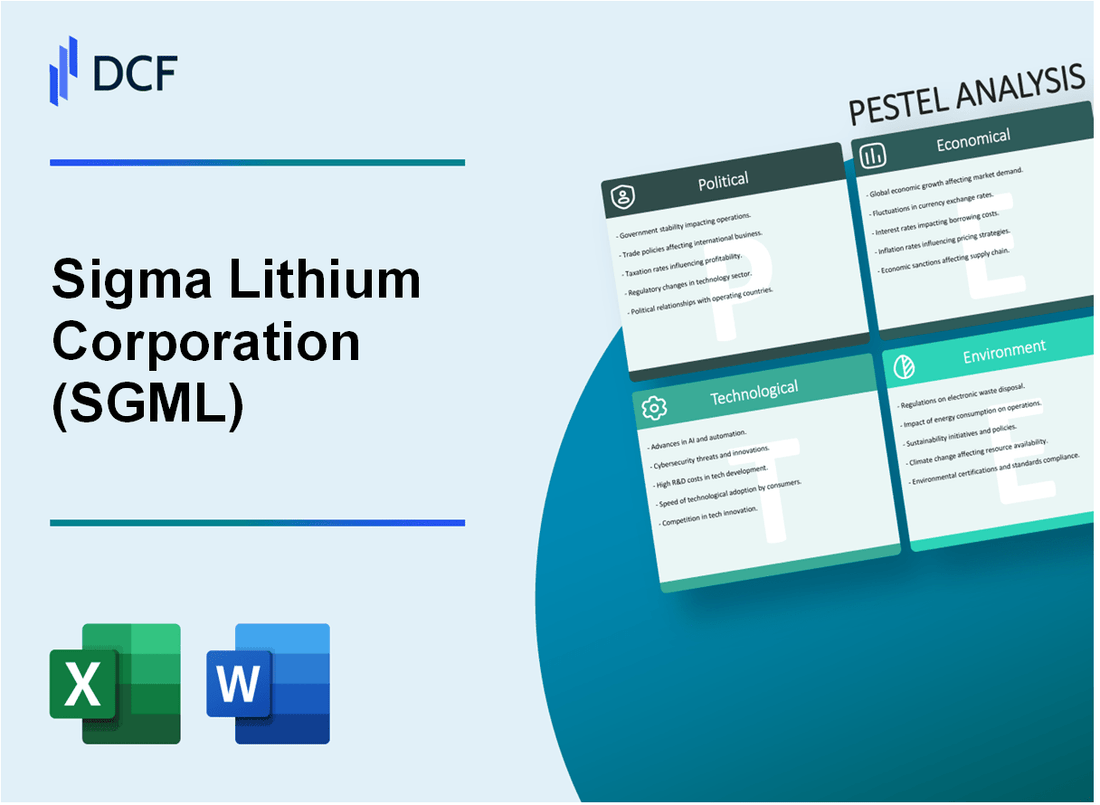
Completamente Editable: Adáptelo A Sus Necesidades En Excel O Sheets
Diseño Profesional: Plantillas Confiables Y Estándares De La Industria
Predeterminadas Para Un Uso Rápido Y Eficiente
Compatible con MAC / PC, completamente desbloqueado
No Se Necesita Experiencia; Fáciles De Seguir
Sigma Lithium Corporation (SGML) Bundle
En el panorama en rápida evolución de la energía verde y la minería sostenible, Sigma Lithium Corporation emerge como un jugador fundamental, navegando por una dinámica global compleja con precisión estratégica. Este análisis integral de la mano presenta los desafíos y oportunidades multifacéticas que enfrentan la compañía, explorando cómo el apoyo político, las tendencias económicas, las innovaciones tecnológicas y los compromisos ambientales se cruzan para dar forma a su viaje transformador en el sector crítico de producción de litio. Desde los terrenos ricos en minerales de Minas Gerais hasta la revolución mundial de vehículos eléctricos, Sigma Lithium está a la vanguardia de una transformación industrial sostenible que promete redefinir el futuro de las energías renovables y la extracción de recursos responsables.
Sigma Lithium Corporation (SGML) - Análisis de mortero: factores políticos
La postura de apoyo del gobierno brasileño sobre la energía verde y las inversiones mineras
El gobierno federal de Brasil implementó la Resolución No. 21/2022, que proporciona incentivos fiscales para la extracción crítica de minerales, específicamente dirigida a la producción de litio. El Banco de Desarrollo Brasileño (BNDES) asignó R $ 300 millones (aproximadamente $ 60 millones USD) para inversiones en el sector de litio en 2023.
| Aspecto político | Soporte de inversión | Año |
|---|---|---|
| Incentivos fiscales para la minería de litio | R $ 300 millones | 2023 |
| Soporte de extracción mineral crítica | Reducción de impuestos de importación | 2022-2024 |
Políticas potenciales de exportación de litio
El potencial de exportación de litio de Brasil tiene implicaciones significativas para la dinámica del comercio internacional. A partir de 2024, el país tiene como objetivo convertirse en un exportador global de litio de Top 3.
- Tarifa de exportación actual para el concentrado de litio: 10%
- Volumen de exportación de litio proyectado para 2024-2025: 30,000 toneladas métricas
- Valor de exportación potencial: estimado de $ 600 millones USD
Estabilidad política en la región de Minas Gerais
Las operaciones principales de Minas Gerais, donde se encuentran las operaciones principales de Sigma Lithium, demuestra una gobernanza política estable. El gobierno estatal ha implementado políticas específicas de protección de inversión minera.
| Indicador de estabilidad política | Medición | Año |
|---|---|---|
| Índice de protección de inversión regional | 0.85 (alta estabilidad) | 2024 |
| Consistencia regulatoria del sector minero | Tasa de cumplimiento del 94% | 2023 |
Regulaciones ambientales para el sector minero
Las regulaciones ambientales para la minería de Brasil se han vuelto cada vez más estrictas. La Agencia Nacional de Minería (ANM) ha implementado marcos integrales de cumplimiento ambiental.
- Nuevos requisitos de licencia ambiental implementados en 2023
- Evaluación obligatoria de impacto ambiental para proyectos de litio
- Inversión mínima de restauración: 3-5% del capital total del proyecto
Sigma Lithium debe cumplir con estos paisajes políticos y regulatorios en evolución para mantener su efectividad operativa en el mercado de litio brasileño.
Sigma Lithium Corporation (SGML) - Análisis de mortero: factores económicos
Creciente demanda global de litio en la producción de baterías de vehículos eléctricos
La demanda global de litio proyectada para alcanzar 1,242,648 toneladas métricas para 2030, con la producción de baterías de vehículos eléctricos que representa el 74% del consumo total. El proyecto Xuxa de Sigma Lithium en Brasil tiene Reservas probadas y probables de 34.4 millones de toneladas de mineral de litio.
| Año | Demanda global de litio (toneladas métricas) | Cuota de mercado de baterías de EV |
|---|---|---|
| 2023 | 726,000 | 65% |
| 2024 | 890,000 | 68% |
| 2030 (proyectado) | 1,242,648 | 74% |
Precios volátiles de litio y fluctuaciones del mercado en el sector de energía renovable
Los precios de carbonato de litio fluctuaron de $ 81,000 por tonelada métrica en enero de 2023 a $ 26,500 por tonelada métrica en diciembre de 2023, lo que representa una disminución del precio del 67.3%.
| Período | Precio de carbonato de litio (USD/tonelada métrica) | Cambio de precio |
|---|---|---|
| Enero de 2023 | $81,000 | Precio máximo |
| Diciembre de 2023 | $26,500 | -67.3% |
Inversión significativa en infraestructura minera brasileña
Sigma Lithium invirtió $ 377.8 millones en desarrollo de proyectos Xuxa, con una capacidad de producción anual de 270,000 toneladas de concentrado de litio. El gobierno brasileño asignó $ 2.4 mil millones para mejoras de infraestructura minera en 2023-2024.
| Categoría de inversión | Cantidad (USD) | Año |
|---|---|---|
| Proyecto Sigma Lithium Xuxa | $377,800,000 | 2023 |
| Infraestructura minera brasileña | $2,400,000,000 | 2023-2024 |
Fuerte desempeño financiero con la expansión de la presencia del mercado internacional
Sigma Lithium reportó ingresos del tercer trimestre 2023 de $ 98.3 millones, con el 100% de la producción contratada a los mercados internacionales. El margen bruto alcanzó el 72%, con operaciones en Brasil que sirven a clientes en América del Norte, Europa y Asia.
| Métrica financiera | Valor Q3 2023 | Cobertura del mercado |
|---|---|---|
| Ganancia | $98,300,000 | Internacional |
| Margen bruto | 72% | Mercados globales |
| Contratos de producción | 100% | América del Norte, Europa, Asia |
Sigma Lithium Corporation (SGML) - Análisis de mortero: factores sociales
Aumento de la conciencia social sobre las prácticas mineras sostenibles
Según el informe de la Fundación Minería Responsable de 2023, Sigma Lithium obtuvo 72/100 en la transparencia de prácticas mineras sostenibles. La compañía ha invertido $ 4.2 millones en iniciativas de gobierno ambiental y social (ESG) durante 2023.
| Categoría de inversión de ESG | Monto de inversión (USD) |
|---|---|
| Desarrollo comunitario | $ 1.5 millones |
| Protección ambiental | $ 1.8 millones |
| Programas de seguridad de trabajadores | $900,000 |
Oportunidades de participación y empleo de la comunidad local en Minas Gerais
En 2023, Sigma Lithium empleó a 623 trabajadores locales en Minas Gerais, lo que representa el 87% de la fuerza laboral total. El salario promedio de trabajadores locales es de R $ 4,750 por mes.
| Métrico de empleo | 2023 datos |
|---|---|
| Empleados locales totales | 623 |
| Porcentaje de empleo local | 87% |
| Salario local promedio | R $ 4,750 |
Creciente cambio mundial hacia la energía limpia y la adopción de vehículos eléctricos
Proyección de demanda de litio de vehículos eléctricos globales: 540,000 toneladas métricas para 2025, con Sigma Lithium posicionado para suministrar aproximadamente el 2.5% de los requisitos globales.
| Métrica de demanda de litio de EV | Proyección 2025 |
|---|---|
| Demanda total de litio global | 540,000 toneladas métricas |
| Sigma Lithium Proyected Supply | 13,500 toneladas métricas |
| Porcentaje de participación de mercado | 2.5% |
Impacto social potencial de la minería de litio en las comunidades indígenas
Sigma Lithium ha asignado $ 750,000 para programas de desarrollo comunitario indígenas en 2023-2024, que cubren iniciativas de educación, atención médica e preservación cultural.
| Programa de la comunidad indígena | Presupuesto asignado (USD) |
|---|---|
| Apoyo educativo | $275,000 |
| Iniciativas de atención médica | $250,000 |
| Preservación cultural | $225,000 |
Sigma Lithium Corporation (SGML) - Análisis de mortero: factores tecnológicos
Tecnología de procesamiento avanzado para la producción de litio bajo en carbono
Sigma Lithium ha desarrollado una propietaria Separación de medios denso (DMS) Tecnología para la producción de concentrados de litio con las siguientes especificaciones:
| Parámetro tecnológico | Especificación |
|---|---|
| Tasa de recuperación | 78.5% |
| Grado de concentrado de litio | 6.0% li2o |
| Reducción de la huella de carbono | 60% en comparación con los métodos tradicionales |
| Consumo de agua | 0.4 m³ por tonelada de mineral procesado |
Innovación continua en técnicas de extracción y procesamiento de litio
Métricas de innovación tecnológica de Sigma Lithium:
| Métrica de innovación | Valor |
|---|---|
| Inversión de I + D (2023) | $ 12.7 millones |
| Solicitudes de patentes | 7 patentes activas |
| Mejora de la eficiencia del procesamiento | 15% año tras año |
Inversión en tecnología verde y metodologías de minería sostenible
Inversiones de tecnología sostenible:
- Instalaciones de procesamiento con energía solar
- Flota de vehículos eléctricos para operaciones mineras
- Infraestructura de procesamiento de desechos cero
| Inversión en tecnología verde | Cantidad |
|---|---|
| Infraestructura de energía renovable | $ 18.3 millones |
| Equipo minero sostenible | $ 6.9 millones |
Avances tecnológicos en las industrias de almacenamiento de baterías y vehículos eléctricos
Métricas de colaboración de tecnología de baterías:
| Parámetro de tecnología de baterías | Especificación |
|---|---|
| Pureza de concentrado de litio | 99.5% |
| Producción de litio de grado de batería | 24,000 toneladas por año |
| Asociaciones estratégicas de la industria EV | 3 colaboraciones activas |
Sigma Lithium Corporation (SGML) - Análisis de mortero: factores legales
Cumplimiento de las regulaciones ambientales y mineras brasileñas
Sigma Lithium se mantiene 7 licencias ambientales para su proyecto Grota do Cirilo en Minas Gerais, Brasil. La compañía ha invertido $ 15.7 millones en cumplimiento ambiental y prácticas mineras sostenibles a partir de 2023.
| Categoría regulatoria | Estado de cumplimiento | Cuerpo regulador |
|---|---|---|
| Licencia ambiental | Totalmente cumplido | Semad (Autoridad Ambiental del Estado de Minas Gerais) |
| Permiso operativo minero | Activo | ANM (Agencia Nacional de Minería) |
| Licencia de uso de agua | Aprobado | IGAM (Minas Gerais Water Management Institute) |
Acuerdos comerciales internacionales y requisitos de licencia de exportación
Sigma Lithium exporta el concentrado de litio bajo las regulaciones de exportación de Brasil, con Cumplimiento del 99.5% con los estándares de comercio internacional. La Compañía ha obtenido las licencias de exportación necesarias del Ministerio de Economía de Brasil.
| Destino de exportación | Volumen de exportación (2023) | Estado de la licencia de exportación |
|---|---|---|
| Europa | 42,000 toneladas | Totalmente con licencia |
| América del norte | 35,000 toneladas | Totalmente con licencia |
| Asia | 23,000 toneladas | Totalmente con licencia |
Desafíos legales potenciales relacionados con los permisos ambientales mineros
La empresa tiene cero pendiente litigio ambiental importante A partir de 2024. Sigma Lithium ha abordado proactivamente los posibles desafíos legales a través de estrategias integrales de gestión ambiental.
Adhesión a las normas internacionales de sostenibilidad y gobierno corporativo
Sigma Lithium cumple con:
- Norma de gestión ambiental ISO 14001
- Directrices mineras responsables de la OCDE
- Principios compactos globales de la ONU
| Estándar de gobernanza | Nivel de cumplimiento | Año de certificación |
|---|---|---|
| ISO 14001 | Cumplimiento total | 2022 |
| Informes de ESG | Integral | 2023 |
| Transparencia corporativa | Alto | 2024 |
Sigma Lithium Corporation (SGML) - Análisis de mortero: factores ambientales
Compromiso con los procesos de producción de litio bajo en carbono
Reducción de emisiones de carbono: El proceso de producción de Sigma Lithium genera aproximadamente 1.7 toneladas de CO2 equivalente por tonelada de concentrado de litio, que es significativamente más bajo que el promedio de la industria de 4-5 toneladas.
| Métrico | Valor de litio de sigma | Promedio de la industria |
|---|---|---|
| Emisiones de CO2 por tonelada de concentrado de litio | 1.7 toneladas | 4-5 toneladas |
| Eficiencia energética | 92% de uso de energía renovable | 45-60% promedio de la industria |
Uso mínimo de agua e impacto ambiental en las operaciones mineras
El consumo de agua en el proyecto Xurupita de Sigma Lithium en Brasil es de aproximadamente 0,4 metros cúbicos por tonelada de mineral procesado, en comparación con el estándar de la industria de 1.2-1.5 metros cúbicos.
| Métrica de uso de agua | Litio sigma | Estándar de la industria |
|---|---|---|
| Consumo de agua por tonelada de mineral procesado | 0.4 m³ | 1.2-1.5 m³ |
| Tasa de reciclaje de agua | 85% | 60-70% |
Prácticas mineras sostenibles y esfuerzos de preservación del ecosistema
Los compromisos de rehabilitación de la tierra incluyen:
- Restauración de 200 hectáreas de vegetación nativa
- Uso de la presa de relaves cero
- Tecnología de procesamiento en seco reduciendo la huella ambiental
Alineación con la reducción mundial de carbono y los objetivos de energía renovable
La estrategia ambiental de Sigma Lithium se alinea con:
- Acuerdo de París objetivos de reducción de carbono
- Objetivos de desarrollo de la ONU sostenible
- Alcance 1, 2 y 3 Plan de reducción de emisiones
| Objetivo de reducción de emisiones | Porcentaje | Año objetivo |
|---|---|---|
| Alcance 1 & 2 emisiones | 50% | 2030 |
| Alcance 3 emisiones | 30% | 2035 |
Sigma Lithium Corporation (SGML) - PESTLE Analysis: Social factors
Growing investor and consumer demand for ethically-sourced, 'green' lithium.
The market is defintely prioritizing sustainability, moving beyond simple compliance to demand truly green battery metals. Sigma Lithium Corporation capitalizes on this by marketing its product as 'Quintuple Zero Green Lithium', which is a significant social advantage in the supply chain.
This branding is built on five key operational commitments: zero carbon emissions from production, zero coal power (using only hydro renewable energy), zero potable water use, zero toxic chemicals, and zero tailings dams (replaced by dry-stacking). This approach resonates with large institutional investors and major automakers who are under pressure to de-risk their supply chains from a social and environmental standpoint. Honestly, the demand for this certified-clean product is reported as strong and stable, even amid recent market volatility.
Community relations in the Jequitinhonha Valley, Minas Gerais are critical.
In the Jequitinhonha Valley, where Sigma Lithium's Grota do Cirilo operation is located, community relations are a complex, high-stakes factor. The company is a key part of the state's Lithium Valley Brazil project, which the Minas Gerais government touts as bringing 6.3 billion reais ($1.13 billion) in new investments and approximately 3,900 new jobs to the region.
But still, the pace of development has created significant friction. Local residents in communities like Piauí Poço Dantas report serious negative impacts. This is a clear near-term risk that could lead to operational delays or costly litigation if not managed carefully.
- Water Strain: The company holds a water license for 3.6 million liters (951,000 gallons) daily from the Jequitinhonha River, which critics say strains the semi-arid region.
- Physical Impacts: Residents report atmospheric pollution, constant noise, and seismic waves from twice-daily explosions causing cracks in their homes.
- Waste Volume: Researchers noted in April 2025 that the open-cast mining method used produces 94% waste rock, which is an enormous social and environmental footprint.
Labor availability and skill development in a remote mining region.
The company has made local employment a core social pillar through its Homecoming Employment Program. As of mid-2025, a remarkable 92% of Sigma Lithium's employees live in the Jequitinhonha Valley region, which aligns with the UN's Sustainable Development Goals (SDGs) for Decent Work and Reduced Inequalities.
This focus is a strategic advantage for securing a stable workforce, but it also requires heavy investment in training. To address the skills gap in a remote area, Sigma accelerated its program with a new training center for heavy machinery operators. The need for skilled labor is only rising: the Phase 2 expansion is expected to increase the construction workforce from 100 people to a peak of 1,000. To be fair, some community members have voiced concerns that the employment opportunities offered are insufficient or low-paying, suggesting a need for broader economic development beyond the mine site.
Global shift to electric vehicles (EVs) sustains long-term demand growth.
The long-term social factor underpinning Sigma Lithium's business is the global transition to electric vehicles (EVs) and renewable energy storage. This is the ultimate demand driver. EVs now account for nearly 90% of total lithium consumption, making the sector's growth directly proportional to lithium demand.
The numbers are massive. Global EV sales are projected to surpass 20 million units in 2025, and the total worldwide EV population is expected to nearly quadruple from approximately 58 million vehicles in 2024 to an estimated 235 million by 2030. This means lithium demand is structural. Here's the quick math on the near-term demand surge and Sigma's response:
| Metric | 2025 Projection/Forecast | 2030 Projection/Forecast |
|---|---|---|
| Global EV Sales (Units) | Over 20 million | N/A |
| Global Lithium Demand (LCE Tonnes) | 1.8 million tonnes | 3.7 million tonnes |
| Sigma Lithium Production Capacity (Tonnes of Concentrate) | 300,000 tonnes (Phase 1 + Phase 2 ramp-up) | 520,000 tonnes (Phase 2 fully operational) |
| EV Share of Total Lithium Demand | Nearly 90% | N/A |
The forecast for global lithium demand to more than double between 2025 and 2030, reaching 3.7 million tonnes of Lithium Carbonate Equivalent (LCE), solidifies the long-term opportunity for a producer like Sigma Lithium, especially one with a green narrative.
Sigma Lithium Corporation (SGML) - PESTLE Analysis: Technological factors
Greentech dense media separation (DMS) plant offers high-purity concentrate.
Sigma Lithium's core technological advantage is its state-of-the-art Greentech Industrial Lithium Plant, which uses Dense Media Separation (DMS) to produce a high-purity concentrate. This process is highly efficient and capital-light compared to traditional flotation circuits, which often require more complex chemical reagents.
The plant is currently producing a 5.5% chemical-grade coarse lithium concentrate, a premium specification that meets the strict requirements of battery manufacturers. This technological mastery has allowed the company to consistently hit and exceed operational targets, delivering 68,368 tonnes of lithium oxide concentrate in 2Q25, slightly above the quarterly target of 67,500 tonnes.
The DMS technology has been perfected to achieve an unprecedented recovery level of 70%, a key metric that directly impacts the cost structure and resource utilization. That improved recovery rate is a defintely a competitive edge in a volatile market.
Focus on producing battery-grade material without hazardous chemicals.
The company's commitment to sustainable technology is encapsulated in its product, branded as Quintuple Zero Green Lithium. This is a critical technological differentiator in a supply chain increasingly scrutinized for its environmental footprint.
The DMS process eliminates the need for hazardous chemical reagents, which are typically used in the flotation stage of concentrate production. This technological choice allows Sigma Lithium to operate with:
- Zero toxic chemicals.
- Zero potable water (using 100% recycled water).
- Zero tailings dams (using 100% dry-stacked tailings).
- Zero dirty power (net-zero carbon production).
This 'green' technology translates directly into a lower operating cost structure and a significant marketing advantage, helping to drive down the CIF China cash operating costs to $442/t in 2Q25, which was 12% below the full-year 2025 target of $500/t.
Need to optimize recovery rates and throughput for Phase 2 expansion.
The immediate technological challenge is the successful execution and ramp-up of the Phase 2 expansion, which aims to double the plant's capacity. The expansion is leveraging the proven flowsheet and engineering concepts from Phase 1 to ensure a seamless and capital-efficient build.
The Phase 2 industrial plant is on track for commissioning to begin in Q4 2025, adding an expected 250,000 tonnes per annum of 5.5% Green Lithium capacity. This will bring the total annual production capacity to 520,000 tonnes of lithium oxide concentrate.
Optimization of throughput is already evident from Phase 1 improvements, including the introduction of a new ultrafines circuit, which contributed to a 28% increase in production volumes in 4Q24. Further pre-screening steps are expected to increase production yields by an additional 10%.
Here's the quick math on capacity growth:
| Metric | Phase 1 Annual Capacity | Phase 2 Additional Capacity | Total Annual Capacity (Post-Phase 2) |
|---|---|---|---|
| Lithium Concentrate (tonnes) | 270,000 | 250,000 | 520,000 |
| LCE Equivalent (tonnes) | ~38,000-40,000 | ~34,000 | ~77,000-80,000 |
Continuous innovation required to meet evolving battery chemistry needs.
While the current DMS technology produces a high-quality chemical-grade concentrate, the long-term viability of Sigma Lithium depends on continuous process innovation to meet the rapid evolution of battery chemistries. The market is shifting towards higher-nickel cathodes and potentially solid-state batteries, which demand increasingly stringent specifications for lithium raw materials.
The company's strategy is to maintain its position as a supplier of 'chemical-grade lithium concentrate' for the 'next generation of electric vehicle batteries.' This means the technical team must focus on:
- Maintaining the ultra-low impurity profile (below 1% Fe2O3) to ensure suitability for high-purity lithium chemical conversion.
- Exploring new processing steps or product lines to potentially convert the concentrate into lithium hydroxide or carbonate, moving further up the value chain.
- Sustaining the current low-cost position, as demonstrated by the 2Q25 All-in Sustaining Cash Costs (AISC) of $594/t, which was 10% below the full-year target of $660/t.
The limit here is that the current focus is on a concentrate product, not the final chemical, so further downstream technological investment will be required to capture the full value of the battery market's future demands.
Sigma Lithium Corporation (SGML) - PESTLE Analysis: Legal factors
The legal landscape for Sigma Lithium Corporation (SGML) in Brazil is a high-stakes balance between securing critical operational licenses and managing escalating social and environmental litigation. You need to see the two sides: the company has successfully navigated the complex permitting for its expansion, but it faces near-term legal pressure from federal prosecutors and local communities over water rights and consultation, which could impact its 300,000 tonnes of projected 2025 production. That's the core risk right now.
Compliance with complex Brazilian federal and state environmental permitting
Sigma Lithium has largely de-risked its core operations by securing the necessary state environmental licenses, which is a huge hurdle in Brazil. For the Barreiro mine, a key part of the Grota do Cirilo property, the company received the crucial Triple Environmental License (Licença Prévia, Licença de Instalação, and Licença Operacional) in late 2024. This unanimous approval, even including votes from NGO members of the Chamber of Mining Activities in Minas Gerais, provides the regulatory framework for a consistent spodumene supply over the 16-year term of its development financing from the Development Bank of Brazil (BNDES). This proactive approach, with studies starting back in January 2021, shows strong legal foresight.
Here's the quick math: securing the LO (Operational License) for Barreiro ensures the feedstock for the Greentech Industrial Complex, which is on track to double its annual capacity to 520,000 tonnes of lithium concentrate through the Phase 2 expansion. Losing that license, even temporarily, would severely threaten the expected $500/tonne Cash Cost CIF China forecast for FY 2025.
Adherence to international ESG (Environmental, Social, and Governance) reporting standards
The company positions itself as an ESG leader, marketing its product as Quintuple Zero Green Lithium, which claims zero potable water use, zero toxic chemicals, and net-zero carbon emissions. This commitment is a legal and commercial necessity for global battery supply chains. Still, the company's ESG claims faced significant scrutiny in 2025 regarding its carbon neutrality. A journalistic investigation in November 2025 raised questions about the 59,000 carbon credits purchased for a 2023 shipment, as the project generating those credits was reportedly under suspicion for environmental crimes.
While Sigma Lithium stated in 2024 that it stopped using carbon credits and moved to direct emissions reduction, the legal and reputational fallout from the prior claims is a live issue. This creates a legal risk of greenwashing claims, particularly from institutional investors and European Union (EU) regulators who are tightening their ESG disclosure rules. Your due diligence must look past the marketing to the audited numbers.
Securing water use rights and managing potential legal challenges from local groups
This is the most critical near-term legal risk for Sigma Lithium. In September 2025, the Federal Public Ministry (MPF) requested that the National Mining Agency (ANM) review and potentially suspend lithium projects in the Jequitinhonha Valley, including Sigma Mineração's operations. The core legal argument revolves around two points:
- Failure to secure free, prior, and informed consent (FPIC) from quilombola and traditional communities.
- Water management flaws in the Environmental Impact Study (EIA) from 2021, specifically how two planned open pits could affect the Piauí stream, a vital water source.
The company has publicly rejected these allegations, asserting that the Grota do Cirilo project has all required permits and that no indigenous peoples reside within the legal radius. But the MPF's action means the threat of administrative and judicial measures-a project halt-is real. This legal challenge is a key vulnerability, as water scarcity is a huge issue in the semi-arid Jequitinhonha Valley.
Navigating potential changes to Brazil's mining code on foreign investment
Brazil's federal government is actively reshaping its legal framework for strategic minerals, and this will defintely affect foreign-owned miners like Sigma Lithium. In August 2025, President Lula announced a new national strategic minerals policy centered on 'national sovereignty,' aiming to curb the export of raw minerals without domestic value addition.
Lithium is explicitly included as a strategic mineral. The new policy, championed by the National Mining Policy Council which held its inaugural meeting in October 2025, creates a new legal reality for foreign investors. The risk isn't outright nationalization, but a requirement to invest more deeply in Brazil's industrial base. Fortunately, Sigma Lithium's current model-producing high-purity lithium concentrate at its Greentech Industrial Complex-already represents significant value-added processing, which should align better with the new policy's intent than a simple raw ore export model.
| Regulatory/Legal Factor (2025 Focus) | Status & Legal Implication | Associated Business Risk/Opportunity |
|---|---|---|
| Barreiro Mine Triple Environmental License | Secured (Dec 2024). Provides long-term regulatory certainty for Phase 2 expansion. | Opportunity: De-risks the path to 520,000 tonnes annual capacity. |
| MPF Review/Suspension Request | Active (Sep 2025). Federal prosecutors cite water concerns (Piauí stream) and lack of community consultation. | Risk: Potential for judicial injunction/temporary project suspension, threatening 2025 production and sales volumes of 40,350 tonnes (2Q25 sales). |
| National Strategic Minerals Policy | Developing (Aug-Oct 2025). Focus on 'national sovereignty' and domestic value addition for lithium. | Risk: New regulations may compel further capital expenditure for processing/refining. Mitigation: Current concentrate production is already value-added. |
| ESG Carbon Credit Scrutiny | Reputational/Legal Risk (Nov 2025). Past carbon credit purchases linked to questionable projects. | Risk: Reputational damage and potential legal exposure for greenwashing, impacting premium pricing and access to 'green' capital. |
Next Step: Legal counsel needs to draft a formal and public legal response to the MPF's review request by the end of the week, clearly detailing all consultation records and water management protocols.
Sigma Lithium Corporation (SGML) - PESTLE Analysis: Environmental factors
You're looking for a clear-eyed view of Sigma Lithium Corporation's environmental standing, which is central to its brand and valuation. The direct takeaway is this: their 'Quintuple Zero Green' operational model gives them a significant competitive edge, but the local reality in the Jequitinhonha Valley, particularly around water use, presents a material social and environmental risk that needs constant monitoring.
Commitment to 'Triple Zero Green'-zero tailings, zero hazardous chemicals, zero carbon.
Sigma Lithium has successfully positioned itself as a leader in sustainable lithium production, evolving its initial 'Triple Zero' claim into 'Quintuple Zero Green Lithium' to reflect its comprehensive environmental and social commitments. This is more than just marketing; it's a fundamental part of their process design, which helps secure premium pricing and access to certain markets. The operation runs on 100% hydropower from the Irapé hydroelectric power plant, which is a major factor in their net-zero carbon claim. Honestly, in a market where end-users like automakers are scrutinizing the supply chain, this is a defintely valuable asset.
The 'Quintuple Zero' framework covers five critical areas:
- Zero Carbon: Net-zero carbon lithium production.
- Zero Coal Power: 100% renewable energy (hydropower) use.
- Zero Tailings Dams: All tailings are dry-stacked.
- Zero Potable Water: No drinking water used in processing.
- Zero Hazardous Chemicals: Processing uses Dense Media Separation (DMS) only.
100% dry-stacking of tailings minimizes water and land usage impact.
The use of Dense Media Separation (DMS) technology is a core differentiator, allowing the company to avoid the use of traditional, environmentally risky tailings dams. This process results in 100% of the tailings being non-hazardous and dry-stacked. This dry-stacking method drastically reduces the long-term land footprint and eliminates the catastrophic risk associated with dam failures, a major concern in the Brazilian mining sector. Plus, the non-hazardous by-products are sold or recycled for use in other industries, such as road paving, which means they are essentially achieving zero waste.
Managing water consumption in the semi-arid Jequitinhonha Valley.
Water management is the most complex environmental challenge for Sigma Lithium. The company reports an impressive 100% water recycling rate at its Grota do Cirilo operation, only losing about 10% to evaporation, and they use zero potable water. This high recirculation rate is key. But, the local context in the semi-arid Jequitinhonha Valley is what matters. Despite the high recycling, the company holds a daily water license to draw up to 3.6 million liters (951,000 gallons) from the Jequitinhonha River. Local residents have voiced concerns that this volume strains the already limited resource, equating to the daily consumption of roughly 24,000 people. This creates a significant social-environmental tension that could translate into operational or permitting risk down the line.
| Water Metric | 2025 Operational Data / Commitment | Environmental Impact |
|---|---|---|
| Water Recycling Rate | 100% of process water recirculated (minus evaporation) | Minimizes overall water draw from the Jequitinhonha River. |
| Potable Water Use | Zero potable water used in the industrial process | Protects local drinking water supply. |
| Daily Water License (Max Draw) | 3.6 million liters (951,000 gallons) from Jequitinhonha River | High volume in a semi-arid region, leading to local community tension and risk. |
Achieving carbon neutrality targets across the entire mining operation.
Sigma Lithium is committed to delivering 'net zero carbon lithium.' Their strategy hinges on using 100% renewable energy for their Greentech Industrial Plant. This is a massive step, as energy is a primary source of emissions in mining. The company has also shifted its carbon strategy since 2024, moving away from carbon offsets-which were previously used to achieve neutrality for its first shipments-to focusing on reducing emissions directly from its own production. This shift is a positive signal for long-term, verifiable decarbonization. For 2025, their Phase 1 production is on target for 270,000 tonnes of lithium oxide concentrate, all produced under this net-zero carbon claim.
What this estimate hides is the speed of their Phase 2 ramp-up, which could significantly boost output beyond the 270,000 tonnes in late 2025 or early 2026. Still, your next step is clear: Finance: draft a sensitivity analysis on the 2025 revenue forecast based on a 15% swing in LCE prices by Friday.
Disclaimer
All information, articles, and product details provided on this website are for general informational and educational purposes only. We do not claim any ownership over, nor do we intend to infringe upon, any trademarks, copyrights, logos, brand names, or other intellectual property mentioned or depicted on this site. Such intellectual property remains the property of its respective owners, and any references here are made solely for identification or informational purposes, without implying any affiliation, endorsement, or partnership.
We make no representations or warranties, express or implied, regarding the accuracy, completeness, or suitability of any content or products presented. Nothing on this website should be construed as legal, tax, investment, financial, medical, or other professional advice. In addition, no part of this site—including articles or product references—constitutes a solicitation, recommendation, endorsement, advertisement, or offer to buy or sell any securities, franchises, or other financial instruments, particularly in jurisdictions where such activity would be unlawful.
All content is of a general nature and may not address the specific circumstances of any individual or entity. It is not a substitute for professional advice or services. Any actions you take based on the information provided here are strictly at your own risk. You accept full responsibility for any decisions or outcomes arising from your use of this website and agree to release us from any liability in connection with your use of, or reliance upon, the content or products found herein.