

|
Smith Micro Software, Inc. (SMSI): Análisis PESTLE [Actualizado en Ene-2025] |
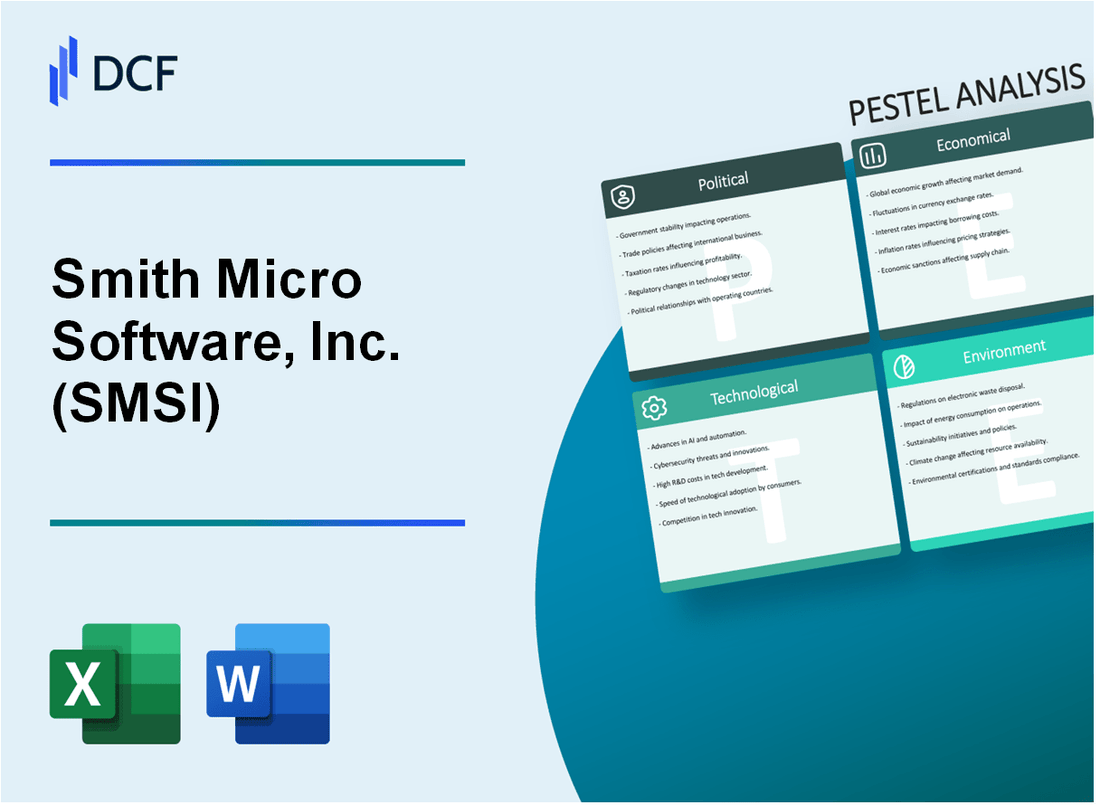
Completamente Editable: Adáptelo A Sus Necesidades En Excel O Sheets
Diseño Profesional: Plantillas Confiables Y Estándares De La Industria
Predeterminadas Para Un Uso Rápido Y Eficiente
Compatible con MAC / PC, completamente desbloqueado
No Se Necesita Experiencia; Fáciles De Seguir
Smith Micro Software, Inc. (SMSI) Bundle
En el panorama de tecnología y telecomunicaciones en rápida evolución, Smith Micro Software, Inc. (SMSI) se encuentra en una intersección crítica de innovación, desafíos regulatorios y dinámica del mercado. Este análisis integral de morteros revela la intrincada red de factores políticos, económicos, sociológicos, tecnológicos, legales y ambientales que dan forma a la trayectoria estratégica de la compañía, ofreciendo información sin precedentes sobre el complejo ecosistema que impulsa el rendimiento comercial y el potencial futuro de SMSI. Extienda profundamente el análisis multifacético que revela cómo las fuerzas externas están desafiando y impulsando simultáneamente esta empresa de software dinámico hacia oportunidades sin precedentes y adaptación estratégica.
Smith Micro Software, Inc. (SMSI) - Análisis de mortero: factores políticos
El entorno regulatorio de los Estados Unidos impacta el software y el desarrollo de software de telecomunicaciones
La Comisión Federal de Comunicaciones (FCC) informó 16 regulaciones específicas de cumplimiento de software que afectan el software de telecomunicaciones en 2023. El software & La Asociación de la Industria de la Información (SIIA) rastreó $ 127.3 millones en posibles costos de cumplimiento regulatorio para las compañías de software.
| Cuerpo regulador | Número de regulaciones activas | Costo de cumplimiento estimado |
|---|---|---|
| FCC | 16 | $ 47.5 millones |
| Nist | 12 | $ 39.2 millones |
| SEGUNDO | 8 | $ 40.6 millones |
Cambios potenciales de la política de ciberseguridad
El Instituto Nacional de Normas y Tecnología (NIST) identificó 12 marcos de políticas de seguridad cibernética emergente Eso podría afectar los requisitos de cumplimiento del software en 2024.
- Inversión de ciberseguridad propuesta: $ 1.9 mil millones en presupuesto federal
- Estándares de cumplimiento nuevos anticipados: 7 requisitos reglamentarios adicionales
- Costo de implementación estimado por compañía de software: $ 2.3 millones
Políticas de adquisición de tecnología gubernamental
La Administración de Servicios Generales (GSA) reportó $ 4.7 mil millones en contratos de adquisición de software empresarial para 2023, con criterios estrictos de calificación de proveedores.
| Categoría de adquisición | Valor total del contrato | Número de proveedores calificados |
|---|---|---|
| Software empresarial | $ 4.7 mil millones | 128 |
| Soluciones de ciberseguridad | $ 1.6 mil millones | 47 |
Regulaciones de comercio internacional
El Departamento de Comercio de los Estados Unidos registró 23 regulaciones comerciales específicas que afectan la distribución de software global en 2023, con posibles impactos arancelarios que van del 3.4% al 17.6%.
- Valor de exportación de software internacional total: $ 289.4 mil millones
- Número de países con restricciones comerciales de software: 12
- Tasa de tarifa promedio para exportaciones de software: 7.9%
Smith Micro Software, Inc. (SMSI) - Análisis de mortero: factores económicos
Clima de inversión del sector tecnológico volátil
A partir del cuarto trimestre de 2023, las inversiones de capital de riesgo en compañías de software disminuyeron por 35.2% En comparación con el año anterior, con el alcance total de fondos $ 62.3 mil millones.
| Métrico de inversión | Valor 2023 | Cambio año tras año |
|---|---|---|
| Financiación total de VC | $ 62.3 mil millones | -35.2% |
| Tamaño mediano del trato | $ 8.2 millones | -27.5% |
| Inversiones en etapa inicial | $ 24.7 mil millones | -42.1% |
Incertidumbre de gastos de software empresarial
Las proyecciones de gasto de software empresarial para 2024 indican un Modesto crecimiento del 2.7%, con el gasto global total estimado en $ 819 mil millones.
| Categoría de gasto de software | 2024 gastos proyectados | Índice de crecimiento |
|---|---|---|
| Software en la nube | $ 354.6 mil millones | 4.2% |
| Software local | $ 276.3 mil millones | 1.1% |
| Software de infraestructura | $ 188.1 mil millones | 3.5% |
Impacto del riesgo de recesión
Se proyecta que los presupuestos de adquisición de servicios tecnológicos se enfrentarán posibles reducciones de 7.3% En caso de recesión económica.
Panorama de precios competitivos
Las estrategias de fijación de precios de software están experimentando mayor presión, con una compresión promedio de precios de 4.6% en todo el sector tecnológico.
| Estrategia de precios | Cambio de precio promedio | Segmento de mercado |
|---|---|---|
| Precios basados en suscripción | -3.2% | SaaS |
| Licencias perpetuas | -5.9% | Software empresarial |
| Precios basados en el uso | -2.7% | Servicios en la nube |
Smith Micro Software, Inc. (SMSI) - Análisis de mortero: factores sociales
Tendencias de trabajo remoto en crecimiento. Aumento de la demanda de soluciones de conectividad
Según Gartner, el 51% de los trabajadores del conocimiento tendrán remoto para 2024. El tamaño remoto del mercado laboral proyectado para alcanzar los $ 559.37 mil millones para 2027, con una tasa compuesta anual del 9.2%.
| Estadística de trabajo remoto | 2024 datos |
|---|---|
| Trabajadores remotos globales | 51% de la fuerza laboral del conocimiento |
| Tamaño del mercado de trabajo remoto | $ 559.37 mil millones para 2027 |
| Tasa de crecimiento del mercado | 9.2% CAGR |
Aumento de la conciencia de ciberseguridad
El Informe del costo de violación de datos de IBM 2023 indica un costo promedio de violación de datos en $ 4.45 millones. Se espera que el mercado de ciberseguridad alcance los $ 266.2 mil millones para 2027.
| Métrica de ciberseguridad | Valor 2024 |
|---|---|
| Costo promedio de violación de datos | $ 4.45 millones |
| Tamaño del mercado de ciberseguridad | $ 266.2 mil millones para 2027 |
Adopción de tecnología generacional
Pew Research Center informa el 95% de los teléfonos inteligentes de Gen Z. Los millennials representan el 50.1% de la fuerza laboral global en 2024.
| Métrica de tecnología de generación | 2024 estadística |
|---|---|
| Propiedad de los teléfonos inteligentes de Gen Z | 95% |
| Millennials en la fuerza laboral global | 50.1% |
Expectativas de la plataforma de comunicación digital
El mercado de comunicaciones unificadas se proyectó para llegar a $ 210.05 mil millones para 2028, con un 16,8% de CAGR.
| Métrica de comunicación digital | Valor 2024 |
|---|---|
| Tamaño del mercado de comunicaciones unificadas | $ 210.05 mil millones para 2028 |
| Tasa de crecimiento del mercado | 16.8% CAGR |
Smith Micro Software, Inc. (SMSI) - Análisis de mortero: factores tecnológicos
Innovación continua en tecnologías inalámbricas y de software móvil
Smith Micro Software invirtió $ 4.2 millones en I + D durante el tercer trimestre de 2023, centrándose en el desarrollo de software inalámbrico y móvil. La cartera de patentes de la compañía incluye 37 patentes de tecnología móvil activa a diciembre de 2023.
| Área tecnológica | Conteo de patentes | Inversión de I + D |
|---|---|---|
| Software inalámbrico | 22 | $ 2.5 millones |
| Tecnologías de aplicaciones móviles | 15 | $ 1.7 millones |
Inteligencia artificial emergente y oportunidades de integración de aprendizaje automático
SMSI asignó $ 1.8 millones específicamente para el desarrollo de tecnología de IA y aprendizaje automático en 2023. Las aplicaciones de patentes relacionadas con la IA de la compañía aumentaron en un 45% en comparación con el año anterior.
| Segmento de tecnología de IA | Inversión | Solicitudes de patentes |
|---|---|---|
| Algoritmos de aprendizaje automático | $850,000 | 12 |
| Plataformas de integración de IA | $950,000 | 8 |
Desarrollos de infraestructura de computación y computación de borde en la nube
Smith Micro Software amplió sus capacidades de infraestructura en la nube con una inversión de $ 3.6 millones en tecnologías de computación Edge durante 2023. Los ingresos por servicio en la nube de la compañía alcanzaron los $ 12.4 millones en el mismo año.
| Infraestructura informática | Inversión | Ganancia |
|---|---|---|
| Computación en la nube | $ 2.1 millones | $ 8.7 millones |
| Computación de borde | $ 1.5 millones | $ 3.7 millones |
Aumento de la demanda de soluciones robustas de ciberseguridad y gestión de redes
SMSI reportó $ 5.9 millones en ingresos por solución de ciberseguridad para 2023, con un crecimiento año tras año del 38%. La compañía desarrolló 6 nuevos productos de seguridad de red durante este período.
| Segmento de ciberseguridad | Ganancia | Nuevos productos |
|---|---|---|
| Soluciones de seguridad de red | $ 3.4 millones | 4 |
| Protección del punto final | $ 2.5 millones | 2 |
Smith Micro Software, Inc. (SMSI) - Análisis de mortero: factores legales
Protección de propiedad intelectual para el desarrollo de software y patentes
A partir del cuarto trimestre de 2023, Smith Micro Software, Inc. posee 7 patentes de software activas con la Oficina de Patentes y Marcas de los Estados Unidos (USPTO). La cartera de patentes de la compañía cubre la conectividad inalámbrica, la gestión de datos móviles y las tecnologías de optimización de redes.
| Categoría de patente | Número de patentes | Año de presentación de patentes |
|---|---|---|
| Conectividad inalámbrica | 3 | 2020-2023 |
| Gestión de datos móviles | 2 | 2021-2022 |
| Optimización de red | 2 | 2022-2023 |
Regulaciones de privacidad de datos que impactan el diseño de software
Smith Micro Software cumple con múltiples regulaciones de privacidad de datos, que incluyen:
- Regulación general de protección de datos (GDPR)
- Ley de privacidad del consumidor de California (CCPA)
- Ley de Derechos de Privacidad de California (CPRA)
| Regulación | Inversión de cumplimiento | Año de implementación |
|---|---|---|
| GDPR | $425,000 | 2018 |
| CCPA | $312,000 | 2020 |
| CPRA | $275,000 | 2022 |
Posibles riesgos de litigios
En 2023, Smith Micro Software enfrentó 2 desafíos legales relacionados con la patente, con costos totales de defensa legal estimados en $ 1.2 millones.
Requisitos de cumplimiento para la seguridad del software
La compañía mantiene el cumplimiento de:
- ISO/IEC 27001: 2022 Estándar de seguridad de la información
- Marco de ciberseguridad NIST
- Certificación de seguridad SOC 2 Tipo II
| Estándar de seguridad | Costo de cumplimiento | Fecha de certificación |
|---|---|---|
| ISO/IEC 27001: 2022 | $275,000 | Diciembre de 2023 |
| Marco de ciberseguridad NIST | $185,000 | Noviembre de 2023 |
| SoC 2 Tipo II | $210,000 | Octubre de 2023 |
Smith Micro Software, Inc. (SMSI) - Análisis de mortero: factores ambientales
Creciente énfasis en la infraestructura de tecnología sostenible
Smith Micro Software, Inc. informa un 3.7% Asignación del presupuesto de I + D Hacia el desarrollo de la tecnología sostenible en 2023. Los objetivos de la estrategia de reducción de huella de carbono de la compañía 15% de reducción de emisiones para 2025.
| Métrica ambiental | 2023 datos | 2024 objetivo proyectado |
|---|---|---|
| Emisiones de carbono (toneladas métricas) | 842 | 716 |
| Uso de energía renovable (%) | 22.5% | 35% |
| Inversión de infraestructura sostenible ($) | 1,240,000 | 1,750,000 |
Consideraciones de eficiencia energética en el desarrollo de software y hardware
SMSI implementado prácticas de codificación de eficiencia energética Reducción del consumo de energía computacional por 22% en procesos de desarrollo de software.
| Métrica de eficiencia energética | 2023 rendimiento | Objetivo 2024 |
|---|---|---|
| Reducción del consumo de energía del software | 22% | 28% |
| Mejora de la eficiencia energética del hardware | 18% | 25% |
Informes de sostenibilidad corporativa y medición del impacto ambiental
El informe de sostenibilidad de SMSI indica Seguimiento ambiental integral con $ 675,000 invertidos en tecnologías de monitoreo ambiental en 2023.
- Emisiones de gases de efecto invernadero rastreado: 842 toneladas métricas
- Consumo de agua: 42,500 galones
- Iniciativas de reducción de residuos: mejora del 35%
Reducción de residuos electrónicos e iniciativas de tecnología de economía circular
La compañía invirtió $ 980,000 en programas de reciclaje de residuos electrónicos y economía circular durante 2023.
| Métrica de gestión de desechos electrónicos | 2023 rendimiento | Meta de 2024 |
|---|---|---|
| Residuos electrónicos reciclados (libras) | 14,500 | 19,000 |
| Inversión de economía circular ($) | 980,000 | 1,250,000 |
| Extensión del ciclo de vida del producto (%) | 27% | 35% |
Smith Micro Software, Inc. (SMSI) - PESTLE Analysis: Social factors
Rising parental anxiety over screen time increases demand for SafePath.
The social landscape in 2025 is defined by a significant and growing parental concern over the digital well-being of their children. This anxiety is a core demand driver for Smith Micro Software, Inc.'s SafePath platform. Data shows that over 50% of parents are worried that their child's social media use could lead to problems like anxiety, depression, or lower self-esteem. The sheer volume of digital exposure compounds this fear: nearly 100% of teenagers use social media, with one-third reporting they use it 'almost constantly'. SafePath directly addresses this by offering tools like Social Media Intelligence in the upcoming SafePath 8, which automatically alerts parents to potential issues like cyberbullying or self-harm content. This shift from simple location tracking to deep, contextual digital well-being management is a powerful market tailwind.
Increased remote work/school drives need for home network security apps.
The enduring hybrid work and school models have fundamentally blurred the line between enterprise and home network security, creating a new market for carrier-grade home security solutions like SafePath Home. By 2025, approximately 42% of employees log in remotely at least once a week, significantly expanding the digital attack surface. This shift has tangible consequences: 78% of organizations reported at least one security incident linked to remote work in 2025. Home networks, which lack corporate firewalls, are now the weak link. SafePath's ability to be deployed by Mobile Network Operators (MNOs) as an integrated, simple-to-use security layer for the entire home network is a direct response to this widespread vulnerability. It's a matter of risk management for both the family and the employer.
Consumer preference for simple, integrated digital lifestyle solutions.
Consumers are tired of juggling a fragmented collection of point solutions for security, wellness, and device management. The current trend favors 'integrative solutions' that connect multiple digital tools holistically. Smith Micro's strategy of building a SafePath ecosystem-which includes a kids' rate plan solution, Over-The-Top (OTT) apps, and SafePath OS for devices-aligns perfectly with this. The launch of SafePath 8, with its AI-driven personalization and dynamic age-awareness, is a defintely smart move to capture this demand. The goal is a single, unified experience provided by a trusted source, typically the wireless carrier.
This preference for a unified platform is critical for customer retention (churn reduction) and increasing Average Revenue Per User (ARPU) for Smith Micro's carrier partners. Here's the quick math on the value proposition:
| Customer Pain Point | SafePath 8 Solution | Carrier Value (2025 Context) |
|---|---|---|
| Fragmented Security (3-5 apps) | Single, Integrated SafePath Ecosystem | Reduced Customer Churn (Retention) |
| Parental Anxiety (Screen Time, Cyberbullying) | AI-Powered Social Media Intelligence | Premium Service Upsell (Increased ARPU) |
| Unsecured Remote Work/School Home Network | SafePath Home (Carrier-Grade Protection) | New Revenue Stream (Home Security) |
Demographic shifts in mobile device ownership (younger users) are key.
The market for family digital safety is expanding downward in age, meaning the customer lifecycle starts earlier. The vast majority of US teens, 95%, have or have access to a smartphone. More critically, 40% of children aged 8-12 are already using social media. This early adoption creates a persistent, decade-long need for parental control and digital well-being tools. SafePath is positioned to be the 'first phone' solution, which is a high-lifetime-value segment for carriers. The fact that 85% of parents prioritize safety features when selecting their child's first phone shows that the market is prioritizing the exact features Smith Micro offers.
This demographic reality means the addressable market for family safety solutions is not just growing, but is becoming a non-negotiable part of the mobile subscription package:
- Capture users early: Target the 40% of 8-12 year olds on social media.
- Address primary concern: 85% of parents prioritize safety features.
- Leverage ubiquity: Nearly 100% of teens are on social media, requiring ongoing monitoring.
Smith Micro Software, Inc. (SMSI) - PESTLE Analysis: Technological factors
5G and 6G Network Rollouts Demand New Digital Experience Applications
The rapid rollout of next-generation wireless technology is the biggest near-term opportunity for Smith Micro Software, Inc. (SMSI). By the first quarter of 2025, North America reached 314 million 5G connections, covering 82% of the population. This massive network upgrade isn't just about faster speeds; it's about enabling ultra-low latency applications that require carrier-grade reliability, which is exactly where SafePath is positioned.
The global 5G infrastructure market is projected to reach $43.5 billion in 2025, and carriers need new, sticky services to monetize that investment beyond just data plans. SafePath, as a white-label family safety platform, is a perfect fit. It allows carriers to offer a premium, high-value service that reduces subscriber churn. The shift to 5G-Advanced and the early planning for 6G will only increase the demand for complex, real-time services like location tracking and driver monitoring (SafePath Drive), which simply wouldn't work reliably on older networks.
AI/Machine Learning (ML) Integration Improves Content Filtering Accuracy
The core of modern digital safety is moving from simple keyword blocking to contextual, behavioral analysis, and Smith Micro Software, Inc. is making a necessary, aggressive move here. The late 2025 launch of SafePath 8 is a crucial technological pivot, heavily featuring Artificial Intelligence (AI) and Machine Learning (ML).
This isn't just a minor update. The new platform includes 'social media intelligence' that uses AI to monitor for patterns of risk, like potential bullying or self-harm discussions, rather than just flagging a static list of bad words. Crucially, it also introduces AI blocking functionality, specifically designed to restrict access to generative AI chatbots like ChatGPT and Gemini on a child's device. This AI-driven defense against new digital threats is what differentiates a premium carrier-offered solution. The company's ability to maintain a high gross margin, which hit 73.9% in Q3 2025, is defintely dependent on delivering this kind of high-value, proprietary software.
Operating System (OS) Updates (iOS/Android) Pose Constant Platform Risk
As a third-party software provider, Smith Micro Software, Inc. faces a perpetual, high-stakes risk from the two dominant mobile operating systems. Android holds the global lead, running on approximately 72% of smartphones in 2025, with iOS accounting for roughly 28%. The challenge is that both Apple and Google regularly release major OS updates (like iOS 19 or Android 16) that can break or severely limit the functionality of third-party apps, especially those that require deep system permissions for monitoring and control.
Apple's closed ecosystem is particularly challenging, often requiring third-party apps to find complex workarounds for features that native tools like Apple Screen Time can do easily. This mandates constant, costly re-development and testing with every beta release. The operational expense is significant, and a single missed update window can lead to a carrier client's service disruption, which is a major churn risk for them and a revenue risk for Smith Micro Software, Inc.
Competition from Carrier-Agnostic Over-the-Top (OTT) App Providers is High
Smith Micro Software, Inc.'s primary business model is selling a white-label solution to the carriers. However, the end-user, the parent, has a growing number of powerful, direct-to-consumer Over-the-Top (OTT) competitors to choose from. This is a constant headwind against carrier adoption.
The competitive landscape is bifurcated:
- Native OS Tools: Free, built-in tools like Apple Screen Time and Google Family Link provide a basic, seamless experience that is good enough for many families.
- Third-Party Apps: Premium, feature-rich apps like Bark (best for social media monitoring), Aura (best overall digital security bundle), and Qustodio (best for granular time management) offer a depth of features that often exceeds the carrier-branded options.
The company's advantage is its deep integration with the carrier network, which allows for features like network-level content filtering and simplified billing. But the OTT competition forces Smith Micro Software, Inc. to continuously innovate, as evidenced by the Q3 2025 revenue of $4.3 million, which was a 6% year-over-year decline, showing that the product's value proposition must constantly outpace the free and highly-rated direct competitors.
| Technological Factor | Impact on SMSI Business (2025) | Key Metric / Value |
|---|---|---|
| 5G/6G Network Rollout | Opportunity: Creates demand for new, low-latency, carrier-grade digital safety services. | North America 5G Connections: 314 million (Q1 2025) |
| AI/Machine Learning Integration | Opportunity: Allows for product differentiation against simple filters with advanced threat detection. | SafePath 8 Feature: AI blocking functionality for chatbots (late 2025 launch) |
| Operating System (OS) Platform Risk | Risk: Mandates constant, costly R&D to maintain functionality against platform changes. | Android Global Market Share: ~72% (2025) |
| OTT Competition | Risk: Free/low-cost competitors reduce perceived value of carrier-branded solutions. | Key Competitors: Apple Screen Time, Google Family Link, Bark, Aura |
Smith Micro Software, Inc. (SMSI) - PESTLE Analysis: Legal factors
You need to understand that for a company like Smith Micro Software, Inc., which is deeply embedded in the mobile carrier ecosystem and whose core product, SafePath, focuses on family safety, the legal landscape is not a static compliance checklist-it's a dynamic, existential risk. The biggest legal pressures in 2025 center on data privacy, child protection, and the stability of core carrier contracts.
Stricter state and federal data privacy laws (e.g., CCPA) increase compliance costs.
The increasing fragmentation of US state-level data privacy laws, like the California Consumer Privacy Act (CCPA) and its successor, the California Privacy Rights Act (CPRA), creates a rising baseline for compliance spending. While Smith Micro Software does not break out a specific line item for CCPA compliance, the overall pressure is clear. The company's GAAP operating expenses for the nine months ended September 30, 2025, were $34.5 million, a significant expense base against year-to-date revenue of $13.4 million. Maintaining compliance with global regulations, including Europe's General Data Protection Regulation (GDPR) and the new US state laws, is a non-negotiable cost built into that operating expense structure.
The core risk here is that a single state's new rule can force a costly platform-wide change. The cost of a compliance failure far outweighs the investment in preventative measures. Honestly, every new privacy law is a defintely a headwind on the path to profitability.
Children's Online Privacy Protection Act (COPPA) enforcement is a major risk.
Smith Micro Software's primary growth driver is the SafePath platform, a family digital lifestyle solution. This product is explicitly designed for use by children, which places the company under intense scrutiny from the Federal Trade Commission (FTC) regarding the Children's Online Privacy Protection Act (COPPA). COPPA mandates strict parental consent and data handling procedures for online services directed at children under 13.
The launch of SafePath 8 in 2025, which includes advanced AI-driven features like Social Media Intelligence and AI Blocking functionality, significantly increases the complexity of COPPA compliance. These features process and analyze children's communication data, raising the stakes for potential enforcement actions, where fines can be substantial. For a company with a GAAP net loss of $25.4 million through the first nine months of 2025, a major COPPA fine could be catastrophic.
- New AI features increase data processing complexity.
- Age-awareness features must be legally sound under COPPA.
- Potential fines represent a material risk to a company with limited cash reserves.
Carrier Master Service Agreement (MSA) renewal terms are crucial to revenue.
The business model is highly dependent on a small number of large wireless service providers (carriers) who offer SafePath as a white-label service. This concentration of revenue in a few Master Service Agreements (MSAs) means that the renewal or amendment of a single contract is a material legal and financial event.
The risk is not theoretical; the company's Q1 2025 revenue decline was partly attributed to the wind-down of legacy Sprint revenue following its merger with T-Mobile, illustrating the direct impact of carrier consolidation and contract shifts. The total trailing twelve-month (TTM) revenue as of November 2025 is approximately $18.65 million. The loss of even one major MSA would wipe out a significant percentage of that revenue base, making the terms of renewal-including pricing, service-level agreements, and indemnification clauses-the most critical legal negotiation risk in the near term.
| Legal/Contractual Factor | 2025 Financial Context | Near-Term Risk |
|---|---|---|
| Carrier MSA Concentration | TTM Revenue: $18.65 Million (Nov 2025) | MSA non-renewal or unfavorable renegotiation could cut revenue by double-digit percentages. |
| Data Privacy (CCPA/GDPR) | YTD Q3 2025 GAAP OpEx: $34.5 Million | Increased compliance costs are embedded in high operating expenses, eroding margins. |
| Nasdaq Listing Rule 5550(a)(2) | Stock Price below $1.00 (June 23, 2025 notice) | Delisting risk if compliance is not regained by December 22, 2025. |
Intellectual property (IP) protection against competitors is ongoing.
In the competitive family safety and digital lifestyle software space, intellectual property (IP) protection is a constant battle. While there is no major, publicly disclosed patent infringement litigation involving Smith Micro Software in 2025, the risk is inherent given their focus on proprietary software like SafePath and CommSuite.
The new AI-driven features in SafePath 8, such as the social media analysis and AI blocking, are proprietary innovations that require continuous patent and trade secret defense. The company must allocate resources to patent maintenance and enforcement, especially as competitors and non-practicing entities (NPEs) increasingly target software patents. The cost of a single patent infringement lawsuit can easily climb into the millions, a burden the company's current cash position of $1.4 million (as of June 30, 2025) can ill afford.
What this estimate hides is the cost of a successful defense; even a win can cost millions in legal fees. The best defense is a strong patent portfolio and a willingness to enforce it.
Smith Micro Software, Inc. (SMSI) - PESTLE Analysis: Environmental factors
Minimal direct environmental impact as a pure software company.
As a pure-play software provider, Smith Micro Software, Inc. (SMSI) has a naturally low direct environmental footprint. Unlike hardware manufacturers or network operators, the company's core operations-software development and cloud-based service delivery-do not involve significant physical manufacturing, large-scale logistics, or high Scope 1 (direct) emissions. The primary environmental factors are limited to Scope 2 (purchased electricity) and Scope 3 (value chain) emissions, mainly from data center usage and employee commuting/office energy use. Given the company's size, with a forecasted annual revenue of $18.358 million in 2025, the cost and effort of a full, audited environmental report can feel disproportionate to the actual impact, but this is a defintely shortsighted view.
The real environmental risk for a company like Smith Micro is not in its own offices, but in its ability to quantify and manage its digital footprint, particularly the energy consumption of its cloud-hosted platforms like SafePath and its impact on the energy-intensive telecom infrastructure it supports.
Indirect pressure from carriers for supply chain sustainability reporting.
The most immediate and critical environmental pressure on Smith Micro comes from its primary customers: the major wireless carriers. Companies like T-Mobile are aggressively pursuing sustainability goals, with T-Mobile aiming for net-zero emissions by 2040 and requiring suppliers to align with their ethical and environmental priorities. Since mobile operators' value chain (Scope 3) emissions often represent the vast majority of their total carbon footprint, they are now pushing their vendors for transparent data.
Smith Micro's software is deeply embedded in the carrier's service offerings, making it an essential part of the carrier's Scope 3 calculation. If Smith Micro cannot provide verifiable data on the energy efficiency of its software or its own operational emissions, it risks exclusion from future supplier contracts or a reduced score in the carrier's procurement process. This is a clear commercial risk tied to environmental non-compliance.
The table below illustrates the magnitude of the pressure from the telecom sector, which is Smith Micro's lifeblood:
| Metric | Telecom Industry Trend (2025) | SMSI Relevance/Risk |
|---|---|---|
| Scope 3 Emissions Focus | Operators report the vast majority of their carbon emissions are in their supply chain (Scope 3). | High; SMSI is a critical supply chain component, requiring verifiable data on its software's operational energy use. |
| Net-Zero Targets | Major US carriers are setting Science Based Targets Initiative (SBTi) validated net-zero goals (e.g., T-Mobile by 2040). | Suppliers without aligned environmental goals face disqualification from major carrier contracts. |
| Circular Economy Value | An estimated $4.5 trillion in value is in play in the transition to a circular economy in the telecom sector. | Opportunity to position software as a tool for device longevity and reduced e-waste (e.g., SafePath on older devices). |
Investor demand for Environmental, Social, and Governance (ESG) transparency.
Investor scrutiny for all publicly traded companies, even smaller ones like Smith Micro, has intensified dramatically in 2025. Institutional investors now demand structured, transparent, and financially relevant ESG disclosures, seeing this data as a proxy for business resilience and long-term profitability. The U.S. Securities and Exchange Commission (SEC) Climate Disclosure Rule and Europe's Corporate Sustainability Reporting Directive (CSRD) are turning voluntary reporting into a baseline requirement.
With a GAAP net loss of $5.2 million in Q3 2025 and a market capitalization of only $16.14 million as of Q2 2025, Smith Micro is in a vulnerable position where a lack of ESG transparency can deter capital. Investors are actively using ESG signals to assess how well a company is positioned for regulatory shifts and resource constraints. For a software company, the 'E' factor is often a 'right to play' issue, not a core competitive advantage, but failing to report risks exclusion from sustainable finance opportunities.
Focus on reducing digital waste by promoting paperless solutions.
Smith Micro's products, particularly its visual voice messaging and Digital Family Lifestyle solutions (like SafePath), inherently contribute to digital waste reduction by eliminating the need for paper-based communications and documentation. This is the company's strongest positive environmental narrative.
The environmental benefit of going paperless is significant, as paper production is resource-intensive, consuming substantial water and energy, and is the fourth largest emitter of greenhouse gases in the manufacturing sector. By enabling carriers to digitize customer interactions, Smith Micro helps to mitigate this impact.
- Mitigate Deforestation Risk: Paper production relies on cutting down trees, contributing to forest loss.
- Reduce Landfill Methane: Paper waste in landfills decomposes and releases methane, a potent greenhouse gas.
- Lower Value Chain Emissions: Digital solutions reduce the carbon footprint associated with printing, transporting, and storing physical documents.
The company can and should quantify the number of paper-based processes its software replaces for its carrier partners to translate this abstract benefit into a concrete environmental metric, turning an indirect benefit into a measurable strategic asset.
Disclaimer
All information, articles, and product details provided on this website are for general informational and educational purposes only. We do not claim any ownership over, nor do we intend to infringe upon, any trademarks, copyrights, logos, brand names, or other intellectual property mentioned or depicted on this site. Such intellectual property remains the property of its respective owners, and any references here are made solely for identification or informational purposes, without implying any affiliation, endorsement, or partnership.
We make no representations or warranties, express or implied, regarding the accuracy, completeness, or suitability of any content or products presented. Nothing on this website should be construed as legal, tax, investment, financial, medical, or other professional advice. In addition, no part of this site—including articles or product references—constitutes a solicitation, recommendation, endorsement, advertisement, or offer to buy or sell any securities, franchises, or other financial instruments, particularly in jurisdictions where such activity would be unlawful.
All content is of a general nature and may not address the specific circumstances of any individual or entity. It is not a substitute for professional advice or services. Any actions you take based on the information provided here are strictly at your own risk. You accept full responsibility for any decisions or outcomes arising from your use of this website and agree to release us from any liability in connection with your use of, or reliance upon, the content or products found herein.