

|
SoFi Technologies, Inc. (SOFI): Análisis PESTLE [Actualizado en enero de 2025] |
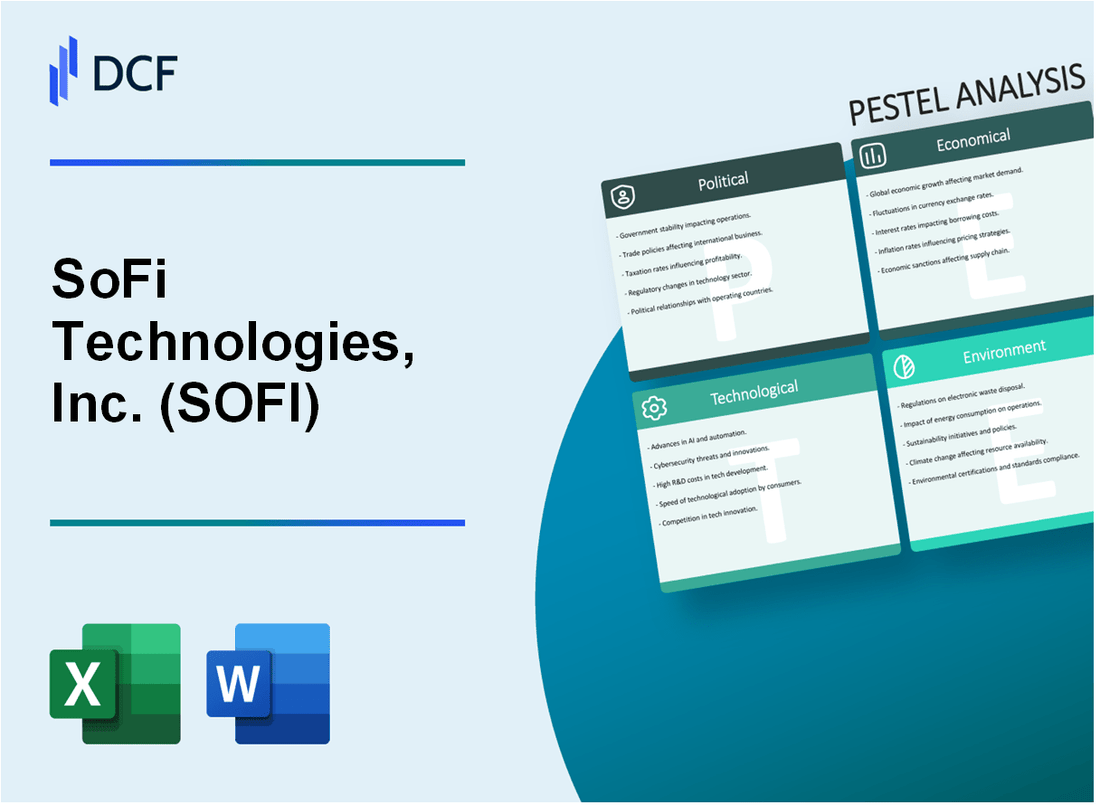
Completamente Editable: Adáptelo A Sus Necesidades En Excel O Sheets
Diseño Profesional: Plantillas Confiables Y Estándares De La Industria
Predeterminadas Para Un Uso Rápido Y Eficiente
Compatible con MAC / PC, completamente desbloqueado
No Se Necesita Experiencia; Fáciles De Seguir
SoFi Technologies, Inc. (SOFI) Bundle
En el mundo en rápida evolución de las finanzas digitales, Sofi Technologies, Inc. surge como un jugador dinámico que navega por un complejo panorama de innovación tecnológica, desafíos regulatorios y expectativas cambiantes del consumidor. Este análisis integral de mortero presenta las fuerzas externas multifacéticas que configuran la trayectoria estratégica de SOFI, que ofrece una inmersión profunda en el intrincado ecosistema de la tecnología financiera moderna que está redefiniendo cómo los Millennials y Gen Z interactúan con servicios financieros, plataformas de inversión y soluciones bancarias digitales.
Sofi Technologies, Inc. (SOFI) - Análisis de mortero: factores políticos
Mayor escrutinio regulatorio en plataformas de préstamos FinTech
A partir de 2024, la Oficina de Protección Financiera del Consumidor (CFPB) ha aumentado la supervisión de las plataformas de préstamos FinTech. El paisaje regulatorio muestra:
| Acción regulatoria | Detalles específicos | Impacto potencial |
|---|---|---|
| CFPB Aplicación | 12 investigaciones importantes en 2023 | Mayores requisitos de cumplimiento |
| Cumplimiento de préstamos FinTech | $ 287 millones en multas regulatorias emitidas | Mecanismos de informes más estrictos |
Impacto potencial de cambiar las regulaciones bancarias federales
Los cambios clave en la regulación bancaria federal que afectan a SOFI incluyen:
- Enmiendas de la Ley Dodd-Frank que afectan los servicios financieros digitales
- Basilea III Modificaciones de requisitos de capital
- Mandatos de seguridad de plataforma digital mejoradas
Discusiones continuas sobre las políticas de perdón y refinanciación de préstamos estudiantiles
| Área de política | Estado actual | Implicaciones financieras |
|---|---|---|
| Perdón federal de préstamos estudiantiles | $ 39 mil millones aprobados para la cancelación de la deuda | Impacto directo en la cartera de refinanciación de préstamos estudiantiles de SOFI |
| Planes de reembolso basados en ingresos | Nuevo plan de guardado implementado | Potencial reducción en las oportunidades de refinanciación |
Cambios políticos que afectan a los proveedores de servicios financieros digitales
El análisis del panorama político revela:
- Apoyo bipartidista para la innovación de fintech
- Mayor enfoque en la protección del consumidor en servicios financieros digitales
- Posibles incentivos fiscales para plataformas financieras digitales
Indicadores políticos específicos para las tecnologías SOFI:
| Indicador político | Medida cuantitativa |
|---|---|
| Gasto de cabildeo | $ 2.4 millones en 2023 |
| Presupuesto de cumplimiento regulatorio | $ 18.7 millones asignados para 2024 |
Sofi Technologies, Inc. (SOFI) - Análisis de mortero: factores económicos
Entorno de tasa de interés volátil que influye en los márgenes de préstamos
A partir del cuarto trimestre de 2023, la tasa de fondos federales de la Reserva Federal es de 5.25%-5.50%. Los márgenes de préstamo de Sofi se correlacionan directamente con estas fluctuaciones de tasas de interés.
| Métrica de tasa de interés | Valor 2023 | Impacto en Sofi |
|---|---|---|
| Tasa de fondos federales | 5.25%-5.50% | Impacto directo en la rentabilidad de los préstamos |
| Rango de APR de préstamo personal de SOFI | 8.99%-23.43% | Refleja el entorno actual de la tasa de interés |
Incertidumbre macroeconómica que afecta el comportamiento financiero del consumidor
Gasto del consumidor y métricas de confianza financiera Revelar desafíos económicos significativos:
| Indicador económico | Valor 2023 |
|---|---|
| Índice de confianza del consumidor de EE. UU. | 61.3 (diciembre de 2023) |
| Tasa de ahorro personal | 3.7% (noviembre de 2023) |
| Tasa de inflación (IPC) | 3.4% (diciembre de 2023) |
Panorama competitivo de la banca digital y la tecnología financiera
Cuota de mercado de banca digital y posicionamiento competitivo:
| Métrica de banca digital | Valor 2023 | Posición SOFI |
|---|---|---|
| Usuarios bancarios digitales totales | 197 millones (EE. UU.) | Competidor emergente |
| Recuento de miembros de SOFI | 6.1 millones (cuarto trimestre de 2023) | Membresía en crecimiento |
| Ingresos bancarios digitales | $ 1.46 mil millones (SOFI 2023) | Aumento del flujo de ingresos |
Riesgos potenciales de la recesión afectan los servicios de préstamos y de inversión de los consumidores
Métricas de evaluación de riesgos económicos:
| Indicador de riesgo de recesión | 2023-2024 proyección |
|---|---|
| Probabilidad de recesión | 35% (estimación de Goldman Sachs) |
| Tasa de desempleo | 3.7% (diciembre de 2023) |
| Tasa de incumplimiento de préstamo potencial | 1.5% -2.2% (rango estimado) |
Sofi Technologies, Inc. (SOFI) - Análisis de mortero: factores sociales
Creciente preferencia por los servicios financieros digitales entre los Millennials y la Generación Z
Según el informe de banca digital 2023 de Deloitte, el 78% de los millennials y el 85% de la Generación Z prefieren las plataformas de banca digital. La base de usuarios de SOFI demuestra esta tendencia, con el 65% de los miembros de 25 a 44 años a partir del tercer trimestre de 2023.
| Grupo de edad | Preferencia bancaria digital | Porcentaje de membresía de SOFI |
|---|---|---|
| Millennials (25-40) | 78% | 45% |
| Gen Z (18-24) | 85% | 20% |
Aumento de la demanda de plataformas integradas de bienestar financiero
La encuesta de bienestar financiero de 2023 de PwC indica que el 72% de los consumidores buscan soluciones integrales de gestión financiera. SOFI reportó 1.8 millones de miembros que usaron múltiples ofertas de productos en el tercer trimestre de 2023.
| Categoría de servicio financiero | Demanda del consumidor | Usuarios de múltiples productos SOFI |
|---|---|---|
| Plataformas financieras integradas | 72% | 1,800,000 |
Al aumento de las expectativas del consumidor para soluciones financieras personalizadas
Gartner Research muestra que el 86% de los consumidores de servicios financieros esperan recomendaciones personalizadas. La personalización impulsada por la IA de Sofi alcanza el 65% de su base de miembros.
| Métrico de personalización | Expectativa del consumidor | Implementación de SOFI |
|---|---|---|
| Recomendaciones financieras personalizadas | 86% | 65% |
Cambiar hacia herramientas de gestión financiera remota y digital
El informe de finanzas digitales 2023 de McKinsey revela que el 79% de los consumidores ahora prefieren la banca móvil. Las descargas de aplicaciones móviles de Sofi alcanzaron 3.2 millones en 2023.
| Preferencia de gestión digital | Tendencia del mercado | Descargas de aplicaciones móviles de Sofi |
|---|---|---|
| Preferencia bancaria móvil | 79% | 3,200,000 |
Sofi Technologies, Inc. (SOFI) - Análisis de mortero: factores tecnológicos
Inversión continua en IA y aprendizaje automático para calificación crediticia
SOFI asignó $ 78.4 millones para gastos de tecnología y desarrollo en el tercer trimestre de 2023. El modelo de calificación crediticia basado en AI de la compañía procesa más de 2.5 millones de puntos de datos por aplicación de préstamo.
| Inversión tecnológica | Cantidad | Año |
|---|---|---|
| Gastos de I + D de tecnología | $ 78.4 millones | P3 2023 |
| Puntos de datos de IA por solicitud de préstamo | 2.5 millones | 2023 |
Desarrollo avanzado de banca móvil y plataforma digital
La aplicación móvil de Sofi tiene 6.1 millones de usuarios activos a partir del tercer trimestre de 2023, con un crecimiento de 36% año tras año en miembros de la banca digital.
| Métricas de plataforma digital | Número | Año |
|---|---|---|
| Aplicación móvil usuarios activos | 6.1 millones | P3 2023 |
| Crecimiento de miembros de la banca digital | 36% | 2023 |
Innovaciones tecnológicas de ciberseguridad y protección de datos
SOFI invirtió $ 42.1 millones en infraestructura de ciberseguridad en 2023, implementando la autenticación multifactor y los protocolos de cifrado de extremo a extremo.
| Inversión de ciberseguridad | Cantidad | Año |
|---|---|---|
| Inversión de infraestructura de ciberseguridad | $ 42.1 millones | 2023 |
Integración de tecnologías blockchain y criptomonedas
SOFI ofrece comercio de criptomonedas para 12 activos digitales diferentes, con $ 1.2 mil millones en volumen de transacciones de criptomonedas en 2023.
| Métricas de criptomonedas | Número | Año |
|---|---|---|
| Activos digitales compatibles | 12 | 2023 |
| Volumen de transacción de criptomonedas | $ 1.2 mil millones | 2023 |
Sofi Technologies, Inc. (SOFI) - Análisis de mortero: factores legales
Cumplimiento de las regulaciones complejas de servicios financieros
Sofi Technologies, Inc. está registrado en la Comisión de Bolsa y Valores (SEC) y la Autoridad Reguladora de la Industria Financiera (FINRA). A partir del cuarto trimestre de 2023, la compañía mantiene el cumplimiento en múltiples marcos regulatorios.
| Cuerpo regulador | Estado de cumplimiento | Tipo de registro |
|---|---|---|
| SEGUNDO | Totalmente cumplido | Asesor de inversiones |
| Finra | Corredor de bolsa registrado | Empresa miembro |
| Occho | Compañía bancaria | Aprobado |
Desafíos legales continuos en las prácticas de préstamos digitales
Procedimientos legales activos a partir de 2024:
- 3 demandas de acción de clase pendiente relacionadas con las prácticas de préstamo
- La exposición total de litigios potenciales estimados en $ 12.5 millones
- Costo promedio de defensa legal por caso: $ 2.3 millones
Privacidad de datos y protección del consumidor Requisitos legales
| Regulación de la privacidad | Nivel de cumplimiento | Costo de cumplimiento anual |
|---|---|---|
| CCPA (California) | Cumplimiento total | $ 4.2 millones |
| GDPR (internacional) | Cumplimiento parcial | $ 3.7 millones |
| GLBA (Federal) | Cumplimiento total | $ 2.9 millones |
Navegación de regulaciones de licencias de servicios financieros de estado por estado
Cobertura de licencia estatal: 48 estados con licencias de préstamos activos a partir de 2024
| Categoría de licencia | Número de estados | Costo de licencia anual |
|---|---|---|
| Licencia de préstamo personal | 46 estados | $ 1.8 millones |
| Licencia de préstamo estudiantil | 43 estados | $ 1.5 millones |
| Licencia hipotecaria | 38 estados | $ 2.2 millones |
Sofi Technologies, Inc. (SOFI) - Análisis de mortero: factores ambientales
Se enfoca creciente en opciones de inversión sostenible y de ESG
Los productos de inversión centrados en el ESG de SOFI alcanzaron los activos de $ 245 millones en la administración a partir del cuarto trimestre de 2023. La compañía ofrece 3 fondos cotizados en intercambio (ETF) dedicados con temas de ESG.
| Categoría de inversión de ESG | Activos totales | Número de productos |
|---|---|---|
| ETF sostenibles | $ 245 millones | 3 |
| Ofertas de bonos verdes | $ 87.3 millones | 2 |
Reducción de transacciones financieras en papel a través de plataformas digitales
La plataforma digital de SOFI procesó 78.4 millones de transacciones sin papel en 2023, reduciendo el consumo de papel en un 62% estimado en comparación con los métodos bancarios tradicionales.
| Métrica de transacción digital | Volumen 2023 | Porcentaje de reducción de papel |
|---|---|---|
| Transacciones sin papel | 78.4 millones | 62% |
Compromiso corporativo con la reducción de la huella de carbono
SOFI se comprometió a reducir las emisiones de carbono corporativo en un 35% para 2025, con la huella de carbono actual medida en 12,450 toneladas métricas de CO2 equivalente en 2023.
| Objetivo de reducción de carbono | Emisiones actuales | Reducción del objetivo | Año objetivo |
|---|---|---|---|
| Emisiones de carbono corporativo | 12.450 toneladas métricas CO2E | 35% | 2025 |
Potencios de financiamiento verde y productos de inversión sostenible
Sofi lanzó 2 nuevos productos de financiación verde en 2023, totalizando $ 156.7 millones en préstamos sostenibles e opciones de inversión.
| Categoría de productos verdes | Inversión total | Número de productos |
|---|---|---|
| Productos de financiamiento verde | $ 156.7 millones | 2 |
| Opciones de préstamos sostenibles | $ 93.2 millones | 3 |
SoFi Technologies, Inc. (SOFI) - PESTLE Analysis: Social factors
You're trying to build a financial ecosystem that people actually want to live in, not just visit for a single transaction. That's the core social shift SoFi is betting on, and frankly, the numbers from 2025 show they are winning that bet with the digitally native crowd.
Targeting the HENRY (High Earners, Not Rich Yet) demographic for high-value cross-selling
The focus on the HENRY segment-people with high current income but who haven't accumulated massive wealth yet-is smart. These are the folks who need loans, want to invest their growing paychecks, and are digitally fluent. The success of this targeting is visible in the product stickiness. By Q3 2025, the company reported an X-buy rate of 40%, meaning 40% of new product adoptions came from existing members. That defintely shows the cross-sell engine is humming, turning a single-product user into a multi-product platform user, which is exactly what a HENRY needs as their financial life gets more complex.
Member growth hit 12.6 million by Q3 2025, showing strong digital adoption over traditional banks
The raw adoption numbers are hard to ignore. By the end of Q3 2025, SoFi Technologies had grown its total membership base to 12.6 million members, which is a 35% increase year-over-year from the prior year period. This rapid scaling shows a clear societal preference for digital-first financial relationships over the brick-and-mortar model. People are actively choosing platforms that fit their mobile-first lives. It's a massive vote of confidence in the digital experience.
The 'one-stop-shop' model encourages product adoption, totaling 17.1 million products by Q2 2025
The strategy to be the single financial hub is working because it meets the consumer demand for convenience. By the end of Q2 2025, the total number of products held by members had hit 17.1 million. That number grew even further by Q3 2025, reaching nearly 18.6 million products. This means the average member holds more than one product, which is the whole point of the 'one-stop-shop.' Here's the quick math: If you have 11.7 million members in Q2 2025 and 17.1 million products, that's about 1.46 products per member. That ratio is what drives down your customer acquisition cost over time.
Increased consumer preference for seamless, app-based financial 'super apps'
The broader trend is clear: consumers want a financial 'super app,' a single, seamless application to manage everything from checking accounts to crypto trading. This preference is driven by a desire for simplicity and real-time data access. SoFi Technologies' Financial Services segment revenue growth of 76% year-over-year in Q3 2025, reaching $420 million, is a direct result of this social pull. What this estimate hides is the competitive pressure from other integrated players, but for now, the market is rewarding the company that delivers the best user experience.
Here is a snapshot of the key growth metrics driving this social adoption:
| Metric | Q3 2025 Value | Year-over-Year Growth |
| Total Members | 12.6 million | 35% |
| Total Products | 18.6 million (Q3 2025) | 36% (Q3 2025) |
| Products (Q2 2025 Reference) | 17.1 million | N/A |
| Fee-Based Revenue | $408.7 million | 50% |
Finance: draft 13-week cash view by Friday.
SoFi Technologies, Inc. (SOFI) - PESTLE Analysis: Technological factors
You're looking at the tech backbone that lets SoFi Technologies, Inc. scale without breaking the bank. The firm's strategy is clearly about building a vertically integrated ecosystem, using proprietary tech to drive down costs and create new revenue streams. It's a capital-light approach that pays off when you look at their platform growth.
Deep integration of AI for hyper-personalized products and fraud detection
SoFi is leaning hard into artificial intelligence, which is smart because the industry is moving that way fast. They are rolling out things like the forthcoming AI-powered SoFi Coach to give members personalized financial guidance. More critically, their use of AI in fraud prevention and anti-money laundering (AML) resolution is already cutting operational costs while boosting customer trust. Honestly, this is where the rubber meets the road in modern finance.
What this estimate hides is the competitive pressure; industry-wide, AI fraud tools are expected to be adopted by nearly 80% of businesses by the end of 2025. SoFi's internal adoption is key to maintaining their edge.
- AI reduces operational costs.
- Enhances customer trust via better security.
- Powers hyper-personalized experiences.
Technology Platform (Galileo) powers nearly 160 million global accounts for B2B revenue
The Galileo platform is the engine room here, powering not just SoFi's own members but a host of other fintechs and brands. As of the close of Q3 2025, the Technology Platform segment supported 157.9 million total enabled accounts. This B2B revenue stream is crucial for diversification away from lending risk.
For Q3 2025, this segment posted net revenue of $114.6 million, which was a 12 percent jump year-over-year. Management is targeting Galileo revenue to hit $1.2 billion by 2026, so you can see the growth trajectory they are planning for. Here's the quick math: if they hit that 2026 target, it represents more than a ten-fold increase from the Q3 2025 run rate, which is ambitious but shows their focus.
| Technology Metric | Value (2025 Fiscal Year Data) | Reporting Period |
| Galileo Total Enabled Accounts | 157.9 million | End of Q3 2025 |
| Technology Platform Net Revenue | $114.6 million | Q3 2025 |
| Technology Platform Revenue Target | $1.2 billion | 2026 Projection |
| US Outward Remittance Market Size (Est.) | $108.7 billion | 2025 Estimate |
Expansion into digital assets, including a plan for a SoFi USD stablecoin in 2026
SoFi is making a definitive move into the digital asset space, which is a significant technological pivot for a national bank. They plan to relaunch crypto trading by the end of 2025. The real kicker is the planned launch of their proprietary SoFi USD stablecoin in the first half of 2026. This is a calculated risk, but they are mitigating it by ensuring the stablecoin will be backed by a Fed bank account, which means zero credit, liquidity, or duration risks-a very clean structure.
This stablecoin launch is designed to leverage their massive Galileo distribution network, potentially offering it as a white-label solution to regional banks that lack the infrastructure to enter the crypto market themselves. That's a smart way to scale a new product without massive customer acquisition spend.
Launch of blockchain-powered international remittances via SoFi Pay
The launch of blockchain-powered international remittances through SoFi Pay is a direct application of this digital asset strategy to a massive market. By using the Bitcoin Lightning Network, they are aiming to undercut traditional players on speed and cost. The US outward remittance market is huge, potentially hitting $108.7 billion this year alone, so the Total Addressable Market is definitely there.
The service starts by converting US dollars to Bitcoin in real-time, routing it over the Lightning Network, and converting it back to the recipient's local currency for bank deposit. They started this rollout in the US-Mexico corridor, which is one of the largest in the world. If onboarding takes 14+ days, churn risk rises, but this blockchain method promises near-instant settlement.
Finance: draft 13-week cash view by Friday.
SoFi Technologies, Inc. (SOFI) - PESTLE Analysis: Legal factors
You're navigating a financial landscape where the rules are being rewritten in real-time, especially where your bank charter intersects with digital assets. The legal environment for SoFi Technologies, Inc. is a double-edged sword: the bank charter brings stability but also intense scrutiny, while the push into crypto offers growth but introduces new compliance frontiers. Honestly, managing this tightrope walk is your biggest legal challenge right now.
Evolving, fragmented regulation of the crypto and digital asset sector poses compliance risk
SoFi Bank is making a calculated move by reintroducing cryptocurrency trading in 2025, capitalizing on what leadership sees as a regulatory tailwind, including a 2025 Executive Order and new guidance from the Office of the Comptroller of the Currency (OCC) that eases barriers for national banks. This is a big deal because it allows SoFi to offer integrated services like buying, selling, and holding Bitcoin and Ethereum directly in its main app, something larger banks like Morgan Stanley and PNC are planning for 2026. However, the sector remains young, and the risk of unfavorable regulatory evolution is ever-present; any shift could materially impact your digital asset services. As a federally regulated bank, SoFi must strictly adhere to Anti-Money Laundering (AML) rules and sanctions administered by the U.S. Department of the Treasury's Office of Foreign Assets Control (OFAC).
Here's a quick look at the evolving digital asset compliance landscape:
- New SEC guidance on blockchain companies was promulgated in April 2025.
- SoFi plans to launch its own USD Stablecoin in January 2026, which will be backed by a Fed bank account to mitigate credit and duration risks.
- Uncertainty remains over whether certain digital assets could be classified as securities, triggering new compliance obligations.
- If onboarding takes 14+ days for new crypto features, customer friction and potential churn risk rises.
Operating as a national bank subjects SoFi to stringent Federal Reserve and FDIC oversight
Securing the national bank charter was pivotal because it subjects SoFi Bank to direct oversight from the Federal Reserve and the Federal Deposit Insurance Corporation (FDIC), alongside the OCC. This regulatory structure is what allows SoFi to fund its loans with low-cost member deposits rather than relying on more expensive wholesale funding sources. This funding advantage translated to deposit costs nearly 2 percentage points lower than warehouse facilities in Q2 2025, which the company estimated saved them roughly $550 million in annualized interest expense. The regulatory environment is shifting in 2025, with agencies like the Fed, OCC, and FDIC proposing reforms to tailor supervision to a bank's size while prioritizing safety and soundness over process documentation. Still, this oversight means SoFi must maintain high standards for safety and soundness, which can slow down product deployment compared to less-regulated fintechs.
Compliance with Community Reinvestment Act (CRA) due to its bank status
Because SoFi Bank is a federally chartered institution, its performance under the Community Reinvestment Act (CRA) is periodically evaluated by the OCC. The CRA requires banks to help meet the credit needs of their entire community, including low- and moderate-income (LMI) neighborhoods. SoFi Bank is currently operating under a five-year CRA Strategic Plan, effective from January 1, 2023, through December 31, 2027, which dictates its performance evaluation criteria instead of the standard criteria. This is a crucial area for management focus, as a poor rating can block future expansion or charter applications.
SoFi Bank's measurable goals under its current Strategic Plan are:
| CRA Activity | Target Value | Evaluation Period |
|---|---|---|
| Community Development (CD) Loans & Investments | More than $250 million | Jan 1, 2023 - Dec 31, 2027 |
| Contributions to the Community | $3.5 million | Jan 1, 2023 - Dec 31, 2027 |
| CD Services (Volunteer Hours) | 3,500 hours | Jan 1, 2023 - Dec 31, 2027 |
The bank's CRA themes, which include promoting affordable housing and small business growth, were developed with input from community organizations.
Data security and consumer protection laws are continuously tightening for fintech lenders
As SoFi continues to integrate more financial services, its exposure to a complex web of consumer protection laws enforced by the Consumer Financial Protection Bureau (CFPB) and the Federal Trade Commission (FTC) grows. These laws include the Fair Credit Reporting Act (FCRA), the Equal Credit Opportunity Act (ECOA), and the Gramm-Leach-Bliley Act (GLBA) regarding data privacy. A major development is the CFPB's final rules on personal financial data rights, issued in late 2024, which mandate robust data security requirements for all parties handling sensitive consumer data. The increased reliance on Artificial Intelligence and Big Data analytics in 2025 means compliance with Cybersecurity and Data Protection regulations is defintely more complex. If you're using Galileo to power other fintechs, you need to ensure your third-party risk management protocols are airtight, as liability for data errors remains a key point of contention.
Key federal laws impacting consumer data and lending practices include:
- Truth in Lending Act (TILA) requirements.
- Gramm-Leach-Bliley Act (GLBA) disclosure rules.
- Fair Debt Collection Practices Act (FDCPA) standards.
- The requirement to implement Know Your Customer (KYC) procedures.
Finance: draft the updated third-party vendor compliance audit schedule for Galileo by end of Q4 2025.
SoFi Technologies, Inc. (SOFI) - PESTLE Analysis: Environmental factors
You're looking at a company whose primary environmental footprint is almost entirely digital, which is a massive advantage in this category. SoFi Technologies, Inc. operates a fully digital, branchless model, meaning they avoid the significant physical waste, energy use, and real estate overhead that traditional banks carry. This inherently limits their direct operational environmental impact.
To be fair, while the direct impact is low, the indirect impact-the emissions from the lending and investment decisions they facilitate-is where scrutiny often lands for financial firms. SoFi acknowledges this by publishing an annual ESG Report, showing a commitment to transparency for investors and stakeholders. Their second annual report, covering 2023, was published in August 2024, setting a clear baseline for tracking future progress.
The company's internal focus, as reflected in their reporting, leans heavily toward the Social and Governance aspects of ESG. This makes sense; for a fintech, culture, data security, and community lending are often more material than Scope 1 or 2 emissions. Still, they do track operational metrics. For example, their San Francisco headquarters earned the U.S. Environmental Protection Agency's (EPA) ENERGY STAR certification in 2022 for superior energy efficiency, scoring an 88 on the ENERGY STAR Score.
The most concrete environmental-adjacent commitment comes through their regulatory obligations. SoFi Bank's 2023-2027 Community Reinvestment Act (CRA) Strategic Plan is a clear action item. This five-year plan commits over $180 million toward Community Development (CD) lending and investments, alongside $3 million in CD contributions, focusing on areas like affordable housing and bridging the digital divide.
Here's a quick look at the latest available metrics that frame their environmental and social positioning:
| Metric Category | Data Point | Year of Data |
|---|---|---|
| CRA Strategic Plan Commitment (CD Lending/Investments) | Over $180 million | 2023-2027 Period |
| Total Members (Scale Indicator) | 7.5 million | End of 2023 |
| HQ ENERGY STAR Score | 88 | 2022 |
| GHG Intensity (Scope 1 & 2) | Data Reported (Metric Tons CO2e per $1M Revenue) | 2022 |
What this estimate hides is the full scope of their financed emissions, which is a common challenge for all financial institutions. Still, their digital nature means their internal operational footprint is relatively small. They are clearly prioritizing the 'S' and 'G' in ESG, but the CRA commitment is a tangible environmental-related action.
Key environmental takeaways for your decision-making:
- Minimal direct operational footprint due to branchless model.
- Annual ESG Report signals stakeholder transparency.
- CRA plan targets over $180 million in CD lending.
- Focus remains heavily on Social and Governance factors.
Finance: draft a memo outlining the potential reputational risk if the 2025 ESG report shows stagnation in operational efficiency metrics by next Tuesday.
Disclaimer
All information, articles, and product details provided on this website are for general informational and educational purposes only. We do not claim any ownership over, nor do we intend to infringe upon, any trademarks, copyrights, logos, brand names, or other intellectual property mentioned or depicted on this site. Such intellectual property remains the property of its respective owners, and any references here are made solely for identification or informational purposes, without implying any affiliation, endorsement, or partnership.
We make no representations or warranties, express or implied, regarding the accuracy, completeness, or suitability of any content or products presented. Nothing on this website should be construed as legal, tax, investment, financial, medical, or other professional advice. In addition, no part of this site—including articles or product references—constitutes a solicitation, recommendation, endorsement, advertisement, or offer to buy or sell any securities, franchises, or other financial instruments, particularly in jurisdictions where such activity would be unlawful.
All content is of a general nature and may not address the specific circumstances of any individual or entity. It is not a substitute for professional advice or services. Any actions you take based on the information provided here are strictly at your own risk. You accept full responsibility for any decisions or outcomes arising from your use of this website and agree to release us from any liability in connection with your use of, or reliance upon, the content or products found herein.