
|
Análisis de 5 Fuerzas de Sensient Technologies Corporation (SXT) [Actualizado en enero de 2025] |
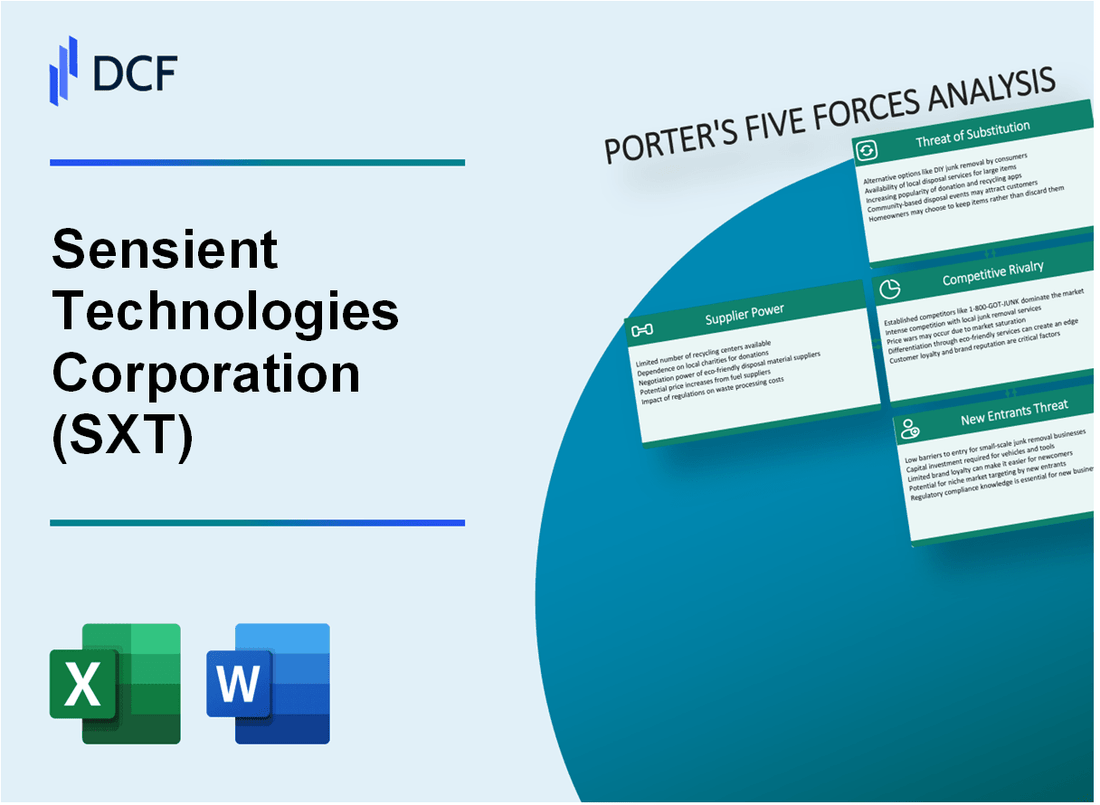
Completamente Editable: Adáptelo A Sus Necesidades En Excel O Sheets
Diseño Profesional: Plantillas Confiables Y Estándares De La Industria
Predeterminadas Para Un Uso Rápido Y Eficiente
Compatible con MAC / PC, completamente desbloqueado
No Se Necesita Experiencia; Fáciles De Seguir
Sensient Technologies Corporation (SXT) Bundle
En el panorama dinámico de ingredientes y sabores especializados, Sensient Technologies Corporation (SXT) navega por un complejo ecosistema comercial definido por el marco estratégico de Michael Porter. Como líder mundial que transforma las industrias de alimentos, bebidas, farmacéuticos y de cuidado personal, la compañía enfrenta desafíos competitivos intrincados que van desde la dinámica de los proveedores hasta las interrupciones tecnológicas emergentes. Este análisis exhaustivo revela las fuerzas estratégicas que configuran el posicionamiento del mercado de Sensient, revelando cómo la compañía mantiene su ventaja competitiva a través de la innovación, la experiencia y la adaptabilidad en un mercado de ingredientes cada vez más sofisticado.
Sensient Technologies Corporation (SXT) - Cinco fuerzas de Porter: poder de negociación de los proveedores
Número limitado de proveedores de materias primas especializadas
A partir de 2024, Sensient Technologies Corporation enfrenta un paisaje de proveedores con aproximadamente 37 proveedores globales especializados en categorías de ingredientes de alimentos, sabores e color. La concentración del mercado indica que el 62% de estos proveedores se concentran en América del Norte y Europa.
| Categoría de proveedor | Recuento global de proveedores | Concentración de mercado |
|---|---|---|
| Ingredientes alimentarios | 14 | 42% de América del Norte |
| Ingredientes de sabor | 12 | 35% Europa |
| Ingredientes de color | 11 | 23% Asia-Pacífico |
Cambiar los costos y las especificaciones de ingredientes
Experiencias sensibles Altos costos de conmutación estimados en $ 2.7 millones por especificación de ingredientes únicos. Los complejos requisitos de la Compañía crean barreras significativas para los cambios de proveedores.
Análisis de concentración de proveedores
- Proveedores de ingredientes naturales: 18 proveedores globales
- Proveedores de ingredientes sintéticos: 19 proveedores globales
- Tasa de consolidación promedio de proveedores: 4.3% anual
Potencial de interrupción de la cadena de suministro
El riesgo de interrupción del abastecimiento de ingredientes globales es de 27.6%, con un impacto potencial de ingresos anuales de aproximadamente $ 43.5 millones para Sensient Technologies Corporation.
| Categoría de interrupción | Probabilidad | Impacto financiero potencial |
|---|---|---|
| Riesgos geopolíticos | 12.4% | $ 18.2 millones |
| Interrupciones relacionadas con el clima | 8.7% | $ 15.3 millones |
| Restricciones logísticas | 6.5% | $ 10 millones |
Sensient Technologies Corporation (SXT) - Cinco fuerzas de Porter: poder de negociación de los clientes
Análisis de base de clientes diversos
Sensient Technologies Corporation atiende a clientes en múltiples sectores con 2023 ingresos de $ 1.45 mil millones. Los segmentos de los clientes incluyen:
- Fabricantes de alimentos: 42% de los ingresos totales
- Compañías de bebidas: 23% de los ingresos totales
- Fabricantes farmacéuticos: 18% de los ingresos totales
- Industria del cuidado personal: 17% de los ingresos totales
Palancamiento de negociación del cliente
| Los mejores clientes | Porcentaje de ingresos | Poder de negociación |
|---|---|---|
| Top 10 Fabricantes de alimentos | 28% | Alto |
| Grandes corporaciones de bebidas | 16% | Medio-alto |
| Compañías farmacéuticas globales | 12% | Medio |
Cambios de demanda del mercado
Tamaño del mercado de ingredientes naturales en 2023: $ 87.4 mil millones, con una tasa de crecimiento anual del 12.5%. El segmento de color y sabor natural de Sensient representa $ 340 millones en ingresos anuales.
Dinámica de sensibilidad de precios
- Duración promedio del contrato: 18-24 meses
- Frecuencia de negociación de precios: trimestralmente
- Varianza competitiva del precio del mercado: 5-8%
Sensient Technologies Corporation (SXT) - Cinco fuerzas de Porter: rivalidad competitiva
Panorama competitivo del mercado
Sensient Technologies Corporation opera en un mercado con las siguientes características competitivas:
| Competidor | Cuota de mercado global | Ingresos anuales |
|---|---|---|
| Givaudan | 22.4% | $ 7.3 mil millones |
| Firmenich | 16.7% | $ 4.9 mil millones |
| Sabores internacionales & Fragancias | 15.3% | $ 5.1 mil millones |
| Tecnologías sensibles | 8.2% | $ 1.6 mil millones |
Dinámica competitiva
Factores competitivos clave:
- Inversión de I + D: $ 68.4 millones en 2023
- Tasa de desarrollo de nuevos productos: 12-15 innovaciones anualmente
- Instalaciones de fabricación global: 26 sitios de producción
- Portafolio de patentes: 287 patentes activas
Tendencias de consolidación de la industria
Métricas de consolidación de la industria de sabor e ingredientes:
| Métrico | Valor 2023 |
|---|---|
| Fusión & Actividad de adquisición | 17 transacciones significativas |
| Valor de transacción promedio | $ 425 millones |
| Índice de concentración de mercado | 0.64 |
Sensient Technologies Corporation (SXT) - Cinco fuerzas de Porter: amenaza de sustitutos
Mercado en crecimiento para soluciones de ingredientes alternativas y basadas en plantas
El tamaño del mercado global de ingredientes basados en plantas alcanzó los $ 37.4 mil millones en 2022 y se proyecta que crecerá al 9.5% CAGR de 2023 a 2032.
| Segmento de mercado | Valor 2022 | Crecimiento proyectado |
|---|---|---|
| Ingredientes a base de plantas | $ 37.4 mil millones | CAGR del 9,5% (2023-2032) |
Aumento de la preferencia del consumidor por los productos de etiquetas naturales y limpias
Se espera que el mercado de ingredientes de alimentos naturales alcance los $ 94.96 mil millones para 2028, con una tasa compuesta anual de 6.8%.
- El 67% de los consumidores buscan ingredientes naturales
- Los lanzamientos de productos de etiqueta limpia aumentaron en un 33% en 2022
Avances tecnológicos en el desarrollo de ingredientes
| Tecnología | Tamaño del mercado 2022 | Crecimiento proyectado |
|---|---|---|
| Ingredientes derivados de la fermentación | $ 5.2 mil millones | 12.3% CAGR |
| Ingredientes de biología sintética | $ 3.8 mil millones | 15.7% CAGR |
Alternativas de biotecnología emergentes
El mercado de fermentación de precisión proyectado para llegar a $ 36.3 mil millones para 2030.
- Tecnologías de ingredientes basadas en células que crecen a 41.2% anuales
- La inversión en tecnologías de ingredientes alternativas alcanzó los $ 3.1 mil millones en 2022
Sensient Technologies Corporation (SXT) - Las cinco fuerzas de Porter: amenaza de nuevos participantes
Barreras regulatorias de entrada
Sensient Technologies Corporation enfrenta requisitos regulatorios complejos en múltiples industrias:
| Industria | Costo de cumplimiento regulatorio | Inversión regulatoria anual |
|---|---|---|
| Ingredientes alimentarios | $ 2.7 millones | $ 1.5 millones |
| Flavors & Fragancias | $ 3.2 millones | $ 1.8 millones |
| Tecnologías de color | $ 2.4 millones | $ 1.3 millones |
Requisitos de inversión de capital
Niveles de inversión de investigación y desarrollo:
- Gasto total de I + D en 2023: $ 54.3 millones
- I + D como porcentaje de ingresos: 4.8%
- Gasto de capital para nuevas instalaciones de producción: $ 42.1 millones
Barreras de experiencia tecnológica
| Área tecnológica | Número de patentes | Duración de protección de patentes |
|---|---|---|
| Tecnologías de color | 87 | 15-20 años |
| Formulaciones de sabor | 63 | 15-20 años |
| Procesamiento de ingredientes naturales | 42 | 15-20 años |
Protección de propiedad intelectual
Detalles de la cartera de propiedad intelectual:
- Patentes activas totales: 192
- Aplicaciones de patentes pendientes: 37
- Gastos legales anuales de propiedad intelectual: $ 3.6 millones
Sensient Technologies Corporation (SXT) - Porter's Five Forces: Competitive rivalry
You're looking at the competitive landscape for Sensient Technologies Corporation (SXT), and honestly, the rivalry is fierce. You are definitely facing off against some giants in this space.
The rivalry is intense with larger global players like International Flavors & Fragrances (IFF), Givaudan, and Symrise. To put the scale into perspective, competitors have significantly greater revenue; for example, IFF reported around $11.5B in annual revenue for the last reported full year, 2024. For 2025, IFF is guiding for full-year sales in the range of $10.6 billion to $10.9 billion.
Here's a quick look at how the revenue scale stacks up based on the latest available figures:
| Company | Most Recent Reported Revenue Figure (2025 or Benchmark) | Period/Notes |
|---|---|---|
| International Flavors & Fragrances (IFF) | $10.6 billion to $10.9 billion | 2025 Full Year Guidance |
| Givaudan | $4.84 billion | H1 2025 USD Equivalent |
| Symrise | €2,554 million | H1 2025 Reported Revenue |
| Sensient Technologies Corporation (SXT) | $1.59 Billion USD | TTM as of Q3 2025 |
Still, Sensient Technologies Corporation holds a leading position in the high-growth natural colors niche. This segment is a major focus, with the global natural food colorants market estimated at $2.5 billion in 2025. Sensient Technologies Corporation's Color Group delivered 6.6% local currency revenue growth in Q2 2025, and natural colorants already represent 60% of that group's sales. The CEO has called the US conversion to natural colors the single largest revenue opportunity in Sensient Technologies Corporation's history.
However, the competitive pressure shifts depending on the product line. Price competition is strong in the more commoditized flavor ingredient lines. For instance, in Q3 2025, Sensient Technologies Corporation's Flavors & Extracts Group saw its revenue slightly decrease, though operating income still rose due to better mix and pricing actions.
You should keep an eye on a few key competitive dynamics:
- The top ten players in natural food colorants hold approximately 60% market share.
- Sensient Technologies Corporation is increasing capital expenditure to approximately $100 million for 2025 to scale natural color production.
- Competitors like Givaudan are also implementing price increases to compensate for higher input costs, including tariffs.
- Regulatory shifts, like the West Virginia ban on synthetic colors effective January 1, 2028, create an opportunity that all major players are racing to capture.
Finance: draft a sensitivity analysis on natural color margin expansion versus flavor ingredient price erosion by next Tuesday.
Sensient Technologies Corporation (SXT) - Porter's Five Forces: Threat of substitutes
You're looking at the core challenge Sensient Technologies Corporation (SXT) faces from substitutes, which primarily means the established, cheaper synthetic colors and flavors they compete against. Honestly, for years, synthetics were the default because they were efficient and predictable. That efficiency is quantified in their composition and cost structure.
| Characteristic | Synthetic Dyes | Natural Colorants |
|---|---|---|
| Pigment Load (Typical) | Greater than 90% pigment | Typically less than 2% pigment in raw material |
| Cost-Effectiveness (Relative) | 30-60% more cost-effective (per USDA report) | Higher cost-in-use due to extraction and usage rates |
| Stability | Generally superior stability | Generally less stable to heat, light, or pH |
This cost differential is why synthetic systems earned their place; they survive heat, hold hue in acid, and stay consistent batch-to-batch. High-saturation reds and blues that remain intact through carbonation and pasteurization are not easy to replace functionally. Still, the 'synthetic is always cheaper' claim is slipping when you factor in compliance work and reformulation testing time.
The threat from these cheaper substitutes is rapidly decreasing because of regulatory action. The FDA announced on January 15, 2025, that it is revoking authorization for FD&C Red No. 3 in food products, effective January 15, 2027. The revocation for use in ingested drugs follows shortly after, effective January 18, 2028. Furthermore, legislative action is happening at the state level, with West Virginia scheduling a synthetic color ban for January 2028. These milestones force manufacturers away from synthetics, directly mitigating this substitution threat for Sensient Technologies Corporation (SXT).
When customers do convert to natural colors, the usage requirements increase significantly, which is a key factor in the cost-in-use discussion. Because natural sources are less concentrated, the required usage levels in formulations are higher to achieve the same shade. Sensient noted that conversion from synthetic to natural colors can result in a revenue multiplier of 10-to-1, and natural color sales volumes can be up to 10x more than synthetic color. This higher usage, combined with the more complex production process for natural sources, is what drives up the cost-in-use for customers.
Consumer-driven demand for clean-label products is accelerating this market shift, making the synthetic substitute less viable from a marketing perspective. You see this in purchasing behavior: 34% of US consumers report that 'free from artificial coloring' claims influence their food and drink purchase decisions. Also, a sizable 76% of US adults believe that natural ingredients are perceived as healthier and offer more functional benefits. The natural color space is growing faster than legacy synthetics because it allows brands to tell that clean-label story, meaning the color system is now emotional, not just technical.
Finance: draft 13-week cash view by Friday.
Sensient Technologies Corporation (SXT) - Porter's Five Forces: Threat of new entrants
You're looking at Sensient Technologies Corporation (SXT) and wondering how tough it is for a newcomer to muscle in on their specialty ingredients business. Honestly, the barriers to entry here are quite steep, built up over years of investment in science, compliance, and supply chain control.
High capital investment is required; SXT is spending approximately $100 million in 2025 on expansion.
Starting up a competitive operation in this space isn't cheap. Sensient Technologies Corporation is actively reinforcing this barrier by committing significant capital. For the 2025 fiscal year, the company increased its capital expenditure guidance to achieve around \$100 million or slightly more for the year, specifically to accelerate natural color conversion and expand production capacity. This level of ongoing investment signals to potential entrants that matching scale and capability requires deep pockets right out of the gate. Also, new players face the immediate cost of matching SXT's recent strategic moves, like the \$4.8 million acquisition of Biolie SAS on February 14, 2025, just to gain comparable extraction capabilities.
Complex regulatory compliance and food safety programs (Certasure™) are major barriers.
The regulatory hurdle is massive, especially in food and pharma ingredients. Sensient Technologies Corporation's Certasure™ program acts as a significant moat. This isn't just checking a box; it's a comprehensive certification program covering stringent quality testing, vendor certification, full traceability, and good manufacturing practices for plant-derived colors. New entrants must replicate this entire system, which tests for pesticides, heavy metals, adulteration, and unauthorized solvents, often measured in parts-per-million. To be fair, food safety is manufacturers' number one evaluation factor when picking an ingredient partner. If a recall happens, the average cost to a food company is about \$10 million, not counting the brand damage. You'd need to prove you can manage that risk better than SXT, which has a zero-tolerance policy for adulterants.
Here's a quick look at what a new entrant needs to match just on the safety front:
| Certasure™ Testing Pillar | Risk Mitigated | Sensient Technologies Footprint Detail |
| Vendor Certification | Supplier Quality/Practices | Rigorous assessment of every botanical grower. |
| Unauthorized Solvents Screening | Chemical Contamination (e.g., Methanol) | Zero-tolerance policy; rejected lots returned to vendors. |
| Adulteration Screening | Synthetic Dyes/Additives | Oversight includes being on the FDA's notification list for flagged raw materials. |
| Global Compliance | Varying International Standards | Setting a precedent to comply with the strictest regional standards, even when not required. |
Requires deep application science and vertical supply chain control for natural ingredients.
The shift to natural colors demands more than just sourcing crops; it needs deep science to stabilize those colors. Sensient Technologies Corporation uses its Seed-to-Shelf Agronomy program to get end-to-end control over natural color supply chains, which helps tighten cost controls against volatile raw material prices. This vertical integration is key for reliability. Also, consider the infrastructure: SXT operates over 40 manufacturing and research and development (R&D) locations across more than 20 countries. A new entrant must build out this global footprint and the associated application science expertise to handle the volatility of natural colorants, like developing stabilization technologies.
The complexity of controlling the supply chain for natural ingredients creates barriers through:
- Seed-to-Shelf Agronomy for multi-hemisphere growing.
- Proprietary dehydrator heat-recovery systems.
- Advanced stabilization technologies for color performance.
- Cross-region manufacturing redundancy for shorter lead times.
Established customer relationships are defintely hard to break into.
When you combine deep regulatory compliance with a proven, stable supply chain, you get sticky customer relationships. Major food manufacturers rely on Sensient Technologies Corporation's ability to deliver consistent, safe ingredients at scale, especially as they convert away from synthetic options. The CEO has called the synthetic-to-natural transition their "biggest opportunity in history," which means SXT is deeply embedded in their customers' reformulation roadmaps. Breaking into these established supply agreements requires a new entrant to offer not just a comparable product, but a demonstrably superior, de-risked, and fully compliant alternative, which is a tall order given SXT's existing infrastructure and certifications.
Disclaimer
All information, articles, and product details provided on this website are for general informational and educational purposes only. We do not claim any ownership over, nor do we intend to infringe upon, any trademarks, copyrights, logos, brand names, or other intellectual property mentioned or depicted on this site. Such intellectual property remains the property of its respective owners, and any references here are made solely for identification or informational purposes, without implying any affiliation, endorsement, or partnership.
We make no representations or warranties, express or implied, regarding the accuracy, completeness, or suitability of any content or products presented. Nothing on this website should be construed as legal, tax, investment, financial, medical, or other professional advice. In addition, no part of this site—including articles or product references—constitutes a solicitation, recommendation, endorsement, advertisement, or offer to buy or sell any securities, franchises, or other financial instruments, particularly in jurisdictions where such activity would be unlawful.
All content is of a general nature and may not address the specific circumstances of any individual or entity. It is not a substitute for professional advice or services. Any actions you take based on the information provided here are strictly at your own risk. You accept full responsibility for any decisions or outcomes arising from your use of this website and agree to release us from any liability in connection with your use of, or reliance upon, the content or products found herein.