

|
Taoping Inc. (TAOP): Análisis de 5 Fuerzas [Actualizado en Ene-2025] |
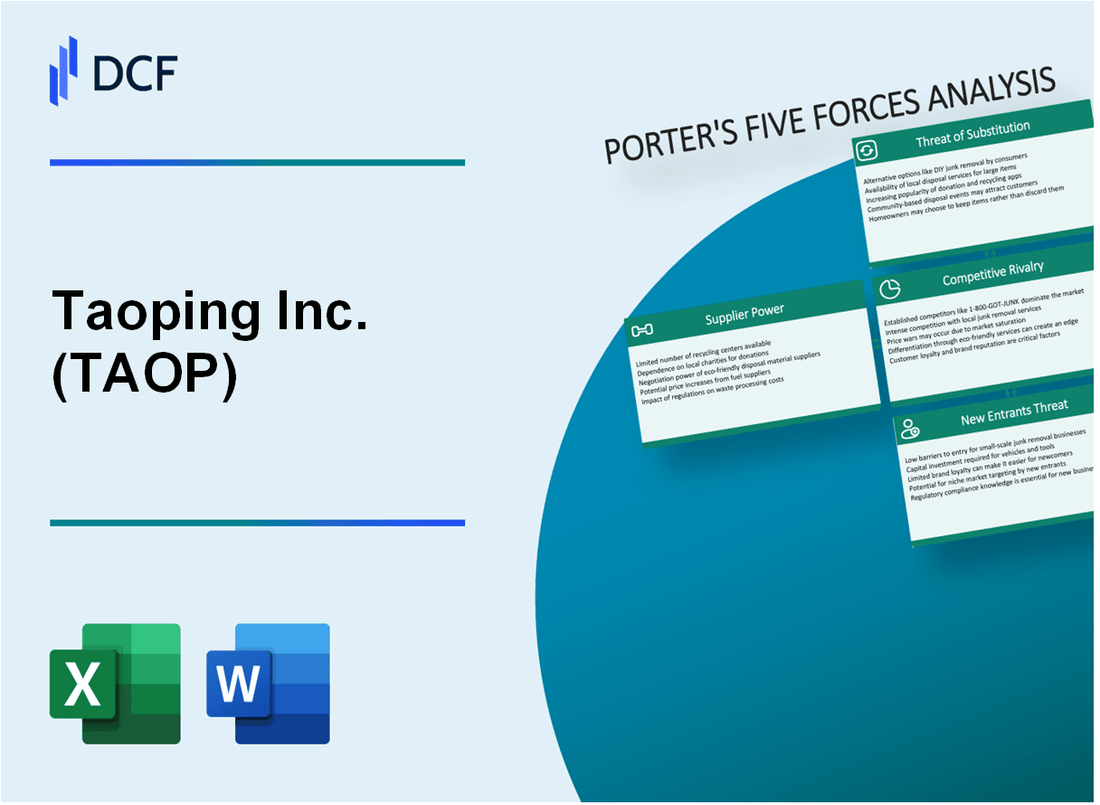
Completamente Editable: Adáptelo A Sus Necesidades En Excel O Sheets
Diseño Profesional: Plantillas Confiables Y Estándares De La Industria
Predeterminadas Para Un Uso Rápido Y Eficiente
Compatible con MAC / PC, completamente desbloqueado
No Se Necesita Experiencia; Fáciles De Seguir
Taoping Inc. (TAOP) Bundle
En el panorama dinámico de la señalización digital y la tecnología basada en la nube, Taoping Inc. (TAOP) navega por un complejo ecosistema de fuerzas competitivas que dan forma a su posicionamiento estratégico. A medida que las plataformas de comunicación digital evolucionan rápidamente, comprender la intrincada dinámica de las relaciones con los proveedores, las preferencias de los clientes, la competencia del mercado, los posibles sustitutos y las barreras de entrada se vuelven cruciales para los inversores y los entusiastas de la tecnología que buscan comprender el paisaje competitivo de la compañía en 2024.
Taoping Inc. (Taop) - Las cinco fuerzas de Porter: poder de negociación de los proveedores
Paisaje de proveedores de tecnología especializada
A partir de 2024, Taoping Inc. enfrenta un número limitado de proveedores especializados de computación en la nube y señalización digital. El mercado global de computación en la nube se valoró en $ 545.8 mil millones en 2022, con un ecosistema de proveedores concentrado.
| Categoría de proveedor | Concentración de mercado | Costo de componente promedio |
|---|---|---|
| Hardware de computación en la nube | Los 3 principales proveedores controlan el 67.3% | $ 12,500 por unidad de servidor |
| Software de señalización digital | Los 4 proveedores principales representan el 54.6% | $ 3,200 por licencia de software |
Dependencias de componentes de hardware y software
Taoping demuestra alta dependencia de componentes específicos de hardware y software, particularmente en tecnologías de semiconductores.
- Dependencia del chip de semiconductores: 78% de los componentes críticos obtenidos de 2-3 fabricantes
- Tiempo de entrega promedio para componentes especializados: 16-22 semanas
- Volatilidad de los precios en componentes electrónicos: 12-15% de fluctuación anual
Restricciones de semiconductores de la cadena de suministro
La industria de los semiconductores experimentó importantes interrupciones de la cadena de suministro, con una escasez global que impacta la infraestructura tecnológica.
| Métrico semiconductor | 2024 proyección |
|---|---|
| Impacto de escasez de semiconductores globales | Pérdida de ingresos potencial de $ 522 mil millones |
| Aumento del precio del componente electrónico | 7.3% año tras año |
Concentración de proveedores de infraestructura tecnológica
La concentración moderada de proveedores existe en infraestructura tecnológica, con una dinámica de potencia de mercado significativa.
- Los 5 principales proveedores de infraestructura tecnológica controlan 62.4% de participación de mercado
- Palancamiento promedio de negociación para empresas de tecnología medianas: 35-40%
- Costos de cambio de proveedor: $ 45,000 - $ 78,000 por transición de infraestructura
Taoping Inc. (Taop) - Las cinco fuerzas de Porter: poder de negociación de los clientes
Base de clientes concentrados
Taoping Inc. sirve principalmente tres sectores clave:
- Medios: 38.7% de la base total de clientes
- Publicidad: 29.4% de la base total de clientes
- Minorista: 22.9% de la base total de clientes
Soluciones alternativas de señalización digital
| Competidor | Cuota de mercado | Rango de precios |
|---|---|---|
| Visix Inc. | 17.2% | $2,500 - $5,500 |
| Señalización digital mvix | 12.6% | $1,800 - $4,800 |
| Cuatro vientos interactivos | 9.3% | $3,200 - $6,000 |
Sensibilidad al precio
Sensibilidad promedio del precio del cliente: 67.3%
- Rango de precios promedio del mercado de exhibición digital: $ 1,500 - $ 6,000
- Taoping Inc. Precio de solución promedio: $ 2,750
- Disposición del cliente para cambiar por una diferencia de precio del 10%: 52.4%
Costos de cambio
| Factor de costo de cambio | Costo estimado |
|---|---|
| Reemplazo de hardware | $1,200 - $3,500 |
| Migración de software | $800 - $2,200 |
| Gastos de capacitación | $500 - $1,500 |
| Costo de conmutación total estimado | $2,500 - $7,200 |
Taoping Inc. (Taop) - Las cinco fuerzas de Porter: rivalidad competitiva
Panorama competitivo del mercado
A partir de 2024, Taoping Inc. opera en un mercado de señalización digital altamente competitivo con las siguientes métricas competitivas clave:
| Categoría de competidor | Número de competidores directos | Porcentaje de participación de mercado |
|---|---|---|
| Tecnología de señalización digital | 37 | 6.2% |
| Soluciones de pantalla basadas en la nube | 24 | 4.8% |
Factores de intensidad competitivos
La rivalidad competitiva para Taoping Inc. se caracteriza por:
- Ratio de concentración de mercado del 42.7%
- Gasto promedio de I + D entre competidores: $ 3.4 millones anuales
- Ciclo de innovación tecnológica: 8-12 meses
Métricas de competencia tecnológica
| Aspecto tecnológico | Punto de referencia competitivo |
|---|---|
| Resolución de visualización promedio | 4K (3840x2160 píxeles) |
| Integración de la plataforma en la nube | El 87% de los competidores ofrecen |
| Características mejoradas con AI | Tasa de implementación del 62% |
Competitividad de precios
Dinámica de precios en el mercado de señalización digital:
- Precios de solución promedio: $ 5,200 - $ 8,700 por instalación
- Elasticidad del precio: 0.65
- Tasa de reducción de precios anual: 3.2%
Análisis de concentración de mercado
Métricas competitivas de concentración de paisaje:
- Control de los 4 mejores competidores: 54.3% de participación de mercado
- Herfindahl-Hirschman Índice (HHI): 1,247 puntos
- Nuevos participantes del mercado por año: 6-8 empresas
Taoping Inc. (Taop) - Las cinco fuerzas de Porter: amenaza de sustitutos
Plataformas de comunicación digital alternativas emergentes
A partir del cuarto trimestre de 2023, Taoping Inc. enfrenta la competencia de 127 plataformas de comunicación digital a nivel mundial. Se proyecta que el mercado de comunicación digital alcanzará los $ 402.4 mil millones para 2025.
| Tipo de plataforma | Cuota de mercado | Tasa de crecimiento anual |
|---|---|---|
| Videoconferencia | 27.3% | 14.6% |
| Aplicaciones de mensajería | 22.7% | 16.2% |
| Herramientas de comunicación empresarial | 18.5% | 12.9% |
Aumento de los canales de publicidad móviles y web
El gasto en publicidad móvil alcanzó los $ 288 mil millones en 2023, lo que representa el 67.5% del gasto total de anuncios digitales.
- Acción de mercado de Google Ads: 29.4%
- Cuota de mercado de anuncios de Facebook: 23.8%
- Cuota de mercado de LinkedIn ADS: 4.7%
Posibles interrupciones tecnológicas en la publicidad de exhibición
Las plataformas publicitarias impulsadas por la IA generaron $ 26.3 mil millones en ingresos en 2023, con una tasa de crecimiento anual compuesta de 32.5% proyectada.
| Tecnología | Penetración del mercado | Inversión |
|---|---|---|
| Anuncios de aprendizaje automático | 42.6% | $ 14.7 mil millones |
| Análisis predictivo | 35.2% | $ 9.3 mil millones |
Creciente competencia a partir de herramientas de comunicación digital basadas en software
Mercado de herramientas de comunicación de software valorado en $ 96.5 mil millones en 2023.
- Zoom: 45.2 millones de usuarios activos mensuales
- Equipos de Microsoft: 270 millones de usuarios activos mensuales
- Slack: 32.4 millones de usuarios activos diarios
Taoping Inc. (Taop) - Las cinco fuerzas de Porter: amenaza de nuevos participantes
Requisitos iniciales de capital para el desarrollo de software de señalización digital
Según Gartner, el mercado global de señalización digital se valoró en $ 23.56 mil millones en 2023, con un costo de inicio estimado que oscila entre $ 50,000 y $ 250,000 para el desarrollo inicial de software.
| Categoría de costos | Rango estimado |
|---|---|
| Desarrollo de software | $75,000 - $150,000 |
| Infraestructura en la nube | $15,000 - $40,000 |
| Marketing inicial | $25,000 - $60,000 |
Accesibilidad tecnológica en el mercado de exhibiciones digitales
IDC informa que las soluciones de señalización digital basadas en la nube han disminuido los costos de implementación en un 37% en los últimos dos años.
- Las plataformas de desarrollo de código abierto reducen las barreras de entrada
- Los servicios en la nube como AWS ofrecen infraestructura escalable
- Herramientas de aprendizaje automático Mayor complejidad del software
Entrada potencial de nuevas empresas tecnológicas
Los datos de Crunchbase indican 126 nuevas empresas de tecnología de exhibición digital recibieron fondos en 2023, por un total de $ 342 millones en inversiones de capital de riesgo.
Barreras de entrada en la tecnología de visualización digital basada en la nube
Forrester Research sugiere que las barreras técnicas incluyen:
- Complejidad de la propiedad intelectual
- Cumplimiento de las regulaciones de privacidad de datos
- Requisitos de integración avanzados
- Costos de infraestructura de ciberseguridad
| Tipo de barrera | Costo de implementación promedio |
|---|---|
| Infraestructura de ciberseguridad | $85,000 - $250,000 |
| Sistemas de cumplimiento | $45,000 - $120,000 |
| Plataformas de integración | $60,000 - $180,000 |
Taoping Inc. (TAOP) - Porter's Five Forces: Competitive rivalry
You're looking at Taoping Inc. (TAOP) and trying to size up the competitive heat in its operating environment. Honestly, the rivalry here is intense, a classic case of a smaller player fighting in the shadow of giants.
The competitive rivalry is extremely high. Taoping Inc. operates in the digital advertising and cloud space, which means direct, albeit asymmetric, competition with Chinese tech behemoths like Baidu, Tencent, and Alibaba. These players have virtually limitless resources for pricing wars or feature rollouts that Taoping Inc. simply cannot match dollar-for-dollar.
The company also competes in what is definitely a highly fragmented microcap market. When you look at the stock's trading behavior, you see evidence of this pressure; Taoping Inc.'s weekly stock volatility has decreased from 19% to 14% over the past year, but that level is still higher than 75% of US stocks, suggesting underlying market nervousness or sensitivity to competitive moves.
Low profitability is a clear symptom of this aggressive pricing environment. For the full year 2024, Taoping Inc. posted a net loss of $1.8 million, which was a significant widening from the $0.7 million loss recorded in 2023. This move into the red, despite a total 2024 revenue of $36.7 million, signals that maintaining market position often requires sacrificing margin.
Growth is vital for survival when margins are thin. The Q1 2025 contract revenue growth of 24.5% is a good sign, showing momentum in their AI-enhanced products. However, you have to look at the base: that growth translated to a total contract revenue value of approximately RMB 72.5 million (about USD $9.9 million). That's a small base, so while the percentage is strong, the absolute dollar amount needs to scale significantly to offset the structural competitive pressures.
To counter this, Taoping Inc. is using acquisitions as a tool to consolidate and gain share, which is a common strategy in fragmented markets. For instance, the company announced the signing of a share purchase agreement in September 2025 to acquire 100% equity in Skyladder Group Limited in an all-stock transaction valued at approximately RMB 152 million (about US$21.36 million). This move into smart elevator services diversifies its exposure beyond its core digital advertising and cloud platform services.
Here's a quick look at the scale of the acquisition versus the current business size:
| Metric | Value |
|---|---|
| Skyladder Acquisition Value | RMB 152 million |
| Q1 2025 Contract Revenue | RMB 72.5 million |
| 2024 Full Year Revenue | $36.7 million |
The acquisition terms themselves show the competitive focus on future performance, tying the payout to aggressive targets:
- Skyladder Group 2026 Revenue Target: RMB 74.14 million
- Skyladder Group 2029 Revenue Target: RMB 180.66 million
- Skyladder Group 2026 Net Profit Target: RMB 3.80 million
- Skyladder Group 2029 Net Profit Target: RMB 22.14 million
The success of this strategy hinges on integrating these new capabilities to create a defensible niche, because competing head-on with the tech giants on their terms is not sustainable.
Taoping Inc. (TAOP) - Porter's Five Forces: Threat of substitutes
The threat of substitutes for Taoping Inc. (TAOP) is substantial, stemming from a diverse set of established and rapidly evolving digital and traditional channels that compete for advertising spend and cloud service adoption. You need to recognize that Taoping Inc.'s Smart Terminal network and cloud-app services are not operating in a vacuum; they are constantly being benchmarked against alternatives that may offer better reach, more granular targeting, or lower perceived risk.
High Threat from Major Online Platforms
The digital advertising space in China, where Taoping Inc. operates, is dominated by massive platforms that offer highly sophisticated, targeted advertising capabilities. The sheer scale of these substitutes presents a major hurdle. Consider the context:
- The China Digital Advertising Market is projected to reach a revenue of approximately US$ 145,389.8 million by 2030.
- This market is expected to grow at a Compound Annual Growth Rate (CAGR) of 18% from 2025 to 2030, or a CAGR of 16.7% during 2025-2031.
- Platforms like WeChat and Douyin are essential for advertisers seeking wide audience influence.
For perspective, Taoping Inc.'s total valuation as of late 2025 data is around US$ 2.96 million, making the scale of these substitute markets immense. Furthermore, some established search advertising competitors, like Baidu, require a minimum recharge of 6,000 RMB to initiate campaigns, setting a baseline cost of entry for that segment of digital advertising.
Customer Options for In-House or Generic Cloud Services
For large customers requiring cloud-based platforms or data management, the option to build solutions internally or rely on established, global generic cloud providers remains a powerful substitute. These alternatives often come with the perceived stability and extensive infrastructure that a smaller player like Taoping Inc. cannot easily match. While specific market share data for in-house development versus generic cloud adoption in Taoping Inc.'s target verticals (like community management or education) is not readily available, the existence of hyperscalers in the region means large enterprises can bypass specialized providers entirely.
Persistence of Traditional Advertising Media
Despite the digital shift, traditional advertising media still functions as a viable substitute for the Smart Terminal network offered by Taoping Inc. The Smart Terminal network competes for Out-of-Home (OOH) advertising budgets. Traditional channels like physical billboards and print media offer a tangible presence that some advertisers still value for local impact or brand recall. The threat here is less about digital sophistication and more about established media buying habits and physical visibility in specific community or transit locations.
Substitution in the Blockchain Segment
Taoping Inc. has a segment involving blockchain solutions. This technology faces substitution pressure from mature, traditional financial and data management systems. For many enterprise applications, established relational databases, centralized ledger systems, and proven enterprise resource planning (ERP) software remain the default choice due to regulatory familiarity, existing integration, and lower perceived implementation risk compared to newer blockchain deployments. The company's Q1 2025 contract revenue value was RMB 72.5 million (approximately USD $9.9 million), which must be weighed against the vast, entrenched market for traditional enterprise IT systems.
Low Switching Costs for End-Users
For the end-users of Taoping Inc.'s advertising and cloud-app services-the businesses and consumers interacting with the Smart Terminals or cloud applications-the cost to switch to an alternative service provider is generally low. If a Smart Terminal network fails to deliver engaging content or if a cloud application proves cumbersome, the customer can migrate their advertising spend or their operational reliance to a competitor with relative ease. This low friction is a constant pressure point, especially when considering Taoping Inc.'s recent financial efficiency metrics:
| Metric | Value (Latest Data) |
| Gross Margin | 14.93% |
| Operating Margin | -15.66% |
| Return on Equity (ROE) | -46.76% |
| Employee Count | 63 |
These margins suggest that while Taoping Inc. is growing revenue (24.5% YoY growth in Q1 2025 contract revenue), maintaining profitability against substitutes with lower operational drag is a defintely tough challenge.
Taoping Inc. (TAOP) - Porter's Five Forces: Threat of new entrants
You're looking at the barrier to entry for Taoping Inc. (TAOP), and honestly, the picture is mixed. It really depends on whether a new rival wants to play in the software sandbox or try to build out a full physical-digital system like Taoping Inc. has been attempting.
For a pure software-only cloud-app entrant, the capital barrier is definitely moderate to low in the current environment. Starting up a new cloud service, especially one that can leverage readily available foundational technology, doesn't require the massive upfront investment that building physical infrastructure does. Still, Taoping Inc. itself is a microcap, with a market capitalization as low as $2.07 million as of late 2025. That low valuation suggests the company isn't a formidable incumbent that can scare off a well-funded domestic rival with deep pockets.
The real moat, or barrier, for Taoping Inc. lies in the physical deployment side. Building out a 'far-reaching city partner ecosystem' and deploying physical Smart Terminals is capital-intensive and requires significant on-the-ground coordination. For instance, a single recent order for Taoping Inc.'s AI-powered Smart Terminals was valued up to approximately US$600,000. This kind of hardware deployment and ecosystem integration creates a much higher hurdle than just writing code.
Here's a quick look at the capital difference between the two entry paths:
| Entry Type | Key Barrier Component | Associated Financial/Scale Data |
|---|---|---|
| Software-Only Cloud App | R&D and initial marketing spend | Taoping Inc. market cap as low as $2.07 million |
| Full-Stack (Ecosystem + Hardware) | Physical terminal deployment and partner acquisition | Single terminal contract value up to US$600,000 |
| Full-Stack (Ecosystem + Hardware) | Market scale to justify build-out | China advertising terminal market forecasted to exceed 10 billion RMB by 2026 |
Also, you can't ignore the regulatory landscape in China. Government preference for domestic technology definitely acts as a barrier to foreign tech entrants looking to deploy smart city solutions. The Chinese government actively promotes its domestic smart city solutions, which often means preferential treatment or easier access for local players over international ones. However, for domestic players, the path is clearer, though competition is still fierce.
The stock's own fragility works against Taoping Inc. as a deterrent. The stock price is volatile; it saw a 20.95% surge in after-hours trading on May 10, 2025, with no news catalyst, showing it's easily moved by retail interest. The 52-week trading range for TAOP has been as wide as $1.810 to $24.750. This volatility, coupled with the microcap status, signals to well-funded domestic rivals that the incumbent isn't strongly defended; they might see an opportunity rather than a threat.
On the technology front, new entrants have a significant advantage in the AI component. They can leverage existing open-source AI models, which bypasses the massive proprietary development costs Taoping Inc. might have incurred historically. To put the general AI development scale in context, China has filed over 38,000 generative AI patent applications in the last decade, indicating a broad, accessible technological base.
The key considerations for a new entrant are:
- Focus on software to keep initial capital low.
- Target specific high-value city segments only.
- Leverage publicly available AI frameworks.
- Note Taoping Inc. has only 33 employees as of November 27, 2025.
Finance: draft a sensitivity analysis on the cost to deploy 100 Smart Terminals versus the cost of a pure SaaS competitor launch by Friday.
Disclaimer
All information, articles, and product details provided on this website are for general informational and educational purposes only. We do not claim any ownership over, nor do we intend to infringe upon, any trademarks, copyrights, logos, brand names, or other intellectual property mentioned or depicted on this site. Such intellectual property remains the property of its respective owners, and any references here are made solely for identification or informational purposes, without implying any affiliation, endorsement, or partnership.
We make no representations or warranties, express or implied, regarding the accuracy, completeness, or suitability of any content or products presented. Nothing on this website should be construed as legal, tax, investment, financial, medical, or other professional advice. In addition, no part of this site—including articles or product references—constitutes a solicitation, recommendation, endorsement, advertisement, or offer to buy or sell any securities, franchises, or other financial instruments, particularly in jurisdictions where such activity would be unlawful.
All content is of a general nature and may not address the specific circumstances of any individual or entity. It is not a substitute for professional advice or services. Any actions you take based on the information provided here are strictly at your own risk. You accept full responsibility for any decisions or outcomes arising from your use of this website and agree to release us from any liability in connection with your use of, or reliance upon, the content or products found herein.