

|
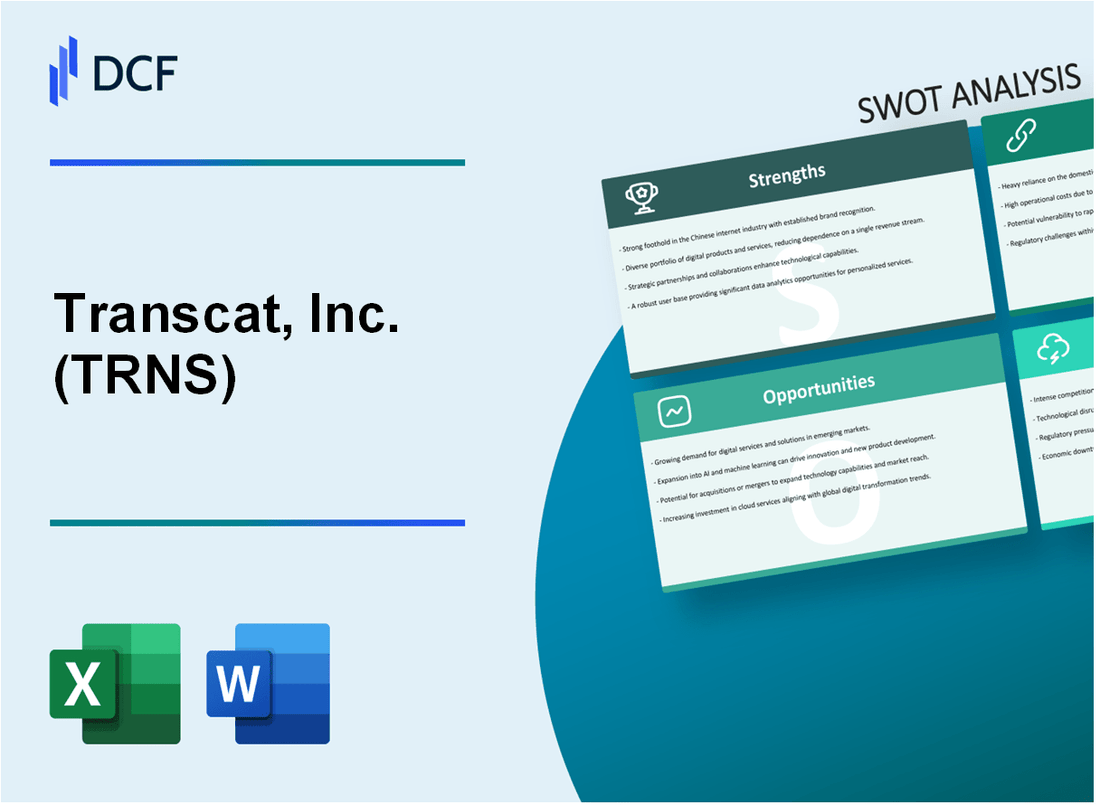
Transcat, Inc. (TRNS): Análisis FODA [Actualizado en Ene-2025] |
Completamente Editable: Adáptelo A Sus Necesidades En Excel O Sheets
Diseño Profesional: Plantillas Confiables Y Estándares De La Industria
Predeterminadas Para Un Uso Rápido Y Eficiente
Compatible con MAC / PC, completamente desbloqueado
No Se Necesita Experiencia; Fáciles De Seguir
Transcat, Inc. (TRNS) Bundle
En el mundo dinámico de la medición de precisión y los servicios técnicos, Transcat, Inc. (TRNS) se encuentra en una coyuntura crítica de evaluación estratégica, navegando a los paisajes complejos del mercado con su experiencia especializada en la calibración. Este análisis FODA completo revela el intrincado posicionamiento competitivo de la compañía, revelando una imagen matizada de su potencial de crecimiento, desafíos y oportunidades estratégicas en el sector de servicios técnicos en rápido evolución. Al diseccionar las fortalezas, debilidades, oportunidades y amenazas de Transcat, proporcionamos una visión profunda de cómo esta empresa innovadora está preparada para aprovechar su destreza técnica y adaptarnos al ecosistema tecnológico cambiante.
Transcat, Inc. (TRNS) - Análisis FODA: fortalezas
Servicios de calibración y reparación especializados
TransCat proporciona Servicios de calibración avanzados a través de dominios técnicos críticos con capacidades de medición de precisión. A partir de 2023, la compañía mantiene más de 20 laboratorios de calibración acreditados ISO/IEC 17025 en todo el país.
| Categoría de servicio | Contribución anual de ingresos |
|---|---|
| Calibración eléctrica | $ 22.3 millones |
| Calibración mecánica | $ 18.7 millones |
| Calibración de temperatura | $ 15.5 millones |
Reputación establecida en la medición de precisión
Transcat ha construido un Fuerte reputación del mercado con más de 40 años de experiencia operativa en soluciones de medición técnica.
- Tasa de retención de clientes: 92%
- Duración promedio de la relación con el cliente: 7.5 años
- Puntuación del promotor neto: 68
Ofertas de servicios diversificados
La compañía atiende a múltiples industrias críticas con soluciones de medición integrales.
| Industria | Penetración de servicio |
|---|---|
| Aeroespacial | 35% de los servicios totales |
| Farmacéutico | 25% de los servicios totales |
| Fabricación | 40% de los servicios totales |
Estabilidad financiera
TransCat demuestra un desempeño financiero constante con un crecimiento constante de los ingresos.
- 2023 Ingresos totales: $ 214.6 millones
- Tasa de crecimiento de ingresos: 8.3%
- Margen bruto: 42.5%
Equipo de gestión experimentado
Equipo de liderazgo con amplia experiencia técnica e industrial.
| Ejecutivo | Años de experiencia |
|---|---|
| CEO Lee D. Rudow | 28 años |
| CFO Mark E. Hakkinen | 22 años |
| COO John P. Nesbitt | 19 años |
Transcat, Inc. (TRNS) - Análisis FODA: debilidades
Capitalización de mercado relativamente pequeña
A partir del cuarto trimestre de 2023, la capitalización de mercado de Transcat era de aproximadamente $ 471.8 millones, significativamente menor en comparación con los competidores de la industria más grandes:
| Competidor | Capitalización de mercado |
|---|---|
| Tecnologías de teclas | $ 26.7 mil millones |
| Corporación | $ 5.2 mil millones |
| Transcat, Inc. | $ 471.8 millones |
Dependencia de sectores de la industria específicos
Desglose de ingresos por sector para el año fiscal 2023:
- Ciencias de la vida: 38%
- Fabricación industrial: 32%
- Tecnología: 18%
- Gobierno/Militar: 12%
Presencia geográfica limitada
La huella operativa de Transcat a partir de 2023:
- Ubicaciones de los Estados Unidos: 23 centros de servicio
- Ubicaciones canadienses: 4 centros de servicio
- Presencia directa internacional: Limitado
Restricciones potenciales de capacidad
Métricas actuales de capacidad de servicio:
| Métrico | Valor |
|---|---|
| Capacidad de servicio anual | Aproximadamente 75,000 órdenes de calibración/reparación |
| Tasa de utilización actual | 82% |
| Limitación de escala potencial | 15-20% sin una inversión de infraestructura significativa |
Vulnerabilidad a las fluctuaciones económicas
Indicadores de sensibilidad económica para los sectores de servicios técnicos:
- Rango de volatilidad de los ingresos: 6-12% durante las recesiones económicas
- Reducción promedio de la demanda del servicio durante la recesión: 9.5%
- Impacto estimado en los ingresos de Transcat: potencialmente $ 15-25 millones anuales
Transcat, Inc. (TRNS) - Análisis FODA: oportunidades
Ampliar la demanda de servicios de calibración de precisión en los sectores de tecnología emergente
El mercado mundial de servicios de calibración se valoró en $ 7.2 mil millones en 2022 y se proyecta que alcanzará los $ 10.5 mil millones para 2027, con una tasa compuesta anual del 7.8%.
| Sector tecnológico | Tamaño del mercado de calibración (2022) | Tasa de crecimiento proyectada |
|---|---|---|
| Semiconductor | $ 1.3 mil millones | 9.2% |
| Aeroespacial & Defensa | $ 1.1 mil millones | 6.5% |
| Electrónica avanzada | $ 850 millones | 8.3% |
Potencial para la expansión del mercado internacional
Oportunidades del mercado de servicios internacionales de calibración:
- Se espera que Europe Market crezca a $ 3.2 mil millones para 2025
- Mercado de calibración de Asia-Pacífico proyectado en $ 2.8 mil millones para 2026
- Los mercados emergentes en India y China muestran un potencial de crecimiento anual del 11.5%
Creciente necesidad de servicios de calibración avanzados en energía renovable y tecnología médica
| Sector | Demanda del servicio de calibración | Inversión anual |
|---|---|---|
| Energía renovable | Tamaño del mercado de $ 1.6 mil millones | $ 450 millones en servicios de calibración |
| Tecnología médica | Tamaño del mercado de $ 2.3 mil millones | $ 680 millones en calibración de precisión |
Adquisiciones estratégicas potenciales
Posibles objetivos de adquisición identificados con rangos de ingresos anuales:
- Proveedores de servicios de calibración pequeña: ingresos de $ 5-15 millones
- Firmas de calibración especializada de tamaño mediano: ingresos de $ 20-50 millones
- Empresas de calibración específicas de tecnología: ingresos de $ 10-30 millones
Adopción creciente de la calibración digital y las tecnologías de monitoreo remoto
Estadísticas del mercado de calibración digital:
- Crecimiento del mercado de calibración digital: 12.4% CAGR
- Mercado de tecnología de monitoreo remoto: $ 4.5 mil millones en 2022
- Mercado de servicios de calibración remota proyectada: $ 7.2 mil millones para 2027
Transcat, Inc. (TRNS) - Análisis FODA: amenazas
Intensa competencia de proveedores de servicios técnicos establecidos
En 2023, la calibración técnica y el mercado de servicios mostraron una presión competitiva significativa. Los competidores clave incluyen:
| Competidor | Cuota de mercado | Ingresos anuales |
|---|---|---|
| Calibración | 18.5% | $ 425 millones |
| Tecnologías de teclas | 15.7% | $ 5.4 mil millones |
| Transcat, Inc. | 7.3% | $ 230.4 millones |
Posibles recesiones económicas que afectan a los sectores industriales y de fabricación
Los indicadores del sector de fabricación muestran vulnerabilidades potenciales:
- PMI de fabricación estadounidense: 46.8 en diciembre de 2023
- Crecimiento de la producción industrial: -0.6% año tras año
- Capital Equipment Invence: 3.2% en el cuarto trimestre de 2023
Cambios tecnológicos rápidos que requieren inversión continua
| Área de inversión tecnológica | Costo anual estimado | Porcentaje de inversión |
|---|---|---|
| Actualizaciones de equipos de calibración | $ 3.5 millones | 5.2% de los ingresos |
| Tecnologías de calibración digital | $ 2.1 millones | 3.1% de los ingresos |
Posibles interrupciones de la cadena de suministro
Factores de riesgo de la cadena de suministro:
- Índice de interrupción de la cadena de suministro global: 6.4 de 10
- Retraso promedio de adquisición de equipos: 4-6 semanas
- Tasa de escasez de componentes: 12.3% en instrumentos de precisión
Aumento de los requisitos de cumplimiento regulatorio
| Área de cumplimiento | Costo de cumplimiento estimado | Complejidad regulatoria |
|---|---|---|
| Certificación ISO/IEC 17025 | $ 450,000 anualmente | Alto |
| Requisitos de trazabilidad de NIST | $ 275,000 anualmente | Medio-alto |
Transcat, Inc. (TRNS) - SWOT Analysis: Opportunities
Further penetration into the Life Sciences sector through expanded service offerings and M&A.
The Life Sciences sector, which includes pharmaceutical, medical device, and other FDA-regulated businesses, is already Transcat's core strength, representing approximately 60% of its Service segment revenue in fiscal year 2025. This heavy regulatory focus means a high cost of failure for customers, which translates directly into recurring, mission-critical revenue for Transcat. You can deepen this penetration by integrating the capabilities from recent, strategic acquisitions.
For instance, the $84 million acquisition of Essco Calibration Laboratory in August 2025, the largest in company history, immediately established a dominant presence in the New England market, a region rich in Life Science and Aerospace & Defense industries. Essco alone brought over $22 million in annual revenue and accretive EBITDA margins above 25%. That's a clean shot at increasing wallet share with blue-chip pharmaceutical clients like Roche, Merck, and Pfizer already on the roster. Continual bolt-on acquisitions in key geographic or capability niches will keep this momentum going.
- Target specialized medical device calibration.
- Expand validation and compliance services.
- Acquire regional leaders with accretive margins.
Expansion of calibration services into new, emerging regulated markets globally.
Transcat's focus on highly regulated industries provides a clear roadmap for geographic and vertical expansion beyond its current footprint in the U.S., Canada, and Ireland. The model is proven: target markets where compliance is non-negotiable. While Life Sciences is the largest, other regulated sectors offer significant, untapped growth.
In fiscal 2025, the Aerospace & Defense sector accounted for about 8% of Service revenue, and Energy/Utilities for 5%. The macro trend of new U.S. onshoring of manufacturing, coupled with surging infrastructure investment, creates a tailwind for these segments. You should look to replicate the New England market dominance achieved with Essco in other high-density manufacturing clusters. The strong balance sheet, with a total net debt leverage ratio of 0.78 as of March 29, 2025, gives you the capacity to finance this expansion, either organically or through M&A.
Here's the quick math on the current segment mix, which shows where the next growth opportunities lie:
| Customer Segment (FY 2025) | Approximate % of Service Revenue |
|---|---|
| Life Science / FDA Regulated | 60% |
| Industrials / Materials | 16% |
| Aerospace / Defense | 8% |
| Services / Consumer Goods | 7% |
| Energy / Utilities | 5% |
Cross-selling opportunities between the Distribution and Services segments to boost wallet share.
The complementary nature of the Distribution and Services segments is a unique competitive advantage and a powerful engine for cross-selling. The Distribution segment, which grew 8% to $97 million in fiscal 2025, is defintely a quality lead generator for the higher-margin Services business. This isn't just a theory; approximately 20% of customers already overlap between the two segments, but that leaves 80% of Distribution customers as a target-rich environment.
The rental channel within Distribution is particularly valuable, as customers who rent specialized equipment are prime candidates for long-term calibration and maintenance contracts. The strategy is simple: use equipment sales and rentals to start the relationship, then lock in recurring revenue with accredited calibration services. This strong cross-selling has already led to margin expansion and higher recurring revenue streams. The Distribution segment's shift toward the higher-margin rental business, including the addition of Becnel Rental Tools, further enhances its role as a service lead source.
Digital transformation of calibration processes (e.g., remote services) to improve operating efficiency.
Operational efficiency through digital transformation is critical for margin expansion, especially in a service business. Transcat is already seeing tangible results from its focus on automation and process improvements. In the fourth quarter of fiscal 2025, Service segment gross margin expanded by 50 basis points to 36.2%. This expansion shows the inherent operating leverage in the calibration lab model is working.
The next step is to accelerate the digital shift toward remote and predictive services. While the Transcat Solutions (NEXA) enterprise asset management channel faced challenges in fiscal 2025, stabilizing and growing this platform is a major opportunity. It allows you to move beyond simple calibration to offering full Cost, Control, and Optimization services-essentially becoming a technical consultant. Leveraging technology to increase technician productivity is the only way to consistently drive Service gross margins higher over time.
Transcat, Inc. (TRNS) - SWOT Analysis: Threats
Economic downturn leading to delayed capital spending on new equipment in the Distribution segment
The primary threat here is that a sustained economic slowdown causes customers to delay capital expenditure (CapEx) on new test and measurement equipment. While Transcat, Inc.'s Distribution segment has been resilient, with revenue growth of 8% in fiscal year 2025 and a strong 24.0% growth in Q2 of fiscal year 2026, a significant portion of this growth comes from the higher-margin rental channel.
This rental strength is a buffer, but it also signals customers are choosing temporary solutions over outright purchases. Honestly, if companies like those in the Life Sciences industry-which represents approximately 60% of the Services segment's revenue-start pulling back on multi-year facility build-outs, the core product sales portion of the Distribution business will suffer. We're already seeing a 'more cautious near-term outlook' among some firms due to delays in federal infrastructure funding disbursement, which could impact projects in 2025.
Here's the quick math on the Distribution segment's recent performance, showing the reliance on growth drivers other than outright CapEx:
| Metric | Fiscal Year 2025 Full Year | Q2 Fiscal Year 2026 (Ended Sept 27, 2025) |
|---|---|---|
| Distribution Segment Revenue | $97.0 million | $29.4 million |
| Year-over-Year Revenue Growth | 8% | 24.0% |
| Distribution Gross Margin | 29.7% | 33.2% |
Increased competition from larger, diversified industrial service providers entering the calibration space
The calibration market is highly fragmented, but the threat is the increasing consolidation by both Transcat and its larger national peers. Transcat is one of about five main national players, alongside companies like Trescal, Tektronics, Simco Electronics, and Applied Technical Services (ATS). These larger, diversified industrial service providers have deeper pockets and broader customer relationships, making it harder to win new national contracts.
Transcat's strategy is to acquire regional leaders, like the August 2025 acquisition of Essco Calibration Laboratory for $84 million, which had over $22 million in annual revenue. But still, every time a competitor buys a regional player, Transcat's addressable market shrinks and the cost of future acquisitions goes up. The risk isn't just the large national players; it's the constant battle for the best regional assets, which drives up the valuation multiple for every deal.
Regulatory changes or technological shifts that reduce the need for traditional, on-site calibration
The core of Transcat's Services segment is traditional, accredited calibration, driven by stringent regulatory requirements from the FDA and others. The threat isn't that regulation goes away-it won't-but that technology changes the method of compliance, making traditional on-site service less necessary or valuable. For example, new software solutions like Fluke's CalStudio are pushing for more efficiency and collaboration in calibration labs.
This technological shift favors automated, remote, or self-calibration methods, which could disrupt the high-margin, technician-heavy model. Transcat is trying to stay ahead by investing heavily in automation and process improvement, which helped the Service segment's gross margin expand to 36.2% in Q4 FY 2025. But if a competitor introduces a truly disruptive, fully remote solution, the need for Transcat's network of over two dozen physical commercial labs could diminish.
- Automated calibration software reduces on-site technician hours.
- Remote monitoring tools delay the need for physical calibration visits.
- Digital solutions lower customer switching costs for service providers.
Rising labor costs for highly skilled technicians, pressuring the Services segment's defintely high margins
The Services segment's profitability relies on maintaining its high gross margins, which were a strong 33.4% for the full fiscal year 2025. This margin is constantly under pressure from the cost of attracting and retaining highly skilled metrology technicians. The labor market for these specialized roles is tight, and that means higher wages and recruitment costs.
While Transcat is successfully using automation and productivity improvements to expand its Service gross margin, the overall net profit margin for the company dropped from 6.6% to 3.8% year over year as of November 2025. This compression suggests that the rising cost of labor, along with necessary investments in technology and acquisitions, is eating into the bottom line. The company's 'Transcat University - Build-A-Tech' program is a clear defensive move, but it's an expensive investment in time and capital to mitigate the labor shortage risk.
What this estimate hides is the true cost of talent scarcity. You have to pay up to keep the best people.
Disclaimer
All information, articles, and product details provided on this website are for general informational and educational purposes only. We do not claim any ownership over, nor do we intend to infringe upon, any trademarks, copyrights, logos, brand names, or other intellectual property mentioned or depicted on this site. Such intellectual property remains the property of its respective owners, and any references here are made solely for identification or informational purposes, without implying any affiliation, endorsement, or partnership.
We make no representations or warranties, express or implied, regarding the accuracy, completeness, or suitability of any content or products presented. Nothing on this website should be construed as legal, tax, investment, financial, medical, or other professional advice. In addition, no part of this site—including articles or product references—constitutes a solicitation, recommendation, endorsement, advertisement, or offer to buy or sell any securities, franchises, or other financial instruments, particularly in jurisdictions where such activity would be unlawful.
All content is of a general nature and may not address the specific circumstances of any individual or entity. It is not a substitute for professional advice or services. Any actions you take based on the information provided here are strictly at your own risk. You accept full responsibility for any decisions or outcomes arising from your use of this website and agree to release us from any liability in connection with your use of, or reliance upon, the content or products found herein.