
|
Taiwan Semiconductor Manufacturing Company Limited (TSM): Análisis PESTLE [Actualizado en enero de 2025] |
Completamente Editable: Adáptelo A Sus Necesidades En Excel O Sheets
Diseño Profesional: Plantillas Confiables Y Estándares De La Industria
Predeterminadas Para Un Uso Rápido Y Eficiente
Compatible con MAC / PC, completamente desbloqueado
No Se Necesita Experiencia; Fáciles De Seguir
Taiwan Semiconductor Manufacturing Company Limited (TSM) Bundle
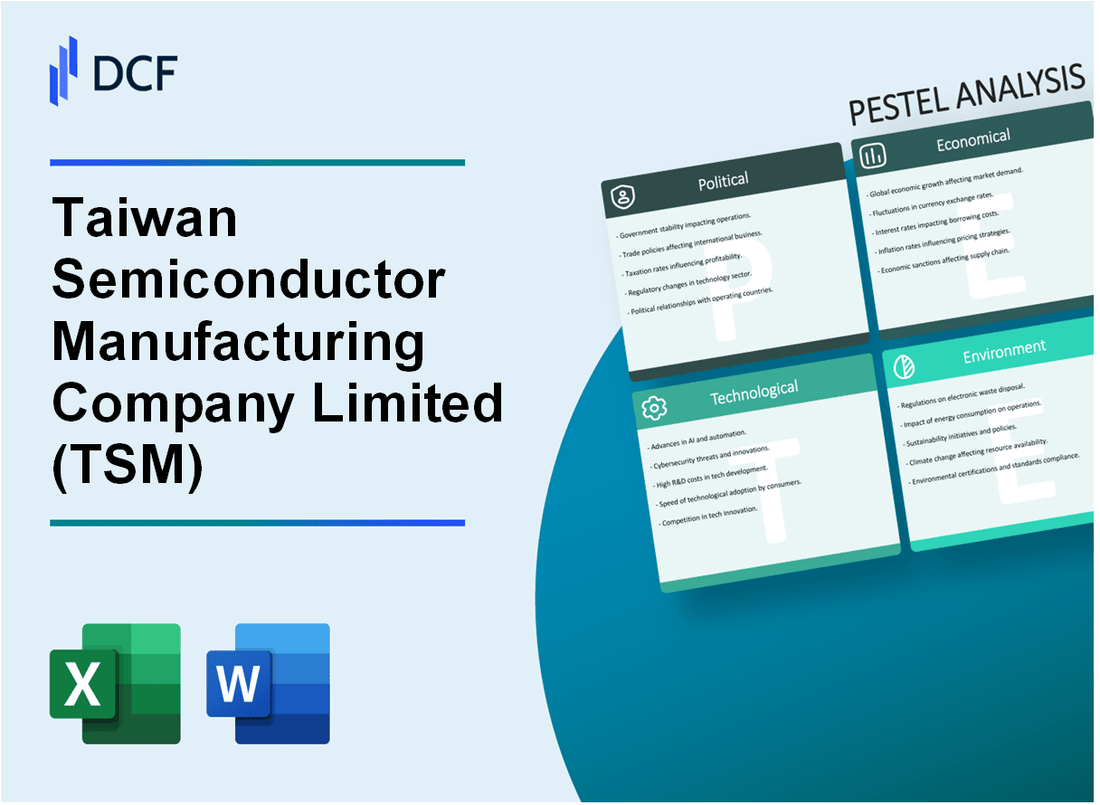
En el mundo de alto riesgo de la fabricación de semiconductores, la empresa de fabricación de semiconductores de Taiwán Limited (TSM) se erige como un titán global, navegando por un complejo panorama de tensiones geopolíticas, innovación tecnológica y desafíos económicos. Con su vanguardia 3 nm y emergente 2 nm Tecnologías de proceso, TSM no es solo un fabricante, sino una potencia estratégica que da forma al futuro de la tecnología global. Este análisis integral de la mano presenta la intrincada red de factores políticos, económicos, sociológicos, tecnológicos, legales y ambientales que definen el notable viaje de TSM y la influencia sin precedentes en la industria de los semiconductores.
Taiwan Semiconductor Manufacturing Company Limited (TSM) - Análisis de mortero: factores políticos
Tensiones geopolíticas entre Taiwán y China
A partir de 2024, las tensiones geopolíticas entre Taiwán y China continúan afectando significativamente las cadenas globales de suministro de semiconductores. La posible amenaza militar de China crea una incertidumbre sustancial para las operaciones de TSM.
| Métricas de tensión política | Estado actual |
|---|---|
| Ejercicios militares cerca de Taiwán | Más de 30 ejercicios a gran escala realizados en 2023 |
| Presión económica de China | Restricciones comerciales continuas e intentos de aislamiento diplomático |
Restricciones de exportación de tecnología de semiconductores de EE. UU.
Estados Unidos ha implementado estrictos controles de exportación dirigidos a la tecnología avanzada de semiconductores a China.
- Restricciones de exportación de EE. UU. Implementadas en octubre de 2022
- Límites en las exportaciones avanzadas de equipos de fabricación de chips
- Requiere licencias especiales para transferencias de tecnología de semiconductores
| Impacto de restricción de exportación | Métrica financiera |
|---|---|
| Pérdida de ingresos estimada | Aproximadamente $ 2.5 mil millones en ingresos potenciales del mercado chino |
| Ajuste de inversión de I + D | $ 1.6 mil millones redirigidos a estrategias de mercado alternativas |
Apoyo gubernamental de Taiwán para la industria de semiconductores
El gobierno taiwanés brinda un apoyo sustancial al sector de semiconductores.
| Mecanismo de apoyo gubernamental | Asignación financiera |
|---|---|
| Subsidios directos de la industria | NT $ 300 mil millones (aproximadamente $ 9.7 mil millones de dólares) |
| Financiación de la investigación y el desarrollo | NT $ 50 mil millones (aproximadamente $ 1.6 mil millones de dólares) |
Desafíos diplomáticos y estrategia de fabricación internacional
TSM continúa navegando por complejos paisajes diplomáticos internacionales mientras se expande las capacidades de fabricación global.
- Instalaciones de fabricación establecidas en Arizona, EE. UU.: Inversión de $ 12 mil millones
- Expansión planificada en Alemania: 10 mil millones de euros cometidos
- Negociaciones continuas con Japón y Países Bajos para la colaboración de tecnología
| Ubicaciones de fabricación internacional | Escala de inversión |
|---|---|
| Estados Unidos (Arizona) | $ 12 mil millones |
| Alemania | € 10 mil millones |
| Instalación de Japón | $ 7 mil millones |
Taiwan Semiconductor Manufacturing Company Limited (TSM) - Análisis de mortero: factores económicos
La demanda global de semiconductores impulsa los ingresos y la expansión del mercado de TSM
Los ingresos totales de TSM en 2023 alcanzaron los $ 67.7 mil millones, con un crecimiento año tras año del 15.4%. El tamaño del mercado de semiconductores se estimó en $ 573.44 mil millones en 2022, proyectado para llegar a $ 1,380.79 mil millones para 2032.
| Año | Ingresos ($ B) | Cuota de mercado (%) |
|---|---|---|
| 2022 | 56.9 | 53.7 |
| 2023 | 67.7 | 54.3 |
Inversiones significativas en tecnologías de fabricación avanzadas
TSM invirtió $ 32.4 mil millones en gastos de capital para 2023, centrándose en tecnologías de proceso de 3NM y 2NM.
| Nodo tecnológico | Inversión ($ b) | Expansión de capacidad |
|---|---|---|
| 3 nm | 20.1 | 100,000 obleas/mes |
| 2 nm | 12.3 | 60,000 obleas/mes |
Fluctuar los tipos de cambio y las condiciones económicas globales
El ingreso neto de TSM en 2023 fue de $ 30.5 mil millones, con impactos de divisas que reducen las ganancias en aproximadamente $ 1.2 mil millones.
| Divisa | Volatilidad del tipo de cambio (%) | Impacto en las ganancias ($ M) |
|---|---|---|
| USD/TWD | 4.3 | -620 |
| USD/CNY | 3.7 | -580 |
Crecimiento en los mercados de computación de alto rendimiento y chips de IA
Los ingresos del mercado de AI Chip para TSM alcanzaron los $ 15.6 mil millones en 2023, lo que representa el 23% de los ingresos totales. El segmento de computación de alto rendimiento creció un 28% año tras año.
| Segmento de mercado | Ingresos ($ B) | Tasa de crecimiento (%) |
|---|---|---|
| Chips ai | 15.6 | 35.2 |
| Informática de alto rendimiento | 22.4 | 28.0 |
Taiwan Semiconductor Manufacturing Company Limited (TSM) - Análisis de mortero: factores sociales
Escasez de talento de ingeniería de semiconductores calificados en el mercado global
A partir de 2024, la industria mundial de semiconductores enfrenta una escasez crítica de talento. Según la Asociación de la Industria de Semiconductores, hay una brecha proyectada de 67,000 ingenieros de semiconductores calificados solo en los Estados Unidos.
| Región | Escasez de talento (2024) | GAP proyectado para 2030 |
|---|---|---|
| Estados Unidos | 67,000 ingenieros | 90,000 ingenieros |
| Taiwán | 12,500 ingenieros | 18,000 ingenieros |
| Porcelana | 45,000 ingenieros | 65,000 ingenieros |
Creciente énfasis en la innovación tecnológica y el desarrollo de la fuerza laboral
TSMC invirtió $ 524 millones en programas de capacitación y desarrollo de la fuerza laboral en 2023, lo que representa un aumento del 12.3% respecto al año anterior.
| Categoría de inversión | 2023 gastos | Crecimiento año tras año |
|---|---|---|
| Capacitación de la fuerza laboral | $ 524 millones | 12.3% |
| Investigación & Desarrollo | $ 3.85 mil millones | 8.7% |
Aumento de la demanda del consumidor de dispositivos electrónicos avanzados
La demanda global de semiconductores de dispositivos electrónicos alcanzó los $ 573.44 mil millones en 2023, con un crecimiento proyectado a $ 1.38 billones para 2030.
| Categoría de dispositivo | 2023 demanda de semiconductores | Demanda proyectada de 2030 |
|---|---|---|
| Teléfonos inteligentes | $ 187.6 mil millones | $ 412.3 mil millones |
| Electrónica automotriz | $ 61.2 mil millones | $ 248.5 mil millones |
| Dispositivos IoT | $ 45.3 mil millones | $ 176.8 mil millones |
Iniciativas de responsabilidad social corporativa
TSMC asignó $ 312 millones para programas de sostenibilidad y participación comunitaria en 2023, centrándose en iniciativas ambientales y sociales.
| Área de enfoque de CSR | 2023 inversión | Métricas clave |
|---|---|---|
| Sostenibilidad ambiental | $ 187 millones | Uso de energía renovable del 40% |
| Desarrollo comunitario | $ 78 millones | 125 programas educativos |
| Bienestar de los empleados | $ 47 millones | Tasa de satisfacción de los empleados del 96% |
Taiwan Semiconductor Manufacturing Company Limited (TSM) - Análisis de mortero: factores tecnológicos
Fabricante líder de tecnologías avanzadas de procesos de semiconductores
TSMC ha logrado Tecnología de proceso de 3 nm Con las siguientes especificaciones:
| Nodo de proceso | Densidad del transistor | Eficiencia energética | Mejora del rendimiento |
|---|---|---|---|
| 3 nm | 1.6x superior a 5 nm | Hasta 30-35% menos consumo de energía | Mejora del rendimiento del 10-15% |
Inversión continua en investigación y desarrollo
Detalles del gasto de I + D de TSMC:
| Año | Inversión de I + D | Porcentaje de ingresos |
|---|---|---|
| 2023 | $ 5.24 mil millones | 8.2% |
| 2024 (proyectado) | $ 6.1 mil millones | 9.1% |
Embalaje avanzado y tecnologías de integración heterogéneas
Capacidades de tecnología de embalaje de TSMC:
- Tecnología integrada de ventilador (información)
- SOLUCIONES DEL SISTEMA IN-PACKAGE (SIP)
- Integración de chips 2.5D y 3D
| Tecnología de envasado | Densidad de interconexión | Velocidad de transmisión de señal |
|---|---|---|
| Embalaje avanzado | Hasta 10,000 conexiones/mm² | 50 Gbps por canal |
Asociaciones estratégicas para la innovación tecnológica
Socios de colaboración de tecnología clave:
| Pareja | Enfoque tecnológico | Año de colaboración |
|---|---|---|
| Manzana | Fabricación de chips móviles | En curso desde 2014 |
| Nvidia | Desarrollo de chip de IA y GPU | 2022-presente |
| Qualcomm | Tecnologías móviles e inalámbricas | En curso desde 2011 |
Taiwan Semiconductor Manufacturing Company Limited (TSM) - Análisis de mortero: factores legales
Cumplimiento de las regulaciones comerciales internacionales y las políticas de control de exportaciones
A partir de 2024, TSM enfrenta estrictas regulaciones de control de exportaciones, particularmente de los Estados Unidos. El Departamento de Comercio de los Estados Unidos impuso restricciones a las exportaciones avanzadas de tecnología de semiconductores a China, impactando directamente las operaciones globales de TSM.
| Cuerpo regulador | Tipo de restricción | Costo de cumplimiento | Rango de penalización |
|---|---|---|---|
| Departamento de Comercio de los Estados Unidos | Controles de exportación de tecnología de chips avanzados | $ 350 millones anuales | $ 50 millones - $ 500 millones por violación |
| unión Europea | Regulaciones de transferencia de tecnología | Gastos de cumplimiento de $ 125 millones | $ 75 millones - $ 250 millones por violación |
Restricciones de protección de propiedad intelectual y transferencia de tecnología
TSM invierte $ 1.2 mil millones anualmente en protección de propiedad intelectual y salvaguardas legales en múltiples jurisdicciones.
| Categoría de protección de IP | Inversión anual | Casos de litigio | Tasa de éxito |
|---|---|---|---|
| Litigio de patente | $ 450 millones | 37 casos activos | Tasa de ganancia del 82% |
| Defensa de transferencia de tecnología | $ 350 millones | 12 disputas internacionales | 76% de resolución a favor de TSM |
Entorno regulatorio complejo en múltiples mercados globales
TSM opera bajo marcos legales complejos en múltiples países, lo que requiere Infraestructura de cumplimiento legal extensa.
- Presupuesto de cumplimiento regulatorio de los Estados Unidos: $ 275 millones
- Costos de adaptación legal del mercado de China: $ 185 millones
- Alineación del marco legal de la Unión Europea: $ 215 millones
Navegar por las leyes antimonopolio y de competencia en la industria de semiconductores
TSM asigna $ 420 millones anuales Gestionar el cumplimiento de la ley antimonopolio y la competencia en los mercados globales.
| Jurisdicción | Presupuesto de cumplimiento antimonopolio | Investigaciones regulatorias | Gastos de mitigación de riesgos legales |
|---|---|---|---|
| Estados Unidos | $ 175 millones | 8 investigaciones activas | $ 95 millones |
| unión Europea | $ 125 millones | 5 revisiones en curso | $ 75 millones |
| Porcelana | $ 85 millones | 3 exámenes regulatorios | $ 55 millones |
Taiwan Semiconductor Manufacturing Company Limited (TSM) - Análisis de mortero: factores ambientales
Compromiso con las prácticas de fabricación de energía renovable y sostenible
En 2023, TSMC se comprometió al uso del 100% de energía renovable para 2050. A partir de 2023, la compañía logró un consumo de energía renovable del 7,4%. La compañía invirtió $ 1.2 mil millones en infraestructura de energía verde y iniciativas de sostenibilidad.
| Año | Objetivo de energía renovable | Uso real de energía renovable | Inversión en energía verde ($) |
|---|---|---|---|
| 2022 | 5% | 4.8% | 890 millones |
| 2023 | 7% | 7.4% | 1.200 millones |
| 2024 (proyectado) | 10% | 9.2% | 1.500 millones |
Reducción de la huella de carbono e implementación de iniciativas de tecnología verde
TSMC redujo las emisiones de gases de efecto invernadero en un 13,7% en 2023 en comparación con la línea de base 2022. La empresa implementada Tecnologías avanzadas de captura de carbono con una inversión de $ 450 millones.
| Métrica de emisión de carbono | Valor 2022 | Valor 2023 | Porcentaje de reducción |
|---|---|---|---|
| Emisiones totales de CO2 (toneladas métricas) | 15.6 millones | 13.5 millones | 13.7% |
| Inversión de captura de carbono | $ 350 millones | $ 450 millones | 28.6% |
Programas de conservación y reciclaje de agua en la producción de semiconductores
TSMC implementó tecnologías avanzadas de reciclaje de agua, logrando una tasa de reciclaje de agua del 30,2% en 2023. La compañía invirtió $ 280 millones en infraestructura de conservación del agua.
| Métrica de gestión del agua | Valor 2022 | Valor 2023 | Porcentaje de mejora |
|---|---|---|---|
| Tasa de reciclaje de agua | 26.5% | 30.2% | 14.0% |
| Inversión en conservación del agua | $ 240 millones | $ 280 millones | 16.7% |
Implementación de principios de economía circular en procesos de fabricación
TSMC alcanzó una tasa de reciclaje de residuos del 92.5% en 2023, con $ 210 millones invertidos en iniciativas de economía circular. La empresa implementada Tecnologías avanzadas de recuperación de materiales.
| Métrica de economía circular | Valor 2022 | Valor 2023 | Porcentaje de mejora |
|---|---|---|---|
| Tasa de reciclaje de residuos | 88.3% | 92.5% | 4.8% |
| Inversión en economía circular | $ 180 millones | $ 210 millones | 16.7% |
Taiwan Semiconductor Manufacturing Company Limited (TSM) - PESTLE Analysis: Social factors
Intense global competition for top-tier chip engineering talent, especially for 2nm and below.
The race for next-generation chip technology, specifically for the 2nm process node and beyond, has turned the global talent market into a zero-sum game. You see this pressure not just in recruitment, but in high-stakes intellectual property (IP) protection. Just this November 2025, Taiwan Semiconductor Manufacturing Company Limited (TSMC) filed a lawsuit against a former Senior Vice President, alleging the leak of confidential information related to its 2nm, A16, and A14 process technologies to a rival. This action underscores the immense financial and strategic value of a single top engineer's knowledge.
To keep pace with its massive global expansion, TSMC is aggressively hiring. The company plans to recruit 8,000 new employees in 2025 alone to staff its expanding production capacity. To attract the best, the compensation has to be top-tier. New engineers with master's degrees in Taiwan can expect an average annual salary of around NT$2.2 million (approximately US$66,875), which is a significant premium over the national average. The battle for advanced process talent is defintely the new frontier in the semiconductor war.
High-pressure work culture in Taiwan raises concerns about employee retention and well-being.
The legendary, intense work culture that built TSMC's dominance in Taiwan is proving to be a serious liability as the company expands overseas, particularly in the US. Reports from the Arizona fab highlight a clash between the rigorous Taiwanese approach-which can involve 12-hour work days and weekend calls-and US workplace expectations. This cultural friction is a direct risk to staffing and operational stability at new sites.
In Taiwan, the company is actively trying to mitigate these issues with its Culture Refresh Program 2.0 launching in 2025. Still, internal metrics show room for improvement. The 2024 employee satisfaction levels for core values like Commitment and Innovation were 92%, missing the company's internal goal of 95%. The new hire turnover rate for employees with less than one year of service was 8.9% in 2024, and the company's overall annual turnover target is to keep it between 5% to 10%. That's a lot of institutional knowledge walking out the door.
| Retention Metric | 2024 Achievement | 2025 Target |
|---|---|---|
| New Hire Turnover Rate (<1 year) | 8.9% | < 15% |
| Annual Turnover Rate (Target Range) | N/A | Maintain 5% to 10% |
| Employee Satisfaction (Commitment/Innovation) | 92% (Missed Target) | Secure > 95% |
Local community resistance to new fab construction due to resource demands, particularly water.
The sheer scale of water consumption required for semiconductor fabrication-which can be up to 10 million gallons of ultrapure water per day for a single plant-creates significant community and political friction, especially in drought-prone areas like Arizona. Globally, TSMC's total ultrapure water usage in 2022 was about 35 billion gallons, representing a 21% year-over-year increase.
To address this head-on, TSMC Arizona broke ground on a 15-acre Industrial Reclamation Water Plant (IRWP) in August/September 2025. This is a crucial move to manage public perception and environmental risk.
- Current water recycling rate at the first Arizona fab: 65%.
- IRWP start-up recycling target: 85%.
- Long-term recycling goal: 90% or better.
- Global water-positive goal: Over 65% by 2030.
This commitment to near-zero liquid discharge is a necessary strategic investment. It shows the company understands that being a good neighbor on resource management is non-negotiable for long-term operational stability in the US.
Increased focus on diversity and inclusion (D&I) in global hiring to staff new overseas fabs.
As TSMC shifts from a primarily Taiwan-centric operation to a global one with major fabs in the US, Japan, and Germany, a strong Diversity and Inclusion (D&I) framework is essential for attracting and integrating local talent. The company is making visible efforts in 2025 to build this framework.
The focus is on creating a truly inclusive workplace to support the new, diverse global workforce. They hosted their inaugural TSMC Inclusion Day in April 2025 and officially established their fifth Employee Resource Group (ERG), Pride@tsmc, in May 2025. Over 400 employees expressed interest in joining the new ERG, showing real internal momentum.
The company also has clear, if ambitious, targets for gender diversity in leadership:
- 2024 Women in Management Achievement: 14.6%.
- 2025 Women in Management Target: 15.2%.
- 2030 Women in Management Target: $\ge$ 18%.
The D&I efforts, including the global expansion of the Inclusion Champion Program in the third quarter of 2025, are a direct response to the need for cultural integration across its new, non-Taiwanese sites. This is a critical action item for ensuring the Arizona and Japan fabs are staffed effectively.
Taiwan Semiconductor Manufacturing Company Limited (TSM) - PESTLE Analysis: Technological factors
Maintaining the lead in advanced node manufacturing (2nm and 1.4nm) is defintely crucial for pricing power.
Your ability to command premium pricing in the foundry market hinges entirely on being the first to deliver the next-generation process node. For Taiwan Semiconductor Manufacturing Company Limited (TSM), that means successfully bringing the 2nm (N2) node to high-volume production. The good news is that the N2 process, which uses the new Gate-All-Around (GAA) nanosheet transistor structure, is on track for mass production in the second half of 2025. This is a massive technical hurdle, but TSM's success here will secure flagship customers like Apple and NVIDIA for their next product cycles. The challenge is the sheer cost; you're talking about a $38 billion to $42 billion capital expenditure (capex) budget for 2025, with roughly 70% of that dedicated to advanced process technologies like N2. That's the price of leadership.
Looking ahead, the 1.4nm (A14) node is already being accelerated, with mass production aimed for the second half of 2028. This relentless pace is what keeps the competition chasing your tail.
Massive research and development (R&D) investment is required to move beyond Gate-All-Around (GAA) transistors.
The move to 2nm introduces the Gate-All-Around (GAA) nanosheet transistor, a fundamental shift from the FinFET architecture used in 3nm and 5nm. But the R&D doesn't stop there. TSM is already pouring billions into the next steps, focusing on nodes beyond A14 and advanced 3D transistors. For the twelve months ending June 30, 2025, TSM's R&D expenses hit $6.986 billion, marking an 11.59% increase year-over-year.
This investment is critical for future competitive nodes like A16 (1.6nm), which is slated for late 2026 and will feature the innovative Super Power Rail (SPR) backside power delivery. This SPR technology offers an 8% speed gain or a 20% power reduction for data center and AI applications, a clear sign that TSM is designing for the high-performance computing (HPC) market's specific needs. Here's the quick math: nearly $7 billion in R&D just to stay ahead of the curve.
Competition from Samsung and Intel, who are aggressively pursuing similar process nodes.
You're not in this race alone. Samsung and Intel are aggressively pushing their own advanced node roadmaps, creating a genuine competitive threat that could erode TSM's market share if there are any missteps. Intel, for example, is targeting 1.8nm (18A) production by 2025, leveraging its RibbonFET (their version of GAA) and PowerVia technologies. Samsung is also planning to begin mass production of its 2nm chips in the fourth quarter of 2025, aiming to directly challenge TSM's N2 rollout timeline.
This intense competition is forcing TSM to accelerate its roadmap, as seen with the A14 node. To be fair, TSM still holds the overall leadership position, but the gap is narrowing, especially as customers explore alternatives for advanced packaging due to TSM's current capacity constraints.
| Foundry | Advanced Node | Target Mass Production (2025) | Transistor Architecture |
|---|---|---|---|
| Taiwan Semiconductor Manufacturing Company Limited (TSM) | 2nm (N2) | Second Half 2025 | Nanosheet (GAA) |
| Samsung Electronics | 2nm | Fourth Quarter 2025 | GAAFET |
| Intel (Foundry Services) | 1.8nm (18A) | Targeted 2025 | RibbonFET (GAA) |
Shift to advanced packaging technologies (e.g., CoWoS) to meet high-performance computing (HPC) and AI demand.
The performance bottleneck isn't just in the transistor size anymore; it's in how you connect the chips. This has made advanced packaging, specifically Chip-on-Wafer-on-Substrate (CoWoS), a critical technological factor. The demand from the AI and HPC sectors is explosive; HPC accounted for about 60% of TSM's total sales in the second quarter of 2025.
The problem is that TSM's CoWoS capacity has been the biggest constraint on AI chip supply. In response, TSM is aggressively expanding: they plan to increase CoWoS production capacity from approximately 36,000 wafers per month to about 90,000 wafers per month by the end of 2025. This means a massive investment, with 10% to 20% of the $38 billion to $42 billion capex for 2025 allocated to advanced packaging and testing.
This shift is vital because CoWoS allows for the integration of multiple chips, like logic and High Bandwidth Memory (HBM), onto a single substrate, which is essential for the high-performance AI accelerators used by companies like NVIDIA and AMD.
- Double CoWoS capacity by 2025 to meet AI demand.
- CoWoS capacity to reach 90,000 wafers per month by end of 2025.
- Advanced packaging receives up to 20% of $38-42 billion 2025 capex.
Taiwan Semiconductor Manufacturing Company Limited (TSM) - PESTLE Analysis: Legal factors
Compliance with Complex and Shifting US Export Control Regulations is a Constant Operational Burden
The regulatory environment for advanced semiconductor technology is defintely the most volatile legal risk TSM faces right now. You have to constantly manage compliance with the US Department of Commerce's Bureau of Industry and Security (BIS) rules, especially those targeting China. This isn't a static policy; it shifts with geopolitical tensions, creating a massive operational burden.
A clear example of this risk is the ongoing BIS investigation into TSM for alleged export control violations after a TSM-manufactured chip was found in a Huawei AI processor. The potential penalty is severe: reports from April 2025 indicate the company could face a fine of up to $1 billion or more, as regulations allow fines up to twice the value of the violating transactions. Plus, in September 2025, the US revoked TSM's Validated End User (VEU) license for its China-based fabs in Shanghai and Nanjing. This means TSM must now apply for individual export permission for all American-made chipmaking equipment shipments to those facilities, drastically increasing administrative overhead and slowing down operations.
Intellectual Property (IP) Protection is Vital Against Competitors and Potential State-Sponsored Theft
Protecting TSM's proprietary process technology-the secret sauce behind its market dominance-is a continuous, high-stakes legal battle. The company invests billions in R&D, so any IP leakage is a direct threat to its competitive edge. Honestly, this is where the legal team earns its keep.
The most recent and public example of this risk is the lawsuit TSM filed on November 25, 2025, against its former Senior Vice President, Wei-Jen Lo, in Taiwan's Intellectual Property and Commercial Court. The lawsuit alleges he violated non-compete and trade secret agreements by joining US competitor Intel as an Executive Vice President shortly after retiring. TSM's core concern is the potential exposure of advanced process secrets, including those related to the cutting-edge 2-nanometer, A16, and A14 technologies. Taiwan authorities are also monitoring the case for potential violations of the National Security Act, underscoring the national-level importance of TSM's IP.
Navigating Varied Labor Laws and Permitting Processes for New Fabs in the US, Japan, and Germany
Building new fabrication plants (fabs) globally means TSM must master a patchwork of local labor laws, permitting rules, and infrastructure requirements, which often leads to delays and higher costs. The legal and regulatory compliance in each region is fundamentally different.
In the US, the $40 billion Arizona project saw the production start of its first fab delayed from late 2024 to mid-2025, citing a lack of skilled labor and permitting issues. The second fab is now delayed until 2027 or 2028. The $6.6 billion in CHIPS Act grants TSM received also mandate adherence to enhanced labor standards, like prevailing wage rules. In Japan, construction of the second Kumamoto fab was postponed from Q1 2025 to the second half of 2025 due to local concerns over traffic congestion caused by the first fab's operations-a permitting issue disguised as a community relations problem.
Here's a quick look at the regulatory hurdles and investment figures for the major expansion sites:
| Fab Location | Total Investment (Approx.) | Key Legal/Regulatory Hurdle in 2025 | Production Start (Latest) |
|---|---|---|---|
| US (Arizona) | $40 Billion (First 2 Fabs) | CHIPS Act labor standards (prevailing wage), skilled labor shortage, permitting delays. | Fab 1: Mid-2025; Fab 2: 2027/2028 |
| Japan (Kumamoto) | 2.96 Trillion Yen (2 Fabs) | Local infrastructure/traffic congestion delays for Fab 2 construction. | Fab 1: Late 2024 (Mass Production); Fab 2: End of 2027 |
| Germany (Dresden) | Exceeds EUR10 Billion | High production costs, potential labor conflicts, need for local housing/infrastructure (10,000 new apartments). | 2027 |
Antitrust Scrutiny Over Market Dominance in the Foundry Space, Though Currently Low
While TSM is not currently facing a major antitrust lawsuit, its sheer dominance in the pure-play foundry market is a latent legal risk that regulators are watching. In the second quarter of 2025, TSM's market share reached a staggering 70.2% of the global pure-play foundry revenue, which hit a record $41.7 billion. This is not just a high market share; it's a near-monopoly in the most advanced nodes (like 3nm and 5nm).
The risk here is that any perceived anti-competitive action-even a minor one-could trigger a formal investigation by the US Federal Trade Commission (FTC) or the European Commission, especially given the geopolitical push to diversify the semiconductor supply chain. TSM's own efforts, like its 'Foundry 2.0' strategy, are partly aimed at addressing customer concerns and preempting this increasing antitrust pressure.
- Dominance invites scrutiny.
- Q2 2025 market share was 70.2%.
- Regulators are looking for any sign of abuse.
So, the action item for TSM's legal team is to draft a quarterly compliance review of all US export transactions by the end of the year, just to be defintely ahead of the curve on that potential $1 billion fine.
Taiwan Semiconductor Manufacturing Company Limited (TSM) - PESTLE Analysis: Environmental factors
Extreme water consumption in Taiwan, a region prone to drought, poses a significant operational risk.
You know that manufacturing advanced semiconductors requires massive amounts of ultra-pure water, and this is a structural vulnerability for Taiwan Semiconductor Manufacturing Company Limited (TSM) in a drought-prone region like Taiwan. Chip production can consume as much water daily as a medium-sized city, and the risk is compounded by climate change and industrial expansion.
The operational risk is clear: a minimum of 40% of all existing semiconductor manufacturing plants globally are in watersheds facing high or extremely high water stress risk by 2030. To combat this, TSM is heavily focused on recycling and new water sources. In 2024, the total amount of water recycled from its recovery systems reached 284.6 million cubic meters. Still, the company anticipates being able to provide only two-thirds of the daily water consumption needed at its Taiwan-based facilities internally.
To be fair, TSM is taking concrete action to diversify its water supply. They signed a purchase agreement in 2024 for 45,000 cubic meters of water per day from desalination plant projects promoted by the Water Resources Agency. This is a necessary, albeit costly, step to enhance supply resilience.
Here's the quick math on TSM's water usage efficiency:
| Metric | 2024 Performance | Target/Context |
|---|---|---|
| Water Consumption per Unit Product (12-inch wafer equivalent) | 161.0 liters | Baseline (2010) was 140.9 liters. New facilities increased fixed consumption. |
| Total Recycled Water (Annual) | 284.6 million cubic meters | Shows significant in-house water reclamation efforts. |
| Water Positive Goal | Achieved in Kumamoto, Japan (JASM) | Restored 5 million cubic meters of groundwater in 2024, three times JASM's consumption. |
| Long-Term Goal (by 2040) | N/A | 100% reclaimed water systems and 2.7% reduction in unit consumption. |
Commitment to net-zero emissions by 2050 requires huge investment in renewable energy procurement.
TSM's commitment to achieving net-zero emissions by 2050 is a massive undertaking, especially since the semiconductor industry's emissions are dominated by electricity consumption, over 80% according to some analyses. The company is accelerating its timeline, moving its RE100 target (100% renewable electricity) forward a decade to 2040 from the original 2050 goal.
The near-term focus is on reaching a critical inflection point: TSM aims to peak its carbon emissions in 2025. This is a crucial goal, as it sets the baseline for the Science Based Targets initiative (SBTi) absolute reduction targets for Scope 1, 2, and 3 emissions by 2035.
The progress in renewable energy adoption is steady but requires huge procurement. In 2024, TSM's total renewable energy usage rose to 3,610 GWh (or 3.61 billion kWh), which accounted for about 13% to 14% of its total electricity usage. The next step is a big leap to a medium-term target of 60% renewable energy usage by 2030. Honestly, meeting that 2030 target will be an enormous capital commitment and a logistical challenge in the Asian power market.
Increased scrutiny from institutional investors on environmental, social, and governance (ESG) performance.
Institutional investors are defintely paying closer attention to ESG performance, and TSM is a leader here, which helps mitigate investor risk. TSM is the only semiconductor company to be included in the Dow Jones Sustainability World Index for 24 consecutive years. This kind of sustained performance signals a mature risk management framework to the market.
The company has formalized its commitment by vowing to use up to 2% of its annual revenue for ESG initiatives. Based on its strong financial results, like the Q1 2025 revenue of US$25.53 billion, this translates into a substantial, recurring investment in sustainability. TSM also proactively adopted the Taskforce on Nature-related Financial Disclosures (TNFD) methodology in 2023 and released its inaugural 'Climate and Nature Report' in 2024, showing a commitment to transparency beyond just carbon.
The strategic value of this is clear:
- Maintains top-tier ESG ratings (like MSCI) to attract capital.
- Strengthens resilience against climate-related financial losses from events like drought.
- Aligns with major clients (like Apple) who also have aggressive carbon neutrality targets.
Pressure to reduce the carbon footprint of the complex global supply chain.
The pressure to reduce the carbon footprint extends far beyond TSM's own fabs, focusing heavily on its Scope 3 emissions-the emissions from its value chain. This is crucial because upstream Scope 3 emissions from materials, equipment, and other suppliers account for roughly 24% of TSM's total emissions.
To drive change, TSM is using both incentives and agreements. They launched a supply chain carbon reduction subsidy project in 2024 to help local Tier-1 raw material suppliers upgrade equipment, aiming for an estimated reduction of 450,000 metric tons of carbon emissions. Plus, they are formalizing commitments.
The key action in 2025 is the launch of the TSMC Greenhouse Gas Reduction, Emissions Elimination & Neutrality (GREEN) Agreement for suppliers. This is a big deal because:
- Over 50 suppliers have signed the agreement.
- These signatories represent nearly 90% of TSM's supply chain carbon emissions.
- The goal is for suppliers to achieve RE85 (85% renewable energy) for production in Taiwan and RE100 for overseas production of products supplied to TSM by 2030.
This is a clear action plan that shifts the burden of decarbonization to the entire ecosystem, but TSM is providing the tools-like the Supplier Carbon Management Tool developed in 2024-to make the accounting and reduction process transparent and consistent.
Disclaimer
All information, articles, and product details provided on this website are for general informational and educational purposes only. We do not claim any ownership over, nor do we intend to infringe upon, any trademarks, copyrights, logos, brand names, or other intellectual property mentioned or depicted on this site. Such intellectual property remains the property of its respective owners, and any references here are made solely for identification or informational purposes, without implying any affiliation, endorsement, or partnership.
We make no representations or warranties, express or implied, regarding the accuracy, completeness, or suitability of any content or products presented. Nothing on this website should be construed as legal, tax, investment, financial, medical, or other professional advice. In addition, no part of this site—including articles or product references—constitutes a solicitation, recommendation, endorsement, advertisement, or offer to buy or sell any securities, franchises, or other financial instruments, particularly in jurisdictions where such activity would be unlawful.
All content is of a general nature and may not address the specific circumstances of any individual or entity. It is not a substitute for professional advice or services. Any actions you take based on the information provided here are strictly at your own risk. You accept full responsibility for any decisions or outcomes arising from your use of this website and agree to release us from any liability in connection with your use of, or reliance upon, the content or products found herein.