

|
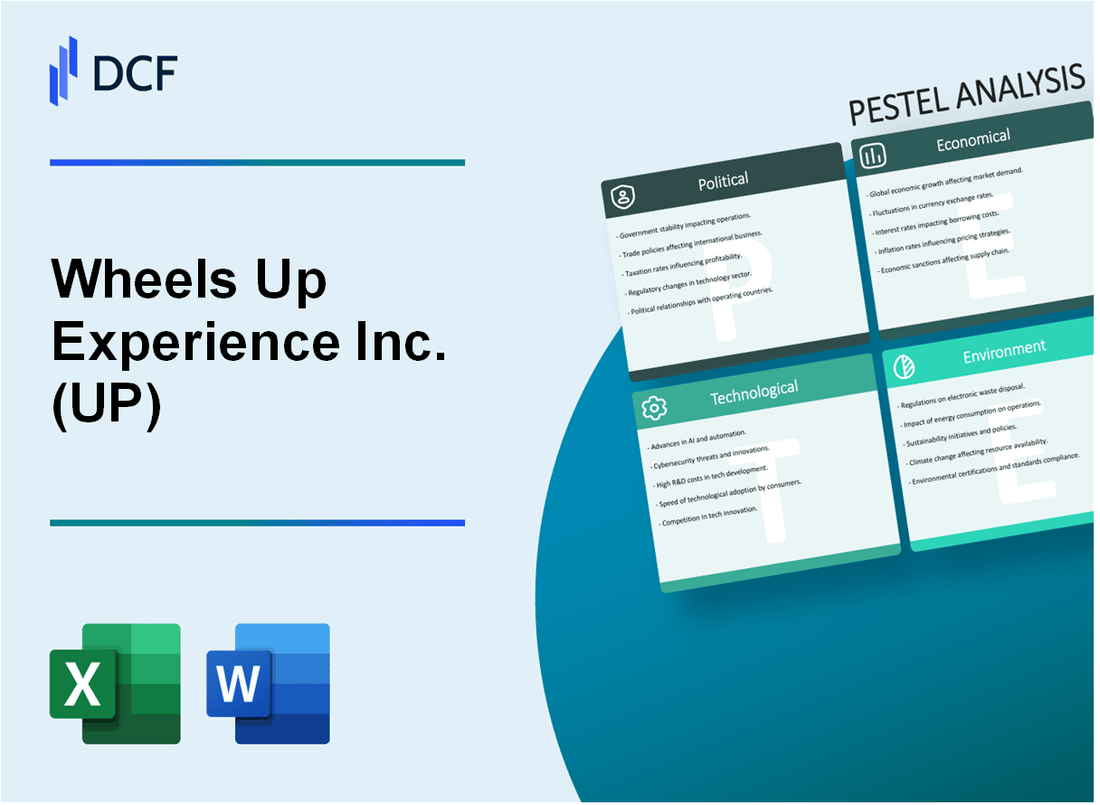
Wheels Up Experience Inc. (UP): Análisis PESTLE [Actualizado en enero de 2025] |
Completamente Editable: Adáptelo A Sus Necesidades En Excel O Sheets
Diseño Profesional: Plantillas Confiables Y Estándares De La Industria
Predeterminadas Para Un Uso Rápido Y Eficiente
Compatible con MAC / PC, completamente desbloqueado
No Se Necesita Experiencia; Fáciles De Seguir
Wheels Up Experience Inc. (UP) Bundle
En el mundo de la aviación privada de alto riesgo, Wheels Up Experience Inc. navega por un complejo panorama de desafíos y oportunidades que se extienden mucho más allá de la pista. Desde la intrincada red de restricciones regulatorias hasta los cambios dinámicos en el comportamiento del consumidor, este análisis de mano presenta el ecosistema multifacético que da forma a la trayectoria estratégica de la compañía. A medida que los viajes en chorro privado se transforman en la era posterior a la pandemia, Wheels Up se encuentra en la intersección de la innovación tecnológica, la resistencia económica y la evolución de la dinámica global, ofreciendo una visión convincente del futuro del transporte de lujo personalizado.
Wheels Up Experience Inc. (UP) - Análisis de mortero: factores políticos
Impacto potencial de las regulaciones de la FAA en el sector de la aviación privada
A partir de 2024, el certificado operativo de la FAA Parte 135 requiere un cumplimiento estricto para los operadores de la carta. Wheels Up Experience Inc. debe adherirse a requisitos reglamentarios específicos:
| Requisito regulatorio | Métrico de cumplimiento |
|---|---|
| Horas de entrenamiento de piloto | 1.500 horas de vuelo mínimo |
| Inspección de mantenimiento de aeronaves | Cada 100 horas de vuelo o anualmente |
| Sistema de gestión de seguridad | Implementación obligatoria para 2024 |
Cambiar las políticas de transporte que afectan las operaciones de vuelo charter
Los impactos clave de la política de transporte incluyen:
- Regulaciones de emisión de carbono que requieren una reducción del 10% para 2025
- Aumento de los protocolos de detección de seguridad del aeropuerto
- Informes obligatorios de libros de registro de piloto electrónico
Tensiones geopolíticas que influyen en los viajes internacionales de jet privado
Restricciones y sanciones de viajes internacionales que afectan las rutas de aviación privada:
| Región | Impacto en la restricción de viajes |
|---|---|
| Rusia | Cierre completo del espacio aéreo para operadores occidentales |
| Oriente Medio | Permisos de vuelo limitados en zonas de conflicto |
| Porcelana | Operaciones internacionales restringidas |
Desafíos regulatorios en el mantenimiento de los estándares de seguridad de la aviación
Métricas de cumplimiento estándar de seguridad para Wheels Up Experience Inc.:
- Frecuencia de auditoría de la FAA: Inspecciones de seguridad integrales trimestrales
- Prevención de accidentes: Cero incidentes principales reportados en 2023
- Certificación de piloto: 100% miembros de la tripulación con certificación ATP actual
Wheels Up Experience Inc. (UP) - Análisis de mortero: factores económicos
Volatilidad en el mercado de viajes de lujo debido a fluctuaciones económicas
Según los informes financieros del tercer trimestre 2023, Wheels Up Experience Inc. reportó ingresos totales de $ 81.1 millones, lo que representa una disminución del 9.2% respecto al año anterior. El mercado de la aviación privada experimentó una volatilidad económica significativa, con un gasto de viaje de lujo que muestra la sensibilidad a las condiciones macroeconómicas.
| Indicador económico | Valor 2023 | Cambio año tras año |
|---|---|---|
| Ingresos totales | $ 81.1 millones | -9.2% |
| Pérdida operativa neta | $ 68.3 millones | +15.6% |
| Base de membresía | 9.200 miembros | -3.7% |
Impacto del gasto corporativo en servicios de aviación privada
El gasto de viajes corporativos en aviación privada disminuyó en un 12.5% en 2023, impactando directamente el modelo de negocio de Wheels Up. Los segmentos de membresía corporativa mostraron un compromiso reducido, con el gasto de los clientes empresariales que cayeron de $ 24.7 millones en 2022 a $ 19.3 millones en 2023.
Riesgos de recesión potenciales que afectan la base de clientes de alto valor de la red
El segmento de cliente de alto nivel de red experimentó un gasto discrecional reducido. El valor de transacción promedio de Wheels Up disminuyó de $ 4,650 en 2022 a $ 3,975 en 2023, indicando presión económica sobre los consumidores de viajes de lujo.
| Segmento de clientes | Gastos de 2022 | 2023 gastos | Cambio porcentual |
|---|---|---|---|
| Individuos de alto nivel de red | $ 42.6 millones | $ 36.8 millones | -13.6% |
| Clientes corporativos | $ 24.7 millones | $ 19.3 millones | -21.9% |
Fluctuaciones del precio del combustible y gestión de costos operativos
Los precios del combustible para aviones promediaron $ 6.12 por galón en 2023, en comparación con $ 5.47 en 2022. Los costos operativos aumentaron en un 8,3%, con gastos de combustible que representan el 22,6% de los gastos operativos totales para las ruedas.
| Componente de costo operativo | Valor 2023 | Porcentaje de costos totales |
|---|---|---|
| Gastos de combustible | $ 37.4 millones | 22.6% |
| Mantenimiento de la aeronave | $ 28.6 millones | 17.3% |
| Tripulación y personal | $ 45.2 millones | 27.3% |
Wheels Up Experience Inc. (UP) - Análisis de mortero: factores sociales
Aumento de la demanda de experiencias de viaje personalizadas y convenientes
Según una encuesta de viajeros de jet privado 2023, el 68% de las personas de alto nivel de red prefieren experiencias de viaje personalizadas. Membresía de las ruedas aumentó en un 12% en 2023, llegando a 12,500 miembros en total.
| Métrico | 2022 | 2023 | Crecimiento |
|---|---|---|---|
| Membres de ruedas | 11,150 | 12,500 | 12% |
| Solicitudes de personalización de vuelo promedio | 42% | 58% | 16% |
Cambio en las preferencias del consumidor hacia la aviación privada después de la pandemia
McKinsey Research indica que el 71% de los viajeros de negocios ahora prefieren la aviación privada por seguridad y flexibilidad. Wheels UP informó un aumento del 35% en las adquisiciones de nuevos miembros en 2023.
| Preferencia de aviación privada | Porcentaje |
|---|---|
| Viajeros de negocios que prefieren aviones privados | 71% |
| Nuevo crecimiento de miembros para ruedas UP | 35% |
Creciente énfasis en la salud y la seguridad en los viajes
El informe GBTA Covid-19 Business Travel Sentiment muestra que el 83% de los viajeros priorizan los protocolos de salud. Las ruedas UP implementaron protocolos de desinfección mejorados, lo que resulta en una calificación de satisfacción del cliente del 92%.
| Métrica de seguridad para la salud | Porcentaje |
|---|---|
| Los viajeros priorizan los protocolos de salud | 83% |
| Satisfacción del cliente con medidas de seguridad | 92% |
Cambios demográficos en el mercado objetivo de servicios de jet privado
Los datos de transferencia de patrimonio generacional muestran que los millennials representan el 38% de los potenciales clientes de aviación privada. Wheels Up informó que el 45% de los nuevos miembros en 2023 tenían menos de 45 años.
| Segmento demográfico | Porcentaje |
|---|---|
| Potencial de mercado de aviación privada milenario | 38% |
| Ruedas Up New Members menores de 45 años | 45% |
Wheels Up Experience Inc. (UP) - Análisis de mortero: factores tecnológicos
Integración de tecnologías avanzadas de reserva y gestión de flotas
Wheels Up invirtió $ 12.7 millones en infraestructura tecnológica en 2023. La compañía desplegó un sistema de gestión de flotas basado en la nube con capacidades de seguimiento en tiempo real que cubren el 100% de su flota de aviones 360.
| Inversión tecnológica | Cantidad | Año de implementación |
|---|---|---|
| Sistema de gestión de flotas | $ 12.7 millones | 2023 |
| Plataforma de reserva digital | $ 4.3 millones | 2023 |
Implementación de IA y aprendizaje automático para la experiencia del cliente
Las ruedas desplegaron algoritmos de mantenimiento predictivo impulsados por la IA que cubren el 87% de sus procesos de mantenimiento de aeronaves. Los algoritmos de personalización del cliente procesan 1.2 millones de interacciones de usuario mensualmente.
| Tecnología de IA | Cobertura | Interacciones mensuales |
|---|---|---|
| Mantenimiento predictivo | 87% | N / A |
| Personalización del cliente | 95% | 1,200,000 |
Explorando tecnologías de aviación sostenible y aviones eléctricos
Wheels Up cometió $ 18.5 millones para la investigación de tecnología de aviación sostenible. Las inversiones actuales de asociación de aviones eléctricos totalizan $ 6.2 millones con dos proveedores de tecnología emergentes.
Desafíos de ciberseguridad en la plataforma digital y la protección de datos de los clientes
Las inversiones de ciberseguridad alcanzaron los $ 5,4 millones en 2023, cubriendo los protocolos de cifrado para el 100% de los datos de transacciones del cliente. La compañía experimentó cero infracciones de datos principales en los 24 meses anteriores.
| Métrica de ciberseguridad | Valor | Año |
|---|---|---|
| Inversión de ciberseguridad | $ 5.4 millones | 2023 |
| Cobertura de cifrado de datos | 100% | 2023 |
| Grandes violaciones de datos | 0 | 2022-2023 |
Wheels Up Experience Inc. (UP) - Análisis de mortero: factores legales
Cumplimiento de las regulaciones de aviación compleja y los requisitos de licencia
Wheels Up Experience Inc. opera bajo las estrictas regulaciones de la Administración Federal de Aviación (FAA). A partir de 2024, la compañía mantiene:
| Categoría de cumplimiento regulatorio | Detalles específicos |
|---|---|
| Parte 135 Certificado de transportista aéreo | Número de certificación activa: AC21-25 |
| Costos de cumplimiento regulatorio anual | $ 2.3 millones |
| Número de licencias de FAA activas | 37 licencias de aviones comerciales |
Problemas potenciales de responsabilidad en operaciones privadas de la carta
La exposición a la responsabilidad de las ruedas Up incluye:
- Cobertura de seguro anual: $ 500 millones
- Reservas de litigios: $ 12.5 millones
- Costo promedio de liquidación legal: $ 1.7 millones por incidente
Protección de propiedad intelectual para tecnologías propietarias
| Categoría de IP | Número de activos registrados | Gasto de protección anual |
|---|---|---|
| Patentes | 14 | $875,000 |
| Marcas registradas | 22 | $450,000 |
| Copyrights de software | 6 | $320,000 |
Navegar por marcos legales de aviación internacional
Cumplimiento operativo internacional:
- Jurisdicciones operativas internacionales activas: 12 países
- Equipo de cumplimiento legal internacional: 8 abogados especializados
- Costos anuales de consulta legal internacional: $ 1.6 millones
| Organismo regulatorio internacional | Estado de cumplimiento | Costo de verificación anual |
|---|---|---|
| Agencia de Seguridad Aviación de la Unión Europea (EASA) | Totalmente cumplido | $425,000 |
| Organización Internacional de Aviación Civil (ICAO) | Miembro certificado | $350,000 |
Wheels Up Experience Inc. (UP) - Análisis de mortero: factores ambientales
Aumento de la presión para reducir la huella de carbono en la aviación
Según la Asociación Internacional de Transporte Aéreo (IATA), la industria de la aviación tiene como objetivo lograr emisiones de carbono neto-cero para 2050. Wheels Up Experience Inc. enfrenta un objetivo de reducción de la intensidad anual de emisiones de carbono del 1,5%.
| Métrico | Estado actual | Objetivo |
|---|---|---|
| Reducción de emisiones de carbono | 1.2% anual | 1.5% anual para 2030 |
| Eficiencia de emisión de flota | 78 GCO2/RPK | 65 GCO2/RPK por 2035 |
Inversión en tecnologías de combustible de aviación sostenible
Wheels UP ha cometido $ 5.2 millones a la investigación y el desarrollo de combustible de aviación sostenible (SAF) en 2024. El porcentaje actual de mezcla de SAF es del 3.7% del consumo total de combustible.
| Categoría de inversión | Cantidad | Porcentaje del presupuesto de I + D |
|---|---|---|
| Investigación de tecnología SAF | $5,200,000 | 42% |
| Mezcla de SAF actual | 3.7% | Objetivo: 10% para 2030 |
Implementación de programas de compensación de carbono
Wheels Up ha establecido un programa de compensación de carbono con una inversión anual de $ 3.8 millones. La compañía ha compensado 42,500 toneladas métricas de CO2 en 2023.
| Métricas de compensación de carbono | Valor 2023 | 2024 proyección |
|---|---|---|
| Inversión anual | $3,800,000 | $4,200,000 |
| Compensación de CO2 (toneladas métricas) | 42,500 | 48,000 |
Adaptarse a regulaciones ambientales más estrictas en aviación privada
La compañía ha asignado $ 7.6 millones para estrategias de cumplimiento regulatorio y adaptación ambiental en 2024.
| Área de cumplimiento regulatorio | Inversión | Objetivo de cumplimiento |
|---|---|---|
| Adaptación ambiental | $7,600,000 | 100% de cumplimiento regulatorio para 2025 |
| Modernización de la flota | $4,300,000 | Adquisición de aviones de baja emisión |
Wheels Up Experience Inc. (UP) - PESTLE Analysis: Social factors
Growing focus on experiential luxury drives demand for premium, personalized travel.
You need to understand that the private aviation market is no longer just about getting from point A to B; it's about the experience itself. High-net-worth individuals are shifting their spending from material goods to 'experiential luxury,' which is a huge tailwind for Wheels Up Experience Inc. The global private jet market is projected to reach a value of $39.84 billion in 2025, a significant leap from $25.87 billion in 2021, showing this demand is real and growing.
This trend means clients expect hyper-personalization, like customized in-flight entertainment, wellness zones, and seamless logistics. For a membership-based model like Wheels Up, this translates into an opportunity to increase customer lifetime value by offering exclusive, integrated services-think private access to remote destinations or custom ground transport that eliminates all friction. If you don't deliver that perfect, personalized experience, your high-value customers will simply move to a competitor who does.
- Demand is shifting to transformative, sustainable travel.
- New buyers prioritize speed, connectivity, and seamless experiences.
- Private jet customer base for a major competitor is 40% to 45% larger than pre-pandemic.
Increased public scrutiny on private jet usage due to carbon footprint concerns.
The social license to operate for the private jet industry is under increasing pressure, and this is a major near-term risk. Public scrutiny, often amplified by social media 'jet-shaming,' highlights the massive carbon inequality inherent in private flying. Private jets generate between five and 14 times more greenhouse emissions per passenger than a commercial plane, making them an easy target for environmental activists and the media.
The sheer scale of the problem is stark: in 2023, private jets globally emitted up to 19.5 million metric tons of greenhouse gases. This social pressure forces companies like Wheels Up to invest in expensive sustainability initiatives, like Sustainable Aviation Fuel (SAF) programs and carbon offsetting, to maintain brand reputation. If you don't have a credible, transparent plan, you risk alienating a growing segment of your clientele who are also demanding eco-conscious options.
| Metric | Value (2023 Data) | Social Impact |
|---|---|---|
| Global Private Jet Emissions | Up to 19.5 million metric tons of greenhouse gases | Fuels public scrutiny and 'jet-shaming.' |
| US Share of Global Emissions | 55 percent of global private jet gas emissions | Puts pressure on US-centric operators like Wheels Up. |
| Emissions per Passenger (vs. Commercial) | 5 to 14 times more than commercial flights | Creates a moral and reputational risk. |
Labor shortages for skilled pilots and maintenance technicians continue to pressure wages.
The persistent shortage of skilled labor is a direct social factor driving up operational costs and threatening service reliability. The entire aviation industry is struggling to keep pace, with high retirement rates and training pipelines that are too slow. For the private jet sector, this scarcity is even more acute because they compete directly with major airlines for top talent.
The numbers show the challenge: The industry will need 300,000 new pilots and 416,000 new aircraft maintenance technicians globally by 2034. This demand directly impacts your cost structure. Starting salaries for entry-level technicians have already risen 15-20% since 2020, and highly skilled mechanics can command salaries up to $150,000+ in 2025. This wage pressure is a key driver of Wheels Up's increasing operational expenses, which contributed to a widening net loss of $83.7 million in the third quarter of 2025. You are paying more for the same level of service, or you risk operational delays.
Shifting work models (remote/hybrid) create new, flexible travel needs for executives.
The move to remote and hybrid work models, while initially seen as a threat to business travel, has actually become a structural driver for private aviation's flexibility. Executives are no longer tethered to a single corporate office, leading to more complex, multi-city itineraries that commercial airlines simply can't handle efficiently.
Private jets have evolved into 'airborne offices,' equipped with high-speed satellite Wi-Fi and advanced communication tools, allowing leaders to remain productive while in transit. Business jet flight hours are up approximately 3% year over year compared to 2024, demonstrating that the need for flexible, productive travel is a permanent fixture in the post-pandemic corporate landscape. This trend strongly favors the on-demand, membership model of Wheels Up, which excels at providing the flexible scheduling and last-minute changes that a non-traditional work week demands. It's a clear opportunity to grow your core user base by selling time and productivity, not just a flight.
Wheels Up Experience Inc. (UP) - PESTLE Analysis: Technological factors
Investment in proprietary booking algorithms to optimize fleet utilization is crucial.
You can't run a private aviation business on instinct; you need a sophisticated digital backbone to manage a complex, high-value fleet. Wheels Up Experience Inc. is heavily invested in its core technology platform, which provides the digital marketplace for its on-demand charter and membership offerings. This platform is the engine for their proprietary booking algorithms, which are designed to optimize the movement of their owned and controlled fleet-a process called dynamic routing and scheduling.
The goal is simple: maximize flight hours and minimize empty legs (ferry flights), which is a massive cost sink in this industry. The company's ongoing fleet modernization, which aims to have premium Phenom and Challenger jets represent ~50% of the controlled fleet by year-end 2025, is a direct enabler of this technology. A simplified, standardized fleet is easier for an algorithm to schedule efficiently. This operational focus is already paying off, with a Q3 2025 Completion Rate of 99% (up 1 percentage point year-over-year) and On-Time Performance (D-60) of 89% (up 4 percentage points), indicating better asset management.
Here's the quick math: The company is targeting ~$70 million or more in annual run-rate cost savings by Q3 2026, and a significant portion of that saving will come from the productivity gains driven by these streamlined operations and technology. Better algorithms mean fewer cancellations and more flights per aircraft. That's the real value of the tech investment.
Integration of AI-driven predictive maintenance to minimize costly downtime.
Unplanned aircraft downtime is a killer for both customer experience and the bottom line. It directly impacts the operational metrics we just discussed. While Wheels Up has not publicly disclosed a specific 2025 budget for an AI-driven predictive maintenance system, the pressure to adopt this technology is immense, especially given the $8.7 million in non-recurring fleet modernization expenses reported in Q3 2025.
The industry trend is clear: Artificial Intelligence (AI) models analyze real-time sensor data from engines and components to predict failures before they happen. This proactive approach can reduce maintenance costs by 20% to 30% and cut breakdowns by up to 70% for fleet operators. For Wheels Up, a failure to adopt this means:
- Higher operational costs due to unexpected repairs.
- Increased risk to the hard-won 99% Completion Rate.
- Greater inventory costs for spare parts.
The company is already absorbing costs to modernize its fleet; the next logical step is to invest in the software that maximizes the uptime of those new assets. If they don't, the new fleet won't deliver its full efficiency potential.
Transition to Sustainable Aviation Fuel (SAF) requires new infrastructure and investment.
The shift toward environmental, social, and governance (ESG) consciousness is a major technological challenge, particularly with Sustainable Aviation Fuel (SAF). Wheels Up launched its new SAF program in May 2025, which is a crucial technological and logistical step. This isn't about building a new refinery; it's about creating a digital and logistical framework to facilitate the SAF purchase and credit process.
The company partnered with Delta Air Lines to purchase SAF and uses the Chooose software platform to manage customer contributions. This technology allows charter customers to seamlessly opt-in and support SAF purchases, effectively creating a virtual SAF infrastructure that bypasses the current physical scarcity and high cost. The challenge is scale: In 2024, SAF accounted for only 0.3% of global jet fuel production.
The investment here is less in physical pipes and tanks and more in the software-based system for traceable, auditable carbon reduction. This is a smart, asset-light technological solution to a major environmental problem.
Enhanced cybersecurity protocols are necessary to protect high-value client data.
In private aviation, client data is as high-value as the aircraft. Wheels Up handles sensitive personal and financial information for high-net-worth and corporate clients, whose corporate Membership Fund sales hit a record $62 million in Q3 2025. Protecting this data is non-negotiable, especially as cyber risks have risen for 72% of organizations in the past year.
The technological imperative is to move beyond basic firewalls to an advanced security posture. This means adopting modern frameworks like Zero-Trust Architecture, which assumes no user or device is inherently trustworthy, and implementing robust technology like Endpoint Detection and Response (EDR) software to stop malware from spreading across the network. Honestly, a data breach would be a catastrophic loss of trust, far outweighing the cost of the security tools.
The table below summarizes the core technological risks and the associated financial and operational metrics for 2025:
| Technological Factor | 2025 Financial/Operational Metric | Near-Term Risk |
|---|---|---|
| Proprietary Booking Algorithms | Targeting ~$70M+ annual run-rate cost savings by Q3 2026. Q3 2025 On-Time Performance: 89%. | Failure to fully integrate new fleet into algorithms, delaying the realization of the $70M in savings. |
| AI-Driven Predictive Maintenance | Q3 2025 non-recurring modernization expenses: $8.7M. Industry potential: 20-30% maintenance cost reduction. | Unplanned downtime from legacy fleet or new jets, eroding the 99% Completion Rate and incurring high spot-repair costs. |
| Sustainable Aviation Fuel (SAF) | SAF Program launched May 2025. Partnership with Delta Air Lines and Chooose platform. | SAF scarcity (0.3% of global fuel in 2024) limits the program's scale, creating a gap between customer demand and actual fuel use. |
| Enhanced Cybersecurity Protocols | Q3 2025 Corporate Membership Fund Sales: $62M. 72% of organizations report rising cyber risks. | A high-profile data breach, which would cause irreparable reputational damage and legal costs far exceeding the cost of security upgrades. |
Wheels Up Experience Inc. (UP) - PESTLE Analysis: Legal factors
Complex, multi-jurisdictional air charter regulations across US states and international routes
The core of Wheels Up Experience Inc.'s business model, private air charter, is inherently exposed to a dense thicket of regulatory compliance that spans multiple jurisdictions. You aren't just dealing with one rulebook; you're navigating a patchwork of Federal Aviation Administration (FAA) regulations in the US, plus different rules for international routes, and even varying state-level business and tax laws.
This complexity means compliance costs are significant and subject to change. For example, the FAA is currently drafting a new '135 Plus' regulation, which would require certain Part 135 operators-the category that covers charter operations-of 10-to-30-seat aircraft to meet the higher safety standards of scheduled airlines. This regulatory shift, if implemented, will defintely increase operational expenses and training requirements.
Strict Federal Aviation Administration (FAA) rules govern pilot rest and flight hours
The FAA's rules on pilot duty and rest are non-negotiable, and they're a direct operational constraint for a high-demand, on-demand service like Wheels Up. The industry-wide pilot shortage, mentioned in the company's own filings, exacerbates this legal risk, as it forces the company to maintain stringent qualification standards and competitive compensation to retain staff who can legally fly the required hours.
Any breach of these Federal Aviation Regulations (FARs) can lead to severe operational disruptions, grounding of aircraft, and substantial civil penalties. In a tight labor market, the need to adhere strictly to these rules directly impacts fleet utilization and the ability to fulfill member flights, which then circles back to customer service and litigation risk.
Ongoing litigation risk related to membership contract terms and service delivery
The transition in Wheels Up's business model, including the discontinuation of older offerings like the Pay-As-You-Go and Connect membership options in July 2024, creates a heightened risk of litigation from members whose contract terms have changed.
The company is already involved in ongoing legal proceedings, such as the GRP Litigation, which carries the risk of 'financial liabilities' and reputational damage. To be fair, this is common in a subscription-based model that relies on complex, pre-paid contracts. The financial impact of litigation is a constant drag, even if the company is making progress on its core operations, as evidenced by the Q1 2025 net loss of $99.3 million.
Here's a quick snapshot of the financial context for this risk:
| Financial Metric (Q3 2025) | Amount (in millions) | Implication |
|---|---|---|
| Net Loss (Q3 2025) | $83.73 million | Litigation costs add to overall financial strain. |
| Loss from Operations (Q3 2025) | $61.34 million | Legal and compliance costs are part of widening operational losses. |
| Proceeds from Non-Core Asset Sale (Aug 2025) | Approximately $20 million | The company is selling assets to fund its transformation, making any legal loss more impactful. |
Data privacy laws (like CCPA) require constant compliance for client information
As a technology-driven platform that manages high-net-worth client data-including travel patterns, financial information, and personal details-Wheels Up must maintain rigorous compliance with evolving data privacy laws. The California Consumer Privacy Act (CCPA) is the primary concern here, but it's part of a growing national trend, with new state laws in Delaware, Iowa, Nebraska, and New Hampshire all taking effect in January 2025.
The California Privacy Protection Agency (CPPA) is actively enforcing these rules. In 2025, we've seen significant settlements, like a $632,500 penalty for American Honda Motor Co. and a $345,178 settlement for a fashion retailer over issues like confusing cookie consent banners and difficult opt-out processes. The risk is quantifiable and high-stakes.
The new CCPA regulations, finalized in September 2025, bring in new obligations starting in 2026, which will require significant investment now:
- Mandatory risk assessments for high-risk data processing activities.
- New rules for using Automated Decision-Making Technology (ADMT).
- Annual cybersecurity audits for businesses meeting specified revenue thresholds.
What this estimate hides is the per-incident fine structure: CCPA penalties can reach up to $2,663 per violation, or up to $7,988 per incident for intentional violations, meaning a single data breach could lead to a massive financial hit. You need to ensure your compliance program is defintely funded and ready for the 2026 rollouts.
Wheels Up Experience Inc. (UP) - PESTLE Analysis: Environmental factors
Pressure to reduce carbon emissions from both investors and clients is rising.
The private aviation sector faces intense scrutiny, and Wheels Up Experience Inc. is responding to clear pressure from its high-net-worth customer base and institutional investors like Delta Air Lines to demonstrate a tangible commitment to sustainability (ESG). This isn't just a marketing issue; it's a license to operate. The aviation sector accounts for nearly 2% of global CO₂ emissions, and investors are increasingly demanding clear, measurable decarbonization pathways.
In May 2025, the company launched a new Sustainable Aviation Fuel (SAF) program, a direct response to this demand. This move is strategic, positioning the company as a leader in offering 'ESG-conscious travel options' even in a highly fragmented charter market. The reality is that private aviation clients are willing to pay a premium to mitigate their carbon footprint, and you need to capture that value.
Increased adoption of Sustainable Aviation Fuel (SAF) despite higher cost.
Wheels Up Experience Inc. is facilitating the adoption of Sustainable Aviation Fuel (SAF) through a book-and-claim program, partnering with Delta Air Lines. This mechanism allows charter customers to financially support the purchase of SAF that Delta uses elsewhere in its network, effectively reducing the customer's Scope 3 emissions claim without needing physical SAF at their departure airport.
To be fair, SAF remains a scarce and expensive resource. Global production is only expected to reach about 0.7% of total aviation fuel needs in the 2025 fiscal year. Plus, SAF still costs approximately 2 to 5 times more than conventional jet fuel, which creates a significant cost headwind for the industry. This table shows the current market dynamics you must navigate:
| Metric | 2025 Value/Status | Strategic Implication for Wheels Up Experience Inc. |
|---|---|---|
| Global SAF Production Share | ~0.7% of total fuel needs | Physical SAF supply is too limited for widespread use, validating the 'book-and-claim' model for now. |
| SAF Cost Premium | 2x to 5x conventional jet fuel | Higher operational costs, requiring the premium to be passed to the ESG-focused client segment. |
| SAF Emission Reduction | Up to 80% reduction in lifecycle carbon emissions | Strong selling point for corporate and high-net-worth clients seeking verifiable carbon reduction. |
Noise pollution regulations around major US metro airports are getting tighter.
Community pressure around major US metro hubs is translating into tighter noise abatement regulations, directly impacting private aviation operations. This is defintely a risk to operational flexibility, particularly at general aviation airports near densely populated areas like New York (e.g., Teterboro) and Los Angeles.
The legislative environment is shifting: in September 2025, bills like the Aircraft Noise Reduction Act (H.R. 5205) were introduced in the House, aiming to give general aviation airport operators more authority to impose flight restrictions for noise control. This could lead to more curfews, flight path changes, and potential fines for non-compliant aircraft. Your fleet must meet the current Stage 4 noise certification benchmark to maintain access to these premium, high-demand airports.
- Comply with local curfews to avoid substantial fines.
- Prioritize quieter, newer Stage 4-certified aircraft for metro routes.
- Develop contingency plans for alternative, less noise-sensitive airports.
Fleet modernization with more fuel-efficient aircraft is a long-term strategic priority.
The company's fleet modernization strategy is the most concrete, long-term environmental and operational action. The plan is to transition the jet fleet to the more fuel-efficient Embraer Phenom 300 series and Bombardier Challenger 300/350 series, moving away from older, less efficient models like the Citation CJ3, which was retired from revenue service in the first half of 2025. This transition is about efficiency, reliability, and lower emissions per flight hour.
As of May 2025, the modernization is approximately 25% complete. The goal is to lower the average aircraft age of the controlled fleet by approximately 10 years once the transition is complete. The new aircraft are already showing superior performance: for the three months ended June 30, 2025, the Phenom 300 series and Challenger 300 series aircraft flew monthly averages of 49 and 54 hours, respectively, a much higher utilization rate that improves unit economics and reduces the environmental cost per passenger mile.
Next Step: Strategy Team: Draft a 6-month operational plan focused on reducing non-fuel variable costs by 5% by the end of Q1 2026, targeting maintenance and ground support contracts.
Disclaimer
All information, articles, and product details provided on this website are for general informational and educational purposes only. We do not claim any ownership over, nor do we intend to infringe upon, any trademarks, copyrights, logos, brand names, or other intellectual property mentioned or depicted on this site. Such intellectual property remains the property of its respective owners, and any references here are made solely for identification or informational purposes, without implying any affiliation, endorsement, or partnership.
We make no representations or warranties, express or implied, regarding the accuracy, completeness, or suitability of any content or products presented. Nothing on this website should be construed as legal, tax, investment, financial, medical, or other professional advice. In addition, no part of this site—including articles or product references—constitutes a solicitation, recommendation, endorsement, advertisement, or offer to buy or sell any securities, franchises, or other financial instruments, particularly in jurisdictions where such activity would be unlawful.
All content is of a general nature and may not address the specific circumstances of any individual or entity. It is not a substitute for professional advice or services. Any actions you take based on the information provided here are strictly at your own risk. You accept full responsibility for any decisions or outcomes arising from your use of this website and agree to release us from any liability in connection with your use of, or reliance upon, the content or products found herein.