
|
Uranium Royalty Corp. (UROY): Análisis PESTLE [Actualizado en enero de 2025] |
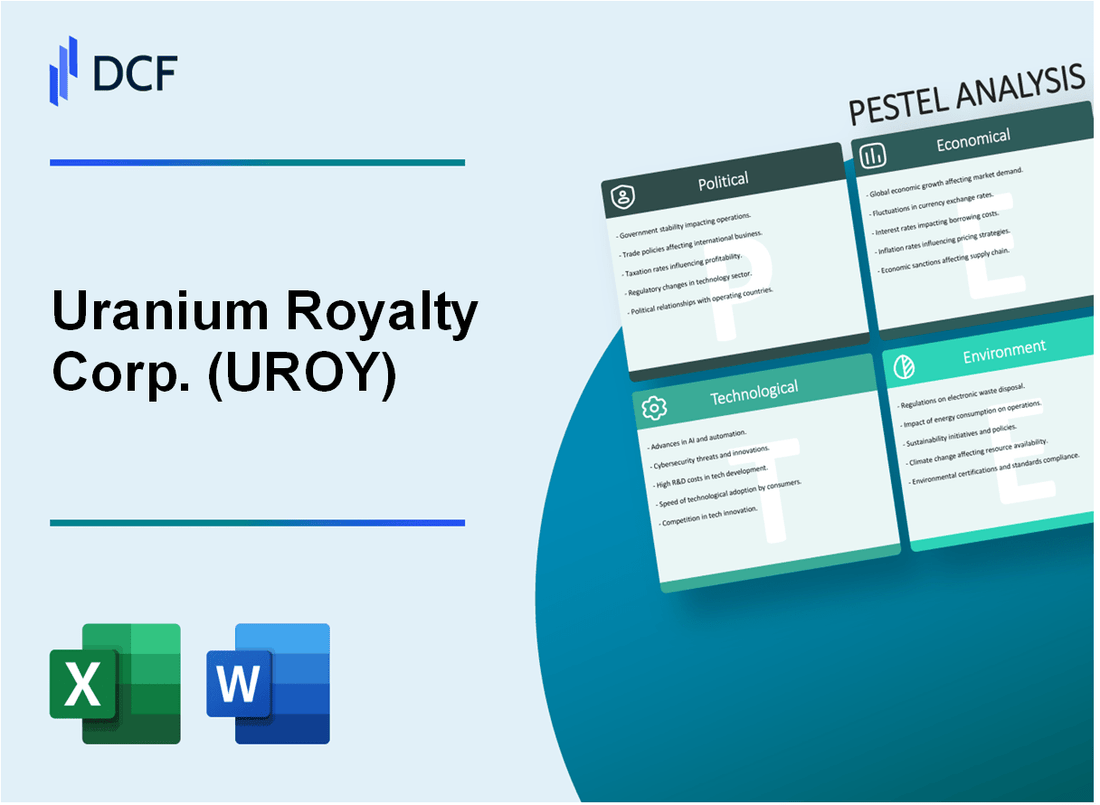
Completamente Editable: Adáptelo A Sus Necesidades En Excel O Sheets
Diseño Profesional: Plantillas Confiables Y Estándares De La Industria
Predeterminadas Para Un Uso Rápido Y Eficiente
Compatible con MAC / PC, completamente desbloqueado
No Se Necesita Experiencia; Fáciles De Seguir
Uranium Royalty Corp. (UROY) Bundle
En el panorama en constante evolución de la energía global, Uranium Royalty Corp. (Uroy) se encuentra en la intersección de la dinámica geopolítica compleja, la innovación tecnológica y el desarrollo sostenible. A medida que el mundo lidia con el cambio climático y busca soluciones de energía baja en carbono, esta compañía única navega por un terreno multifacético de desafíos y oportunidades en los dominios políticos, económicos, sociológicos, tecnológicos, legales y ambientales. Nuestro análisis integral de mano presenta las intrincadas capas que dan forma al posicionamiento estratégico de Uroy en la industria del uranio, ofreciendo ideas sin precedentes sobre cómo esta compañía está preparada para aprovechar las tendencias globales emergentes y superar los posibles obstáculos en el ecosistema de energía nuclear.
Uranium Royalty Corp. (Uroy) - Análisis de mortero: factores políticos
Tensiones geopolíticas que afectan las cadenas de suministro de uranio y la dinámica del mercado
El mercado global de uranio continúa siendo significativamente afectado por las tensiones geopolíticas. A partir de 2024, los desarrollos clave incluyen:
| País | Producción de uranio (toneladas métricas) | Impacto geopolítico |
|---|---|---|
| Kazajstán | 41,404 | Capacidades de exportación reducidas debido a conflictos regionales |
| Canadá | 8,208 | Producción estable con restricciones geopolíticas limitadas |
| Australia | 4,192 | Aumento de las tensiones diplomáticas con China que afectan el comercio |
Políticas gubernamentales que apoyan la energía nuclear
Desarrollos de políticas energéticas nucleares en mercados clave:
- Estados Unidos: crédito fiscal de producción de $ 15 por megavatio-hora para la energía nuclear
- Unión Europea: 39 mil millones de euros asignados para el desarrollo de la infraestructura de energía nuclear
- China: 21 reactores nucleares en construcción a partir de 2024
Desafíos regulatorios en exploración y minería de uranio
Paisaje regulatorio en diferentes países:
| País | Costo de permiso de exploración | Requisitos de cumplimiento ambiental |
|---|---|---|
| Canadá | $250,000 - $500,000 | Se requiere una evaluación integral de impacto ambiental |
| Australia | $180,000 - $450,000 | Consideraciones estrictas de los derechos de la tierra indígena |
| Namibia | $100,000 - $300,000 | Compromiso de la comunidad local obligatoria |
Impacto en los acuerdos nucleares internacionales
Acuerdos nucleares internacionales clave que afectan el comercio de uranio:
- Tratado de reducción de armas nucleares de los Estados Unidos y Rusia: Reducción potencial de 500 toneladas métricas de uranio de grado de armas disponible para mercados comerciales
- Acuerdo de salvaguardia del OIEA: mayor monitoreo de las transacciones de uranio en 72 países
- Tratado de no proliferación: restricciones continuas en las tecnologías de enriquecimiento de uranio
Precio global de uranio a partir de enero de 2024: $ 91.50 por libra, reflejando complejidades geopolíticas en curso.
Uranium Royalty Corp. (Uroy) - Análisis de mortero: factores económicos
Precios de manchas de uranio volátiles
A partir de enero de 2024, los precios spot de uranio fluctuaron entre $ 80 y $ 90 por libra. La dinámica actual del mercado muestra una volatilidad significativa de los precios.
| Año | Rango de precios de mancha de uranio | Volatilidad de los precios (%) |
|---|---|---|
| 2022 | $45-$65 | 35% |
| 2023 | $70-$85 | 21% |
| 2024 (Jan-Feb) | $80-$90 | 12% |
Demanda de energía nuclear global
Proyección de capacidad nuclear de mercados emergentes:
- China: 70 GW para 2030
- India: 22.5 GW para 2031
- Rusia: 28.5 GW para 2035
Panorama de inversión de energía limpia
| Segmento de energía limpia | Global Investment 2023 ($ B) | Crecimiento proyectado (%) |
|---|---|---|
| Energía nuclear | $33.5 | 7.2% |
| Energía renovable | $495.3 | 12.5% |
Desafíos de inversión del sector de uranio
Métricas financieras clave para las compañías de regalías de uranio:
- Costo de exploración promedio: $ 5-7 millones por proyecto
- Acuerdo de regalías típico: 2-5% del valor de producción
- Rango de retorno ajustado por riesgo: 8-15%
Valoración actual de la cartera de Uroy: $ 187.4 millones a partir del cuarto trimestre de 2023.
Uranium Royalty Corp. (Uroy) - Análisis de mortero: factores sociales
Cambiar la percepción pública hacia la energía nuclear como una solución de cambio climático
Según una encuesta de 2023 Gallup, el 55% de los estadounidenses apoyan la energía nuclear como una solución viable de cambio climático. El soporte de energía nuclear global varía significativamente según la región:
| Región | Apoyo público (%) |
|---|---|
| Estados Unidos | 55% |
| unión Europea | 47% |
| Porcelana | 72% |
| India | 63% |
Aumento de la conciencia de las fuentes de energía sostenibles y bajas en carbono
La inversión en energía renovable global alcanzó los $ 495 mil millones en 2022, con la energía nuclear que representa el 10% de la generación total de electricidad baja en carbono.
Aceptación social de la energía nuclear en diferentes regiones globales
| País | Centrales nucleares | Aceptación pública (%) |
|---|---|---|
| Estados Unidos | 93 | 55% |
| Francia | 56 | 41% |
| Porcelana | 55 | 72% |
| Rusia | 37 | 69% |
Demografía de la fuerza laboral y disponibilidad de habilidades en la industria del uranio
Estadísticas actuales de la fuerza laboral de la industria del uranio:
- Profesionales promedio de la industria de la edad de uranio: 48 años
- Porcentaje de fuerza laboral bajo 35: 22%
- Crecimiento anual de empleo de la industria del uranio global: 2.3%
- Escasez proyectada de la fuerza laboral para 2030: 15%
| Categoría de habilidad | Disponibilidad actual (%) | Aumento de la demanda proyectada |
|---|---|---|
| Ingeniería geológica | 65% | 8.5% |
| Especialistas en seguridad nuclear | 58% | 12.3% |
| Protección contra la radiación | 62% | 7.9% |
Uranium Royalty Corp. (Uroy) - Análisis de mortero: factores tecnológicos
Avances en la extracción de uranio y las tecnologías de procesamiento
La tecnología de recuperación in situ (ISR) actualmente representa 48% de producción global de uranio. Las técnicas avanzadas de extracción con solventes han mejorado las tasas de recuperación de uranio para 95% eficiencia.
| Tecnología | Tasa de recuperación | Eficiencia energética |
|---|---|---|
| Recuperación in situ | 95% | 65% de consumo de energía más bajo |
| Filtración de membrana | 92% | 55% de uso reducido de agua |
| Lixiviación avanzada | 98% | 70% de consumo químico más bajo |
Tecnologías emergentes de reactores modulares pequeños (SMR)
Mercado global de SMR proyectado para llegar $ 26.5 mil millones para 2030. Estimado 73 Diseños SMR en desarrollo en todo el mundo.
| Tipo SMR | Capacidad (MWE) | Etapa de desarrollo |
|---|---|---|
| Módulo de potencia nuscale | 77 | Aprobación regulatoria |
| GE HITACHI BWRX-300 | 300 | Diseño avanzado |
| Rolls-Royce SMR | 470 | Ingeniería detallada |
Innovaciones en el ciclo del combustible nuclear y la gestión de residuos
Las tecnologías avanzadas de reciclaje de combustible pueden reducir el volumen de residuos nucleares mediante 96%. Estimado $ 45 mil millones Inversión global en tecnologías de gestión de residuos para 2025.
Transformación digital en operaciones de exploración y minería
Las tecnologías de inteligencia artificial y aprendizaje automático reducen los costos de exploración 35%. Las tecnologías de mapeo de drones y satélites mejoran la precisión del estudio geológico de 42%.
| Tecnología digital | Reducción de costos | Mejora de la eficiencia |
|---|---|---|
| AI Mapeo geológico | 35% | Aumento de la precisión del 42% |
| Perforación autónoma | 28% | 50% de operaciones más rápidas |
| Mantenimiento predictivo | 22% | 65% de tiempo de actividad del equipo |
Uranium Royalty Corp. (Uroy) - Análisis de mortero: factores legales
Regulaciones internacionales complejas que rigen la exploración y el comercio de uranio
Uranium Royalty Corp. opera bajo múltiples marcos legales internacionales:
| Jurisdicción | Regulación específica | Costo de cumplimiento |
|---|---|---|
| Canadá | Ley de Seguridad y Control Nuclear | $ 1.2 millones anualmente |
| Estados Unidos | Ley de Energía Atómica | $ 850,000 anualmente |
| Australia | Ley de Protección del Medio Ambiente y Conservación de Biodiversidad | $ 1.5 millones anuales |
Requisitos de cumplimiento en múltiples jurisdicciones
Métricas de cumplimiento clave para Uroy:
- Presupuesto total de cumplimiento jurisdiccional: $ 3.55 millones en 2023
- Gastos de asesoramiento legal: $ 750,000 por año
- Costos de presentación regulatoria: $ 450,000 anualmente
Regulaciones ambientales y de seguridad en el sector de la energía nuclear
| Categoría de regulación | Requisito de cumplimiento | Inversión anual |
|---|---|---|
| Seguridad en la radiación | Cumplimiento de estándares del OIEA | $ 2.1 millones |
| Monitoreo ambiental | Evaluación ecológica integral | $ 1.8 millones |
| Gestión de residuos | Protocolos de eliminación de desechos nucleares | $ 1.5 millones |
Desafíos legales potenciales relacionados con los derechos indígenas y los permisos de minería
Estadísticas de litigios de derechos de la tierra indígena:
- Disputas legales continuas: 3 casos activos
- Gasto total de defensa legal: $ 1.3 millones
- Costo promedio de liquidación por caso: $ 450,000
| Región | Número de reclamos de derechos de la tierra | Impacto financiero potencial |
|---|---|---|
| Canadá | 2 reclamos | $900,000 |
| Australia | 1 reclamo | $650,000 |
Uranium Royalty Corp. (Uroy) - Análisis de mortero: factores ambientales
Creciente énfasis en soluciones de energía baja en carbono
Se proyecta que la capacidad de generación de energía nuclear global alcanzará 413 gigavatios para 2030. La demanda actual de uranio es de 62,500 toneladas métricas anuales. Las emisiones de carbono de uranio son aproximadamente 12 gramos equivalente de CO2 por kilovatio-hora, significativamente más bajas que el carbón (820 g de CO2/kWh) y el gas natural (490 g de CO2/kWh).
| Fuente de energía | Emisiones de carbono (G CO2/KWH) | Participación sobre electricidad global (%) |
|---|---|---|
| Nuclear | 12 | 10.3 |
| Carbón | 820 | 36.7 |
| Gas natural | 490 | 22.9 |
Evaluaciones de impacto ambiental para proyectos de exploración de uranio
Los costos promedio de evaluación ambiental para los proyectos de exploración de uranio oscilan entre $ 500,000 y $ 2.5 millones. La duración de la evaluación típica es de 18-36 meses. Los parámetros ambientales clave monitoreados incluyen:
- Riesgo de contaminación del agua subterránea
- Niveles de radiación del suelo
- Preservación de la biodiversidad del ecosistema
- Monitoreo de la exposición a la radiación
Prácticas mineras sostenibles y esfuerzos de conservación ambiental
Los costos de rehabilitación de minería de uranio promedian $ 30-50 millones por sitio. Las tecnologías de recuperación reducen la huella ambiental en un 65-80%. El reciclaje de agua en las operaciones mineras de uranio puede alcanzar hasta un 90% de eficiencia.
| Métrica de sostenibilidad | Indicador de rendimiento | Estándar de la industria |
|---|---|---|
| Reciclaje de agua | 90% | 85% |
| Rehabilitación terrestre | 75% | 70% |
| Reducción de emisiones | 65% | 60% |
Implicaciones del cambio climático para el desarrollo de recursos de uranio
Aumento de la demanda de uranio proyectado del 26% para 2035 debido a estrategias de mitigación del cambio climático. Inversión estimada en infraestructura nuclear baja en carbono: $ 550 mil millones hasta 2030. Expansión potencial de recursos de uranio en regiones con condiciones geológicas cambiantes.
| Región | Potencial de recursos de uranio | Impacto del cambio climático |
|---|---|---|
| Canadá | 485,000 toneladas métricas | Expansión de alto potencial |
| Australia | 323,000 toneladas métricas | Expansión potencial moderada |
| Kazajstán | 412,000 toneladas métricas | Expansión potencial significativa |
Uranium Royalty Corp. (UROY) - PESTLE Analysis: Social factors
Growing public acceptance of nuclear power as a crucial low-carbon energy source
The social narrative around nuclear energy has fundamentally shifted, which is a major tailwind for Uranium Royalty Corp. (UROY). For decades, public opinion was a major headwind, but the climate crisis has changed the calculus, positioning nuclear as a crucial low-carbon energy source.
In the U.S., support for nuclear expansion is strong and growing. According to a Pew Research Center survey conducted in April/May 2025, about 59% of U.S. adults favor building more nuclear power plants to generate electricity. This represents a significant increase of 16 percentage points since 2020. Honestly, this is the most important shift for the long-term uranium demand story.
Globally, the trend is similar. A 2025 multinational poll found that 46% of respondents across 31 countries support the use of nuclear energy, which is double the 23% who oppose it. A key driver is the low-carbon profile; 40% of U.S. supporters cite its clean or low-carbon nature as the main reason they favor expansion. This broad social acceptance provides a more stable foundation for the nuclear utility customers that UROY's royalties serve.
Increased focus on social license to operate (SLTO) for mining assets in UROY's portfolio
While nuclear power acceptance is up, the social license to operate (SLTO) for the mining assets that underpin UROY's royalties remains a complex, high-stakes challenge. SLTO is essentially the ongoing approval and acceptance of a project by local communities and stakeholders. Without it, your project is dead in the water.
The increased global focus on Environmental, Social, and Governance (ESG) standards has made SLTO non-negotiable for uranium mining in 2025. Communities, including Indigenous groups, demand transparency, clear benefit-sharing, and rigorous environmental stewardship, especially concerning radioactive tailings and water management. This scrutiny significantly extends project timelines.
Here's the quick math on the impact: new conventional uranium mines now typically require 7-10 years from discovery to production, compared to historical timelines of 5-7 years. That extra time directly translates to higher capital costs and a lower Net Present Value (NPV) for any new development in UROY's portfolio.
Workforce availability and skill shortages in the specialized nuclear and mining sectors
The nuclear and uranium mining sectors face a genuine talent crunch, which acts as a bottleneck on the industry's ability to ramp up production to meet the new demand. The uranium production workforce contracted significantly during the extended downturn, and now the skills are scarce.
Specialized roles like mining engineers, geologists, and processing technicians with uranium experience are hard to find. Training a new, proficient operator for in-situ recovery (ISR) facilities, a method common in the U.S., takes 6-12 months. This inexperience has a direct operational impact; for example, one U.S. uranium facility was noted in 2024 to be operating at only 45-50% capacity due to workforce and technical constraints.
This challenge is structural. The International Atomic Energy Agency (IAEA) forecasts the nuclear industry will need to acquire four million new professionals by 2050 to support the projected capacity expansion. This is a massive hiring task, and it means UROY's operating partners must invest heavily in talent acquisition and retention programs to maintain their production forecasts.
Indigenous and community relations impacting permitting timelines for new mine development
The relationship between mining projects and Indigenous and local communities is a critical determinant of project success, especially in jurisdictions like the U.S., Canada, and Australia where UROY holds interests. Free, Prior, and Informed Consent (FPIC) is now the standard for projects on or near Indigenous lands.
Formal Impact Benefit Agreements (IBAs) with Indigenous communities often require 3-5 year negotiation periods before a project can move forward, and sometimes up to 7 years for larger, more complex mines. You have to get this right, or you face indefinite delays.
While the U.S. has designated uranium as a critical mineral, allowing for expedited permitting under the FAST-41 framework-potentially compressing federal timelines by two to four years-state and Tribal consultation requirements remain independent and time-consuming. For instance, the Navajo Nation has a long-standing moratorium on new uranium mining and processing on its tribal land, which complicates development in historic U.S. uranium districts.
The economic impact of positive engagement is clear. Indigenous businesses generated approximately $12.5 billion in economic activity through relationships with the Canadian resource sector in 2024, demonstrating that partnership is the only viable path forward.
| Social Factor | 2025 Key Data Point | Implication for UROY's Royalty Assets |
|---|---|---|
| Public Acceptance of Nuclear | 59% of U.S. adults favor building more nuclear plants (Pew Research, 2025). | Stronger long-term demand and price stability for uranium, directly benefiting royalty revenue. |
| Social License to Operate (SLTO) | New conventional mine development timelines are typically 7-10 years due to ESG/SLTO scrutiny. | Increases the value of existing, permitted, or near-term production assets in UROY's portfolio. |
| Workforce Shortages | Training a new proficient operator takes 6-12 months; one U.S. facility ran at 45-50% capacity due to inexperience. | Operational risk for partners; potential for higher operating costs and slower ramp-ups on new production. |
| Indigenous Relations | Impact Benefit Agreements (IBAs) require 3-5 year negotiation periods. | Adds significant time and cost to new project development; UROY benefits from partners with established, positive community relationships. |
Uranium Royalty Corp. (UROY) - PESTLE Analysis: Technological factors
You're looking at Uranium Royalty Corp. (UROY) in a market that is fundamentally changing, and technology is the biggest driver. It's not just about the price of a pound of uranium anymore; it's about how efficiently and cleanly that pound is produced and, more importantly, where it's going to be used next. The core takeaway is this: technological advancements, particularly in reactor design and mining, are creating a long-term, decentralized demand floor for uranium, which is excellent for a pure-play royalty company like UROY.
Development and deployment of Small Modular Reactors (SMRs) creating a new, decentralized demand base.
The rise of Small Modular Reactors (SMRs) is the single most important technological shift for uranium demand. These are factory-built, smaller-scale reactors, typically under 300 MWe, that can be deployed quickly and close to the end-user. This changes the demand profile from a few massive, multi-decade projects to a multitude of smaller, faster-to-market ones. The global SMR market, valued at $6.3 billion in 2024, is projected to grow to $6.9 billion in 2025, reflecting a 9.1% compound annual growth rate (CAGR). That's real momentum.
SMRs are a game-changer because they solve the massive capital risk and long construction timelines of traditional nuclear. A large plant takes 8-12 years to build, but an SMR can be manufactured in a controlled environment and deployed in just 12-24 months. This speed is attracting new, price-insensitive customers like tech giants, with companies like Amazon and Google investing in SMRs to power their energy-hungry data centers. This decentralized demand base, which the International Atomic Energy Agency (IAEA) projects will account for 24% of new nuclear capacity in their high-case scenario by 2050, directly benefits UROY's diversified royalty portfolio.
Advancements in In-Situ Recovery (ISR) mining technology reducing operating costs for royalty-linked projects.
In-Situ Recovery (ISR) is the dominant uranium mining method globally, accounting for over 55% of production, and technology is making it even more cost-effective and environmentally friendly. ISR is a lower-impact process where a solution is injected to dissolve the uranium underground, which is then pumped to the surface. Since UROY's portfolio includes royalty interests on numerous US-based ISR projects, these advancements directly reduce the operating costs of the underlying assets, effectively increasing the margin potential for the operator and securing the long-term viability of the royalty stream.
The cost impact is profound. Here's the quick math: one major US operator, EnCore Energy, reported that its extraction costs dropped from $97.91 per pound in 2024 to $53.71 per pound year-to-date through Q3 2025. That's a 45% cost reduction driven primarily by operational optimization and increased throughput from advanced ISR techniques. Plus, ISR is a much cleaner process, using 50-80% less water than conventional mining, which is a key factor for permitting and ESG compliance.
Key ISR Technological Advancements:
- 3D Reactive Transport Modeling: Optimizes wellfield design to maximize uranium recovery rates.
- AI and Machine Learning: Used for real-time process control, reducing chemical usage and enhancing monitoring.
- Enhanced Leaching Solutions: Enables higher yields from lower-grade ore bodies.
Innovation in uranium enrichment and conversion processes affecting overall supply chain efficiency.
While UROY is a royalty company and not an enricher, the efficiency of the overall nuclear fuel cycle is a macro factor that affects demand stability. The global uranium enrichment and conversion market is a crucial bottleneck, but it is expanding, projected to be valued at $1125 million in 2025 and growing at a robust 10% CAGR through 2033.
The innovation here is focused on efficiency and new fuel types. Modern facilities predominantly use advanced gas centrifuge technology, which offers superior energy efficiency compared to older methods. More importantly, the SMR revolution is driving the need for High-Assay Low-Enriched Uranium (HALEU), which is enriched to 5% to 20% uranium-235, far above the typical 3-5% for conventional reactors. The construction start of X-Energy's TRISO fuel plant in November 2025 is a critical step in establishing a domestic HALEU supply chain. This development signals a secure, domestic fuel source for the next generation of reactors, defintely boosting long-term confidence in nuclear power and, by extension, uranium demand.
Digitalization of mine site monitoring improving safety and environmental compliance.
Digitalization across the mining sector is no longer optional; it's a core component of risk management and efficiency. The Smart Mining market is estimated at USD 15.68 billion in 2025, and this trend is fully integrated into the uranium space. For UROY, which holds non-operating interests, this is a risk mitigator, as better-run mines mean more reliable royalty payments.
The technology is focused on real-time data and automation.
| Technology | Impact on Uranium Mining Operations | Quantifiable Benefit (Industry Average) |
|---|---|---|
| IoT Sensors & AI Analytics | Predictive maintenance and process optimization | Up to 20% cost optimization |
| Autonomous Vehicles & Drones | Remote surveying, safety, and environmental checks | 60% survey time reduction via drone technology |
| Digital Twin Technology | Virtual simulation of operations for planning and upgrades | 30% planning efficiency improvement |
This level of real-time monitoring, often via satellite imagery and AI, improves safety, ensures environmental compliance, and reduces unplanned downtime. For a royalty holder, this means the assets underlying your income stream are more resilient and predictable.
Uranium Royalty Corp. (UROY) - PESTLE Analysis: Legal factors
Complex, Multi-Jurisdictional Permitting Processes for New Uranium Mine Development
The biggest near-term legal drag on new uranium supply is the sheer length of the permitting process, especially for conventional mines. You're looking at development cycles of 7-10 years from discovery to production for a conventional mine, and even nimble In-Situ Recovery (ISR) projects take 3-5 years, often extended by multi-agency reviews.
However, the US is making a conscious effort to cut this timeline. The reinstatement of uranium to the 2025 Critical Minerals List unlocks the FAST-41 expedited permitting process for domestic projects. This federal program can compress project timelines by two to four years, which is a huge shift in the risk-reward calculation for US-based royalty assets like UROY's Churchrock royalty. For example, the Anfield Energy Velvet Wood project in Utah received approval following a rapid 14-day environmental review in May 2025, showing what an executive order can accomplish.
In contrast, Canada, where UROY has many assets, offers a more stable, transparent permitting regime, which reduces development risk upfront.
Potential US Legislation to Formally Ban or Severely Restrict Russian Uranium Imports by 2026
The uncertainty around Russian supply is now a legal certainty, which is a massive tailwind for UROY's portfolio. The Prohibiting Russian Uranium Imports Act (H.R. 1042) was enacted in May 2024, formally banning the import of Russian low-enriched uranium (LEU) into the US, effective August 11, 2024.
This law is a game-changer, but it's not an immediate shut-off. The ban includes a waiver system until the end of 2027 to prevent immediate disruption to US utilities, which relied on Russia for 27% of their enriched uranium demand in 2023. The caps are clear, so you can model the market impact precisely.
| Calendar Year | Maximum Russian LEU Import Cap (Kilograms) | Impact on US Supply Security |
|---|---|---|
| 2025 | 470,376 | Waiver allows imports, but at a capped level. |
| 2026 | 464,183 | Cap decreases, increasing pressure on Western supply. |
| 2027 | 459,083 | Final year for waivers before the full ban. |
| 2028 | 0 | Full ban takes effect on January 1. |
Plus, the legislation unlocked $2.72 billion in federal funding to rebuild domestic uranium enrichment capacity, which will defintely support the long-term value of North American royalties.
Changes to Royalty Tax Regimes in Key Operating Countries like Canada and Australia
As a royalty company, UROY's revenue is directly tied to the stability of the royalty and tax regimes in its operating countries. While there are no major, negative royalty tax rate hikes reported in 2025, the trend is toward new incentives and policy reviews that create opportunities and risks.
In Canada's Saskatchewan province, a major uranium hub, the government is actively using tax policy to drive investment. The 2025 federal budget proposes changes to the Critical Mineral Exploration Tax Credit, including a 30% non-refundable credit for exploration expenses, which covers uranium. Saskatchewan is also projected to attract over $7 billion in overall mining investment in 2025, supported by incentives like the Targeted Mineral Exploration Incentive. This is a net positive: it encourages new mine development, which ultimately creates new royalty acquisition targets for UROY.
In Australia, the biggest legal factor is the potential policy shift in Western Australia, which currently prohibits uranium mining. A parliamentary inquiry is underway in late 2025, with potential policy changes by late 2026. If the ban is lifted, it could unlock significant royalty revenue potential, as industry estimates suggest a single operating mine could generate $15-30 million in annual royalty payments to the state government. That's a huge potential upside for UROY's Australian assets.
Strict Anti-Corruption and Transparency Laws Governing Resource Extraction Investments
For any company with global resource exposure, anti-corruption laws are a critical risk management factor. The global standard for transparency is set by laws like the US Dodd-Frank Act's Section 1504 and similar legislation in the 27 European Union member states, Canada, Norway, Switzerland, and the United Kingdom. These laws require public disclosure of payments made to foreign governments for resource extraction, giving investors and citizens the data to monitor for corruption.
However, the US enforcement landscape saw a temporary shift in early 2025. A reported Executive Order in February 2025 paused all investigations and prosecutions under the U.S. Foreign Corrupt Practices Act (FCPA) for at least 180 days to review enforcement guidelines. While the FCPA remains law, this pause signals a potential near-term softening of enforcement priority, which creates a complex compliance environment for companies operating in high-risk jurisdictions.
The G7's late October 2025 Roadmap to Promote Standard-based Markets for Critical Minerals reaffirms the long-term trend, explicitly including the establishment of minimum threshold criteria for labor, human rights, rule-of-law, and anti-corruption protections.
- Action: Finance: Draft a risk matrix mapping UROY's top five non-North American royalty assets against the Transparency International's 2024 Corruption Perceptions Index (CPI) score by end of the week.
Uranium Royalty Corp. (UROY) - PESTLE Analysis: Environmental factors
The environmental landscape for the uranium sector is shifting from a liability-focused view to a climate-solution narrative, which is a major tailwind for Uranium Royalty Corp. (UROY). The core risk is no longer just contamination, but the cost and complexity of meeting heightened Environmental, Social, and Governance (ESG) standards across a globally diversified portfolio.
Here's the quick math: If the long-term price holds above $85/lb, the net present value of UROY's royalty assets rises materially. Finance: Track the US congressional action on Russian uranium import restrictions weekly.
Heightened focus on Environmental, Social, and Governance (ESG) reporting for all resource companies.
You are seeing investors demand real ESG data, not just platitudes, and UROY is responding to this pressure despite being a non-operating royalty company. As the only pure-play uranium royalty company listed on NASDAQ, UROY's strategy is to conduct enhanced sustainability due diligence on 100% of its deals, effectively outsourcing the operational risk while maintaining a high bar for its partners. This is a smart way to manage environmental risk.
The company explicitly aligns its reporting with major frameworks, which is defintely a necessary step for institutional capital attraction. This transparency helps mitigate the perception of risk attached to the underlying mining assets.
- SASB (Sustainability Accounting Standards Board) and TCFD (Task Force on Climate-related Financial Disclosures) are mentioned in UROY's 2025 fiscal year filings.
- Thematic investing is key: 100% of the company's held royalties and transactions are screened for sustainability factors.
- UROY reported a net income of $1.525 million for Q3 2025 (ending July 31, 2025), showing the financial model is working while adhering to these standards.
Nuclear power's near-zero carbon emissions positioning it favorably in climate policy.
The biggest environmental opportunity for UROY is the global recognition of nuclear power as a critical, near-zero carbon baseload energy source. This positioning is driving massive policy support and demand growth. The International Energy Agency (IEA) expects nuclear power generation to reach a new record level in 2025, a direct result of global net-zero commitments.
The scale of nuclear's environmental contribution is significant. In 2024 alone, global nuclear reactors helped avoid an estimated 2.1 billion tonnes of carbon dioxide emissions compared to equivalent coal generation. This environmental benefit supports the long-term uranium price, which saw the TradeTech Long-Term Uranium Price Indicator climb to $86.00 per pound by October 31, 2025. This is a macro-environmental trend that directly underpins UROY's valuation.
Regulatory requirements for mine decommissioning and long-term tailings management.
While UROY does not operate mines, the long-term viability of its royalty assets depends entirely on its operators meeting stringent closure and waste management standards. Regulators in key jurisdictions, like the Canadian Nuclear Safety Commission (CNSC), mandate comprehensive plans for the safe, long-term storage of radioactive tailings and mine waste rock.
The industry is moving toward global best practices. The International Council on Mining and Metals (ICMM) updated its guidance in February 2025 to strengthen approaches to the closure of tailings storage facilities, emphasizing that closure planning must start early and be progressive. This means higher upfront and ongoing costs for operators, which can affect the economics of a project, but it ensures the longevity of the asset.
| Environmental Risk Factor | Regulatory/Industry Response (2025) | Impact on UROY's Royalty Assets |
|---|---|---|
| Radioactive Tailings Management | ICMM updates to closure guidance (Feb 2025); Mandated engineered solutions for long-term containment. | Increases operating partner's capital expenditure, but de-risks the asset's long-term environmental liability. |
| Mine Decommissioning | Stringent regulatory frameworks requiring comprehensive, funded mine closure plans. | Ensures financial provision for closure, supporting the asset's value through its full lifecycle. |
| Groundwater Contamination | US NRC Proposed Rule: Groundwater Protection at ISR Facilities (codifying best practices). | Formalizes best practices, reducing the risk of costly operational shutdowns or remediation. |
Water usage and contamination risks associated with ISR mining in arid regions.
In-Situ Recovery (ISR) mining, which dominates U.S. uranium production, presents a unique environmental profile. While it avoids large surface disturbances and waste rock piles, the risk of groundwater contamination from the leaching solution remains a focus, especially in arid regions like Wyoming and Texas.
However, modern regulations and technology are mitigating this. The industry is rapidly adopting closed-loop systems and advanced monitoring. For instance, new regulatory codes in 2025 require mining sites to recycle over 95% of wastewater, with the ultimate goal of zero liquid discharge, which is a significant step toward water stewardship. For an operator like UR-Energy, which uses ISR at its Lost Creek facility (licensed capacity: 2.2 million pounds annually), the annual cost of regulatory compliance is substantial, averaging $5-7 million. That's a high fixed cost, but it's the price of a social license to operate. The reality is that ISR is more water-efficient than conventional mining, and that's a competitive advantage.
Disclaimer
All information, articles, and product details provided on this website are for general informational and educational purposes only. We do not claim any ownership over, nor do we intend to infringe upon, any trademarks, copyrights, logos, brand names, or other intellectual property mentioned or depicted on this site. Such intellectual property remains the property of its respective owners, and any references here are made solely for identification or informational purposes, without implying any affiliation, endorsement, or partnership.
We make no representations or warranties, express or implied, regarding the accuracy, completeness, or suitability of any content or products presented. Nothing on this website should be construed as legal, tax, investment, financial, medical, or other professional advice. In addition, no part of this site—including articles or product references—constitutes a solicitation, recommendation, endorsement, advertisement, or offer to buy or sell any securities, franchises, or other financial instruments, particularly in jurisdictions where such activity would be unlawful.
All content is of a general nature and may not address the specific circumstances of any individual or entity. It is not a substitute for professional advice or services. Any actions you take based on the information provided here are strictly at your own risk. You accept full responsibility for any decisions or outcomes arising from your use of this website and agree to release us from any liability in connection with your use of, or reliance upon, the content or products found herein.