
|
Vulcan Materials Company (VMC): Análisis PESTLE [Actualizado en enero de 2025] |
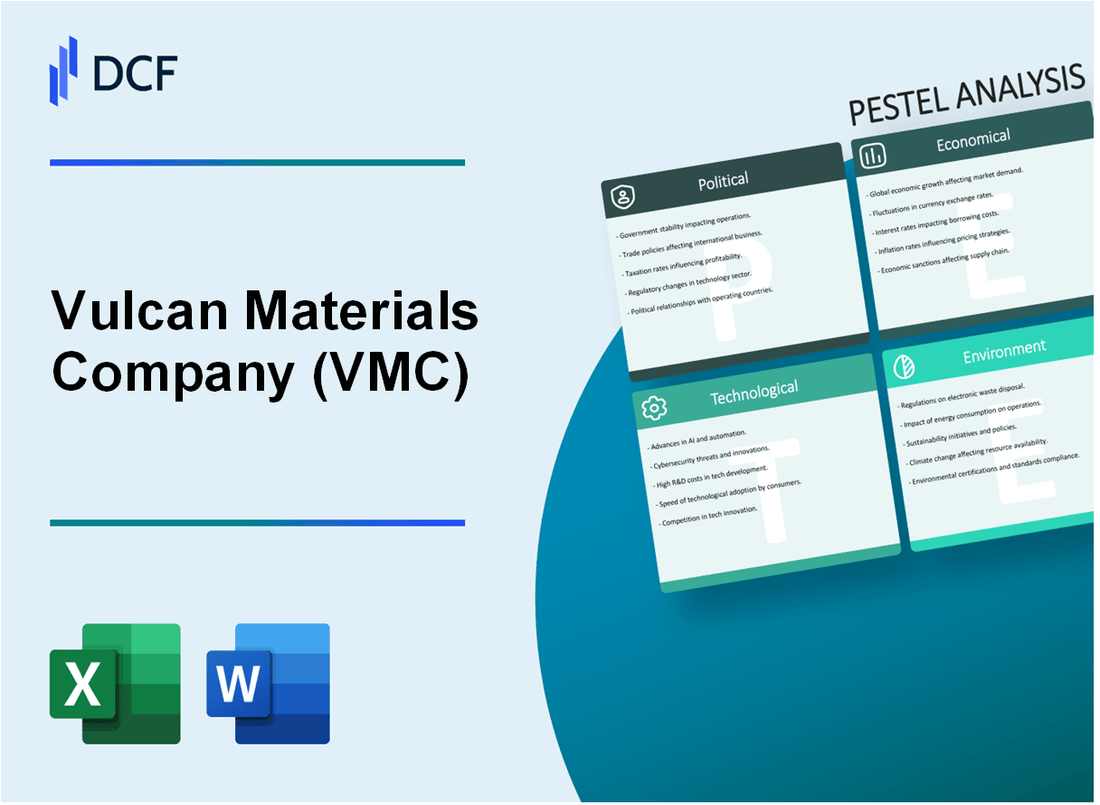
Completamente Editable: Adáptelo A Sus Necesidades En Excel O Sheets
Diseño Profesional: Plantillas Confiables Y Estándares De La Industria
Predeterminadas Para Un Uso Rápido Y Eficiente
Compatible con MAC / PC, completamente desbloqueado
No Se Necesita Experiencia; Fáciles De Seguir
Vulcan Materials Company (VMC) Bundle
En el mundo dinámico de los materiales de construcción, Vulcan Materials Company (VMC) se encuentra en la encrucijada de las complejas fuerzas globales, navegando por un paisaje formado por desafíos políticos, económicos, sociológicos, tecnológicos, legales y ambientales complejos. Este análisis integral de la mano presenta las presiones y oportunidades multifacéticas que impulsan las decisiones estratégicas de VMC, ofreciendo una visión matizada de cómo un productor líder de agregados se adapta y prospera en medio de condiciones de mercado en rápida evolución. Desde inversiones de infraestructura hasta innovaciones de sostenibilidad, el viaje de VMC refleja el intrincado danza de la resiliencia corporativa en un ecosistema industrial transformador.
Vulcan Materials Company (VMC) - Análisis de mortero: factores políticos
Las facturas de inversión de infraestructura potencialmente aumentan la demanda de materiales de construcción agregados
La Ley de Inversión y Empleos de Infraestructura (IJA) asignó $ 1.2 billones para el desarrollo de infraestructura, con $ 550 mil millones en nuevos gastos federales durante cinco años. Esta legislación impacta directamente en las oportunidades potenciales de mercado de los materiales de Vulcan.
| Categoría de gasto de infraestructura | Fondos asignados |
|---|---|
| Infraestructura de transporte | $ 284 mil millones |
| Infraestructura de agua | $ 55 mil millones |
| Infraestructura de banda ancha | $ 65 mil millones |
Las regulaciones ambientales potenciales impactan los procesos de producción de agregado y cemento
Las regulaciones de la Agencia de Protección Ambiental (EPA) potencialmente aumentan los costos de cumplimiento para la producción agregada.
- Costos de cumplimiento de la Ley de Aire Limpio estimados en $ 3.2 millones anualmente para grandes productores agregados
- Objetivos de reducción de emisiones de gases de efecto invernadero que requieren Modificaciones del proceso del 15%
Los ciclos de financiación de transporte gubernamental influyen directamente en las ventas de material de construcción
La financiación de transporte de la Administración Federal de Carreteras (FHWA) para el año fiscal 2024 se proyecta en $ 68.9 mil millones.
| Fuente de financiación de transporte | Asignación anual |
|---|---|
| Fondo fiduciario federal de carreteras | $ 47.3 mil millones |
| Financiación de infraestructura suplementaria | $ 21.6 mil millones |
Políticas comerciales que afectan las importaciones de materiales de construcción y el abastecimiento de materias primas
Las tarifas arancelas actuales sobre los materiales de construcción importados varían entre 5% a 25%, impactando las estrategias de adquisición de materias primas.
- Tasa de tarifa de materiales agregados importados: 7.2%
- Tasa de tarifa de cemento importada: 15.5%
- Políticas de preferencia de abastecimiento doméstico que aumentan la adquisición de materiales domésticos
Vulcan Materials Company (VMC) - Análisis de mortero: factores económicos
Impacto ciclicalidad de la industria de la construcción en los flujos de ingresos
Los ingresos del cuarto trimestre de Vulcan Materials Company fueron de $ 1.67 mil millones, con ingresos de segmento de productos agregados de $ 1.36 mil millones. La industria de los materiales de construcción demostró sensibilidad a los ciclos económicos, con envíos agregados por un total de 178 millones de toneladas en 2023.
| Año | Ingresos totales | Envíos agregados | Precio promedio por tonelada |
|---|---|---|---|
| 2023 | $ 6.87 mil millones | 178 millones de toneladas | $ 38.59/tonelada |
| 2022 | $ 6.53 mil millones | 171 millones de toneladas | $ 38.19/tonelada |
Fluctuaciones de tasas de interés y financiamiento de proyectos
Las tasas de interés de la Reserva Federal en 2024 oscilan entre 5.25% y 5.50%, lo que impacta directamente el financiamiento del proyecto de construcción. Los gastos de capital de VMC para 2023 fueron de $ 444 millones, lo que refleja estrategias de inversión que responden a las condiciones económicas.
Influencia del desarrollo económico regional
Mercados de infraestructura clave para VMC en 2024:
- Sudeste de los Estados Unidos: 42% de la producción agregada
- Suroeste de los Estados Unidos: 28% de la producción agregada
- Occidente de los Estados Unidos: 18% de la producción agregada
- Noreste de los Estados Unidos: 12% de la producción agregada
Indicadores macroeconómicos y demanda de material de construcción
| Indicador económico | Valor 2023 | 2024 Valor proyectado |
|---|---|---|
| Crecimiento del PIB de EE. UU. | 2.5% | 2.1% |
| Gasto de construcción | $ 1.87 billones | $ 1.93 billones |
| Crecimiento de la construcción no residencial | 4.7% | 5.2% |
El posicionamiento estratégico de VMC en los mercados de infraestructura de alto crecimiento permite la adaptación receptiva a las fluctuaciones macroeconómicas.
Vulcan Materials Company (VMC) - Análisis de mortero: factores sociales
Las tendencias de la urbanización aumentan la demanda de infraestructura y materiales de construcción
A partir de 2024, la población urbana estadounidense alcanzó los 285.5 millones, lo que representa el 86.4% de la población total. La demanda de materiales de construcción en áreas urbanas aumentó en un 7,2% año tras año. El volumen de ventas de agregados de Vulcan Materials Company en regiones metropolitanas creció un 5,8% en 2023.
| Métrica de población urbana | 2024 datos |
|---|---|
| Total de la población urbana de los Estados Unidos | 285.5 millones |
| Porcentaje de población urbana | 86.4% |
| Los materiales de construcción exigen crecimiento | 7.2% |
| VMC Agreges de crecimiento del volumen de ventas | 5.8% |
Los cambios demográficos de la fuerza laboral impactan la disponibilidad laboral
La edad media de la fuerza laboral de construcción en 2024 es de 42.3 años. La tasa de participación laboral en el sector de la construcción disminuyó al 61.7%. Vulcan Materials Company experimentó una reducción de la fuerza laboral del 3.2% en las divisiones de fabricación y construcción.
| Métrica demográfica de la fuerza laboral | 2024 datos |
|---|---|
| Edad media de la fuerza laboral de construcción | 42.3 años |
| Tasa de participación en mano de obra de construcción | 61.7% |
| VMC Reducción de la fuerza laboral | 3.2% |
La conciencia de sostenibilidad impulsa la demanda de materiales ecológicos
El tamaño del mercado de materiales de construcción verde alcanzó los $ 374.6 mil millones en 2024. La línea de productos sostenible de Vulcan Materials Company representaba el 22.4% de los ingresos totales, con un crecimiento de los productos de 15.3% año tras año en el segmento de productos ecológico.
| Métrica de sostenibilidad | 2024 datos |
|---|---|
| Tamaño del mercado de materiales de construcción verde | $ 374.6 mil millones |
| VMC Compartir los ingresos del producto sostenible | 22.4% |
| Crecimiento del segmento de productos ecológico | 15.3% |
Crecimiento de la población en las regiones del cinturón de sol
La población de la región de Sunbelt aumentó a 126.3 millones en 2024. La demanda de material de construcción en estas regiones creció en un 8,9%. La cuota de mercado de Vulcan Materials Company en SunBelt States se expandió al 34.6%.
| Métrica de la región de Sunbelt | 2024 datos |
|---|---|
| Población de la región del cBel de sol | 126.3 millones |
| Crecimiento de la demanda de material de construcción | 8.9% |
| Cuota de mercado de VMC en SunBelt States | 34.6% |
Vulcan Materials Company (VMC) - Análisis de mortero: factores tecnológicos
Las tecnologías de fabricación avanzadas mejoran la eficiencia de producción y la gestión de costos
Vulcan Materials Company invirtió $ 78.3 millones en infraestructura tecnológica en 2023. La compañía desplegó maquinaria avanzada con GPS que aumentó la productividad de la cantera en un 17.4%. Las tecnologías de corte de precisión redujeron los desechos de material en un 22,6%, lo que resulta en ahorros de costos operativos directos.
| Inversión tecnológica | Mejora de la productividad | Reducción de desechos |
|---|---|---|
| $ 78.3 millones | 17.4% | 22.6% |
La transformación digital mejora la cadena de suministro y la optimización logística
VMC implementó sistemas de gestión de logística impulsados por AI con una inversión de $ 42.5 millones. Las tecnologías de seguimiento en tiempo real redujeron los costos de transporte en un 14.3% y una mayor precisión de entrega a 98.7%.
| Inversión digital | Reducción de costos de transporte | Precisión de entrega |
|---|---|---|
| $ 42.5 millones | 14.3% | 98.7% |
Implementación de automatización e implementación de robótica en la cantera e instalaciones de producción
Los materiales Vulcan desplegaron 73 sistemas robóticos autónomos en las instalaciones de producción. La implementación robótica aumentó la eficiencia operativa en un 26,2% y redujo los costos de trabajo humano en $ 11.6 millones anuales.
| Sistemas robóticos autónomos | Aumento de eficiencia operativa | Reducción de costos de mano de obra |
|---|---|---|
| 73 sistemas | 26.2% | $ 11.6 millones |
Pruebas de materiales innovadoras y tecnologías de control de calidad
VMC invirtió $ 35.7 millones en tecnologías avanzadas de control de calidad de escaneo y láser de escaneo. Estas tecnologías mejoraron la consistencia del producto en un 94.5% y redujeron las tasas de defectos a 0.8%.
| Inversión tecnológica | Consistencia del producto | Tasa de defectos |
|---|---|---|
| $ 35.7 millones | 94.5% | 0.8% |
Vulcan Materials Company (VMC) - Análisis de mortero: factores legales
Cumplimiento de los permisos ambientales para operaciones de cantera y extracción de minerales
Vulcan Materials Company posee 352 permisos de minería activa en 17 estados a partir de 2023. La compañía mantiene el cumplimiento de la Ley de Aire Limpio de la EPA y las regulaciones de la Ley de Agua Limpia, con gastos totales de cumplimiento ambiental de $ 48.3 millones en 2022.
| Tipo de permiso | Número de permisos activos | Costo de cumplimiento anual |
|---|---|---|
| Permisos de minería de superficie | 237 | $ 23.6 millones |
| Permisos de descarga de agua | 82 | $ 15.7 millones |
| Permisos de calidad del aire | 33 | $ 9 millones |
Regulaciones de seguridad en el lugar de trabajo en sectores mineros y de fabricación
En 2022, Vulcan Materials reportó 0.89 tasa de lesiones registrables de OSHA, en comparación con el promedio de la industria de 1.2. La compañía invirtió $ 22.1 millones en capacitación en seguridad y equipos en 2022.
| Métrica de seguridad | Rendimiento de VMC | Punto de referencia de la industria |
|---|---|---|
| Tasa de lesiones registrables | 0.89 | 1.2 |
| Tasa de incidentes de tiempo perdido | 0.37 | 0.52 |
| Inversión de capacitación en seguridad | $ 22.1 millones | N / A |
Posibles riesgos de litigios relacionados con el impacto ambiental y la seguridad de los trabajadores
Los materiales de Vulcan enfrentaron 12 reclamos legales ambientales y relacionados con la seguridad en 2022, con gastos de litigio totales de $ 4.3 millones. Los costos de liquidación ascendieron a $ 2.7 millones.
| Categoría de litigio | Número de reclamos | Gastos legales totales |
|---|---|---|
| Reclamaciones de impacto ambiental | 7 | $ 2.1 millones |
| Reclamaciones de seguridad de los trabajadores | 5 | $ 2.2 millones |
Consideraciones antimonopolio y ley de competencia en el mercado de agregados
Vulcan Materials mantiene el cumplimiento de las regulaciones antimonopolio del Departamento de Justicia. La cuota de mercado de la compañía en los agregados es del 16,4% a nivel nacional, sin investigaciones antimonopolio significativas reportadas en 2022.
| Métrica de concentración del mercado | Valor |
|---|---|
| Cuota de mercado nacional | 16.4% |
| Concentración de mercado regional (4 principales empresas) | 45.7% |
| Investigaciones antimonopolio | 0 |
Vulcan Materials Company (VMC) - Análisis de mortero: factores ambientales
Estrategias de reducción de emisiones de carbono en procesos de fabricación
Vulcan Materials Company informó un Reducción del 15% en el alcance 1 y el alcance 2 emisiones de gases de efecto invernadero Entre 2019 y 2022. Las emisiones totales de carbono de la compañía en 2022 fueron 1,456,000 toneladas métricas CO2E.
| Año | Emisiones totales de carbono (toneladas métricas CO2E) | Porcentaje de reducción |
|---|---|---|
| 2019 | 1,712,000 | - |
| 2020 | 1,589,000 | 7.2% |
| 2021 | 1,523,000 | 11.3% |
| 2022 | 1,456,000 | 15% |
Prácticas sostenibles de canteras y recuperación de tierras
Vulcan Materials invirtió $ 42.3 millones en proyectos de recuperación y rehabilitación de tierras en 2022. La compañía administra activamente 37,000 acres de sitios de cantera, con el 22% actualmente bajo recuperación activa.
| Métrica de recuperación de tierras | Datos 2022 |
|---|---|
| Sitios de cantera totales administrados | 37,000 acres |
| Acres bajo recuperación activa | 8,140 acres |
| Inversión en recuperación | $ 42.3 millones |
Conservación y gestión del agua en instalaciones de producción
En 2022, los materiales vulcanos redujeron el consumo de agua 18% en comparación con la línea de base de 2019. El uso total del agua fue de 2.600 millones de galones, con el 65% del agua reciclada o reutilizada en los procesos de producción.
| Métrica de gestión del agua | Datos 2022 |
|---|---|
| Uso total del agua | 2.600 millones de galones |
| Tasa de reciclaje de agua | 65% |
| Reducción del consumo de agua | 18% (desde 2019) |
Iniciativas de economía circular para el reciclaje de materiales de construcción
Materiales vulcanos procesados 12.4 millones de toneladas de materiales de construcción reciclados en 2022, representando el 22% de la producción total de agregados. El programa de reciclaje de la compañía generó $ 186 millones en ingresos a partir de materiales reciclados.
| Métrica de economía circular | Datos 2022 |
|---|---|
| Materiales reciclados procesados | 12.4 millones de toneladas |
| Porcentaje de producción agregada total | 22% |
| Ingresos de materiales reciclados | $ 186 millones |
Vulcan Materials Company (VMC) - PESTLE Analysis: Social factors
Growing public opposition to quarry noise, dust, and truck traffic in suburban expansion areas.
The biggest social risk for Vulcan Materials Company is the inevitable clash between its extraction sites and the expanding US suburban footprint. As residential and commercial development pushes further into traditionally industrial or rural areas, quarry operations face increased scrutiny over noise, dust, and heavy truck traffic. This opposition directly impacts the company's ability to secure new permits and expand existing sites, which are critical for long-term reserves.
While a specific dollar cost for community opposition in 2025 is hard to isolate, the company's commitment to community relations is a necessary, non-trivial expense. Vulcan Materials Company actively manages this through its charitable foundation, which has provided nearly $70 million in support to various organizations over the last two decades, demonstrating a long-term investment in community goodwill to mitigate local opposition. This proactive approach is essential, as a single, protracted permitting battle can cost millions in legal fees and lost revenue. For example, the company was recognized with a 2025 Gold Community Relations Excellence Award from the National Stone, Sand and Gravel Association (NSSGA), underscoring the importance of these efforts to their operating license.
Labor shortages in skilled trades (e.g., heavy equipment operators) pushing up wage costs.
The US construction sector faces a deep structural labor shortage, a trend that directly translates to higher operating costs for Vulcan Materials Company. The Associated Builders and Contractors (ABC) estimates the industry needs to hire an additional 439,000 workers in 2025 to meet demand, a gap that keeps upward pressure on wages for skilled roles like heavy equipment operators and maintenance personnel.
This shortage means VMC must pay a premium to attract and retain talent. For a field craft professional in construction, the average hourly earnings rose about 4% year-over-year in early 2025, reaching approximately $36.54 per hour. This is roughly an 18% premium over the typical private-sector wage, a clear reflection of the acute demand for skilled labor. This cost pressure is a permanent feature of the operating environment.
| US Construction Labor Trend | 2025 Data / Forecast | Impact on Vulcan Materials Company |
|---|---|---|
| Additional Workers Needed (Industry-wide) | 439,000 | Intensifies competition for heavy equipment operators and maintenance staff. |
| Average Hourly Wage (Field Craft Professionals) | ~$36.54 (Early 2025) | Pushes up Selling, Administrative, and General (SAG) expenses, which were $550 million on a trailing-twelve months basis in Q2 2025. |
| Annual Wage Growth (Union Construction Workers) | Average 4.5% (March 2024-March 2025) | Increases labor cost per ton, requiring continued pricing discipline to maintain margin growth. |
Increased focus on worker safety and health standards, requiring higher investment in training and equipment.
Worker safety is not just a regulatory requirement but a core social factor that impacts operational efficiency and reputation. Vulcan Materials Company maintains a strong focus on its Safety, Health, and Environmental (SHE) programs, which is evident in its operational metrics. As of 2024, 92% of Vulcan facilities reported zero lost-time injuries, and 313 sites achieved 'triple zero' status (zero MSHA/OSHA injuries, MSHA citations, and environmental citations).
The need for higher investment is constant. While a specific 2025 safety training budget is not publicly itemized, the company's total capital expenditures for maintenance and growth projects are substantial, projected to be between $750 million and $800 million for the full year 2025. A portion of this capital spending is defintely allocated to modernizing equipment and implementing automation to reduce human-machine interface risks, as well as delivering ongoing technical and skills-based training modules. This investment is necessary to prevent incidents like the one in June 2025 at the Clear Creek Quarry, where an MSHA 'imminent danger order' was issued, highlighting the continuous need for stringent on-site protocol enforcement.
Shifting demographics driving demand for new schools, hospitals, and logistics centers (non-residential construction).
Demographic shifts in the US are creating a durable demand for aggregates in the institutional and commercial non-residential sectors, which is a key opportunity for Vulcan Materials Company. Population migration and aging infrastructure require new public and private facilities.
The Institutional construction sector, which includes schools, hospitals, and public works, is forecast to be the strongest non-residential segment in 2025, with projected spending gains of 6.1%. This growth is vital because it is less interest-rate sensitive than residential construction.
The overall Total Nonresidential Building activity is also forecast to rise by a healthy 8% in 2025, driven by these institutional and select commercial segments. This demand is a direct result of social needs:
- Healthcare: Aging populations and new suburban communities drive the need for new hospitals and medical facilities.
- Education: Although long-term demographic trends for the under-18 population are unfavorable, the average age of existing school facilities is approximately 49 years, necessitating significant maintenance and upgrade spending.
- Logistics/Warehousing: The shift to e-commerce continues to fuel demand for new logistics centers and distribution warehouses, which require vast amounts of aggregates for foundations and access roads.
Vulcan Materials Company (VMC) - PESTLE Analysis: Technological factors
The core of Vulcan Materials Company's (VMC) technological strategy in 2025 is not about a single breakthrough, but rather the systematic deployment of digital tools and automation across its operations, collectively branded as the Vulcan Way of Operating. This focus on structural efficiency is the primary driver behind the company's strong unit profitability gains.
For the full fiscal year 2025, VMC is channeling significant capital into these areas, with projected capital expenditures for maintenance and growth projects expected to be between $750 million and $800 million. This investment is directly translating to bottom-line performance, with Aggregates cash gross profit per ton increasing by 9% in the third quarter of 2025, partly due to cost discipline and efficiency.
Increased adoption of autonomous hauling and drilling equipment to improve quarry efficiency.
While Vulcan Materials Company does not publicly disclose the exact number of autonomous vehicles deployed, the drive toward automation is a central pillar of the Vulcan Way of Operating initiative, targeting structural efficiency gains in the quarry. The industry trend shows that automation in core mining equipment, such as haul trucks and drills, is rapidly accelerating, driven by the promise of 10%-30% improvements in productivity and significant safety gains. VMC's strategy is to leverage this technology to manage its extensive reserve base of an estimated 15.6 billion tons of proven and probable aggregates reserves more efficiently.
The push for automation is visible in VMC's talent strategy, which actively seeks expertise in areas like Heavy Equipment Operations and Diesel Truck, Heavy Equipment & Power Generation, signaling a commitment to maintaining and eventually automating its fleet. This is a multi-year effort, but the early benefits are already baked into the 2% decrease in cash costs per unit reported in Q3 2025.
Use of data analytics and AI for optimizing logistics, reducing haul distances, and fuel burn.
Vulcan Materials Company's logistics innovation is driven by a proprietary, data-centric approach that manages the shipment of nearly half of its products. The goal is to transform the supply chain from a reactive cost center to a strategic asset. The company uses advanced business intelligence (BI) tools to analyze its vast operational data, translating it into actionable insights for dispatching and route optimization.
The key platforms enabling this optimization include:
- Oracle Analytics Cloud (OAC): Used for migrating and developing core logistics analytics projects.
- Tableau: Utilized for data visualization, providing end-users with dashboards to monitor real-time, forward-looking metrics.
This data-driven approach is critical for mitigating the risk of logistics disruptions and controlling the freight-adjusted unit cash cost of sales, which remained disciplined in 2025 despite external pressures. The optimized scheduling and routing directly reduce haul distances and, consequently, fuel burn, contributing to the overall cost discipline that is a hallmark of the Vulcan Way of Operating.
Advanced material testing and quality control systems for high-specification concrete and asphalt mixes.
Quality control (QC) is a non-negotiable technological factor for VMC, especially in its downstream products like asphalt and concrete. The company maintains rigorous quality control programs at each of its over 400 facilities, employing a staff of highly trained engineers, quality control managers, and materials technicians.
The technological edge here lies in:
- Statistical Information Systems: Real-time data collection and statistical analysis are used to continuously adjust production processes, ensuring materials consistently meet or exceed the varied state and local specifications for high-specification mixes.
- R&D Investment: VMC has historically invested in Construction Materials Research and Development, with a focus on advanced aggregate processing technologies and sustainable materials development, which directly impacts the quality and performance of its products.
This commitment to precision is what allows VMC to deliver the 'highest quality material' and maintain its pricing power, which is anticipated to be high-single-digit price growth for FY25.
Digital tools for real-time inventory management and customer order tracking.
Vulcan Materials Company has significantly digitized its customer interface and internal order fulfillment process, streamlining transactions and enhancing the customer experience. This is a clear demonstration of the Vulcan Way of Selling discipline.
The core digital ecosystem includes:
- MyVulcan: The customer-facing online service center that provides direct control over a customer's account, allowing them to request quotes, pay online, and access tickets anytime, anywhere.
- Apex Ticketing System: This proprietary internal system automates the quarry-to-truck process. The system scans truck plates upon arrival, sends loading information to the operator, and allows customers to pick up their ticket at a remote printer without ever having to interact with the scale house directly.
This technology allows VMC to run its operations more efficiently, getting trucks in and out in a reasonable amount of time. The adoption rate for digital channels is strong, with online order volume representing 37% of total transactions in a recent period, supported by 3,200 registered business accounts, demonstrating a successful shift to a digital-first customer experience.
| Technological Initiative | VMC System/Program Name | FY 2025 Quantifiable Impact/Metric |
|---|---|---|
| Operational Efficiency & Cost Control | The Vulcan Way of Operating | 2% decrease in cash costs per unit (Q3 2025) |
| Logistics & Analytics | Oracle Analytics Cloud (OAC), Tableau | Aggregates cash gross profit per ton increased 9% (Q3 2025) |
| Digital Customer & Order Management | MyVulcan, Apex Ticketing System | Online order volume was 37% of total transactions (Recent Period) |
| Capital Investment in Technology | Maintenance and Growth Projects | Full-year 2025 CapEx guidance: $750 million to $800 million |
The clear next step for you is to model the potential margin impact if VMC can push its digital order volume past the 50% mark in 2026, as that will defintely drive down administrative costs further.
Vulcan Materials Company (VMC) - PESTLE Analysis: Legal factors
You need to understand that the legal landscape for a company like Vulcan Materials Company, operating hundreds of quarries and asphalt plants, is less about a single silver bullet and more about a constant, grinding pressure from federal safety, environmental, and local land-use laws. The near-term focus is on stricter enforcement and the rising cost of compliance, especially with new dust and water quality rules coming into effect in 2025.
Stricter enforcement of Mine Safety and Health Administration (MSHA) regulations, increasing compliance costs.
MSHA enforcement is definitely tightening, particularly around high-risk areas. The agency's focus for 2025 is on fatality prevention, targeting chronic hazards like powered haulage, which is a major risk at quarry sites. This means more intense inspections and a higher likelihood of significant citations.
We saw this directly in March 2025 when an imminent danger order was issued to Vulcan Construction Materials, LLC at the Liberty Quarry in South Carolina. The order was due to two employees working without fall protection in the scalping screen of a tower. This resulted in an immediate shutdown and a significant and substantial citation under section 104(a) of the Federal Mine Safety and Health Act of 1977.
The biggest regulatory cost driver, however, is the new respirable crystalline silica standard, which was finalized in April 2024. This rule halves the Permissible Exposure Limit (PEL) for silica dust from 100 to 50 µg/m³ (8-hour Time-Weighted Average). For the metal/nonmetal mining sector, which includes aggregates, the compliance date for this rule is April 14, 2026, but the capital expenditure and operational changes needed to meet this new limit are a major 2025 priority. Historically, Vulcan Materials Company has faced workplace safety or health violations totaling $1,380,094 across 101 records, showing the recurring nature of this risk.
New federal and state water discharge permits (Clean Water Act) impacting quarry operations.
Water discharge permits under the National Pollutant Discharge Elimination System (NPDES) are a constant headache for quarry operators, which use a lot of water for washing aggregates and managing stormwater runoff. The legal ground for these permits shifted in March 2025 with the Supreme Court's ruling in City and County of San Francisco v. Environmental Protection Agency.
The Court held that the Environmental Protection Agency (EPA) cannot impose vague "end-result" requirements in NPDES permits, such as a blanket prohibition on discharges that 'contribute to a violation of any applicable water quality standard.' The upside is this reduces the risk of massive, unexpected penalties for water quality issues beyond a company's direct control. The downside is that the EPA and state regulators must now write permits with much more specificity, which is likely to cause delays and substantial expense in the permitting process as they gather the data needed to set concrete effluent limitations.
For context, new permits and projects already carry significant fees. In California, for instance, a project involving fill and excavation discharges can incur a project fee of up to $365,465, not including the annual compliance fees. This is the cost of doing business, but the new specificity requirement will slow down the approval of new or expanded quarry sites.
Litigation risks related to environmental damage or community nuisance claims near quarry sites.
The aggregates business is inherently exposed to local litigation, often called 'nuisance claims,' related to noise, dust, and truck traffic. While Vulcan Materials Company's 2024 net earnings attributable to Vulcan were strong at $911.9 million, a single, protracted community lawsuit can drain resources and halt operations.
While specific 2025 nuisance case values are confidential, the underlying risk is visible in the company's historical environmental exposure. The table below shows the top environmental violation types and total penalties reported for Vulcan Materials Company:
| Primary Offense Type | Penalty Total (Historical) | Number of Records |
|---|---|---|
| Air Pollution Violation | $1,908,573 | 15 |
| Water Pollution Violation | $725,720 | 9 |
| Environmental Violation | $434,138 | 12 |
Here's the quick math: The total historical penalty for air, water, and general environmental violations is over $3 million. This is a small fraction of the company's annual revenue of $7.4 billion, but it shows the recurring financial risk from environmental non-compliance. The real risk isn't the fine; it's the injunction that stops production and damages community relations, which are critical for future land-use approvals.
Land use and eminent domain laws governing access to new mineral reserves.
Access to new, high-quality mineral reserves is the lifeblood of an aggregates company, and it's increasingly difficult to secure due to local zoning and competing public interests. Eminent domain, the government's power to take private land for public use, is a double-edged sword for Vulcan Materials Company.
On one hand, the company's products-crushed stone, sand, and gravel-are essential for public infrastructure like roads and bridges, which are often built using eminent domain. This creates demand. On the other hand, the company's own land for new quarries is often targeted or blocked by competing public projects, or by local ordinances that restrict mining near residential areas.
Key legal and legislative trends in 2025 are impacting land access:
- Competing Public Use: New state laws, like the South Carolina Energy Security Act (House Bill 3309) enacted in 2025, streamline approval for major energy infrastructure projects, which can use eminent domain to secure land. This increases competition for large tracts of land, potentially blocking future quarry sites.
- Zoning and Density: In high-growth areas like California, new legislation such as Senate Bill 79 (SB 79) overrides local zoning to increase housing density near transit hubs. This makes it harder to site a quarry or processing plant near a major metropolitan area due to increased population density and community opposition.
- Valuation Risk: The threat of eminent domain for public projects, even if it doesn't directly take a quarry, creates uncertainty in the valuation of land parcels that Vulcan Materials Company might be considering for future reserves.
The core issue is that aggregates are a low-margin, high-volume, and high-freight-cost product, so quarries must be close to the end-market. Stricter land-use laws and competing public projects force new quarries farther out, which directly cuts into the aggregates cash gross profit per ton, which was $10.61 in 2024. You defintely need to factor in a longer, more expensive permitting timeline for any new reserve acquisition.
Vulcan Materials Company (VMC) - PESTLE Analysis: Environmental factors
Corporate commitment to reducing Scope 1 and 2 greenhouse gas emissions by 2030.
You need to know the hard numbers on carbon, and Vulcan Materials Company (VMC) is focused on intensity, which is the right metric for a growing aggregates business. Their core commitment is to reduce Scope 1 and 2 greenhouse gas (GHG) emissions intensity per ton of product produced by 10% by 2030. This is a measurable goal tied directly to production efficiency, so any growth in output doesn't automatically mean a failure on the environmental front.
Here's the quick math: In the 2024 Sustainability Report Data Appendix, published in June 2025, VMC reported gross global Scope 1 emissions totaling 921,276 MTCO2e (Metric Tons of Carbon Dioxide Equivalent). That's a massive number, but it represents the direct emissions from their operations, primarily from mobile combustion in heavy equipment and some fixed sources. To be fair, their emissions intensity remained relatively flat from 2022 to 2023, which signals that the real work on decarbonization strategies-like the shift to renewable diesel-needs to defintely accelerate to hit the 2030 target.
The company is also working to secure 5% of all energy from renewable sources by 2030, which is a clear action to help cut Scope 2 emissions (indirect emissions from purchased electricity). That's where you see the direct impact of their sourcing decisions.
Focus on land reclamation and biodiversity preservation as part of quarry closure plans.
Land management is critical for a company that owns approximately 300,000 acres of land across 23 states. Their approach is holistic, managing the entire lifecycle of the land from pre-mining to final reclamation. This isn't just a regulatory box-checking exercise; it's a strategic asset management play.
The focus is on converting former mining sites into high-value post-mining uses, which often means biodiversity preservation. For example, VMC's quarry closure plans frequently result in the creation of new assets like:
- Drinking water reservoirs.
- Aquifer recharge basins (critical in the Southwest US).
- Public recreational areas.
- Wildlife habitats certified through programs like the Wildlife Habitat Council.
They track the metric of 'Terrestrial acreage disturbed, percentage of impacted area restored' in their reporting, which is a key indicator for investors looking at long-term liability and asset value. They partner with conservation groups, such as their work with the San Joaquin River Parkway & Conservation Trust in California to restore land along the river, turning former pits into good wildlife habitats. It's a smart way to manage their long-term liability.
Increased scrutiny on water usage and runoff management, especially in drought-prone regions.
Water scarcity is a growing risk, especially in the Western and Southern US markets where VMC operates. The company uses water for filtration, stormwater collection, and dust control, so efficient use is a financial necessity, not just an environmental one. They remain committed to reducing their operational water requirements.
The scrutiny is highest in places like California. For instance, the Austin Quarry in Madera County, CA, has to report its water withdrawal and consumptive use to maintain permit compliance. More broadly, VMC facilities are required to develop a Stormwater Pollution Prevention Plan (SWPPP) to manage runoff quality. This is crucial because poor runoff management can lead to significant fines and community issues.
Specific actions to manage runoff include:
- Implementing temporary Best Management Practices (BMPs) to capture and contain pollutants.
- Using lined containment systems for rinse water from washing concrete delivery trucks and equipment.
- Continuous visual surface water monitoring during active construction periods to detect accidental discharges.
This is a major operational risk in the near-term, so capital expenditure on water control infrastructure is a clear priority.
Transition to alternative fuels (e.g., renewable diesel) for heavy equipment to meet sustainability goals.
The transition to alternative fuels is one of the most direct ways VMC can hit that 10% GHG intensity reduction target, since mobile combustion is a huge part of their Scope 1 emissions. Their strategy explicitly identifies the sourcing of renewable diesel as a significant Scope 1 reduction opportunity for both the Aggregates and Concrete segments.
They are accelerating the use of these fuels and replacing older equipment with newer, more efficient machines. Renewable diesel (RD) is a drop-in fuel, chemically identical to petroleum diesel, so it can be seamlessly integrated into their existing fleet without costly engine modifications. This makes the rollout fast and efficient.
Here is a summary of the key environmental metrics and actions:
| Environmental Metric/Goal | Target/Value (2025/2030) | Relevance to Operations |
|---|---|---|
| Scope 1 & 2 GHG Emissions Intensity Reduction | 10% by 2030 (per ton of product) | Primary climate change goal; links emissions to production efficiency. |
| Gross Global Scope 1 Emissions (2024 data, reported 2025) | 921,276 MTCO2e | Baseline for direct emissions from heavy equipment and fixed sources. |
| Renewable Energy Sourcing Target | 5% of total energy by 2030 | Direct action to reduce Scope 2 emissions. |
| Total Land Portfolio Managed | Approximately 300,000 acres | Scale of land reclamation and biodiversity preservation commitment. |
| Alternative Fuel Strategy | Accelerated use of renewable diesel | Key strategy for Scope 1 reduction in Aggregates and Concrete segments. |
Disclaimer
All information, articles, and product details provided on this website are for general informational and educational purposes only. We do not claim any ownership over, nor do we intend to infringe upon, any trademarks, copyrights, logos, brand names, or other intellectual property mentioned or depicted on this site. Such intellectual property remains the property of its respective owners, and any references here are made solely for identification or informational purposes, without implying any affiliation, endorsement, or partnership.
We make no representations or warranties, express or implied, regarding the accuracy, completeness, or suitability of any content or products presented. Nothing on this website should be construed as legal, tax, investment, financial, medical, or other professional advice. In addition, no part of this site—including articles or product references—constitutes a solicitation, recommendation, endorsement, advertisement, or offer to buy or sell any securities, franchises, or other financial instruments, particularly in jurisdictions where such activity would be unlawful.
All content is of a general nature and may not address the specific circumstances of any individual or entity. It is not a substitute for professional advice or services. Any actions you take based on the information provided here are strictly at your own risk. You accept full responsibility for any decisions or outcomes arising from your use of this website and agree to release us from any liability in connection with your use of, or reliance upon, the content or products found herein.