

|
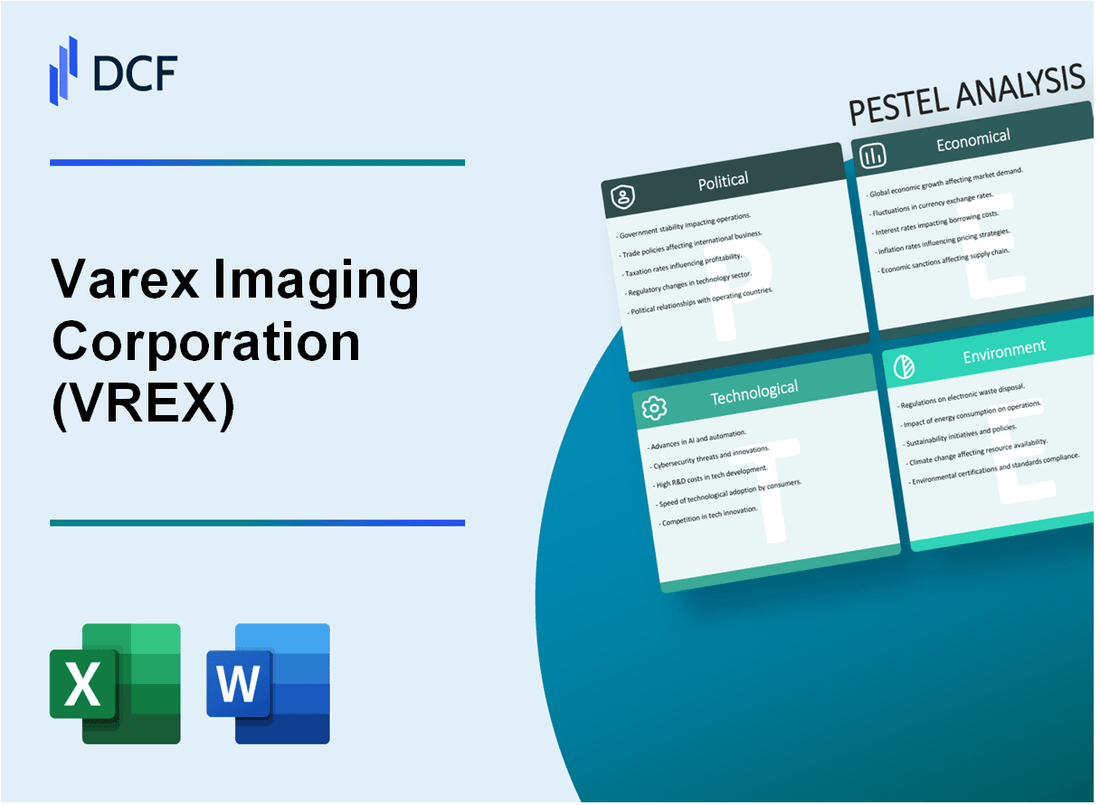
Varex Imaging Corporation (VREX): Análisis PESTLE [Actualizado en Ene-2025] |
Completamente Editable: Adáptelo A Sus Necesidades En Excel O Sheets
Diseño Profesional: Plantillas Confiables Y Estándares De La Industria
Predeterminadas Para Un Uso Rápido Y Eficiente
Compatible con MAC / PC, completamente desbloqueado
No Se Necesita Experiencia; Fáciles De Seguir
Varex Imaging Corporation (VREX) Bundle
En el panorama dinámico de la tecnología de imágenes médicas, Varex Imaging Corporation se encuentra en la encrucijada de la innovación y los desafíos del mercado global. Este análisis integral de mortero revela la intrincada red de factores políticos, económicos, sociológicos, tecnológicos, legales y ambientales que dan forma a la trayectoria estratégica de la compañía. Desde navegar paisajes regulatorios complejos hasta aprovechar los avances tecnológicos de vanguardia, Varex debe maniobrar hábilmente a través de un entorno empresarial multifacético que exige precisión y adaptabilidad en el mundo de los diagnósticos médicos en constante evolución.
Varex Imaging Corporation (VREX) - Análisis de mortero: factores políticos
El impacto de las regulaciones de dispositivos médicos de EE. UU. En la estrategia del mercado global
La clasificación del dispositivo médico de la FDA influye directamente en el desarrollo de productos y las estrategias de mercado de Varex Imaging. A partir de 2024, la FDA clasifica los dispositivos de imágenes médicas en:
| Clasificación del dispositivo | Requisitos regulatorios | Costo de cumplimiento |
|---|---|---|
| Dispositivos de clase I | Controles generales | $5,000 - $10,000 |
| Dispositivos de clase II | Controles especiales | $25,000 - $75,000 |
| Dispositivos de clase III | Aprobación previa a la comercialización | $100,000 - $250,000 |
Tensiones comerciales potenciales que afectan las exportaciones internacionales de equipos de imágenes médicas
Las tensiones comerciales actuales impactan las estrategias de exportación internacionales de Varex, con implicaciones arancelas específicas:
- Aranceles de China sobre equipos médicos: 15-25% de aranceles de importación adicionales
- Regulaciones de importación de dispositivos médicos de la UE: Costos de cumplimiento de aproximadamente 50,000 € por línea de productos
- Restricciones de control de exportación de EE. UU.: Los costos de cumplimiento de ITAR rangan $ 75,000 - $ 150,000 anuales
Cambios de gasto en salud del gobierno y políticas
| País | Presupuesto de tecnología de salud 2024 | Porcentaje de inversión de imágenes médicas |
|---|---|---|
| Estados Unidos | $ 4.3 billones | 7.2% |
| unión Europea | € 1.2 billones | 6.5% |
| Porcelana | ¥ 8.5 billones | 5.9% |
Procesos de aprobación del dispositivo médico
Varex Imaging navega por complejos paisajes regulatorios internacionales con plazos de aprobación variables:
- Proceso de aprobación de la FDA: Promedio de 10 a 18 meses
- Marca europea ce: Aproximadamente 6-12 meses
- Certificación PMDA japonesa: 12-24 meses
- Registro de NMPA chino: 18-36 meses
Los costos de cumplimiento para las aprobaciones globales de dispositivos médicos oscilan entre $ 250,000 y $ 750,000 por categoría de producto.
Varex Imaging Corporation (VREX) - Análisis de mortero: factores económicos
Los presupuestos de atención médica fluctuantes impactan la demanda de equipos de imágenes médicas
El gasto en salud global alcanzó los $ 9.4 billones en 2022, con equipos de imágenes médicas que representan aproximadamente $ 35.2 mil millones del mercado. Los ingresos de Varex Imaging Corporation fueron de $ 789.4 millones en el año fiscal 2023, directamente influenciado por las asignaciones de presupuesto de atención médica.
| Año | Gasto global de atención médica | Valor de mercado de imágenes médicas | Ingresos de imágenes de Varex |
|---|---|---|---|
| 2022 | $ 9.4 billones | $ 35.2 mil millones | $ 789.4 millones |
Crecimiento del mercado de tecnología médica impulsado por la población global envejecida
Se proyecta que la población mundial de 65 años o más alcanzará 1.500 millones para 2050, lo que impulsa la demanda de equipos de imágenes médicas. Se espera que el mercado de imágenes médicas crezca a una tasa compuesta anual de 5.3% de 2023 a 2030.
| Métrico demográfico | Valor 2023 | Proyección 2050 | CAGR del mercado |
|---|---|---|---|
| Población global 65+ | 771 millones | 1.500 millones | 5.3% |
La volatilidad del tipo de cambio de divisas afecta las ventas internacionales
Varex Imaging Corporation genera el 62% de sus ingresos de los mercados internacionales. El tipo de cambio de USD a EUR fluctuó entre 0.91 y 1.12 en 2023, lo que afectó la rentabilidad de las ventas internacionales.
| Pareja | Tasa más baja 2023 | Tasa más alta 2023 | Porcentaje de ingresos internacionales |
|---|---|---|---|
| USD/EUR | 0.91 | 1.12 | 62% |
La recuperación económica influye en las inversiones de equipos de capital
Las inversiones de equipos de capital global en atención médica aumentaron en un 4,7% en 2023. El gasto de capital de Varex Imaging fue de $ 42.3 millones, lo que representa el 5,4% de los ingresos totales.
| Métrico de inversión | Valor 2023 | Porcentaje de crecimiento | Porcentaje de ingresos |
|---|---|---|---|
| Inversiones de equipos de capital de atención médica | $ 187.5 mil millones | 4.7% | 5.4% |
Varex Imaging Corporation (VREX) - Análisis de mortero: factores sociales
El aumento de la conciencia mundial de la salud impulsa la adopción de la tecnología de imágenes médicas
El tamaño del mercado mundial de imágenes médicas alcanzó los $ 33.87 mil millones en 2022 y se proyecta que crecerá a $ 43.47 mil millones para 2027, con una tasa compuesta anual de 5.1%.
| Región | Cuota de mercado de imágenes médicas 2022 | Tasa de crecimiento proyectada |
|---|---|---|
| América del norte | 42.3% | 5.5% |
| Europa | 28.6% | 4.9% |
| Asia-Pacífico | 22.1% | 6.2% |
La población que envejece crea una mayor demanda de servicios de diagnóstico de imágenes
La población global de más de 65 años se espera que alcancen 1.500 millones para 2050, lo que aumenta los requisitos de diagnóstico de imágenes.
| Grupo de edad | Frecuencia de diagnóstico | Gastos anuales de atención médica |
|---|---|---|
| 65-74 años | 3.4 escaneos/año | $11,300 |
| 75-84 años | 4.6 escaneos/año | $16,500 |
| 85+ años | 5.9 escaneos/año | $24,700 |
Preferencia creciente por tecnologías de diagnóstico médico avanzado
El mercado avanzado de tecnologías de imágenes proyectadas para llegar a $ 39.6 mil millones para 2027.
- Mercado de tomografía computarizada: $ 7.2 mil millones en 2022
- Market MRI: $ 6.8 mil millones en 2022
- Mercado digital de rayos X: $ 5.4 mil millones en 2022
Cambiar hacia medicamentos personalizados y de precisión aumenta los requisitos de los equipos de imagen
Se espera que el mercado de medicina de precisión alcance los $ 175.4 mil millones para 2028, lo que impulsa la demanda de tecnología de imágenes avanzadas.
| Especialidad médica | Tasa de adopción de precisión de imágenes | Inversión anual |
|---|---|---|
| Oncología | 68% | $ 42.3 millones |
| Cardiología | 52% | $ 29.7 millones |
| Neurología | 45% | $ 22.5 millones |
Varex Imaging Corporation (VREX) - Análisis de mortero: factores tecnológicos
Innovación continua en rayos X y tecnologías de detección de imágenes médicas
Varex Imaging Corporation invirtió $ 45.2 millones en I + D para tecnologías de imágenes médicas en 2023. La compañía posee 87 patentes activas en tecnología de detección de rayos X a partir del cuarto trimestre de 2023.
| Categoría de tecnología | Conteo de patentes | Inversión de I + D |
|---|---|---|
| Detección de rayos X | 87 | $ 45.2 millones |
| Sensores de imágenes digitales | 53 | $ 28.6 millones |
Integración de inteligencia artificial en diagnósticos de imágenes médicas
Varex ha asignado $ 22.7 millones específicamente para el desarrollo de tecnología de IA en imágenes médicas para 2024. Las soluciones de imagen mejoradas con AI de la compañía han mostrado una mejora del 37% en la precisión diagnóstica.
| Métrica de tecnología de IA | Valor |
|---|---|
| Inversión de I + D | $ 22.7 millones |
| Mejora de la precisión del diagnóstico | 37% |
Desarrollo de equipos de imagen más compactos y eficientes
Varex ha reducido el tamaño del equipo de imágenes en un 24% mientras mantiene el rendimiento. Los últimos módulos de detector compacto de la compañía pesan 0,8 kg en comparación con los modelos anteriores de 1.05 kg.
| Característico del equipo | Modelo anterior | Modelo actual | Mejora |
|---|---|---|---|
| Peso | 1.05 kg | 0.8 kg | Reducción del 24% |
Aumento del enfoque en las tecnologías de reducción de la dosis de radiación
Varex ha desarrollado tecnologías de reducción de dosis de radiación que disminuyen la exposición al paciente hasta en hasta un 42%. La compañía invirtió $ 18.3 millones en investigaciones de imágenes de dosis bajas en 2023.
| Métrica de reducción de la dosis de radiación | Valor |
|---|---|
| Reducción de dosis máxima | 42% |
| Inversión en investigación de baja dosis | $ 18.3 millones |
Varex Imaging Corporation (VREX) - Análisis de mortero: factores legales
Estrictos requisitos de cumplimiento regulatorio de la FDA y los dispositivos médicos internacionales
Varex Imaging Corporation enfrenta un paisaje regulatorio complejo con métricas de cumplimiento específicas:
| Cuerpo regulador | Requisitos de cumplimiento | Frecuencia de auditoría anual |
|---|---|---|
| FDA | 21 CFR Parte 820 Regulación del sistema de calidad | 2-3 auditorías integrales por año |
| Regulación europea de dispositivos médicos (MDR) | Clasificación de dispositivos médicos de clase IIB | Recertificación anual de marcado CE |
| Comisión Electrotécnica Internacional (IEC) | 60601-1 estándares de equipos eléctricos médicos | Verificación de cumplimiento bienal |
Protección de propiedad intelectual para innovaciones de tecnología de imágenes
Desglose de la cartera de patentes:
| Categoría de patente | Patentes activas totales | Duración de protección de patentes |
|---|---|---|
| Tecnología de imágenes de rayos X | 37 patentes activas | 15-20 años desde la fecha de presentación |
| Innovaciones del sistema de detectores | 22 patentes activas | 15-20 años desde la fecha de presentación |
| Algoritmos de software | 16 patentes activas | 10-15 años desde la fecha de presentación |
Seguridad de dispositivos médicos y cumplimiento de estándares de rendimiento
Métricas de cumplimiento de seguridad para Varex Imaging Corporation:
- ISO 13485: Certificación del sistema de gestión de calidad de dispositivos médicos 2016
- Cero incidentes de seguridad crítica reportados en 2023
- 99.98% Tasa de confiabilidad del rendimiento del producto
Responsabilidad potencial del producto y desafíos de certificación de dispositivos médicos
| Métrico de responsabilidad | 2023 datos | Estrategia de mitigación de riesgos |
|---|---|---|
| Cobertura de seguro de responsabilidad civil del producto | Límite agregado de $ 50 millones | Programa integral de gestión de riesgos |
| Presupuesto de cumplimiento legal | $ 4.2 millones anuales | Equipo de cumplimiento legal y regulatorio dedicado |
| Costo de mantenimiento de certificación | $ 1.7 millones por año | Procesos de mejora de la calidad continua |
Varex Imaging Corporation (VREX) - Análisis de mortero: factores ambientales
Creciente énfasis en las prácticas de fabricación sostenible
Varex Imaging Corporation informó un 15.3% de reducción en las emisiones de carbono En su informe de sostenibilidad de 2023. La compañía invirtió $ 2.7 millones en tecnologías de fabricación verde durante el año fiscal.
| Métrica ambiental | Valor 2022 | Valor 2023 | Cambio porcentual |
|---|---|---|---|
| Emisiones de carbono (toneladas métricas) | 4,230 | 3,585 | -15.3% |
| Uso de agua (galones) | 1,250,000 | 1,087,500 | -13.0% |
| Reducción de desechos (libras) | 87,500 | 76,125 | -13.0% |
Reducción de desechos electrónicos en la producción de equipos de imágenes médicas
En 2023, Varex implementó un Programa de reciclaje que recuperó el 68.5% de los componentes electrónicos del desperdicio de producción. La compañía gastó $ 1.4 millones en infraestructura de gestión de residuos electrónicos.
| Gestión de residuos electrónicos | Datos 2022 | 2023 datos |
|---|---|---|
| Residuos electrónicos totales generados (libras) | 92,000 | 79,420 |
| Componentes electrónicos reciclados (%) | 62.3% | 68.5% |
| Inversión en infraestructura de reciclaje ($) | 1,200,000 | 1,400,000 |
Mejoras de eficiencia energética en la tecnología de imágenes
Varex logrado 22.7% de mejora de la eficiencia energética en sus últimos modelos de tecnología de imágenes. La compañía asignó $ 3.6 millones para I + D de eficiencia energética en 2023.
| Métricas de eficiencia energética | Modelo anterior | Modelo actual | Mejora |
|---|---|---|---|
| Consumo de energía (Watts) | 450 | 348 | 22.7% de reducción |
| Ahorro anual de costos de energía | $215,000 | $287,500 | Aumento del 33.7% |
Implementación de materiales ecológicos en la fabricación de dispositivos
Varex aumentó Uso de material sostenible al 42.6% en su proceso de fabricación. La compañía invirtió $ 2.1 millones en el desarrollo de alternativas materiales ecológicas.
| Uso de material sostenible | 2022 porcentaje | 2023 porcentaje | Inversión |
|---|---|---|---|
| Materiales reciclables | 35.2% | 42.6% | $2,100,000 |
| Componentes biológicos | 12.5% | 18.3% | $950,000 |
Varex Imaging Corporation (VREX) - PESTLE Analysis: Social factors
The aging global population is a defintely long-term driver for diagnostic imaging demand.
You can't ignore the demographic wave; it's the single biggest tailwind for Varex Imaging Corporation. Honestly, the aging global population is a defintely long-term driver for diagnostic imaging demand because older patients inherently require more medical screening and complex diagnoses for chronic conditions like cancer and cardiovascular disease. The global diagnostic imaging market, which Varex's components power, is projected to grow from an estimated $46 billion in 2025 to $75.8 billion by 2034, expanding at a Compound Annual Growth Rate (CAGR) of 5.7%. This growth is directly tied to the rising geriatric population base.
Here's the quick math: more people over 65 means a higher prevalence of chronic diseases, which translates directly into increased utilization of X-ray, CT, and MRI systems-all modalities where Varex's tubes and digital detectors are essential. This isn't a cyclical trend; it's a permanent structural shift in healthcare demand.
| Market Segment Driver | 2025-2034 Projected Impact | Key Varex Opportunity |
|---|---|---|
| Global Diagnostic Imaging Market Value (2025) | $46 billion | Core Market Size |
| Projected CAGR (2025-2034) | 5.7% | Sustained Component Demand |
| PET Imaging Volume Growth (by 2029) | +8% | High-End Digital Detector Sales |
| Mammography Volume Growth (by 2029) | +7% | Digital X-ray Detector Upgrades |
What this estimate hides is the regional variation. Asia-Pacific, for example, is predicted to be the fastest-growing region for diagnostic imaging over the 2025-2032 period, driven by its own rapidly aging population and expanding healthcare access.
Increased public awareness and focus on preventative healthcare boost utilization.
Increased public awareness and a greater focus on preventative healthcare are boosting diagnostic imaging utilization, moving it from a reactive tool to a proactive one. This shift is driven by public health initiatives and education campaigns that encourage early disease detection and health check-ups. The ability to diagnose a disease in its early stage greatly improves patient outcomes, making diagnostic imaging a popular recourse among both doctors and patients.
For Varex, this means higher volume demand for screening procedures. Look at the numbers in the US market: volume growth for key preventative screenings is strong.
- PET imaging volume is projected to grow by +8% by 2029.
- Mammography volume is projected to grow by +7% by 2029.
This steady, high-volume growth in screening procedures provides a stable, long-term revenue base for Varex's core X-ray tube and detector products. It's a simple equation: more screening equals more scans, and more scans require more components.
Disparities in healthcare access affect adoption rates in emerging markets.
Disparities in healthcare access affect adoption rates in emerging markets, but this is also a clear opportunity. While developed markets like North America held the largest diagnostic imaging market share in 2024, regions like Asia-Pacific are the fastest-growing. The challenge is that smaller hospitals and rural areas often struggle to afford or justify high-end, stationary equipment.
However, the focus on health equity is driving the expansion of innovative solutions. This includes low-cost portable ultrasound devices and mobile CT/MRI units, which are making high-quality imaging more accessible worldwide. This trend is a perfect fit for Varex's digital flat panel detectors, which are critical components in both stationary and mobile/portable X-ray systems.
The expansion of digital health solutions and health insurance coverage in emerging markets is expected to improve access to advanced diagnostic tools by 2025, creating a larger addressable market. For example, increased healthcare expenditure and domestic manufacturing in emerging markets like China and India are already enhancing the demand for medical imaging devices.
Workforce shortages in radiology can slow down new equipment installation.
Workforce shortages in radiology are a critical near-term risk that can slow down the utilization and installation of new imaging equipment, even if the capital is available. The shortage of radiologists and technologists is a global issue, not just a US problem. The demand for imaging services is outpacing the supply of professionals.
In the US, demand for imaging is projected to outpace radiologist supply through 2055. Radiologist attrition rates have jumped a staggering 50% since 2020. Across the pond, the UK's National Health Service (NHS) is grappling with a severe radiologist shortage, facing a 30% shortfall, which is equivalent to 1,962 clinical radiology consultants.
This shortage creates an experience gap: patient cases are more complex, technology is more advanced, but fewer seasoned technologists are available. This logistical bottleneck can delay the full operational use of new Varex-equipped systems. Still, this challenge is also driving a key opportunity for Varex: the increased adoption of AI-enabled and easy-to-use portable solutions. These technologies, which often rely on Varex's components, help guide less experienced users and improve workflow efficiency, directly addressing the staffing crisis.
Finance: Monitor hospital capital expenditure reports for any slowdown in large fixed-system purchases due to staffing constraints.
Varex Imaging Corporation (VREX) - PESTLE Analysis: Technological factors
Rapid shift from older image intensifiers to digital flat-panel detectors (FPDs)
You are seeing a clear, decisive technological transition in the medical and industrial imaging markets away from legacy image intensifiers (IIs) toward digital flat-panel detectors (FPDs). This is not a slow evolution; it's a market mandate for better image quality, lower radiation dose, and a fully digital workflow. Varex Imaging is positioned as a leader in this shift, producing in excess of 20,000 digital flat panels annually, which drives a significant portion of their business.
The next frontier is Photon Counting Detectors (PC-CT), which promises to dramatically improve image quality and reduce patient dosage in Computed Tomography (CT). Varex Imaging is actively working to bring PC-CT detectors to production, which is a critical technological step to remain competitive with major OEMs.
Here's the quick math: Varex Imaging's total revenue for fiscal year 2025 was $845 million, with the Medical segment-where FPDs are a core component-contributing $593 million. This revenue is directly tied to the successful adoption of these advanced digital components.
Integration of Artificial Intelligence (AI) into image processing and workflow optimization
The value in imaging is rapidly moving beyond the hardware to the software that processes the images and optimizes the clinical workflow. AI is the tool that makes this happen. Varex Imaging has been involved in image processing solutions for a long time, having an installed base of 16,500 software instances, including their AI/CAD (Computer-Aided Detection) software.
The company views AI as a core growth pillar, especially through its Mavis unit, which is focused on developing AI technologies for applications like lung screening. This integration helps original equipment manufacturers (OEMs) offer systems that can screen patients faster and more accurately, which is defintely a key differentiator in a crowded market.
- AI Focus Area: Lung screening applications via Mavis unit.
- Installed Base: Over 16,500 software instances globally.
- Strategic Insight: AI-enabled software is crucial for turning component sales into a platform solution.
Ongoing R&D is critical to maintain a lead in high-performance X-ray tubes
While detectors grab the headlines, the X-ray tube remains the engine of the imaging system. Varex Imaging produces in excess of 27,000 X-ray tubes annually and must constantly innovate to maintain its market position, especially against major OEM competitors who are also vertically integrating.
The company is making a significant transition to Liquid Metal Bearing (LMB) X-ray tubes and pioneering cold cathode technology. LMB tubes offer superior performance and longevity, especially in high-demand modalities like CT and cardiac imaging. The exploration of cold cathode technology, including shipping evaluation test kits for nanotube technology, is a proactive move to stay ahead of the curve.
This R&D intensity is evident in their operational expenditures. The company's strategy is to maintain quarterly operating expenses (OpEx) around $52 million to $53 million, which includes the necessary investment to develop these next-generation components.
| X-ray Tube Innovation Focus (FY2025) | Technological Advancement | Strategic Impact |
|---|---|---|
| High-Performance CT Tubes | Transition to Liquid Metal Bearing (LMB) X-ray tubes | Meets demand for higher speed, longer life in high-end CT systems. |
| Next-Gen Tube Technology | Development and evaluation of Cold Cathode Nanotube Technology | Enables smaller, lighter, and more efficient X-ray sources for new applications. |
| Manufacturing Efficiency | End-to-end LMB X-ray tube facility in India | Streamlines supply chain and reduces manufacturing costs for global supply. |
Miniaturization of imaging components for portable and point-of-care devices
The demand for imaging outside of the traditional hospital setting-in ambulances, clinics, and remote locations-is driving the need for smaller, more robust components. Varex Imaging is addressing this with products like Portable Flat Panel Detectors and by investing in technologies that naturally facilitate miniaturization.
The push for nanotube technology in X-ray sources is a direct response to this trend. Cold cathode technology, which Varex Imaging is developing, allows for multiple field emitters in a single tube without generating excessive heat, leading to a smaller, more compact X-ray source. This is the core enabler for lightweight, mobile X-ray units, making advanced imaging more accessible and cost-effective for point-of-care diagnostics.
The company's new detector factory in India, which started shipments in FY25, is primarily focused on radiography-related components, further supporting the high-volume, cost-sensitive, and often portable, segment of the market.
Varex Imaging Corporation (VREX) - PESTLE Analysis: Legal factors
The legal landscape for Varex Imaging Corporation is a high-stakes environment where regulatory compliance and intellectual property defense directly impact market access and financial performance. The core takeaway is that the cost of maintaining global regulatory approvals and defending a massive patent portfolio is a significant, non-negotiable operating expense, plus the company faces acute, near-term trade scrutiny in a critical market.
Compliance with stringent U.S. FDA and European Medical Device Regulation (MDR) is costly.
You can't sell a medical device component without navigating a maze of global regulatory bodies, and that process is expensive. Varex Imaging's X-ray tubes and digital detectors fall under the purview of the U.S. Food and Drug Administration (FDA) and the European Medical Device Regulation (MDR), which is far more stringent than its predecessor. This isn't a one-time cost; it's a continuous investment in documentation, clinical evidence, and quality systems.
For fiscal year 2025, Varex's investment in research and development (R&D), which includes a substantial component for regulatory-driven product changes and clinical data generation, was 10.8% of total revenue. With total revenue at $845 million, that translates to approximately $91.26 million in R&D spending. To be fair, this also funds innovation, but a large portion is simply the cost of staying compliant. For smaller manufacturers, industry surveys suggest the EU MDR alone can cost more than 5% of annual turnover, which would be over $42.25 million for Varex, just to maintain market access in Europe.
Protecting intellectual property (IP) for X-ray tube and detector patents is a continuous battle.
Varex Imaging operates in a technology-intensive space, so its intellectual property (IP) is its moat. The company must constantly file new patents and defend existing ones against competitors and non-practicing entities (often called patent trolls). Litigation is costly, time-consuming, and the company does not maintain insurance for infringement claims, meaning the entire cost of defense is borne internally. That's a huge financial risk.
Here's the quick math on their IP scale as of the end of fiscal year 2025:
- Owns approximately 240 patents issued in the United States.
- Holds approximately 420 patents issued throughout the rest of the world.
- Has approximately 210 patent applications pending globally.
This portfolio, totaling over 635 patents and applications, is a key barrier to entry for competitors, but it requires a dedicated legal and technical team to defend. The patents issued expire between 2025 and 2044, showing the long-term nature of this legal commitment.
Global data privacy laws (e.g., HIPAA) apply to the handling of imaging data by customers.
While Varex Imaging primarily sells components like X-ray tubes and detectors to Original Equipment Manufacturers (OEMs), its products are integral to systems that capture and process protected health information (PHI). This means Varex's software and digital detector components must be designed to be compatible with customer compliance requirements for laws like the U.S. Health Insurance Portability and Accountability Act (HIPAA) and the European General Data Protection Regulation (GDPR).
The risk here is indirect but critical: a security flaw in Varex's image processing software or a breach of a customer's system traced back to a Varex component could lead to massive liability, reputational damage, and loss of major OEM business. The company's Code of Conduct explicitly commits to the highest standards of protection for customer data, but a disruption of critical information systems remains a stated risk in their filings. You have to keep your digital house in order, defintely.
Antitrust scrutiny in the highly consolidated medical device component market.
The medical device component market is highly consolidated, with Varex Imaging supplying a limited number of large OEM customers. This concentration raises the risk of antitrust or trade-related scrutiny, especially in key international markets. In April 2025, the China Ministry of Commerce (MOFCOM) announced an anti-dumping investigation into imports of certain medical CT X-ray tubes originating from the United States and India.
This is a clear, near-term financial threat. The uncertainty and potential for retaliatory tariffs from the MOFCOM investigation were a factor in Varex's decision to recognize a goodwill impairment charge of $93.9 million during the third quarter of fiscal year 2025. This shows how quickly trade and antitrust actions can translate into a direct hit on the balance sheet. For context on consolidation, Varex's top five customers-Canon Medical Systems Corporation, United Imaging Healthcare, General Electric Company, Siemens Healthineers AG, and Rapiscan Systems, Inc.-accounted for approximately 40% of total revenue in fiscal year 2025.
| Legal Risk Area | FY 2025 Financial/Operational Impact | Mitigation/Action |
|---|---|---|
| Regulatory Compliance (FDA/EU MDR) | R&D expense of approximately $91.26 million (10.8% of $845M revenue) funds compliance-driven product updates. Annual recurring MDR compliance costs estimated at €10,000-€30,000 per device family. | Maintain a robust Quality Management System (QMS) and invest in R&D to meet evolving standards for clinical evidence and post-market surveillance. |
| Intellectual Property (IP) Protection | Portfolio includes 240 US patents, 420 international patents, and 210 pending applications (as of 10/3/2025). Cost of defense is borne internally and can be significant. | Continuous patent filing (especially in key markets like China, which dominates grants) and active monitoring for infringement. |
| Antitrust/Trade Scrutiny | MOFCOM anti-dumping investigation on CT X-ray tubes (announced April 2025) contributed to a $93.9 million goodwill impairment charge in Q3 FY2025. | Cooperate fully with the MOFCOM investigation; continue to diversify manufacturing and supply chains (e.g., new factory in India) to mitigate tariff and trade war impacts. |
Varex Imaging Corporation (VREX) - PESTLE Analysis: Environmental factors
Growing pressure from customers (hospitals) for sustainable and energy-efficient imaging products.
You are seeing a clear shift in demand from major Original Equipment Manufacturers (OEMs) and hospital systems, our primary customers, who are increasingly prioritizing sustainability. This isn't just about public relations; it's about operational cost and patient safety, which are now core Environmental, Social, and Governance (ESG) metrics for them. Varex Imaging Corporation is tackling this through product innovation, specifically focusing on energy and dose efficiency.
For instance, our Sustainable Innovation Guidelines guide product development to meet this need. A key area is dose efficiency, where we develop solutions that deliver superior imaging quality at a lower radiation dose to the patient. Another is the push toward a circular economy, where we actively collaborate with customers who share our values on improving resource efficiency and reducing emissions.
This is a direct market opportunity. We are also meeting customer demands for products containing a certain proportion of recycled content, which we can now better control by bringing material recovery processes in-house.
- Focus on dose efficiency for patient safety.
- Innovate for faster, more reliable, and more portable systems.
- Meet OEM demand for recycled materials in components.
Compliance with WEEE (Waste Electrical and Electronic Equipment) directives for product disposal.
Compliance with global product disposal regulations, particularly the European Union's Waste Electrical and Electronic Equipment (WEEE) directive, is a critical operational and financial risk. These regulations require manufacturers to manage or bear the cost of product disposal at the end of its useful life.
Varex Imaging has embedded a 'cradle-to-cradle philosophy' into its operations, designing products for reparability and recyclability to mitigate this cost and risk. In 2023, this circular approach saw 5,617 retired X-ray tubes returned to us for reconditioning and recycling, which was a 3% increase over the 5,546 tubes recycled in 2022. This is a smart way to conserve precious resources and eliminate waste.
Here's the quick math: by controlling the material recovery process, we reduce reliance on third-party vendors and secure the supply of reusable materials, which directly drives down the cost of purchasing new raw materials.
Managing the supply chain for conflict minerals used in certain components.
The complexity of our global supply chain, which involves multiple tiers between Varex Imaging and the mines, makes managing conflict minerals a continuous, high-priority due diligence exercise. We use four key minerals-tin, tantalum, tungsten, and gold (3TG)-in our components, requiring strict adherence to the Organisation for Economic Co-operation and Development (OECD) Guidance.
We are a member of the Responsible Minerals Initiative (RMI) to access industry-wide tools and resources for responsible sourcing. For the reporting period ended December 31, 2024, our due diligence involved surveying 172 in-scope direct vendors. Our inquiry identified 376 Smelters or Refiners (SORs) in our supply chain.
While a portion of the necessary conflict minerals originated or may have originated in the Democratic Republic of the Congo or an adjoining country (Covered Countries), all identified SORs sourcing from these regions have been audited by the RMI and validated as conformant with the Responsible Minerals Assurance Process (RMAP) standards.
Reducing the environmental footprint of manufacturing facilities is a key ESG metric.
Minimizing the environmental footprint of our 12 manufacturing sites is a core part of our ESG strategy, with a long-term goal to work toward zero manufacturing waste and carbon neutrality. This focus translates into tangible operational improvements and certifications.
For example, our facility in Walluf, Germany, achieved the ISO 14001 certification for its environmental management system in fiscal year 2024, demonstrating a commitment to responsible environmental standards. A significant past win involved a project to recapture sulfur hexafluoride ($\text{SF}_6$), a potent greenhouse gas used in our large industrial X-ray equipment. This gas previously comprised almost 30% of our 2022 GHG emissions, and the recapture process, fully integrated in 2022, prevents its release into the atmosphere.
Overall, our total Scope 1 and 2 Greenhouse Gas (GHG) emissions (market-based) for the fiscal year 2022 stood at 15,722 metric tonnes of $\text{CO}_2$e, with Scope 1 (direct emissions) at 4,195 metric tonnes of $\text{CO}_2$e. This gives you a baseline for tracking our progress toward the carbon neutrality goal.
| Environmental KPI | Fiscal Year 2022 Value | Fiscal Year 2023 Activity | Significance / Target |
|---|---|---|---|
| Total GHG Emissions (Market-Based) | 15,722 metric tonnes $\text{CO}_2$e | N/A (2024 report released in 2025) | Working toward carbon neutrality. |
| Recycled X-ray Tubes (Circular Economy) | 5,546 tubes | 5,617 tubes (3% increase) | Reduces raw material reliance and WEEE compliance risk. |
| Water Withdrawn (Total Volume) | N/A | 126,808m³ | Monitored for resource stewardship and efficiency. |
| SF6 Recapture Project | Fully Integrated | Sustained operation | Mitigates a gas that comprised almost 30% of 2022 GHG emissions. |
Disclaimer
All information, articles, and product details provided on this website are for general informational and educational purposes only. We do not claim any ownership over, nor do we intend to infringe upon, any trademarks, copyrights, logos, brand names, or other intellectual property mentioned or depicted on this site. Such intellectual property remains the property of its respective owners, and any references here are made solely for identification or informational purposes, without implying any affiliation, endorsement, or partnership.
We make no representations or warranties, express or implied, regarding the accuracy, completeness, or suitability of any content or products presented. Nothing on this website should be construed as legal, tax, investment, financial, medical, or other professional advice. In addition, no part of this site—including articles or product references—constitutes a solicitation, recommendation, endorsement, advertisement, or offer to buy or sell any securities, franchises, or other financial instruments, particularly in jurisdictions where such activity would be unlawful.
All content is of a general nature and may not address the specific circumstances of any individual or entity. It is not a substitute for professional advice or services. Any actions you take based on the information provided here are strictly at your own risk. You accept full responsibility for any decisions or outcomes arising from your use of this website and agree to release us from any liability in connection with your use of, or reliance upon, the content or products found herein.