
|
Walker & Dunlop, Inc. (WD): Análisis PESTLE [Actualizado en Ene-2025] |
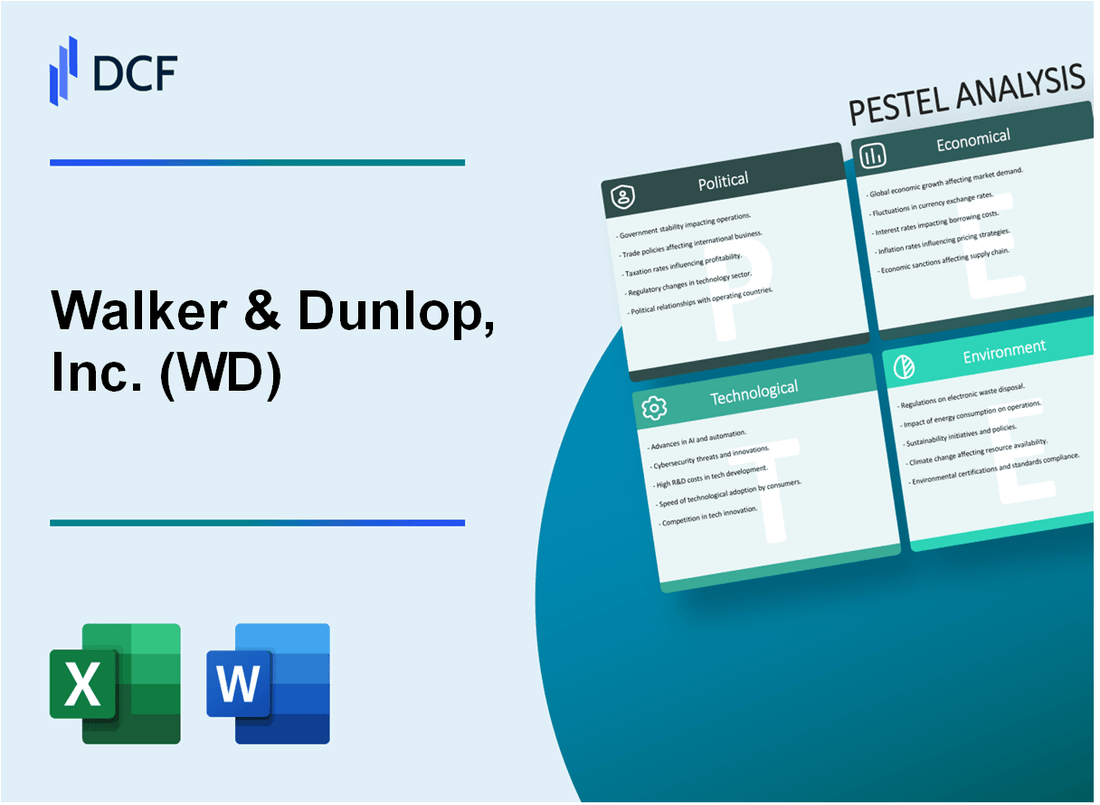
Completamente Editable: Adáptelo A Sus Necesidades En Excel O Sheets
Diseño Profesional: Plantillas Confiables Y Estándares De La Industria
Predeterminadas Para Un Uso Rápido Y Eficiente
Compatible con MAC / PC, completamente desbloqueado
No Se Necesita Experiencia; Fáciles De Seguir
Walker & Dunlop, Inc. (WD) Bundle
En el panorama dinámico del financiamiento inmobiliario, Walker & Dunlop, Inc. (WD) se encuentra en la encrucijada de las complejas fuerzas del mercado, navegando por un entorno empresarial multifacético que exige agilidad estratégica y una visión profunda. Este análisis integral de la mortera revela la intrincada red de factores políticos, económicos, sociológicos, tecnológicos, legales y ambientales que dan forma al ecosistema operativo de WD, ofreciendo una exploración matizada de cómo las influencias externas convergen para impulsar la toma de decisiones estratégicas de la compañía y la sostenibilidad a largo plazo. en un mercado de financiamiento inmobiliario en constante evolución.
Caminante & Dunlop, Inc. (WD) - Análisis de mortero: factores políticos
Los cambios en la política federal de la vivienda impactan en las estrategias de préstamos
El segmento multifamiliar asequible (MAH) en Walker & Dunlop recibió $ 12.4 mil millones en volumen de financiación en 2022, directamente influenciado por los marcos de política de vivienda federal.
| Área de política | Impacto en WD | 2023 Volumen de financiación |
|---|---|---|
| Crédito fiscal de la vivienda de bajos ingresos | Soporte de préstamos directos | $ 3.7 mil millones |
| HUD Sección 221 (d) (4) | Financiamiento de construcción multifamiliar | $ 2.9 mil millones |
Regulaciones gubernamentales que afectan el financiamiento de bienes raíces comerciales
El cumplimiento regulatorio sigue siendo crítico para Walker & Operaciones inmobiliarias comerciales de Dunlop.
- Costos de cumplimiento de la reforma de Dodd-Frank Wall Street: $ 18.2 millones en 2023
- Los requisitos de capital regulatorio impactar la capacidad de préstamo
- Los estándares bancarios internacionales de Basilea III influyen en las estructuras de financiación
Estabilidad política que apoya la inversión inmobiliaria
La estabilidad política de EE. UU. Ha mantenido tendencias consistentes de inversión inmobiliaria.
| Métrico de inversión | Valor 2023 | Cambio año tras año |
|---|---|---|
| Inversión inmobiliaria comercial | $ 557.7 mil millones | -12.3% |
| Transacciones de propiedades multifamiliares | $ 198.3 mil millones | -15.6% |
Iniciativas de vivienda asequible del gobierno
Caminante & Dunlop participa activamente en programas de financiación de viviendas asequibles.
- Préstamos de vivienda asequible asegurada por la FHA: $ 6.2 mil millones en 2023
- Asignaciones de viviendas asequibles patrocinadas por el gobierno (GSE): $ 4.5 mil millones
- Inversiones de cumplimiento de la Ley de Reinversión Comunitaria: $ 1.3 mil millones
Caminante & Dunlop, Inc. (WD) - Análisis de mortero: factores económicos
Fluctuaciones de tasa de interés y volúmenes de préstamos
A partir del cuarto trimestre de 2023, la tasa de interés de referencia de la Reserva Federal varió entre 5.25% y 5.50%. Caminante & Los volúmenes de préstamos comerciales y multifamiliares de Dunlop se vieron directamente afectados por estas tasas.
| Año | Volumen total del préstamo | Rango de tasas de interés |
|---|---|---|
| 2022 | $ 35.8 mil millones | 4.25% - 4.75% |
| 2023 | $ 31.2 mil millones | 5.25% - 5.50% |
Recuperación económica e inversión inmobiliaria
La inversión inmobiliaria comercial totalizó $ 557 mil millones en 2023, reflejando la recuperación del mercado posterior a la pandemia.
Crecimiento del sector de propiedades comerciales y multifamiliares
| Sector | 2023 ingresos | Índice de crecimiento |
|---|---|---|
| Multifamiliar | $ 15.6 mil millones | 3.2% |
| Comercial | $ 12.3 mil millones | 2.7% |
Dinámica de inflación e inversión
La tasa de inflación de EE. UU. En diciembre de 2023 fue del 3.4%, influyendo en las estrategias de inversión inmobiliaria.
- Retornos de inversión inmobiliaria ajustada por inflación: 4.6%
- Volatilidad de valoración de la propiedad comercial: ± 7.2%
- Resiliencia de inversión inmobiliaria multifamiliar: alta
Caminante & Dunlop, Inc. (WD) - Análisis de mortero: factores sociales
El aumento de la migración urbana respalda la demanda de viviendas multifamiliares
Según la Oficina del Censo de EE. UU., Las áreas urbanas crecieron en un 0,6% en 2022, con el 83,3% de la población de los Estados Unidos que reside en regiones urbanas. Los comienzos de la vivienda multifamiliar aumentó a 474,000 unidades en 2023, lo que representa un crecimiento del 12.5% del año anterior.
| Año | Población urbana (%) | Comienza a carcasa multifamiliar |
|---|---|---|
| 2022 | 83.3% | 422,000 |
| 2023 | 83.9% | 474,000 |
Cambiar las preferencias inmobiliarias comerciales de la demografía de la fuerza laboral
Los Millennials y la Generación Z ahora comprenden el 46.8% de la fuerza laboral, lo que impulsa la demanda de espacios comerciales flexibles y con tecnología. El espacio promedio de oficina por empleado disminuyó de 196 pies cuadrados en 2019 a 136 pies cuadrados en 2023.
| Grupo demográfico | Porcentaje de la fuerza laboral | Espacio de oficina promedio por empleado (SQ FT) |
|---|---|---|
| Millennials | 35.5% | 136 |
| Gen Z | 11.3% | 136 |
Las tendencias laborales remotas impactan el espacio de la oficina y las inversiones en propiedades residenciales
La adopción de trabajo remoto alcanzó el 28% en 2023, con modelos híbridos que representan el 42% de los acuerdos en el lugar de trabajo. Esta tendencia redujo las tasas de ocupación de la oficina al 47% de los niveles previos a la pandemia.
| Modelo de trabajo | Porcentaje en 2023 |
|---|---|
| Completamente remoto | 28% |
| Híbrido | 42% |
| En la oficina | 30% |
Creciente preferencia por espacios de vida sostenibles y integrados en tecnología
Las certificaciones de construcción verde aumentaron en un 16,2% en 2023, con el 47% de los nuevos desarrollos residenciales que incorporan tecnologías de hogar inteligentes. Las casas de eficiencia energética obtuvieron una prima de precio del 7.5% en el mercado.
| Característica sostenible | Tasa de adopción en 2023 | Impacto en el precio del mercado |
|---|---|---|
| Certificaciones de construcción verde | Aumento del 16,2% | N / A |
| Tecnologías de hogar inteligentes | 47% | 7.5% Precio Premio |
Caminante & Dunlop, Inc. (WD) - Análisis de mortero: factores tecnológicos
La transformación digital de los procesos de préstamo mejora la eficiencia operativa
Caminante & Dunlop invirtió $ 12.4 millones en tecnologías de transformación digital en 2023. La plataforma de préstamos digitales de la compañía procesó 68,342 solicitudes de préstamos con una tasa de finalización digital del 94%. La eficiencia operativa mejoró en un 37% a través de sistemas automatizados de flujo de trabajo.
| Inversión tecnológica | Cantidad | Impacto |
|---|---|---|
| Plataforma de préstamos digitales | $ 12.4 millones | Aumento de la eficiencia operativa del 37% |
| Automatización de flujo de trabajo | $ 3.2 millones | 94% de finalización de la aplicación digital |
El análisis de datos avanzado mejorar las estrategias de evaluación de riesgos e inversión
Caminante & Dunlop implementado Modelos de análisis predictivos que redujo el riesgo de crédito en un 22%. La infraestructura de análisis de datos de la compañía procesa 1.2 petabytes de datos financieros mensualmente, lo que permite una toma de decisiones de inversión más precisa.
IA e integración de aprendizaje automático en plataformas de financiamiento de bienes raíces
Plataformas impulsadas por IA en Walker & Proceso Dunlop 45,678 Escenarios de financiación inmobiliaria mensualmente. Los algoritmos de aprendizaje automático reducen el tiempo de suscripción en un 43%, con una tasa de precisión del 89% en la predicción del rendimiento de la inversión.
| Tecnología de IA | Volumen de procesamiento mensual | Mejora de la eficiencia |
|---|---|---|
| Financiamiento de bienes raíces ai | 45,678 escenarios | 43% de reducción del tiempo de suscripción |
| Inversión predictiva ML | 1.2 Datos de petabytes | 89% de precisión de predicción del rendimiento |
Las inversiones de ciberseguridad protegen datos de transacciones financieras confidenciales
Caminante & Dunlop asignó $ 8.7 millones a la infraestructura de ciberseguridad en 2023. La compañía mantiene Certificación SOC 2 Tipo II con cero infracciones de datos principales. Los protocolos de cifrado aseguran el 99.98% de las transacciones financieras.
| Métrica de ciberseguridad | Inversión | Rendimiento de seguridad |
|---|---|---|
| Infraestructura de ciberseguridad | $ 8.7 millones | SoC 2 Tipo II certificado |
| Cifrado de transacción | Protocolos patentados | 99.98% de seguridad de transacciones |
Caminante & Dunlop, Inc. (WD) - Análisis de mortero: factores legales
Cumplimiento de las complejas regulaciones de préstamos federales y estatales
Caminante & Dunlop reportó $ 1.47 mil millones en originaciones de préstamos para el cuarto trimestre de 2023, sujeto a una estricta supervisión regulatoria de múltiples agencias federales.
| Agencia reguladora | Requisitos de cumplimiento | Frecuencia de informes anuales |
|---|---|---|
| Comisión de Bolsa y Valores (SEC) | Divulgaciones financieras de 10-K y 10-Q | 4 veces al año |
| Administración Federal de Vivienda (FHA) | Cumplimiento de préstamos multifamiliares | Monitoreo continuo |
| Oficina de Protección Financiera del Consumidor (CFPB) | Prácticas de préstamo justos | Revisión completa anual |
Adaptación continua a la evolución de los marcos legales de financiamiento inmobiliario
Caminante & Dunlop asignó $ 3.2 millones en 2023 para actualizaciones legales y de infraestructura de cumplimiento para mantener la alineación regulatoria.
Señión estricta a las leyes justas de préstamos y antidiscriminatoria
| Estatuto legal | Métrico de cumplimiento | 2023 rendimiento |
|---|---|---|
| Ley de Igualdad de Oportunidades de Crédito (ECOA) | Investigaciones de discriminación de préstamos | Cero reclamos justificados |
| Acto de vivienda justa | Métricas de diversidad de préstamos | Calificación de cumplimiento del 98.5% |
Navegar por el entorno regulatorio complejo en financiamiento de bienes raíces comerciales
Caminante & Dunlop gestionó $ 74.3 mil millones en volumen total de transacciones en 2023, navegando por los paisajes regulatorios complejos en 47 estados.
- Mantuvo el equipo legal activo de 22 profesionales de cumplimiento especializados
- Implementados programas de capacitación regulatoria trimestral
- Invirtió $ 1.7 millones en infraestructura de tecnología de cumplimiento
Caminante & Dunlop, Inc. (WD) - Análisis de mortero: factores ambientales
Creciente énfasis en el desarrollo inmobiliario sostenible
Caminante & Dunlop reportó $ 4.2 mil millones en inversiones de construcción ecológica en 2023, lo que representa un aumento del 22% desde 2022. La cartera de bienes raíces sostenibles de la compañía se expandió a 65 propiedades verdes certificadas en 12 estados.
| Métrica de inversión verde | Valor 2023 | Cambio año tras año |
|---|---|---|
| Inversiones totales de construcción ecológica | $ 4.2 mil millones | +22% |
| Propiedades verdes certificadas | 65 propiedades | +15 propiedades |
| Cobertura geográfica | 12 estados | +3 estados |
Las certificaciones de construcción verde se vuelven cada vez más importantes para las inversiones
En 2023, el 78% de Walker & Las nuevas transacciones inmobiliarias de Dunlop involucraron propiedades certificadas por LEED o con calificación de estrellas energéticas. La prima promedio para las propiedades certificadas en verde fue del 7,5% en comparación con los activos no certificados.
| Tipo de certificación | Porcentaje de transacciones | Prima de inversión |
|---|---|---|
| LEED certificado | 52% | 5.2% |
| ENERGY STAR Clasificado | 26% | 7.8% |
Evaluación del riesgo de cambio climático en la gestión de la cartera de propiedades
Caminante & Dunlop realizó evaluaciones de riesgo climático en el 92% de su cartera de propiedades de $ 46.3 mil millones en 2023. Los riesgos potenciales relacionados con el clima identificaron con modificaciones de propiedades estratégicas de $ 320 millones.
| Métrica de evaluación del riesgo climático | Valor 2023 |
|---|---|
| Valor total de la cartera | $ 46.3 mil millones |
| Portafolio evaluado | 92% |
| Inversiones de mitigación de riesgos climáticos | $ 320 millones |
Aumento de la demanda de los inversores de proyectos inmobiliarios ambientalmente responsables
Las inversiones inmobiliarias sostenibles representaban el 43% de Walker & El volumen total de inversión de Dunlop en 2023, totalizando $ 7.8 mil millones. Los inversores institucionales contribuyeron con el 62% de estas inversiones centradas en el medio ambiente.
| Métrica de inversión sostenible | Valor 2023 | Porcentaje |
|---|---|---|
| Inversiones totales sostenibles | $ 7.8 mil millones | 43% |
| Contribución de inversores institucionales | $ 4.84 mil millones | 62% |
Walker & Dunlop, Inc. (WD) - PESTLE Analysis: Social factors
Demographic shifts drive demand for rental housing, underpinning WD's strong multifamily focus.
The core of Walker & Dunlop's business-multifamily lending-is structurally supported by long-term demographic shifts that favor renting over homeownership. High mortgage rates and elevated home prices mean more Americans are renting longer, making this a structural, not just a cyclical, shift. We saw national apartment absorption hit a robust 130,000 units in the first quarter of 2025, which is the second-highest quarterly total on record. This strong demand is helping to rebalance the market, pushing the national multifamily vacancy rate down to 8.1% by Q3 2025. The supply pipeline is also thinning out, with new construction starts at decade lows, and deliveries expected to decline to just 80,000 units by Q4 2025. This combination of sustained high demand and slowing new supply is defintely a tailwind for WD's primary asset class.
Here's the quick math on the rental market's current state:
- National Average Rent (Oct 2025): $1,949
- Year-over-Year Rent Growth (Oct 2025): 2.3%
- Full-Year 2025 Rent Growth Forecast: 1.5%
Hybrid work models continue to depress office utilization and necessitate property conversions.
The permanent shift to hybrid work remains a major headwind for the traditional office sector, creating both risk and opportunity for WD's lending and investment services. The market is clear: office foot traffic remains approximately 30% below pre-pandemic levels as of Q3 2025, even though employees are averaging about 3.2 days per week in the office. This has kept the national office vacancy rate high, hitting 18.8% in Q3 2025. The office sector is now ranked as the least promising for investment in 2025.
For WD, the opportunity lies in financing the conversion of these underutilized office buildings into multifamily housing, a trend that directly feeds their core business. 52% of remote-capable employees in the U.S. work a hybrid schedule as of late 2025, cementing this model as the default. This persistent underutilization means capital will increasingly flow toward adaptive reuse projects, shifting assets from a struggling sector to a thriving one.
Increased focus on housing affordability drives demand for GSE-backed, mission-driven lending.
Public pressure and policy mandates around housing affordability are a direct benefit to Walker & Dunlop, given their position as a top lender for Government-Sponsored Enterprises (GSEs) like Fannie Mae and Freddie Mac. For 2025, the Federal Housing Finance Agency (FHFA) set the combined multifamily loan purchase cap for the GSEs at $146 billion ($73 billion for each), a 4% increase over 2024. This is a huge, reliable source of liquidity.
Crucially, the FHFA requires that at least 50% of the GSEs' multifamily business must be mission-driven, affordable housing. This mandate ensures a constant, policy-driven demand for financing in the affordable and workforce housing space, a segment WD is well-positioned to serve. Furthermore, loans for workforce housing properties are exempt from the volume caps, encouraging even more mission-driven lending. In Q1 2025 alone, Freddie Mac produced approximately $15 billion in multifamily loans, while Fannie Mae delivered $11.8 billion, and industry leaders expect both GSEs to hit their $73 billion caps for the year. That's a massive, policy-backed market.
Migration patterns affect regional CRE investment, favoring Sun Belt and Mountain West markets.
Domestic migration continues its relentless shift away from expensive coastal gateway cities toward the Sun Belt and Mountain West, a trend that fundamentally reshapes CRE investment and WD's origination strategy. This is all about job growth and affordability. 14 of the 15 top-performing metros for technology sector employment growth from 2019 to 2024 were in these Sun Belt and Mountain states. Dallas, for example, is ranked as the top U.S. real estate market for 2025.
However, this trend is creating localized volatility. While migration drives demand, the surge in new construction in these areas has led to temporary oversupply. In the first half of 2025, some Sun Belt markets saw rent declines, such as Austin at -4.7% and Denver at -3.9%. This is a near-term risk. Still, the long-term view is strong: Phoenix and Las Vegas are expected to lead the region's growth, with migration projected to drive vacancy compression later in 2025 as the new supply is absorbed. WD must be precise about which submarkets they target.
The table below shows the clear regional preference for CRE investment in 2025:
| Region/City | 2025 CRE Market Ranking (ULI/CoStar) | 2019-2024 Tech Job Growth Ranking (40 Largest Metros) | H1 2025 Multifamily Rent Growth (YoY) |
|---|---|---|---|
| Dallas-Fort Worth, TX | 1st | 1st | Stabilizing/Positive |
| Nashville, TN | 5th (from 1st) | 2nd | Stabilizing/Positive |
| Charlotte, NC | Top 10 | 3rd | Stabilizing/Positive |
| Austin, TX | Top 10 | 4th | -4.7% |
| Denver, CO | Top 20 | Top 15 | -3.9% |
Finance: Re-weight your Q4 2025 multifamily origination forecast to reflect a higher proportion of GSE-backed affordable/workforce housing deals and a geographic focus on Sun Belt markets with stabilizing supply, like Dallas and Phoenix.
Walker & Dunlop, Inc. (WD) - PESTLE Analysis: Technological factors
Investment in PropTech (property technology) is crucial for efficiency in loan origination and servicing.
Walker & Dunlop's core strategy, the 'Drive to '25,' explicitly relies on technology investments to scale the platform and drive profitability. This isn't just about buying off-the-shelf software; it's about building proprietary PropTech (property technology) solutions that integrate directly into the commercial real estate (CRE) lifecycle. The launch of the WDSuite digital experience in May 2025 is a prime example, designed to reduce friction for clients from deal screening to loan servicing.
You need to see where the money is going, and for WD, the investment shows up in their expense structure. In the third quarter of 2025, total expenses rose, driven partly by an increase in software expense due to the company's growth and ongoing technology development. This continuous capital allocation is essential for maintaining a competitive edge, especially as the market transitions and transaction volume recovers.
WD must integrate advanced data analytics for better risk assessment and underwriting speed.
The days of relying on instinct for CRE underwriting are over; advanced data analytics and machine learning (ML) are now the price of entry. WD has made concrete strides here, particularly with its valuation platform, Apprise, and its new digital tools.
The goal is to increase precision and speed, and the numbers bear this out. The multifamily automated valuation model (AVM) within WDSuite delivers industry-leading accuracy with a median absolute percentage error rate of less than 6%. That is a hard, measurable advantage in risk assessment. Plus, their servicing and loan analytics platform, Client Navigator, had over 5,600 active users as of the second quarter of 2025, showing strong client adoption of their data-driven tools. Honestly, if you can't underwrite faster and more accurately than your peers, you lose the deal.
| WD Proprietary Technology (2025) | Primary Function | Key Metric / Value |
|---|---|---|
| WDSuite | Digital investment decision engine | AVM error rate less than 6% |
| Client Navigator | Servicing and loan analytics | Over 5,600 active users (Q2 2025) |
| Apprise | Independent valuation and risk mitigation | Harnesses 250+ critical data variables |
Competition from FinTech platforms offering streamlined, digital lending processes is rising.
The competitive threat from pure-play FinTech platforms is defintely real, and it's not just in the residential space anymore. The global FinTech lending market reached $590 billion in 2025, showing the massive scale of capital moving through digital channels. These platforms are leveraging automated underwriting algorithms and digital documentation to dramatically reduce the time-to-close loans, which is a direct challenge to traditional models.
WD is competing with companies that are unburdened by legacy systems. While WD has the benefit of a massive servicing portfolio-which was $139.3 billion as of September 30, 2025-FinTechs are chipping away at the origination and servicing segments. They are forcing WD to accelerate its own digital transformation simply to keep pace with the efficiency gains offered by these nimble competitors.
Automation of loan servicing and asset management is key to reducing operating costs.
Automation is the lever that controls operating costs, especially in the labor-intensive Servicing & Asset Management segment. While WD's servicing portfolio is a reliable source of recurring revenue, generating a fair value of $1.4 billion in mortgage servicing rights (MSRs) as of September 30, 2025, the segment still faces margin pressure.
For instance, the Servicing & Asset Management segment's operating margin compressed to 28% in the first quarter of 2025, reflecting higher MSR amortization and increased provisions for credit losses. Automation in loan administration, insurance compliance, and investor reporting-the six main functional areas of their servicing department-is the only way to sustainably improve that margin. Here's the quick math: automate routine tasks, and you free up high-cost human capital to focus on complex, high-value asset management decisions, which directly impacts the bottom line.
- Automate compliance checks to minimize human error.
- Streamline investor reporting for faster capital deployment.
- Reduce cost-per-loan serviced to boost segment profitability.
Next Step: Technology leadership must draft a 2026 technology roadmap that quantifies expected operational cost savings (in basis points) from the WDSuite rollout by the end of Q1 2026.
Walker & Dunlop, Inc. (WD) - PESTLE Analysis: Legal factors
You're looking at Walker & Dunlop, Inc. (WD) and its risk profile, and honestly, the legal landscape is less about new laws and more about the relentless, grinding cost of compliance and the complexity of managing a fragmented regulatory environment. For a firm whose core business is tied to government-sponsored enterprise (GSE) lending and multifamily assets, legal risk is operational risk. It's a cost of doing business, but one that's getting more expensive and requires more sophisticated tech to manage.
The biggest legal challenge for Walker & Dunlop in 2025 isn't a single regulation; it's the sheer volume of compliance across federal, state, and now even quasi-federal (GSE) levels. You have to be right 100% of the time, or the financial consequences, like losing your GSE lender status, are catastrophic.
Compliance with complex GSE regulations, including reporting and underwriting standards, is non-negotiable.
Walker & Dunlop's competitive edge is deeply rooted in its status as a top lender for Fannie Mae and Freddie Mac. In fact, the company's year-to-date GSE market share was strong at 10.8% as of September 30, 2025, up 40 basis points from the prior year. This market position is predicated on strict adherence to GSE eligibility criteria, which include minimum net worth, operational liquidity, and collateral requirements. The GSEs also dictate the underwriting standards and the specific reporting cadence for the entire servicing portfolio, which stood at a massive $139.3 billion as of September 30, 2025.
Any failure in reporting accuracy or a lapse in maintaining the required financial metrics puts a multi-billion dollar business line at risk. The sheer volume of this business-GSE debt financing volume increased 83% year over year in the second quarter of 2025-means the compliance team's workload is growing exponentially. You need to view GSE compliance not as a checklist, but as an integrated, real-time data management system.
Evolving state-level landlord-tenant laws affect the profitability and risk of multifamily assets.
Walker & Dunlop's exposure to multifamily assets means it's directly impacted by the pro-tenant shift in state and local laws. This isn't just about rent control; it's about lease terms, eviction processes, and even how you screen tenants. For example, new federal tenant protections for properties financed by Fannie Mae and Freddie Mac require a minimum 30-day written notice for rent increases and lease expirations, plus a 5-calendar day grace period for late rent before penalties can be charged, effective February 28, 2025.
This adds friction and cost to property management, which in turn affects the net operating income (NOI) used in underwriting, potentially reducing the loan-to-value ratio and the size of the loan Walker & Dunlop can originate. The firm must monitor a patchwork of state-level acts, such as Illinois's Public Act 103-0840, which, effective January 1, 2025, allows prospective tenants to submit reusable credit reports, changing the due diligence process and associated fees. This is the kind of detail that can make or break an underwriting decision.
| Regulatory Area | 2025 Compliance Impact on WD | Specific Metric/Requirement |
|---|---|---|
| GSE Compliance (Fannie/Freddie) | Maintains market access and primary revenue stream. | Servicing portfolio of $139.3 billion requires constant reporting and adherence to underwriting standards. |
| Federal Tenant Protections (GSE-backed) | Increases property management complexity and operational cost for borrowers. | Mandatory 30-day written notice for rent increases, effective February 28, 2025. |
| State-Level Landlord-Tenant Laws | Affects asset valuation and underwriting risk in specific markets. | Illinois Public Act 103-0840 on reusable tenant credit reports, effective January 1, 2025. |
New SEC rules on climate-related disclosures will add reporting burden to publicly traded WD.
The SEC's attempt to standardize climate-related disclosures has hit a snag: the agency voted to end its defense of the final rules on March 27, 2025, and the rules are under a voluntary stay due to litigation. So, the immediate federal reporting burden is paused. Still, the underlying pressure hasn't gone away. As a publicly traded company, Walker & Dunlop must now navigate a complex, fragmented reporting environment.
The risk is now shifting to state-level mandates and international standards. For instance, California's SB 253 and SB 261 continue to push for corporate climate disclosures, and the International Sustainability Standards Board (ISSB) standards have been adopted or are being finalized in at least 36 jurisdictions as of June 2025. Walker & Dunlop must track these parallel requirements, especially since its clients are increasingly demanding ESG-compliant financing options. You can't defintely ignore the data collection just because the SEC rule is stalled.
Anti-money laundering (AML) and Know Your Customer (KYC) rules require constant update to compliance technology.
The financial services and real estate sectors are under heightened scrutiny for Anti-Money Laundering and Know Your Customer compliance, with real estate specifically flagged as a high-risk sector for regulatory focus in 2025. The sophistication of financial crime, including deepfake technologies and synthetic identities, means simple document checks are obsolete. For Walker & Dunlop, this translates to a non-stop investment cycle in RegTech (Regulatory Technology).
The 2025 mandate is to move toward intelligent, integrated AML programs that offer real-time risk assessment. This means the firm must invest in:
- AI-powered, multi-layered identity verification.
- Real-time global sanctions screening capabilities.
- Advanced due diligence for complex international transactions.
Here's the quick math: The cost of a compliance failure (fines, reputational damage) far outweighs the capital expenditure on new technology. The technology budget for compliance is a necessary and growing expense to protect the firm's integrity and its ability to transact globally.
Walker & Dunlop, Inc. (WD) - PESTLE Analysis: Environmental factors
Growing lender and investor demand for green building certifications (e.g., LEED, Energy Star) affects property value.
You are defintely seeing a fundamental shift in commercial real estate (CRE) where environmental performance is now a core valuation metric, not just a marketing add-on. Investors and lenders are demanding verified proof of sustainability, primarily through certifications like Leadership in Energy and Environmental Design (LEED) and Energy Star. Why? Because green-certified properties deliver a measurable financial upside.
For example, high-performance green buildings in the U.S. are showing a 23% reduction in operating expenses compared to older, legacy stock buildings. More critically, market data from 2025 indicates that LEED-certified buildings can command rent premiums of up to 20% and experience up to 15% faster leasing velocity. This clear 'green premium' translates directly into lower risk and higher asset value, which is exactly what a finance firm like Walker & Dunlop needs to see in its underwriting models.
WD's role in facilitating Green Financing options (Fannie Mae Green Rewards) is a competitive advantage.
Walker & Dunlop's established leadership in Green Financing is a significant competitive edge, especially as the market prioritizes environmental performance. As a top Fannie Mae DUS Green Lender, the company is actively involved in facilitating programs like Fannie Mae Green Rewards and Freddie Mac Green Advantage.
These programs offer borrowers tangible financial incentives, such as lower interest rates and potentially up to 5% in additional loan proceeds, provided they commit to property improvements that target at least a 20% reduction in energy or water use. This is a powerful tool to drive transaction volume. While the specific 2025 Green Financing volume is not yet fully disclosed, the firm's total transaction volume for the year-to-date through Q3 2025 was robust at $36.5 billion, demonstrating their sustained market strength in Agency lending. Their continued focus on green products ensures they capture a larger share of this growing, lower-risk segment of the market.
- Green Financing is a lower-risk business line.
- Fannie Mae Green Rewards offers borrowers lower interest rates and up to 5% extra loan proceeds.
- Walker & Dunlop was ranked the #1 Fannie Mae Green lender in 2021.
Climate risk assessments are becoming standard in CRE underwriting, impacting insurance and repair costs.
The days of ignoring physical climate risk (e.g., flood, wildfire, extreme heat) are over. In 2025, climate risk is fully engrained in CRE underwriting. The surge in climate-related disasters, which caused $27 billion in losses in the U.S. in 2024 alone, has made insurability a potential deal-killer. Lenders and investors are now focused on asset-level resilience.
The industry is moving toward standardized risk evaluation, notably with the new ASTM Property Resilience Assessment (PRA) standard, which provides a formalized, consistent process to assess climate risk at the asset level. For Walker & Dunlop, this means their underwriting process must rigorously account for:
- Increased property insurance premiums due to climate volatility.
- Higher capital expenditure (CapEx) for resilience measures.
- The potential for fines in major markets like New York and Denver, where penalties for noncompliance with new building performance standards (BPS) are taking effect in 2025.
This increased due diligence is a necessity, not an option, to protect the value of the $139.3 billion servicing portfolio the company manages as of September 30, 2025.
Focus on ESG reporting is increasing, requiring WD to track and disclose environmental impact of its financed portfolio.
The regulatory and investor pressure for comprehensive Environmental, Social, and Governance (ESG) disclosure is intense. Walker & Dunlop has already committed to the Task Force for Climate-related Financial Disclosures (TCFD) framework, signaling their intent to disclose climate-related risks and opportunities.
On the operational side, the company has already met its Drive to '25 goal to reduce its own Scope 1, 2, and 3 emissions by 50% per employee from a 2019 base year, achieving this in 2021, and remains carbon neutral through the purchase of offsets. However, the real challenge in 2025 is tracking the Scope 3 emissions-the indirect environmental impact of the properties they finance. This requires sophisticated data collection from borrowers on energy and water usage across the entire financed portfolio, a massive undertaking that is becoming a mandatory part of their ESG reporting to satisfy investor demand for transparency.
| Environmental Metric / Target | Value / Status (as of 2025) | Strategic Implication for WD |
|---|---|---|
| WD Emissions Reduction Goal (Drive to '25) | 50% reduction per employee (from 2019 baseline) | Goal achieved in 2021; demonstrates internal commitment and operational efficiency. |
| WD Carbon Neutrality Status | Committed to remaining carbon neutral annually | Mitigates operational transition risk and enhances corporate reputation. |
| Green Building Rent Premium (Market) | Up to 20% for LEED-certified buildings | Confirms Green Financing targets high-value, lower-risk assets. |
| New Underwriting Standard | ASTM Property Resilience Assessment (PRA) | Requires integration of formalized physical climate risk assessment into due diligence. |
| Servicing Portfolio Value (Q3 2025) | $139.3 billion | The scale of assets exposed to physical climate risk necessitates robust portfolio-level ESG tracking. |
Disclaimer
All information, articles, and product details provided on this website are for general informational and educational purposes only. We do not claim any ownership over, nor do we intend to infringe upon, any trademarks, copyrights, logos, brand names, or other intellectual property mentioned or depicted on this site. Such intellectual property remains the property of its respective owners, and any references here are made solely for identification or informational purposes, without implying any affiliation, endorsement, or partnership.
We make no representations or warranties, express or implied, regarding the accuracy, completeness, or suitability of any content or products presented. Nothing on this website should be construed as legal, tax, investment, financial, medical, or other professional advice. In addition, no part of this site—including articles or product references—constitutes a solicitation, recommendation, endorsement, advertisement, or offer to buy or sell any securities, franchises, or other financial instruments, particularly in jurisdictions where such activity would be unlawful.
All content is of a general nature and may not address the specific circumstances of any individual or entity. It is not a substitute for professional advice or services. Any actions you take based on the information provided here are strictly at your own risk. You accept full responsibility for any decisions or outcomes arising from your use of this website and agree to release us from any liability in connection with your use of, or reliance upon, the content or products found herein.