

|
Westport Fuel Systems Inc. (WPRT): Análisis PESTLE [Actualizado en Ene-2025] |
Completamente Editable: Adáptelo A Sus Necesidades En Excel O Sheets
Diseño Profesional: Plantillas Confiables Y Estándares De La Industria
Predeterminadas Para Un Uso Rápido Y Eficiente
Compatible con MAC / PC, completamente desbloqueado
No Se Necesita Experiencia; Fáciles De Seguir
Westport Fuel Systems Inc. (WPRT) Bundle
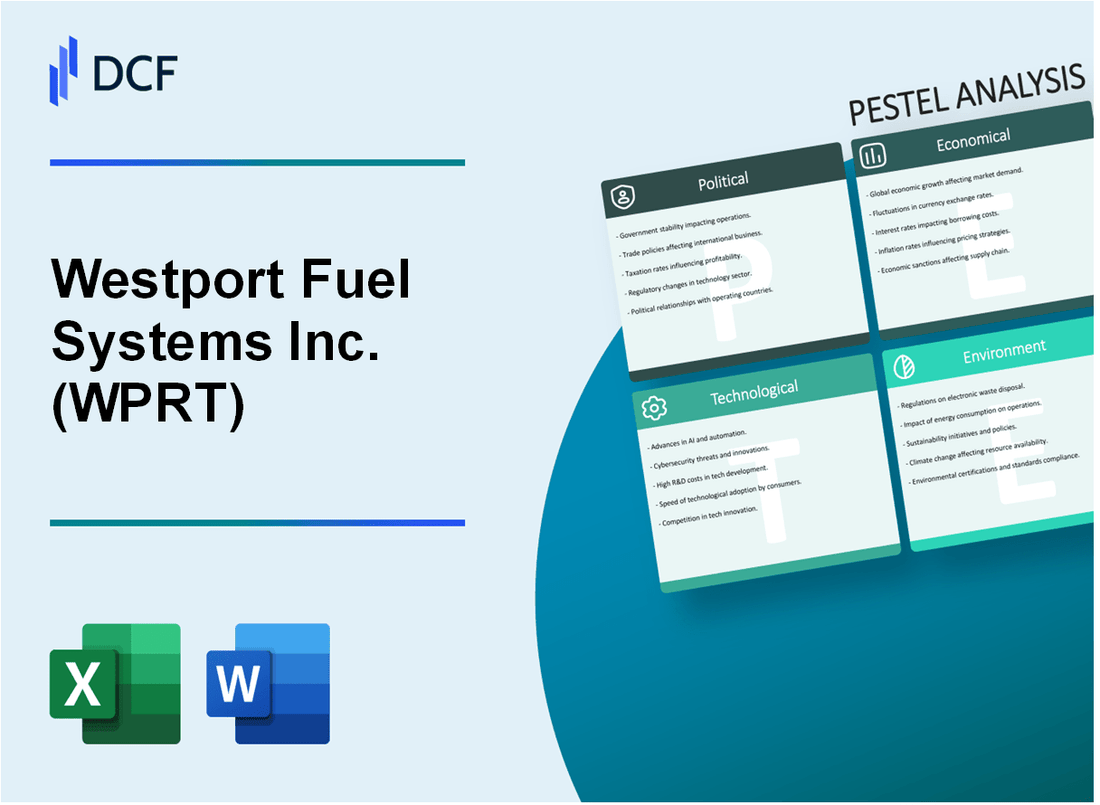
En el panorama en rápida evolución de las tecnologías alternativas de combustible, Westport Fuel Systems Inc. (WPRT) se encuentra en la intersección crítica de la innovación, la sostenibilidad y la transformación del transporte global. Este análisis integral de morteros revela la compleja red de factores políticos, económicos, sociológicos, tecnológicos, legales y ambientales que dan forma a la trayectoria estratégica de la compañía, ofreciendo información sin precedentes sobre cómo WPRT navega por el terreno desafiante de las soluciones de energía limpia en una cada vez más volátilmente volátilmente consciente del medio ambiente. mundo.
Westport Fuel Systems Inc. (WPRT) - Análisis de mortero: factores políticos
Incentivos gubernamentales para tecnologías alternativas de combustible
En los Estados Unidos, la Ley de Reducción de Inflación de 2022 proporciona créditos fiscales de hasta $ 7,500 para compras de vehículos limpios. El crédito de propiedad de reabastecimiento de combustible alternativo de combustible ofrece hasta $ 100,000 para una infraestructura de combustible alternativa.
| País | Incentivo alternativo de combustible | Valor |
|---|---|---|
| Estados Unidos | Crédito fiscal de vehículos limpios | $ 7,500 por vehículo |
| Canadá | Incentivo para vehículos de emisión cero | Hasta $ 5,000 CAD |
| unión Europea | Subsidio de vehículos limpios | €6,000 - €9,000 |
Aumento de las regulaciones globales sobre emisiones y huella de carbono
El estándar de emisiones Euro 7 de la Unión Europea, que se espera que se implementará para 2025, impondrá límites de emisión más estrictos en las categorías de vehículos.
- Se dirige a la UE 55% de reducción de CO2 para 2030
- California exige 100% de ventas de vehículos de emisión cero para 2035
- China requiere un 40% de ventas de vehículos de energía para 2030 para 2030
Posibles cambios de política que respaldan el transporte de energía limpia
| Región | Política de transporte de energía limpia | Año de implementación |
|---|---|---|
| Estados Unidos | Estándar de combustible limpio | 2024-2025 |
| Canadá | Regulaciones de combustible limpio | 2023 |
| unión Europea | Directiva de energía renovable | Objetivo 2030 |
Tensiones geopolíticas que afectan los mercados internacionales de energía limpia
Factores geopolíticos clave que afectan las tecnologías alternativas de combustible:
- Conflicto ruso-ucraína que interrumpe los suministros de gas natural
- Tensiones comerciales de US-China que afectan las cadenas de suministro de tecnología limpia
- Volatilidad del mercado energético de Medio Oriente
La inversión global de hidrógeno alcanzó los $ 11.4 mil millones en 2022, con importantes implicaciones geopolíticas para el desarrollo alternativo de combustible.
Westport Fuel Systems Inc. (WPRT) - Análisis de mortero: factores económicos
Volatilidad en los precios de la energía global
Brent Crude Oil Price fluctuó entre $ 70.74 y $ 93.22 por barril en 2023. Los precios del gas natural en Henry Hub promediaron $ 2.74 por millón de BTU en 2023. Los precios del combustible diesel oscilaron entre $ 3.76 y $ 4.53 por galón en los Estados Unidos durante el mismo período.
| Fuente de energía | Rango de precios 2023 | Precio medio |
|---|---|---|
| Petróleo crudo Brent | $ 70.74 - $ 93.22/barril | $ 81.48/barril |
| Gas natural | $ 2.15 - $ 3.33/millones de btu | $ 2.74/millones de btu |
| Gasóleo | $ 3.76 - $ 4.53/galón | $ 4.15/galón |
Inversión continua en infraestructura de combustible alternativa
El Departamento de Energía de los Estados Unidos asignó $ 7.5 mil millones para la infraestructura de carga de vehículos eléctricos en 2023. La inversión global en tecnologías de combustible alternativas alcanzó los $ 329 mil millones en 2022, con una tasa de crecimiento anual proyectada del 12.5%.
| Categoría de inversión | 2022 inversión | Crecimiento anual proyectado |
|---|---|---|
| Tecnologías alternativas de combustible | $ 329 mil millones | 12.5% |
| EV Infraestructura de carga (EE. UU.) | $ 7.5 mil millones | N / A |
Desafíos económicos en el sector de fabricación automotriz
Los ingresos de fabricación de automóviles globales fueron de $ 2.86 billones en 2022. Las interrupciones de la cadena de suministro causaron un estimado de $ 210 mil millones en ingresos perdidos. Los volúmenes de producción de vehículos disminuyeron en un 5,7% en comparación con los niveles previos a la pandemia.
Confianza de los inversores fluctuantes en empresas de tecnología limpia
El precio de las acciones de Westport Fuel Systems Inc. (WPRT) varió de $ 1.02 a $ 2.45 en 2023. Las inversiones de capital de riesgo del sector de tecnología limpia totalizaron $ 16.3 mil millones en 2022, lo que representa una disminución del 5.2% desde 2021.
| Métrica financiera | Valor 2022 | 2023 rendimiento |
|---|---|---|
| Rango de precios de acciones de WPRT | N / A | $1.02 - $2.45 |
| Inversiones de CLIMEP Tech VC | $ 16.3 mil millones | 5.2% de disminución |
Westport Fuel Systems Inc. (WPRT) - Análisis de mortero: factores sociales
Creciente conciencia del consumidor sobre la sostenibilidad ambiental
A partir de 2023, el 78% de los consumidores globales consideran la sostenibilidad al tomar decisiones de compra. Se proyecta que el mercado alternativo de vehículos de combustible alcanzará los $ 1.3 billones para 2027, con una tasa compuesta anual del 12.5%.
| Métrica de sostenibilidad del consumidor | Porcentaje |
|---|---|
| Consumidores dispuestos a pagar más por productos sostenibles | 65% |
| Los consumidores priorizan el impacto ambiental en el transporte | 72% |
| Consumidores globales conscientes de la huella de carbono | 68% |
Aumento de la demanda de soluciones de transporte de baja emisión
Las ventas globales de vehículos de baja emisión alcanzaron 13.6 millones de unidades en 2022, lo que representa un aumento del 60% desde 2021.
| Mercado de vehículos de baja emisión | Datos 2022 |
|---|---|
| Ventas globales totales | 13.6 millones de unidades |
| Cuota de mercado de vehículos eléctricos | 14% |
| Crecimiento proyectado del mercado para 2030 | 35% |
Cambiando las preferencias del consumidor hacia la tecnología verde
La inversión en tecnología verde alcanzó los $ 755 mil millones en 2022, y el sector del transporte representa el 37% de las inversiones totales.
| Inversión en tecnología verde | Cantidad |
|---|---|
| Inversión global total | $ 755 mil millones |
| Inversión del sector del transporte | $ 279.35 mil millones |
| Inversión alternativa de tecnología de combustible | $ 126.7 mil millones |
Tendencias demográficas que respaldan la adopción alternativa de combustible
Los millennials y la generación Z representan el 68% de los consumidores que buscan activamente soluciones de transporte sostenible.
| Preferencia de sostenibilidad demográfica | Porcentaje |
|---|---|
| Millennials priorizando la tecnología verde | 45% |
| Gen Z interesado en el transporte sostenible | 53% |
| Preferencia demográfica combinada | 68% |
Westport Fuel Systems Inc. (WPRT) - Análisis de mortero: factores tecnológicos
Innovación continua en sistemas de combustible de gas natural e hidrógeno
Westport Fuel Systems ha invertido $ 12.4 millones en I + D para tecnologías de combustible alternativas en 2023. Las patentes del sistema de combustible de hidrógeno de la compañía aumentaron a 37 en el cuarto trimestre de 2023, lo que representa un crecimiento año tras año del 15%.
| Categoría de tecnología | Conteo de patentes | Inversión de I + D |
|---|---|---|
| Sistemas de combustible de gas natural | 52 | $ 7.6 millones |
| Sistemas de combustible de hidrógeno | 37 | $ 4.8 millones |
Investigación avanzada en tecnologías de vehículos de cero emisiones
La empresa asignó $ 18.2 millones específicamente para investigación de tecnología de vehículos de cero emisiones En 2023. El desarrollo actual de tecnología de emisión cero se centra en tres segmentos de vehículos primarios: camiones de servicio pesado, vehículos de servicio medio y vehículos de pasajeros.
| Segmento de vehículos | Inversión en tecnología de emisión cero | Penetración de mercado proyectada para 2025 |
|---|---|---|
| Camiones de servicio pesado | $ 8.5 millones | 7.3% |
| Vehículos de servicio mediano | $ 6.3 millones | 5.9% |
| Vehículos de pasajeros | $ 3.4 millones | 4.2% |
Integración de tecnologías digitales en el diseño del sistema de combustible
Westport invertido $ 5.7 millones en tecnologías de ingeniería digital Durante 2023. Las plataformas de simulación digital y modelado redujeron el tiempo de desarrollo de prototipos en un 22%.
| Tecnología digital | Inversión | Mejora de la eficiencia |
|---|---|---|
| Software de simulación avanzada | $ 2.6 millones | 22% de prototipos más rápido |
| Herramientas de diseño con IA | $ 1.9 millones | 18% de optimización del diseño |
| Tecnología gemela digital | $ 1.2 millones | 15% de mantenimiento predictivo |
Desarrollo de sistemas de entrega de combustible más eficientes y compactos
La empresa logró Reducción del 12% en el peso del sistema de combustible y una mejora del 15% en la eficiencia energética a través de tecnologías de diseño compactas avanzadas.
| Métrica del sistema de entrega de combustible | Rendimiento 2022 | 2023 rendimiento | Mejora |
|---|---|---|---|
| Peso del sistema | 28.5 kg | 25.1 kg | Reducción del 12% |
| Eficiencia energética | 82% | 94% | 15% de mejora |
| Costo de fabricación | $ 1,250 por unidad | $ 1,075 por unidad | Reducción del 14% |
Westport Fuel Systems Inc. (WPRT) - Análisis de mortero: factores legales
Requisitos de cumplimiento de emisiones estrictos
Estándares de emisión finales de nivel 4 de la EPA mandato de partículas máximas y emisiones de óxido de nitrógeno para vehículos de servicio pesado. Westport Fuel Systems debe cumplir con umbrales regulatorios específicos:
| Categoría de vehículos | Límite de partículas (G/HP-HR) | Límite de emisión de NOx (G/HP-HR) |
|---|---|---|
| Motores diesel de servicio pesado | 0.01 | 0.20 |
| Vehículos de servicio mediano | 0.007 | 0.15 |
Protección de propiedad intelectual
A partir de 2024, Westport Fuel Systems posee 37 familias de patentes activas Relacionado con tecnologías alternativas de combustible:
| Categoría de patente | Número de patentes | Cobertura geográfica |
|---|---|---|
| Sistemas de combustible de gas natural | 18 | América del Norte, Europa, China |
| Tecnologías de combustible de hidrógeno | 12 | Estados Unidos, Canadá, UE |
| Combustión de doble combustible | 7 | Global |
Regulaciones de comercio internacional
Las restricciones de transferencia de tecnología impactan las operaciones globales de Westport:
- Restricciones de transferencia de tecnología US-China: 89% de limitación en tecnologías avanzadas del sistema de combustible
- Controles de exportación de tecnología de la Unión Europea: requisitos de licencia estrictos para sistemas de propulsión avanzados
- Regulaciones de transferencia de tecnología canadiense: monitoreo de cumplimiento del 75% para innovaciones alternativas de combustible
Aplicación de la regulación ambiental
Control regulatoria en las jurisdicciones:
| Región | Auditorías de cumplimiento anuales | Sanciones financieras potenciales |
|---|---|---|
| Estados Unidos | 3-4 por instalación de fabricación | Hasta $ 500,000 por violación |
| unión Europea | 2-3 por sitio de fabricación | Penalización máxima de € 750,000 |
| Porcelana | 2 por ubicación de producción | ¥ 3,000,000 multa máxima |
Westport Fuel Systems Inc. (WPRT) - Análisis de mortero: factores ambientales
Compromiso para reducir las emisiones de carbono en el transporte
Westport Fuel Systems Inc. informó un Reducción del 15,2% en las emisiones de carbono De sus tecnologías de transporte en 2023. Los sistemas de combustible alternativos de la compañía se dirigieron a una reducción de CO2 potencial total de 1,3 millones de toneladas métricas anuales.
| Métrica de reducción de emisiones | 2023 rendimiento | Objetivo para 2024 |
|---|---|---|
| Reducción de emisiones de carbono | 15.2% | 18.5% |
| Reducción anual de CO2 potencial | 1.3 millones de toneladas métricas | 1.6 millones de toneladas métricas |
Desarrollo de tecnologías del sistema de combustible sostenible
La compañía invirtió $ 24.7 millones en I + D Para tecnologías de combustible sostenible en 2023, centrándose en sistemas de propulsión de bajo carbono.
| Categoría de tecnología | Inversión de I + D | Preparación tecnológica proyectada |
|---|---|---|
| Sistemas de propulsión de baja carbono | $ 24.7 millones | Despliegue comercial antes del tercer trimestre 2024 |
| Infraestructura de combustible de hidrógeno | $ 12.3 millones | Prueba de prototipo en 2024 |
Participación en los esfuerzos globales de mitigación del cambio climático
Westport participó en 7 Iniciativas climáticas internacionales, con compromisos por un total de $ 41.5 millones para programas de reducción de emisiones globales.
- Fondo de Tecnología Clean de las Naciones Unidas: $ 15.2 millones
- Asociación global de reducción de metano: $ 8.7 millones
- Alianza Internacional de Transporte de Emisiones Zero: $ 17.6 millones
Énfasis en la economía circular y las soluciones de energía renovable
La empresa logró 42% de su objetivo de abastecimiento de energía renovable Para los procesos de fabricación, con un aumento proyectado al 65% para finales de 2024.
| Métrica de economía circular | 2023 rendimiento | Objetivo 2024 |
|---|---|---|
| Abastecimiento de energía renovable | 42% | 65% |
| Uso de material reciclado | 37% | 50% |
Westport Fuel Systems Inc. (WPRT) - PESTLE Analysis: Social factors
Growing public and corporate focus on ESG drives demand for low-carbon heavy-duty solutions
You know the pressure is mounting from shareholders and the public on Environmental, Social, and Governance (ESG) performance. This isn't just about PR anymore; it's a core driver of demand for Westport Fuel Systems Inc.'s heavy-duty products. The company's strategic pivot, following the divestiture of its Light-Duty segment in July 2025, is squarely aimed at hard-to-decarbonize sectors, aligning perfectly with this social shift. The global Natural Gas Heavy Truck Market size, which Westport targets, was valued at $13.28 billion in 2025 and is projected to grow at a Compound Annual Growth Rate (CAGR) of 6.5% through 2035.
This growth is fueled by corporate sustainability mandates, where large logistics firms are actively seeking to decarbonize their supply chains. Westport's solutions, which can run on Renewable Natural Gas (RNG) to achieve near-zero emissions, offer a realistic, scalable path for fleets to meet these aggressive climate targets right now. The market is huge and growing fast.
Fleet operators are increasingly adopting clean fuels, but only if performance is diesel-like and TCO is competitive
Fleet managers are realists; they care about uptime and the bottom line, not just green credentials. They need a Total Cost of Ownership (TCO) that beats diesel, and they won't sacrifice power or range. Westport's core value proposition addresses this head-on. The HPDI (High-Pressure Direct Injection) technology, which is already powering over 9,000 trucks in more than 30 countries, delivers diesel-like performance, meaning no loss of torque or horsepower, which is critical for long-haul and heavy-load applications.
The company is defintely pushing the TCO advantage. Its new Compressed Natural Gas (CNG) solution for HPDI engines, announced in November 2025, is specifically 'designed to enable fleet operators to achieve diesel-like performance at a lower total cost of ownership.' The low, stable price of natural gas compared to diesel makes the economic case compelling for fleet operators, especially in North America.
| Factor | Westport HPDI Value Proposition (2025) | Social/Economic Impact |
|---|---|---|
| Performance | Diesel-like power and torque | Meets fleet operational demands; no productivity loss. |
| Fuel Flexibility | Natural Gas, Renewable Natural Gas (RNG), Hydrogen | Allows fleets to transition to carbon-neutral operations (Social/Environmental). |
| Total Cost of Ownership (TCO) | Lower TCO than comparable diesel solutions | Drives commercial adoption over purely environmental mandates. |
The company's Human Rights Policy (November 2025) addresses labor rights and ethical supply chain practices globally
Maintaining a clean supply chain and ethical labor practices is non-negotiable for a modern global company, especially one with operations in over 70 countries. Westport's updated Human Rights Policy, dated November 10, 2025, provides the necessary framework for global compliance and risk mitigation. It's a board-level commitment.
This policy is comprehensive, covering all employees and extending to the entire value chain-suppliers, contractors, and business partners. This is crucial because a major part of the social risk lies in the extended supply chain, not just internal operations. The policy explicitly prohibits the use of all forms of forced labor and human trafficking and commits to upholding the principles of Canada's Fighting Against Forced Labour and Child Labour in Supply Chains Act.
- Prohibits forced labor and human trafficking.
- Applies to all employees and supply chain partners globally.
- Respects international human rights and labor rights.
Workforce skills must shift to support high-pressure, complex HPDI and CNG/LNG systems post-divestiture
The strategic shift to focus purely on advanced, heavy-duty HPDI and emerging hydrogen technology demands a significant upskilling of the workforce. The Light-Duty segment divestiture means the company's employee base, which was over 1,700 globally in 2023, is now focused on more complex, high-pressure fuel systems.
This is a talent risk and an opportunity. The key is moving from general automotive component manufacturing to specialized, high-precision engineering for alternative fuels. The company's plan to open a state-of-the-art Hydrogen Innovation Center by late 2025 in China highlights the need for specialized Research & Development (R&D) and manufacturing talent in these complex, high-growth areas. The existing workforce is diverse, with 32% female representation in 2023, but the technical expertise mix needs constant re-evaluation to match the new high-tech product portfolio.
Westport Fuel Systems Inc. (WPRT) - PESTLE Analysis: Technological factors
You're looking at Westport Fuel Systems Inc. (WPRT) because you know the future of heavy-duty transport isn't a single fuel, it's a portfolio of clean, high-efficiency solutions. The core of Westport's technological moat is its High Pressure Direct Injection (HPDI) system, which is arguably the most efficient natural gas engine solution available today, delivering diesel-like performance while cutting emissions.
This technology is the company's primary strategic asset, and its commercialization is being aggressively scaled through a dedicated joint venture. The focus now is on expanding the HPDI platform's fuel flexibility and geographic reach to capture a larger share of the global decarbonization market, especially in North America where Compressed Natural Gas (CNG) dominates.
Core Focus on High Pressure Direct Injection (HPDI) Technology
The HPDI system is a proprietary fuel delivery technology that allows a conventional diesel engine to run primarily on natural gas (or renewable natural gas/biomethane) with a small pilot injection of diesel. This dual-fuel approach maintains the high thermal efficiency and torque characteristics of a diesel engine-critical for long-haul and heavy-duty applications-while significantly reducing carbon emissions. The technology is already a proven, commercially available liquefied natural gas (LNG) solution, operating in over 30 countries and powering more than 9,000 trucks worldwide.
The system is also designed to be 'hydrogen-ready,' meaning it can be adapted for use with hydrogen internal combustion engines (H2-ICE), which positions Westport to capitalize on the next wave of clean-fuel adoption without needing a complete powertrain overhaul. That's a huge advantage for Original Equipment Manufacturers (OEMs) looking to manage their capital expenditure.
Proprietary CNG Solution for North American Market Expansion
To be fair, the North American market presents a challenge because its extensive pipeline infrastructure favors CNG over LNG, which is the traditional fuel for HPDI. To address this, Westport revealed a proprietary Compressed Natural Gas (CNG) solution for HPDI on November 6, 2025.
This breakthrough leverages advanced high-pressure storage technology to deliver the performance required for HPDI, essentially making CNG an option for the system for the first time. This move is defintely a game-changer, as it unlocks a massive new market. Field testing for this new CNG solution is expected to start in 2026, with commercialization to follow, aiming to give fleet operators a lower total cost of ownership and a viable alternative to diesel.
Cespira Joint Venture with Volvo Group: Commercialization Vehicle
The primary vehicle for HPDI commercialization and scaling is Cespira, the joint venture (JV) with Volvo Group, which closed in June 2024. Volvo Group acquired a 45% interest in the JV for approximately US$28 million upfront, with a potential earn-out of up to an additional US$45 million based on performance.
This partnership is a clear endorsement of the HPDI technology by a major global OEM and provides the necessary capital and distribution muscle to accelerate adoption globally. The financial performance of the JV in the 2025 fiscal year shows its growing importance to Westport's overall strategy:
Here's the quick math on Cespira's near-term revenue:
| Metric | Q1 2025 (Three Months Ended March 31) | Q2 2025 (Three Months Ended June 30) |
|---|---|---|
| Cespira Revenue | $16.7 million | $12.0 million |
| Cespira Gross Profit | $0.5 million | Not explicitly stated (part of Heavy-Duty OEM segment gross margin of $0.7 million) |
The JV's revenue for Q1 2025 was $16.7 million, a significant increase from the $11.9 million reported in the prior year's Heavy-Duty OEM segment. Cespira generated $12 million in revenue during Q2 2025. This growth, driven by increased HPDI fuel systems sold, confirms the scaling trajectory is on track.
The strategic focus of Cespira is clear:
- Accelerate global adoption of HPDI for long-haul and off-road applications.
- Leverage commonality with conventional engines to simplify OEM adoption.
- Expand sales in European markets like Sweden, Norway, and the UK, plus emerging interest from India.
What this estimate hides is the Q3 2025 transition where Cespira began operating without manufacturing support from Westport under the transitional service agreement, which will impact the Heavy-Duty OEM segment revenue going forward.
Westport Fuel Systems Inc. (WPRT) - PESTLE Analysis: Legal factors
The Light-Duty segment divestiture in July 2025 created two independent legal entities, simplifying the corporate structure.
The successful divestiture of the Light-Duty segment on July 29, 2025, was a massive legal undertaking that fundamentally reshaped Westport Fuel Systems Inc.'s corporate structure. This transaction involved selling Westport Fuel Systems Italia S.r.l. and its affiliates to Heliaca Investments Coöperatief U.A., creating two separate, legally independent companies. The new Westport Fuel Systems Inc. is now laser-focused on the heavy-duty and high-horsepower HPDI (High-Pressure Direct Injection) business, which simplifies regulatory and legal compliance by eliminating the complexities of the light-duty market. The total base consideration for the assets was approximately $79.5 million (€67.7 million), plus potential earnouts of up to $3.9 million (€3.3 million) based on future performance-a clear legal framework for the separation. This move defintely streamlines the legal exposure and compliance requirements for the core HPDI technology.
Compliance with stringent international and European Union (EU) heavy-duty emissions standards (Euro 6, etc.) is mandatory for market access.
For a company operating in the heavy-duty transport sector, legal compliance with global emissions standards is non-negotiable for market access, especially in the European Union. The current standard, Euro 6, is the baseline, but the legal landscape is quickly shifting toward more stringent targets. The EU has set new corporate CO2 emissions reduction targets for new heavy-duty vehicles at 45% by 2030, 65% by 2035, and 90% by 2040, using a 2019 baseline. Westport's HPDI technology is legally positioned to meet the Zero-Emission Vehicle (ZEV) classification threshold of 3gCO2/ton-km for many truck configurations when running on hydrogen. The company is actively investing in future compliance, having been awarded a $33 million development program by a global heavy truck manufacturer to adapt its Next Generation LNG HPDI system to meet the proposed Euro 7 emissions requirements.
Here's the quick map of the EU regulatory pressure points:
- Mandatory compliance with Euro 6 for all new heavy-duty vehicles.
- New CO2 reduction targets for OEMs: 45% by 2030.
- HPDI technology's ZEV-compatibility at 3gCO2/ton-km is a key legal differentiator.
Adherence to Canada's Fighting Against Forced Labour and Child Labour in Supply Chains Act is a key compliance factor.
As a Canadian-headquartered entity, Westport Fuel Systems Inc. is legally bound by the Fighting Against Forced Labour and Child Labour in Supply Chains Act, which came into force on January 1, 2024. This law mandates an annual public report detailing steps taken to prevent and reduce the risk of forced and child labor in its supply chains, with a reporting deadline of May 31 each year. The company's compliance framework includes a Code of Conduct that explicitly opposes all forms of forced labor, human trafficking, and child labor. In its initial reporting, the company stated that based on its 2023 assessment, no incidents of forced labor or child labor were identified in its activities or supply chains, meaning no remediation measures were necessary. The legal risk here is reputational and financial, tied to the complexity of auditing a global supply chain for components like those used in the HPDI system.
The Cespira joint venture is governed by complex legal agreements with Volvo Group entities (filed with the SEC in November 2025).
The Cespira joint venture, which closed on June 3, 2024, is a complex legal structure that governs the High-Pressure Direct Injection (HPDI) technology in partnership with Volvo Group. Westport contributed its HPDI assets and intellectual property (IP) into the joint venture, while Volvo Group acquired a 45% interest for an initial payment of approximately $28 million, plus potential future earn-outs of up to $45 million. This structure requires meticulous legal oversight of IP licensing, profit-sharing, and governance. A key legal milestone in the near-term was the October 14, 2025 agreement Cespira signed with a major OEM to supply several hundred sets of a key HPDI component for a customer truck trial, for which Cespira received full payment. This commercial agreement, a direct legal outcome of the joint venture, signals the first major revenue-generating step toward realizing the earn-out potential.
| Legal Entity/Agreement | Key Legal/Financial Detail (2025 FY) | Westport's Stake/Involvement |
|---|---|---|
| Light-Duty Divestiture | Closed July 29, 2025. Base consideration: $79.5 million. | Divested (Slightly strengthened balance sheet). |
| Cespira Joint Venture | Volvo Group acquired 45% interest for $28 million + up to $45 million earn-out. | Retained 55% majority interest. |
| EU Emissions (Euro 7) | Development program awarded to meet Euro 7 standards, valued at $33 million. | Technology supplier and IP owner. |
| Forced Labour Act (Canada) | Annual report required by May 31. 2023 assessment reported no incidents. | Compliance owner for all global supply chains. |
Finance: Track Cespira's progress toward the $45 million earn-out milestones by the end of Q4 2025.
Westport Fuel Systems Inc. (WPRT) - PESTLE Analysis: Environmental factors
HPDI technology enables the use of Renewable Natural Gas (RNG) for near-zero lifecycle greenhouse gas emissions in heavy-duty transport.
The environmental case for Westport Fuel Systems Inc. is incredibly strong, and it centers on its High Pressure Direct Injection (HPDI) technology. This system is a critical enabler for fleets to achieve genuine decarbonization without sacrificing performance, which is a big deal for heavy-duty trucking.
HPDI allows engines to run on low-carbon fuels like natural gas, biomethane (Renewable Natural Gas or RNG), and even hydrogen. When using pure biomethane, the system can deliver zero Well-to-Wheel ($\text{CO}_2$) emissions, meaning the entire lifecycle from production to use is carbon neutral. Even with a blend, HPDI with 40% biomethane delivers the same life cycle $\text{CO}_2$ reductions as fuel cells using blue/green hydrogen blends. This is a practical, affordable, and scalable path to net-zero carbon for fleets today, not a decade from now.
The market is already moving this way: the use of RNG in transportation has grown by a massive 93% in the past five years.
Here's the quick math on the potential impact:
- HPDI-equipped engines provide a $\text{GHG}$ reduction range of 20-100% on a well-to-wheel basis compared to diesel.
- The HPDI fuel system is a commercially viable option that can deliver net 0 carbon emissions for heavy-duty transport.
The company's core mission aligns with decarbonizing the 'hard-to-abate' heavy-duty sector, a major climate challenge.
Westport Fuel Systems Inc. is positioned squarely in the center of a major global climate challenge: decarbonizing the hard-to-abate transport sector. This isn't about passenger cars; this is about the long-haul freight that keeps the economy moving. To be fair, long-haul operations driving over $\mathbf{100,000}$ km annually are responsible for almost 90% of $\text{CO}_2$ emissions from the entire on-road freight sector.
The company's focus, especially through its Cespira joint venture with Volvo Group, is on providing solutions that allow original equipment manufacturers (OEMs) to reduce emissions with ease and efficiency. This strategic focus on the toughest part of the transport problem gives the company a structural advantage as global climate commitments tighten. The HPDI technology was defintely pioneered to address this critical challenge without compromising the power, torque, or reliability that fleet managers demand.
Commitment to prevent pollution and minimize environmental impacts from its operations and supply chain is formalized in policy.
Beyond the product itself, the company has a strong, formalized commitment to its own environmental stewardship. The Environmental Policy, reviewed and accepted by the Board of Directors on November 3rd, 2023, commits to operating in an environmentally sustainable manner.
The policy formalizes a commitment to prevent pollution and minimize environmental impacts from its operations and supply chain. This commitment is crucial because it addresses the whole value chain, not just the end-use product. They are committed to:
- Continual identification and assessment of environmental risks throughout the supply chain.
- Managing waste and working toward reducing product scrap and returns rate.
- Contributing to achieving the Paris Agreement objective of net zero emissions by 2050.
Continued global pressure to reduce nitrogen oxide (NOx) and particulate matter (PM) emissions favors cleaner-burning natural gas engines.
The environmental pressure isn't just about $\text{CO}_2$; it's also about local air quality pollutants like nitrogen oxide ($\text{NOx}$) and particulate matter ($\text{PM}$). The regulatory environment is creating a massive tailwind for cleaner-burning fuels like natural gas, where Westport Fuel Systems Inc. is a leader. The US Environmental Protection Agency ($\text{EPA}$) is introducing the strictest $\text{NOx}$ emission limits ever for new heavy-duty trucks, starting in Model Year 2027.
This mandates a cut in $\text{NOx}$ emissions by about 90% compared to the previous standard. The HPDI system's ability to meet stringent emission standards, including Euro 6 Step E regulations taking effect in 2024, positions it as a compliance pathway for OEMs struggling to meet these new limits with conventional diesel technology.
The table below shows the dramatic tightening of US standards, which is a clear opportunity for alternative fuel systems:
| Regulation | Standard | $\text{NOx}$ Limit (g/bhp-hr) | Effective Model Year |
|---|---|---|---|
| Current Federal Standard | Heavy-Duty $\text{NOx}$ | $\mathbf{0.20}$ | Pre-2027 |
| CARB Omnibus Regulation | Low $\text{NOx}$ Standard | $\mathbf{0.050}$ (75% reduction) | 2024-2026 |
| EPA 2027 $\text{NOx}$ Rule | Ultra-Low $\text{NOx}$ Standard | $\mathbf{0.035}$ (90% reduction) | 2027 |
The requirement to meet a $\text{NOx}$ cap of $\mathbf{0.035}$ $\text{g/bhp-hr}$ in normal operation is a huge technological hurdle for diesel. That's why the company's technology is so valuable right now.
Disclaimer
All information, articles, and product details provided on this website are for general informational and educational purposes only. We do not claim any ownership over, nor do we intend to infringe upon, any trademarks, copyrights, logos, brand names, or other intellectual property mentioned or depicted on this site. Such intellectual property remains the property of its respective owners, and any references here are made solely for identification or informational purposes, without implying any affiliation, endorsement, or partnership.
We make no representations or warranties, express or implied, regarding the accuracy, completeness, or suitability of any content or products presented. Nothing on this website should be construed as legal, tax, investment, financial, medical, or other professional advice. In addition, no part of this site—including articles or product references—constitutes a solicitation, recommendation, endorsement, advertisement, or offer to buy or sell any securities, franchises, or other financial instruments, particularly in jurisdictions where such activity would be unlawful.
All content is of a general nature and may not address the specific circumstances of any individual or entity. It is not a substitute for professional advice or services. Any actions you take based on the information provided here are strictly at your own risk. You accept full responsibility for any decisions or outcomes arising from your use of this website and agree to release us from any liability in connection with your use of, or reliance upon, the content or products found herein.