

|
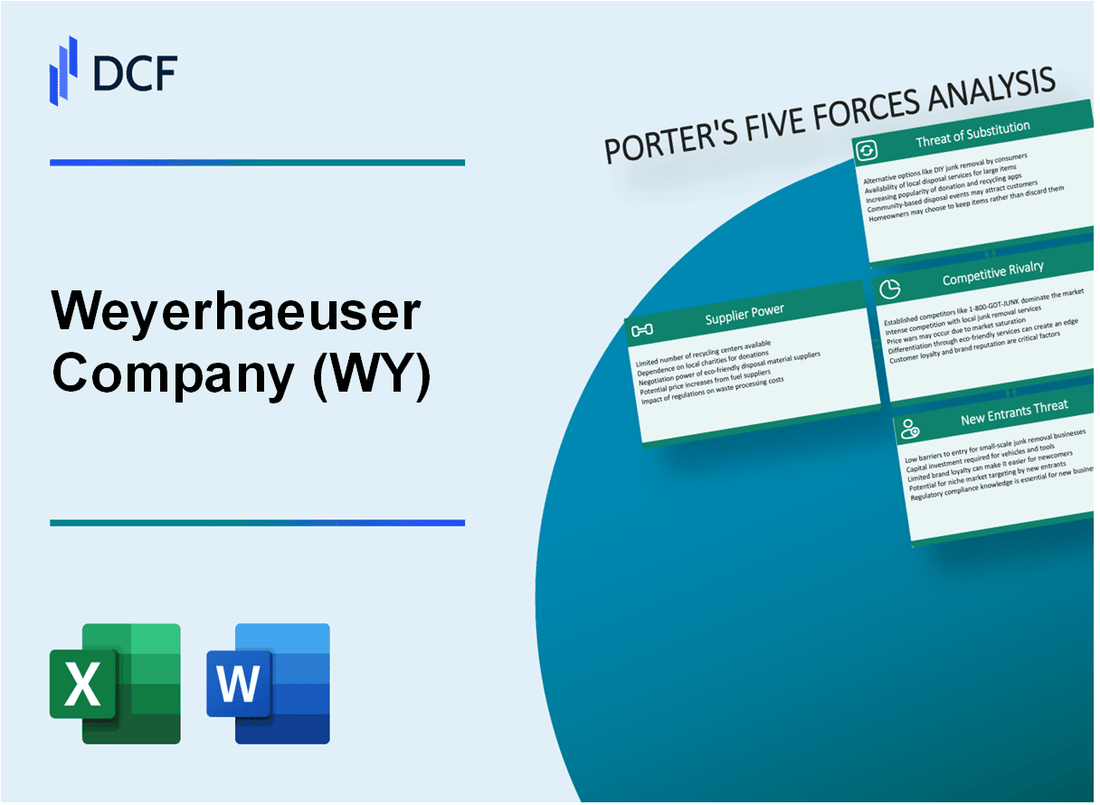
Análisis de 5 Fuerzas de Weyerhaeuser Company (WY) [Actualizado en enero de 2025] |
Completamente Editable: Adáptelo A Sus Necesidades En Excel O Sheets
Diseño Profesional: Plantillas Confiables Y Estándares De La Industria
Predeterminadas Para Un Uso Rápido Y Eficiente
Compatible con MAC / PC, completamente desbloqueado
No Se Necesita Experiencia; Fáciles De Seguir
Weyerhaeuser Company (WY) Bundle
En el mundo dinámico de la madera y los productos forestales, Weyerhaeuser Company (WY) navega por un paisaje complejo de fuerzas competitivas que dan forma a su posicionamiento estratégico. Como jugador líder en la industria forestal, la compañía enfrenta desafíos intrincados de proveedores, clientes, rivales, posibles sustitutos y nuevos participantes del mercado. Comprender estas dinámicas competitivas a través del marco Five Forces de Michael Porter revela el entorno estratégico matizado que impulsa las decisiones operativas de Weyerhaeuser, la resiliencia del mercado y el potencial de crecimiento a largo plazo en un mercado global cada vez más competitivo y ambientalmente consciente.
Weyerhaeuser Company (WY) - Las cinco fuerzas de Porter: poder de negociación de los proveedores
Número limitado de fabricantes especializados de madera y equipos forestales
A partir de 2024, el mercado mundial de equipos forestales está dominado por algunos fabricantes clave:
| Fabricante | Cuota de mercado (%) | Ingresos anuales ($) |
|---|---|---|
| John Deere | 38.5% | $ 47.9 mil millones |
| Oruga | 29.7% | $ 59.4 mil millones |
| Komatsu | 22.3% | $ 33.8 mil millones |
Altos costos de conmutación para maquinaria y tecnología forestales especializadas
Los costos de cambio de equipos forestales especializados son significativos:
- Costo promedio de una cosechadora forestal: $ 500,000 - $ 750,000
- Costo de reemplazo del equipo de reenvío: $ 400,000 - $ 600,000
- Gastos de integración de tecnología forestal especializada: $ 250,000 - $ 350,000
Mercado de suministro concentrado para el equipo de recolección y procesamiento de madera
Métricas de concentración de mercado para proveedores de equipos forestales:
| Métrico | Valor |
|---|---|
| Herfindahl-Hirschman Índice (HHI) | 2,350 |
| Número de principales fabricantes de equipos | 5 |
| Tasa de consolidación del mercado | 12.3% anual |
La integración vertical potencial de Weyerhaeuser reduce el apalancamiento del proveedor
Capacidades de integración vertical de Weyerhaeuser:
- Tierra forestal de propiedad: 11 millones de acres
- Producción anual de madera: 6.4 mil millones de pies de la junta
- Presupuesto de mantenimiento del equipo interno: $ 85 millones
- Inversión de integración vertical: $ 240 millones en 2023
Weyerhaeuser Company (WY) - Las cinco fuerzas de Porter: poder de negociación de los clientes
Composición de la base de clientes
Weyerhaeuser atiende a clientes en múltiples industrias con el siguiente desglose:
| Segmento de la industria | Porcentaje de la base de clientes |
|---|---|
| Construcción de viviendas | 42% |
| Embalaje | 28% |
| Madera industrial | 18% |
| Otros productos de madera | 12% |
Gran poder de negociación de clientes
Los principales clientes incluyen:
- Dr. Horton (construcción de viviendas) - ingresos anuales de $ 8.1 mil millones
- Lennar Corporation - $ 27.1 mil millones de ingresos anuales
- PulteGroup - Ingresos anuales de $ 12.8 mil millones
Dinámica del mercado de productos básicos
Rangos de precios de productos de madera y madera:
| Producto | Rango de precios por mil pies de tablero |
|---|---|
| Madera blanda | $400 - $650 |
| Madera dura | $300 - $550 |
| Tablero de hilos orientado | $250 - $450 |
Estrategias del canal de distribución
Los canales de distribución de Weyerhaeuser incluyen:
- Ventas directas: 55%
- Distribuidores al por mayor: 30%
- Plataformas en línea: 15%
Weyerhaeuser Company (WY) - Las cinco fuerzas de Porter: rivalidad competitiva
Intensa competencia en la industria de la madera y los productos forestales
A partir de 2024, Weyerhaeuser Company opera en un mercado de productos forestales y de madera altamente competitivos con el siguiente panorama competitivo:
| Competidor | Capitalización de mercado | Ingresos anuales |
|---|---|---|
| Rayonier | $ 4.2 mil millones | $ 1.1 mil millones |
| Louisiana-Pacific | $ 6.7 mil millones | $ 4.8 mil millones |
| Papel internacional | $ 16.3 mil millones | $ 20.1 mil millones |
| Weyerhaeuser | $ 20.1 mil millones | $ 9.4 mil millones |
Dinámica de concentración del mercado
Las tendencias de consolidación de la industria revelaron la siguiente estructura del mercado:
- Las 4 empresas principales controlan el 62% de la participación en el mercado de producción de madera
- La actividad de fusión y adquisición redujo importantes actores del mercado en un 17% desde 2020
- Integración horizontal que aumenta entre las compañías de productos forestales
Factores de competencia de precios
| Métrica de precio de madera | Valor 2024 |
|---|---|
| Precio de futuros de madera | $ 456 por mil pies de mesa |
| Índice de volatilidad del mercado global de madera | 34.6% |
| Costo promedio de producción por pie de la mesa | $312 |
Weyerhaeuser Company (WY) - Las cinco fuerzas de Porter: amenaza de sustitutos
Materiales de construcción alternativos
En 2023, el mercado mundial de acero se valoró en $ 1.07 billones. El tamaño del mercado de concreto alcanzó los $ 395.8 mil millones a nivel mundial. Mercado de materiales compuestos proyectado en $ 126.7 mil millones para 2027.
| Material | Valor de mercado 2023 | Potencial de sustitución |
|---|---|---|
| Acero | $ 1.07 billones | Alto |
| Concreto | $ 395.8 mil millones | Medio |
| Compuestos | $ 85.4 mil millones | Bajo |
Sostenibilidad ambiental
Se espera que el mercado de productos de madera sostenible alcance los $ 561.8 mil millones para 2030, creciendo a un 6,2% de CAGR.
Productos de madera de ingeniería
Mercado mundial de madera de ingeniería valorado en $ 93.5 mil millones en 2022, proyectado para llegar a $ 143.6 mil millones para 2030.
| Tipo de producto | Valor de mercado 2022 | 2030 proyección |
|---|---|---|
| Madera laminada cruzada | $ 1.3 mil millones | $ 3.2 mil millones |
| Madera laminada de pegamento | $ 2.1 mil millones | $ 4.7 mil millones |
Ventaja de madera renovable
Ciclo de regeneración de madera: 20-80 años. Sequestration de carbono: 1 metro cúbico de tiendas de madera aproximadamente 1 tonelada de CO2.
- Área forestal administrada por Weyerhaeuser: 11 millones de acres
- Crecimiento anual de la madera: 24.5 millones de metros cúbicos
- Tasa de cosecha sostenible: 85% del crecimiento anual
Weyerhaeuser Company (WY) - Las cinco fuerzas de Porter: amenaza de nuevos participantes
Altos requisitos de capital para la adquisición de tierras de madera y la infraestructura de procesamiento
Weyerhaeuser posee 11 millones de acres de Timberlands en los Estados Unidos a partir de 2023. Los costos iniciales de adquisición de tierras varían de $ 2,500 a $ 5,000 por acre. El procesamiento de la inversión en infraestructura generalmente requiere $ 50- $ 100 millones para una instalación de procesamiento de madera a mediana.
| Categoría de inversión de capital | Rango de costos estimado |
|---|---|
| Adquisición de tierras | $ 27.5 mil millones de valor total de la tierra |
| Equipo de procesamiento | $ 75- $ 150 millones por instalación |
| Mantenimiento anual | Mantenimiento de la infraestructura de $ 500 millones |
Barreras regulatorias significativas en el cumplimiento forestal y ambiental
Los costos de cumplimiento ambiental para las operaciones de madera promedian $ 5- $ 10 millones anuales por empresa. La adquisición de permisos regulatorios requiere aproximadamente 18-24 meses de tiempo de procesamiento.
- Costo de certificación de gestión forestal: $ 250,000 por certificación
- Evaluación de impacto ambiental: $ 500,000 por estudio
- Monitoreo anual de cumplimiento: $ 1.2 millones por empresa
Economías de escala establecidas
Los ingresos de 2023 de Weyerhaeuser fueron de $ 9.7 mil millones. Las grandes compañías madereras producen el 75% de la producción total de madera, creando barreras significativas para los nuevos participantes del mercado.
| Métrica de concentración del mercado | Porcentaje |
|---|---|
| Cuota de mercado de las 4 empresas principales | 62% |
| Ventaja de volumen de producción | 75% |
Experiencia tecnológica y habilidades de gestión de tierras a largo plazo
La inversión avanzada de tecnología forestal varía de $ 10 a $ 25 millones anuales. Las tecnologías forestales de monitoreo satelital y precisión requieren experiencia especializada.
- Costo de tecnología de mapeo GIS: $ 5 millones
- Sistemas de monitoreo satelital: $ 3.2 millones
- Gestión forestal de aprendizaje automático: $ 7.5 millones
Weyerhaeuser Company (WY) - Porter's Five Forces: Competitive rivalry
You're analyzing the competitive landscape for Weyerhaeuser Company (WY) right now, and the rivalry in the wood products space is definitely intense, even as policy shifts offer some breathing room. The core business of manufacturing wood products faces direct, head-to-head competition from established North American giants. This rivalry is a major factor in the recent financial results you're seeing.
The market softness in late 2025 really hammered the segment profitability. For instance, Weyerhaeuser Company's Wood Products Adjusted EBITDA plummeted to just $8 million in Q3 2025. That's a massive drop from the $101 million reported in the second quarter of 2025, showing just how quickly pricing power can evaporate when demand softens. To be fair, the Lumber business within that segment was posting an adjusted EBITDA loss of -$48 million on its own for the quarter.
When you map out the key players, you see a field of well-capitalized companies, making market share gains a hard-fought battle. Weyerhaeuser Company competes directly with firms like West Fraser Timber Co Ltd and PotlatchDeltic. Here's a quick comparison of some of these major North American players based on recent public figures, though remember that 2025 operational data will vary widely:
| Company | Headquarters Location | Reported Revenue (Select Year) | Approximate Employees |
| Weyerhaeuser Company (WY) | United States | $1.7 billion (Q3 2025 Net Sales) | N/A |
| West Fraser Timber Co Ltd | Canada | $6.2 billion (Select Year Data) | 9,689 |
| Boise Cascade Co (BCC) | United States | $6.7 billion (Select Year Data) | 7,640 |
| Canfor Corp | Canada | $3.8 billion (Select Year Data) | 6,634 |
Still, government action is creating a distinct competitive wedge. The implementation of new U.S. tariffs on Canadian lumber imports is a significant factor favoring domestic producers. Weyerhaeuser Company, with approximately 80% of its lumber milling capacity located in the U.S., is positioned to benefit directly from this policy shift. A recent 10% tariff on wood imports, effective mid-October 2025, adds cost pressure on rivals while potentially boosting domestic pricing for Weyerhaeuser. This policy dynamic helps insulate Weyerhaeuser's domestic operations from the low-cost import pressure that often compresses margins during downturns.
Also, the competition isn't just about cutting and selling boards; it's increasingly about the highest and best use of the land itself. Weyerhaeuser Company is actively competing for land value against other uses, particularly in the burgeoning natural climate solutions sector. The company set an aggressive goal back in 2021 to generate $100 million of Adjusted EBITDA from its Natural Climate Solutions business by the end of 2025. This shows how seriously they view this non-timber revenue stream as a competitive differentiator against peers who might be slower to monetize their acreage for carbon sequestration.
Here are a few data points illustrating the scale of this emerging competition for land value:
- Weyerhaeuser Company's Real Estate, Energy & Natural Resources segment posted an Adjusted EBITDA of $91 million in Q3 2025.
- In a prior transaction, Weyerhaeuser sold 32,000 carbon credits at $29 per credit from its Maine project.
- The competition includes family forest owners and specialized startups entering the carbon market.
- The company's strategy involves extending harvest rotations on its vast land base to store more carbon.
The pressure from rivals like West Fraser and PotlatchDeltic on commodity pricing is real, but the tariff environment and the race for carbon credit revenue are reshaping the competitive dynamics for Weyerhaeuser Company heading into 2026.
Finance: draft the Q4 2025 Adjusted EBITDA forecast sensitivity analysis by next Tuesday.
Weyerhaeuser Company (WY) - Porter's Five Forces: Threat of substitutes
When you look at Weyerhaeuser Company's position, the threat of substitutes-materials that can do the same job as wood-is definitely present, but it's a complex picture of trade-offs between initial cost and long-term value. Honestly, for many standard residential builds, traditional materials like steel and concrete still pose a moderate threat, primarily on a sticker-price basis.
Here's the quick math on initial framing costs in a major U.S. metro area as of late 2025. While wood framing is often the more budget-friendly choice upfront, the gap is narrowing, and steel offers durability advantages that offset its higher initial outlay. What this estimate hides is the long-term maintenance cost difference, which favors steel or engineered wood.
| Material Type | Cost Range (Per Square Foot) | Key Cost Driver/Note |
|---|---|---|
| Traditional Wood Framing (Total) | $13 to $19 | Most cost-effective for many residential projects. |
| Panelized Cold-Formed Steel (Total) | $16 to $21 | Higher initial material cost, but less on-site labor. |
| Base Model Steel Buildings | $11 to $20 | Price dependent on current steel prices and customization. |
The threat from these traditional materials is, however, being actively mitigated by the industry's own evolution: mass timber. Mass timber, which includes products like Cross-Laminated Timber (CLT), is gaining serious traction as a sustainable, low-carbon alternative. This shift isn't just about being green; it's about meeting new regulatory demands and achieving better lifecycle performance.
The market data shows this is a high-growth area, which is a direct opportunity for Weyerhaeuser Company:
- US Mass Timber Market is projected to grow from $1.6 billion in 2025 to $4.7 billion by 2031.
- The projected Compound Annual Growth Rate (CAGR) for the US Mass Timber Market is 19.4% through 2031.
- North America's mass timber industry is expanding at an estimated annual growth rate of 15.5% by 2032.
- The CLT segment alone is expected to reach over $1.1 billion by 2030.
- Residential construction accounted for over 50% of the total mass timber market share in 2024.
Weyerhaeuser is definitely positioning itself to capture this demand. You see this clearly in their capital deployment strategy. For instance, Weyerhaeuser Company broke ground in June 2025 on a new TimberStrand® facility in South Arkansas, an investment of an estimated $500 million, with operations planned to start in late 2027. This move is strategic because the new plant is expected to add approximately 10 million cubic feet of annual production capacity and doubles Weyerhaeuser's North American TimberStrand® capacity. Devin W. Stockfish, Weyerhaeuser's CEO, noted this plant will better serve end markets, including mass timber applications. At full capacity, this facility is projected to generate over $100 million of annual Adjusted EBITDA.
On the other side of the demand equation, the persistent repair and remodel sector acts as a strong tailwind, boosting overall wood product demand and somewhat mitigating the substitution threat in the residential space. Homeowners are still investing in their properties, even if the pace has moderated from the pandemic highs. The total home improvement market size is projected to reach $593.8 billion in 2025.
Here are the key figures supporting that persistent demand:
- Annual expenditures for home renovation and repair are projected to grow by 1.2% through the third quarter of 2025.
- Homeowner spending is expected to increase by $9 billion between the last quarter of 2024 and the end of 2025.
- Spending on home improvements and repairs has surged by 82% from 2015 to 2024.
- The overall market size projection for 2025 was revised up by $30 billion, or 6.4%, to $509 billion based on new benchmark data.
If onboarding takes 14+ days, churn risk rises, but in this case, steady spending in the remodel sector helps stabilize Weyerhaeuser's baseline volume.
Weyerhaeuser Company (WY) - Porter's Five Forces: Threat of new entrants
The threat of new entrants for Weyerhaeuser Company (WY) remains decidedly low, primarily because the barrier to entry is erected by massive capital requirements for acquiring a comparable timberland base.
Consider the sheer scale of Weyerhaeuser Company (WY)'s existing asset base. The company owns or controls approximately 10.4 million acres of timberlands in the U.S. alone. To even begin to compete, a new entrant would need to secure a similar land base, which requires immense upfront capital. For context, in the third quarter of 2025, Weyerhaeuser Company (WY) executed two timberland acquisitions totaling $459 million. One of these deals involved 117,000 acres in North Carolina and Virginia for $364 million. These high-quality lands were acquired at a combined timber-only Adjusted EBITDA multiple of 21x. The cost of acquiring a competitive, immediately productive asset base is prohibitive for most potential competitors.
Furthermore, any serious new entrant must contend with the complex web of regulations governing sustainable forest management and certification. While some recent federal actions in 2025 have aimed to streamline timber project approvals by modifying reviews under the Endangered Species Act (ESA) and the National Environmental Policy Act (NEPA), the industry standard, which Weyerhaeuser Company (WY) adheres to, requires compliance with internationally recognized sustainable forestry standards. New entrants must establish this compliance infrastructure from scratch, a process that demands significant time and capital investment to meet the expected high bar for responsible sourcing.
New players also cannot easily replicate the operational efficiencies derived from Weyerhaeuser Company (WY)'s existing scale and vertical integration. The company leverages its owned timber to feed its manufacturing base, creating internal cost advantages. For example, the new Engineered Wood Products (EWP) facility in Monticello, Arkansas, is designed so that approximately 80% of its raw material sourcing will come from Weyerhaeuser Company (WY)'s own fee timberlands in the region. This integration allows the conversion of lower-quality logs and by-products into higher-value EWP, a process expected to generate over $100 million of annual Adjusted EBITDA. A new entrant would face the high cost of building both a raw material base and a corresponding, fully integrated manufacturing and distribution network.
Finally, the inherent cyclical volatility and the potential for severe margin compression in the wood products sector actively deter new investment. The market punishes underperformance severely, which acts as a strong deterrent to capital looking for stable returns. In the third quarter of 2025, Weyerhaeuser Company (WY)'s Wood Products segment posted an Adjusted EBITDA of only $8 million, a steep decline of $93 million sequentially. The Lumber business alone recorded an adjusted EBITDA loss of $48 million in that same quarter due to historically low prices. Looking ahead, analyst consensus for the fourth quarter of 2025 projected an Earnings Per Share (EPS) loss of $0.05. This demonstrated cyclical risk, where margins can turn negative rapidly, makes the industry unattractive for capital that is not already deeply entrenched.
| Metric | Weyerhaeuser Company (WY) Data Point (Late 2025) | Relevance to New Entrants |
|---|---|---|
| U.S. Timberland Acres Owned/Controlled | 10.4 million acres | Establishes the massive scale required to compete in raw material supply. |
| Q3 2025 Timberland Acquisition Spend | $459 million total for two deals | Demonstrates the high capital outlay needed for portfolio growth. |
| Q3 2025 Lumber Adjusted EBITDA | $48 million loss | Highlights severe cyclical downside risk that deters new, unproven capital. |
| Q3 2025 Wood Products Adjusted EBITDA | $8 million (down $93 million sequentially) | Shows rapid erosion of profitability under market stress. |
| New EWP Facility Raw Material Sourcing (Internal) | Approximately 80% from WY fee timberlands | Quantifies the vertical integration advantage in raw material cost control. |
| Expected Annual Adjusted EBITDA from New EWP Facility | $100+ million | Shows the high return on integrated capital investment that new entrants lack. |
The barriers to entry are substantial, resting on the foundation of existing asset size and operational integration.
- Acquisition cost for 117,000 acres was $364 million.
- Divestitures expected to yield $410 million in proceeds by year-end 2025.
- Acquisitions occurred at a 21x timber-only Adjusted EBITDA multiple.
- Analyst consensus for Q4 2025 EPS is a loss of $0.05.
- Weyerhaeuser Company (WY) has maintained dividend payments for 55 consecutive years.
Disclaimer
All information, articles, and product details provided on this website are for general informational and educational purposes only. We do not claim any ownership over, nor do we intend to infringe upon, any trademarks, copyrights, logos, brand names, or other intellectual property mentioned or depicted on this site. Such intellectual property remains the property of its respective owners, and any references here are made solely for identification or informational purposes, without implying any affiliation, endorsement, or partnership.
We make no representations or warranties, express or implied, regarding the accuracy, completeness, or suitability of any content or products presented. Nothing on this website should be construed as legal, tax, investment, financial, medical, or other professional advice. In addition, no part of this site—including articles or product references—constitutes a solicitation, recommendation, endorsement, advertisement, or offer to buy or sell any securities, franchises, or other financial instruments, particularly in jurisdictions where such activity would be unlawful.
All content is of a general nature and may not address the specific circumstances of any individual or entity. It is not a substitute for professional advice or services. Any actions you take based on the information provided here are strictly at your own risk. You accept full responsibility for any decisions or outcomes arising from your use of this website and agree to release us from any liability in connection with your use of, or reliance upon, the content or products found herein.