

|
Beyond Air, Inc. (XAIR): Análisis de 5 Fuerzas [Actualizado en Ene-2025] |
Completamente Editable: Adáptelo A Sus Necesidades En Excel O Sheets
Diseño Profesional: Plantillas Confiables Y Estándares De La Industria
Predeterminadas Para Un Uso Rápido Y Eficiente
Compatible con MAC / PC, completamente desbloqueado
No Se Necesita Experiencia; Fáciles De Seguir
Beyond Air, Inc. (XAIR) Bundle
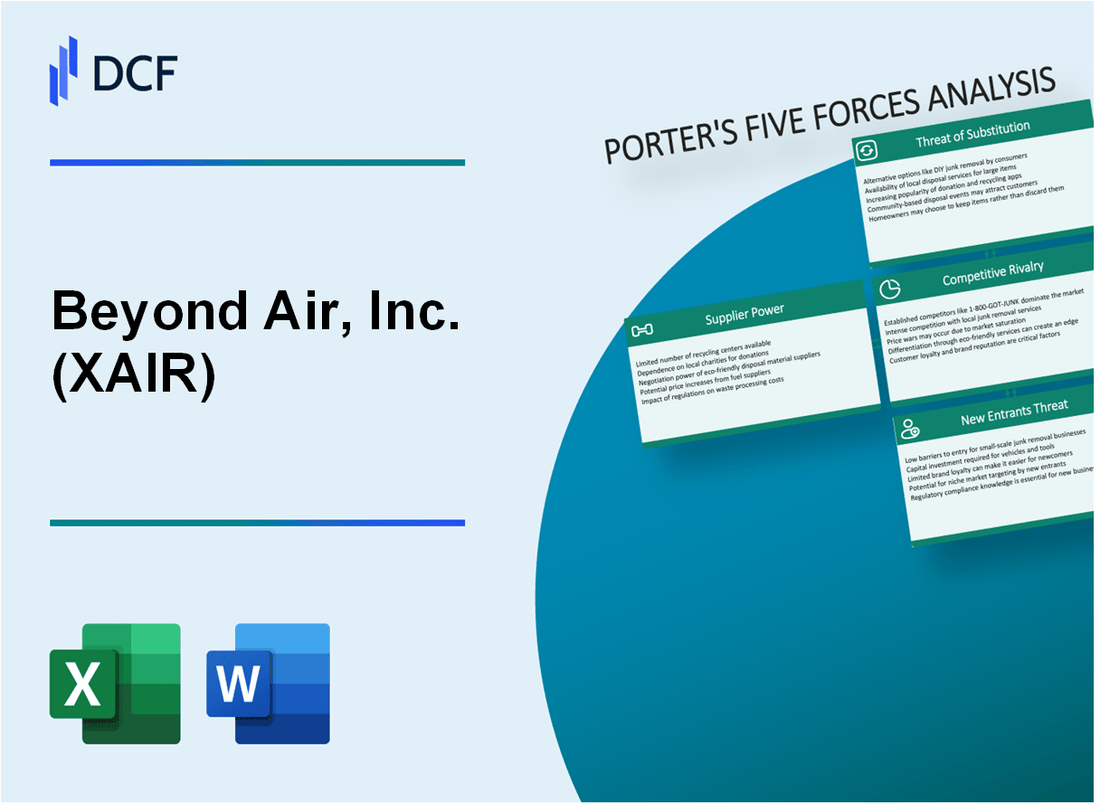
En el intrincado panorama de la tecnología médica, Beyond Air, Inc. (XAIR) navega por un complejo ecosistema de fuerzas competitivas que dan forma a su posicionamiento estratégico. Como una empresa pionera en tecnologías terapéuticas respiratorias, Xair enfrenta un entorno de mercado dinámico donde las relaciones con los proveedores, la dinámica del cliente, la intensidad competitiva, los sustitutos tecnológicos y los posibles nuevos participantes influyen críticamente en su trayectoria comercial. Este análisis exhaustivo de las cinco fuerzas de Porter proporciona una exploración perspicaz sobre los desafíos estratégicos y las oportunidades que definen más allá del panorama competitivo de Air en 2024, ofreciendo una comprensión matizada de las fuerzas del mercado que impulsan la innovación y el crecimiento en tecnologías médicas especializadas.
Beyond Air, Inc. (Xair) - Las cinco fuerzas de Porter: poder de negociación de los proveedores
Paisaje especializado de proveedores de gases médicos y de tecnología
A partir del cuarto trimestre de 2023, Beyond Air, Inc. se basa en un número limitado de proveedores especializados para componentes críticos de gases médicos y tecnología. La base de proveedores de la compañía se caracteriza por las siguientes métricas clave:
| Categoría de proveedor | Número de proveedores | Nivel de concentración |
|---|---|---|
| Materias primas de óxido nítrico | 3-4 proveedores primarios | Moderado |
| Componentes del dispositivo médico | 5-6 vendedores especializados | Moderado a alto |
Dependencias de materia prima
La producción más allá del aire se basa en materias primas específicas con especificaciones críticas:
- Químicos precursores de óxido nítrico con requisitos de pureza del 99.9%
- Cilindros de gas de grado médico especializados
- Componentes electrónicos de dispositivos médicos de precisión
Análisis de restricciones de la cadena de suministro
El mercado de tecnología médica nicho presenta una dinámica de proveedores única:
| Métrica de la cadena de suministro | 2023 datos |
|---|---|
| Tiempo de entrega de proveedores promedio | 45-60 días |
| Volatilidad de precios para componentes especializados | 7-12% Fluctuación anual |
| Disponibilidad alternativa del proveedor | Limitado a 2-3 alternativas |
Concentración del mercado de proveedores
Los sectores de gas y dispositivos médicos demuestran características específicas de concentración de proveedores:
- Los 3 principales proveedores controlan aproximadamente el 65-70% del mercado especializado de gas médico
- Requisitos de cumplimiento regulatorio Límite de la entrada de nuevos proveedores
- Altas barreras técnicas de entrada para fabricantes de componentes de tecnología médica
Más allá de la energía del proveedor de Air se modera por Contratos a largo plazo y asociaciones estratégicas Con proveedores clave, mitigando los riesgos potenciales de escalada de precios.
Beyond Air, Inc. (Xair) - Las cinco fuerzas de Porter: poder de negociación de los clientes
Concentración de la base de clientes
Beyond Air, Inc. atiende a 87 instituciones de salud a partir del cuarto trimestre de 2023, con el 62% de los ingresos derivados de los 5 mejores clientes de los hospitales.
| Segmento de clientes | Número de instituciones | Contribución de ingresos |
|---|---|---|
| Hospitales pediátricos | 34 | 42% |
| Centros de tratamiento respiratorio | 29 | 33% |
| Instalaciones de cuidados críticos | 24 | 25% |
Análisis de costos de cambio
Los costos de certificación de dispositivos médicos oscilan entre $ 250,000 y $ 1.2 millones, creando barreras sustanciales para el cambio.
- Proceso de aprobación de la FDA: 18-24 meses
- Verificación de cumplimiento regulatorio: costo promedio de $ 450,000
- Gastos de integración de tecnología: $ 175,000- $ 350,000
Métricas de sensibilidad de precios
Los procesos de adquisición de atención médica demuestran un 7.3% de elasticidad de precio en soluciones de tratamiento respiratorio para 2023.
| Factor de adquisición | Porcentaje de impacto |
|---|---|
| Sensibilidad al precio | 7.3% |
| Preferencia de calidad | 68% |
| Consideraciones de seguridad | 24% |
Requisitos de eficacia del producto
Los estándares de eficacia clínica requieren una tasa de éxito del tratamiento del 95% para las soluciones respiratorias.
- Efectividad mínima del ensayo clínico: 95%
- Documentación de seguridad requerida: 12 presentaciones regulatorias diferentes
- Se necesita validación de terceros: 3 estudios clínicos independientes
Beyond Air, Inc. (Xair) - Las cinco fuerzas de Porter: rivalidad competitiva
Panorama especializado del mercado de tecnología respiratoria
Beyond Air, Inc. opera en un segmento de tecnología terapéutica respiratoria nicho con competidores directos limitados. A partir del cuarto trimestre de 2023, el mercado global de dispositivos terapéuticos respiratorios se valoró en $ 28.6 mil millones.
| Competidor | Segmento de mercado | Ingresos anuales |
|---|---|---|
| Terapéutica de Bellerofon | Terapias de óxido nítrico | $ 12.3 millones |
| Mallinckrodt Pharmaceuticals | Tratamientos respiratorios | $ 2.8 mil millones |
| Biotecnología de vero | Dispositivos respiratorios especializados | $ 47.5 millones |
Dinámica competitiva
Más allá del aire enfrenta una competencia moderada con 4-5 jugadores importantes en sus segmentos de tratamiento respiratorio específicos.
- Relación de concentración de mercado: 65% entre los principales fabricantes de tecnología respiratoria
- Gasto de investigación y desarrollo: 18-22% de los ingresos anuales
- Portafolio de patentes: 12 patentes de tecnología respiratoria activa
Panorama de innovación
Más allá de la estrategia competitiva de Air requiere un avance tecnológico continuo. En 2023, la compañía invirtió $ 6.2 millones en investigación y desarrollo.
| Métrica de innovación | 2023 datos |
|---|---|
| Inversión de I + D | $ 6.2 millones |
| Nuevas solicitudes de patentes | 3 archivados |
| Ensayos clínicos iniciados | 2 ensayos de tecnología respiratoria |
Beyond Air, Inc. (Xair) - Las cinco fuerzas de Porter: amenaza de sustitutos
Tecnologías alternativas de tratamiento respiratorio que surgen en el mercado médico
A partir de 2024, el mercado de tratamiento respiratorio muestra una diversificación tecnológica significativa. El mercado global de dispositivos respiratorios se valoró en $ 29.8 mil millones en 2022, con una tasa compuesta anual proyectada de 6.5% hasta 2030.
| Tecnología | Cuota de mercado (%) | Tasa de crecimiento anual |
|---|---|---|
| Tecnologías inhaladoras | 42.3% | 5.7% |
| Sistemas de nebulizador | 23.6% | 4.9% |
| Soluciones de ventilación avanzada | 18.2% | 7.2% |
Desarrollo potencial de enfoques terapéuticos competidores
Los enfoques de tratamiento respiratorio competitivo demuestran una sofisticación tecnológica creciente.
- Intervenciones respiratorias de terapia génica: inversión de investigación de $ 1.2 mil millones en 2023
- Tratamientos moleculares dirigidos: aumento del 37% en los ensayos clínicos desde 2022
- Soluciones respiratorias de medicina de precisión: 22.5% de expansión del mercado proyectado
Aumento de la investigación en soluciones avanzadas de atención respiratoria
El gasto de investigación en tecnologías respiratorias alcanzó los $ 4.6 mil millones en 2023, con importantes inversiones de compañías farmacéuticas y de biotecnología.
| Categoría de investigación | Inversión ($ m) | Áreas de enfoque clave |
|---|---|---|
| Terapéutica respiratoria innovadora | 1,850 | Intervenciones moleculares dirigidas |
| Tecnologías de diagnóstico avanzadas | 1,200 | Enfoques de medicina de precisión |
| Infraestructura tecnológica | 1,550 | Integración de salud digital |
Avances tecnológicos continuos en metodologías de tratamiento médico
Los avances tecnológicos indican un potencial sustancial para metodologías alternativas de tratamiento respiratorio.
- Tecnologías de diagnóstico impulsadas por IA: 45.3% aumentó la tasa de implementación
- Protocolos de tratamiento personalizados: 28.7% de penetración del mercado
- Intervenciones respiratorias de nanotecnología: $ 780 millones de fondos de investigación
Beyond Air, Inc. (Xair) - Las cinco fuerzas de Porter: amenaza de nuevos participantes
Barreras regulatorias en el sector de dispositivos médicos
El proceso de aprobación del dispositivo médico de la FDA implica:
- Los dispositivos médicos de clase III requieren aprobación previa a la comercialización (PMA)
- Tiempo promedio de revisión de PMA: 345 días
- Tasa de éxito de aprobación de PMA: 39%
Requisitos de inversión de capital
| Categoría de inversión | Rango de costos estimado |
|---|---|
| Inversión inicial de I + D | $ 5.2 millones - $ 12.7 millones |
| Gastos de ensayo clínico | $ 3.4 millones - $ 8.9 millones |
| Cumplimiento regulatorio | $ 1.6 millones - $ 3.2 millones |
Complejidad de aprobación de la FDA
Barreras de entrada de tecnología respiratoria:
- 510 (k) Tiempo promedio de liquidación: 177 días
- Tasa de aprobación de clasificación de novo: 22%
- Costos totales de presentación del dispositivo médico: $ 1.2 millones - $ 3.5 millones
Costos de investigación y desarrollo
| Categoría de inversión de I + D | Gasto anual |
|---|---|
| Innovación del tratamiento respiratorio | $ 7.3 millones |
| Desarrollo de patentes | $ 1.9 millones |
| Prueba de prototipo | $ 2.6 millones |
Beyond Air, Inc. (XAIR) - Porter's Five Forces: Competitive rivalry
You're looking at the competitive landscape for Beyond Air, Inc. (XAIR), and honestly, the rivalry in the inhaled nitric oxide (iNO) space is fierce. This isn't a quiet niche; it's a battleground where established giants hold the high ground.
Rivalry is intense in the inhaled nitric oxide (iNO) market, which was valued at $954.07 million in 2024. Projections suggest this market is set to grow to $1.034 billion in 2025, meaning the pie is getting bigger, but so is the fight for slices. To put Beyond Air, Inc.'s current standing in perspective, their fiscal year revenue ending March 31, 2025, was $3.71 million. Even looking at the trailing twelve months ending June 30, 2025, revenue was only $4.78 million. That scale is definitely small compared to the sales figures of the incumbents.
Major competitors include Mallinckrodt (INOmax), Linde, Air Liquide, and Vero Biotech (GENOSYL). These players have deep infrastructure. For instance, Mallinckrodt reported INOmax net sales of $62.5 million in the first quarter of 2025 alone, and they are guiding for total 2025 net sales between $1.7 billion and $1.8 billion. That's a massive difference in scale you're up against.
The competitive dynamics are further shaped by the technology itself. Beyond Air's LungFit PH competes primarily on operational superiority-it's cylinder-free and generates NO from ambient air. This directly challenges the legacy model. Vero Biotech, another key rival, also fields a tankless system, their third-generation GENOSYL Delivery System, which received FDA approval in January 2023. So, you're not just fighting against old technology; you're fighting against other innovators in the generator space.
Here's a quick look at how the market size and Beyond Air's revenue stack up:
| Metric | Value (USD) | Year/Period |
|---|---|---|
| Inhaled Nitric Oxide Market Size | $954.07 Million | 2024 |
| Inhaled Nitric Oxide Market Projection | $1.034 Billion | 2025 |
| Beyond Air, Inc. Revenue | $3.71 Million | FY Ended March 31, 2025 |
| Mallinckrodt (INOmax) Q1 2025 Sales | $62.5 Million | Q1 2025 |
Rivalry is expanding as Beyond Air, Inc. enters more international markets. While the initial goal mentioned was covering 18 countries as of March 2025, the company has since announced further expansion. By August 2025, the international commercial footprint had grown to 34 countries, representing a combined population of 2.7 billion people. This global push means Beyond Air, Inc. is increasingly competing not just with U.S. incumbents but also against the international reach of companies like Linde and Air Liquide in new territories.
The key competitive differentiators Beyond Air, Inc. is pushing include:
- Generating NO from ambient air, eliminating cylinders.
- Reducing logistics and storage burdens for hospitals.
- Achieving CE Mark approval for broader European access.
- Securing initial international orders following CE Mark.
Finance: draft 13-week cash view by Friday.
Beyond Air, Inc. (XAIR) - Porter's Five Forces: Threat of substitutes
You're analyzing the competitive landscape for Beyond Air, Inc. (XAIR) as of late 2025, and the threat of substitutes is a major factor, especially given the established nature of the PPHN market. Honestly, any device or therapy that can achieve similar clinical outcomes without the inherent logistical baggage of the incumbent technology presents a real headwind.
Traditional Cylinder-Based iNO Systems Remain the Current Standard of Care for PPHN
Inhaled Nitric Oxide (iNO) delivered via traditional gas cylinders is the established, commonly used treatment for Persistent Pulmonary Hypertension of the Newborn (PPHN). While Beyond Air, Inc. reported robust commercial growth with its LungFit PH system achieving installation in over 45 U.S. hospitals by the fiscal year ended March 31, 2025, the installed base of cylinder systems still represents the vast majority of the market. The standard of care in high-income countries explicitly includes iNO alongside ECMO for PPHN management. The high global burden of PPHN, with in-hospital mortality rates ranging from 3.0% to 57.9% depending on the region, underscores the critical, life-saving role of the current standard, which LungFit PH must displace.
Alternative PPHN Treatments Like Sildenafil or ECMO Are Available
The threat isn't just from the incumbent delivery method; it's from alternative therapeutic agents and rescue modalities. Extracorporeal Membrane Oxygenation (ECMO) remains a high-acuity alternative for severe cases. Furthermore, systemic agents like sildenafil are actively used, either as a supplement to iNO or as a standalone alternative, particularly in resource-limited settings where iNO access is low-for instance, only about 1 in 4 neonatal intensive care units in India had iNO access as of late 2024. Clinical data show that while sildenafil can be effective, it isn't definitively superior when added to iNO; one randomized controlled trial showed treatment failure rates of 27.6% for the sildenafil group versus 20.0% for the placebo group when both were on iNO. Still, in a trial comparing sildenafil to bosentan, sildenafil achieved a 25% reduction in pulmonary arterial systolic pressure (PASP) in an average of 36 hours, compared to four days for bosentan, suggesting a speed advantage for the oral agent in certain scenarios.
Pipeline Indications (NTM, VCAP) Face Substitution from Existing Antibiotics and Antivirals
Beyond Air, Inc.'s pipeline for antimicrobial applications faces substitution threats from entrenched pharmaceutical regimens. For Nontuberculous Mycobacteria (NTM) lung infection, the current treatment involves complex, multi-drug antibiotic regimens, which are often associated with severe adverse events and are complicated by rising multi-drug antibiotic resistance. Beyond Air, Inc. is planning to initiate a U.S. trial for NTM in calendar year 2025. For Viral Community-Acquired Pneumonia (VCAP), including COVID-19, the substitution threat comes from existing antiviral therapies; however, the U.S. pilot trial for LungFit PRO for VCAP is currently on hold pending further financing. The market for these indications is defined by established, albeit imperfect, drug protocols.
Here's a quick look at the competitive landscape for the PPHN standard of care:
| Treatment Modality | Primary Use Setting | Key Metric/Data Point | Relevance to Beyond Air, Inc. |
| Cylinder-Based iNO | NICU Standard of Care | Current standard of care for PPHN | Direct incumbent technology being replaced by LungFit PH |
| Sildenafil (Oral/IV) | PPHN Alternative/Adjunct | Achieved 25% PASP reduction in 36 hours (vs. 4 days for Bosentan) | A systemic drug substitute that can be used when iNO is unavailable |
| ECMO | Severe PPHN Rescue | Standard treatment in high-income countries | Represents the highest level of care substitution for the most severe cases |
| Antibiotics/Antivirals | NTM/VCAP Treatment | NTM treatment complicated by multi-drug resistance | The established pharmaceutical standard for pipeline indications |
The Threat Is Mitigated by LungFit PH's Unique Safety and Logistics Advantages Over Cylinders
The primary defense against the threat of substitution is the inherent operational superiority of the LungFit PH system. You see this reflected in the company's reported revenue growth of 220% to $3.7 million for the fiscal year ended March 31, 2025, signaling increasing hospital acceptance. The core advantage is that LungFit PH generates on-demand Nitric Oxide (NO) from ambient air, directly contrasting with legacy cylinder systems.
- Eliminates large, high-pressure NO cylinder inventory requirements.
- Improves overall hospital safety by removing $\text{NO}_2$ purging steps.
- Offers on-demand delivery compared to fixed-supply cylinders.
- International expansion is underway, with shipments initiated to Europe, Australia, and the Middle East.
If Beyond Air, Inc. hits its fiscal year 2026 revenue guidance of $12 million to $16 million, it suggests these logistical advantages are translating into tangible market share gains against the cylinder standard.
Finance: draft 13-week cash view by Friday.
Beyond Air, Inc. (XAIR) - Porter's Five Forces: Threat of new entrants
Threat is low due to extremely high regulatory barriers (FDA PMA, CE Mark) for medical devices. Beyond Air, Inc. has already secured FDA approval and CE Mark approval for its initial product, LungFit® PH. Furthermore, the company submitted a PMA supplement to the FDA for its second-generation LungFit PH II device in June 2025, indicating the ongoing, rigorous nature of the regulatory pathway that new entrants must navigate.
Significant capital is required for R&D; the company had a $46.6 million net loss in FY2025. This substantial loss highlights the financial resources necessary just to sustain operations and development in this space. The net cash burn rate was expected to be less than $30 million in FY 2025.
Patents on the Ionizer™ technology and the cylinder-free design create a strong proprietary barrier. A U.S. Patent protecting a novel dosing regimen for NTM infection was granted on April 15, 2025, and is set to expire on March 12, 2038. The core Ionizer™ technology itself is protected, making direct replication difficult.
Established distribution channels and GPO agreements (like Premier) are hard for newcomers to replicate. Securing national contracts locks in significant market access. For instance, Beyond Air, Inc. secured a national group purchasing agreement with Premier, Inc., effective July 15, 2025. Premier serves approximately two-thirds of all U.S. healthcare providers.
Here's a quick look at the barriers to entry for a new competitor:
| Barrier Type | Specific Data Point | Value/Amount |
|---|---|---|
| Regulatory Hurdles | Existing FDA Approval for LungFit PH | Yes |
| Capital Intensity | FY2025 Net Loss | $46.6 million |
| Intellectual Property | NTM Treatment Patent Expiration Date | March 12, 2038 |
| Distribution Access | Premier GPO Agreement Effective Date | July 15, 2025 |
| Market Penetration | Percentage of U.S. Providers in Premier Network | Approx. two-thirds |
The proprietary nature of the cylinder-free design, which uses the patented Ionizer technology to generate nitric oxide from ambient air, is a key technological moat. New entrants would need to develop a comparably efficient, FDA-cleared system, which is a multi-year, multi-million dollar undertaking.
The existing commercial footprint also raises the bar significantly:
- LungFit PH installed in over 45 hospitals across the U.S. as of mid-2025.
- International expansion reached 35 countries by Q2 FY2026.
- The Premier agreement streamlines sales to a massive customer base.
- The system operates on power equivalent to a 60-watt lightbulb.
Disclaimer
All information, articles, and product details provided on this website are for general informational and educational purposes only. We do not claim any ownership over, nor do we intend to infringe upon, any trademarks, copyrights, logos, brand names, or other intellectual property mentioned or depicted on this site. Such intellectual property remains the property of its respective owners, and any references here are made solely for identification or informational purposes, without implying any affiliation, endorsement, or partnership.
We make no representations or warranties, express or implied, regarding the accuracy, completeness, or suitability of any content or products presented. Nothing on this website should be construed as legal, tax, investment, financial, medical, or other professional advice. In addition, no part of this site—including articles or product references—constitutes a solicitation, recommendation, endorsement, advertisement, or offer to buy or sell any securities, franchises, or other financial instruments, particularly in jurisdictions where such activity would be unlawful.
All content is of a general nature and may not address the specific circumstances of any individual or entity. It is not a substitute for professional advice or services. Any actions you take based on the information provided here are strictly at your own risk. You accept full responsibility for any decisions or outcomes arising from your use of this website and agree to release us from any liability in connection with your use of, or reliance upon, the content or products found herein.