
|
Exxon Mobil Corporation (XOM): Análisis de la Matriz ANSOFF [Actualizado en Ene-2025] |
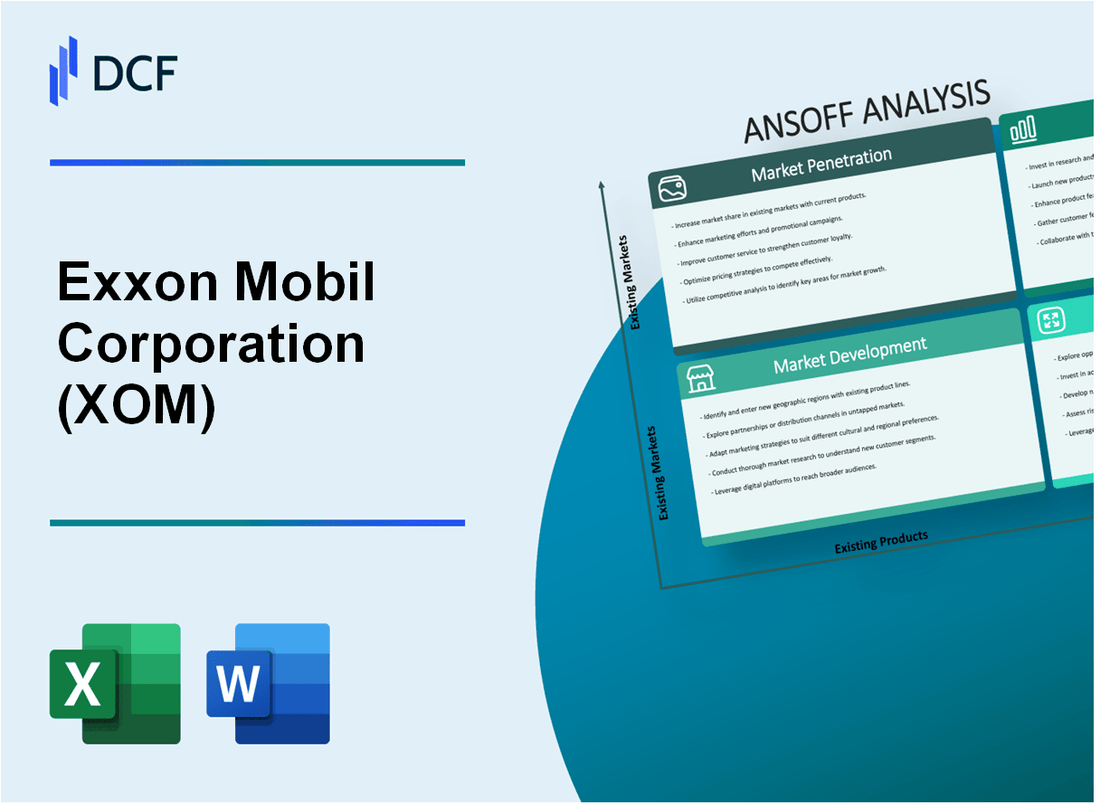
Completamente Editable: Adáptelo A Sus Necesidades En Excel O Sheets
Diseño Profesional: Plantillas Confiables Y Estándares De La Industria
Predeterminadas Para Un Uso Rápido Y Eficiente
Compatible con MAC / PC, completamente desbloqueado
No Se Necesita Experiencia; Fáciles De Seguir
Exxon Mobil Corporation (XOM) Bundle
En el panorama energético en rápida evolución, Exxon Mobil Corporation se encuentra en una encrucijada crítica, reinventando estratégicamente su futuro a través de una matriz Ansoff integral que indica una transformación audaz de la dominancia tradicional de combustibles fósiles a una potencia energética multifacética y sostenible. Al seguir simultáneamente la penetración del mercado, el desarrollo del mercado, la innovación de productos y la diversificación estratégica, Exxon no se adapta simplemente a las transiciones de energía global, sino que se posiciona como una fuerza pionera en el ecosistema de energía limpia emergente. Este enfoque dinámico revela una hoja de ruta sofisticada que podría redefinir la trayectoria de la compañía, desafiando las normas de la industria y establecer nuevos estándares para la resiliencia corporativa en una era de interrupción ambiental y tecnológica sin precedentes.
Exxon Mobil Corporation (XOM) - Ansoff Matrix: Penetración del mercado
Expandir campañas de marketing agresivas
En 2022, el gasto de marketing de Exxon Mobil alcanzó los $ 1.24 mil millones, dirigidos a los consumidores de energía industrial y comercial. La estrategia de marketing de la compañía se centró en sectores clave, incluidos la fabricación, el transporte y las industrias pesadas.
| Segmento de mercado | Inversión de marketing | Alcance objetivo |
|---|---|---|
| Consumidores industriales | $ 620 millones | 15,000 empresas |
| Sector de energía comercial | $ 420 millones | 8.500 clientes comerciales |
Optimizar las tecnologías de extracción de petróleo y gas
Exxon Mobil invirtió $ 3.7 mil millones en mejoras tecnológicas en 2022, reduciendo los costos de producción en un 12,4% en sus operaciones globales.
- La eficiencia de producción de la cuenca del Pérmico aumentó en un 18,2%
- Mejoras de tecnología de extracción en alta mar Los gastos operativos reducidos en $ 0.87 por barril
Aumentar los esfuerzos de marketing digital
El presupuesto de marketing digital en 2022 fue de $ 210 millones, con un aumento del 22.5% en la participación en línea en las plataformas del sector energético.
| Canal digital | Métricas de compromiso | Inversión |
|---|---|---|
| 2.3 millones de impresiones | $ 45 millones | |
| Sitios web de la industria | 1.7 millones de visitantes únicos | $ 85 millones |
Desarrollar programas de fidelización de clientes
La inversión del programa de lealtad alcanzó los $ 157 millones en 2022, dirigidos a los consumidores comerciales y minoristas de combustible.
- Programa de flota comercial cubierto 42,000 vehículos
- El programa de lealtad de combustible minorista incluyó 3,6 millones de miembros activos
Mejorar la eficiencia operativa
Las iniciativas de eficiencia operativa ahorraron $ 2.1 mil millones en 2022, lo que permite estrategias de precios más competitivas.
| Área de eficiencia | Ahorro de costos | Mejora porcentual |
|---|---|---|
| Optimización de la cadena de suministro | $ 890 millones | 14.3% |
| Automatización tecnológica | $ 1.2 mil millones | 17.6% |
Exxon Mobil Corporation (XOM) - Ansoff Matrix: Desarrollo del mercado
Explore los mercados de energía renovable en economías emergentes
Exxon Mobil invirtió $ 10 mil millones en tecnologías bajas en carbono en 2022. Mercado proyectado de energía renovable en economías emergentes que se espera que alcance los $ 1.3 billones para 2025.
| Región | Inversión renovable ($ b) | Crecimiento del mercado proyectado |
|---|---|---|
| India | 2.5 | 12.5% anual |
| Brasil | 1.8 | 10.2% anual |
| Porcelana | 3.6 | 15.7% anual |
Expandir la huella geográfica en los mercados energéticos del sudeste asiático y africano
XOM actualmente opera en 6 países del sudeste asiático. La expansión del mercado de energía africana se dirige a una inversión de $ 45 mil millones para 2030.
- Indonesia: $ 1.2 mil millones de inversión ascendente
- Vietnam: Desarrollo de infraestructura energética de $ 750 millones
- Nigeria: Proyecto de exploración de gas de $ 2.1 mil millones
Desarrollar asociaciones estratégicas con distribuidores de energía locales
XOM estableció 12 nuevas asociaciones estratégicas en los mercados emergentes durante 2022. La inversión en asociación total alcanzó los $ 3.7 mil millones.
| País | Pareja | Inversión ($ m) |
|---|---|---|
| Malasia | Petronas | 620 |
| Kenia | Kengen | 450 |
| Indonesia | Pertamina | 890 |
Invertir en hidrógeno e infraestructura energética alternativa
XOM comprometió $ 15 mil millones a la infraestructura energética de hidrógeno y alternativa para 2027. Los mercados europeos y asiáticos representan el 70% de las inversiones específicas.
- Capacidad de producción de hidrógeno: 1 millón de toneladas anuales para 2030
- Inversión de infraestructura europea: $ 6.5 mil millones
- Inversión de infraestructura asiática: $ 4.3 mil millones
Apuntar a los nuevos segmentos de clientes a través de soluciones de transición de energía
XOM identificó 5 nuevos segmentos de clientes para la transición de energía. Ingresos proyectados de nuevos segmentos estimados en $ 8.2 mil millones para 2026.
| Segmento de clientes | Ingresos proyectados ($ b) | Índice de crecimiento |
|---|---|---|
| Carga de vehículos eléctricos | 2.4 | 22% |
| Microrredes renovables | 1.7 | 18% |
| Consumidores de hidrógeno verde | 4.1 | 35% |
Exxon Mobil Corporation (XOM) - Ansoff Matrix: Desarrollo de productos
Acelerar la investigación y el desarrollo de tecnologías energéticas bajas en carbono
Exxon Mobil invirtió $ 10 mil millones en tecnologías bajas en carbono entre 2022-2027. El gasto en investigación y desarrollo alcanzó los $ 1.06 mil millones en 2022.
| Año | Inversión de I + D de baja carbono | Objetivo de reducción de carbono |
|---|---|---|
| 2022 | $ 1.06 mil millones | 20% de reducción de emisiones para 2030 |
| 2023-2027 | $ 10 mil millones en total | 50 millones de toneladas métricas Reducción de CO2 |
Desarrollar líneas avanzadas de productos de biocombustibles y combustible sintético
Exxon Mobil produjo 4.5 millones de galones de biocombustibles avanzados en 2022. El presupuesto de investigación de combustible sintético asignó $ 350 millones en el mismo año.
- Producción avanzada de biocombustibles: 4.5 millones de galones
- Inversión de investigación de combustible sintético: $ 350 millones
- Expansión de biocombustibles objetivo: 25% para 2025
Crear soluciones integradas de captura y almacenamiento de carbono
La capacidad de captura de carbono alcanzó los 9 millones de toneladas métricas anualmente. Contratos de clientes industriales valorados en $ 750 millones en 2022.
| Métrica de captura de carbono | Rendimiento 2022 |
|---|---|
| Capacidad de captura anual | 9 millones de toneladas métricas |
| Valor del contrato del cliente industrial | $ 750 millones |
Diseño de infraestructura de carga de vehículos eléctricos de próxima generación
Invirtió $ 500 millones en desarrollo de tecnología de carga EV. Desplegó 1.200 estaciones de carga en 42 estados.
- Inversión de tecnología de carga EV: $ 500 millones
- Estaciones de carga desplegadas: 1.200
- Estados con infraestructura: 42
Invierta en plataformas de gestión de energía digital
La inversión en la plataforma de energía digital alcanzó los $ 275 millones en 2022. La cartera de soluciones de energía inteligente se expandió a 15 tecnologías distintas.
| Categoría de inversión de energía digital | Valor 2022 |
|---|---|
| Inversión de plataforma | $ 275 millones |
| Tecnologías de energía inteligente | 15 soluciones distintas |
Exxon Mobil Corporation (XOM) - Ansoff Matrix: Diversificación
Invierta en una cartera integral de energía renovable
Exxon Mobil invirtió $ 10 mil millones en tecnologías bajas en carbono entre 2022-2027. Capacidad de energía renovable planificada de 42,000 megavatios para 2027.
| Tecnología renovable | Inversión ($ m) | Capacidad proyectada (MW) |
|---|---|---|
| Energía eólica | 3,500 | 15,000 |
| Energía solar | 4,200 | 22,000 |
| Hidrógeno | 2,300 | 5,000 |
Desarrollar plataformas integradas de comercio de carbono
Carbon Credit Market proyectado en $ 50.4 mil millones para 2026. Exxon Mobil apuntando a 25 millones de toneladas métricas de compensación de carbono anualmente.
Expandir la red de carga de vehículos eléctricos
Se espera que el mercado global de infraestructura de carga EV alcance los $ 111.9 mil millones para 2028. Exxon Planning 5,000 estaciones de carga para 2030.
| Región | Estaciones de carga planificadas | Inversión ($ m) |
|---|---|---|
| América del norte | 2,500 | 1,200 |
| Europa | 1,500 | 900 |
| Asia Pacífico | 1,000 | 600 |
Consultoría tecnológica para transición energética
Global Energy Consulting Market valorado en $ 8.7 mil millones en 2022. Exxon dirigido a $ 500 millones de ingresos de los servicios de consultoría para 2025.
Adquisiciones estratégicas en tecnología limpia
El mercado de M&A de tecnología limpia alcanzó los $ 60.4 mil millones en 2022. Exxon asignó $ 5 mil millones para posibles adquisiciones en sectores de tecnología limpia emergentes.
- Los sectores objetivo incluyen tecnología de batería
- Innovaciones de captura de carbono
- Sistemas avanzados de energía renovable
Exxon Mobil Corporation (XOM) - Ansoff Matrix: Market Penetration
You're looking at how Exxon Mobil Corporation drives growth by selling more of its current products into its existing markets. This is about maximizing what you already have, which often means squeezing more out of the best assets you own right now.
For Exxon Mobil Corporation, a major focus in 2025 is the Permian Basin. The strategy here is about efficiency gains post-acquisition. The integration of Pioneer Natural Resources assets is specifically expected to reduce per-unit production costs by 15%. This focus on operational excellence is yielding results; Exxon Mobil Corporation's Q2 2025 output from the Permian Basin hit a record 1.6 million barrels of oil equivalent per day (boe/d). This output helped push total upstream production to 4.6 million boe/d in that quarter, the highest second-quarter figure since the Exxon-Mobil merger over 25 years ago. The company is also deploying a patented lightweight proppant that improves recovery by up to 20% from its wells, increasing total recoverable resources in the Permian from 16 billion to 18 billion barrels of oil equivalent (boe). The longer-term penetration goal is to grow Permian production from 1.6 million boe/d to 2.3 million boe/d by 2030.
When it comes to retail fuel, the sheer scale of the network supports market penetration efforts through loyalty and pricing. As of year-end 2024, Exxon Mobil Corporation had a total of 10,573 owned/leased and distributor/reseller fuel sites in the United States. Texas remains the core market, holding 1,955 locations, which is approximately 17% of the entire US network. The volume focus is on maximizing sales at these established points of presence.
In the chemicals segment, market penetration means capturing a larger slice of the existing, growing polymer markets. The global polypropylene market was valued at USD 99.3 billion in 2025. Exxon Mobil Corporation is a key player in this space. North America is a significant region for this product, projected to hold a 27.6% market share in 2025. The company continues to push products like polyethylene and polypropylene into these established industrial and consumer packaging channels.
| Metric Category | Specific Metric | Value | Unit/Context |
|---|---|---|---|
| Permian Basin Efficiency | Q2 2025 Record Production | 1.6 million | boe/d |
| Permian Basin Efficiency | Targeted Cost Reduction (Pioneer Integration) | 15% | Unit Cost Reduction |
| Refining Optimization | US Operable Distillation Capacity (Jan 1, 2025) | 18.4 million | barrels per calendar day (bpcd) |
| Retail Footprint (US) | Total US Fuel Sites (Year-End 2024) | 10,573 | Sites |
| Chemicals Market (Polypropylene) | Global Market Value (2025 Estimate) | USD 99.3 billion | Market Size |
| Natural Gas Market (US) | 2024 Full-Year Domestic Gas Volume | 2.9 Bcf/d | Billion cubic feet per day |
Optimizing refinery throughput directly impacts the margin captured on existing fuel sales. While Exxon Mobil Corporation's Beaumont, Texas, facility saw its capacity boosted to 609,000 barrels per calendar day following a 250,000 barrels per day expansion completed in early 2023, the focus in 2025 has been on operational stability. For example, in May 2025, the 250,000-bpd refinery in Joliet, Illinois, brought its catalytic cracker unit back to full capacity after running at approximately 50% capacity the prior week. Overall US operable atmospheric distillation capacity stood at 18.4 million bpcd as of January 1, 2025.
Aggressively marketing natural gas involves capitalizing on current demand drivers within North America. The company's US gas volumes for the full year 2024 increased to 2.9 Bcf/d from 2.3 Bcf/d in 2023. The natural gas price reached its 12-month high of $4.769 in Q3 2025. Furthermore, the executive team sees opportunities tied to the buildout of US data centers, where power demand may nearly triple from 2025 to 2030. This positions existing North American gas supply to industrial users, like these data centers, as a key penetration strategy.
You can see the focus on maximizing current assets across the board:
- Permian production hit 1.6 million boe/d in Q2 2025.
- US retail sites totaled 10,573 at the end of 2024.
- The global polypropylene market is valued at USD 99.3 billion in 2025.
- Joliet refinery's catalytic cracker returned to 100% capacity in May 2025.
- US domestic gas volumes for 2024 were 2.9 Bcf/d.
Finance: draft 13-week cash view by Friday.
Exxon Mobil Corporation (XOM) - Ansoff Matrix: Market Development
Accelerate oil and gas exploration and production in new, high-potential regions like Guyana.
Exxon Mobil Corporation expects to produce 800,000 barrels per day (bpd) in Guyana by 2025. This upward revision follows the progress on its fourth deepwater project, Yellowtail, which is targeted to begin production at the end of 2025 and contribute 250,000 bpd. As of October 2025, production by the consortium led by Exxon Mobil Corporation reached 770,000 bpd following the startup of the fourth floating output facility. The company has committed nearly $55 billion toward the development of six sanctioned projects offshore Guyana. Furthermore, the seventh project, Hammerhead, represents a $6.8 billion investment, with production anticipated in 2029. The total funds committed for seven approved projects now exceed $60 billion. Exxon Mobil Corporation's affiliate operates the Stabroek projects with a 45% interest.
| Guyana Development Metric | Value/Target | Year/Context |
|---|---|---|
| Expected Production Target | 800,000 bpd | 2025 |
| Actual Production Reported | 770,000 bpd | October 2025 |
| Yellowtail Project Capacity | 250,000 bpd | Start-up end of 2025 |
| Total Committed to Six Sanctioned Projects | Nearly $55 billion | Ongoing |
| Hammerhead Project Investment | $6.8 billion | FID taken in 2025 |
Establish a stronger retail presence in fast-growing Asian economies, especially India and China.
Exxon Mobil Corporation is focused on providing the energy and products India needs as it manages its energy transition. The company is backing a 'Made in India' approach to boost Indian manufacturing.
Enter new European markets with liquefied natural gas (LNG) supply contracts.
Exxon Mobil Corporation anticipates the European Union (EU) will sign multi-decade contracts for U.S. LNG as part of a $750 billion pledge to buy American energy by 2028. Europe is now considered the most critical market for U.S. LNG exports. Approximately 80% of Exxon Mobil Corporation's LNG sales are already under long-term contracts. In 2024, Europe's LNG imports rose 20% year-over-year, with the U.S. supplying 55% of that total. The Golden Pass terminal in Texas, developed with QatarEnergy, is set to launch next year and eventually export over 15 million tonnes annually.
Target new industrial sectors in the US for large-scale Carbon Capture and Storage (CCS) services.
Exxon Mobil Corporation plans to invest up to $30 billion in lower-emission projects between 2025 and 2030. The company aims to capture and store 30 million metric tons of CO2 annually by 2030. A key step is the project with CF Industries Holdings Inc.'s ammonia plant in Donaldsonville, Louisiana, where Exxon Mobil Corporation plans to take as much as 2 million tons of CO2 emissions annually, targeting a start-up in early 2025 pending regulatory approval. Another partnership involves transporting and storing up to 2 million metric tons of CO2 annually from Calpine's Baytown Energy Center in Texas. The acquisition of Denbury in 2023 secured the largest CO2 pipeline network in the U.S.. Exxon Mobil Corporation is targeting $2 billion in earnings growth by 2027 from these lower-emission initiatives.
- Investment allocated to third-party decarbonization: approximately 65% of the $30 billion total.
- Project with CF Industries in Mississippi: capture and store up to 500,000 metric tons of CO2 annually.
- Potential joint venture for a Direct Air Capture (DAC) plant in Texas: investment up to $500 million.
Secure long-term contracts with emerging African nations for refined products supply.
Exxon Mobil Corporation is progressing with the $24 billion Rovuma LNG project in Mozambique's offshore Area 4, with front-end engineering design (FEED) confirmed and a path to a final investment decision (FID) by 2026. In Angola, the production sharing contract for Block 15, which includes the Kizomba deepwater development, was extended until 2037. Exxon Mobil Corporation has signed a memorandum of understanding (MoU) with Libya's National Oil Corporation to study four offshore blocks, marking a return to the country after a decade hiatus. Nigeria's oil reserves are estimated at 37.5 billion barrels by the Nigerian Upstream Petroleum Regulatory Commission (NUPRC). In South Africa, Exxon Mobil Corporation is pursuing infrastructure, signing an MoU with Royal Vopak to explore an LNG regasification terminal at the Port of Richards Bay.
| African Market Focus | Key Metric/Action | Status/Target Year |
|---|---|---|
| Mozambique LNG (Rovuma) | Project Value | $24 billion |
| Mozambique LNG (Rovuma) | FID Target | By 2026 |
| Angola (Block 15) | Contract Extension | Until 2037 |
| Libya | MoU Signed | For technical study of four offshore blocks |
| South Africa | LNG Terminal Exploration | MoU with Royal Vopak |
Exxon Mobil Corporation (XOM) - Ansoff Matrix: Product Development
Scale up investment in advanced biofuels production for the aviation and marine sectors.
Exxon Mobil plans to launch 12 additional biofuel projects to help reach a goal of 200,000 bpd by 2030. The renewable diesel facility at Imperial Oil's Strathcona refinery is expected to start up in 2025 using locally sourced bio-feedstock.
Develop and commercialize new, lower-emission lubricants and specialty chemicals.
Specialty Products year-to-date earnings for 2025 were $1.4 billion. The Product Solutions business expects annual earnings potential growth of $8 billion by 2030, representing a 10% compound annual growth rate (CAGR) based on average margins from 2010-2019.
Introduce next-generation, high-performance polymers for electric vehicle components.
The company is targeting commercial-scale synthetic graphite production by 2029 for EV batteries, aiming to supply enough for over 1 million EVs annually by 2030. This new carbon material offers up to 30% higher capacity and 30% faster charging times. Exxon Mobil plans to ramp up Proxxima™ feedstock production to nearly 200,000 metric tons per year by 2030.
Invest in hydrogen production technologies for industrial and transportation applications.
The low-carbon hydrogen facility in Baytown, Texas, is designed to produce up to 1 billion standard cubic feet of virtually carbon-free hydrogen per day, with approximately 98% of the CO2 captured and stored. This facility could produce over 1 million metric tons of low-carbon ammonia per year. A final investment decision is anticipated in 2025, with potential operations start in 2029.
Pilot new direct air capture (DAC) technologies to expand the low-carbon solutions portfolio.
Exxon Mobil's CEO stated the cost for DAC needs to be lowered by at least 50 percent from the current range of $600-$1,000 a ton. A potential joint venture for a DAC plant in Texas aims for an annual capacity of 500,000 tons of CO2, with a potential investment up to $500 million. The company brought a DAC prototype demonstration unit online in early 2024.
The overall lower-emission investment strategy outlines the following targets:
| Metric | Value/Target | Timeframe | Source of Investment |
| Total Lower-Emission Investment Pursued | Up to $30 billion | 2025 through 2030 | Total CapEx for Low Carbon Solutions |
| Investment Directed to Third-Party Decarbonization | About 65% of $30 billion | 2025 through 2030 | Low Carbon Solutions Business |
| Expected 2025 Cash Capital Expenditures (Total) | $27 to $29 billion | 2025 | Total Corporate Plan |
| Biofuel Production Goal | 200,000 bpd | By 2030 | Product Solutions Business |
| Strathcona Biofuel Initial Capacity | 20,000 bpd | Start up in 2025 | Strathcona Refinery |
| Hydrogen Production Capacity (Baytown) | 1 billion standard cubic feet per day | Targeted Operation by 2029 | Low Carbon Hydrogen Facility |
| DAC Plant Capacity (Potential JV) | 500,000 tons of CO2 annually | Future Commercial Scale | Potential Joint Venture |
| Proxxima™ Feedstock Production Target | Nearly 200,000 metric tons per year | By 2030 | Product Solutions Business |
| Low Carbon Solutions Earnings Contribution Goal | Additional $2 billion | By 2030 versus 2024 | Low Carbon Solutions Business |
The Product Solutions business is on track to launch six major projects in 2025, including:
- Chemical complex in China
- Hydrofiner in Fawley, U.K.
- Singapore resid upgrade
- Renewable diesel project in Strathcona, Canada
- Additional advanced plastics recycling units at Baytown, Texas
- Expansion of Proxxima™ thermoset resin manufacturing facilities in East Texas
The company expects its Low Carbon Solutions business to grow earnings contributions by $2 billion in 2030 versus 2024 levels.
Exxon Mobil Corporation (XOM) - Ansoff Matrix: Diversification
You're looking at Exxon Mobil Corporation (XOM) moving beyond its traditional upstream and downstream boundaries, which is a classic diversification play. This isn't about small tweaks; it's about building entirely new revenue streams based on adjacent capabilities, like subsurface expertise and large-scale project execution.
Acquire a controlling stake in a renewable power generation company to enter the utility sector
While a direct utility acquisition wasn't explicitly detailed in the latest reports, Exxon Mobil Corporation (XOM) is moving into the power generation space, specifically targeting the massive electricity demand from data centers. This acts as a utility-like service for large corporate customers. The strategy involves leveraging natural gas power generation integrated with Carbon Capture and Storage (CCS). A key timeline marker is the plan for a fully operational, decarbonized data center power site by 2029. This is underpinned by foundational partnerships formed to build out a CCS and low-carbon hydrogen ecosystem on the U.S. Gulf Coast with firms like Linde, CF Industries, and Air Liquide.
Establish a global business unit focused solely on geothermal energy exploration and development
Exxon Mobil Corporation (XOM) has shifted its stance on geothermal from passive observation to active preparation. The company now formally includes geothermal in its Total Addressable Market (TAM) analysis for its low-carbon solutions fund covering 2025 through 2030. This fund is earmarked for up to $30 billion in lower-emission investments. A concrete, low-risk action demonstrating this intent was the sale of two former natural gas wells in Munster, Germany, to a geothermal heating project developer in July 2025. This move leverages their subsurface expertise while facilitating market growth at low risk to the core business.
Launch a venture capital arm to invest in early-stage energy transition technologies
The mechanism for this is Exxon Mobil Corporation (XOM)'s dedicated low-carbon investment pool, which is pursuing up to $30 billion in opportunities between 2025 and 2030. The focus verticals for this capital are carbon capture and storage (CCS), hydrogen, and lithium. The company is also making direct moves into battery materials, aiming to produce enough lithium from brine reservoirs in southern Arkansas to power 1 million electric vehicles (EVs) annually by the early 2030s. The Baytown hydrogen facility is targeted to produce up to 1 billion cubic feet of virtually carbon-free hydrogen per day, with a final investment decision anticipated in 2025 and potential operations in 2029.
Here's a quick look at the financial framework supporting these diversification efforts:
| Metric | Amount/Period | Context |
| Total Low-Emission Investment Target | $30 billion | Planned capital allocation from 2025 through 2030. |
| Low Carbon Solutions Earnings Potential (by 2030) | $1 billion to $2 billion | Growth projected versus 2024 levels, driven by CCS, hydrogen, and biofuels. |
| Planned 2025 Cash Capex | $27 billion to $29 billion | Overall capital expenditure for the year. |
| Targeted Annual CO2 Storage Capacity (by 2030) | 30 million metric tons | Goal for the CCS business. |
| Lithium Production Goal (Early 2030s) | Supply for 1 million EVs annually | Based on development in southern Arkansas. |
Develop a global trading platform for carbon credits and environmental products
Exxon Mobil Corporation (XOM) is directly engaging with the infrastructure of environmental markets by co-founding a new coalition. Launched on October 22, 2025, the group, called Carbon Measures, includes BlackRock's Global Infrastructure Partners (GIP) and Banco Santander. The goal is to build a clear, dependable global system to track emissions and solve the issue of "double counting". This is happening as the compliance carbon credit market was valued at around $113 billion in 2024 and is projected to exceed $500 billion by 2030. Exxon Mobil Corporation (XOM) is also developing science-based approaches for measuring, reporting, and verifying carbon credits.
Partner with tech firms to offer digital energy management solutions to large corporations
The company is deeply involved in digital partnerships to enhance its energy offerings, particularly for high-demand sectors like data centers. This includes collaborations with GE Vernova to develop integrated power and carbon capture solutions. Furthermore, Exxon Mobil Corporation (XOM) uses its internal digital capabilities externally, collecting over 6 trillion individual data points from its refineries and chemical plants into a high-performance computing environment, or data lake, to drive efficiency. Partnerships with firms like Intel on liquid cooling technologies also signal a deeper integration into the tech supply chain. The company reported $81.5 billion in revenue in Q2 2025, demonstrating the scale of operations these digital tools manage.
Disclaimer
All information, articles, and product details provided on this website are for general informational and educational purposes only. We do not claim any ownership over, nor do we intend to infringe upon, any trademarks, copyrights, logos, brand names, or other intellectual property mentioned or depicted on this site. Such intellectual property remains the property of its respective owners, and any references here are made solely for identification or informational purposes, without implying any affiliation, endorsement, or partnership.
We make no representations or warranties, express or implied, regarding the accuracy, completeness, or suitability of any content or products presented. Nothing on this website should be construed as legal, tax, investment, financial, medical, or other professional advice. In addition, no part of this site—including articles or product references—constitutes a solicitation, recommendation, endorsement, advertisement, or offer to buy or sell any securities, franchises, or other financial instruments, particularly in jurisdictions where such activity would be unlawful.
All content is of a general nature and may not address the specific circumstances of any individual or entity. It is not a substitute for professional advice or services. Any actions you take based on the information provided here are strictly at your own risk. You accept full responsibility for any decisions or outcomes arising from your use of this website and agree to release us from any liability in connection with your use of, or reliance upon, the content or products found herein.