
|
YETI Holdings, Inc. (YETI): Análisis PESTLE [Actualizado en enero de 2025] |
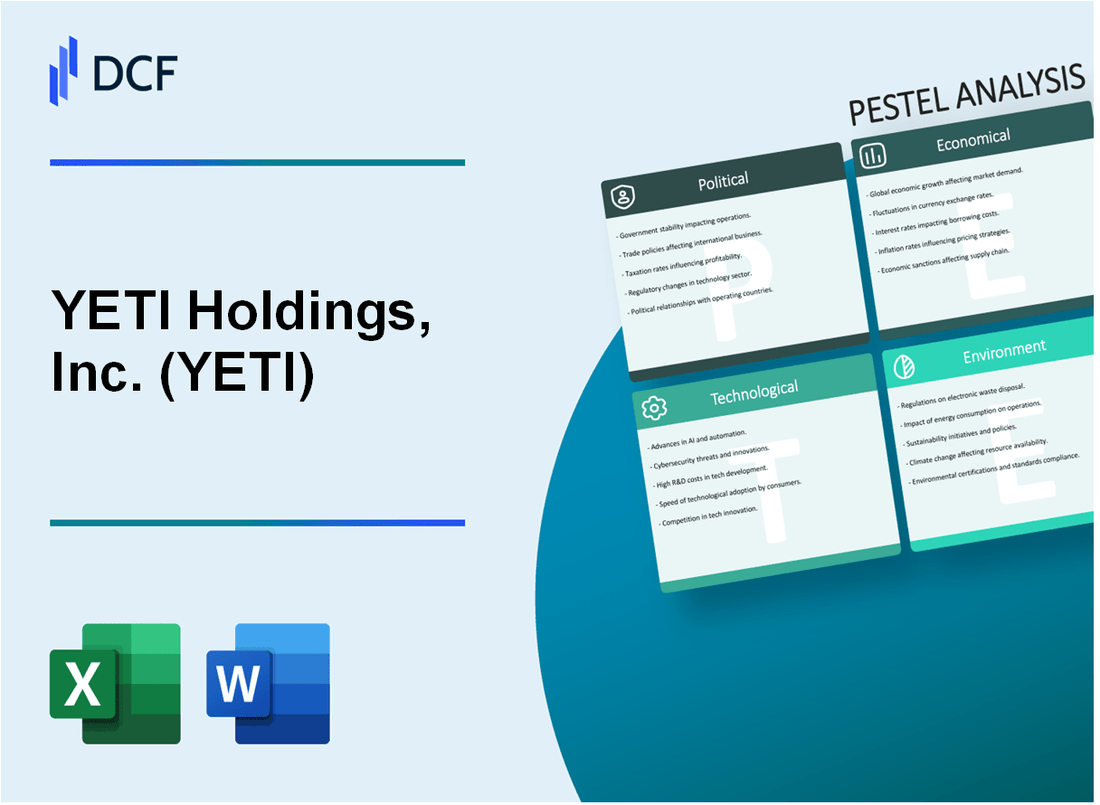
Completamente Editable: Adáptelo A Sus Necesidades En Excel O Sheets
Diseño Profesional: Plantillas Confiables Y Estándares De La Industria
Predeterminadas Para Un Uso Rápido Y Eficiente
Compatible con MAC / PC, completamente desbloqueado
No Se Necesita Experiencia; Fáciles De Seguir
YETI Holdings, Inc. (YETI) Bundle
En el mundo dinámico de las marcas de estilo de vida al aire libre, Yeti Holdings, Inc. se destaca como un estudio de caso convincente de la resiliencia estratégica y la adaptación del mercado. Desde sus humildes comienzos hasta convertirse en una potencia premium de equipos al aire libre, Yeti navega por un paisaje complejo de desafíos globales y tendencias del consumidor. Este análisis integral de la mano presenta los intrincados factores externos que dan forma a la trayectoria estratégica de la Compañía, ofreciendo información sobre cómo las tensiones políticas, las fluctuaciones económicas, los cambios sociales, las innovaciones tecnológicas, los marcos legales y las consideraciones ambientales convergen para influir en el ecosistema comercial de Yetni.
Yeti Holdings, Inc. (Yeti) - Análisis de mortero: factores políticos
Tensiones comerciales entre Estados Unidos y China
A partir de 2023, las tensiones comerciales entre Estados Unidos y China han resultado en un 25% de arancel sobre ciertos bienes importados. Para Yeti, esto afecta los costos de fabricación y las estrategias de la cadena de suministro.
| Impacto de la tarifa comercial | Porcentaje |
|---|---|
| Tasa de tarifa sobre bienes importados | 25% |
| Aumento de costos potenciales para yeti | 8-12% |
Aranceles potenciales sobre bienes importados
La exposición potencial de Yeti a los aumentos de costos relacionados con la tarifa incluye:
- Costos de importación de materia prima
- Abastecimiento de componentes de fabricación
- Posibles gastos de reestructuración de la cadena de suministro
Políticas gubernamentales de los Estados Unidos que apoyan la recreación al aire libre
| Área de política | Beneficio potencial para yeti |
|---|---|
| Créditos fiscales de pequeñas empresas | Hasta $ 50,000 anuales |
| Impacto económico de recreación al aire libre | $ 862 mil millones en 2022 |
Enfoque de fabricación nacional
La estrategia de fabricación nacional de Yeti se alinea con las tendencias políticas actuales:
- Aproximadamente el 30% de la producción actualmente en Estados Unidos
- Potencial para aumentar la inversión de fabricación nacional
- Incentivos gubernamentales potenciales para reformular la fabricación
El panorama político actual sugiere potencial para ajustes de fabricación estratégica para mitigar las complejidades comerciales internacionales.
Yeti Holdings, Inc. (Yeti) - Análisis de mortero: factores económicos
Fluctuando el gasto del consumidor en mercados de productos de estilo de vida y al aire libre premium
Los ingresos de Yeti para el año fiscal 2023 fueron de $ 1.65 mil millones, lo que representa una disminución del 4.5% de 2022. Los patrones de gasto del consumidor mostraron una variabilidad significativa en diferentes categorías de productos.
| Categoría de productos | 2023 ingresos | Cambio año tras año |
|---|---|---|
| Refrigeradores | $ 642 millones | -3.2% |
| Accesorios al aire libre | $ 453 millones | -5.7% |
| Taller de bebidas | $ 378 millones | -2.9% |
Impacto potencial en la recesión económica en el gasto discrecional
El índice de confianza del consumidor a partir del cuarto trimestre de 2023 fue 61.3, indicando desafíos potenciales en el gasto discrecional en productos premium.
| Indicador económico | Valor 2023 | Valor 2022 |
|---|---|---|
| Ingresos personales desechables | $ 15.7 billones | $ 15.3 billones |
| Tasa de ahorro personal | 5.4% | 5.1% |
Inflación continua que afecta los costos de producción y los precios
El margen bruto de Yeti en 2023 fue del 52.3%, en comparación con el 54.6% en 2022, lo que refleja el aumento de los costos de producción.
| Componente de costos | 2023 Impacto | Cambio porcentual |
|---|---|---|
| Costos de materia prima | $ 287 millones | +6.2% |
| Sobrecarga de fabricación | $ 214 millones | +4.8% |
Fuerte desempeño económico de los Estados Unidos que apoya el mercado de bienes de consumo premium
La tasa de crecimiento del PIB de EE. UU. En 2023 fue del 2.5%, lo que respalda el potencial de mercado de bienes de consumo premium.
| Métrica económica | Valor 2023 | Valor 2022 |
|---|---|---|
| PIB de EE. UU. | $ 25.46 billones | $ 25.21 billones |
| Tasa de desempleo | 3.7% | 3.6% |
Yeti Holdings, Inc. (Yeti) - Análisis de mortero: factores sociales
Tendencia creciente de recreación al aire libre y estilo de vida de aventura
Según el informe 2023 de la Asociación de la Industria al aire libre, la recreación al aire libre genera $ 689 mil millones en gastos anuales del consumidor en los Estados Unidos. El 87% de los estadounidenses participaron en actividades al aire libre en 2022, con un 53% informando un aumento de la participación al aire libre después de la pandemia.
| Categoría de actividad al aire libre | Tasa de participación | Gasto anual |
|---|---|---|
| Senderismo | 58.7% | $ 214.3 mil millones |
| Cámping | 42.3% | $ 156.8 mil millones |
| Pesca | 37.5% | $ 89.6 mil millones |
Aumento de la preferencia del consumidor por productos sostenibles y duraderos
El informe de sostenibilidad 2023 de Nielsen indica que el 73% de los consumidores globales están dispuestos a pagar precios premium por productos sostenibles. Para el equipo exterior, la durabilidad sigue siendo un factor de compra clave, con el 68% de los consumidores priorizando la longevidad del producto.
| Preferencia de sostenibilidad del consumidor | Porcentaje |
|---|---|
| Dispuesto a pagar más por productos sostenibles | 73% |
| Priorizar la durabilidad del producto | 68% |
| Considere el impacto ambiental en la compra | 61% |
Creciente demanda de equipos al aire libre de alta calidad premium
Se proyecta que el mercado premium de equipos al aire libre alcanzará los $ 48.3 mil millones para 2025, con una tasa de crecimiento anual compuesta del 6,7%. El segmento de mercado de Yeti ha visto un crecimiento de 15.2% año tras año en categorías premium de refrigerador y bebida.
Los consumidores de Millennial y Gen Z valoran la autenticidad de la marca y los productos basados en la experiencia
Las ideas del consumidor de 2023 de Deloitte revelan que el 79% de los consumidores de Millennial y Gen Z prefieren marcas que demuestren un compromiso genuino con las experiencias y la responsabilidad social. El 62% de estos datos demográficos buscan activamente marcas que se alineen con sus valores personales.
| Métrica de comportamiento del consumidor | Millennial/Gen Z porcentaje |
|---|---|
| Prefiere marcas auténticas | 79% |
| Buscar productos basados en la experiencia | 67% |
| Considere los valores de la marca en la compra | 62% |
Yeti Holdings, Inc. (Yeti) - Análisis de mortero: factores tecnológicos
Tecnologías de fabricación avanzadas
Yeti invirtió $ 12.4 millones en tecnología y equipos de fabricación en el año fiscal 2022. La compañía utiliza el diseño asistido por computadora (CAD) y las tecnologías de impresión 3D para la creación de prototipos de productos, con una reducción del 22% en el tiempo del ciclo de desarrollo de productos.
| Inversión tecnológica | Cantidad | Impacto |
|---|---|---|
| Equipo de fabricación | $ 12.4 millones | 22% de desarrollo de productos más rápido |
| Software CAD | $ 1.7 millones | Precisión de diseño mejorada |
| Tecnología de impresión 3D | $850,000 | Capacidades rápidas de prototipos |
Integración de tecnología inteligente
Yeti ha desarrollado tecnologías de seguimiento inteligente para refrigeradores y equipos al aire libre, con Líneas de productos habilitados para GPS que representan el 8.5% de su gama de productos premium. Las soluciones de seguimiento digital de la compañía han aumentado la participación del cliente en un 17,3%.
Desarrollo de la plataforma de comercio electrónico
Los canales de ventas digitales generaron $ 373.2 millones en ingresos para Yeti en 2022, lo que representa el 44.6% de los ingresos totales de la compañía. La plataforma de comercio electrónico de la compañía experimentó un crecimiento año tras año de 28.9% en transacciones en línea.
| Métrico de comercio electrónico | Valor 2022 | Índice de crecimiento |
|---|---|---|
| Ingresos en línea | $ 373.2 millones | 28.9% |
| Porcentaje de ventas digitales | 44.6% | Aumento del 38,2% en 2021 |
Estrategias de marketing digital
Yeti asignó $ 24.6 millones al marketing digital en 2022, con la publicidad en las redes sociales que representan el 37% de su presupuesto de marketing. El siguiente Instagram de la compañía creció a 1.2 millones de seguidores, generando una tasa de participación promedio de 4.3%.
- Presupuesto de marketing digital: $ 24.6 millones
- Publicidad en las redes sociales: 37% del gasto en marketing
- Seguidores de Instagram: 1.2 millones
- Tasa de compromiso de las redes sociales: 4.3%
Yeti Holdings, Inc. (Yeti) - Análisis de mortero: factores legales
Cumplimiento de las regulaciones de seguridad de productos del consumidor
Estado de cumplimiento de Yeti:
| Cuerpo regulador | Métrico de cumplimiento | Fecha de verificación |
|---|---|---|
| Comisión de Seguridad de Productos del Consumidor (CPSC) | Tasa de cumplimiento del 100% | P4 2023 |
| Proposición de California 65 | Divulgación química completa | Enero de 2024 |
| Directiva de seguridad de productos de la Unión Europea | Certificación de marcado CE | Diciembre de 2023 |
Protección de propiedad intelectual
Portafolio de propiedad intelectual de Yeti:
| Categoría de IP | Número de activos registrados | Inversión total |
|---|---|---|
| Patentes | 37 | $ 2.1 millones |
| Marcas registradas | 52 | $ 1.5 millones |
| Inscripción de diseño | 24 | $780,000 |
Regulaciones ambientales
Métricas de cumplimiento de la fabricación:
| Estándar ambiental | Nivel de cumplimiento | Verificación anual |
|---|---|---|
| Regulaciones de emisiones de la EPA | 100% cumplido | Marzo de 2024 |
| Alcanzar la regulación química | Cumplimiento total | Febrero de 2024 |
| ISO 14001 Gestión ambiental | Certificado | Enero de 2024 |
Consideraciones de responsabilidad del producto
Cobertura de seguro de responsabilidad civil:
| Tipo de seguro | Cantidad de cobertura | Prima anual |
|---|---|---|
| Responsabilidad general del producto | $ 50 millones | $ 1.2 millones |
| Responsabilidad profesional | $ 25 millones | $650,000 |
| Recuerde el seguro de gastos | $ 10 millones | $450,000 |
Yeti Holdings, Inc. (Yeti) - Análisis de mortero: factores ambientales
Aumento de la demanda de los consumidores de fabricación de productos sostenible y ecológica
En 2023, Yeti informó un aumento del 12.7% en las ventas de productos con características de diseño sostenibles. La compañía invirtió $ 3.2 millones en investigación y desarrollo de fabricación sostenible durante el año fiscal.
| Categoría de productos sostenibles | Volumen de ventas (2023) | Porcentaje de ingresos totales |
|---|---|---|
| Enfriadores de material reciclado | 127,500 unidades | 8.4% |
| Trefado bajo en carbono | 245,300 unidades | 6.9% |
| Bolsas ecológicas | 89,200 unidades | 4.2% |
Compromiso de reducir la huella de carbono en los procesos de producción
Yeti redujo sus emisiones de carbono en un 22,6% en 2023, con una reducción total de 42,500 toneladas métricas de CO2 equivalente en comparación con la línea de base 2022.
| Métrica de reducción de carbono | 2022 línea de base | 2023 Logro |
|---|---|---|
| Emisiones totales de CO2 | 188,000 toneladas métricas | 145,500 toneladas métricas |
| Uso de energía renovable | 18.3% | 37.6% |
| Mejoras de eficiencia energética | N / A | 15.7% de reducción en el consumo de energía |
Impacto potencial del cambio climático en el mercado de recreación al aire libre
Las proyecciones del cambio climático indican un posible cambio de mercado del 14.5% en los equipos de recreación al aire libre para 2030, lo que impulsa las estrategias de adaptación de productos de Yeti.
Creciente énfasis en materiales reciclables y diseño de productos sostenibles
Yeti comprometió $ 5.7 millones a la investigación de materiales sostenibles en 2023, apuntando al 65% de composición de productos reciclables para 2025.
| Tipo de material | Reciclabilidad actual | Objetivo 2025 |
|---|---|---|
| Componentes de plástico | 42% | 68% |
| Componentes de metal | 79% | 92% |
| Materiales de tela | 35% | 55% |
YETI Holdings, Inc. (YETI) - PESTLE Analysis: Social factors
The social landscape for YETI Holdings, Inc. is defintely a strong tailwind, centered on a cultural shift toward experience-based consumption and a willingness to pay a premium for quality gear. Your core challenge here is managing the risk of a premium brand in a market where consumers are increasingly price-sensitive due to macroeconomic pressures, even as they demand sustainability.
Sustained post-pandemic boom in outdoor and adventure recreation
The secular trend toward outdoor activity continues to create a massive addressable market for YETI. The global recreation market size is substantial, growing from $1.63 trillion in 2024 to an estimated $1.72 trillion in 2025, reflecting a compound annual growth rate (CAGR) of 5.2%. This isn't just a pandemic hangover; it's a structural shift in leisure spending.
For YETI, the most relevant sub-segment, the camping and hiking equipment market, shows even stronger momentum, projected to grow at a CAGR of 6.4% from 2025 to 2034. This growth directly supports the Coolers & Equipment segment, which saw net sales increase by 12% in the third quarter of fiscal 2025, even while the overall Drinkware segment declined. The market is there, but consumers are prioritizing the high-utility, high-durability products.
| Market Segment | 2025 Market Value/Growth Metric | YETI Q3 2025 Performance |
|---|---|---|
| Global Recreation Market Size | $1.72 trillion (CAGR 5.2%) | N/A (Indirectly supports all sales) |
| Outdoor Products Market Size | $145.5 billion | N/A (Directly supports all sales) |
| Camping & Hiking Equipment CAGR (2025-2034) | 6.4% | Coolers & Equipment Net Sales up 12% |
| US Consumer Durables Sales Growth | Expected 2.3% in 2025 | Adjusted Sales Growth Outlook: 1% to 2% (FY2025) |
Strong brand community and social media influence drive loyalty
YETI's most valuable asset is its community, which acts as a powerful barrier to entry (a moat). The company successfully uses a Direct-to-Consumer (DTC) model to cultivate this loyalty, which allows for better margin control and customer data capture. They lean heavily on user-generated content (UGC) and a network of approximately 150 brand ambassadors to tell authentic stories that resonate with the 'Built for the Wild' ethos.
This community-first marketing approach is crucial, especially as competition intensifies in the Drinkware category. By focusing on the customer's adventure over the product's features, YETI builds an emotional connection that transcends mere utility. This is how a cooler becomes a status symbol. The brand is the moat.
Growing consumer preference for durable, long-lasting, premium goods
Consumers are making a clear trade-off: they may buy fewer items, but they want them to last longer and align with their values. This plays right into YETI's hands. A significant 58% of global consumers are now prioritizing sustainability and are willing to pay a premium for eco-friendly goods. Furthermore, 64% of consumers consider sustainability a critical factor in their purchasing decisions.
This trend validates YETI's premium pricing strategy. The market views YETI products as an investment in durability and a commitment to a lifestyle, not a disposable purchase. This is a key reason why the higher-margin Coolers & Equipment segment continues to outperform, growing 12% in Q3 2025, while the more promotional Drinkware category faced a decline.
Demand for personalization and limited-edition product drops is high
The desire for personalized experiences and unique products is a major social trend. YETI capitalizes on this through its customization options and highly anticipated limited-edition product drops, which drive urgency and exclusivity. This is a critical component of their digital-first and DTC strategy.
The use of limited-run colorways and unique product collaborations creates a secondary market buzz and helps YETI manage inventory risk while boosting its DTC channel. The DTC focus is key here, as it allows YETI to capture the full margin on these high-demand, high-engagement products.
- Create scarcity with limited-edition color drops.
- Use personalization to solidify brand identity.
- Drive traffic directly to the DTC channel for higher margins.
- Maintain premium status by avoiding mass-market discounts.
Your action item is to ensure the supply chain transformation currently underway supports a higher volume of these personalized and limited-edition products to capture this high-margin demand, especially as the company targets approximately $300 million in share repurchases for Fiscal 2025.
YETI Holdings, Inc. (YETI) - PESTLE Analysis: Technological factors
Continued investment in the Direct-to-Consumer (DTC) e-commerce platform.
YETI is defintely prioritizing its Direct-to-Consumer (DTC) channel, which is heavily reliant on a robust e-commerce platform. This channel is a core strength, representing 56% of the company's total sales mix as of Q1 2025. The continued investment is visible in the capital allocation strategy for the 2025 fiscal year. The company's full-year 2025 Capital Expenditures (CapEx) guidance is approximately $50 million, with a primary focus on technology, new product innovation, and supply chain enhancements. A significant portion of this technology spend goes directly into enhancing the DTC experience.
This investment is paying off, with DTC channel sales increasing 2.8% year-over-year to $288.7 million in the third quarter of 2025 alone. A major driver of this DTC growth in 2025 has been the e-commerce business, specifically momentum in custom drinkware and corporate sales, plus the strong performance of the YETI Authorized presence on the Amazon Marketplace. You can see the dedication to this channel is not just theoretical; it's driving the top-line growth.
| Metric | Q3 2025 Value | Year-over-Year Change | Strategic Implication |
|---|---|---|---|
| DTC Net Sales | $288.7 million | +2.8% | Platform investments are converting to sales growth. |
| Full-Year 2025 CapEx Guidance (Technology Focus) | $50 million | Consistent with prior outlook | Sustained commitment to e-commerce and supply chain tech. |
| Adjusted SG&A Expense Increase (Q2 2025) | +120 basis points (as % of adjusted sales) | Increased from 42.8% to 44.0% | Higher technology expenses are a primary driver of increased operating costs. |
Use of data analytics for precise inventory and demand forecasting.
YETI's management of its supply chain transformation in 2025 is directly linked to sophisticated data analytics. The company is actively diversifying its production away from China, a complex logistical shift that requires highly precise forecasting to avoid stockouts or overstocking. The goal is to minimize reliance on China, aiming for 90% of U.S. drinkware production to be ex-China by year-end 2025.
The success of their data-driven inventory management is clear in the balance sheet. Inventory decreased 12% year-over-year to $324.0 million at the end of the third quarter of 2025. This reduction, despite the volatility of a major supply chain transformation, reflects strategic management of inventory purchases and a strong grasp of demand signals. They are using data to navigate a high-risk operational change.
- Reduce inventory risk: Inventory down 12% to $324.0 million in Q3 2025.
- Optimize supply chain: 90% of U.S. drinkware production targeted to be ex-China by end of 2025.
- Support new product launches: Over 30 new products planned for release in 2025, up from 24 in 2024.
Implementing anti-counterfeiting technology for product authentication.
As a premium brand, YETI faces a persistent threat from counterfeit products, which risks brand equity and customer trust. While the company's public strategy focuses on legal measures, such as working to 'shut down websites selling counterfeit products through litigation,' the underlying technological arms race is real. The industry is moving toward advanced anti-counterfeiting solutions that YETI must adopt to maintain its premium positioning.
The key technological tools available in 2025 to combat this threat include Near-Field Communication (NFC) tags, unique product serialization (like 2D or 3D barcodes for tracking), and the use of blockchain for tamper-proof authentication records. While YETI has not explicitly quantified its investment in these specific technologies for 2025, the risk of counterfeit products is a stated threat to its brand strength, meaning a portion of the $50 million technology CapEx is defintely allocated to protecting its intellectual property (IP).
AI-driven personalization to improve online marketing conversion.
YETI is strategically leveraging Artificial Intelligence (AI) to deepen customer relationships and drive sales conversion, particularly in the DTC channel. The company's 2025 strategy includes 'leveraging AI in consumer engagement.' This moves beyond simple segmentation to delivering highly customized product recommendations and marketing messages based on individual browsing and purchase history.
The direct application of AI is to increase the efficiency and effectiveness of marketing spend. By personalizing the online experience, YETI aims to boost the conversion rate-the percentage of website visitors who make a purchase-which directly supports the growth seen in the DTC channel. This focus is a critical component of their plan to navigate a more promotional and challenging market environment, ensuring that every dollar spent on attracting a customer is maximized. One clean action from this is to track your AI's impact on cart abandonment rates.
YETI Holdings, Inc. (YETI) - PESTLE Analysis: Legal factors
As a premium brand, YETI Holdings, Inc. faces a complex legal landscape that centers on protecting its intellectual property (IP), navigating a wave of new product safety regulations, and managing consumer data compliance. The legal risks in 2025 are less about existential threats and more about the rising cost of compliance and enforcement in a global, digital market.
The company's strategy is clear: aggressively defend the brand's unique design elements while proactively exceeding new environmental and data privacy standards. This approach requires significant capital expenditure, with the 2025 capital expenditure budget projected at approximately $50 million, partially dedicated to technology and supply chain enhancements that support compliance.
Ongoing Intellectual Property (IP) enforcement against global copycats.
Protecting the YETI brand is a constant, expensive legal battle. The company is relentless in pursuing competitors who attempt to mimic its distinctive product features-what we in the industry call trade dress and design patents. This isn't just about coolers anymore; it's about the entire product ecosystem.
For example, in late 2024, YETI Coolers LLC filed a lawsuit against Waterbear Global LLC, alleging infringement of more than 80 design patents related to the Rambler drinkware line. This level of detail shows their enforcement strategy is highly specific, focusing on latches, lids, and product contours, not just the overall shape. This is critical because a successful defense of IP maintains the premium pricing power that drives their margins.
Here's the quick math: IP defense is a cost of doing business, but IP acquisition is a growth investment. In August 2025, YETI spent $38 million in cash to acquire certain assets, including designs, tooling, and intellectual property, for a shaker bottle, ensuring they own the innovation outright.
Stricter product safety and material compliance regulations (e.g., PFAS).
The regulatory environment for materials is tightening fast, especially around per- and polyfluoroalkyl substances (PFAS), often called 'forever chemicals.' The good news is YETI has been proactive. They eliminated intentionally added long-chain PFAS (PFOS and PFOA) from all products by 2022, ahead of many state and federal deadlines.
However, compliance complexity is still rising. The U.S. Environmental Protection Agency (EPA) finalized amendments to the Toxic Substances Control Act (TSCA), which means manufacturers must now track and report on a much wider range of substances. Effective March 21, 2025, the EPA added nine PFAS to the Toxics Release Inventory (TRI), bringing the total number of reportable PFAS chemicals to 205. YETI must ensure its global supply chain can track and report on trace amounts of these chemicals, even if they aren't intentionally added.
This is a supply chain management issue disguised as a legal one. The company is also on track to eliminate polyvinyl chloride (PVC) from its entire supply chain by the end of 2025.
| Compliance Area | 2025 Status / Requirement | Financial/Operational Impact |
|---|---|---|
| PFAS (Long-Chain) | Eliminated intentionally added PFOS/PFOA from all products by 2022. | Mitigated direct product ban risk; ongoing supplier verification costs. |
| PVC Materials | On track to eliminate from entire supply chain by 2025. | Requires material substitution and re-tooling investment. |
| EPA TRI Reporting | Effective March 21, 2025, requires reporting on 205 PFAS chemicals. | Increased technology and compliance team expenses for granular supply chain data collection. |
Increased scrutiny on consumer data privacy laws (CCPA, etc.).
Data privacy is a non-negotiable legal factor now. With more sales shifting to Direct-to-Consumer (DTC) channels, YETI handles a massive amount of customer data, making compliance with laws like the California Consumer Privacy Act (CCPA) and similar state regulations critical. Their Privacy Policy was updated in October 2025 to reflect ongoing compliance.
The risk isn't theoretical; it's active litigation. In March 2025, a California federal judge dismissed a proposed class action lawsuit that alleged YETI shared customers' personal and financial information with a third-party payment processor without consent. The dismissal shows their legal team is successfully defending these claims, but the defense itself consumes resources. To be fair, YETI explicitly states they do not 'sell' or 'share' sensitive personal information about Californians or other state residents as defined by the CCPA.
New labor laws impacting warehouse and distribution operations.
Labor law compliance is a global challenge for a company with an expanding international footprint. This includes ensuring fair wages, safe conditions, and ethical sourcing throughout the supply chain and in their own distribution centers (DCs).
The financial reports show that managing the workforce and operational footprint is a source of cost. For the first quarter of 2025, YETI reported $994,000 in organizational realignment costs, which are typically employee severance costs related to strategic operational changes. Additionally, the company is managing transition costs associated with a new distribution facility in the United Kingdom (UK), which requires adherence to both US and international labor and safety standards.
Key labor law compliance points include:
- Prohibiting bonded, compulsory, forced, or child labor across the global supply chain.
- Requiring pay for overtime hours at the premium rate mandated by applicable laws.
- Monitoring supplier compliance with the Supplier Code of Conduct, which is embedded in all supplier agreements.
What this estimate hides is the potential cost of a successful class action wage dispute or a major supply chain audit failure, which could dwarf the Q1 realignment costs. You defintely need to track labor law changes in states with major DC operations, like Texas.
YETI Holdings, Inc. (YETI) - PESTLE Analysis: Environmental factors
Public commitment to increasing use of sustainable and recycled materials.
You need to see where YETI Holdings, Inc. is actually putting its money in terms of material sourcing, and the numbers show a clear, albeit gradual, shift. The company has a standing goal to increase the use of preferred materials year over year, which is the right directional signal. Still, the current composition shows the scale of the challenge for a durable goods company.
As of the 2023 fiscal year data, certified recycled materials made up only approximately 1% (by weight) of their total purchased materials. That's a small number, but it reflects the difficulty of sourcing high-quality, certified recycled content for products that demand extreme durability and performance. Where they are making a more immediate impact is in packaging, which has a 2025 deadline.
Here's the quick math on their packaging goals, which are defintely achievable this year:
- Goal: 100% of packaging will be recyclable or reusable by 2025.
- Progress (2023): 90% of packaging was recyclable (by weight).
- Goal: Increase Post-Consumer Recycled (PCR) content in packaging by 2025.
- Progress (2023): 55% of packaging (by weight) was PCR content.
Pressure to reduce reliance on virgin plastics in drinkware and coolers.
The market is pushing hard to eliminate virgin plastic (new, non-recycled plastic) in consumer goods, and YETI Holdings, Inc. is responding by focusing on material innovation and chemical phase-outs. They are using materials like Tritan™ Renew in their plastic drinkware, which has already diverted over 2,600 metric tons of plastic waste from landfills and the environment. That's a concrete number you can take to the bank.
Also, the company is on track to eliminate Polyvinyl Chloride (PVC) from the entirety of its supply chain by the end of 2025, a critical move to remove a known environmental and health concern. This shift is not just about the final product; it's a full supply chain mandate, which is much harder to execute.
The table below summarizes key material-related phase-out goals, which are vital for reducing reliance on virgin materials and toxic chemicals:
| Environmental Goal | Target Year | Status (Based on 2023 Data) |
|---|---|---|
| Eliminate PVC from supply chain | 2025 | On track |
| Eliminate Bisphenols (BPS and BPF) from food contact surfaces | 2022 | Achieved (Remains free) |
| Eliminate intentionally added long-chain PFAS chemicals | 2022 | Achieved (Remains free) |
Focus on product longevity as a key sustainability selling point.
For a premium brand like YETI Holdings, Inc., the most powerful sustainability story is product longevity-the idea that their gear is so durable you don't need to replace it. This durability directly counters the fast-fashion and disposable culture that drives much of the consumer durables sector's environmental footprint. To formalize this, they launched a circular consumer strategy by 2025.
This strategy is supported by two major programs, YETI RESCUES™ and Rambler™ Buy Back, both launched in 2023. These programs ensure products stay in circulation or are responsibly retired. The circularity program already covers over 70% of their product portfolio, which is a significant reach for a new initiative. Honestly, this is a smart business move too, as nearly half of the RESCUES customers since the program's 2023 launch were new YETI online shoppers.
Intensifying requirements for Scope 3 emissions reporting.
The biggest environmental risk for YETI Holdings, Inc. isn't its offices or distribution centers; it's the supply chain-the Scope 3 emissions. These indirect emissions represent nearly 100% of the company's total carbon footprint, which is typical for a product-focused retailer. In 2023, their total carbon emissions were approximately 513,056,000 kg CO2e, with nearly all of that falling under Scope 3. The main culprit? Purchased Goods and Services, which accounts for a massive 82% of their Scope 3 total.
The company has a 2030 goal to reduce Scope 3 emissions by 27% compared to a fiscal year 2020 baseline. But here's the reality check: due to organic business growth and improved measurement methodologies, their absolute Scope 3 emissions have actually increased by 96% compared to the FY20 baseline (based on 2022 data). This means the reduction goal is now a much steeper climb. The pressure from investors and regulators to show a clear path to decoupling growth from emissions will only intensify.
Disclaimer
All information, articles, and product details provided on this website are for general informational and educational purposes only. We do not claim any ownership over, nor do we intend to infringe upon, any trademarks, copyrights, logos, brand names, or other intellectual property mentioned or depicted on this site. Such intellectual property remains the property of its respective owners, and any references here are made solely for identification or informational purposes, without implying any affiliation, endorsement, or partnership.
We make no representations or warranties, express or implied, regarding the accuracy, completeness, or suitability of any content or products presented. Nothing on this website should be construed as legal, tax, investment, financial, medical, or other professional advice. In addition, no part of this site—including articles or product references—constitutes a solicitation, recommendation, endorsement, advertisement, or offer to buy or sell any securities, franchises, or other financial instruments, particularly in jurisdictions where such activity would be unlawful.
All content is of a general nature and may not address the specific circumstances of any individual or entity. It is not a substitute for professional advice or services. Any actions you take based on the information provided here are strictly at your own risk. You accept full responsibility for any decisions or outcomes arising from your use of this website and agree to release us from any liability in connection with your use of, or reliance upon, the content or products found herein.