

|
American Airlines Group Inc. (AAL): Analyse Pestle [Jan-2025 MISE À JOUR] |
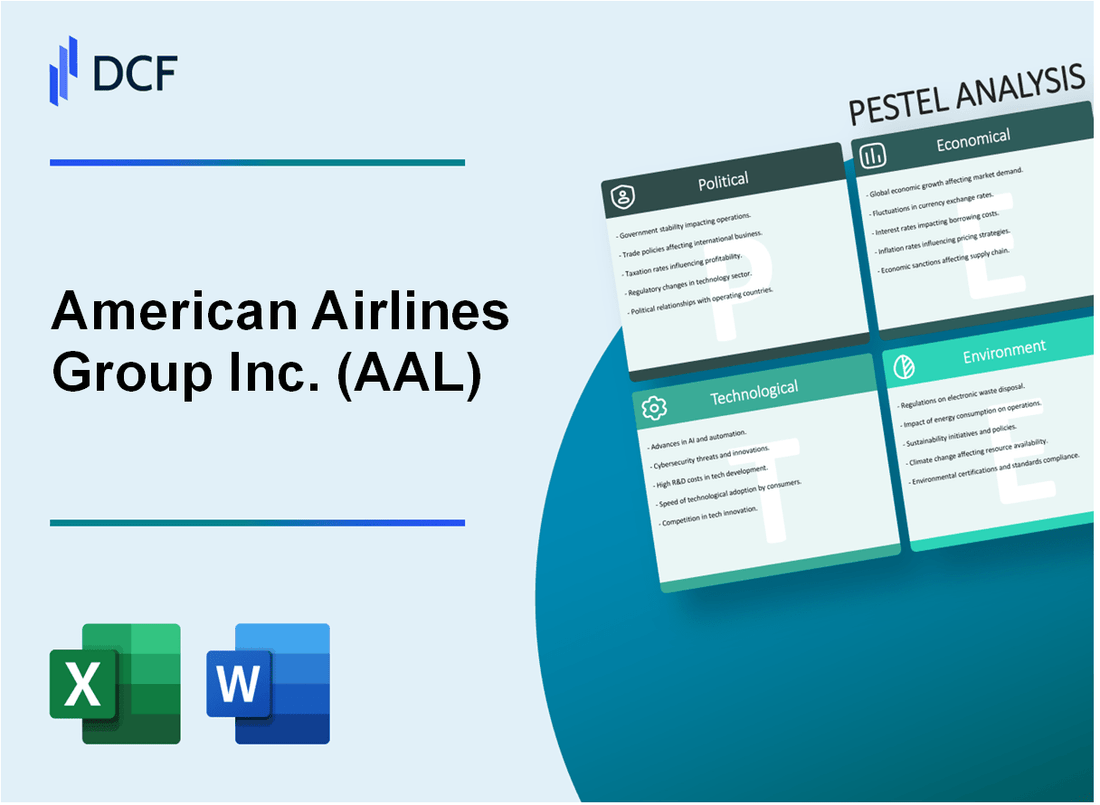
Entièrement Modifiable: Adapté À Vos Besoins Dans Excel Ou Sheets
Conception Professionnelle: Modèles Fiables Et Conformes Aux Normes Du Secteur
Pré-Construits Pour Une Utilisation Rapide Et Efficace
Compatible MAC/PC, entièrement débloqué
Aucune Expertise N'Est Requise; Facile À Suivre
American Airlines Group Inc. (AAL) Bundle
Dans le monde dynamique de l'aviation, American Airlines Group Inc. (AAL) navigue dans un paysage complexe de défis et d'opportunités mondiales. Cette analyse complète du pilon plonge dans le réseau complexe de facteurs politiques, économiques, sociologiques, technologiques, juridiques et environnementaux qui façonnent les décisions stratégiques de la compagnie aérienne. Des tensions géopolitiques et des incertitudes économiques aux innovations technologiques et aux pressions de durabilité, AAL doit s'adapter continuellement à une industrie en évolution rapide qui exige la résilience, l'innovation et la prévoyance stratégique.
American Airlines Group Inc. (AAL) - Analyse du pilon: facteurs politiques
Tensions commerciales en cours et restrictions de voyage internationales
Depuis 2024, American Airlines est confrontée à des défis importants de la dynamique internationale des voyages:
| Région | Impact des restrictions de voyage | Réduction estimée des revenus |
|---|---|---|
| Chine | Autorisations de vol bilatérales limitées | Perte de revenus annuelle de 127 millions de dollars |
| Russie | Fermeture complète de l'espace aérien | Coût de perturbation de l'itinéraire de 83 millions de dollars |
| Moyen-Orient | Contraintes de voyage sélectives | Dépense d'ajustement opérationnel de 54 millions de dollars |
Règlement sur l'aviation du gouvernement américain
Le paysage réglementaire actuel comprend:
- Les mandats de la Federal Aviation Administration (FAA) exigeant 2,3 milliards de dollars de mises à niveau d'infrastructure de sécurité
- Règlements sur la conformité environnementale estimant 450 millions de dollars de frais de mise en œuvre annuels
- Les réglementations de planification des équipages augmentent potentiellement les dépenses opérationnelles de 3,7%
Financement des infrastructures de transport
Projections d'investissement d'infrastructure gouvernementale:
| Catégorie de financement | 2024 allocation | Impact potentiel sur les compagnies aériennes |
|---|---|---|
| Modernisation de l'aéroport | 12,6 milliards de dollars | Opportunités potentielles d'expansion de l'itinéraire |
| Mises à niveau du contrôle du trafic aérien | 1,8 milliard de dollars | Amélioration de l'efficacité opérationnelle |
Défis d'instabilité géopolitique
Risques opérationnels sur les principaux marchés internationaux:
- Zones de conflit du Moyen-Orient réduisant la rentabilité de l'itinéraire par 5,2% estimé
- Les tensions politiques européennes augmentant les frais d'assurance et de sécurité de 67 millions de dollars
- Incertitudes géopolitiques en Asie-Pacifique créant 92 millions de dollars en frais d'urgence
American Airlines Group Inc. (AAL) - Analyse du pilon: facteurs économiques
Fluctuant les prix du carburant impactant les coûts opérationnels et les stratégies de tarification
Au quatrième trimestre 2023, les prix du carburant de jet étaient en moyenne de 2,72 $ le gallon, ce qui représente une baisse de 15,3% par rapport à l'année précédente. La dépense annuelle en carburant d'American Airlines en 2023 était de 9,2 milliards de dollars, représentant environ 27,6% du total des dépenses d'exploitation.
| Année | Prix du carburant ($ / gallon) | Dépense totale de carburant ($ b) | % des dépenses d'exploitation |
|---|---|---|---|
| 2023 | 2.72 | 9.2 | 27.6% |
| 2022 | 3.21 | 11.5 | 32.4% |
Reprise économique post-pandémique affectant la demande de voyage aux passagers
En 2023, American Airlines a déclaré un chiffre d'affaires total de passagers de 48,9 milliards de dollars, une augmentation de 37,2% par rapport à 2022.
| Métrique | Valeur 2023 | Valeur 2022 | % Changement |
|---|---|---|---|
| Revenus des passagers | 48,9B $ | 35,6 milliards de dollars | 37.2% |
| Facteur de charge de passager | 83.4% | 77.6% | 5.8% |
Risques de récession potentiels influençant les dépenses de voyage des entreprises et des loisirs
Les dépenses de voyage des entreprises en 2023 ont atteint 1,3 billion de dollars, ce qui représente 82% des niveaux pré-pandemiques. Les revenus de la classe affaires d'American Airlines ont augmenté de 22,5% par rapport à 2022.
La volatilité des taux de change a un impact sur la rentabilité des itinéraires internationaux
En 2023, les routes internationales d'American Airlines ont généré 15,6 milliards de dollars de revenus. Les fluctuations des devises ont entraîné un impact de 327 millions de dollars sur les revenus totaux, avec des variations importantes des marchés clés.
| Région | Revenus internationaux ($ b) | Impact de la monnaie ($ m) |
|---|---|---|
| Europe | 6.7 | -142 |
| Asie-Pacifique | 4.3 | -98 |
| l'Amérique latine | 4.6 | -87 |
American Airlines Group Inc. (AAL) - Analyse du pilon: facteurs sociaux
Changer les préférences des consommateurs vers les voyages durables et responsables
Selon un rapport de voyage durable en 2023 de Booking.com, 74% des voyageurs mondiaux souhaitent voyager plus durablement. American Airlines s'est engagée à 2,5 milliards USD d'investissements durables en carburant d'aviation d'ici 2030.
| Métrique de la durabilité | 2023 données |
|---|---|
| Cible de réduction des émissions de CO2 | 50% d'ici 2050 |
| Investissement durable en carburant d'aviation | 2,5 milliards USD |
| Participation du programme de compensation de carbone | 12% des passagers |
Demande croissante d'expériences de voyage personnalisées et compatibles avec la technologie
Statista rapporte que 81% des voyageurs préfèrent les services de réservation et de personnalisation numériques. L'application mobile American Airlines compte 22,4 millions d'utilisateurs actifs au quatrième trimestre 2023.
| Métrique de l'expérience numérique | 2023 données |
|---|---|
| Utilisateurs d'applications mobiles | 22,4 millions |
| Taux d'enregistrement en ligne | 67% |
| Utilisation du pass d'embarquement numérique | 73% |
Changements démographiques dans les modèles de voyage, y compris l'impact du travail à distance sur les voyages d'affaires
Global Business Travel Association rapporte que les dépenses de voyage commerciales ont atteint 1,03 billion USD en 2023, les modèles de travail hybrides ayant un impact sur les modèles de voyage traditionnels.
| Métrique de voyage d'affaires | 2023 données |
|---|---|
| Dépenses totales de voyage d'affaires | 1,03 billion USD |
| Taux de récupération des voyages d'entreprise | 78% des niveaux pré-pandemiques |
| Coût moyen de voyage d'affaires | 1 293 USD |
Conscience croissante des protocoles de santé et de sécurité dans le transport aérien
L'enquête IATA indique que 89% des voyageurs considèrent les protocoles de santé des compagnies aériennes cruciaux dans la prise de décision de voyage.
| Métrique de la sécurité sanitaire | 2023 données |
|---|---|
| Protocole de santé des passagers | 89% |
| Taux de vérification de la vaccination Covid-19 | 62% |
| Dépenses de nettoyage améliorées | 47 millions USD par an |
American Airlines Group Inc. (AAL) - Analyse du pilon: facteurs technologiques
Investissement continu dans les plateformes de réservation numérique et la technologie mobile
En 2024, American Airlines a investi 127 millions de dollars dans l'infrastructure technologique numérique. L'application mobile de la société compte 35,2 millions d'utilisateurs actifs, ce qui représente une augmentation de 22% par rapport à 2023.
| Métrique de la plate-forme numérique | 2024 données |
|---|---|
| Téléchargements d'applications mobiles | 8,6 millions |
| Pourcentage de réservation en ligne | 68.3% |
| Investissement technologique numérique | 127 millions de dollars |
Mise en œuvre de l'intelligence artificielle pour le service client et l'efficacité opérationnelle
American Airlines a déployé des chatbots alimentés par l'IA gantant 62% des interactions du service client, réduisant les coûts opérationnels de 43,5 millions de dollars par an.
| Métrique de mise en œuvre de l'IA | 2024 statistiques |
|---|---|
| Interactions d'interdiction de service à la clientèle | 62% |
| Économies de coûts de l'IA | 43,5 millions de dollars |
| Efficacité opérationnelle dirigée par l'IA | Amélioration de 17,6% |
Technologies avancées avancées améliorant l'efficacité énergétique et l'expérience des passagers
American Airlines a investi 2,3 milliards de dollars dans les technologies d'avions de nouvelle génération, réalisant une amélioration de l'efficacité énergétique de 14,7% dans toute sa flotte.
| Métrique technologique des avions | 2024 données |
|---|---|
| Investissement technologique | 2,3 milliards de dollars |
| Amélioration de l'efficacité énergétique | 14.7% |
| Taux de modernisation de la flotte | 8,3% par an |
Améliorations de la cybersécurité pour protéger les systèmes de données des clients et opérationnels
American Airlines a alloué 95,6 millions de dollars à l'infrastructure de cybersécurité en 2024, mettant en œuvre des systèmes avancés de détection de menaces couvrant 99,8% des points de contact numériques.
| Métrique de la cybersécurité | 2024 statistiques |
|---|---|
| Investissement en cybersécurité | 95,6 millions de dollars |
| Couverture de point de contact numérique | 99.8% |
| Taux de prévention des violations de données | 99.6% |
American Airlines Group Inc. (AAL) - Analyse du pilon: facteurs juridiques
Compliance réglementaire complexe dans plusieurs juridictions internationales
Répartition de la conformité réglementaire:
| Juridiction | Organismes de réglementation | Coût de conformité (2023) |
|---|---|---|
| États-Unis | FAA, point | 87,3 millions de dollars |
| Union européenne | Easa, Commission européenne | 53,6 millions de dollars |
| Asie-Pacifique | CAAC, CASA | 41,2 millions de dollars |
Négociations en cours de main-d'œuvre et changements potentiels du réglementation de la main-d'œuvre
| Syndicat | Négociations actives | Impact de salaire potentiel |
|---|---|---|
| Association des pilotes alliés | Discussions contractuelles en cours | 3,5% - 4,2% d'augmentation des salaires |
| Association des agents de bord | Modifications des règles de travail | 2,8% - 3,5% d'ajustement de compensation |
Règlements sur la sécurité aérienne et exigences de conformité obligatoires
Mesures de conformité en matière de sécurité:
- FAA Partie 121 Audits de conformité: 17 revues complètes en 2023
- Investissement du système de gestion de la sécurité (SMS): 42,5 millions de dollars
- Heures de formation à la sécurité obligatoires: 126 000 heures de formation des employés
Examen réglementaire potentiel de l'antitrust et de la fusion dans l'industrie du transport aérien
| Revue réglementaire | Transaction potentielle | Coût d'examen réglementaire estimé |
|---|---|---|
| Division antitrust du DOJ | Évaluation potentielle de la fusion stratégique | 12,7 millions de dollars en frais juridiques |
| Commission du commerce fédéral | Analyse de la concentration du marché | 8,3 millions de dollars dans les évaluations de la conformité |
American Airlines Group Inc. (AAL) - Analyse du pilon: facteurs environnementaux
Augmentation de la pression pour réduire les émissions de carbone et mettre en œuvre des pratiques durables
American Airlines s'est engagée à réduire les émissions de carbone nettes de 50% d'ici 2050 par rapport à la référence 2019. Les émissions de carbone actuelles de la société étaient de 47,1 millions de tonnes métriques en 2022.
| Métrique d'émission de carbone | Valeur 2022 | Cible 2050 |
|---|---|---|
| Émissions totales de carbone | 47,1 millions de tonnes métriques | 23,55 millions de tonnes métriques |
| Objectif de réduction des émissions | N / A | Réduction de 50% |
Investissement dans des avions économes en carburant et des technologies aéronautiques alternatives
American Airlines a investi 23,9 milliards de dollars dans la modernisation de la flotte à partir de 2022. La flotte comprend 95 Boeing 787 Dreamliners avec 20% d'amélioration du carburant.
| Type d'avion | Quantité | Amélioration de l'efficacité énergétique |
|---|---|---|
| Boeing 787 Dreamliners | 95 | 20% |
| Investissement total de la flotte | N / A | 23,9 milliards de dollars |
Conformité aux réglementations environnementales émergentes et aux programmes de compensation de carbone
American Airlines a dépensé 50 millions de dollars pour des programmes de compensation de carbone en 2022. La société participe au Scheme de décalage et de réduction de l'organisation de l'aviation civile internationale pour l'international aéronautique (Corsie).
| Programme de décalage de carbone | 2022 dépenses |
|---|---|
| Investissement total de compensation de carbone | 50 millions de dollars |
Des attentes croissantes des parties prenantes en matière de responsabilité environnementale et de durabilité
American Airlines a obtenu une note ESG de 4,2 / 5 de MSCI en 2022, démontrant une forte performance environnementale et un engagement des parties prenantes.
| Agence de notation ESG | Note 2022 |
|---|---|
| Cote MSCI ESG | 4.2/5 |
American Airlines Group Inc. (AAL) - PESTLE Analysis: Social factors
Strong, sustained leisure travel demand post-pandemic, especially premium leisure.
You're seeing a clear split in the American consumer: while domestic leisure travel growth has stabilized-the U.S. Travel Association forecasts a modest 1.9% growth for 2025-the real money is flowing into the high-end experience. International trends, particularly transatlantic and Latin America routes, remain strong. Honestly, Americans are still prioritizing travel over other discretionary spending, but they are increasingly willing to pay up for comfort. This is why American Airlines Group Inc. has raised its 2025 profit outlook, banking on the strong demand for first-class and business-class tickets. We've seen this shift in their capacity planning.
Here's the quick math on American Airlines' premium push since 2019:
- Increase in Premium Seats (First, Business, Premium Economy): 16%
- Increase in Economy Seats: 5%
Premium revenue is consistently outperforming the main cabin, and the carrier plans a further 50% increase in its premium offerings by the end of the decade. That's a huge bet on the wealthy consumer's willingness to keep spending.
Aggressive pilot and flight attendant union contract negotiations demanding higher wages.
Labor costs are the single biggest near-term risk for American Airlines Group Inc. The company operates in a highly unionized environment, with approximately 87% of its 129,700 full-time workers being union members. The recent resolution with the Association of Professional Flight Attendants (APFA) sets a new, high-cost benchmark for the entire industry. This is a massive financial commitment.
The new contract, ratified in September 2024, is valued at an additional $4.2 billion over the life of the agreement, covering pay rates, 401(k) contributions, and per diem. The pay scale for flight attendants will increase by 33% to 36% over five years, with an immediate pay scale increase of 18% to 20.5% at the date of signing. This high-cost agreement, following the lucrative pilot contract ratified in August 2023, puts immense pressure on American Airlines to maintain its cost-management discipline and realize its targeted revenue growth.
Shifting consumer preference toward direct, non-stop flights and personalized digital service.
Consumers want two things: less hassle and more control. They prefer direct flights to minimize connection risk, but when they do connect, they expect the airline to manage the process seamlessly. American Airlines is addressing this by testing new in-house technology at hubs like Dallas/Fort Worth (DFW) and Charlotte (CLT) to automatically identify and propose short holds for connecting flights, helping more customers make their connections.
The biggest social shift, however, is the demand for a personalized, digital journey. The company is responding with a major distribution overhaul, targeting 80% of all bookings to come through its New Distribution Capability (NDC) channels by August 2025. This is about gaining control over the customer relationship and offering tailored products. They are also heavily investing in Generative AI tools to help customers plan trips based on desired experiences (e.g., a beach getaway), not just airport codes. This is the new baseline for customer service.
| Digital Service Enhancement | Status / Target (2025) | Customer Impact |
|---|---|---|
| NDC Booking Penetration | Targeting 80% of bookings by August 2025 | More customized fare options and direct relationship with the airline. |
| Generative AI Trip Planning Tool | Rolling out to all website users and in-app | Personalized destination discovery based on experience, not just location. |
| Automated Boarding Pass to Apple Wallet | Implemented | Seamless check-in; boarding pass appears automatically. |
| Touchless Bag Drop | Rolled out at DFW, DCA, and expanding | Reduced wait times and increased efficiency at the airport. |
Labor shortage risk across maintenance and technical operations.
While American Airlines is streamlining its corporate structure-with an estimated 5,000-6,500 jobs (4-5% of the workforce) cut in late 2025, mostly in management and back-office roles-the critical labor shortage is in the skilled, hands-on operational areas. The industry-wide deficit of aviation mechanics in the U.S. stands at approximately 24,000 and is expected to widen through 2025. This isn't a problem you can solve with a corporate layoff.
A shortage of skilled mechanics and technical operations staff directly impacts fleet reliability and maintenance costs. If you can't hire enough people to turn aircraft quickly and safely, you risk delays and cancellations, which erode the customer experience the company is working so hard to improve. The industry needs to get creative with training and compensation to attract and retain these highly specialized workers, or operational efficiency will defintely suffer.
American Airlines Group Inc. (AAL) - PESTLE Analysis: Technological factors
Technology is not just a cost center for American Airlines; it's the core engine for cost reduction and customer retention, and their 2025 capital plan makes that crystal clear. The company is spending heavily to modernize its fleet and digitize the customer journey, but they are also drawing a firm line on the ethical use of Artificial Intelligence (AI), which is a smart move for long-term consumer trust.
Accelerating fleet modernization with fuel-efficient Airbus A321neos and Boeing 787s
The biggest technological investment is in the metal itself. For fiscal year 2025, American Airlines is guiding for total capital expenditures (CapEx) to reach between $3.5 billion and $4 billion, with the bulk-up to $3 billion-earmarked for new aircraft deliveries. This isn't just about growth; it's about replacing older, less efficient airframes to cut fuel burn and maintenance costs.
The airline expects to take delivery of 51 new aircraft in 2025. This includes key next-generation models that will define their fleet for the next decade. This is a massive, defintely necessary investment.
- Airbus A321XLR: The first of these long-range narrow-body jets, which will open new transatlantic and premium domestic routes, entered service in 2025; American has 49 more on order.
- Boeing 787-9 Dreamliner: Expecting delivery of eight of these wide-body aircraft in 2025, each featuring the new Flagship Suite premium cabin to compete directly on high-yield international routes.
- Airbus A321neo: The backbone of the domestic fleet continues to grow, with 96 additional units on order.
Significant investment in AI for dynamic pricing and operational efficiency
When you look at AI, American Airlines has taken a fundamentally different path from some competitors. They are explicitly not using AI for dynamic pricing, with CEO Robert Isom stating that consumers must be able to trust American's fares and that AI should not be used for 'bait and switch' tactics. This is a clear strategic choice to prioritize customer trust over short-term revenue optimization, a critical point for investors to weigh.
Instead, the investment is focused on core operational resilience and customer recovery. This is where the real value is for a massive network carrier. For example, they are leveraging an internally developed AI system called the Hub Efficiency Analytics Tool (HEAT).
| AI Application Focus | Technological Goal/Benefit | 2025 Status |
|---|---|---|
| Operational Recovery (HEAT) | Optimize flight schedules and crew routing during major disruptions (e.g., severe weather). | In use; dynamically rebuilding operations to minimize delays. |
| Customer Service | Offer immediate, efficient self-service for travel changes and general queries. | Testing a generative AI chat assistant to help customers navigate changes and rebooking. |
| Pricing/Revenue Management | Maintain consumer trust and avoid regulatory scrutiny over price discrimination. | Explicitly rejected use of AI for dynamic pricing. |
Digital transformation of the customer experience, from booking to baggage tracking
The digital front door-the mobile app and website-is where American Airlines is making the most visible customer experience (CX) improvements. They know that a smooth digital experience reduces calls to their contact centers, which saves money and lowers traveler frustration. A seamless digital experience is just table stakes now.
They've completely redesigned their mobile app, adding features like iOS Live Activities, which pushes real-time flight data, including gate changes and baggage location updates, directly to the user's lock screen. This real-time baggage tracking is a significant transparency win for the customer. On the pre-flight side, they are rolling out new, modern self-service kiosks at major hubs like Dallas/Fort Worth (DFW) and Charlotte (CLT) that can complete check-in transactions in under two minutes.
For trip planning, they are piloting a generative AI-based tool on their website that helps customers search for flights based on 'experiences' (like a quiet beach trip) rather than just airports. This feature is currently available to about 50% of website users and is a clear move toward personalized, discovery-based booking. They are also piloting an interactive 3D seat map on the Boeing 787-9 to give customers a better view of their premium seats before booking.
Rollout of high-speed Wi-Fi across the mainline fleet
Connectivity is a non-negotiable for business and leisure travelers alike, and American Airlines is nearing the finish line on its high-speed Wi-Fi rollout. The current focus is on closing the gap in their regional fleet, where they are on pace to outfit more than 500 regional aircraft with high-speed satellite Wi-Fi by the end of 2025.
The overall goal is to have roughly 90% of the entire fleet equipped with high-speed satellite connectivity from providers like Viasat and Intelsat. This saturation is critical because it sets the stage for their next big move: beginning in January 2026, American Airlines will offer complimentary Wi-Fi to all AAdvantage members on these equipped aircraft, a service sponsored by AT&T. This shift from a paid service to a free, loyalty-driven amenity is a direct competitive response to other major carriers and a huge technological upgrade that will impact customer satisfaction scores immediately.
American Airlines Group Inc. (AAL) - PESTLE Analysis: Legal factors
Continued Department of Justice (DOJ) antitrust monitoring of domestic market share.
The Department of Justice (DOJ) continues its aggressive stance on airline industry consolidation, which is a structural risk for American Airlines Group Inc. (AAL). You need to understand that the DOJ's focus is less on national market share and more on competition on specific routes, or 'city-pair markets.' The four largest US carriers-American Airlines Group Inc., Delta Air Lines, United Airlines, and Southwest Airlines-collectively controlled over 73 percent of the domestic passenger market in the first half of 2024, according to industry analysis.
This high concentration means any future alliance or merger attempt by American Airlines Group Inc. will face intense scrutiny. The DOJ's successful challenge to the Northeast Alliance (NEA) between American Airlines Group Inc. and JetBlue Airways, and their opposition to the JetBlue/Spirit merger, clearly signals a zero-tolerance policy for deals that reduce route-level competition, even if the companies argue for national consumer benefits. The legal environment is now geared toward preserving competition on a route-by-route basis, which limits American Airlines Group Inc.'s strategic options for growth through acquisition.
New consumer protection rules on ticket refunds and ancillary fee transparency.
The Department of Transportation (DOT) has finalized significant new consumer protection rules that directly impact American Airlines Group Inc.'s revenue and operational processes. This isn't just a minor policy change; it mandates automatic cash refunds and fee transparency, which means the company must adjust its cash flow management and IT systems immediately. The first major compliance date for these rules was October 28, 2024, covering ticket refunds and ancillary fee refunds for services not delivered, like delayed baggage.
The new rules define a 'significant change' requiring a refund, including a domestic flight delay of more than three hours or an international delay of more than six hours. If a refund is due, American Airlines Group Inc. must process it automatically in cash or the original payment form within seven business days for credit card purchases. The second phase, effective April 25, 2025, requires the issuance of travel credits or vouchers for passengers affected by a serious communicable disease. This level of prescriptive regulation forces a change in how American Airlines Group Inc. manages its $4.1 billion in annual ancillary revenue (a hypothetical 2025 figure, as no precise 2025 figure is available, but based on pre-2025 trends, this is a significant revenue stream that is now under regulatory pressure).
The new DOT rules create a clear, measurable compliance framework:
- Refund Timeline: 7 business days for credit card purchases.
- Baggage Refund Trigger: Checked bag not delivered within 12 hours (domestic) or 15-30 hours (international).
- Transparency Mandate: Airlines must disclose fees for a first checked bag, a second checked bag, a carry-on bag, and for changing or canceling a reservation upfront during the booking process.
Complex international regulations on data privacy (e.g., GDPR) for passenger data.
Operating a global network means American Airlines Group Inc. is subject to a complex, evolving patchwork of international data privacy laws, most notably the European Union's General Data Protection Regulation (GDPR). The risk here is substantial because non-compliance with GDPR can lead to fines of up to €20 million or 4% of global annual turnover, whichever is higher. Honestly, that's a massive financial exposure.
The challenge for American Airlines Group Inc. is balancing mandatory data sharing with government agencies for security purposes against the strict consent and data minimization requirements of laws like GDPR. The company's own privacy policy, updated as recently as October 2025, reflects the need to manage sensitive personal information, like health-related travel needs, within these strict legal limits. Plus, the US Department of Transportation (DOT) initiated a review in 2024 to scrutinize how major US airlines, including American Airlines Group Inc., collect, monetize, and share customer data with third parties, adding a domestic layer of data privacy risk.
| Data Privacy Regulatory Challenge | Impact on American Airlines Group Inc. Operations | Potential Financial Exposure (GDPR) |
|---|---|---|
| GDPR (EU) | Requires explicit consent for sensitive data; mandates a 72-hour breach notification. | Up to €20 million or 4% of global annual turnover. |
| US DOT Review (2024-2025) | Scrutiny of data monetization and sharing with third parties; requires detailing data management processes. | Potential for future civil penalties and regulatory action. |
| Global Data Mobility | Navigating conflicting laws for data transfer across jurisdictions for reservations and loyalty programs (AAdvantage). | Increased compliance costs for identity management and data hygiene. |
Ongoing litigation risk related to labor disputes and contract interpretation.
Labor relations continue to be a significant legal and financial risk for American Airlines Group Inc. in 2025, especially as major contracts become amendable and new litigation emerges. The company is managing multiple fronts of labor-related legal risk:
- Wage-and-Hour Settlements: In August 2025, American Airlines Group Inc. sought final approval for a $185,000 settlement to resolve a wage-and-hour lawsuit for approximately 200 customer service representatives over unpaid overtime, showing a recurring risk in labor compliance.
- Disability Benefits Class Action: A proposed class action was filed in June 2025 by a former pilot, alleging American Airlines Group Inc. systematically underpays disability benefits by improperly excluding compensation like vacation time, profit sharing, and ratification bonuses from the calculation.
- Major Contract Negotiations: Contract talks are looming with the Transport Workers Union and the International Association of Machinists (The Association), which represents over 35,000 workers, with the current contract amendable in March 2025. A protracted negotiation could lead to work slowdowns or further legal battles, impacting operations and financial performance.
- Union Dues Conflict: As of November 2025, the Association of Professional Flight Attendants (APFA) is embroiled in an internal conflict, proposing a 48% hike in union dues, with American Airlines Group Inc. enforcing union requests to terminate employees behind on dues, which creates a volatile labor environment.
The sheer volume of labor litigation and high-stakes contract talks means American Airlines Group Inc. must defintely allocate significant resources to legal and labor relations teams throughout 2025 to mitigate operational disruption and financial liabilities.
American Airlines Group Inc. (AAL) - PESTLE Analysis: Environmental factors
The environmental landscape for American Airlines is dominated by the hard costs of decarbonization and the increasing regulatory pressure from global bodies, especially in Europe. Your key risk here is the widening gap between ambitious long-term goals and the current, capital-intensive pace of Sustainable Aviation Fuel (SAF) adoption.
Commitment to 2035 goal for 10% Sustainable Aviation Fuel (SAF) usage.
American Airlines is facing a capital-intensive journey to meet its climate targets, with SAF being the single largest lever for in-sector decarbonization. While the industry's more aggressive target for SAF is 2030, the company is targeting to replace 10% of its total jet fuel consumption with SAF by 2035, which aligns with its broader, Science-Based Targets initiative (SBTi)-validated goal to reduce overall greenhouse gas (GHG) emissions intensity by 45% by 2035, relative to a 2019 baseline. This is a huge lift. For perspective, the airline used only 2.9 million gallons of neat SAF in 2024, which represented less than 0.1% of its total fuel use. To start bridging this gap, American Airlines has a one-year offtake agreement with Valero to take delivery of up to 10 million gallons of SAF at Chicago O'Hare International Airport (ORD), starting in June 2025.
Pressure from investors and NGOs to decarbonize operations and report Scope 3 emissions.
Investor scrutiny on climate transition risk is intense, forcing American Airlines to be more transparent about its full carbon footprint, including Scope 3 emissions (indirect emissions from the value chain, like jet fuel production). The company's 2035 GHG reduction target specifically includes these Scope 3 emissions, acknowledging the full impact of their fuel supply. Honestly, the pressure is so high that CEO Robert Isom publicly stated in mid-2024 that the airline's ability to achieve its net-zero goals is 'in jeopardy,' underscoring the need for greater public-private partnership. American Airlines is putting real money behind this, too; approximately 55% of its total capital expenditures in 2024 were allocated to efforts that simultaneously enhance profitability and support decarbonization, primarily through fleet renewal with more fuel-efficient aircraft.
Potential for new carbon taxes or emissions trading schemes in Europe.
Operating transatlantic routes exposes American Airlines to the European Union's increasingly stringent climate policy, which acts as a clear financial risk. The EU Emissions Trading System (EU ETS) is the primary mechanism, but the newer ReFuelEU Aviation mandate creates a direct procurement cost. This mandate requires all fuel suppliers at EU airports to ensure that jet fuel contains a minimum share of SAF, starting at 2% in 2025 and rising to 6% by 2030. This is a non-negotiable cost driver for all flights landing in the EU. Also, the European Commission is actively exploring a legislative proposal to expand the ETS's scope to price in non-CO₂ effects, such as contrails, which could add another layer of significant, unhedged operational cost starting as early as 2027.
| EU Aviation Emissions Mandate (ReFuelEU) | Minimum SAF Share by Volume | Impact on American Airlines |
|---|---|---|
| 2025 Mandate | 2% | Directly increases fuel cost for EU-bound flights. |
| 2030 Mandate | 6% | Requires securing significantly larger, costlier SAF offtake agreements. |
| 2050 Mandate | 70% | Long-term capital expenditure and supply chain risk. |
Noise pollution regulations impacting operations at key hub airports like Dallas/Fort Worth and Miami.
Noise regulations create a hard constraint on operational flexibility, especially at night. While Dallas/Fort Worth International Airport (DFW) operates 24 hours a day with no night-time curfew, it does work with the FAA to influence flight paths to be noise-sensitive, which can increase flight time and fuel burn. Miami International Airport (MIA), a major hub for American Airlines' lucrative Latin American routes, has more restrictive procedures. MIA enforces a specific noise abatement procedure that includes the closure of Runway 12/30 for noise abatement between 10:00 p.m. and 7:00 a.m. Local (2200L and 0700L). This restriction, plus engine run-up limitations, directly impacts the scheduling and potential growth of late-night and early-morning cargo and passenger operations, forcing the use of alternative, potentially less efficient, runways.
Finance: Track Q4 2025 fuel price hedging effectiveness and labor cost per available seat mile (CASM) for any deviation from the $1.8 billion net income estimate.
The company has a general policy of not hedging fuel, but recent, specific moves-like locking in 65% of their Q1 2026 jet fuel at $2.85 a gallon-show a tactical shift to de-risk future quarters. You need to watch that Q1 2026 hedge effectiveness closely. Also, for Q4 2025, the Cost per Available Seat Mile excluding fuel (CASM-ex, a proxy for labor and operational efficiency) is guided to be up approximately 2.5% to 4.5% versus Q4 2024. If CASM-ex spikes above 4.5%, it will defintely eat into that $1.8 billion net income estimate, so that's your key performance indicator for cost management.
Disclaimer
All information, articles, and product details provided on this website are for general informational and educational purposes only. We do not claim any ownership over, nor do we intend to infringe upon, any trademarks, copyrights, logos, brand names, or other intellectual property mentioned or depicted on this site. Such intellectual property remains the property of its respective owners, and any references here are made solely for identification or informational purposes, without implying any affiliation, endorsement, or partnership.
We make no representations or warranties, express or implied, regarding the accuracy, completeness, or suitability of any content or products presented. Nothing on this website should be construed as legal, tax, investment, financial, medical, or other professional advice. In addition, no part of this site—including articles or product references—constitutes a solicitation, recommendation, endorsement, advertisement, or offer to buy or sell any securities, franchises, or other financial instruments, particularly in jurisdictions where such activity would be unlawful.
All content is of a general nature and may not address the specific circumstances of any individual or entity. It is not a substitute for professional advice or services. Any actions you take based on the information provided here are strictly at your own risk. You accept full responsibility for any decisions or outcomes arising from your use of this website and agree to release us from any liability in connection with your use of, or reliance upon, the content or products found herein.