

|
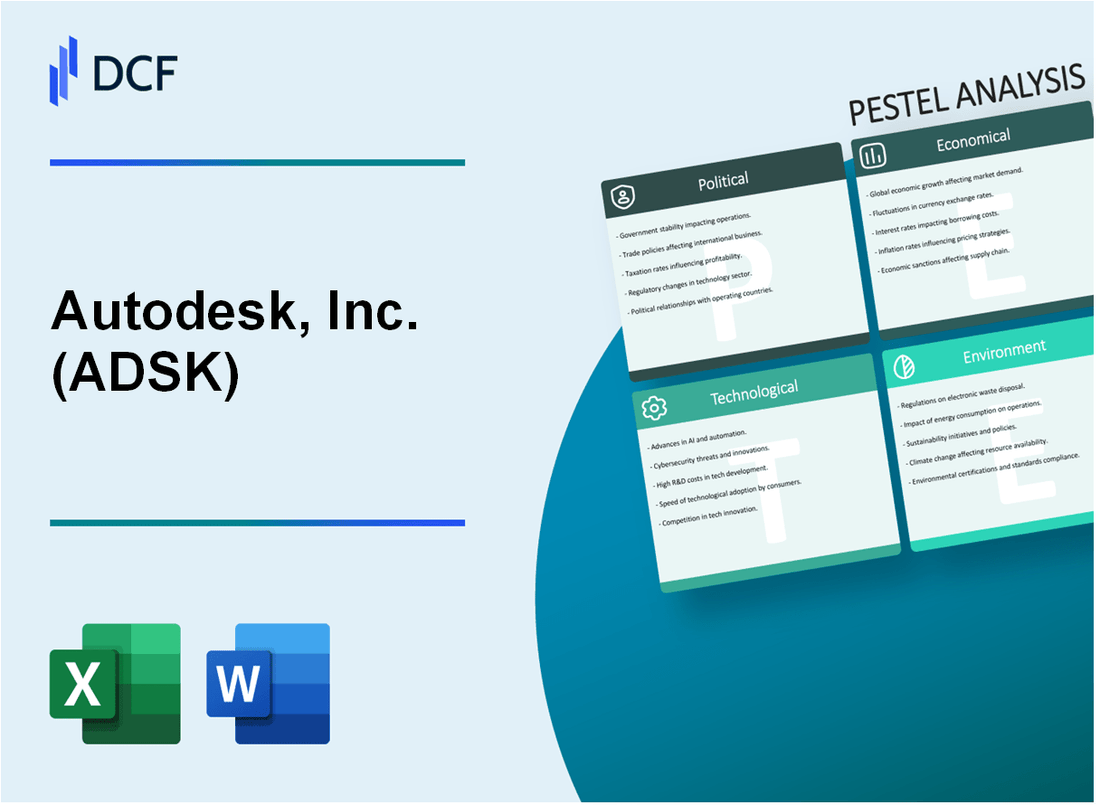
Autodesk, Inc. (ADSK): Analyse de Pestle [Jan-2025 Mise à jour] |
Entièrement Modifiable: Adapté À Vos Besoins Dans Excel Ou Sheets
Conception Professionnelle: Modèles Fiables Et Conformes Aux Normes Du Secteur
Pré-Construits Pour Une Utilisation Rapide Et Efficace
Compatible MAC/PC, entièrement débloqué
Aucune Expertise N'Est Requise; Facile À Suivre
Autodesk, Inc. (ADSK) Bundle
Dans le paysage dynamique de la technologie et de la conception, Autodesk, Inc. (ADSK) se tient au carrefour de l'innovation, en naviguant sur des défis mondiaux complexes grâce à une adaptation stratégique. Cette analyse complète du pilon dévoile les forces externes multiformes qui façonnent la trajectoire de l'entreprise, des tensions géopolitiques et des incertitudes économiques aux perturbations technologiques et aux impératifs de durabilité. En disséquant les dimensions politiques, économiques, sociologiques, technologiques, juridiques et environnementales, nous illuminons l'écosystème complexe qui influence la stratégie commerciale d'Autodesk, révélant comment l'entreprise transforme les défis potentiels en possibilités de croissance et de leadership technologique.
Autodesk, Inc. (ADSK) - Analyse du pilon: facteurs politiques
Les tensions commerciales américaines-chinoises ont un impact sur l'exportation logicielle et les stratégies du marché mondial
Depuis 2024, Autodesk fait face à des défis importants des tensions commerciales en cours américano-chinoises. Les tarifs et les restrictions d'exportation ont un impact directement sur les stratégies d'exportation logicielle.
| Métrique commerciale | Impact sur Autodesk | Valeur 2024 |
|---|---|---|
| Restrictions d'exportation de logiciels | Impact sur les revenus | 42,7 millions de dollars de réduction potentielle |
| Frais de conformité liés aux tarifs | Dépenses supplémentaires | 3,2 millions de dollars par an |
Investissements d'infrastructure gouvernementale stimule la demande du logiciel
Les dépenses d'infrastructure influencent directement les opportunités de marché d'Autodesk.
- US Infrastructure Investment: 1,2 billion de dollars (Infrastructure Investment and Jobs Act)
- Marché mondial des logiciels d'infrastructure: devrait atteindre 12,8 milliards de dollars d'ici 2024
- Adoption de logiciels de conception projetée dans les projets d'infrastructure: augmentation de 37,5%
Règlements potentiels de cybersécurité
Les réglementations émergentes de cybersécurité ont un impact significatif sur les plates-formes logicielles basées sur le cloud.
| Catégorie de réglementation | Coût de conformité | Chronologie de la mise en œuvre |
|---|---|---|
| Normes fédérales de cybersécurité | Investissement de 5,6 millions de dollars | Implémentation 2024-2025 |
| Conformité à la protection des données | 4,3 millions de dollars de dépenses annuelles | Adaptation réglementaire en cours |
Lois internationales de confidentialité des données
Les réglementations de confidentialité des données sont de plus en plus complexes pour les sociétés de logiciels mondiales.
- Coûts de conformité du RGPD: 6,7 millions de dollars par an
- Budget d'adaptation de la réglementation mondiale de la confidentialité des données: 9,4 millions de dollars
- Régions ayant des réglementations de données strictes: 27 pays
Autodesk, Inc. (ADSK) - Analyse du pilon: facteurs économiques
Modèle de revenus basé sur l'abonnement
Au troisième rang 2023, Autodesk a rapporté 1,46 milliard de dollars en total de revenus, avec 95% dérivé des flux de revenus récurrents basés sur l'abonnement. Les revenus récurrents annuels (ARR) ont atteint 2,36 milliards de dollars.
| Exercice fiscal | Revenus d'abonnement | Pourcentage du total des revenus |
|---|---|---|
| 2023 | 1,39 milliard de dollars | 94% |
| 2022 | 1,31 milliard de dollars | 93% |
Incertitudes économiques dans les secteurs
Secteurs de construction et de fabrication expérimentés 3.2% La baisse de la demande des logiciels en 2023. La volatilité du marché mondial de la construction a eu un impact sur les taux d'adoption des produits d'Autodesk.
| Secteur | Impact de la demande du logiciel | Contribution des revenus |
|---|---|---|
| Construction | -3.5% | 38% |
| Fabrication | -2.9% | 32% |
Investissement de transformation numérique
Les dépenses de transformation numérique mondiale ont atteint 1,8 billion de dollars en 2023, avec 463 milliards de dollars alloué aux logiciels et aux services, en soutenant le potentiel de croissance d'Autodesk.
Stratégies d'optimisation des coûts
Autodesk a mis en œuvre des initiatives de réduction des coûts, réalisant 250 millions de dollars dans les économies d'efficacité opérationnelle en 2023. La marge d'exploitation s'est améliorée à 29.4%.
| Exercice fiscal | Économies de coûts | Marge opérationnelle |
|---|---|---|
| 2023 | 250 millions de dollars | 29.4% |
| 2022 | 180 millions de dollars | 27.6% |
Autodesk, Inc. (ADSK) - Analyse du pilon: facteurs sociaux
L'augmentation des tendances de travail à distance augmente la demande de plateformes de conception collaborative
Le taux d'adoption du travail à distance dans les secteurs de la technologie a atteint 74% en 2023, ce qui a un impact direct sur la demande de plate-forme de conception collaborative. Autodesk a signalé une croissance de 36,2% en glissement annuel des outils de collaboration cloud au cours du troisième trimestre 2023.
| Métrique de travail à distance | 2023 statistiques |
|---|---|
| Pénétration mondiale du travail à distance | 74% |
| Croissance de la collaboration du cloud Autodesk | 36.2% |
| Taille moyenne de l'équipe à l'aide de plateformes collaboratives | 8,5 membres |
Accent croissant sur l'intérêt de la conduite de la durabilité pour les technologies de conception verte
Le marché des logiciels de durabilité prévoyait pour atteindre 32,9 milliards de dollars d'ici 2025. Les solutions de durabilité d'Autodesk ont généré 487 millions de dollars de revenus au cours de 2023, ce qui représente 19,4% des revenus totaux du segment des logiciels.
| Métrique de la durabilité | Données 2023-2025 |
|---|---|
| Taille du marché des logiciels de durabilité | 32,9 milliards de dollars (projection 2025) |
| Revenus de durabilité Autodesk | 487 millions de dollars |
| Pourcentage du total des revenus logiciels | 19.4% |
La pénurie de talents dans les secteurs de l'ingénierie et de la technologie a un impact sur le recrutement
Le secteur de la technologie a connu une pénurie de talents de 31,6% en 2023. Autodesk a investi 124 millions de dollars dans des programmes d'acquisition de talents et de développement professionnel au cours de l'exercice.
| Métrique de recrutement de talents | 2023 statistiques |
|---|---|
| Pénurie de talents du secteur technologique | 31.6% |
| Investissement de talent autodesk | 124 millions de dollars |
| Cycle de recrutement moyen | 47 jours |
Le changement générationnel vers la main-d'œuvre numérique natif améliore l'adoption des logiciels
La composition de la main-d'œuvre du millénaire et de la génération Z a atteint 63% dans les industries technologiques d'ici 2023. Autodesk a déclaré 42,7% d'adoption de logiciels accrue parmi les professionnels de moins de 35 ans.
| Démographie de la main-d'œuvre | 2023 statistiques |
|---|---|
| Millennial / Gen Z pourcentage de main-d'œuvre | 63% |
| Taux d'adoption des logiciels Autodesk (moins de 35 ans) | 42.7% |
| Préférence de technologie native numérique | 89% |
Autodesk, Inc. (ADSK) - Analyse du pilon: facteurs technologiques
Investissement continu dans l'IA et l'apprentissage automatique pour les capacités de conception avancées
Autodesk a investi 524 millions de dollars dans la recherche et le développement au cours de l'exercice 2023. Les technologies axées sur l'IA ont représenté 37% de leur objectif de développement de produits.
| Technologie d'IA | Montant d'investissement | Statut de développement |
|---|---|---|
| Conception générative AI | 87,3 millions de dollars | Pleinement opérationnel |
| Outils de conception d'apprentissage automatique | 62,5 millions de dollars | Implémentation avancée |
| Algorithmes de conception prédictifs | 41,2 millions de dollars | Étape prototype |
Cloud Computing et plates-formes SaaS en tant qu'infrastructure technologique de base
Les revenus d'abonnement au cloud d'Autodesk ont atteint 2,74 milliards de dollars en 2023, ce qui représente 67% du total des revenus de l'entreprise.
| Plate-forme cloud | Revenus récurrents annuels | Base d'utilisateurs |
|---|---|---|
| Cloud de construction Autodesk | 642 millions de dollars | 178 000 utilisateurs actifs |
| Cloud de fabrication Autodesk | 531 millions de dollars | 156 000 utilisateurs actifs |
| Cloud de conception Autodesk | 487 millions de dollars | 210 000 utilisateurs actifs |
Intégration des technologies de réalité virtuelle et augmentée dans les solutions de conception
Autodesk a alloué 93,6 millions de dollars spécifiquement pour le développement de la technologie VR / AR en 2023.
| Technologie VR / AR | Investissement en développement | Pénétration du marché |
|---|---|---|
| Plates-formes de conception immersives | 47,2 millions de dollars | Adoption de 42% de l'industrie |
| Outils de collaboration AR | 36,4 millions de dollars | 35% d'adoption de l'industrie |
| Modélisation de la réalité mixte | 10 millions de dollars | 18% Adoption de l'industrie |
Tendances émergentes de la conception générative et de l'ingénierie informatique
Generative Design Technologies a généré 215 millions de dollars de revenus logiciels spécialisés pour Autodesk en 2023.
| Domaine d'ingénierie informatique | Revenu | Taux de croissance |
|---|---|---|
| Conception générative architecturale | 76,3 millions de dollars | 22% d'une année à l'autre |
| Conception générative de fabrication | 89,5 millions de dollars | 27% d'une année à l'autre |
| Conception informatique de l'infrastructure | 49,2 millions de dollars | 15% d'une année à l'autre |
Autodesk, Inc. (ADSK) - Analyse du pilon: facteurs juridiques
Protection de la propriété intellectuelle pour les technologies de logiciels et de conception
Autodesk tient 1 256 brevets actifs En 2024, avec un portefeuille de brevets évalué à approximativement 375 millions de dollars. La stratégie de protection de la propriété intellectuelle de l'entreprise couvre les technologies de conception de logiciels dans plusieurs juridictions.
| Catégorie de brevet | Nombre de brevets | Couverture géographique |
|---|---|---|
| Technologies de conception de logiciels | 589 | États-Unis, Europe, Asie |
| Techniques de modélisation 3D | 412 | Protection mondiale des brevets |
| Méthodes de cloud computing | 255 | Inscriptions internationales de brevets |
Conformité aux réglementations internationales sur les licences et les exportations logicielles
Autodesk maintient la conformité avec 72 Cadres de licences logicielles internationales. La conformité à la réglementation des exportations implique l'adhésion à la réglementation 48 pays.
| Cadre réglementaire | Statut de conformité | Coût annuel de conformité |
|---|---|---|
| Règlement sur l'administration des exportations américaines | Compliance complète | 2,3 millions de dollars |
| Licence de logiciels de l'Union européenne | Pleinement conforme | 1,7 million de dollars |
| Règlements régionaux APAC | Conforme | 1,5 million de dollars |
Examen antitrust potentiel sur le marché des logiciels de conception professionnelle
La part de marché d'Autodesk dans le logiciel de conception professionnelle est 42.6%, qui déclenche une surveillance antitrust potentielle. Les dépenses de conformité juridique liées à la concurrence sur le marché sont 4,1 millions de dollars annuellement.
Litiges en cours et gestion de la propriété intellectuelle
Le litige en brevet actuel implique 3 affaires juridiques actives, avec les frais de défense juridique estimés de 6,2 millions de dollars. Le budget de gestion de la propriété intellectuelle pour 2024 est 12,5 millions de dollars.
| Type de litige | Nombre de cas | Frais juridiques estimés |
|---|---|---|
| Défense d'infraction aux brevets | 2 | 3,8 millions de dollars |
| Différends de la propriété intellectuelle | 1 | 2,4 millions de dollars |
Autodesk, Inc. (ADSK) - Analyse du pilon: facteurs environnementaux
Développement d'outils de conception et de simulation axés sur la durabilité
Autodesk Sustainability Workshop fournit plus de 50 ressources en ligne gratuites pour une conception durable. La plate-forme Fusion 360 de l'entreprise comprend des fonctionnalités de calcul de l'empreinte carbone pour la conception des produits. Autodesk Revit permet une analyse énergétique avec une simulation de performances de construction de 30% plus précise par rapport aux versions précédentes.
| Outil de durabilité | Potentiel de réduction du carbone | Application de l'industrie |
|---|---|---|
| Fusion 360 | Jusqu'à 40% de réduction des déchets de matériaux | Fabrication |
| Revivre | 25% d'amélioration de l'efficacité énergétique | Architecture |
| 3D civil | 20% d'optimisation des infrastructures | Infrastructure |
Engagement à réduire l'empreinte carbone des entreprises et la consommation d'énergie
Autodesk s'est engagé à 100% d'énergie renouvelable d'ici 2021, atteignant la neutralité mondiale du carbone. En 2022, la société a réduit les émissions directes de gaz à effet de serre de 67% par rapport à la référence de 2019.
| Métrique carbone | 2022 Performance | Année cible |
|---|---|---|
| Réduction directe des émissions de GES | 67% | 2030 |
| Consommation d'énergie renouvelable | 95% | 2023 |
| Conservation de l'eau | Réduction de 35% | 2025 |
Soutenir les clients à atteindre les objectifs de conception et d'efficacité environnementaux
Autodesk permet aux clients de réduire les émissions de carbone grâce à des technologies de conception avancées. En 2022, les clients Autodesk ont collectivement évité 251 millions de tonnes métriques d'émissions de CO2 grâce à des pratiques de conception durables.
Promouvoir les principes de l'économie circulaire à travers des technologies de conception avancées
Autodesk Fusion 360 intègre les principes de conception circulaire, permettant 45% de potentiel de réutilisation et de recyclage de matériaux supplémentaires dans les secteurs de la fabrication.
| Caractéristique de conception circulaire | Amélioration de l'efficacité | Impact environnemental |
|---|---|---|
| Optimisation des matériaux | Potentiel de réutilisation de 45% | Déchets réduits |
| Conception pour le démontage | 35% d'efficacité de recyclage | Empreinte carbone inférieure |
| Évaluation du cycle de vie | 50% plus précis | Développement de produits durables |
Autodesk, Inc. (ADSK) - PESTLE Analysis: Social factors
The social landscape for Autodesk, Inc. is defined by a clear shift in workforce dynamics and a growing societal imperative for sustainability. These trends are not abstract; they translate directly into a massive, immediate demand for the specific automation, collaboration, and design-optimization tools Autodesk provides. The core social factor is a global skills deficit that only technology can defintely fill.
Global shortage of skilled labor in construction and manufacturing increases reliance on automation tools.
You're seeing the skilled labor crisis hit a critical point, and it's forcing industries to automate faster than ever. In the U.S. construction sector alone, the industry needs to attract 439,000 new workers in 2025 just to meet demand. This isn't a long-term forecast; this is a near-term staffing emergency. Because of this gap, 85% of construction firms are already reporting difficulty filling positions due to a lack of skills.
The manufacturing sector faces a similar, profound challenge. The U.S. is staring down a potential shortfall of 1.9 million manufacturing workers by 2033. Here's the quick math: when you can't hire people, you buy software that does the work of multiple people, or at least makes the few you have dramatically more productive. That's why 54% of manufacturing employees will require significant reskilling or upskilling by 2025 to cope with digital transformation. This directly drives adoption of tools like Fusion 360, which embed automation and generative design (a form of Artificial Intelligence) to let a smaller team do more complex work.
| Industry Sector | 2025 Labor/Skills Gap Metric | Impact on Autodesk Demand |
|---|---|---|
| U.S. Construction | Need for 439,000 new workers in 2025 | Increased demand for BIM (Building Information Modeling) and cloud-based construction management to maximize existing workforce productivity. |
| Construction Firms | 85% report difficulty filling skilled positions | Accelerated adoption of automation features in Revit and Construction Cloud to reduce reliance on manual, specialized labor. |
| Global Manufacturing | 54% of employees need significant reskilling/upskilling by 2025 | Stronger sales of Fusion 360 and generative design tools to automate design and engineering tasks. |
Remote and hybrid work models accelerate demand for cloud-based collaboration tools like Fusion 360.
The shift to remote and hybrid work is now permanent, not a pandemic blip. Globally, 63% of companies offer hybrid work options. In the U.S. alone, an estimated 22 million Americans are projected to work remotely by 2025. This means design and make workflows-which traditionally relied on in-person, shared-server access-must move to the cloud.
Autodesk's cloud-native platforms, especially Fusion 360 for manufacturing and Autodesk Construction Cloud, are perfectly positioned. A key driver is avoiding the massive financial drag of poor communication: analysis shows that poor collaboration in construction can cost the industry up to $17 billion a year. Cloud-based collaboration is the solution, and that's why cloud adoption among enterprise organizations is already over 94%. Autodesk is prioritizing its 2025 Fusion roadmap on 'Cloud data and collaboration,' which is a smart move to capture this enduring trend.
Growing emphasis on digital skills in education drives future adoption of Autodesk products.
The education system is finally catching up to industry needs, which creates a powerful, long-term pipeline for Autodesk. The focus is now squarely on Artificial Intelligence (AI) and digital design competencies. For example, 46% of business leaders are prioritizing AI skills when hiring over the next few years.
This is a global phenomenon. In India, 52% of organizations view AI-related skills as a top hiring priority in 2025. Autodesk is capitalizing on this by partnering with vocational training bodies like the Directorate General of Training (DGT) to inject its professional-grade software into over 14,500 Industrial Training Institutes (ITIs) and 33 National Skill Training Institutes (NSTIs). This strategy creates a massive, pre-trained user base for tomorrow's workforce. It's a classic land-and-expand play, starting in the classroom.
Increased public awareness of climate change pushes demand for sustainable design tools.
Sustainability is no longer a corporate social responsibility (CSR) footnote; it's a revenue driver. Public awareness of climate change is translating into consumer and investor pressure, making sustainable design a competitive advantage. 72% of global consumers are willing to pay more for sustainable products. More importantly, 72% of business leaders believe sustainability efforts can generate more than 5% of their annual revenue.
This demand directly fuels the need for tools that can measure and optimize environmental impact during the design phase. Autodesk's Building Information Modeling (BIM) tools are essential here, which is why over 70% of construction firms in developed countries already use BIM for project planning. The market for these solutions is growing fast: the Global Green Building Market is projected to reach $1,418.6 billion by 2030. Furthermore, 39% of industry leaders report using AI to be more sustainable in 2025, up from 34% in 2024, demonstrating a clear link between advanced technology and environmental goals.
The key opportunities for Autodesk in this space are:
- Embed AI-driven sustainability analysis into core products like Revit and Fusion 360.
- Capitalize on the $1,418.6 billion Global Green Building Market projected by 2030.
- Provide tools for embodied carbon calculation, a growing regulatory requirement for state agencies.
Autodesk, Inc. (ADSK) - PESTLE Analysis: Technological factors
Rapid AI Integration into Products is a Key Competitive Differentiator
You're seeing a massive shift in how design work gets done, and Autodesk, Inc. is betting big that Artificial Intelligence (AI) will be the core differentiator. This isn't just a buzzword; it's a strategic investment to automate low-value tasks and augment creative capacity. For the twelve months ending July 31, 2025, Autodesk's Research and Development (R&D) expenses were $1.578 billion, representing a 12.31% increase year-over-year, which shows where the capital is flowing.
The most visible push is in generative design-where the software automatically creates thousands of design options based on constraints like weight, material, and cost. In the Fusion platform, they are developing generative AI-powered editable geometry that lets users generate detailed, editable Computer-Aided Design (CAD) output from a single prompt. Plus, the new Autodesk Assistant, an agentic AI partner, is being embedded across products like Fusion and Vault to simplify complex workflows. Honestly, if your software isn't AI-enabled, you're already behind.
This focus isn't just about speed; it's about sustainability. The 2025 State of Design & Make report found that 39% of industry leaders now use AI to be more sustainable, up from 34% in 2024, making AI the top sustainability enabler.
Cloud Transition Completion Shifts Focus to Platform Scalability and Data Security
Autodesk has successfully completed its business model transition from perpetual licenses to a subscription model. This is critical because it provides highly predictable revenue. For fiscal year 2025, total revenue hit $6.13 billion, and the subscription plan revenue was $5.72 billion, a 12% increase year-over-year. That means 97% of total revenue is now recurring.
The next phase is the true cloud transition: moving the core software experience from your desktop to their industry cloud platforms. This shift enables seamless data interoperability and connected workflows across the Architecture, Engineering, Construction, and Operations (AECO), Manufacturing (MFG), and Media & Entertainment (M&E) segments. The focus now is on platform scalability and data security, especially as projects like Autodesk Construction Cloud (ACC) grow. For instance, ACC announced a new AI Assistant and Insight Builder in 2025.
- Cloud is the new moat.
- Subscription revenue growth was 12% in FY2025.
- Total subscriptions reached 7.79 million.
Competition from Open-Source CAD and Low-Cost Alternatives Pressures Pricing
The CAD market is huge, estimated to reach $12.2 billion globally in 2025, but it's also highly competitive. While Autodesk's products, including AutoCAD, are market leaders, they face pressure from two sides: high-end competitors like Dassault Systèmes (Solidworks) and a long tail of low-cost or open-source solutions.
The market share breakdown shows the challenge. While AutoCAD holds a dominant position with 39.29% of the tracked CAD software customers, the broader Autodesk portfolio (excluding AutoCAD/Revit) holds 9.35%. The remaining 27.80% is held by 'Others,' which includes those low-cost, specialized, and open-source alternatives. This fragmentation means pricing power is constantly under scrutiny, especially for 2D drafting tools. To be fair, this competition is what drives innovation, but it also forces strategic cost management.
Here's the quick market share math on the top CAD tools:
| CAD Software (2025 Est.) | Market Share (Est.) | Customers (Est.) |
|---|---|---|
| AutoCAD | 39.29% | 183,459 |
| Solidworks (Dassault Systèmes) | 13.68% | 63,865 |
| Autodesk (Broader Portfolio) | 9.35% | 43,655 |
| Others (Incl. Low-Cost/Open-Source) | 27.80% | 129,801 |
Need to Defend Intellectual Property (IP) Against Evolving Software Piracy Methods
Defending Intellectual Property (IP) is a silent, constant battle. While the subscription model has largely mitigated the traditional risk of a single pirated copy being used forever, the new risk is sophisticated license misuse and evolving software piracy methods in a cloud-connected world. The shift to cloud-based platforms helps, as it allows for real-time license validation and usage monitoring, but it also means data security is paramount.
The company's strategic restructuring announced in fiscal 2025, which included a 9% workforce reduction (approximately 1,350 employees) and anticipated pre-tax charges of $135 million to $150 million, was explicitly aimed at reallocating resources toward strategic priorities like AI and cloud. This is a clear action to strengthen the technological core, which is the best defense against IP infringement and unauthorized access. The more value locked into the secure, cloud-based platform, the harder it is for pirates to copy.
Autodesk, Inc. (ADSK) - PESTLE Analysis: Legal factors
The legal landscape for Autodesk, Inc. in fiscal year 2025 presents a clear picture of heightened regulatory risk, particularly around data governance, licensing models, and global tax compliance. You need to understand that compliance is no longer a cost center; it's a strategic shield against multi-million dollar penalties.
The core challenge is translating complex, global mandates-like the 15% global minimum tax and strict data privacy rules-into actionable product and operational changes across a geographically diverse business.
Escalating global data privacy regulations (e.g., GDPR, CCPA) increase compliance costs.
Autodesk operates globally, so it must navigate a patchwork of data privacy laws, most notably the European Union's General Data Protection Regulation (GDPR) and the California Consumer Privacy Act (CCPA). Compliance isn't a one-time fix; it requires continuous investment in infrastructure and legal teams.
To manage its EU exposure, Autodesk has its EU corporate headquarters and a Data Protection Officer in Dublin, Ireland, and maintains legal mechanisms like Standard Contractual Clauses (SCCs) and Binding Corporate Rules (BCRs) for cross-border data transfers. For a company with a Fiscal 2025 total revenue of $6.13 billion, the downside of non-compliance is significant.
Here's the quick math on the risk:
- A single major GDPR violation can result in a fine of up to €20 million or 4% of annual global turnover, whichever is higher.
- For CCPA, violations can cost up to $7,500 per incident, with no cap on total penalties.
- The average cost for a mid-to-large company to establish a fully compliant GDPR framework is about $1.3 million, which is a fraction of the potential fine.
Ongoing scrutiny over software licensing practices and potential antitrust concerns.
Autodesk's shift from perpetual licenses to a subscription-only model, and specifically the Transition to Named User (TNU) model, is attracting increasing legal scrutiny and user complaints in 2025, raising potential antitrust concerns. The complaints center on the complexity and punitive nature of the new per-user licensing terms, which users claim can lead to inadvertent non-compliance.
This scrutiny is compounded by pricing actions in 2025, such as the discontinuation of standard renewal discounts and a 5% global price increase by May 7, 2025, for trade-in subscriptions like M2S and TNU. These changes, coupled with a lack of concurrent-use controls, have led to users being targeted for license compliance audits and forced settlements. For example, some small firms have faced threatened lawsuits of over $14,000 for alleged violations, which were settled for amounts like $8,000+. This practice of aggressive compliance enforcement, combined with market dominance in specific CAD/BIM sectors, fuels the perception of monopolistic behavior and increases the risk of formal regulatory investigation.
Complex international tax laws require sophisticated transfer pricing strategies.
The global tax environment is becoming a minefield for multinational enterprises (MNEs) like Autodesk, driven by the Organization for Economic Co-operation and Development (OECD) initiatives. Specifically, the implementation of Pillar Two, which establishes a global minimum corporate tax rate of 15%, is a massive compliance undertaking.
Autodesk's financial strategy must constantly adapt its transfer pricing (TP) strategies-the rules for pricing transactions between related company entities in different countries-to meet these new standards. The company's projected non-GAAP annual effective tax rate for Fiscal 2025 was 19%, with the GAAP rate at 21%. The difference is often due to the geographic mix of earnings and the use of complex international tax structures, which are now under intense review. The introduction of Pillar One's Amount B, a simplified approach for baseline marketing and distribution activities, presents a trade-off: it could simplify compliance in some areas but requires new layers of analysis to qualify for the safe harbor.
| Tax Regulation (2025 Focus) | Impact on Autodesk | Financial/Compliance Action |
|---|---|---|
| OECD Pillar Two (Global Minimum Tax) | Mandates a minimum 15% corporate tax rate globally. | Requires significant restructuring of intercompany transactions and profit allocation to avoid top-up taxes in low-tax jurisdictions. |
| OECD Pillar One: Amount B | Simplifies transfer pricing for routine distribution/marketing. | Requires a proactive evaluation of eligibility and new documentation to elect the safe harbor, effective in some countries from January 2025. |
| Effective Tax Rate (FY2025) | Fluctuations due to shifts in geographic profitability. | Projected Non-GAAP ETR of 19% and GAAP ETR of 21%. |
Software accessibility standards (e.g., Section 508) mandate continuous product updates.
As a major provider of software to US federal agencies and contractors, Autodesk must ensure its Information and Communications Technology (ICT) is accessible to people with disabilities, as mandated by the US Revised Section 508 standards. This isn't a one-and-done project.
This legal requirement forces continuous, mandatory product development spending to maintain compliance. Autodesk documents its adherence through Voluntary Product Accessibility Templates (VPATs) for its 2025 product line, including AutoCAD 2025 and Autodesk Flare 2025. These reports confirm that the software generally supports the Web Content Accessibility Guidelines (WCAG) 2.0 at Levels A and AA, but the 'Partially Supports' ratings in some areas mean the development teams must constantly iterate to close accessibility gaps.
The risk here is less about fines and more about losing access to lucrative government contracts if compliance slips.
Next Step: Legal and Finance teams need to model the full cost of Pillar Two compliance against the current transfer pricing strategy by the end of Q4 2025.
Autodesk, Inc. (ADSK) - PESTLE Analysis: Environmental factors
You're seeing the environmental landscape shift from a compliance issue to a core business driver, and Autodesk, Inc. (ADSK) is positioned right in the middle of that change. The massive demand for low-carbon design tools is now a significant revenue opportunity, but it also means the company must defintely meet its own ambitious operational commitments. This is a classic risk-and-reward scenario driven by global climate goals.
Demand for Building Information Modeling (BIM) tools to meet green building standards is rising
The global push for decarbonization has made Building Information Modeling (BIM) the essential digital backbone for sustainable construction, not just a 3D modeling tool. The market is huge and growing fast. The net-zero energy buildings market is projected to grow from a value of $60.2 billion in 2025 to $416.6 billion by 2037, representing a massive tailwind for Autodesk's core products. This market pressure is forcing architects and engineers to adopt BIM-based workflows to meet tightening green building standards.
Here's the quick math: The BIM software market itself is expected to nearly double, growing from $9.9 billion in 2025 to $19 billion by 2030, a compound annual growth rate (CAGR) of 13.9%. This growth is directly tied to the measurable benefits BIM offers for sustainability:
- Achieve 20-30% improvement in energy efficiency.
- Cut construction waste by up to 25% through accurate material quantification.
- Realize 15-20% lifecycle cost savings from reduced rework and lower energy bills.
Customers require tools to model and report on carbon footprint and energy efficiency
Your customers aren't just looking for energy modeling anymore; they need a single, integrated platform for total carbon analysis-both embodied and operational carbon. In FY2025, Autodesk responded to this demand by launching its next-generation solution, the Total Carbon Analysis for Architects. This new workflow, which is part of the AEC Collection, integrates the Embodied Carbon Analysis in Autodesk Forma with the new Autodesk Insight in Revit.
The goal is to allow designers to track a building's carbon footprint from the earliest planning stages, where the potential for emissions reduction is greatest. The new Insight tool is a big step because it's open, leveraging Building Transparency's open-source EPD (Environmental Product Declaration) database for embodied carbon and EnergyPlus for energy modeling. This shift from older tools like Autodesk Insight Energy Analysis and Green Building Studio to the new, integrated Total Carbon Analysis is a clear signal of market maturity. The old tools were phased out by mid-2025, forcing a migration to the new, more powerful carbon-focused platform.
Company commits to reducing its operational carbon emissions in line with science-based targets
Autodesk's own operational credibility is a key factor for its environmentally-conscious customer base, and the company has made concrete progress on its Science Based Targets initiative (SBTi) commitments. Their targets, validated in FY2022, are aligned with the rigorous 1.5C trajectory for global warming mitigation. As of FY2025, the company has achieved 20.6% of its SBTi-validated targets, based on preliminary estimates.
A major win is the company's success in sourcing 100% renewable energy for its global operations, which includes its facilities, cloud services, and even employee work from home. To drive internal accountability, Autodesk significantly increased its internal price on carbon in FY2025 from $20 to $33/metric ton for approximately 155,000 metric tons of CO₂e. That's real money driving internal decisions.
Environmental impact of data centers requires investment in sustainable cloud infrastructure
As Autodesk shifts more of its software to cloud-based industry platforms, the environmental impact of its data centers becomes a critical risk area. The company is actively addressing this by decarbonizing the infrastructure that supports its cloud and generative AI growth.
The company's strategy involves direct investment and innovative purchasing agreements, as detailed in the FY2025 Impact Report:
| Sustainability Investment Area | FY2025 Data/Action | Impact |
|---|---|---|
| Renewable Energy Sourcing | 100% renewable energy sourced for cloud services. | Mitigates Scope 2 emissions from data center operations. |
| Virtual Power Purchase Agreements (VPPAs) | Received 6,000 MWh in first batch of renewable energy certificates (from Liberty Solar VPPA). | Adds new clean energy capacity to the grid, offsetting cloud energy use. |
| Autodesk Carbon Fund Investment | $5.1 million invested in FY2025. | Funds high-impact carbon removal and reduction projects across the value chain. |
| Infrastructure Decarbonization | Active steps taken to decarbonize the infrastructure driving generative AI growth. | Addresses the growing energy demand of advanced cloud computing services. |
The investment of $5.1 million in FY2025 through the Autodesk Carbon Fund shows a tangible commitment to mitigating residual emissions across the entire value chain. This focus on sustainable cloud infrastructure is crucial for maintaining the trust of their large enterprise customers who have their own net-zero mandates.
Next Step: Review the FY2026 capital expenditure plan for a dedicated line item showing the year-over-year increase in sustainable cloud infrastructure investment.
Disclaimer
All information, articles, and product details provided on this website are for general informational and educational purposes only. We do not claim any ownership over, nor do we intend to infringe upon, any trademarks, copyrights, logos, brand names, or other intellectual property mentioned or depicted on this site. Such intellectual property remains the property of its respective owners, and any references here are made solely for identification or informational purposes, without implying any affiliation, endorsement, or partnership.
We make no representations or warranties, express or implied, regarding the accuracy, completeness, or suitability of any content or products presented. Nothing on this website should be construed as legal, tax, investment, financial, medical, or other professional advice. In addition, no part of this site—including articles or product references—constitutes a solicitation, recommendation, endorsement, advertisement, or offer to buy or sell any securities, franchises, or other financial instruments, particularly in jurisdictions where such activity would be unlawful.
All content is of a general nature and may not address the specific circumstances of any individual or entity. It is not a substitute for professional advice or services. Any actions you take based on the information provided here are strictly at your own risk. You accept full responsibility for any decisions or outcomes arising from your use of this website and agree to release us from any liability in connection with your use of, or reliance upon, the content or products found herein.