

|
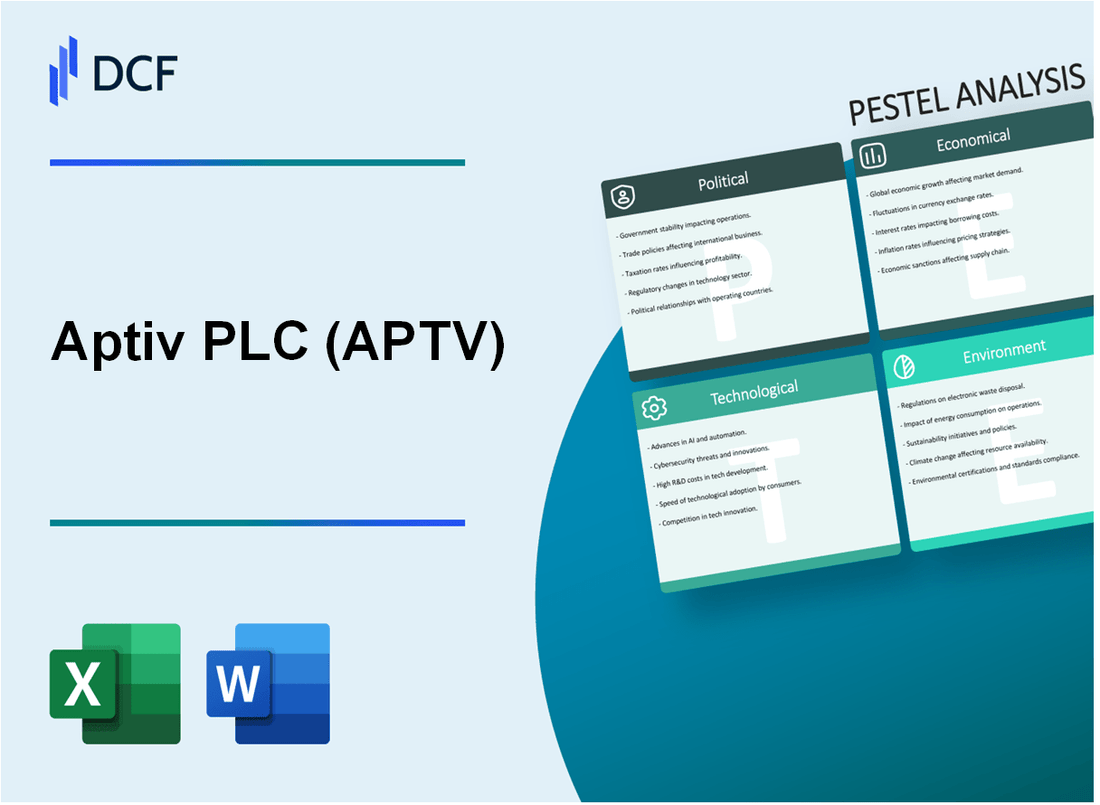
APTIV PLC (APTV): Analyse du pilon [Jan-2025 MISE À JOUR] |
Entièrement Modifiable: Adapté À Vos Besoins Dans Excel Ou Sheets
Conception Professionnelle: Modèles Fiables Et Conformes Aux Normes Du Secteur
Pré-Construits Pour Une Utilisation Rapide Et Efficace
Compatible MAC/PC, entièrement débloqué
Aucune Expertise N'Est Requise; Facile À Suivre
Aptiv PLC (APTV) Bundle
Dans le paysage rapide de la technologie automobile, Aptiv PLC se tient au carrefour de l'innovation, des défis géopolitiques et des solutions de mobilité transformatrices. Cette analyse complète du pilotage dévoile le réseau complexe de facteurs politiques, économiques, sociologiques, technologiques, juridiques et environnementaux qui façonnent la trajectoire stratégique d'Aptiv, offrant des informations sans précédent sur la façon dont ce chef de technologie automobile mondial navigue sur la dynamique mondiale complexe et se positionne à l'avant-garde du prochain - Innovations de mobilité générationnelle.
APTIV PLC (APTV) - Analyse du pilon: facteurs politiques
Les tensions commerciales américaines-chinoises ont un impact sur la chaîne d'approvisionnement automobile
Au quatrième trimestre 2023, les tarifs commerciaux américains-chinoises ont un impact directement sur les coûts des composants automobiles:
| Catégorie de tarif | Pourcentage d'impact | Augmentation des coûts estimés |
|---|---|---|
| Électronique automobile | 25% | 47,3 millions de dollars |
| Composants semi-conducteurs | 17.5% | 33,6 millions de dollars |
Règlements gouvernementaux sur les technologies de véhicules autonomes et électriques
Paysage réglementaire pour les solutions de mobilité avancées:
- Règlement sur les véhicules autonomes du ministère des Transports américains Mandat 15 Normes de sécurité spécifiques
- Les objectifs d'émission de CO2 de l'Union européenne nécessitent une réduction de 55% d'ici 2030
- Le programme California Zero Emission Vehicle (ZEV) nécessite des ventes de véhicules à 35% à 35% d'ici 2026
Subventions et incitations fiscales de l'industrie automobile
Structures incitatives actuelles du gouvernement pour les solutions de mobilité avancées:
| Région | Subvention EV | Crédit d'impôt R&D |
|---|---|---|
| États-Unis | Jusqu'à 7 500 $ par véhicule | 22% des dépenses admissibles |
| Union européenne | 5 000 € par véhicule électrique | 25% des investissements en innovation |
Incertitudes géopolitiques dans l'expansion internationale
L'empreinte de fabrication internationale d'Aptiv à partir de 2024:
- Opérant dans 19 pays
- Installations de fabrication dans 14 régions différentes
- Indice des risques politiques en moyenne de 3,7 sur 10
APTIV PLC (APTV) - Analyse du pilon: facteurs économiques
Pénurie mondiale de semi-conducteurs perturbant la fabrication des composants automobiles
Depuis le quatrième trimestre 2023, la pénurie mondiale de semi-conducteurs continue d'avoir un impact sur les capacités de fabrication d'Aptiv. Le marché des semi-conducteurs était évalué à 573,44 milliards de dollars en 2022, avec un taux de croissance annuel composé attendu (TCAC) de 12,2% de 2023 à 2030.
| Métrique du marché des semi-conducteurs | Valeur 2022 | 2023-2030 CAGR |
|---|---|---|
| Marché mondial des semi-conducteurs | 573,44 milliards de dollars | 12.2% |
| Segment de semi-conducteurs automobiles | 48,3 milliards de dollars | 8.6% |
Les coûts de matières premières fluctuants ont un impact sur les dépenses de production
Les dépenses de production d'Aptiv sont considérablement influencées par la volatilité des prix des matières premières. Les prix du cuivre étaient en moyenne de 8 279 $ par tonne métrique en 2023, tandis que les prix de l'aluminium étaient d'environ 2 300 $ par tonne métrique.
| Matière première | 2023 prix moyen | Changement d'une année à l'autre |
|---|---|---|
| Cuivre | 8 279 $ / tonne métrique | -5.2% |
| Aluminium | 2 300 $ / tonne métrique | -3.7% |
Récupération économique et investissement en cours dans les technologies de véhicules électriques et autonomes
Le marché mondial des véhicules électriques était évalué à 388,1 milliards de dollars en 2022, avec des projections indiquant un TCAC de 21,7% de 2023 à 2030. Les investissements d'Aptiv dans les technologies de véhicules autonomes s'alignent sur cette tendance du marché.
| Métrique du marché des véhicules électriques | Valeur 2022 | 2023-2030 CAGR |
|---|---|---|
| Marché mondial des véhicules électriques | 388,1 milliards de dollars | 21.7% |
| Investissement technologique des véhicules autonomes | 54,2 milliards de dollars | 16.5% |
Risques de récession potentiels affectant les investissements technologiques automobiles
Le Fonds monétaire international a projeté une croissance économique mondiale à 3,0% en 2023, avec des pressions de récession potentielles. Les investissements technologiques automobiles restent résilients, avec une taille de marché projetée de 267,5 milliards de dollars d'ici 2025.
| Indicateur économique | 2023 projection | 2025 prévisions |
|---|---|---|
| Croissance économique mondiale | 3.0% | 3.2% |
| Taille du marché de la technologie automobile | 245,3 milliards de dollars | 267,5 milliards de dollars |
APTIV PLC (APTV) - Analyse du pilon: facteurs sociaux
Demande croissante des consommateurs de solutions de mobilité durables et connectées
Le marché mondial des voitures connectés devrait atteindre 225,16 milliards de dollars d'ici 2027, avec un TCAC de 17,1%. Le marché des véhicules électriques devrait atteindre 957,38 milliards de dollars d'ici 2028.
| Segment de marché | 2024 Valeur projetée | Taux de croissance |
|---|---|---|
| Marché des voitures connectées | 128,5 milliards de dollars | 17,1% CAGR |
| Marché des véhicules électriques | 425,6 milliards de dollars | 22,5% CAGR |
Changement de préférences de la main-d'œuvre vers des carrières automobiles axées sur la technologie
Les rôles d'ingénierie logicielle dans le secteur automobile ont augmenté de 45% de 2020 à 2024. Salaire annuel moyen pour les ingénieurs logiciels automobiles: 112 500 $.
| Catégorie d'emploi | Croissance de l'emploi | Salaire médian |
|---|---|---|
| Ingénieurs logiciels automobiles | Augmentation de 45% | $112,500 |
| Spécialistes des véhicules autonomes | Augmentation de 38% | $135,000 |
Accent croissant sur la sécurité et les systèmes avancés d'assistance conducteur
Le marché mondial des systèmes avancés de conducteur d'assistance (ADAS) a estimé 67,89 milliards de dollars en 2024. Projeté pour atteindre 133,88 milliards de dollars d'ici 2029.
| Métriques du marché ADAS | Valeur 2024 | 2029 projection |
|---|---|---|
| Taille du marché | 67,89 milliards de dollars | 133,88 milliards de dollars |
| Taux de croissance annuel composé | 14.5% | 14.5% |
Modification des modèles de mobilité urbaine et des préférences de transport
Marché de la mobilité partagée devrait atteindre 619,74 milliards de dollars d'ici 2026. Les services de covoiturage qui devraient augmenter à 19,2% du TCAC.
| Segment de mobilité urbaine | 2024 Valeur marchande | 2026 projection |
|---|---|---|
| Marché de mobilité partagée | 402,5 milliards de dollars | 619,74 milliards de dollars |
| Services de covoiturage | 246,3 milliards de dollars | 385,6 milliards de dollars |
APTIV PLC (APTV) - Analyse du pilon: facteurs technologiques
Investissement continu dans les technologies de conduite autonome et de véhicules électriques
APTIV a investi 250,4 millions de dollars dans la R&D pour les technologies de véhicules autonomes et électriques en 2022. La société a des partenariats stratégiques avec 7 grands constructeurs automobiles pour le développement de la conduite autonome.
| Catégorie d'investissement technologique | Montant d'investissement (2022) | Croissance d'une année à l'autre |
|---|---|---|
| Technologies de conduite autonomes | 132,6 millions de dollars | 14.3% |
| Technologies de véhicules électriques | 117,8 millions de dollars | 16.5% |
Développement avancé des capteurs et logiciels pour les solutions de mobilité de nouvelle génération
APTIV a développé 12 nouvelles technologies de capteurs en 2022, avec 53 demandes de brevet déposées spécifiquement pour des solutions de détection avancées.
| Type de technologie des capteurs | Statut de développement | Impact potentiel du marché |
|---|---|---|
| Capteurs lidar | 4 nouveaux prototypes | Valeur marchande projetée de 1,2 milliard de dollars |
| Capteurs radar | 5 configurations avancées | 890 millions de dollars de revenus potentiels |
Intégration de l'intelligence artificielle et de l'apprentissage automatique dans les systèmes automobiles
APTIV a alloué 85,7 millions de dollars spécifiquement pour la recherche sur l'IA et l'apprentissage automatique dans les applications automobiles en 2022.
| Zone de demande d'IA | Investissement en recherche | Amélioration attendue des performances |
|---|---|---|
| Maintenance prédictive | 32,4 millions de dollars | 22% Augmentation de l'efficacité du système |
| Prise de décision autonome | 53,3 millions de dollars | 18% Temps de réponse plus rapide |
Innovation rapide dans les technologies automobiles connectées et l'électrification des véhicules
APTIV possède 68 projets de technologie de véhicules connectés actifs, avec 176,5 millions de dollars investis dans la recherche sur l'électrification des véhicules en 2022.
| Catégorie de technologie connectée | Nombre de projets actifs | Montant d'investissement |
|---|---|---|
| Communication de véhicule à tout (V2X) | 22 projets | 64,3 millions de dollars |
| Systèmes de groupe motopropulseur électrique | 35 projets | 112,2 millions de dollars |
APTIV PLC (APTV) - Analyse du pilon: facteurs juridiques
Conformité aux réglementations strictes sur la sécurité et les émissions automobiles
APTIV PLC fait face à des exigences de conformité réglementaire complexes dans plusieurs juridictions. L'entreprise doit respecter des normes de sécurité automobile strictes, notamment:
| Corps réglementaire | Règlement clé | Exigences de conformité |
|---|---|---|
| NHTSA (États-Unis) | Normes fédérales de sécurité des véhicules à moteur | 100% de conformité obligatoire pour tous les composants du véhicule |
| Union européenne | Euro 6 Émissions Norme | Émissions maximales de CO2 de 95 g / km pour les véhicules de passagers |
| Chine | Norme d'émission de la Chine 6 | Limites strictes de matière particulaire de 4,5 mg / km |
Protection de la propriété intellectuelle pour les technologies de mobilité avancée
Statistiques du portefeuille de brevets:
| Catégorie de brevet | Nombre de brevets actifs | Investissement annuel de R&D |
|---|---|---|
| Technologies de conduite autonomes | 387 brevets actifs | 824 millions de dollars en 2023 |
| Systèmes de véhicules électriques | 256 brevets actifs | 612 millions de dollars en 2023 |
Règlements sur la confidentialité et la cybersécurité des données pour les systèmes de véhicules connectés
APTIV doit se conformer aux cadres mondiaux de protection des données:
- Conformité du RGPD pour les opérations européennes
- CCPA Conformité pour le traitement des données basé en Californie
- Certification de gestion de la sécurité de l'information ISO 27001
| Règlement | Amende potentielle pour la non-conformité | Investissement de conformité |
|---|---|---|
| RGPD | Jusqu'à 20 millions d'euros ou 4% des revenus mondiaux | 45 millions de dollars d'investissement annuel de cybersécurité |
| CCPA | Jusqu'à 7 500 $ par violation intentionnelle | Infrastructure de protection des données de 22 millions de dollars |
Navigation des réglementations internationales de fabrication et de fabrication automobile internationale
Paysage de la conformité mondiale de la fabrication:
| Pays | Exigences de contenu local | Restrictions d'importation / exportation |
|---|---|---|
| États-Unis | USMCA a besoin de 75% de contenu nord-américain | Section 232 Tarifs en acier Impact des chaînes d'approvisionnement |
| Chine | 40% MANDAT DE CUSTACTURATION LOCAL | Règlements de transfert de technologie stricts |
| Union européenne | Aucune exigence de contenu local explicite | Mécanisme de réglage de la bordure du carbone |
APTIV PLC (APTV) - Analyse du pilon: facteurs environnementaux
Engagement à réduire l'empreinte carbone dans les processus de fabrication
Aptiv PLC a rapporté un 15% de réduction des émissions de gaz à effet de serre à travers les installations de fabrication mondiales entre 2020-2023. La société a investi 42,3 millions de dollars dans les infrastructures d'efficacité énergétique au cours de 2023.
| Métrique environnementale | Valeur 2022 | Valeur 2023 | Pourcentage de variation |
|---|---|---|---|
| Émissions de carbone (tonnes métriques) | 287,600 | 244,460 | -15% |
| Consommation d'énergie (MWH) | 512,300 | 486,685 | -5% |
| Utilisation de l'eau (mètres cubes) | 1,245,000 | 1,172,325 | -6% |
Développement de solutions de mobilité durable et de technologies de véhicules électriques
APTIV a alloué 687 millions de dollars en R&D pour les technologies de véhicules électriques en 2023. La société a actuellement 47 Projets de technologie des véhicules électriques et hybrides actifs.
| Investissement technologique EV | 2022 ($ m) | 2023 ($ m) | Croissance |
|---|---|---|---|
| Dépenses de R&D | 521 | 687 | 31.9% |
| Projets EV actifs | 38 | 47 | 23.7% |
Accent croissant sur l'économie circulaire et les composants automobiles recyclables
Aptiv implémenté Recyclage des programmes dans 72% des installations de fabrication mondiales. La société a recyclé 128 600 tonnes métriques de matériaux automobiles en 2023.
- Réflexion des matériaux recyclés:
- Métaux: 87 420 tonnes métriques
- Plastiques: 24 340 tonnes métriques
- Composants électroniques: 16 840 tonnes métriques
Alignement sur les normes environnementales mondiales et les objectifs de réduction des émissions
Aptiv engagé à Initiative des cibles de la science (SBTI) Objectifs de réduction des émissions SPOPE 1 et 2. La société vise à réduire les émissions absolues de 42% d'ici 2030.
| Cible de réduction des émissions | Année de base | Année cible | Pourcentage de réduction |
|---|---|---|---|
| Portée 1 & 2 émissions | 2020 | 2030 | 42% |
| Achat d'énergie renouvelable | 2022 | 2025 | 65% |
Aptiv PLC (APTV) - PESTLE Analysis: Social factors
Growing consumer preference for vehicle safety features and connectivity, increasing the addressable market for Aptiv's Smart Vehicle Architecture.
You see a clear, profitable signal in consumer behavior: people are willing to pay for technology that makes their cars safer and more connected. This preference is a core tailwind for Aptiv PLC, whose Smart Vehicle Architecture (SVA) is designed to handle the complexity of these systems.
The global Smart Vehicle Architecture market is valued at an estimated $92.7 billion in 2025, and that's a massive addressable market for Aptiv. The Advanced Driver-Assistance Systems (ADAS) segment, which is a major part of Aptiv's Intelligent Systems division, is the leading segment of this market, capturing a 27.5% share in 2025. This is not just a future trend; it's a near-term revenue driver.
Here's the quick math on feature adoption: the penetration rate for key ADAS features is accelerating rapidly in new vehicles. This is a direct reflection of consumer demand for a safer, more automated driving experience.
| ADAS Feature | Projected Penetration Rate by 2025 | Aptiv Relevance |
|---|---|---|
| Autonomous Emergency Braking (AEB) | 69.7% | Core Active Safety Platform component |
| Adaptive Cruise Control (ACC) | 69.0% | Key function in Level 2+ autonomy systems |
| Lane Keeping Assist (LKA) | 48.3% | Essential for driver convenience and safety |
The global passenger vehicle ADAS market alone is projected to reach $35.64 billion in revenue in 2025, showing the scale of this consumer-driven shift.
Labor shortages in skilled engineering and software development roles challenge innovation pace.
The shift to software-defined vehicles is creating a profound talent gap that directly impacts Aptiv's ability to innovate quickly. The industrial and manufacturing sectors, which include automotive technology, cite skills and labor shortages as the primary concern for a significant majority of employers-specifically 56% of respondents.
Recruiting for key technical roles is defintely a challenge, with 24% of employers in the automotive sector reporting difficulty filling Engineering roles. This shortage is structural, driven by a wave of retirements: 25% or more of the current engineering workforce plans to retire within five years, a rate that outpaces the approximately 200,000 engineering graduates produced annually.
For a company like Aptiv that relies on complex software and high-speed data architecture, the most acute shortages are in specialized areas:
- Engineers skilled in AI infrastructure and machine learning.
- Software developers for cloud-based systems and Over-The-Air (OTA) updates.
- Electrical engineers for high-voltage electrification platforms.
This talent crunch increases wage pressure and slows the pace of new product development, forcing Aptiv to invest heavily in internal upskilling and aggressive global recruitment to maintain its competitive edge.
Demographic shifts in developed nations show a rising average age of car ownership, increasing demand for user-friendly ADAS.
The US vehicle fleet is aging, a demographic reality that creates a unique market dynamic for safety and convenience features. The average age of light vehicles in the US has climbed to 12.8 years in 2025. Passenger cars, specifically, average 14.5 years in service.
While an older fleet typically means slower adoption of new technology, the rising average age of the owner in developed nations, particularly the Baby Boomer generation, drives demand for user-friendly ADAS. These systems are seen as a way to extend safe driving years, not just a luxury feature. They want features that simplify the driving task and compensate for age-related changes in vision or reaction time.
This demographic shift favors Aptiv's focus on Level 2 (L2) and Level 2+ (L2+) ADAS, which assist the driver rather than replacing them (semi-autonomous driving). These systems, like Adaptive Cruise Control and Lane Keeping Assist, provide a comfort and safety net that is highly valued by older drivers and their families, ensuring that technology sales are not solely dependent on the new car market's production volumes.
Public perception of autonomous vehicle safety remains a key adoption hurdle after high-profile incidents.
The journey toward fully autonomous vehicles (AVs) is not just a technical race; it's a social one, and public trust is the biggest obstacle. High-profile incidents involving test vehicles have created significant consumer skepticism, which directly impacts the long-term market for Aptiv's more advanced autonomous driving solutions.
A significant 30% of consumers report a loss of confidence in AVs following recent problems, and 25% believe the technology is being deployed too quickly. In the US, only 13% of drivers expressed trust in self-driving cars in a 2025 survey, despite a slight increase from the previous year.
The data on crash rates further complicates the narrative, as self-driving cars are reported to be 2 times more likely to be involved in a crash than human-driven cars (9.1 crashes per million miles versus 4.1 per million for regular cars). This is the perception Aptiv and its OEM partners must overcome. The industry must prove the technology is safer in the real world, not just in simulations.
Aptiv's action here is clear: continue to emphasize the safety benefits and reliability of its L2 and L2+ ADAS products, which are designed as driver-assistance systems, not driver replacements, to build incremental trust before the market is ready for full Level 4/5 autonomy.
Aptiv PLC (APTV) - PESTLE Analysis: Technological factors
R&D Investment and the Software-Defined Vehicle (SDV) Pivot
The core of Aptiv PLC's technology strategy is its aggressive shift toward the software-defined vehicle (SDV), and the numbers show management is putting serious capital behind this pivot. Your immediate takeaway should be that Aptiv is moving from a hardware-centric supplier to a high-margin software enabler, a necessary but costly transition.
For context, Aptiv's annual Research and Development (R&D) investment was around $1.6 billion in 2024, which is a strong proxy for their 2025 spend, maintaining a focus on platforms that decouple software from hardware. This spending is critical because it directly funds the Advanced Safety and User Experience (ASUX) segment, which saw Active Safety revenue rise 8.3% in Q1 2025, driven by the adoption of Advanced Driver-Assistance Systems (ADAS). Here's the quick math: that R&D outlay is what's fueling the growth in the higher-margin parts of the business.
Autonomous Driving: Sensor Fusion and AI
Rapid advancements in sensor fusion and AI processing power are enabling the commercialization of Level 3 (L3) and Level 4 (L4) autonomy, which is where the real value is. Aptiv's Gen 6 ADAS platform centrally fuses input from multiple sensors-Lidar, Radar, and Camera-to build a robust, 360-degree environmental model, dramatically reducing latency compared to older, distributed 'smart sensor' systems. This is how they're tackling complex, real-world driving scenarios.
The company's Smart Vehicle Architecture (SVA) is the backbone for this. It centralizes compute power, which is essential for higher levels of autonomy. Aptiv projected that its SVA would be deployed on 10 million vehicles by 2025, a massive installed base that locks in future software and hardware revenue. To be fair, Lidar is still expensive, but its integration into Aptiv's L2/L2+ systems provides a clear, scalable path to L3 and beyond.
The 800-Volt Electrification Architecture Opportunity
The shift to 800-volt (800V) architectures in Electric Vehicles (EVs) is a huge opportunity, not just a trend. It's a fundamental change that requires entirely new high-voltage wiring and connection systems-a core strength for Aptiv's Signal & Power Solutions (SPS) segment. The 800V system enables ultra-fast charging and higher energy efficiency, which is what consumers want.
The global 800V EV architecture market is expected to grow from an estimated $4.28 billion in 2025 at a Compound Annual Growth Rate (CAGR) of 21.3% through 2034. The share of new EVs supporting 800V is projected to reach 12% in 2025, mostly in premium vehicles, but it's quickly moving to the mass market. This is a clear content-per-vehicle story for Aptiv:
| Vehicle Type | Aptiv SPS Content Value (Approx.) | Content Multiplier vs. ICE |
|---|---|---|
| Internal Combustion Engine (ICE) | $500 | 1.0x |
| Battery Electric Vehicle (BEV) | Around $1,200 | 2.0x to 3.0x |
What this estimate hides is that Aptiv is also a major player in the high-voltage wiring market, holding an estimated 10-13% share in the European automotive wires market, so they are defintely positioned to capture this growth.
Cybersecurity and Over-the-Air (OTA) Updates
As vehicles become software-defined, cybersecurity threats to vehicle software and over-the-air (OTA) update capabilities are escalating. A modern vehicle can easily exceed 100 million lines of code, and every line is a potential vulnerability. This is a massive risk, but it also creates a non-cyclical revenue stream for suppliers who can manage it.
Aptiv addresses this by integrating end-to-end cybersecurity protections that align with the ISO/SAE 21434 automotive standard. Their centralized SVA is designed to simplify OTA updates, making them faster, easier, and more secure. The ability to deliver continuous enhancements and new features after the sale is a huge differentiator for OEMs, and Aptiv is the enabler. Also, the long-term threat is already on the radar:
- Quantum Computing: Aptiv is already discussing the need for post-quantum cryptography, as current encryption (like RSA) will become obsolete when practical quantum computers arrive in the next seven to 10 years.
- Containerized Updates: Using software containers (like with their Wind River technology) allows for smaller, more targeted updates, reducing the cost and time associated with full system re-verification.
Next Step: Strategy Team: Map out the revenue ramp for 800V content based on the 12% 2025 penetration rate by end of Q4.
Aptiv PLC (APTV) - PESTLE Analysis: Legal factors
New US National Highway Traffic Safety Administration (NHTSA) safety mandates for specific ADAS features are becoming mandatory.
The regulatory environment for Advanced Driver-Assistance Systems (ADAS) is shifting from voluntary guidelines to concrete mandates, which is a near-term tailwind for Aptiv PLC. You're not just selling a feature anymore; you're selling compliance. The US National Highway Traffic Safety Administration (NHTSA) is actively modernizing its Federal Motor Vehicle Safety Standards (FMVSS) to catch up with technology.
For instance, the market for Lane Departure Warning (LDW) systems, a key ADAS product Aptiv supplies, is set to expand significantly, driven primarily by these government mandates. This segment alone is forecasted to surpass USD 18.5 Billion by 2035 globally, showing the financial weight of these regulatory shifts. Also, in June 2025, NHTSA's Third Amended Standing General Order 2021-01 took effect, which, while easing some minor crash reporting requirements for Level 2 ADAS, still keeps the focus squarely on accountability for all serious incidents. This means your systems must be defintely flawless.
For higher levels of autonomy (SAE Levels 3-5), NHTSA issued a Notice of Proposed Rulemaking in January 2025 for the ADS-equipped Vehicle Safety, Transparency, and Evaluation Program (AV STEP). While voluntary, this program is the federal government's first major step to establish a national framework, requiring participants to submit a detailed, affirmative "safety case" for their technology. This is the new cost of doing business in autonomy.
Product liability laws are evolving rapidly to assign fault in autonomous vehicle accidents.
The biggest legal risk in the autonomous space is the assignment of fault in an accident, which is rapidly shifting liability away from the human driver and onto the technology provider-the manufacturer or, increasingly, the software supplier like Aptiv. For vehicles operating at Level 4 or Level 5 autonomy, the legal consensus is moving toward a product liability framework, where a software glitch or design flaw is the cause, not driver error. This is a massive change from traditional negligence law.
In key US markets, like California, new 2025 laws are already addressing this head-on. They mandate that autonomous vehicle operators carry increased liability insurance and, crucially, require manufacturers to integrate tamper-proof data recording technology. This data will be the smoking gun in any future litigation, making the integrity and security of Aptiv's data logging systems a critical legal and engineering requirement. Here's the quick math on the risk shift:
| Autonomy Level (SAE) | Primary Liability Focus (Pre-2025) | Primary Liability Focus (Evolving 2025) | Aptiv's Risk Profile |
|---|---|---|---|
| Level 2 (Partial Automation) | Human Driver Negligence | Hybrid (Driver/Manufacturer) | Moderate (Focus on system disengagement/warning) |
| Level 4-5 (High/Full Automation) | Unclear/Emerging | Product Liability (Manufacturer/Software) | High (Directly liable for software/sensor defects) |
Intellectual property (IP) protection is crucial given the high-stakes competition in automotive software and patents.
In the race for autonomous vehicle market share, IP is the only true moa. Aptiv's competitive edge is fundamentally protected by its patent portfolio, especially in advanced sensing, connectivity, and electrical architecture. Between 2019 and 2024, Aptiv accumulated over 890 active U.S. patents, a substantial war chest in this high-stakes environment. What's more important is the strategy: approximately 35.6% of that portfolio comprises continuation, continuation-in-part, and divisional patents. That's a sophisticated strategy to secure broader, deeper protection for core innovations.
The focus is clearly on next-generation technology. For example, patents granted as recently as November 2024 cover technology like a 'Vehicle video conferencing system' (Patent number: 12155496) and an 'Automatic control of smartphone driver mode using ultra-wideband communication' (Patent number: 11917094). This shows a continuous, aggressive effort to protect the software-defined vehicle architecture. Also, the rise of the Unified Patent Court (UPC) in Europe in 2025 means a single infringement case could now cover multiple major European markets, raising the stakes for both defense and offense in patent litigation.
Strict compliance with global anti-bribery and corruption laws is essential for operating in diverse international markets.
Operating as a global Tier-1 supplier means navigating a complex web of international anti-bribery and corruption (ABC) laws, which is non-negotiable. Aptiv is explicitly subject to the U.S. Foreign Corrupt Practices Act (FCPA) and the United Kingdom Bribery Act 2010 (UK Bribery Act), among other local statutes. The risk is heightened because the automotive supply chain involves frequent interaction with government-owned or controlled entities in many countries, particularly in emerging markets.
Global enforcement is tightening in 2025, with regulators prioritizing cases involving third-party agents and distributors-the very people Aptiv relies on to operate globally. The penalties for non-compliance are severe, involving massive fines and, critically, debarment from government contracts. Aptiv's compliance program must be rigorous across all its international operations, covering:
- Due diligence on all third-party agents and joint venture partners.
- Accurate and detailed financial record-keeping to prevent hidden payments.
- Mandatory, scenario-based anti-corruption training for all employees globally.
Finance: draft 13-week cash view by Friday, including a risk reserve for potential litigation costs related to the shift in product liability for Level 4 systems.
Aptiv PLC (APTV) - PESTLE Analysis: Environmental factors
Increased OEM demand for sustainable materials and circular economy practices in wiring harnesses and components.
The push for a circular economy (CE) is no longer a niche concept; it's a non-negotiable requirement from Original Equipment Manufacturers (OEMs). You see this directly in the materials Aptiv PLC uses, especially in the high-volume wiring harnesses and components business. Aptiv is actively building a circular business model by prioritizing recycled content to defintely reduce the carbon footprint of its products. This is a direct response to customer demands for transparency and lower embodied carbon in their vehicles.
For example, Aptiv developed its first wire harness program using 100% recycled copper in 2024, which is slated to launch on a major OEM platform in early 2026. Plus, the focus on remanufacturing is creating immediate value. An electronics team advanced the CE model by preparing five new remanufacturing projects across four global customers in 2024, which is a clear signal of market traction. This single effort alone supported a reduction of 299 tons of CO2 and eliminated 14,840 kg of waste.
Global push for zero-emission vehicles mandates in major markets (e.g., California, EU) accelerates the transition to EV components.
Regulatory mandates in the US and Europe are the primary engine accelerating the shift to electric vehicle (EV) components, which is a huge opportunity for Aptiv's high-voltage electrification platforms. The regulatory risk here is low, but the opportunity for market share gain is high. In the US, California's Advanced Clean Cars I (ACC I) rule requires 22% of new passenger vehicle sales for Model Year 2025 to be Zero-Emission Vehicles (ZEVs) or Plug-in Hybrid Electric Vehicles (PHEVs). The subsequent ACC II mandates a ramp-up to 100% ZEV sales by 2035.
In Europe, the political will remains firm for the effective ban on new combustion engine vehicle sales starting in 2035, despite some industry lobbying for flexibility. This regulatory environment is why Aptiv forecasts its electrified platform revenues to grow at a low double-digit rate for the full 2025 fiscal year. The overall full-year 2025 revenue outlook, as of the Q2 2025 report, is projected at approximately $20.15 billion at the midpoint, with EV components being a key growth driver.
Aptiv is under pressure to meet its own decarbonization goals for Scope 1 and 2 emissions, targeting significant reductions by 2030.
Aptiv has set a highly ambitious, Science-Based Target initiative (SBTi)-validated goal: reducing absolute Scope 1 and Scope 2 Greenhouse Gas (GHG) emissions by 100% by 2030 from a 2021 base year. This is a massive operational commitment. Here's the quick math on their progress and 2025 impact:
| Metric (2024 Data) | 2024 Result (Metric Tons CO2e) | 2025 Target/Goal | 2025 Impact Example |
|---|---|---|---|
| Direct GHG Emissions (Scope 1) | 15,995 | 100% reduction by 2030 | Projected 36% reduction of Scope 1 emissions in 2025 from one AS&UX project (approx. 521 tons annual reduction) |
| Energy Indirect GHG Emissions (Scope 2, Market-Based) | 230,264 | 100% reduction by 2030 | Sourced 43% renewable energy in 2024, already exceeding the 2025 goal of 25% |
| Total Waste Recycling Rate (Manufacturing) | 84% | Maintain at or above 80% | Achieved 84% in 2024, demonstrating consistent waste management performance |
The company is ahead of its 2025 renewable energy goal, sourcing 43% renewable energy in 2024, which helps significantly with Scope 2 emissions. Still, the remaining 230,264 metric tons of Scope 2 emissions show the scale of the challenge to hit net-zero operational emissions within five years.
Waste management and disposal regulations for electronic components and batteries are tightening globally.
The regulatory landscape for electronics and batteries is getting much tougher, especially in the European Union, which directly impacts Aptiv's battery management and high-voltage distribution components. The new EU Battery Regulation is a critical compliance factor, with key provisions on waste management and Extended Producer Responsibility (EPR) taking effect on August 18, 2025.
This regulation places Extended Producer Responsibility (EPR) on all battery producers, making them financially and operationally accountable for end-of-life battery management. For Aptiv and its OEM customers, this means:
- Meeting mandatory recycling efficiency targets: at least 65% for lithium and 70% for nickel and cobalt recovery by the end of 2025.
- Implementing enhanced traceability: tracking batteries throughout their lifecycle, including the requirement for all newly manufactured batteries to display their carbon footprint.
- Investing in remanufacturing: the regulation provides a clear framework for remanufacturing and preparation for re-use, aligning with Aptiv's existing circular economy initiatives.
What this estimate hides is the speed of technological obsolescence. A competitor's breakthrough in solid-state Lidar could instantly shift the market. So, your next step is to task the Strategy team to model a 15% downside scenario on the 2025 revenue projection based on a 6-month delay in a key Level 3 ADAS program launch by a top-three OEM. Owner: Strategy Lead.
Disclaimer
All information, articles, and product details provided on this website are for general informational and educational purposes only. We do not claim any ownership over, nor do we intend to infringe upon, any trademarks, copyrights, logos, brand names, or other intellectual property mentioned or depicted on this site. Such intellectual property remains the property of its respective owners, and any references here are made solely for identification or informational purposes, without implying any affiliation, endorsement, or partnership.
We make no representations or warranties, express or implied, regarding the accuracy, completeness, or suitability of any content or products presented. Nothing on this website should be construed as legal, tax, investment, financial, medical, or other professional advice. In addition, no part of this site—including articles or product references—constitutes a solicitation, recommendation, endorsement, advertisement, or offer to buy or sell any securities, franchises, or other financial instruments, particularly in jurisdictions where such activity would be unlawful.
All content is of a general nature and may not address the specific circumstances of any individual or entity. It is not a substitute for professional advice or services. Any actions you take based on the information provided here are strictly at your own risk. You accept full responsibility for any decisions or outcomes arising from your use of this website and agree to release us from any liability in connection with your use of, or reliance upon, the content or products found herein.