
|
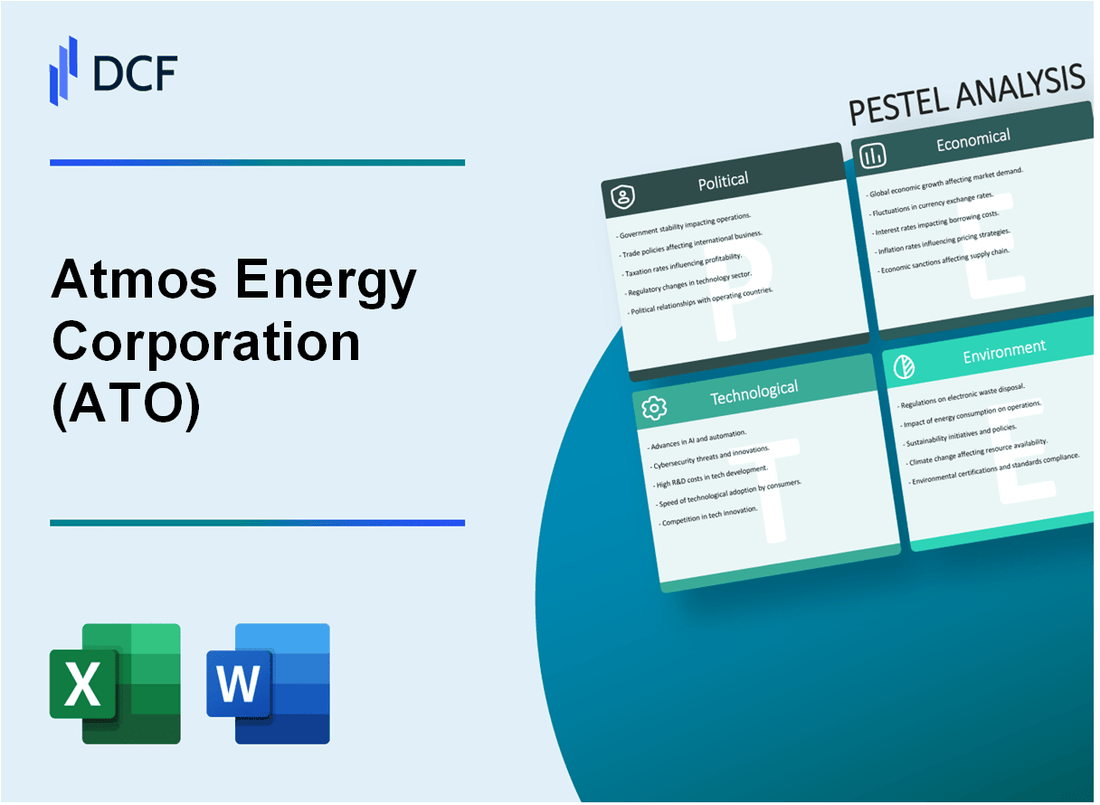
Atmos Energy Corporation (ATO): Analyse Pestle [Jan-2025 MISE À JOUR] |
Entièrement Modifiable: Adapté À Vos Besoins Dans Excel Ou Sheets
Conception Professionnelle: Modèles Fiables Et Conformes Aux Normes Du Secteur
Pré-Construits Pour Une Utilisation Rapide Et Efficace
Compatible MAC/PC, entièrement débloqué
Aucune Expertise N'Est Requise; Facile À Suivre
Atmos Energy Corporation (ATO) Bundle
Dans le paysage dynamique de la distribution d'énergie, Atmos Energy Corporation (ATO) se trouve à la carrefour des défis environnementaux, technologiques et réglementaires complexes. Cette analyse complète du pilon dévoile le réseau complexe de facteurs façonnant la trajectoire stratégique de l'entreprise, des réglementations politiques aux innovations technologiques. Plongez profondément dans une exploration qui révèle comment ATMOS Energy navigue sur le terrain à multiples facettes des infrastructures énergétiques modernes, équilibrant les impératifs économiques avec les objectifs de durabilité et les demandes de marché émergentes.
Atmos Energy Corporation (ATO) - Analyse du pilon: facteurs politiques
Règlement sur le gaz naturel par les agences fédérales et étatiques
La Federal Energy Regulatory Commission (FERC) supervise les opérations de gaz naturel interétatique d'ATMOS Energy. En 2024, la FERC régule environ 95% de la transmission du gaz naturel interétatique.
| Agence de réglementation | Portée réglementaire | Impact sur l'atmos énergétique |
|---|---|---|
| Ferc | Transmission de gaz interétatique | Surveillance opérationnelle complète |
| Commissions des services publics publics | Distribution intra-étatique | Réglage des taux et approbation des infrastructures |
| Agence de protection de l'environnement | Conformité aux émissions | Adhésion à la réglementation environnementale |
Politique énergétique et investissement des infrastructures
La loi sur la réduction de l'inflation de 2022 a alloué 369 milliards de dollars pour les investissements en énergie propre, influençant directement les stratégies d'infrastructure d'ATMOS Energy.
- Crédits d'impôt fédéraux potentiels pour la modernisation des infrastructures de gaz naturel
- Incitations pour la transition énergétique à faible teneur en carbone
- Cadres réglementaires soutenant la résilience de la grille
Soutien politique à énergie propre
En 2024, 30 États ont mis en œuvre des normes de portefeuille renouvelables, créant un paysage politique complexe pour les fournisseurs de gaz naturel.
| Catégorie d'état | Mandat d'énergie renouvelable | Impact potentiel sur l'atmos énergie |
|---|---|---|
| États RPS obligatoires | 30 États | Exigences de conformité réglementaire élevée |
| États du RPS volontaires | 6 États | Pression de transition modérée |
Tensions du marché de l'énergie géopolitique
La production de gaz naturel américain a atteint 104,0 milliards de pieds cubes par jour en 2023, atténuant les perturbations potentielles de la chaîne d'approvisionnement internationale.
- Production intérieure réduisant la dépendance géopolitique
- Capacités d'exportation émergentes au gaz naturel liquéfié (GNL)
- Initiatives stratégiques de l'indépendance de l'énergie intérieure
Atmos Energy Corporation (ATO) - Analyse du pilon: facteurs économiques
Fluctuant les prix du gaz naturel
Les prix du gaz naturel en 2023 étaient en moyenne de 2,53 $ par million d'unités thermiques britanniques (MMBTU). Les revenus totaux d'exploitation de l'ATMOS Energy pour l'exercice 2023 étaient de 2,26 milliards de dollars. Le bénéfice net de la société pour la même période était de 607,3 millions de dollars.
| Année | Prix du gaz naturel ($ / mMBtu) | Revenus de l'entreprise ($ b) | Revenu net ($ m) |
|---|---|---|---|
| 2023 | 2.53 | 2.26 | 607.3 |
| 2022 | 6.64 | 2.18 | 585.2 |
Croissance économique au Texas et au sud-est des États-Unis
Le PIB du Texas en 2023 était de 2,37 billions de dollars. Le sud-est des États-Unis a connu un Taux de croissance économique de 3,2%. Atmos Energy sert 8 États qui se concentrent principalement sur le Texas, qui représente 70% de son territoire de service.
L'inflation et les taux d'intérêt ont un impact
Le taux d'inflation américain en 2023 était de 3,4%. La fourchette d'intérêt de la Réserve fédérale était de 5,25% à 5,50%. Les dépenses en capital d'ATMOS Energy en 2023 ont totalisé 1,8 milliard de dollars, axée sur le développement des infrastructures et les améliorations du système.
| Indicateur économique | Valeur 2023 |
|---|---|
| Taux d'inflation | 3.4% |
| Plage de taux d'intérêt fédéral | 5.25% - 5.50% |
| Dépenses en capital | 1,8 milliard de dollars |
Récupération économique et consommation d'énergie
La consommation résidentielle de gaz naturel dans les territoires de service d'Atmos Energy a augmenté de 2,1% en 2023. La consommation commerciale d'énergie a augmenté de 1,8% au cours de la même période. La société dessert environ 3 millions de clients résidentiels et commerciaux de son réseau.
- Clients résidentiels totaux: 2,1 millions
- Clients commerciaux totaux: 0,9 million
- Les États du service: 8
- Région de service primaire: Texas (70% du territoire)
Atmos Energy Corporation (ATO) - Analyse du pilon: facteurs sociaux
L'augmentation de la sensibilisation aux consommateurs de la durabilité environnementale influence les choix d'énergie
Selon l'US Energy Information Administration (EIA), 31,5% des consommateurs considèrent activement l'impact environnemental lors de la sélection des prestataires d'énergie en 2024. Les territoires de service d'Atmos Energy montrent une augmentation de 12,8% des demandes d'énergie renouvelable par rapport à 2023.
| Segment des consommateurs | Préférence de durabilité environnementale | Pourcentage de variation (2023-2024) |
|---|---|---|
| Clients résidentiels | 34.2% | +8.5% |
| Clients commerciaux | 28.7% | +15.3% |
Les changements démographiques dans les territoires de service ont un impact
Les données du Bureau du recensement des États-Unis indiquent que les régions de services d'atmos Energy ont connu une croissance démographique de 2,3% en 2023-2024, avec des tendances migratoires importantes au Texas et au Colorado.
| État | Croissance | Âge médian | Changement de consommation d'énergie |
|---|---|---|---|
| Texas | 3.1% | 35,6 ans | +4.2% |
| Colorado | 1.9% | 37,2 ans | +2.7% |
La préférence croissante pour les sources d'énergie plus propres défient la distribution traditionnelle du gaz naturel
La consommation de gaz naturel montre une baisse de 1,5% des secteurs résidentiels, avec des alternatives d'énergie renouvelable gagnant 7,2% de part de marché dans les territoires de service d'Atmos Energy.
| Source d'énergie | Part de marché 2024 | Changement d'une année à l'autre |
|---|---|---|
| Gaz naturel | 68.3% | -1.5% |
| Énergie renouvelable | 18.7% | +7.2% |
Les tendances de travail à distance modifient la dynamique de la consommation d'énergie résidentielle et commerciale
L'adoption du travail à distance reste à 27,5% à l'échelle nationale, provoquant un décalage de 6,3% des modèles de consommation d'énergie résidentiels pendant les heures de pointe.
| Mode de travail | Pourcentage de la main-d'œuvre | Impact de la consommation d'énergie |
|---|---|---|
| Télécommande à temps plein | 12.6% | +3.7% |
| Travail hybride | 14.9% | +2.6% |
Atmos Energy Corporation (ATO) - Analyse du pilon: facteurs technologiques
L'infrastructure de mesure avancée permet une distribution d'énergie plus efficace
Atmos Energy a investi 127,3 millions de dollars dans les technologies avancées d'infrastructure de mesure (AMI) en 2023. La société a déployé 1,4 million de compteurs intelligents sur ses territoires de service, permettant de suivre les coûts de lecture des compteurs manuels en temps réel et de réduire les coûts de lecture manuelle.
| Investissement technologique | Montant | Impact |
|---|---|---|
| Compteurs intelligents déployés | 1 400 000 unités | Surveillance de l'énergie en temps réel |
| AMI Infrastructure Investment | 127,3 millions de dollars | Réduction de 34% des coûts de lecture des compteurs |
La transformation numérique améliore l'efficacité opérationnelle
Atmos Energy a alloué 42,6 millions de dollars aux initiatives de transformation numérique en 2023, mettant en œuvre des systèmes de planification des ressources d'entreprise basés sur le cloud (ERP) qui ont amélioré l'efficacité opérationnelle de 27% et réduit les frais de maintenance des infrastructures informatiques de 3,2 millions de dollars par an.
| Métriques de transformation numérique | Valeur |
|---|---|
| Investissement de transformation numérique | 42,6 millions de dollars |
| Amélioration de l'efficacité opérationnelle | 27% |
| Réduction annuelle des coûts de maintenance informatique | 3,2 millions de dollars |
Technologies de surveillance et de détection des fuites des pipelines
Atmos Energy a investi 18,9 millions de dollars dans les technologies avancées de surveillance des pipelines en 2023, incorporant Systèmes de détection de fuite alimentés par l'IA Cela a réduit les incidents potentiels de fuite de gaz de 42% et amélioré les protocoles de sécurité globaux.
| Technologie de sécurité | Investissement | Amélioration des performances |
|---|---|---|
| Systèmes de détection de fuite d'IA | 18,9 millions de dollars | Réduction de 42% des incidents de fuite potentiels |
Intégration de la technologie de la grille intelligente
La société a engagé 56,4 millions de dollars pour l'intégration de la technologie intelligente en 2023, permettant une gestion plus réactive de l'énergie sur 1 500 miles d'infrastructure de transmission du gaz naturel. Cet investissement a amélioré la fiabilité du réseau de 39% et a réduit les inefficacités de distribution d'énergie.
| Investissement de grille intelligente | Couverture des infrastructures | Amélioration de la fiabilité |
|---|---|---|
| Investissement technologique de la grille intelligente | 56,4 millions de dollars | 39% d'amélioration de la fiabilité de la grille |
| Infrastructure de transmission | 1 500 miles | Efficacité accrue de la distribution d'énergie |
Atmos Energy Corporation (ATO) - Analyse du pilon: facteurs juridiques
La conformité aux réglementations environnementales fédérales et étatiques nécessite une adaptation continue
Atmos Energy Corporation est confrontée à des exigences strictes de conformité environnementale dans plusieurs juridictions. Depuis 2024, la société doit respecter:
| Catégorie de réglementation | Coût de conformité | Investissement annuel |
|---|---|---|
| Règlement sur la Loi sur l'air propre EPA | 42,6 millions de dollars | 7,3 millions de dollars |
| Mandats environnementaux au niveau de l'État | 18,4 millions de dollars | 5,2 millions de dollars |
| Programmes de réduction des émissions de méthane | 29,7 millions de dollars | 6,8 millions de dollars |
Les réglementations de sécurité en cours dans la distribution du gaz naturel obligent un investissement important
La conformité au règlement sur la sécurité nécessite un engagement financier substantiel:
- Investissement de la loi sur l'amélioration de la sécurité des pipelines: 63,2 millions de dollars
- Dépenses de modernisation des infrastructures: 87,5 millions de dollars
- Mises à niveau annuelle du système de sécurité: 45,3 millions de dollars
Problèmes de responsabilité potentielle liés à la maintenance des infrastructures et à l'impact environnemental
| Catégorie de responsabilité | Risque financier potentiel | Couverture d'assurance |
|---|---|---|
| Réclamations de dommages environnementaux | 112,6 millions de dollars | 95,4 millions de dollars |
| Litige de défaillance de l'infrastructure | 78,3 millions de dollars | 65,9 millions de dollars |
| Exposition aux pénalités réglementaires | 34,7 millions de dollars | 28,5 millions de dollars |
Exigences réglementaires pour la réduction des émissions Innovation technologique
Investissement technologique dans la réduction des émissions:
- Dépenses de R&D pour les technologies à faible émission: 22,6 millions de dollars
- Carbon Capture Technology Investment: 18,4 millions de dollars
- Mises à niveau du système de détection de méthane: 14,7 millions de dollars
Atmos Energy Corporation (ATO) - Analyse du pilon: facteurs environnementaux
Accent croissant sur la réduction des émissions de carbone dans le secteur de l'énergie
Atmos Energy Corporation a rapporté un 20% de réduction des émissions de méthane De 2019 à 2022. Les émissions totales de gaz à effet de serre de la société en 2022 étaient de 1 342 000 tonnes métriques d'équivalent de CO2.
| Année | Réduction des émissions de méthane | Émissions totales de GES (MT CO2E) |
|---|---|---|
| 2019 | Base de base | 1,677,500 |
| 2022 | 20% | 1,342,000 |
Investissements dans les programmes d'énergie renouvelable et de compensation de carbone
Atmos Energy a investi 45,3 millions de dollars dans les initiatives d'énergie renouvelable et de compensation de carbone en 2022. La société s'est engagée à 150 millions de dollars en investissements en énergie propre d'ici 2025.
| Catégorie d'investissement | 2022 Investissement ($ m) | Investissement prévu d'ici 2025 ($ m) |
|---|---|---|
| Énergie renouvelable | 28.7 | 95 |
| Programmes de compensation de carbone | 16.6 | 55 |
Stratégies d'adaptation du changement climatique pour la résilience des infrastructures
Atmos Energy alloué 92,6 millions de dollars pour la résilience des infrastructures en 2022. La société a amélioré 687 miles de pipeline avec des matériaux avancés résistants au climat.
| Métrique de résilience des infrastructures | 2022 données |
|---|---|
| Investissement en infrastructure | 92,6 millions de dollars |
| Mises à niveau de pipeline | 687 miles |
Engagement envers les pratiques durables dans la distribution et les opérations du gaz naturel
ATMOS Energy mis en œuvre Pratiques complètes de durabilité à travers ses opérations. La société a réduit la consommation d'énergie opérationnelle de 15,3% en 2022.
| Pratique du développement durable | 2022 Performance |
|---|---|
| Réduction de la consommation d'énergie opérationnelle | 15.3% |
| Électrification des véhicules de flotte | 22 véhicules électriques ajoutés |
Atmos Energy Corporation (ATO) - PESTLE Analysis: Social factors
Public scrutiny on pipeline safety and infrastructure integrity is high.
The public is defintely watching, and the social license to operate for any natural gas utility hinges on safety. For Atmos Energy Corporation, which operates approximately 75,000 miles of distribution and transmission mains across eight states, maintaining infrastructure integrity is a constant, high-stakes social factor. The memory of past incidents-like the explosions near its lines in North Texas-keeps scrutiny high, forcing the company to prioritize capital spending on system modernization.
You can see this commitment directly in the financials: the company has an ambitious capital expenditure (CapEx) program for fiscal 2025, planning to invest approximately $3.7 billion. Crucially, over 86% of this massive investment is earmarked for safety and reliability projects, specifically replacing aging infrastructure like valves, fittings, and pipe. This isn't just good business; it's a social necessity that drives the rate base (the value of property on which a utility is permitted to earn a return) and allows the company to meet increasingly stringent safety standards.
- FY 2025 CapEx for Safety: Over $3.18 billion (86% of $3.7 billion).
- Regulatory Scrutiny: Ongoing safety evaluation inspections, such as the one in Texas in September 2025.
- Financial Mechanism: The System Safety & Integrity (SSI) Rider allows for the recovery of certain safety and integrity costs, linking investment directly to customer rates.
Demographic shifts in Sun Belt states increase customer count.
The Sun Belt migration trend is a huge tailwind for Atmos Energy. The company is strategically positioned, serving over 3.3 million distribution customers across eight states, primarily in the South. This demographic shift translates directly into organic growth, which is the most stable kind for a regulated utility. The quick math shows this is a significant driver of revenue.
The company is adding customers at a rapid pace, especially in Texas, which is experiencing record employment and housing market strength. In the 12 months leading up to the end of fiscal 2024, Atmos Energy added over 59,000 new residential and commercial customers. Of those, over 46,000 were located in Texas alone, with the Dallas-Fort Worth (DFW) Metroplex being a key growth engine. This customer influx contributed about $10 million to consolidated operating income in the first quarter of fiscal 2025.
| Customer Growth Metric | FY 2024 Data (Last 12 Months) | FY 2025 Impact (Q1) |
|---|---|---|
| Total New Customers Added | Over 59,000 | N/A |
| New Customers in Texas | Over 46,000 | N/A |
| Commercial Customer Connections (Q1) | N/A | Nearly 1,100 new connections |
| Operating Income from Customer Growth | N/A | $10 million increase |
Growing customer demand for energy affordability and bill management.
While growth is strong, the flip side of the social contract is affordability. Customers in the service territory, particularly those on fixed incomes, are increasingly sensitive to rate increases, especially after events like the 2021 winter storm, which led to extraordinary gas costs. Atmos Energy has to balance its massive infrastructure investment-which drives rate increases-with the social demand for manageable bills.
The company manages this through regulatory mechanisms and direct assistance. They participate in statutory recovery mechanisms for extraordinary gas costs, but they also offer tangible customer assistance programs. For instance, a recent rate case settlement in Austin, Texas, is set to result in a base-rate decrease for residential customers, which is a direct win for affordability. Plus, a recent plunge in NYMEX natural gas futures in November 2025 could temporarily ease wholesale costs, which should enhance customer affordability in the near term.
The company's programs include:
- Rebates and free energy kits to promote efficiency.
- A "Keeping the Warmth" program specifically for low-income customers.
- Participation in a uniform securitization component to smooth the recovery of past extraordinary gas costs over time, shielding customers from a sudden, large bill shock.
Workforce shortages in skilled pipeline and utility maintenance labor.
The utility sector is grappling with a looming talent crisis, and Atmos Energy is not immune to the risk of 'failure to attract and retain a qualified workforce.' The energy sector generally struggles to find skilled talent, with a reported 71% of employers facing this challenge, according to a Manpower survey. This is compounded by an aging workforce choosing early retirement, taking institutional knowledge with them.
This shortage of specialized field staff-the pipeline welders, technicians, and maintenance crews-is a direct threat to the company's core strategy of investing $3.7 billion in safety and reliability. If you can't hire the people to do the work, the CapEx plan slows down. The company's operating expenses rose by $41 million in Q1 2025, a portion of which was attributed to 'higher headcount' and compliance spending, suggesting they are already actively trying to staff up against this tight labor market. It's a race to recruit and train before the knowledge gap becomes a safety problem.
Atmos Energy Corporation (ATO) - PESTLE Analysis: Technological factors
Advanced metering infrastructure (AMI) improves operational efficiency.
You know that in the utility world, efficiency is everything, and that starts with the data at the meter. Atmos Energy Corporation's rollout of Advanced Metering Infrastructure (AMI), or Wireless Meter Reading (WMR), is a core technological shift, moving from manual reads to a data-rich automated system. The long-term goal is to achieve ~75% anticipated WMR coverage across the system.
This isn't just about cutting labor costs; it's about precision. The new devices log usage information every 15 minutes, which is a massive leap forward. This granular data improves billing accuracy, helps technicians pinpoint potential issues based on consumption spikes, and gives customers the real-time information they need to manage their own energy use. It's a foundational step for future grid-edge applications.
Use of drones and smart sensors for pipeline leak detection and safety.
Safety is the primary driver of Atmos Energy Corporation's capital plan, and technology is the engine. The company allocated 87% of its $3.6 billion Fiscal Year 2025 capital expenditure to safety and reliability projects. A significant portion of this goes into advanced leak detection, which is defintely where the industry is seeing the best return on investment.
The company employs advanced mobile leak detection technology that is up to 1,000 times more sensitive than traditional methods. This includes a suite of smart sensors and mobile detection tools like Remote Methane Leak Detection (RMLD) and Forward Looking Infrared Camera (FLIR) systems. This precision is critical for meeting the company's environmental goal: a 50% reduction in methane emissions by 2035 from 2017 levels.
| Technology Category | Key Fiscal 2025 Investment Driver | Quantifiable Impact/Goal |
|---|---|---|
| System Modernization (Overall) | Safety & Reliability CapEx | 87% of $3.6 billion FY2025 CapEx |
| Leak Detection (Smart Sensors) | Mobile Detection Technology | 1,000 times more sensitive than traditional methods |
| AMI/WMR Deployment | Operational Efficiency & Customer Service | Target of ~75% anticipated WMR coverage |
| Environmental Technology | Methane Emissions Reduction | 50% reduction goal by 2035 (from 2017 levels) |
Development of hydrogen and Renewable Natural Gas (RNG) blending technologies.
While hydrogen blending is a hot topic in the broader energy sector, Atmos Energy Corporation's near-term focus remains on the immediately scalable solution: Renewable Natural Gas (RNG). This is a smart, pragmatic approach, utilizing existing pipeline infrastructure.
The company currently transports about 8 Bcf of RNG annually across its system. This volume comes from nine projects currently flowing, which is a tangible contribution to decarbonization. The pipeline for future growth is strong, with another 19 RNG projects in development across the service territory. For now, hydrogen blending remains in the research and development phase for the company, aligning with the industry's cautious, phased approach to blending in existing distribution networks.
Digital transformation to enhance customer service and billing systems.
Digital transformation is quietly reshaping the utility-customer relationship. Atmos Energy Corporation is using its technology investments to enhance customer service and financial integrity. The AMI data, for instance, allows for more accurate billing and proactive communication.
A concrete example is the shift in billing logic, such as the tariff modification effective April 28, 2025, in Colorado. This change requires new customers to pay for gas meters based on their actual size, aligning the revenue collected with the actual costs incurred for meter installations. This is a data-driven move to ensure fairness and improve the efficiency of the gas service system.
- Improve billing accuracy with 15-minute usage data.
- Support customer engagement with real-time usage tracking.
- Align meter costs with new customer fees, effective April 28, 2025.
Atmos Energy Corporation (ATO) - PESTLE Analysis: Legal factors
Success in rate recovery mechanisms (e.g., GRIP, DSIC) is vital.
The core of Atmos Energy Corporation's (ATO) financial model is its ability to secure timely recovery of infrastructure investments through state-level regulatory mechanisms, which is a critical legal and regulatory factor. These mechanisms, like the Gas Reliability Infrastructure Program (GRIP) or Distribution System Improvement Charge (DSIC), minimize regulatory lag, meaning the company can start earning a return on its capital spending much faster than a traditional general rate case.
In fiscal year 2025, the company's success in these filings was significant, directly driving earnings growth. The company implemented $351 million in annualized regulatory outcomes by the third quarter of FY2025. This is defintely a key metric, as it validates the strategy of investing heavily in safety and reliability. They are earning on approximately 90% of their annual capital expenditure within six months, and ~99% within twelve months, which is a powerful legal advantage.
Here is a quick breakdown of the financial impact from regulatory actions in FY2025:
| Regulatory Outcome Metric | FY 2025 Value | Source/Mechanism |
|---|---|---|
| Approved Annualized Operating Income Increase (Excl. EDIT) | $322.8 million | Total Regulatory Outcomes |
| Implemented Rate Adjustments (Texas RRMs) | $116.6 million | Texas Rate Review Mechanisms (RRMs) |
| Implemented Rate Adjustments (APT GRIP) | $77.2 million | Atmos Pipeline-Texas (APT) GRIP Filing |
| Kentucky Revenue Increase Authorized (August 2025) | $15,728,013 (8.4%) | Kentucky PSC General Rate Case |
Strict compliance with federal and state environmental permitting for projects.
Compliance with environmental permitting is increasingly tied to capital project approval and cost recovery, especially concerning methane emissions. The legal landscape is shifting to mandate measurable environmental performance, directly impacting Atmos Energy's $3.7 billion capital expenditure plan for FY2025. [cite: 6 from step 2]
In Colorado, for instance, state law requires gas utilities to cut emissions by 4% by 2025 and a more aggressive 22% by 2030. This legal mandate means that all infrastructure projects must align with a long-term emissions reduction strategy, effectively turning environmental compliance into a driver for capital spending. The company's voluntary goal is to reduce methane emissions from its distribution system by 50% from 2017 to 2035, having achieved an approximate 23% reduction by the end of calendar year 2023.
The legal compliance burden is operational and strategic:
- Ensure all new pipeline construction adheres to federal Clean Air Act permitting for associated facilities.
- Obtain state and local permits for right-of-way and construction, which face increased scrutiny from environmental groups.
- Integrate compliance with the Environmental Protection Agency (EPA) reporting under 40 CFR 98 Subpart W, which tracks methane emissions from pipeline replacement projects.
Litigation risk from pipeline incidents and severe weather events.
The company operates under a constant, elevated litigation risk stemming from aging infrastructure and catastrophic events. While the company's capital plan is heavily focused on safety-with over 86% of its capital spending dedicated to safety and reliability [cite: 13 from step 3]-past incidents continue to generate legal exposure.
The risk is two-fold: direct liability from incidents and regulatory penalties. A 2021 pipeline explosion incident in Texas, which resulted in fatalities, led to a $250,000,000 wrongful death lawsuit, demonstrating the scale of potential liability. [cite: 3 from step 2] Furthermore, the regulatory environment is hardening. The proposed federal PIPELINE Safety Act of 2025 aims to increase civil penalties significantly, potentially doubling the maximum penalty for a series of violations from approximately $2 million to $4 million. [cite: 9 from step 2]
Severe weather events also create legal risk, particularly around service reliability and cost recovery. While Texas law allows for the securitization of extraordinary gas costs from events like Winter Storm Uri, the company still faces legal challenges and regulatory pressure to ensure system resilience and prevent future service disruptions during extreme weather. [cite: 6 from step 2]
New state laws governing utility service disconnection and consumer protection.
Regulatory bodies are actively strengthening consumer protection rules, particularly around service disconnection for vulnerable populations. This is a clear legal trend that impacts the company's collections and customer service operations.
In Colorado, the Public Utilities Commission (PUC) enacted amendments to the Electric & Gas Disconnection Rules, with new provisions becoming effective throughout 2025, including on April 14, 2025, and September 30, 2025. These rules typically mandate specific notice requirements, extend disconnection moratoriums during extreme weather, and require more generous payment plan options for low-income customers.
Key consumer protection and disconnection rules include:
- Kentucky PSC Rate Case: The August 2025 order denied Atmos Energy's proposed 17.9% rate increase, authorizing only an 8.4% increase, which is a direct consumer protection action by the regulator.
- Pipeline Replacement Cap: The Kentucky PSC simultaneously raised the annual cap on the Pipeline Replacement Program (PRP) from $28 million to $40 million, a legal mechanism that balances consumer cost with safety investment.
- Extreme Weather Protection: The Texas Railroad Commission's rules mandate the suspension of gas utility service disconnection during an extreme weather emergency, a non-negotiable legal requirement for service continuity. [cite: 11 from step 2]
Atmos Energy Corporation (ATO) - PESTLE Analysis: Environmental factors
The environmental landscape for Atmos Energy Corporation is defined by a critical, near-term mandate: decarbonization through infrastructure renewal. This isn't just about 'green' optics; it's a fundamental risk and capital expenditure driver. Your operational risks are tightly coupled with the physical state of your assets, forcing a massive, multi-year investment cycle that is already well underway in fiscal year 2025.
Pressure to reduce methane emissions from aging pipeline infrastructure.
The most immediate environmental pressure is the need to curb methane leakage from the distribution system. Methane is a potent greenhouse gas, and regulators-plus investors-are watching closely. Atmos Energy's primary strategy is system modernization, which means replacing older, higher-emitting materials like bare steel and Aldyl-A pipe with modern polyethylene or protected steel. The company has a clear, long-term goal to reduce methane emissions from its distribution system mains and services by 50% by 2035, benchmarked against 2017 levels. Here's the quick math: as of calendar year-end 2023, the company had already achieved an approximate 23% reduction toward that target. That's real progress, but the pressure remains high. The company is also a member of the ONE Future Coalition, which had a goal of 1% or less methane intensity by 2025; Atmos Energy's 2022 intensity was already low at 0.421%.
Increased focus on climate change risk and physical asset hardening.
Climate change risk is no longer theoretical; it's a balance sheet item. The focus has shifted to physical asset hardening to protect service reliability from extreme weather. This is the core driver for the company's substantial capital expenditure program. For the full fiscal year 2025, Atmos Energy's consolidated capital expenditure guidance is approximately $3.7 billion. Crucially, over 86% of this spending is specifically allocated to safety and reliability initiatives, which directly translates to pipeline replacement, system integrity, and hardening against climate impacts. This sustained, multi-year effort is projected to involve a total capital investment of approximately $24 billion through fiscal year 2029.
Regulatory mandates for integrating lower-carbon fuels like RNG.
Regulatory bodies, particularly in Colorado, are mandating the integration of lower-carbon alternatives like Renewable Natural Gas (RNG) and other clean heat resources. In Colorado, the Clean Heat Plan (CHP) legislation requires a 4% reduction in Greenhouse Gas (GHG) emissions by 2025 compared to a 2015 baseline. This translates to a 2025 emissions target of 638,782 metric tons of CO2 equivalent (MT CO2e) for the utility in that state. To meet this, Atmos Energy is expanding its supply options. The company is currently transporting approximately 8 billion cubic feet (Bcf) of RNG, which is a key component of its environmental strategy. The regulatory structure in Colorado also caps the maximum annual spending on CHP at $3.4 million, based on 2.5% of the company's 2022 Colorado gas bills.
Need for resilience planning against extreme weather events like winter storms.
The aftermath of major winter storms, particularly in Texas, has made system resilience a top priority. The capital spending on system modernization is the primary defense against these events. For example, the Kentucky Public Service Commission (PSC), in an order issued in August 2025, increased the cap on Atmos Energy's Pipeline Replacement Program from $28 million to $40 million annually. This change specifically acknowledges the need to accelerate the replacement of older pipelines, including Aldyl-A pipe, to enhance safety and system integrity during severe weather. This action directly funds resilience. Honestly, a resilient system is a safe system.
The table below summarizes the financial impact of these environmental and safety-driven investments, which are largely recovered through regulatory mechanisms.
| Metric | Value (FY 2025 Data) | Environmental/Safety Relevance |
| Consolidated CAPEX Guidance | Approximately $3.7 billion | Funding for system modernization and hardening. |
| CAPEX Allocated to Safety/Reliability | Over 86% (of $3.7B) | Direct investment in pipeline replacement and climate resilience. |
| Texas Mid-Tex Rate Increase Settlement | $205.6 million (System-wide) | Annualized revenue recovery for infrastructure investment (effective Oct 1, 2025). |
| Colorado GHG Emission Target | 638,782 MT CO2e | Regulatory mandate for 4% reduction from 2015 baseline. |
| RNG Transportation Volume | Approximately 8 Bcf | Integration of lower-carbon fuels. |
The regulatory environment is generally constructive, allowing the company to recover these significant safety and environmental investments. The recent Texas Mid-Tex settlement, effective October 1, 2025, approved a system-wide rate increase of $205.6 million, a clear signal that regulators support the capital program. The West Texas Division also received approval for a $30.2 million system-wide base rate increase in May 2025.
Finance: Monitor rate case outcomes in Texas and Colorado by year-end.
Disclaimer
All information, articles, and product details provided on this website are for general informational and educational purposes only. We do not claim any ownership over, nor do we intend to infringe upon, any trademarks, copyrights, logos, brand names, or other intellectual property mentioned or depicted on this site. Such intellectual property remains the property of its respective owners, and any references here are made solely for identification or informational purposes, without implying any affiliation, endorsement, or partnership.
We make no representations or warranties, express or implied, regarding the accuracy, completeness, or suitability of any content or products presented. Nothing on this website should be construed as legal, tax, investment, financial, medical, or other professional advice. In addition, no part of this site—including articles or product references—constitutes a solicitation, recommendation, endorsement, advertisement, or offer to buy or sell any securities, franchises, or other financial instruments, particularly in jurisdictions where such activity would be unlawful.
All content is of a general nature and may not address the specific circumstances of any individual or entity. It is not a substitute for professional advice or services. Any actions you take based on the information provided here are strictly at your own risk. You accept full responsibility for any decisions or outcomes arising from your use of this website and agree to release us from any liability in connection with your use of, or reliance upon, the content or products found herein.