

|
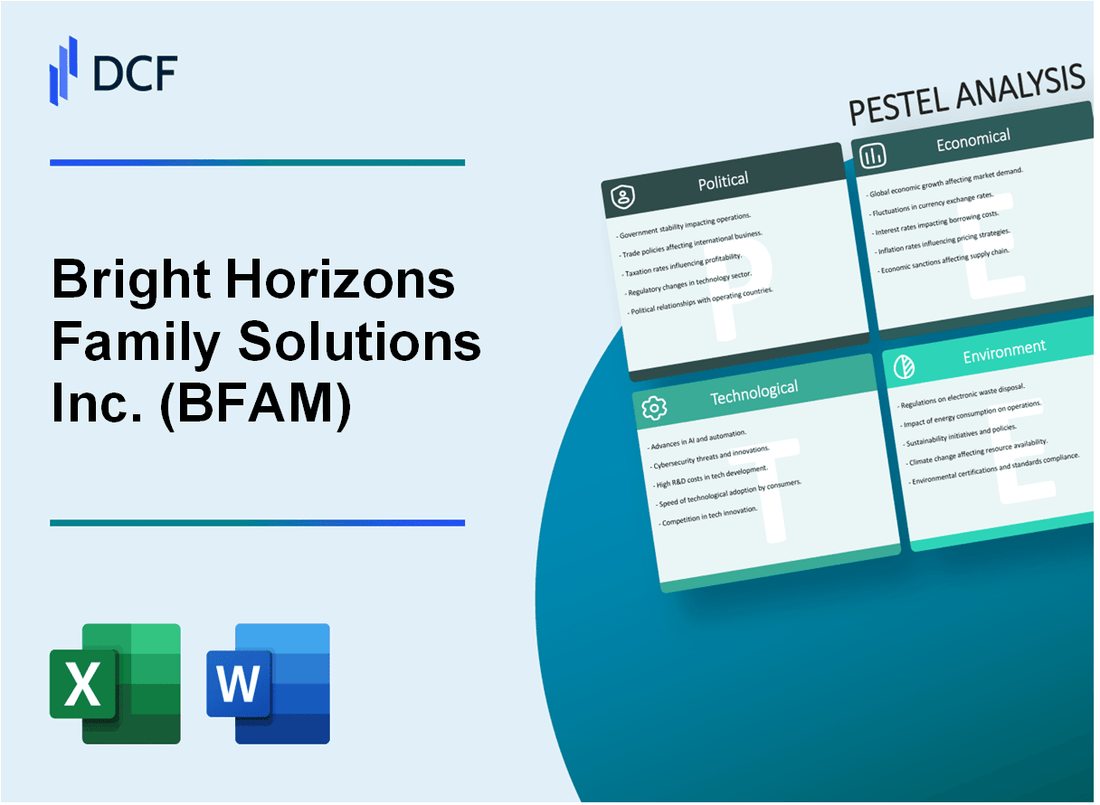
Bright Horizons Family Solutions Inc. (BFAM): Analyse de Pestle [Jan-2025 MISE À JOUR] |
Entièrement Modifiable: Adapté À Vos Besoins Dans Excel Ou Sheets
Conception Professionnelle: Modèles Fiables Et Conformes Aux Normes Du Secteur
Pré-Construits Pour Une Utilisation Rapide Et Efficace
Compatible MAC/PC, entièrement débloqué
Aucune Expertise N'Est Requise; Facile À Suivre
Bright Horizons Family Solutions Inc. (BFAM) Bundle
Dans le paysage dynamique des solutions de soins familiaux, Bright Horizons Family Solutions Inc. (BFAM) est à l'intersection de l'innovation, des besoins sociétaux et des environnements réglementaires complexes. Cette analyse complète du pilon déracine les facteurs externes à multiples facettes qui façonnent le positionnement stratégique de l'entreprise, révélant comment les politiques politiques, les tendances économiques, les transformations sociales, les progrès technologiques, les cadres juridiques et les considérations environnementales convergent pour influencer l'un des secteurs de service les plus critiques de la société moderne. Plongez profondément dans l'écosystème complexe qui entraîne le modèle commercial des Horizons Bright et comprend les défis et les opportunités profonds qui définissent son paysage opérationnel.
Bright Horizons Family Solutions Inc. (BFAM) - Analyse du pilon: facteurs politiques
Variations de politique de garde d'enfants entre les États américains
En 2024, les réglementations sur les services de garde montrent des variations importantes au niveau de l'État:
| État | Rapport d'enfant à étape | Exigences de licence |
|---|---|---|
| Californie | 1: 4 (nourrissons) | Vérification complète des antécédents |
| Texas | 1: 5 (tout-petits) | Inspections annuelles des installations |
| New York | 1: 3 (nourrissons) | Exigences de réduction avancées |
Subventions gouvernementales et crédits d'impôt
Soutien financier fédéral et étatique en garderie en 2024:
- Bloc de garde d'enfants et de développement Block (CCDBG): Financement annuel de 8,3 milliards de dollars
- Crédit d'impôt moyen pour les services de garde: 1 200 $ par enfant
- Crédit d'impôt sur la garderie fournis par l'employeur: jusqu'à 150 000 $ par an
Politique d'éducation de la petite enfance
Investissements clés de la politique nationale d'éducation:
| Domaine politique | Financement annuel | Population cible |
|---|---|---|
| Éducation pré-k | 6,5 milliards de dollars | 3-4 ans |
| Subventions au défi d'apprentissage précoce | 1,2 milliard de dollars | Régions à faible revenu |
Exigences de conformité réglementaire
Normes de conformité critiques pour les centres de garderie:
- Règlement sur la vérification des antécédents: Dépistage complet de 50 États
- Normes de sécurité de l'OSHA: protocoles obligatoires de sécurité au travail
- Conformité Americans with Disabilities Act (ADA): Conditions d'accessibilité universelle
- Protocoles de santé Covid-19: mandats de désinfection et de dépistage en cours
Bright Horizons Family Solutions Inc. (BFAM) - Analyse du pilon: facteurs économiques
La fluctuation du marché du travail affecte la demande de services de garde d'enfants
Au quatrième trimestre 2023, le taux de participation aux participations des marchés du travail américain était de 67,4%. La main-d'œuvre de garde d'enfants a connu une contraction de 3,2% par rapport aux niveaux pré-pandemiques.
| Année | Emploi de garde d'enfants | Participation au travail des parents |
|---|---|---|
| 2022 | 1,42 million de travailleurs | 66.8% |
| 2023 | 1,38 million de travailleurs | 67.4% |
La hausse de l'inflation a un impact sur les coûts opérationnels et les stratégies de tarification
Horizons brillants face Augmentation des coûts opérationnels de 5,7% en 2023, les coûts de main-d'œuvre représentant 68% du total des dépenses.
| Catégorie de coûts | 2022 dépenses | 2023 dépenses | Pourcentage d'augmentation |
|---|---|---|---|
| Coûts de main-d'œuvre | 512 millions de dollars | 541 millions de dollars | 5.7% |
| Dépenses de l'installation | 124 millions de dollars | 132 millions de dollars | 6.5% |
Tendance des avantages sociaux des entreprises Soutien des solutions de soins familiaux
Le marché des prestations de garde d'entreprise a augmenté de 12,3% en 2023, avec 37% des entreprises du Fortune 500 offrant une certaine forme de soutien à la garde d'enfants.
| Type de prestations | Pourcentage d'entreprises | Investissement annuel |
|---|---|---|
| Garde d'enfants sur place | 14% | Moyenne de 2,4 millions de dollars |
| Subventions à la garde d'enfants | 23% | Moyenne de 1,8 million de dollars |
Incertitude économique influençant les dépenses familiales en garderie
Les dépenses moyennes des ménages en garde d'enfants ont diminué de 2,9% en 2023, avec des dépenses annuelles médianes à 8 320 $.
| Tranche de revenu | 2022 dépenses de garde d'enfants | 2023 Dépenses de garde d'enfants | Pourcentage de variation |
|---|---|---|---|
| Revenu intermédiaire inférieur | $6,500 | $6,320 | -2.8% |
| Revenu moyen supérieur | $9,800 | $9,540 | -2.7% |
Bright Horizons Family Solutions Inc. (BFAM) - Analyse du pilon: facteurs sociaux
Les ménages à double revenu croissant augmentent la demande de services de garde d'enfants
Selon le Bureau américain des statistiques du travail, 60,2% des familles avec des enfants de moins de 18 ans avaient les deux parents travaillant en 2022. Le revenu médian des ménages pour les familles avec enfants était de 95 700 $.
| Année | Ménages à double revenu (%) | Dépenses moyennes de garde d'enfants |
|---|---|---|
| 2020 | 59.8% | 9 697 $ par an |
| 2021 | 60.0% | 10 174 $ par an |
| 2022 | 60.2% | 10 640 $ par an |
Changement démographique de la main-d'œuvre avec plus de parents qui travaillent
En 2022, 33,1 millions de parents qui travaillent étaient dans la population active américaine, ce qui représente 32,8% de la main-d'œuvre totale.
| Démographique | Pourcentage de parents qui travaillent |
|---|---|
| Parents de la génération Y | 22.4% |
| Parents de la génération X | 35.6% |
| Parents de baby-boomers | 16.9% |
Accent accru sur l'équilibre entre vie professionnelle et vie privée et soutien familial
75% des employés considèrent l'équilibre entre vie professionnelle et vie privée comme un facteur critique Lors de la sélection des employeurs. Les tendances de travail à distance montrent que 35,4% des travailleurs ont des dispositions de travail hybrides.
| Disposition du travail | Pourcentage de la main-d'œuvre |
|---|---|
| Télécommande à temps plein | 14.7% |
| Hybride | 35.4% |
| Sur place | 49.9% |
Changements générationnels dans les préférences de la parentalité et de la garde d'enfants
Les parents du millénaire et de la génération Z priorisent les solutions de garde d'enfants flexibles et intégrées à la technologie.
| Génération | Type de garde d'enfants préférée | Préférence d'intégration technologique |
|---|---|---|
| Milléniaux | Soins au centre | 82% veulent une communication numérique |
| Gen Z | Soins flexibles / hybrides | 91% recherchent des services basés sur les applications |
Bright Horizons Family Solutions Inc. (BFAM) - Analyse du pilon: facteurs technologiques
Plateformes numériques pour la gestion et la réservation de garde d'enfants distants
Bright Horizons a lancé sa plate-forme numérique avec les principales spécifications technologiques suivantes:
| Fonctionnalité de plate-forme | Spécifications technologiques | Taux d'adoption des utilisateurs |
|---|---|---|
| Fonctionnalité d'application mobile | Compatibilité iOS et Android | 78% des parents utilisant activement la réservation mobile |
| Suivi de disponibilité en temps réel | Système de réservation basé sur le cloud | 92% de précision de créneaux de créneaux en temps réel |
| Intégration de paiement numérique | Passerelle de paiement sécurisée | 65% des transactions effectuées en ligne |
Systèmes de gestion avancée de l'apprentissage
Les infrastructures technologiques pour les programmes éducatives comprennent:
| Composant du système d'apprentissage | Capacité technologique | Métrique de performance |
|---|---|---|
| Gestion des programmes | Suivi du curriculum basé sur le cloud | 97% de standardisation du curriculum |
| Analyse des performances des enseignants | Outils d'évaluation de l'apprentissage automatique | 85% Précision de l'évaluation des performances des enseignants |
| Surveillance des progrès des étudiants | Suivi de développement en temps réel | 89% de l'engagement des parents avec les rapports d'étape |
IA et analyse des données pour le développement de l'enfant
Investissements technologiques dans le suivi du développement de l'enfant:
- Suivi des jalons de développement alimentés par l'IA
- Analyse prédictive pour une intervention précoce
- Génération de chemins d'apprentissage personnalisés
| Technologie d'IA | Échelle de mise en œuvre | Taux de précision |
|---|---|---|
| Algorithmes d'apprentissage automatique | Déployé dans 1 200 centres | 93% de précision prédictive |
| Reconnaissance du modèle de développement | Analysé 250 000 profils enfants | 88% de fiabilité d'identification des modèles |
Mesures de cybersécurité
Infrastructure de sécurité technologique:
| Couche de sécurité | Mécanisme de protection | Niveau de conformité |
|---|---|---|
| Chiffrement des données | Cryptage SSL 256 bits | HIPAA et GDPR conformes |
| Contrôle d'accès | Authentification multi-facteurs | 99,8% de prévention de l'accès non autorisé |
| Sécurité du réseau | Protection avancée du pare-feu | Zéro violations de sécurité majeures en 2023 |
Bright Horizons Family Solutions Inc. (BFAM) - Analyse du pilon: facteurs juridiques
Exigences strictes sur les licences et l'accréditation pour les services de garde d'enfants
Bright Horizons Family Solutions Inc. doit se conformer aux réglementations de licence spécifiques à l'État dans plusieurs juridictions. En 2024, la société opère dans 41 États avec une moyenne de 4,2 contrôles de conformité réglementaire par centre par an.
| Catégorie de licence d'État | Coût de conformité annuel moyen | Fréquence de renouvellement |
|---|---|---|
| Permis de garde d'enfants de base | 2 750 $ par centre | Annuel |
| Accréditation avancée | 5 600 $ par centre | Biennal |
Conformité aux réglementations sur la sécurité et la protection des enfants
L'entreprise maintient des protocoles de vérification des antécédents stricts pour tous les employés. En 2023, Bright Horizons a effectué 12 345 projections complètes d'arrière-plan avec un taux de dégagement de 99,7%.
| Composant de vérification des antécédents | Détails de dépistage |
|---|---|
| Vérification des antécédents criminels | 100% des nouvelles recrues |
| Dépistage du registre de la maltraitance des enfants | 100% des nouvelles recrues |
| Vérification des empreintes digitales du FBI | 100% des nouvelles recrues |
Adhésion au droit de l'emploi aux travailleurs de la garde d'enfants
Conformité des salaires: Bright Horizons garantit un respect strict des réglementations du travail fédéral et étatique. Les salaires horaires moyens pour les travailleurs de la garde d'enfants varient de 15,40 $ à 22,75 $ selon l'emplacement et l'expérience.
| Catégorie d'emploi | Conformité au salaire minimum | Adhésion au réglementation des heures supplémentaires |
|---|---|---|
| Travailleur de garde d'enfants d'entrée de gamme | 15,40 $ / heure | Compliance 100% FLSA |
| Professionnel de garde d'enfants senior | 22,75 $ / heure | Compliance 100% FLSA |
Règlements sur la confidentialité et la protection des données pour l'information sur l'enfant
Bright Horizons investit 3,2 millions de dollars par an dans les infrastructures de cybersécurité pour protéger les données de l'enfant et de la famille. La société maintient la conformité HIPAA et FERPA sur toutes les plateformes numériques.
| Métrique de protection des données | Pourcentage de conformité | Investissement annuel |
|---|---|---|
| Compliance HIPAA | 100% | 1,5 million de dollars |
| Ferpa Conformité | 100% | 1,7 million de dollars |
Bright Horizons Family Solutions Inc. (BFAM) - Analyse du pilon: facteurs environnementaux
Conception durable et pratiques de construction verte des installations
Bright Horizons a mis en œuvre des pratiques de construction vertes dans 1 091 centres à partir de 2023. La société utilise des principes de conception certifiés LEED dans environ 15% de ses installations.
| Métrique du bâtiment vert | Pourcentage / nombre |
|---|---|
| Centres certifiés LEED | 15% |
| Centres totaux | 1,091 |
| Matériaux de construction économes en énergie | 72% |
Initiatives d'efficacité énergétique dans les services de garde d'enfants
L'entreprise a réduit la consommation d'énergie de 22% dans ses centres grâce à des programmes d'efficacité stratégique. Les installations de panneaux solaires couvrent 38 centres, générant environ 1,2 million de kWh par an.
| Métrique de l'efficacité énergétique | Valeur |
|---|---|
| Réduction de la consommation d'énergie | 22% |
| Centres avec panneaux solaires | 38 |
| Production annuelle d'énergie solaire | 1 200 000 kWh |
Programmes de réduction des déchets et de recyclage
Stratégies de gestion des déchets ont permis aux horizons brillants de détourner 65% des déchets centraux des décharges. Les programmes de recyclage sont mis en œuvre dans 89% de leurs installations.
| Métrique de gestion des déchets | Pourcentage |
|---|---|
| Les déchets détournés des décharges | 65% |
| Installations avec des programmes de recyclage | 89% |
| Mise en œuvre du compostage | 42% |
Programmes éducatifs axés sur la conscience de l'environnement
Bright Horizons intègre l'éducation environnementale dans le programme d'études pour 98% de ses centres. Curriculum de durabilité atteint environ 184 000 enfants par an.
- Couverture du programme environnemental: 98% des centres
- Enfants exposés à l'éducation à la durabilité: 184 000 par an
- Groupes d'âge ciblés: 6 mois à 12 ans
| Métrique de l'éducation environnementale | Valeur |
|---|---|
| Centres avec un programme d'études environnemental | 98% |
| Les enfants annuels atteints | 184,000 |
| Sujets de durabilité couverts | 7 |
Bright Horizons Family Solutions Inc. (BFAM) - PESTLE Analysis: Social factors
Sustained hybrid and remote work models shift demand for on-site versus near-site childcare solutions.
You and your peers are navigating a permanent shift in where and how people work, and this directly impacts demand for Bright Horizons Family Solutions Inc.'s (BFAM) services. The hybrid work model is no longer a perk; it's a non-negotiable expectation for a significant portion of the workforce. Globally, approximately 83% of employees prefer a hybrid model, and in the U.S., about 23% of workers currently hold hybrid or remote roles.
This reality has created a dual demand: on-site centers remain critical for companies enforcing a Return-to-Office (RTO) mandate, but the real growth engine is flexible, near-site, and in-home backup care. When care breaks down, employees can't work. This is why BFAM's Back-Up Care segment is outperforming, with revenue increasing by a notable 26% to $253 million in the third quarter of 2025. That's a clear signal that employers are buying flexibility to manage their RTO mandates and keep employees productive. It's about business continuity, not just a nice benefit.
Here's the quick math: a care breakdown is a productivity drain.
| BFAM Segment | Q3 2025 Revenue | YoY Growth (Q3 2024 to Q3 2025) | Social Trend Driver |
|---|---|---|---|
| Back-Up Care | $253 million | 26% increase | Hybrid Work, RTO Mandates, Care Breakdowns |
| Full-Service Centers | $516 million | 6% increase | Enrollment Gains, Employer-Sponsored On-Site Need |
Growing parental focus on early STEM and language education drives demand for BFAM's curriculum quality.
Parents today are defintely more focused on 'school readiness' than just basic care. They view early childhood education as a foundational investment, not merely a babysitting service. This trend elevates the importance of a high-quality, structured curriculum like BFAM's, which is built on a Discovery Driven Learning approach.
The company explicitly integrates key academic areas into its programs, which directly addresses parent anxiety about future academic success. This focus allows BFAM to command higher tuition and maintain enrollment growth in its full-service centers, which saw a 6% revenue increase to $516 million in Q3 2025. This isn't about marketing fluff; it's about delivering a tangible educational product that parents value.
- STEM: Encourages exploration of science, technology, engineering, and math through experimentation and problem-solving.
- Language and Literacy: Cultivates a lifelong love of reading and foundational literacy skills from an early age.
- Social-Emotional Learning: Nurtures self-esteem and positive interactions, a critical component for modern school success.
The tight labor market forces employers to offer enhanced family support benefits to attract and retain talent.
The competition for talent remains fierce, making family support benefits a core part of the Employee Value Proposition (EVP). For companies, offering childcare is a clear competitive advantage because only about 12% of all U.S. workers currently receive childcare benefits through their employers. This scarcity creates a massive opportunity for BFAM's employer-sponsored model.
The data is stark: 73% of working parents consider their employer's support for family life before accepting a new job or promotion. Plus, one in five workers would switch jobs for better childcare benefits. This means BFAM is selling a critical retention tool to Fortune 500 firms, not just a service. The full-year 2025 revenue guidance of approximately $2.925 billion for Bright Horizons Family Solutions Inc. reflects this sustained corporate investment in talent-critical benefits.
Increased awareness of mental health and work-life balance makes employer-sponsored care a non-negotiable benefit.
Mental health and work-life balance have moved from being a soft HR topic to a hard business risk in 2025. Almost a third of working parents report severe stress, and a concerning 80% of those find it hard to focus on work. That stress is expensive. Unaddressed stress among professional services staff in the UK and US can cost firms over £4 million annually.
Employer-sponsored care, particularly the flexible Back-Up Care that BFAM provides, directly mitigates this risk by offering a safety net for care breakdowns. Historically, childcare issues caused a massive spike in sick leave, up by 183% for parents and carers in one recent study, which is a significant drag on productivity. Providing a reliable solution is a direct investment in reducing absenteeism and improving employee focus. It is a non-negotiable for companies serious about their employees' well-being and their own bottom line.
Next Step: Analyze the competitive landscape to see which BFAM segments are most vulnerable to disruption from smaller, flexible-care providers like those using app-based models.
Bright Horizons Family Solutions Inc. (BFAM) - PESTLE Analysis: Technological factors
Investment in EdTech platforms for curriculum delivery and parent communication is essential for competitive advantage.
You can't compete in the 2025 education market without a strong digital backbone, and Bright Horizons Family Solutions is defintely prioritizing this. The company's strategy explicitly calls for significant investments in technology and programming to enhance the experience and efficiency across its global center footprint. This is a must-do, not a nice-to-have, especially since parents are increasingly concerned with digital-age readiness.
In the first half of 2025, Bright Horizons made net investments (which include capital expenditures and acquisitions) totaling $38.0 million, with $19 million in fixed asset investments in the second quarter alone, a substantial portion of which is dedicated to technology infrastructure and educational technology (EdTech). This focus is directly tied to parental demand: the 2025 Modern Family Index shows that 73% of parents believe the rise of Artificial Intelligence (AI) will significantly impact the skills their children need, driving demand for tech-integrated learning.
- Actionable Insight: Use EdTech to deliver the proprietary curriculum, reinforcing the brand's premium value proposition over smaller, less digitally mature competitors.
BFAM is using proprietary software for center management, enrollment, and staff scheduling to boost efficiency.
Operational efficiency is where the margin is made, especially in the Full-Service Center-Based Child Care segment, which generated $540 million in revenue in Q2 2025 alone. Bright Horizons uses a proprietary digital ecosystem to manage the complexity of over 1,020 centers globally as of June 30, 2025. This proprietary software streamlines the entire customer journey, from initial inquiry to daily operations.
The core of this efficiency lies in digitalizing high-friction processes. For center management, this includes proprietary systems for staff scheduling and compliance tracking. For the customer, it means the Family Information Center and a secure family account system that handles registration, waitlist management, and tuition payments, which is crucial for maximizing enrollment gains and improving operating leverage. The Back-Up Care segment's exceptional Q3 2025 adjusted operating margin of 38% is a direct result of this scalable, technology-enabled operational model. It's simple: better software means lower administrative costs per child.
Cybersecurity risks are rising due to the volume of sensitive child and family data managed across the network.
The digital scale that drives efficiency also creates a massive, and growing, attack surface. Bright Horizons manages an immense volume of highly sensitive Personally Identifiable Information (PII), including child health records, family financial data, and employer-client contracts for over 1,450 corporate clients. The risk profile here is elevated because a breach would not just mean financial loss; it would be a catastrophic breach of trust, which is the company's core asset.
In 2025, the cybersecurity landscape is defined by increasingly sophisticated ransomware attacks, making data protection a critical operational expense. While specific BFAM cybersecurity costs are not broken out, the industry trend is clear: IT budgets are being stretched. The potential for reputational damage is acute, especially since 57% of parents surveyed in the 2025 Modern Family Index cite their child's safety as their top concern. The company must treat its data infrastructure with the same rigor it applies to its physical centers.
Telehealth and virtual tutoring services are expanding, creating both competition and partnership opportunities.
The demand for flexible, virtual support has exploded, and Bright Horizons is capitalizing on this through strategic partnerships rather than building all services in-house. This is a smart capital-light approach to trend-following.
The company's Back-Up Care program now includes a robust Virtual Tutoring service for dependents aged 5-18, delivered in partnership with established EdTech providers like Varsity Tutors and Sylvan Learning. This service covers over 3,000 subjects, providing 4 hours of tutoring for each back-up care use. For the Elder Care segment, the virtual component takes the form of Care Coach services, offering unlimited one-hour phone consultations and a proprietary online platform for care coordination, which essentially acts as a virtual advisory service, replacing the need for traditional, in-person health consultation referrals.
This hybrid model of virtual delivery expands the addressable market and diversifies revenue streams, which is a key driver for the Back-Up Care segment's projected 14% to 16% revenue growth for the full year 2025.
| Technological Factor | BFAM 2025 Metric / Impact | Strategic Implication |
|---|---|---|
| EdTech Investment (CapEx) | $19 million in Q2 2025 fixed asset investments (includes technology) | Essential to enhance proprietary curriculum and meet parental demand for digital-age skills. |
| Proprietary Software Scale | Manages operations for 1,020+ centers and 1,450+ employer clients. | Drives operational efficiency; key to achieving the 38% Q3 2025 margin in Back-Up Care. |
| Cybersecurity Risk Exposure | Manages PII for children, families, and 1,450+ corporate partners. | High-stakes risk; a breach could severely damage the core asset of trust and safety. |
| Virtual Services Expansion | Virtual Tutoring in 3,000+ subjects via partners; unlimited Care Coach phone consultations. | Capital-light revenue diversification; supports the Back-Up Care segment's strong growth trajectory. |
Bright Horizons Family Solutions Inc. (BFAM) - PESTLE Analysis: Legal factors
You're operating a multi-state service business, so the legal landscape for Bright Horizons Family Solutions is less about a single federal mandate and more about a complex, expensive patchwork of state and local regulations. This jurisdictional variability is a constant headwind, driving up compliance costs and creating a significant barrier to scaling efficiently. The core challenge is maintaining a high-quality, standardized service model against a backdrop of non-negotiable, hyper-local rules.
Here's the quick math: managing compliance across over 1,000 centers in the US and internationally means every regulatory shift in a major market like California or New York directly impacts your bottom line, particularly through labor and staffing costs.
State-level licensing and staff-to-child ratio regulations are constantly changing, requiring defintely high compliance costs.
The most direct legal impact on Bright Horizons Family Solutions' operating model comes from state-level licensing requirements, particularly the mandated staff-to-child ratios. These ratios dictate the minimum number of teachers required per child, which is the single largest driver of the company's cost of services. In the first quarter of 2025, the company's cost of services for its Full-Service Center-Based Child Care segment was approximately $422.1 million, a figure heavily influenced by personnel costs.
When a state tightens its ratio, say from 1:4 to 1:3 for infants, it forces an immediate, non-discretionary increase in payroll expenditure per classroom. The company's compliance efforts must track and adhere to these granular differences across all jurisdictions. This is not a one-time fix; it's a continuous, high-cost operational burden.
| Key State Infant Staff-to-Child Ratios (Approximate, 2025) | Age Group | Minimum Ratio (Staff:Child) | Regulatory Impact |
| California (Title 22) | Infants (0-2 years) | 1:4 | A key operational benchmark for the West Coast market. |
| New York City | Infants (under 12 months) | 1:4 | Stricter ratios in urban centers drive up labor costs in high-revenue areas. |
| Massachusetts (Home State) | Infants (under 15 months) | 1:4 | The company's home state ratio sets a baseline for quality and cost. |
Mandatory reporting laws and child protection regulations are strict and non-negotiable across all operating states.
Child protection is the most critical area of legal risk, and there is zero tolerance for non-compliance. Every staff member is a mandated reporter, legally required to immediately notify state authorities of suspected abuse or neglect. Failure to report is a misdemeanor and can lead to employment disqualification for the individual.
The company must invest heavily in training, background checks, and internal audit functions to mitigate this risk. In its 2025 filings, Bright Horizons Family Solutions acknowledges that litigation-related and insurance risks are a constant factor, and a failure to comply with regulations could lead to governmental sanctions, including fines or the suspension of a center's license.
Labor laws regarding overtime, benefits, and unionization efforts for center staff vary widely by jurisdiction.
The fluid nature of US labor law, especially around wages and employee classification, is a significant financial risk. The push for higher minimum wages and the potential for federal changes, like the proposed increase in the Fair Labor Standards Act (FLSA) overtime salary threshold from $35,568 to $58,656 in 2025, directly threatens the cost structure of a large employer like Bright Horizons Family Solutions.
This kind of change forces a choice: raise thousands of employee salaries above the new threshold or pay significantly more in overtime. The risk is compounded by varying state laws on sick time, paid family leave, and benefit mandates. Furthermore, unionization efforts, while not explicitly quantified in the company's 2025 financials, are an ever-present risk in the labor-intensive child care sector, which could fundamentally alter wage and benefit negotiations.
- Changes in human capital laws increase compliance costs.
- State-specific sick time and leave mandates add complexity to payroll.
- The 2025 federal overtime threshold change is a major compensation pressure point.
Data privacy laws (like CCPA) govern the handling of personal information for clients and families.
As a provider of employer-sponsored benefits, Bright Horizons Family Solutions handles vast amounts of personal information for both client employees and their dependents, making it a target for evolving data privacy regulations. The company must comply with comprehensive laws like the California Consumer Privacy Act (CCPA), as amended by the California Privacy Rights Act (CPRA).
The CPRA, with new obligations taking effect in early 2026, mandates new requirements like cybersecurity audits and risk assessments for large businesses. Bright Horizons Family Solutions acts as both a 'controller' (business) and a 'processor' (service provider), depending on the service, which creates a dual compliance burden. This means the company must continually invest in its information technology security to prevent a data breach, which the company lists as a material risk in its 2025 filings.
Bright Horizons Family Solutions Inc. (BFAM) - PESTLE Analysis: Environmental factors
Growing corporate client demand for Environmental, Social, and Governance (ESG) reporting influences Bright Horizons Family Solutions Inc.'s operations.
You need to understand that Bright Horizons Family Solutions Inc.'s business model is inherently tied to the ESG mandates of its corporate clients. As of the 2025 fiscal year, the company serves over 1,450 employer clients, including more than 220 Fortune 500 companies. These large clients are now facing mandatory, rigorous sustainability reporting requirements, especially those with European operations falling under the EU's Corporate Sustainability Reporting Directive (CSRD).
The biggest near-term risk for Bright Horizons Family Solutions Inc. is the lack of public, verifiable environmental data. Honestly, this is a competitive disadvantage. While the company's DitchCarbon score of 27 is slightly above the industry average of 29, the firm has not publicly committed to specific 2030 or 2050 climate goals and does not disclose its Scope 1, 2, or 3 carbon emissions for the most recent year. Your clients, who are under pressure to report their Scope 3 (supply chain) emissions, will increasingly demand this data from Bright Horizons Family Solutions Inc. to calculate their own carbon footprint.
Focus on sustainable sourcing for classroom materials and food services is becoming a competitive differentiator.
The shift to sustainable sourcing is no longer just a feel-good measure; it's a cost-optimization and brand-protection strategy. Bright Horizons Family Solutions Inc. is actively integrating this into its supply chain, which directly impacts the materials used in its over 1,000 global centers. The company's 'Future Earth' program sets concrete, measurable procurement targets, which is exactly what you want to see.
Here's the quick math on their sourcing commitments:
- Aim to achieve 100% of wood products from certified sustainable sources (PEFC/FSC).
- Commitment to using MSC certified fish and Red Tractor food products where available.
- New food order processes are in place to directly reduce excess or unwanted food items at the nursery level, cutting waste and food costs.
Plus, the company secured a new contract for certifiable renewable electricity supply, which they project will reduce overall carbon emissions by more than 10%. That's a defintely material saving on utility expenses, not just an environmental win.
Center design increasingly incorporates energy efficiency and green building standards to reduce utility costs.
The move toward green building standards like LEED (Leadership in Energy and Environmental Design) is a clear response to rising energy costs and client demand for sustainable facilities. The company's new Jim Greenman Early Education Innovation Center serves as a prototype model for future construction, integrating high-efficiency features right from the start.
We have concrete data from existing LEED-certified centers, which shows the long-term financial benefit of this strategy:
| Metric | Result at LEED Gold Certified Center | Financial Impact |
|---|---|---|
| Energy Usage Reduction | 31.23% below baseline | Directly lowers utility operating expenses |
| Water Use Reduction | 20.86% achieved with low-flow fixtures | Reduces water bills and strain on local resources |
| Natural Light Utilization | Over 77% of occupied spaces meet daylighting requirements | Reduces the need for electric lighting and associated costs |
The broader market trend supports this: the global green building market is projected to reach $1,374.23 billion by 2034, growing at a Compound Annual Growth Rate (CAGR) of 9.29%, driven by these very efficiency improvements and stringent building codes.
Waste reduction and recycling mandates at the local level impact center-level operational procedures.
Local and state-level mandates are putting direct pressure on center-level operations and costs in 2025. This is a hyper-local risk, but it has a national financial impact. For instance, single-use polystyrene foam containers are now banned in key operating states like New Jersey and Oregon as of 2025, forcing a switch to more expensive, compostable alternatives.
The financial incentive to comply and go beyond is clear in major operating areas. In Fort Worth, Texas, for example, the cost to landfill waste is approximately $24.00 per ton, while the cost to recycle is only $12.13 per ton. That means every ton of waste diverted to recycling provides a net benefit of $11.87 to the center's operating budget.
Bright Horizons Family Solutions Inc. is tackling this with innovation, like its pilot program with Huggies in the Boston area to divert thousands of pounds of trash (diapers and wipes) from local landfills via a Waste-to-Energy conversion process. This proactive approach helps them anticipate and manage the increasing cost of waste disposal in urban markets.
Disclaimer
All information, articles, and product details provided on this website are for general informational and educational purposes only. We do not claim any ownership over, nor do we intend to infringe upon, any trademarks, copyrights, logos, brand names, or other intellectual property mentioned or depicted on this site. Such intellectual property remains the property of its respective owners, and any references here are made solely for identification or informational purposes, without implying any affiliation, endorsement, or partnership.
We make no representations or warranties, express or implied, regarding the accuracy, completeness, or suitability of any content or products presented. Nothing on this website should be construed as legal, tax, investment, financial, medical, or other professional advice. In addition, no part of this site—including articles or product references—constitutes a solicitation, recommendation, endorsement, advertisement, or offer to buy or sell any securities, franchises, or other financial instruments, particularly in jurisdictions where such activity would be unlawful.
All content is of a general nature and may not address the specific circumstances of any individual or entity. It is not a substitute for professional advice or services. Any actions you take based on the information provided here are strictly at your own risk. You accept full responsibility for any decisions or outcomes arising from your use of this website and agree to release us from any liability in connection with your use of, or reliance upon, the content or products found herein.