

|
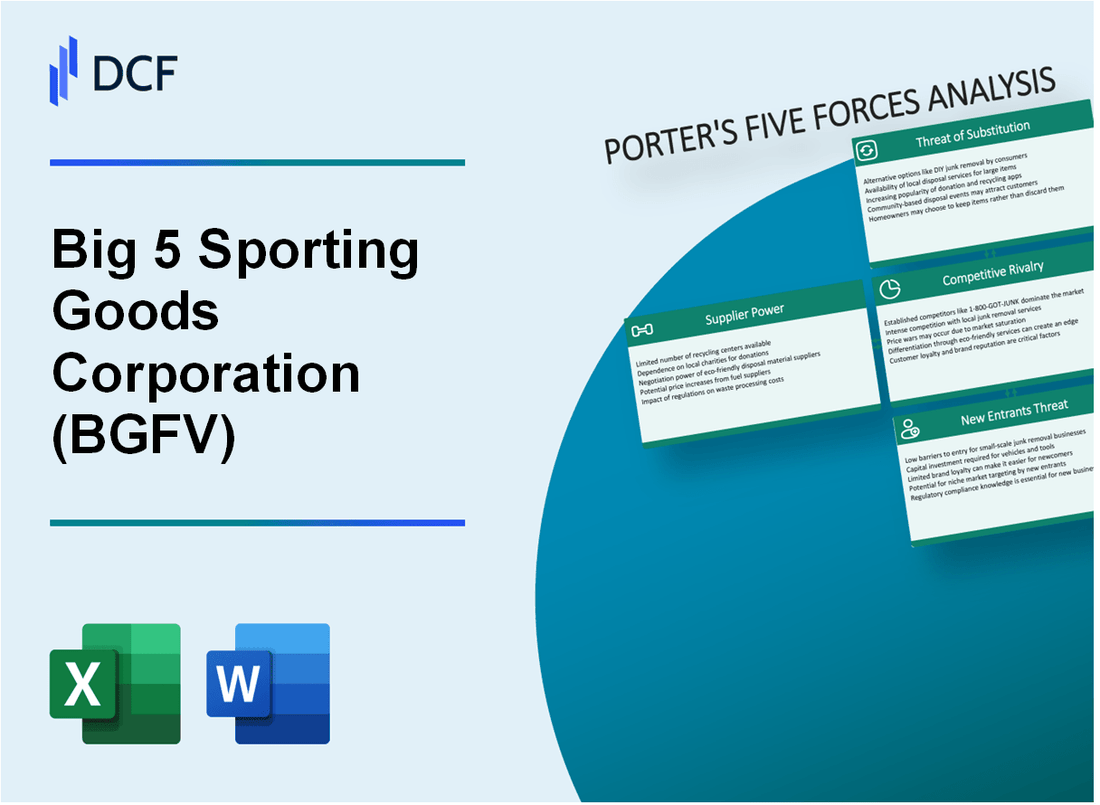
Big 5 Sporting Goods Corporation (BGFV): 5 Forces Analysis [Jan-2025 Mis à jour] |
Entièrement Modifiable: Adapté À Vos Besoins Dans Excel Ou Sheets
Conception Professionnelle: Modèles Fiables Et Conformes Aux Normes Du Secteur
Pré-Construits Pour Une Utilisation Rapide Et Efficace
Compatible MAC/PC, entièrement débloqué
Aucune Expertise N'Est Requise; Facile À Suivre
Big 5 Sporting Goods Corporation (BGFV) Bundle
Dans le monde dynamique des articles de sport, Big 5 Sporting Goods Corporation (BGFV) navigue dans un paysage compétitif complexe façonné par les cinq forces stratégiques de Michael Porter. De lutter contre les détaillants nationaux féroces à la gestion des relations avec les fournisseurs et à l'adaptation aux perturbations numériques, le BGFV fait face à des défis à multiples face peut potentiellement tirer parti ou atténuer ces pressions concurrentielles pour maintenir sa pertinence et son potentiel de croissance sur le marché.
Big 5 Sporting Goods Corporation (BGFV) - Five Forces de Porter: Pouvoir de négociation des fournisseurs
Concentration du marché des fournisseurs
En 2024, le marché des fournisseurs d'articles de sport démontre une concentration importante avec les fabricants clés:
| Fabricant | Part de marché mondial (%) | Revenus annuels ($ b) |
|---|---|---|
| Nike | 27.4% | 51.2 |
| Adidas | 16.8% | 23.7 |
| Sous l'armure | 8.2% | 6.1 |
Facteurs de levier des fournisseurs
La dynamique de négociation des fournisseurs pour BGFV comprend:
- Nombre limité de principaux fabricants d'articles de sport
- Solide reconnaissance de la marque des meilleurs fournisseurs
- Fluctuations d'inventaire saisonnière
- Dépendances complexes de la chaîne d'approvisionnement
Alimentation de tarification du fournisseur
Indicateurs de tarification des fournisseurs clés pour 2024:
| Tarification métrique | Valeur |
|---|---|
| Augmentation moyenne des prix du fournisseur | 4.3% |
| Durée du contrat du fournisseur | 12-18 mois |
| Flexibilité de négociation | Modéré |
Big 5 Sporting Goods Corporation (BGFV) - Porter's Five Forces: Bargaising Power of Clients
Consommateurs sensibles aux prix sur le marché de la vente au détail d'articles de sport
Selon NPD Group, 57% des consommateurs d'articles de sport hiérarchisent le prix lors de la prise de décisions d'achat. Le consommateur moyen dépense 540 $ par an en articles de sport et en équipement sportif.
| Métrique de sensibilité au prix de la consommation | Pourcentage |
|---|---|
| Consommateurs comparant les prix en ligne | 72% |
| Consommateurs à la recherche de réductions | 64% |
| Les consommateurs sont prêts à changer de détail pour de meilleurs prix | 53% |
Plusieurs canaux de vente au détail alternatifs
En 2023, la répartition des canaux de vente au détail des articles de sport:
- Retail en ligne: 38% du total des ventes
- Magasins de brique et de mortier: 55% du total des ventes
- Magasins spécialisés: 7% du total des ventes
Coûts de commutation faibles pour les clients
| Facteur de coût de commutation | Impact |
|---|---|
| Temps moyen pour changer de détail | 2,3 jours |
| Coût de la commutation des détaillants | $0 |
| Temps de comparaison des prix en ligne | 12 minutes |
Clientèle diversifiée
Demographie de la participation sportive en 2023:
- Courir / jogging: 49,5 millions de participants
- Activités de fitness / gymnase: 62,3 millions de participants
- Basketball: 26,7 millions de participants
- Cycling: 40,8 millions de participants
Big 5 Sporting Goods Corporation (BGFV) - Five Forces de Porter: rivalité compétitive
Concurrence intense des grands détaillants nationaux
Dick's Sporting Goods a déclaré 12,8 milliards de dollars de revenus pour l'exercice 2022, représentant une menace compétitive importante pour le BGFV.
| Concurrent | Revenus annuels | Nombre de magasins |
|---|---|---|
| Dick's Sporting Goods | 12,8 milliards de dollars | 858 emplacements |
| Sports de l'académie | 7,4 milliards de dollars | 285 emplacements |
Concours de plate-forme en ligne
Le segment des articles de sport d'Amazon a généré environ 31,8 milliards de dollars de revenus en 2022.
- Amazon Sports Merchandise Market Shart: 37%
- Croissance des ventes de produits de sport en ligne: 15,2% par an
Chaînes de produits de sport régionaux
BGFV exploite 461 magasins dans 17 États en 2023.
| Chaîne régionale | Couverture géographique | Comptage des magasins |
|---|---|---|
| Big 5 Goods de sport | Occidental des États-Unis | 461 magasins |
Prix et pressions de variétés de produits
La marge brute moyenne de BGFV: 28,6% au cours de l'exercice 2022.
- Plage de prix moyen du produit: 15 $ - 250 $
- Catégories de produits: 12 segments de produits de sport distincts
Big 5 Sporting Goods Corporation (BGFV) - Five Forces de Porter: menace de substituts
Plates-formes d'achat en ligne offrant des articles de sport similaires
Amazon a déclaré 31,8 milliards de dollars de ventes de catégories sportives et en plein air en 2023. Les revenus des articles de sport en ligne de Walmart ont atteint 4,2 milliards de dollars la même année. Dick's Sporting Goods a généré 12,5 milliards de dollars de ventes de commerce électronique en 2022.
| Plate-forme en ligne | 2023 Revenus de produits de sport | Part de marché |
|---|---|---|
| Amazone | 31,8 milliards de dollars | 42% |
| Walmart | 4,2 milliards de dollars | 8% |
| Dick's Sporting Goods | 12,5 milliards de dollars | 15% |
Activités alternatives sur la forme physique et les loisirs
Le marché des équipements de fitness à domicile d'une valeur de 14,7 milliards de dollars en 2023. Peloton a déclaré 3,1 milliards de dollars de revenus pour 2022. Les téléchargements d'applications de fitness ont augmenté de 29% en 2023.
- La participation au yoga est passée à 36,7 millions d'Américains en 2022
- La participation du cyclisme est passée à 54,3 millions de participants en 2023
- L'adhésion à CrossFit a atteint 15 000 gymnases affiliés dans le monde entier
Marchés d'équipement sportif d'occasion
Les plateformes de revente en ligne ont généré 40,5 milliards de dollars en 2023. Les listes d'équipements sportifs du marché Facebook ont augmenté de 37% en glissement annuel.
| Plate-forme de revente | 2023 Ventes d'équipements sportifs | Taux de croissance |
|---|---|---|
| eBay | 18,2 milliards de dollars | 22% |
| Marché Facebook | 12,7 milliards de dollars | 37% |
| Chic | 6,3 milliards de dollars | 15% |
Plates-formes de fitness numériques
Le marché mondial du fitness numérique a atteint 15,2 milliards de dollars en 2023. L'application Nike Training Club comptait 23,6 millions d'utilisateurs actifs. Strava a signalé 100 millions d'utilisateurs enregistrés en 2023.
- Apple Fitness + abonnés: 17,4 millions
- Croissance du marché des applications de fitness: 45,4% par an
- Participants de la classe de fitness virtuel: 62,5 millions en 2023
Big 5 Sporting Goods Corporation (BGFV) - Five Forces de Porter: Menace de nouveaux entrants
Exigences de capital initial
Big 5 Goods de sport nécessite un investissement initial important pour l'entrée du marché:
| Catégorie d'investissement | Coût estimé |
|---|---|
| Configuration du magasin | 1,2 million de dollars - 2,5 millions de dollars par emplacement |
| Inventaire initial | $500,000 - $750,000 |
| Infrastructure technologique | $250,000 - $350,000 |
| Capital initial total | 1,95 million de dollars - 3,6 millions de dollars |
Barrières de la relation de marque
Les principales barrières à l'entrée comprennent:
- Relations de fournisseurs établis avec plus de 500 fabricants d'articles de sport
- Accords de distribution exclusifs avec des marques grandes comme Nike, adidas
- Les contrats de fournisseurs à long terme ont en moyenne 3 à 5 ans
Complexité de la chaîne d'approvisionnement
Les défis de la chaîne d'approvisionnement comprennent:
| Métrique de la chaîne d'approvisionnement | Valeur |
|---|---|
| Nombre de SKU | 15,000 - 20,000 |
| Taux de rotation des stocks | 4,2 fois par an |
| Entrepôts logistiques | 7 centres de distribution régionaux |
Impact du commerce électronique
Capacités de commerce électronique:
- Croissance des ventes en ligne: 22,5% en 2023
- Investissement de plate-forme numérique: 8,3 millions de dollars
- Utilisateurs d'applications mobiles: 450 000
Big 5 Sporting Goods Corporation (BGFV) - Porter's Five Forces: Competitive rivalry
You're looking at a retail environment where Big 5 Sporting Goods Corporation is clearly on the defensive, fighting rivals who are aggressively investing in growth and experience. The pressure here is palpable, and the numbers from Q2 2025 definitely tell that story.
Rivalry is intense, especially when you look at the expansion plans of national superstores. Take Dick's Sporting Goods, for example. While Big 5 Sporting Goods is shrinking its footprint, its competitor is doubling down on experiential retail. Dick's Sporting Goods operates 885 stores across 47 states as of May 2025. They are expanding their flagship 'House of Sport' concept, which currently stands at 35 locations, including 16 opened in fiscal 2025, with a long-term goal of 75 to 100 such stores by the end of fiscal year 2027. They're also rolling out the 'Field House' concept, with approximately 18 new ones slated for opening in 2025.
This divergence in strategy is stark. Big 5 Sporting Goods is closing approximately 15 stores in fiscal 2025. That's a total reduction from the 414 stores in operation as of Q2 2025. This shrinking physical presence contrasts sharply with rivals' growth, which includes Dick's Sporting Goods raising its full-year guidance for its core business sales to between $13.95 billion and $14.0 billion.
The competition from e-commerce giants like Amazon and mass merchandisers like Walmart forces Big 5 Sporting Goods into a tough spot on pricing. You see the direct impact of this promotional environment on the bottom line. The gross profit margin for Big 5 Sporting Goods in Q2 2025 was 28.2%, a dip from 29.4% in the prior year's second quarter. Gross profit itself fell to $52.2 million from $58.7 million year-over-year.
Here's a quick look at how that pressure translated into top-line performance for Big 5 Sporting Goods in the second quarter of fiscal 2025:
| Metric | Q2 2025 Value | Q2 2024 Value | Year-over-Year Change |
|---|---|---|---|
| Net Sales | $184.9 million | $199.8 million | -7.5% |
| Same Store Sales | Decreased 6.1% | N/A | Decreased 6.1% |
| Net Loss (Basic Share) | $(1.11) | $(0.46) | Wider Loss |
| Adjusted EBITDA | $(14.7) million | $(8.7) million | Worsened by $6.0 million |
The company's Q2 2025 net sales of $184.9 million reflects a 7.5% year-over-year decline. This decline, which exceeded the low- to mid-single digit decrease management had anticipated, highlights the market share pressure. The widening net loss to $1.11 per basic share from $0.46 per basic share in Q2 2024 shows how margin pressure and shrinking sales combine to hurt profitability.
The competitive intensity manifests in several operational areas for Big 5 Sporting Goods:
- Store count reduction: Planning to close approximately seven additional stores in Q3 FY2025.
- Margin compression: Gross margin fell 120 basis points year-over-year in Q2 2025.
- Sales performance: Same store sales dropped 6.1% in Q2 2025.
- Cost structure: Selling and administrative expense as a percentage of net sales rose to 40.8% in Q2 2025 from 36.1% in Q2 2024.
Honestly, when a competitor like Dick's Sporting Goods is making transformative moves, like acquiring Foot Locker and expecting it to be accretive to EPS in fiscal 2026, it sets a very high bar for the remaining independent players.
Finance: review the impact of the 15 store reduction on fixed overhead costs for the full fiscal year 2025.
Big 5 Sporting Goods Corporation (BGFV) - Porter's Five Forces: Threat of substitutes
The threat of substitutes for Big 5 Sporting Goods Corporation remains a significant competitive pressure, driven by shifts in how consumers acquire and use sporting goods and fitness solutions. You see this pressure reflected in the company's own performance; for instance, Big 5 Sporting Goods Corporation reported net sales of only $184.9 million for the second quarter ending June 29, 2025, down from $199.8 million in the prior year's second quarter, with same store sales decreasing by 6.1% in that period.
This substitution effect is multifaceted, touching on direct brand competition, digital fitness adoption, and the move toward experiential consumption over ownership.
- High threat from direct-to-consumer (DTC) brands bypassing traditional retail for specialized gear.
The migration of sales to digital-native brands that control the entire customer journey is a major headwind. The global D2C e-commerce market is projected to reach $217 Billion in 2025, according to one estimate, while another projects U.S. DTC e-commerce sales alone to hit $212.9 Billion in 2025. Legacy sportswear giants are aggressively pursuing this model; for example, Adidas aims for its direct-to-consumer business to account for half of its total sales by 2025, and Nike's DTC sales already accounted for 44% of its total sales in its last reported fiscal year. This direct relationship allows these brands to capture margin and customer data that Big 5 Sporting Goods Corporation cannot easily access through traditional wholesale channels.
- The market is seeing a rise of smaller, niche challenger brands capturing market share from incumbents.
These challenger brands, often digitally focused, are chipping away at market share by specializing. Across the global sporting goods industry, which is projected to reach $173 Billion in 2025, challenger brands have captured 3% market share since 2019 by focusing intensely on specific niches and innovation. This trend directly impacts Big 5 Sporting Goods Corporation's broad assortment strategy. The pressure is evident in the company's Q1 2025 results, where same store sales dropped 7.8%, suggesting consumers are choosing specialized alternatives over Big 5 Sporting Goods Corporation's general offerings.
Here's a quick look at the scale of the digital shift versus the traditional retailer's current footprint:
| Metric | Value (2025 Data) | Context |
|---|---|---|
| Big 5 Sporting Goods Corporation TTM Revenue | $0.76 Billion USD | Total revenue for the trailing twelve months ending in 2025. |
| U.S. DTC E-commerce Sales Projection | $212.9 Billion USD | Projected U.S. sales for the direct-to-consumer channel in 2025. |
| Interactive Fitness Market Value | $6.22 Billion USD | Projected global value of the interactive fitness market in 2025. |
| North America Sports Equipment Rental Market Value | $2.15 Billion USD | Estimated market value in 2024, a direct substitute for purchase. |
| Big 5 Sporting Goods Corporation Stores in Operation | 414 locations | Number of stores operated as of early 2025. |
- Shifting consumer behavior toward digital fitness and at-home equipment (e.g., Peloton) substitutes traditional gym gear.
The sustained trend toward home-based fitness directly reduces the need for Big 5 Sporting Goods Corporation to sell traditional gym equipment or apparel for gym use. The home fitness equipment market size is expected to grow to $19.98 Billion in 2025, up from $18.18 billion in 2024, reflecting a 9.9% CAGR. Furthermore, the interactive fitness market, which includes connected equipment and software, is valued at $6.22 Billion in 2025. While the conventional fitness equipment segment held 75.45% of the market revenue in 2024, the smart/connected devices segment is set for faster growth, expanding at a 6.33% CAGR through 2030, indicating a clear technological substitution trend.
- Rental services for expensive, seasonal equipment (ski, camping) reduce the need for outright purchase.
For high-cost, low-frequency use items, renting is increasingly the rational choice, especially for younger demographics valuing experiences. The global sports equipment rental market reached $5.87 Billion in 2024 and is projected to grow at a 6.1% CAGR from 2025 to 2033. North America, where Big 5 Sporting Goods Corporation operates, is the largest regional market, accounting for approximately $2.15 Billion in 2024. Even in specialized segments like Ski & Snowboard Rental in the US, industry revenue is estimated to reach $274.8 million in 2025, showing that even for seasonal gear, the rental market is substantial, directly substituting outright purchase decisions.
Big 5 Sporting Goods Corporation (BGFV) - Porter's Five Forces: Threat of new entrants
The threat of new entrants for Big 5 Sporting Goods Corporation remains a dynamic tension, best characterized as moderate-to-high because the digital landscape has definitely lowered some traditional entry barriers for new brands. E-commerce platforms allow digitally native competitors to bypass the massive initial outlay for physical footprint expansion. For instance, the online store big5sportinggoods.com generated $153 million in revenue in 2024, with projections indicating a 0-5% increase in 2025. This digital channel is far easier to establish than a chain of brick-and-mortar stores, meaning new, specialized online-only players can emerge quickly to target specific product niches.
Still, replicating the established physical scale and distribution network of Big 5 Sporting Goods Corporation requires significant capital expenditure. While the company is currently contracting its physical presence, planning to close approximately 15 stores in fiscal 2025, its existing infrastructure represents a substantial sunk cost barrier. New entrants must decide whether to commit to a physical presence, which carries high fixed costs like rent and utilities, or remain purely digital. Big 5 Sporting Goods Corporation expects its capital expenditures for fiscal 2025 to range from approximately $4.0 million to $7.0 million, mostly earmarked for remodeling and IT, illustrating the ongoing investment needed just to maintain, let alone build, a competitive physical and logistical base.
Here's a quick look at the scale a new physical entrant would need to match:
| Metric | Big 5 Sporting Goods Corporation Data Point |
|---|---|
| Number of Stores (Late 2024) | 422 |
| Average Store Size | Approx. 12,000 square feet |
| Projected Fiscal 2025 Capital Expenditure Range | $4.0 million to $7.0 million |
| E-commerce Revenue (2024) | $153 million |
New entrants also face the challenge of securing prime retail locations and building brand recognition against established names. For a physical retailer, securing leases in desirable, high-traffic western US markets-where Big 5 Sporting Goods Corporation has its base-is competitive and expensive. Furthermore, building the trust and awareness that comes from decades of operation, including sponsorship support of events like the LA Marathon, takes time and marketing dollars that a startup lacks. You're competing against a known entity, even if that entity is currently streamlining its footprint.
The most defintely high hurdle for new physical retailers is the established vendor ecosystem. Big 5 Sporting Goods Corporation maintains strong relationships with over 600 vendors. These long-term working relationships, carefully nurtured by senior management and buyers, provide advantages in purchasing volume, exclusive merchandise, and opportunistic buys of vendor over-stock. A newcomer must convince these major brands to allocate limited supply and favorable terms to an unproven entity, which is difficult when incumbents have proven purchasing power and established logistics integration.
- Vendor relationships with over 600 suppliers create a high hurdle.
- Securing prime retail locations requires significant upfront capital.
- Digital-native entrants bypass physical overhead but face brand recognition lag.
- Physical scale requires multi-million dollar annual capital commitments.
Disclaimer
All information, articles, and product details provided on this website are for general informational and educational purposes only. We do not claim any ownership over, nor do we intend to infringe upon, any trademarks, copyrights, logos, brand names, or other intellectual property mentioned or depicted on this site. Such intellectual property remains the property of its respective owners, and any references here are made solely for identification or informational purposes, without implying any affiliation, endorsement, or partnership.
We make no representations or warranties, express or implied, regarding the accuracy, completeness, or suitability of any content or products presented. Nothing on this website should be construed as legal, tax, investment, financial, medical, or other professional advice. In addition, no part of this site—including articles or product references—constitutes a solicitation, recommendation, endorsement, advertisement, or offer to buy or sell any securities, franchises, or other financial instruments, particularly in jurisdictions where such activity would be unlawful.
All content is of a general nature and may not address the specific circumstances of any individual or entity. It is not a substitute for professional advice or services. Any actions you take based on the information provided here are strictly at your own risk. You accept full responsibility for any decisions or outcomes arising from your use of this website and agree to release us from any liability in connection with your use of, or reliance upon, the content or products found herein.