

|
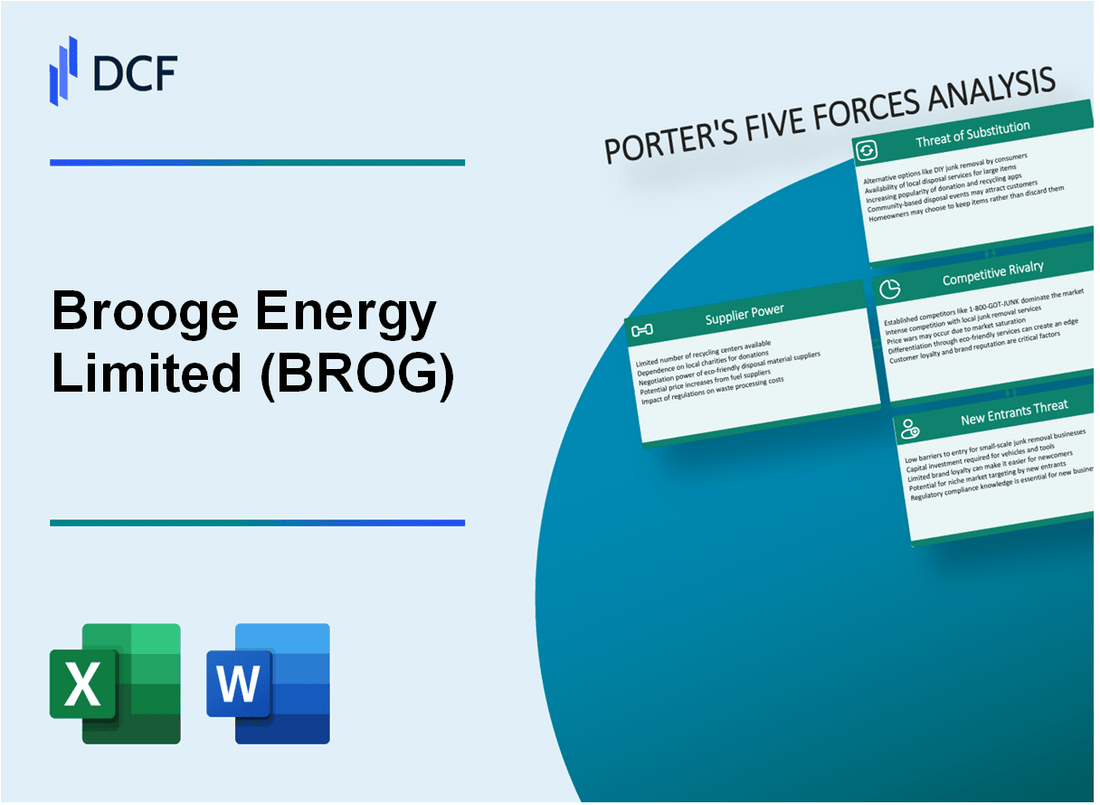
Brooge Energy Limited (Brog): 5 Forces Analysis [Jan-2025 MISE À JOUR] |
Entièrement Modifiable: Adapté À Vos Besoins Dans Excel Ou Sheets
Conception Professionnelle: Modèles Fiables Et Conformes Aux Normes Du Secteur
Pré-Construits Pour Une Utilisation Rapide Et Efficace
Compatible MAC/PC, entièrement débloqué
Aucune Expertise N'Est Requise; Facile À Suivre
Brooge Energy Limited (BROG) Bundle
Dans le paysage dynamique de la logistique pétrolière, Brooge Energy Limited (BROG) est à un moment critique, naviguant dans l'interaction complexe des forces du marché qui façonnent son positionnement stratégique. Lorsque le secteur de l'énergie subit des changements transformateurs aux EAU et au Moyen-Orient, la compréhension de l'écosystème compétitif devient primordial. Cette plongée profonde dans les cinq forces de Porter révèle les défis et les opportunités complexes auxquels l'énergie Brooge est confrontée, de la dynamique des fournisseurs et des relations avec les clients aux pressions concurrentielles et aux perturbations technologiques émergentes qui pourraient redéfinir le paysage de l'infrastructure de stockage de pétrole.
Brooge Energy Limited (BROG) - Five Forces de Porter: Pouvoir de négociation des fournisseurs
Nombre limité de fournisseurs d'infrastructures de stockage de pétrole et de carburant spécialisés
Sur le marché du stockage du pétrole des EAU, il y a environ 7 à 9 fournisseurs d'infrastructures spécialisées en 2024. Brooge Energy fonctionne sur un marché concentré avec des options de fournisseurs alternatifs limités.
| Segment de marché | Nombre de prestataires | Part de marché (%) |
|---|---|---|
| Infrastructure de stockage de pétrole | 7-9 | 15-22% |
| Équipement de manutention du carburant | 5-6 | 18-25% |
Dépendance potentielle à l'égard des fabricants d'équipements spécifiques
Les coûts d'approvisionnement en équipement pour Brooge Energy varient entre 4,5 millions à 7,2 millions de dollars par an. Les fabricants d'équipements clés comprennent:
- Technip Energies (Pays-Bas)
- Saipem S.P.A. (Italie)
- Worley Limited (Australie)
Contraintes géographiques sur le marché du stockage de pétrole des EAU
Brooge Energy fait face à des limitations géographiques avec les infrastructures de stockage concentrées dans des régions spécifiques:
| Région | Capacité de stockage (millions de barils) | Disponibilité des infrastructures |
|---|---|---|
| Fujairah | 14.5 | Haut |
| Abu Dhabi | 8.3 | Modéré |
Concentration modérée des fournisseurs dans le secteur de la logistique pétrolière
Les mesures de concentration des fournisseurs pour l'énergie de Brooge indiquent des contraintes de puissance de négociation modérées:
- Coûts de commutation des fournisseurs: 1,2 million de dollars - 2,5 millions de dollars
- Durée du contrat moyen des fournisseurs: 3-5 ans
- Indice de diversification de la chaîne d'approvisionnement: 0,62
L'effet de levier de négociation des fournisseurs totale estimé à 42-55% basé sur la dynamique actuelle du marché.
Brooge Energy Limited (Brog) - Five Forces de Porter: Pouvoir de négociation des clients
Concentration de consommateurs d'énergie industrielle et commerciale aux EAU et au Moyen-Orient
Concentration du marché de l'énergie des EAU à partir de 2024:
| Secteur | Nombre de grands consommateurs | Part de marché (%) |
|---|---|---|
| Huile & Gaz | 12 | 58% |
| Pétrochimique | 8 | 22% |
| Production d'électricité | 6 | 15% |
| Fabrication | 5 | 5% |
Sensibilité aux prix dans les services de stockage et de logistique du pétrole
Métriques d'élasticité des prix pour les services de stockage du pétrole au Moyen-Orient:
- Coefficient moyen de sensibilité au prix: 0,75
- Plage de tolérance de changement de prix: ± 3,5%
- Fréquence de renégociation contractuelle: tous les 24 à 36 mois
Associé diversifiée, y compris le gouvernement et les entités du secteur privé
Répartition de la composition des clients pour Brooge Energy Limited:
| Type de client | Pourcentage | Valeur du contrat annuel |
|---|---|---|
| Entités gouvernementales | 45% | 87,3 millions de dollars |
| Compagnies pétrolières privées | 35% | 68,5 millions de dollars |
| Commerçants internationaux | 20% | 39,2 millions de dollars |
Les accords contractuels à long terme atténuent les coûts de commutation des clients
Durée du contrat et analyse des coûts de commutation:
- Durée moyenne du contrat: 5-7 ans
- Coût de commutation estimé: 2,4 millions de dollars par contrat
- Pénalité de résiliation anticipée: 15 à 20% de la valeur du contrat restant
Brooge Energy Limited (Brog) - Five Forces de Porter: Rivalité compétitive
Concurrence émergente dans les infrastructures de stockage de pétrole aux EAU
En 2024, Fujairah accueille environ 7,4 millions de mètres cubes de capacité de stockage de pétrole. Brooge Energy Limited fonctionne avec 360 000 mètres cubes d'infrastructures de stockage dans cette région.
| Concurrent | Capacité de stockage (mètres cubes) | Part de marché (%) |
|---|---|---|
| Brooge Energy Limited | 360,000 | 4.86% |
| International Petroleum Investment Company | 1,200,000 | 16.22% |
| Vtti bv | 800,000 | 10.81% |
Nombre limité d'installations de stockage de pétrole spécialisées
La région de Fujairah compte actuellement 5 grands opérateurs de stockage de pétrole spécialisés avec une capacité combinée totale de 7,4 millions de mètres cubes.
- Coût d'investissement moyen des installations de stockage: 150 millions de dollars
- Temps de construction moyen: 24-36 mois
- Processus d'approbation réglementaire: 12-18 mois
Emplacement stratégique Avantage concurrentiel
L'emplacement maritime stratégique de Fujairah représente 60% du point de transit mondial du commerce du pétrole, avec un volume de transbordement annuel estimé de 120 millions de tonnes métriques.
Consolidation potentielle du marché
Évaluation actuelle du secteur de la logistique du pétrole: 3,2 milliards de dollars, avec un taux de croissance annuel prévu de 5 à 7% dans la région des EAU.
Brooge Energy Limited (Brog) - Five Forces de Porter: Menace des substituts
Augmentation des alternatives d'énergie renouvelable au Moyen-Orient
En 2024, le marché des énergies renouvelables du Moyen-Orient devrait atteindre 45,2 milliards de dollars, la capacité solaire qui devrait atteindre 64,4 GW d'ici 2030.
| Secteur des énergies renouvelables | Investissement (USD) | Croissance projetée |
|---|---|---|
| Énergie solaire | 18,3 milliards de dollars | 12,5% CAGR |
| Énergie éolienne | 7,6 milliards de dollars | 8,7% CAGR |
Intérêt croissant pour l'hydrogène vert et les solutions énergétiques durables
L'investissement en hydrogène vert au Moyen-Orient a atteint 2,1 milliards de dollars en 2023, avec les EAU et les développements régionaux de premier plan saoudien.
- Target de production d'hydrogène verte des EAU: 1,4 million de tonnes d'ici 2031
- Investissement du projet hydrogène saoudien: 5 milliards de dollars
- Marché mondial de l'hydrogène vert projeté: 72 milliards de dollars d'ici 2030
Perturbations technologiques potentielles dans les infrastructures de stockage de pétrole
Les technologies de stockage émergentes remettent en question les infrastructures de pétrole traditionnelles, avec un marché mondial du stockage d'énergie alternatif estimé à 27,3 milliards de dollars en 2024.
| Technologie de stockage | Valeur marchande (USD) | Taux de croissance |
|---|---|---|
| Stockage de batterie | 15,6 milliards de dollars | 14,2% CAGR |
| Stockage d'hydrogène | 4,7 milliards de dollars | 11,8% CAGR |
Suite progressive vers les technologies d'énergie plus propre
Investissement en transition d'énergie propre au Moyen-Orient prévu pour atteindre 63,5 milliards de dollars d'ici 2030, ce qui représente une menace importante pour les infrastructures pétrolières traditionnelles.
- Investissement en énergie propre des EAU: 163 milliards de dollars d'ici 2050
- Arabie saoudite cible des énergies renouvelables: 58,7 GW d'ici 2030
- Réduction projetée de la dépendance aux combustibles fossiles: 35% d'ici 2035
Brooge Energy Limited (Brog) - Five Forces de Porter: menace de nouveaux entrants
Exigences de capital élevé pour les infrastructures de stockage de pétrole
Brooge Energy Limited nécessite environ 150 à 250 millions de dollars pour établir une nouvelle installation de stockage de pétrole aux EAU. L'investissement initial des infrastructures comprend:
- Acquisition de terres: 30 à 50 millions de dollars
- Construction de réservoirs de stockage: 75 à 100 millions de dollars
- Systèmes de sécurité avancés: 20 à 40 millions de dollars
- Équipement spécialisé: 25 à 60 millions de dollars
Des obstacles réglementaires importants dans le secteur de l'énergie des EAU
| Exigence réglementaire | Coût de conformité estimé | Temps de traitement |
|---|---|---|
| Ministère de l'approbation de l'énergie | $500,000 | 12-18 mois |
| Évaluation de l'impact environnemental | $750,000 | 9-15 mois |
| Certification de sécurité | $350,000 | 6-12 mois |
Normes complexes de conformité environnementale et de sécurité
Le secteur du stockage du pétrole des EAU nécessite une conformité stricte aux normes internationales:
- Certification de gestion de l'environnement ISO 14001: 250 000 $
- Implémentation de la norme de sécurité OHSAS 18001: 300 000 $
- Coûts de recertification annuels: 100 000 $ à 150 000 $
Disponibilité limitée des terres pour les nouvelles installations de stockage de pétrole
Contraintes terrestres dans le secteur du stockage du pétrole des EAU:
- Terres industrielles disponibles à Fujairah: environ 500 hectares
- Taux d'occupation actuel: 85%
- Coût moyen des terres par hectare: 5 à 7 millions de dollars
- Les restrictions de zonage limitent le développement de nouveaux installations
Brooge Energy Limited (BROG) - Porter's Five Forces: Competitive rivalry
You're looking at the competitive landscape in Fujairah, and honestly, it's a crowded space. The rivalry here is intense because the location itself-the Port of Fujairah-is the world's second-largest bunkering hub.
The sheer scale of existing infrastructure means that capacity additions by any player immediately translate into price pressure. For context, the Port of Fujairah boasts a total crude and product storage capacity exceeding 100 million barrels, which translates to roughly 11.1 million cu m. Brooge Energy Limited, before its recent acquisition, held approximately 1 million cubic meters of that capacity.
You are competing directly against some very large, established global operators. Take VTTI, for instance; they control 2 million cu m of storage capacity in Fujairah, positioning them as the second-largest terminal operator at the port. VTTI's total global capacity is anticipated to rise to over 10 million cubic metres across its terminals.
Here's a quick comparison of the storage footprint in this highly competitive hub, based on the latest available figures:
| Entity | Fujairah Storage Capacity (Geometric) | Notes |
|---|---|---|
| Port of Fujairah Total Capacity | Approx. 11.1 million cu m | Total crude and product storage capacity. |
| VTTI (Major Competitor) | 2 million cu m | Second-largest terminal operator at the port. |
| Brooge Energy Limited (Pre-Acquisition) | Approx. 1 million cu m | Combined Phase I (approx. 0.399 million m³) and Phase II (600,000 cu m). |
The market is defintely prone to price pressure. When Brooge Energy announced its Phase II facility, it was noted that the entire capacity was fully contracted with multi-year take-or-pay contracts, which speaks to the high demand but also the need to lock in revenue streams against potential rate erosion. The recent shareholder approval in September 2025 for the sale of core assets to Gulf Navigation for an estimated $884 million signals a major strategic shift, partly driven by the need to consolidate strength in this competitive environment.
To counter the pure capacity play, Brooge Energy has focused on service differentiation. This is where the ancillary services come into play, which contribute to the overall revenue stream, which was reported as $76.5M on a trailing twelve-month basis as of December 31, 2024. You need to look at the value captured here:
- Ancillary services are a variable component of revenue.
- Past examples show specific ancillary service invoicing, such as $679,000 per month for a customer based on volume metrics.
- Differentiation centers on high-accuracy blending capabilities.
- Fast processing times are a key operational advantage cited.
If onboarding takes 14+ days, churn risk rises, especially when competitors like VTTI are fully sold out with blue-chip customers.
Brooge Energy Limited (BROG) - Porter's Five Forces: Threat of substitutes
You're analyzing the competitive landscape for Brooge Energy Limited (BROG) as of late 2025, and the threat from substitutes is a dynamic one, heavily influenced by market structure and the long-term energy shift. For a company whose core business, prior to the September 2025 shareholder-approved sale of its BPGIC FZE and BPGIC Phase III FZE interests, was centered on physical storage, understanding these alternatives is key.
Floating Storage (Tankers) as a Short-Term Substitute
When the oil market is in contango-meaning futures prices are higher than spot prices-the economic incentive for physical storage becomes very strong. This market structure, which the oil market displayed toward the end of 2025, directly competes with fixed storage capacity like that previously offered by Brooge Energy Limited's assets, which stood at 1,001,388 cbm across Phase I and II at year-end 2022. The financial incentive for this 'cash and carry' trade is clear: buy today, store, and sell later at a higher price.
This financial arbitrage has a quantifiable impact on the availability of floating storage, which acts as a direct, albeit temporary, substitute for land-based tanks. As of October 2025, the number of Very Large Crude Carriers (VLCCs) utilized for floating storage had increased by a notable 24% compared to January 2025. Total crude and condensate volumes held on tankers reached approximately 1.24 billion barrels in the week ending October 17, 2025. This surge is underpinned by a forecasted global oil surplus of 2.3 million barrels per day (mb/d) for 2025, with projections suggesting it could balloon to 4.0 mb/d in 2026. If you're looking at the immediate supply/demand balance, this floating capacity is a major substitute for any available tank space.
Geographical Substitutes: Global Hub Competition
Geographically, Brooge Energy Limited's location in Fujairah competes with other major global storage and bunkering hubs. These hubs offer alternative destinations for oil traders looking to store or process products. The competition is fierce, especially in the bunkering space, where Fujairah is a top-three hub.
Here's a look at the recent bunker sales volumes for two key substitutes, giving you a sense of scale:
| Hub | Reporting Period | Conventional & Biofuel Sales (Metric Tons) |
| Singapore | Q2 2025 | 13.73 million mt |
| Rotterdam | Q2 2025 | 2.2 million mt |
| Rotterdam | July-September 2025 (Marine Fuel Sales) | 2.45 million metric tons |
Rotterdam, the world's second-largest marine refueling hub, reported 2.45 million metric tons of marine fuel sales between July and September 2025. Singapore, the largest, recorded 13.73 million mt in Q2 2025 alone. These figures show the sheer volume handled by these alternative locations, which can absorb supply that might otherwise flow to the Middle East.
Long-Term Threat: The Energy Transition
The most significant long-term substitute threat isn't another oil storage facility; it's the structural decline in demand for fossil fuel storage itself. While the transition is complex, the data shows clear momentum. Fossil fuels still account for around 80% of total global energy consumption. However, DNV's Energy Transition Outlook 2025 forecasts a shift from today's 80/20 fossil/non-fossil primary energy mix to a 50/50 mix by 2050.
We are seeing early signs of this shift in power generation. Global fossil fuel generation fell slightly by 27 TWh in the first half of 2025 compared to the same period last year. Furthermore, global investment in renewable energy technologies reached USD 807 billion in 2024. This sustained investment means that the need for storing crude oil and refined products will eventually erode, which is a deflating factor for the long-term value of pure-play fossil storage assets. It's a slow burn, but the direction is set.
Low Threat from Alternative Logistics (Pipelines)
For short-haul regional trade, the threat from alternative logistics like pipelines is generally low, especially in the context of Fujairah's strategic importance. The region is anchored by the Habshan-Fujairah oil pipeline (ADCOP), which has a capacity of 1.5 million barrels per day (or approximately 7.5x10⁷ t/a). This pipeline exists specifically to bypass the Strait of Hormuz bottleneck, making the Fujairah location more attractive, not less, for regional producers like Abu Dhabi.
Moreover, the Port of Fujairah's infrastructure itself includes features that mitigate pipeline substitution for intra-hub movements. The Port Tanker Terminals (FOTT) utilize two highly sophisticated Matrix Manifold Systems and a large number of piggable pipelines, allowing for product transfers directly between terminals without chartering a vessel. This internal connectivity reduces the need for short-haul vessel transport, which might otherwise be substituted by a competing pipeline network.
- Contango market structure makes floating storage economically viable.
- Floating storage utilization rose 24% from January to October 2025.
- Global oil surplus is forecast at 2.3 mb/d for 2025.
- Singapore handled 13.73 million mt in Q2 2025 bunker sales.
- Fossil fuels are projected to drop from 80% to 50% of primary energy by 2050.
- ADCOP pipeline capacity is 1.5 million barrels per day.
Finance: draft a sensitivity analysis on the impact of a sustained $62/bbl Brent price on the implied storage rate needed to match the 2022 Brooge capacity utilization by next Tuesday.
Brooge Energy Limited (BROG) - Porter's Five Forces: Threat of new entrants
You're looking at the barriers to entry in the specialized world of oil storage in Fujairah, and honestly, the hurdles are massive. For any new player, the capital outlay alone is enough to stop most ventures before they even start. We are talking about infrastructure that requires deep pockets and long-term vision.
Extremely high capital requirement for building a modern, 1 Million cbm terminal.
Building a world-class terminal, like the one Brooge Energy Limited operates, is not a small undertaking. Think about the scale: a new entrant would need capital comparable to recent regional projects. For instance, a project announced for a 1.1 million cubic meter facility in Fujairah was valued at USD 350 million. That number sets the baseline for what it takes to compete in capacity terms. Brooge Energy Limited, before its recent strategic pivot, already had approximately 1 million cbm of operational storage capacity, split between Phase I (around 400,000 cbm) and Phase II (600,000 cbm). A new entrant must match this scale to be relevant in this major global hub.
Significant regulatory and permitting hurdles in the strategic Fujairah Free Zone.
Operating in the Fujairah Free Zone means navigating a complex web of local and federal regulations. This isn't just about getting a building permit; it involves stringent environmental, safety, and operational compliance for handling crude oil and clean petroleum products. The high level of regulatory scrutiny is evident in the governance surrounding major corporate actions. For example, Brooge Energy Limited's September 30, 2025, Extraordinary General Meeting saw an overwhelming 96.46% participation rate from shareholders voting on asset sales, showing that significant corporate moves are tightly managed and require broad stakeholder buy-in in this regulated space.
- Securing necessary environmental clearances is time-consuming.
- Port authority approvals dictate operational access.
- Compliance with international maritime standards is mandatory.
- Land use and zoning approvals are highly restrictive.
Difficulty securing strategic land plots and dedicated port connectivity.
The best locations in Fujairah, the world's 2nd largest bunkering hub, are already taken. New entrants face a scarcity of prime, adjacent land plots with direct access to the port's jetties. Brooge Energy Limited's competitive advantage stems from its established physical footprint, which includes dedicated lines connecting the Port of Fujairah. Securing similar dedicated connectivity is nearly impossible once the existing infrastructure is built out. A new competitor would likely face significantly higher costs to build new pipelines or negotiate access rights with existing terminal operators.
Brooge Energy's existing infrastructure provided a competitive edge over any new market entrants.
The established infrastructure of Brooge Energy Limited acts as a powerful deterrent. It's not just the tanks; it's the operational history, the contracted capacity, and the proven technology. While Brooge Energy Limited is selling its core assets for approximately $884 million in 2025, the market it was operating in still presents these barriers for a new company starting today. The incumbent's established capacity and operational history mean a new entrant starts years behind in terms of revenue generation and customer trust.
Here's a quick look at the asset disparity a new entrant faces:
| Metric | Hypothetical New Entrant (1 Million cbm Target) | Brooge Energy Limited (Established Asset Base) |
| Estimated Capital Requirement | ~USD 350 Million | Historical investment already sunk |
| Operational Capacity | 0 cbm (Start from zero) | ~1 Million cbm (Phase I & II) |
| Port Connectivity | Must negotiate/build new access | Existing dedicated lines to Port of Fujairah |
| Regulatory Track Record | None | Years of operational history in the Free Zone |
To be fair, the recent shareholder approval for the sale of BPGIC FZE and BPGIC Phase III FZE signals a major shift for Brooge Energy Limited, potentially reducing its direct operational threat in this specific segment, but the barrier to entry for anyone else wanting to replicate that business remains extremely high based on the capital and regulatory facts.
Disclaimer
All information, articles, and product details provided on this website are for general informational and educational purposes only. We do not claim any ownership over, nor do we intend to infringe upon, any trademarks, copyrights, logos, brand names, or other intellectual property mentioned or depicted on this site. Such intellectual property remains the property of its respective owners, and any references here are made solely for identification or informational purposes, without implying any affiliation, endorsement, or partnership.
We make no representations or warranties, express or implied, regarding the accuracy, completeness, or suitability of any content or products presented. Nothing on this website should be construed as legal, tax, investment, financial, medical, or other professional advice. In addition, no part of this site—including articles or product references—constitutes a solicitation, recommendation, endorsement, advertisement, or offer to buy or sell any securities, franchises, or other financial instruments, particularly in jurisdictions where such activity would be unlawful.
All content is of a general nature and may not address the specific circumstances of any individual or entity. It is not a substitute for professional advice or services. Any actions you take based on the information provided here are strictly at your own risk. You accept full responsibility for any decisions or outcomes arising from your use of this website and agree to release us from any liability in connection with your use of, or reliance upon, the content or products found herein.