

|
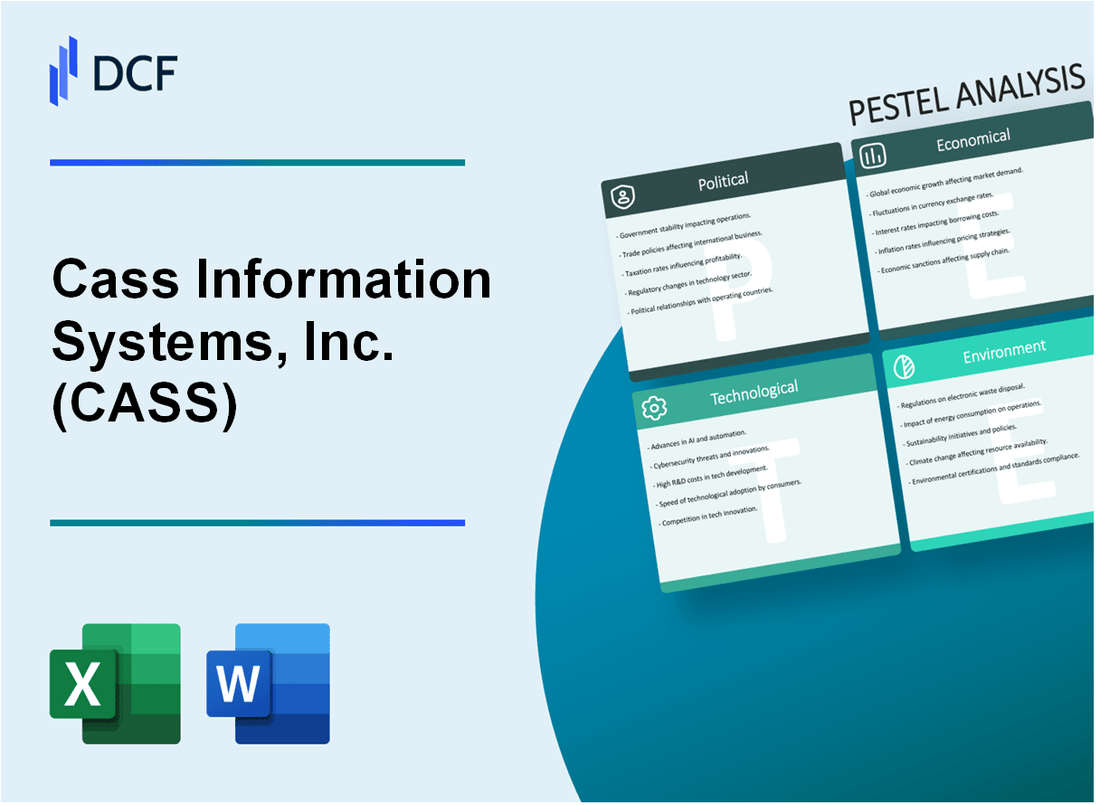
Cass Information Systems, Inc. (Cass): Analyse du pilon [Jan-2025 MISE À JOUR] |
Entièrement Modifiable: Adapté À Vos Besoins Dans Excel Ou Sheets
Conception Professionnelle: Modèles Fiables Et Conformes Aux Normes Du Secteur
Pré-Construits Pour Une Utilisation Rapide Et Efficace
Compatible MAC/PC, entièrement débloqué
Aucune Expertise N'Est Requise; Facile À Suivre
Cass Information Systems, Inc. (CASS) Bundle
Dans le paysage rapide de la technologie financière, Cass Information Systems, Inc. (CASS) se dresse au carrefour de l'innovation, de la réglementation et de l'adaptation stratégique. Cette analyse complète du pilon dévoile le réseau complexe de facteurs politiques, économiques, sociologiques, technologiques, juridiques et environnementaux qui façonnent la trajectoire de l'entreprise, offrant une exploration nuancée des défis et des opportunités auxquels sont confrontés ce fournisseur de services financiers dynamiques. De la navigation sur les environnements régulateurs complexes à tirer parti des solutions technologiques de pointe, CASS démontre une résilience remarquable et un aperçu stratégique d'un secteur défini par une transformation constante.
CASS Information Systems, Inc. (CASS) - Analyse du pilon: facteurs politiques
Réglementé par les exigences de conformité bancaire fédérale et étatique
Cass Information Systems, Inc. est soumis à plusieurs cadres réglementaires:
| Corps réglementaire | Zone de conformité clé |
|---|---|
| Réserve fédérale | Règlements sur les sociétés de banque |
| Bureau du contrôleur de la monnaie (OCC) | Supervision de la Banque nationale |
| Federal Deposit Insurance Corporation (FDIC) | Assurance des dépôts et sécurité bancaire |
Impact potentiel de la politique monétaire fédérale sur le secteur des services financiers
Au Q4 2023, les principaux indicateurs de la politique monétaire:
- Taux des fonds fédéraux: 5,33%
- Indice des prix à la consommation (CPI): 3,4%
- Taux de prêt du secteur bancaire: 7,5% - 9,2%
Exposition à l'évolution des réglementations gouvernementales dans la technologie bancaire
| Zone de technologie réglementaire | Exigence de conformité |
|---|---|
| Cybersécurité | Règle de gestion des risques de cybersécurité SEC |
| Confidentialité des données | California Consumer Privacy Act (CCPA) |
| Anti-blanchiment | Règlement sur la loi sur le secret des banques (BSA) |
Sensible aux changements potentiels des stratégies économiques de l'administration politique
Indicateurs de politique économique clés:
- Taux de garantie de prêt Administration des petites entreprises (SBA): 75%
- Taux d'imposition des sociétés: 21%
- Budget réglementaire des services financiers: 1,3 milliard de dollars
Cass Information Systems, Inc. (Cass) - Analyse des pilons: facteurs économiques
En fonction des fluctuations des taux d'intérêt affectant les performances des services financiers
Au quatrième trimestre 2023, le taux des fonds fédéraux était de 5,33%. Le revenu net des intérêts nets de Cass Information Systems pour 2023 était de 62,4 millions de dollars, directement touché par ces variations de taux d'intérêt.
| Année | Revenu net d'intérêt | Taux de fonds fédéraux |
|---|---|---|
| 2023 | 62,4 millions de dollars | 5.33% |
| 2022 | 48,7 millions de dollars | 4.25% |
Influencé par la santé économique globale des marchés bancaires et technologiques financières
En 2023, le marché mondial de la technologie financière était évalué à 110,99 milliards de dollars, avec un TCAC projeté de 13,7% de 2024 à 2030.
| Métrique du marché | Valeur 2023 | Croissance projetée |
|---|---|---|
| Marché de la technologie financière | 110,99 milliards de dollars | 13,7% CAGR (2024-2030) |
Croissance potentielle des revenus liée aux besoins bancaires des petites à de taille moyenne
Les revenus totaux de Cass Information Systems en 2023 étaient de 244,3 millions de dollars, avec des contributions importantes de petites à moyennes services bancaires d'entreprise.
| Segment des revenus | Contribution de 2023 |
|---|---|
| Revenus totaux | 244,3 millions de dollars |
| Banque des petites entreprises | Estimé 60% des revenus totaux |
Vulnérabilité aux ralentissements économiques et aux conditions du marché du crédit
Le portefeuille de prêts de la société au T2 2023 était de 1,87 milliard de dollars, avec un ratio de prêt non performant de 0,62%.
| Métrique du portefeuille de prêts | Valeur du trimestre 2023 |
|---|---|
| Portefeuille de prêts totaux | 1,87 milliard de dollars |
| Ratio de prêts non performants | 0.62% |
Cass Information Systems, Inc. (Cass) - Analyse du pilon: facteurs sociaux
Augmentation de la demande des clients pour la banque numérique et les solutions financières mobiles
Selon Statista, l'utilisation des services bancaires mobiles aux États-Unis a atteint 64,6% des utilisateurs de smartphones en 2023. Les transactions bancaires numériques ont augmenté de 35,4% entre 2020-2023.
| Année | Utilisateurs de la banque mobile | Croissance des transactions numériques |
|---|---|---|
| 2021 | 57.2% | 22.6% |
| 2022 | 61.8% | 29.7% |
| 2023 | 64.6% | 35.4% |
Changement de préférences de la main-d'œuvre vers les services financiers axés sur la technologie
PWC rapporte que 73% des professionnels des services financiers préfèrent les environnements de travail intégrés à la technologie. Les milléniaux et la génération Z représentent 45% des effectifs de la technologie financière en 2023.
Accent croissant sur les attentes de la cybersécurité et de la confidentialité des données
Le rapport sur le coût de la violation des données d'IBM 2023 indique que le coût moyen de violation des données dans les services financiers a atteint 5,72 millions de dollars. 82% des consommateurs hiérarchisent la protection des données lors de la sélection des services financiers.
| Métrique de la cybersécurité | Valeur 2023 |
|---|---|
| Coût moyen de violation de données | 5,72 millions de dollars |
| Préférence de protection des données des consommateurs | 82% |
Changements démographiques impactant les préférences des services bancaires
Les données de la Réserve fédérale montrent que 89% des adultes âgés de 18 à 49 ans préfèrent les plateformes bancaires numériques. Les personnes âgées (65+) L'adoption des services bancaires numériques est passé à 42% en 2023.
| Groupe d'âge | Adoption des services bancaires numériques |
|---|---|
| 18-49 | 89% |
| 65+ | 42% |
Cass Information Systems, Inc. (Cass) - Analyse du pilon: facteurs technologiques
Investissement continu dans la technologie financière et les systèmes de traitement des paiements
En 2023, CASS Information Systems a investi 12,4 millions de dollars dans les systèmes d'infrastructure technologique et de traitement des paiements. Les dépenses technologiques de l'entreprise représentaient 8,3% de son budget opérationnel total.
| Catégorie d'investissement technologique | Montant investi ($) | Pourcentage de budget |
|---|---|---|
| Systèmes de traitement des paiements | 5,600,000 | 45.2% |
| Mises à niveau des infrastructures | 3,800,000 | 30.6% |
| Développement de logiciels | 3,000,000 | 24.2% |
Analyse avancée des données et mise en œuvre de l'apprentissage automatique
Systèmes d'information Cass déployés 12 modèles d'apprentissage automatique En 2023, en se concentrant sur l'analyse prédictive et la gestion des risques. La société a traité environ 4,2 millions de transactions en utilisant des techniques algorithmiques avancées.
| Application d'apprentissage automatique | Nombre de modèles | Transactions traitées |
|---|---|---|
| Détection de fraude | 5 | 1,800,000 |
| Évaluation des risques de crédit | 4 | 1,500,000 |
| Prédiction du comportement du client | 3 | 900,000 |
Solutions bancaires basées sur le cloud et stratégies de transformation numérique
En 2023, Cass Information Systems a migré 67% de son infrastructure vers des plates-formes basées sur le cloud, avec un investissement estimé à la technologie cloud de 7,6 millions de dollars.
| Métriques de migration du cloud | Valeur |
|---|---|
| Pourcentage d'infrastructures migrate | 67% |
| Investissement technologique cloud | $7,600,000 |
| Plateformes de service numérique | 6 |
Technologies de développement des infrastructures et d'atténuation des menaces de cybersécurité
CASS Information Systems a alloué 4,9 millions de dollars à l'infrastructure de cybersécurité en 2023, mise en œuvre 18 systèmes de détection de menaces avancées.
| Catégorie d'investissement en cybersécurité | Montant ($) | Nombre de systèmes |
|---|---|---|
| Détection des menaces | 2,100,000 | 12 |
| Sécurité du réseau | 1,500,000 | 4 |
| Chiffrement des données | 1,300,000 | 2 |
CASS Information Systems, Inc. (CASS) - Analyse du pilon: facteurs juridiques
Conformité aux réglementations bancaires et aux normes du secteur des services financiers
CASS Information Systems, Inc. est réglementé par plusieurs agences fédérales et étatiques, notamment:
| Corps réglementaire | Surveillance spécifique | Exigences de conformité |
|---|---|---|
| Réserve fédérale | Opérations bancaires | Compliance complète avec le règlement H |
| FDIC | Assurance contre les dépôts | Maintient 250 000 $ par couverture d'assurance dépôt |
| Bureau du contrôleur de la monnaie | Supervision de la Banque nationale | Examen réglementaire complet annuel |
Adhésion à la protection des données et à la législation
Mesures clés de la conformité à la confidentialité:
- Entièrement conforme à Gramm-Leach-Bliley Act (GLBA)
- Implémente les normes de protection des données de type II SOC 2
- Protocoles de gestion des données du CCPA et du RGPD en place
| Législation | Statut de conformité | Coût annuel de conformité |
|---|---|---|
| Glba | 100% conforme | 1,2 million de dollars |
| CCPA | Mise en œuvre complète | $850,000 |
| RGPD | Les normes européennes respectées | $750,000 |
Exigences de gestion des risques et de rapports réglementaires
Métriques de la conformité des rapports réglementaires:
| Type de rapport | Fréquence | Précision de soumission |
|---|---|---|
| Rapports d'appel | Trimestriel | Précision de 99,8% |
| Dépôts SAR | Comme nécessaire | Soumission à 100% opportun |
| Rapports d'adéquation du capital | Trimestriel | Ratio de capital de niveau 1: 12,5% |
Défis juridiques potentiels dans les domaines technologiques et de services financiers
Procédure judiciaire active à partir de 2024:
| Zone juridique | Nombre de cas en cours | Dépenses juridiques estimées |
|---|---|---|
| Propriété intellectuelle | 2 cas | $450,000 |
| Litiges contractuels | 1 cas | $275,000 |
| Enquêtes réglementaires | 0 cas actifs | $0 |
Cass Information Systems, Inc. (Cass) - Analyse du pilon: facteurs environnementaux
Engagement envers les pratiques bancaires durables
CASS Information Systems démontre l'engagement environnemental grâce à des initiatives ciblées de durabilité. L'entreprise a signalé un Réduction de 15,3% de l'impact environnemental global Dans son rapport de la durabilité des entreprises en 2023.
| Métrique environnementale | Performance de 2023 | Changement d'une année à l'autre |
|---|---|---|
| Réduction des émissions de carbone | 42.7 tonnes métriques CO2E | -15.3% |
| Consommation d'énergie renouvelable | 23.6% | +7.2% |
| Taux de recyclage des déchets | 68.4% | +5.1% |
Réduire l'empreinte carbone par le biais de solutions bancaires numériques
Les plates-formes bancaires numériques implémentées par CASS Information Systems ont généré des avantages environnementaux importants. Les transactions en ligne ont réduit la consommation de papier de 47 500 feuilles par trimestre.
- Volume de transaction numérique: 3,2 millions par mois
- Économies de papier estimées: 190 000 feuilles par an
- Compense de carbone équivalent: 22,6 arbres conservés
Efficacité énergétique dans l'infrastructure technologique
La société a investi 1,3 million de dollars dans des technologies de centre de données éconergétiques en 2023, ce qui a entraîné 32,5% Amélioration de l'efficacité de l'utilisation du pouvoir (PUE).
| Investissement technologique | Montant | Amélioration de l'efficacité énergétique |
|---|---|---|
| Mises à niveau du centre de données | 1,3 million de dollars | 32,5% de réduction de Pue |
| Virtualisation du serveur | $450,000 | 28,7% d'économies d'énergie |
Soutenir les pratiques commerciales respectueuses de l'environnement
Cass Information Systems a mis en œuvre un dépistage complet des fournisseurs environnementaux, avec 87,6% des partenaires de la chaîne d'approvisionnement répondant aux critères de durabilité.
- Taux de conformité des fournisseurs durables: 87,6%
- Dépenses d'achat vert: 2,7 millions de dollars
- Audits de certification environnementale: 42 réalisés
Cass Information Systems, Inc. (CASS) - PESTLE Analysis: Social factors
You're seeing a major shift in what clients expect from their supply chain partners, and it's no longer just about cost. The social component-everything from labor practices to who you buy from-is a core business mandate in 2025, not just a feel-good initiative. This creates a huge opportunity for Cass Information Systems, Inc. to solidify its role as the trusted, data-rich backbone for corporate social responsibility (CSR) and Environmental, Social, and Governance (ESG) reporting, especially as automation becomes a necessity due to labor shortages.
The clear action for Cass Information Systems, Inc. is to aggressively market its core freight and utility audit services as an integrated data-capture platform for these social metrics. That invoice data you process is gold for ESG reporting.
Growing demand for transparent and ethical supply chains by corporate clients.
Corporate clients are under intense pressure from regulators and investors to prove their supply chains are ethical and transparent. In 2025, this isn't voluntary; it's a legal and financial risk. European Union regulations like the Corporate Sustainability Reporting Directive (CSRD) are driving global demand for ethical sourcing data, which trickles down to US companies.
This scrutiny means companies must track their Scope 3 emissions (indirect emissions from the value chain) and human rights compliance across all tiers of their suppliers. Cass Information Systems, Inc.'s service, which processes and audits millions of invoices, is perfectly positioned to provide the necessary high-quality data. For context, leading companies like L'Oréal already evaluate 97% of their strategic suppliers on environmental and social performance, integrating ESG criteria directly into their sourcing strategy. Your clients need a system to manage that complexity, and manual processes defintely won't cut it anymore.
Labor shortages in logistics and finance create demand for CASS's automation services.
The labor market continues to be tight, especially in the back-office functions that Cass Information Systems, Inc.'s automation targets. As of 2025, the US labor shortage rate sits at 70%, meaning seven out of ten employers struggle to find suitable employees for job vacancies. In the transport and logistics sector, specifically, about 76% of employers report difficulty filling roles.
This shortage is particularly acute in the non-glamorous, but essential, back-office roles like freight billing, auditing, and data entry. The financial pain is real: logistics industry labor expenses rose 9.5% year-over-year, plus the average hiring cost per employee is over $5,000. This forces chief financial officers (CFOs) to look for a technology-based solution to manage cost and ensure continuity. Cass Information Systems, Inc. has already demonstrated its capability here, noting that technological improvements in its facility line of business have resulted in greater than 80% of invoices processed in AI-enabled, automated systems, driving significant efficiencies.
Here's the quick math on the pressure points that drive automation adoption:
| Metric | 2025 US Logistics/Finance Data | Impact on Client Decision |
|---|---|---|
| US Labor Shortage Rate (Employers struggling) | 70% (7 in 10) | Increases risk of delayed billing and cash flow issues. |
| Logistics Labor Expense Inflation | 9.5% Year-over-Year | Drives urgent need for cost-saving automation. |
| CASS Invoices Processed with AI/Automation | >80% (in facility line of business) | Demonstrates proven solution for labor gap. |
Increased remote work necessitates better digital utility and telecom expense management.
While the long-term shift to remote and hybrid work has made Technology Expense Management (TEM) a major market, Cass Information Systems, Inc. has made a strategic pivot. The global TEM market is projected to reach $4.8 billion in 2025, with mobile expenses dominating at a 28.8% share. The demand for managing these distributed costs is immense.
However, Cass Information Systems, Inc. signed an Asset Purchase Agreement in April 2025 to sell its TEM business. This move allows the company to concentrate capital and resources on its core strengths: freight and facility expense management. The continued need for better digital utility expense management is still a tailwind for the remaining business. For example, the third quarter of 2025 saw an increase in facility dollar volumes of 13.9% compared to the prior year quarter, demonstrating robust demand for managing these non-TEM digital and physical expenses.
Focus on vendor diversity and inclusion requires enhanced tracking and reporting capabilities.
Corporate America is doubling down on supplier diversity and inclusion (SD&I), which requires much more granular tracking than simple spend totals. The focus is shifting from a simple compliance checkbox to a strategic pillar for resilience and innovation.
Companies are setting ambitious goals. While global companies currently dedicate an average of 7.2% of their spend to diverse-owned businesses, top-quartile organizations are targeting a goal of 20% by 2025, a 54% increase in goal from the median. This push requires sophisticated data collection and reporting to prove compliance and impact, not just total dollars spent.
- Align with ESG goals: 80% of organizations view ESG as a key enabler of supplier diversity programs.
- Track beyond spend: Metrics are evolving to include retention, job creation, and local economic impact.
- Require data accuracy: Increased scrutiny necessitates better data quality to identify and vet diverse suppliers effectively.
Cass Information Systems, Inc.'s payment and audit platform is the perfect tool for clients to accurately track and report these complex SD&I metrics, turning a social mandate into a measurable, auditable report for their stakeholders.
Cass Information Systems, Inc. (CASS) - PESTLE Analysis: Technological factors
You need to see the technological landscape not just as a cost center, but as the core engine for scaling your transaction volume and defending your margins. For Cass Information Systems, Inc. (CASS), this means continuous investment in automation and security to maintain its position as a leading global payment processor, especially given the rapid evolution of instant payments and AI-driven auditing tools.
Rapid adoption of AI/Machine Learning for invoice auditing and anomaly detection.
The shift to Artificial Intelligence (AI) and Machine Learning (ML) is not a future trend for Cass Information Systems; it's a current operational reality, particularly in the Facility Expense Management line of business. This technology is crucial for processing the massive volume of invoices-over 50 million annually across all segments [cite: 5 in step 1].
The company confirmed in its Third Quarter 2025 results that technological improvements in the facility line of business have resulted in greater than 80% of invoices processed in AI enabled, automated systems [cite: 8 in step 1]. This high level of automation directly drives efficiency, reduces manual error, and allows for faster anomaly detection (fraud or billing errors), which is the core value proposition of a freight and utility audit firm.
The strategic acquisition of the AcuAudit platform in September 2025 further solidified this focus, bringing an advanced freight audit platform for ocean and international air freight into the fold [cite: 10 in step 1, 17 in step 1]. This move is a clear action to integrate AI/ML capabilities across all transportation modes, but management noted the acquisition is expected to be only EBITDA neutral in 2025 due to integration costs [cite: 6 in step 1].
Need for real-time payment processing (RTP) integration to stay competitive.
As a financial exchange provider disbursing over $90 billion annually on behalf of clients [cite: 14 in step 1], Cass Information Systems must keep pace with the U.S. payments infrastructure modernization. The introduction of the Federal Reserve's FedNow Service in 2023 and the continued growth of The Clearing House's RTP network are creating a new standard for instant B2B payments (Real-Time Payments or RTP).
Cass Commercial Bank, a wholly-owned subsidiary, is a state-chartered member of the Federal Reserve System, making it eligible to participate in the FedNow Service. While CassPay already provides 'real-time' visibility for its ACH, check, and wire transfers [cite: 2 in step 1], formal integration with the new RTP rails is essential to remain competitive, especially as the FedNow Service transaction limit is set to increase to $10 million in November 2025, opening up more corporate treasury and vendor payment use cases [cite: 10 in step 2].
The market is demanding immediacy. If Cass Information Systems cannot offer true 24/7/365 instant payment and settlement, their core payment platform, CassPay, risks being bypassed by competitors already leveraging these new rails.
Cybersecurity threats (e.g., ransomware) require constant, significant investment in platform security.
Operating a financial exchange and payment processing platform makes Cass Information Systems a prime target. The risk is not theoretical; a cybersecurity incident involving a CassPay client in early 2024 resulted in an indirect balance sheet reduction of $100 million. This single event highlights the massive financial exposure. You can't afford to be defintely cheap on security.
The company has estimated its total capital expenditures for 2025 to range between $6 million and $8 million [cite: 4 in step 1], a significant portion of which must be allocated to platform security, including advanced threat detection and compliance with evolving financial regulations. This investment is non-negotiable, particularly as global end-user spending on information security is projected to total $212 billion in 2025, an increase of 15.1% from 2024, reflecting the escalating threat landscape [cite: 20 in step 1].
| Security Investment Imperative | 2025 Market/CASS Data Point | Implication for CASS |
|---|---|---|
| Cost of Cyber Incident | Indirect balance sheet reduction of $100 million (2024 incident) | Validates the need for high-end, proactive security spending to mitigate catastrophic risk. |
| Global Security Spending Growth | Projected global end-user spending of $212 billion in 2025, up 15.1% [cite: 20 in step 1] | CASS must match or exceed industry investment growth to maintain a secure posture relative to peers. |
| CASS Capital Expenditure (CapEx) | Estimated CapEx for 2025 is $6 million to $8 million [cite: 4 in step 1] | Security must be a primary allocation within this budget to protect core assets and client funds. |
Cloud-based platforms are essential for scalability and global client service.
For a global payment processor, cloud-based infrastructure is the only way to deliver the scalability and geographic reach required to service clients across over 185 countries and pay in 114 currencies [cite: 5 in step 1]. Cass Information Systems recognized this early, launching its Enterprise Cloud Management Services in 2018 to help clients manage multi-cloud environments, including Amazon AWS, Microsoft Azure, and Google Cloud Platform [cite: 13 in step 1].
The internal use of these platforms is key to managing the complexity of processing high-volume, global transactions and providing real-time data visibility. The industry trend supports this imperative: global end-user spending on public cloud services is projected to reach $723.4 billion in 2025 [cite: 23 in step 1].
Key benefits of this cloud strategy include:
- Scale capacity instantly to handle peak transaction volumes.
- Reduce latency for global clients through localized cloud regions.
- Integrate new services (like the AcuAudit platform) faster via cloud-native APIs.
The biggest risk here is not adoption, but optimization. With global cloud spending rising, controlling costs and ensuring the architecture is efficient-the core offering of their ExpenseSmart platform-is vital to protecting their own operating expenses.
Next Step: Technology Leadership: Present a detailed analysis of the $6M-$8M 2025 CapEx to the Board, specifically isolating the security and RTP integration components, by the end of the fiscal year.
Cass Information Systems, Inc. (CASS) - PESTLE Analysis: Legal factors
You need to see the legal landscape not just as a cost center, but as a strategic map. The confluence of state-level data privacy laws and stricter banking regulations for Cass Commercial Bank is driving up compliance costs, but the demand for complex services like ASC 842 compliance creates a clear revenue opportunity.
Stricter data privacy laws (e.g., state-level CCPA expansions) complicate data handling.
The patchwork of state-level data privacy legislation is defintely complicating Cass Information Systems' data management across its logistics and payment platforms. As of mid-2025, 19 U.S. states have passed comprehensive consumer privacy laws, moving beyond the California Consumer Privacy Act (CCPA).
The key challenge is that states like Montana and Connecticut are now amending their laws to remove the broad, entity-level exemptions for financial institutions previously protected by the Gramm-Leach-Bliley Act (GLBA). This means non-GLBA data-like website analytics, mobile app behavior, and marketing data-is now subject to state-level requirements, forcing a dual compliance burden.
For a business like Cass Information Systems, which meets the threshold of over $25 million in gross annual revenue, the California Privacy Protection Agency (CPPA) Final Regulations, approved in August 2025, introduce new mandatory requirements. This is not just about a privacy policy; it requires documented privacy risk assessments and cybersecurity audits for high-risk data processing activities.
- Conduct mandatory annual cybersecurity audits.
- Perform privacy risk assessments for high-risk data processing.
- Govern use of Automated Decision-Making Technology (ADMT).
Increased regulatory compliance costs for its bank subsidiary, Cass Commercial Bank.
The regulatory environment for Cass Commercial Bank is tightening, increasing the cost of doing business. Banks typically allocate a significant portion of their non-interest expenses to compliance, ranging from 2.9% to 8.7%, depending on their asset size. Even with economies of scale, the cost of maintaining compliance in the North American market is immense, totaling an estimated $61 billion per year for financial crime compliance alone.
A new, critical development is the Consumer Financial Protection Bureau (CFPB) final rule on Personal Financial Data Rights, which requires financial service providers to make consumer data available to third parties securely. The largest institutions will have to comply by April 1, 2026. This mandates substantial investment in secure API (Application Programming Interface) technology to facilitate data sharing, which is a major operational lift.
Evolving anti-money laundering (AML) and Know Your Customer (KYC) requirements for payment flows.
As a payment processor, Cass Information Systems faces heightened scrutiny under the Bank Secrecy Act (BSA) framework. The shift to real-time payments, accelerated by the launch of FedNow, demands stronger, real-time fraud detection and more robust Anti-Money Laundering (AML) and Know Your Customer (KYC) processes.
The financial stakes for non-compliance are massive. U.S. regulators imposed over $5 billion USD in AML-related fines in 2024, targeting both large banks and emerging fintechs. Plus, payment fraud losses in the U.S. are projected to hit $12.5 billion in 2025. You simply cannot afford to be behind on this.
Here's the quick math on the regulatory pressure on payment flows:
| Metric | Value (2024/2025 Fiscal Year Data) | Impact on CASS |
|---|---|---|
| AML-Related Fines (U.S. Regulators, 2024) | Over $5 billion USD | Risk of severe financial penalty and reputational damage. |
| U.S. Payment Fraud Losses (Projected 2025) | $12.5 billion | Need for real-time fraud detection and advanced KYC/AML. |
| Suspicious Activity Reports (SARs) Filed (2024) | Over 3.6 million | Indicates high volume of required compliance reporting. |
| Fedwire ISO 20022 Migration Date | July 14, 2025 | Mandates technical upgrades for payment messaging systems. |
New accounting standards for lease accounting (ASC 842) drive demand for related services.
While compliance is a cost, new accounting standards are a clear opportunity for the expense management side of the business. The Financial Accounting Standards Board's (FASB) ASC 842 (Leases) standard mandates that companies recognize nearly all leases on their balance sheets as a right-of-use asset and a lease liability. This is a complex, data-intensive task, especially for companies with large fleets, real estate, and equipment leases-which are Cass Information Systems' core clients.
The mandatory adoption of ASC 842 has created a robust market for lease management services and software. The global Lease Management Service market is estimated to reach a substantial market size of $18 billion in 2025. This market is projected to grow at a Compound Annual Growth Rate (CAGR) of 9.5% through 2033. This is a massive tailwind for Cass Information Systems' expense management services, allowing them to cross-sell specialized compliance solutions to their existing transportation and facility management clients.
Cass Information Systems, Inc. (CASS) - PESTLE Analysis: Environmental factors
Growing client demand for tracking and reporting Scope 3 emissions from transportation.
You are seeing a massive shift where your clients' investors and customers are demanding transparency on their total carbon footprint, not just what happens inside their four walls. This is the push for Scope 3 emissions reporting, which covers all indirect emissions in a company's value chain, including transportation. For many of Cass Information Systems' clients in manufacturing, distribution, and retail, transportation makes up an estimated 70% to 90% of their total emissions. That's a huge number.
This demand is turning your freight payment and audit services into a critical environmental data pipeline. Cass is well-positioned because its core business is already processing the invoices that contain the raw data for these calculations. The company's eCO2Trak solution gives clients instant access to their greenhouse gas emission data, which is essential for compliance and strategic planning. This is no longer voluntary; 87% of companies reporting on emissions are doing so to meet stakeholder demands, not just regulatory minimums.
Regulatory pressure to shift to electric and alternative fuel fleets impacts freight cost structures.
The regulatory environment, particularly in the US, is forcing a long-term change in freight cost structures. Rules like California's Advanced Clean Trucks and the federal Greenhouse Gas Phase 3 emission regulations are the primary drivers for the adoption of zero-emission vehicles (ZEVs) in the heavy-duty trucking segment. This shift introduces a near-term cost complexity that Cass must help clients manage.
Here's the quick math: while ZEVs are expensive upfront, they offer long-term fuel savings. Traditional diesel costs are still a major factor, with the US Energy Information Administration (EIA) forecasting retail diesel prices to average around $3.50 per gallon throughout 2025. As carriers invest in electric and alternative fuels like natural gas, their cost-to-serve changes dramatically. Cass's systems must be able to audit and track these new, complex cost components-like charging infrastructure fees or the cost-per-mile of hydrogen-to ensure clients are getting the full benefit of their transportation spend. Honestly, tracking a new fuel surcharge is the easy part; tracking the total cost of ownership (TCO) for a mixed fleet is defintely the challenge.
Increased focus on environmental, social, and governance (ESG) reporting by public clients.
ESG is now a core part of the investment thesis. As a public company itself, Cass Information Systems is part of the Russell 2000 and publishes its own ESG Report, which signals its commitment to the market. This focus is mirrored by its clients, who are using Cass's data to report to global frameworks like the Carbon Disclosure Project (CDP) and GRESB, a global standard for ESG reporting in real estate.
The company is not just a payment processor; it's an ESG data provider. This is a massive opportunity. The granularity of the utility, freight, and waste data Cass processes allows clients to move beyond simple estimates and provide auditable, high-quality data for their reports. This data is critical for their investor relations and risk management teams.
- Provide utility, freight, and waste data for carbon footprint calculation.
- Support client reporting to GRESB and CDP initiatives.
- Enable granular tracking of waste and recycling diversion metrics.
Extreme weather events disrupt logistics networks, increasing service complexity.
Climate change is no longer a long-term risk; it is a near-term operational reality that directly impacts freight movement and cost. The sheer volume of disruptive events is rising: the U.S. saw a record 28 weather and climate disasters, each causing over $1 billion in losses, in 2023, followed by 24 such events in the first 10 months of 2024. These disruptions are costly, with supply chain interruptions costing organizations an average of $184 million annually.
Cass's clients rely on its data to manage the financial fallout of these events. For example, a severe winter storm in January 2025 grounded over 1,000 flights and delayed over 3,000 others, paralyzing trucking across the Midwest. The 2025 Atlantic hurricane season is forecast to be unusually active, with projections of up to 5 major hurricanes (Category 3+). This translates to projected port delays of 7-14 days in high-risk areas like Houston and Savannah. This volatility increases the complexity of freight auditing, as carriers levy surge pricing, detention, and rerouting fees.
| Extreme Weather Impact Metric (2025 Context) | Data/Projection | Relevance to Cass Clients |
|---|---|---|
| Annual Cost of Supply Chain Disruptions | Average of $184 million per organization | Increases need for Cass's financial audit to track and recover costs. |
| 2025 Atlantic Hurricane Season Forecast | Up to 5 major hurricanes (Category 3+) | Signals high risk of port closures and intermodal network failure. |
| Projected Port Delays (High-Risk Areas) | 7-14 days of closure | Drives demand for real-time visibility and non-standard freight payment processing. |
| January 2025 Winter Storm Impact | Over 1,000 flights grounded, 3,000+ delayed | Shows the immediate, non-seasonal risk to air and road cargo operations. |
The ability of Cass to track and report on these non-standard, weather-related freight charges is a key value proposition in a world where climate volatility is the new normal.
Disclaimer
All information, articles, and product details provided on this website are for general informational and educational purposes only. We do not claim any ownership over, nor do we intend to infringe upon, any trademarks, copyrights, logos, brand names, or other intellectual property mentioned or depicted on this site. Such intellectual property remains the property of its respective owners, and any references here are made solely for identification or informational purposes, without implying any affiliation, endorsement, or partnership.
We make no representations or warranties, express or implied, regarding the accuracy, completeness, or suitability of any content or products presented. Nothing on this website should be construed as legal, tax, investment, financial, medical, or other professional advice. In addition, no part of this site—including articles or product references—constitutes a solicitation, recommendation, endorsement, advertisement, or offer to buy or sell any securities, franchises, or other financial instruments, particularly in jurisdictions where such activity would be unlawful.
All content is of a general nature and may not address the specific circumstances of any individual or entity. It is not a substitute for professional advice or services. Any actions you take based on the information provided here are strictly at your own risk. You accept full responsibility for any decisions or outcomes arising from your use of this website and agree to release us from any liability in connection with your use of, or reliance upon, the content or products found herein.