

|
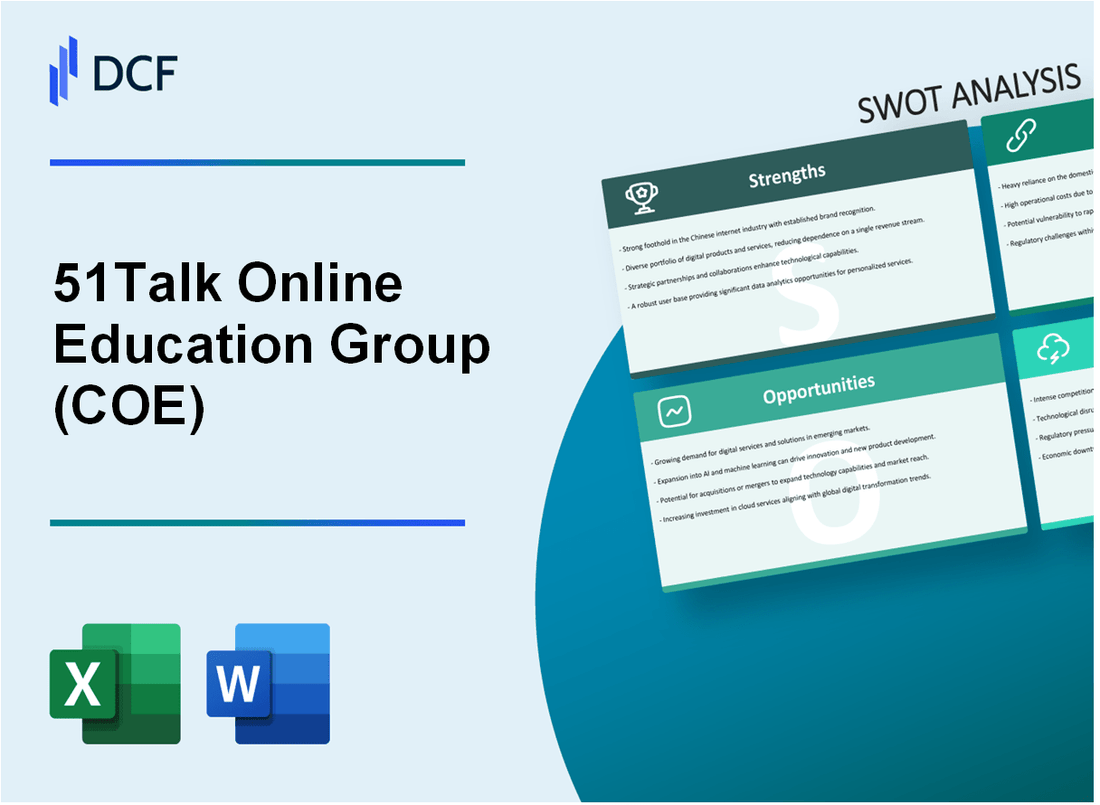
51Talk Online Education Group (COE): Analyse SWOT [Jan-2025 Mise à jour] |
Entièrement Modifiable: Adapté À Vos Besoins Dans Excel Ou Sheets
Conception Professionnelle: Modèles Fiables Et Conformes Aux Normes Du Secteur
Pré-Construits Pour Une Utilisation Rapide Et Efficace
Compatible MAC/PC, entièrement débloqué
Aucune Expertise N'Est Requise; Facile À Suivre
51Talk Online Education Group (COE) Bundle
Dans le paysage rapide de l'éducation en ligne en évolution, le groupe d'éducation en ligne 51 TALK est à un moment critique, naviguant sur la dynamique du marché complexe et les transformations technologiques. Cette analyse SWOT complète dévoile le positionnement stratégique d'une plate-forme pionnière EDTech chinoise qui a connecté les étudiants avec des professeurs de langue étrangère grâce à des solutions numériques innovantes. En disséquant ses capacités internes et ses défis externes, nous fournissons une exploration perspicace de la façon dont 51talk est sur le point de tirer parti de ses forces, de traiter les faiblesses potentielles, de capitaliser sur les opportunités émergentes et d'atténuer les menaces importantes dans l'écosystème de l'éducation mondiale compétitive en ligne.
51 Talk en ligne Group d'éducation (COE) - Analyse SWOT: Forces
Plateforme d'éducation anglaise en ligne établie
51 Talk fonctionne depuis 2011, avec un base d'utilisateurs de plus de 2,5 millions d'étudiants En Chine à partir de 2023. La plate-forme est spécialisée dans la connexion des étudiants chinois avec des professeurs d'anglais étrangers via des cours interactifs en ligne.
| Métriques de la plate-forme | Données |
|---|---|
| Étudiants totaux | 2,5 millions |
| Années de fonctionnement | 12 ans et plus |
| Nationalités des enseignants | 20+ pays |
Infrastructure technologique robuste
Plateforme technologique de 51 Talk Apprentissage en ligne interactif en temps réel avec 99,5% de disponibilité du système. La plate-forme propose:
- Capacités de streaming vidéo HD
- Technologie de communication à faible latence
- Tableau blanc numérique interactif
- Outils d'évaluation d'apprentissage alimentés par l'IA
Expérience sur le marché en éducation en anglais
51 Talk sert divers segments d'étudiants avec des programmes spécialisés:
| Segment des étudiants | Part de marché |
|---|---|
| Étudiants K-12 | 65% |
| Apprenants adultes | 35% |
Solide reconnaissance de la marque
51 Talk a obtenu un positionnement important sur le marché avec 128,6 millions de dollars de revenus pour 2022 et la reconnaissance sur les principaux marchés éducatifs chinois.
- Inscrit sur NASDAQ depuis 2016
- Nommé "Top 10 plateformes d'éducation en ligne en Chine"
- Plus de 10 000 enseignants étrangers certifiés
51Talk en ligne Education Group (COE) - Analyse SWOT: faiblesses
Accrue de la concurrence des autres plateformes d'éducation en ligne
En 2024, le marché de l'éducation en ligne en Chine est devenu de plus en plus saturé. Selon les données d'études de marché:
| Concurrent | Part de marché | Revenus annuels |
|---|---|---|
| Vipkid | 18.5% | 320 millions de dollars |
| 51 TALK | 12.3% | 215 millions de dollars |
| Genshixue | 15.7% | 280 millions de dollars |
Défis potentiels pour maintenir la qualité et la cohérence des enseignants
Les mesures de performance liées aux enseignants indiquent des défis importants:
- Taux de rotation des enseignants: 35% par an
- Période moyenne de rétention des enseignants: 18 mois
- Coûts de vérification de la qualification des enseignants: 1,2 million de dollars par an
Vulnérabilité aux changements réglementaires dans le secteur de l'éducation en ligne de la Chine
Impact réglementaire sur le modèle commercial de 51 Talk:
| Action réglementaire | Impact financier potentiel |
|---|---|
| Restrictions de tutorat après l'école | Réduction potentielle des revenus de 22-27% |
| Exigences de conformité de la plate-forme d'éducation en ligne | Coûts de conformité estimés: 5,6 millions de dollars |
Expansion géographique limitée au-delà du marché chinois
Distribution géographique actuelle des opérations de 51 Talk:
- Couverture du marché intérieur: 95%
- Présence du marché international: 5%
- Pays ayant des opérations actuelles: Chine, présence limitée en Asie du Sud-Est
Indicateurs de performance clés mettant en évidence les faiblesses:
| Métrique | Valeur 2024 |
|---|---|
| Taux de croissance des revenus | 4.2% |
| Marge opérationnelle | 6.8% |
| Coût d'acquisition des clients | 87 $ par étudiant |
51Talk en ligne Education Group (COE) - Analyse SWOT: Opportunités
Demande croissante d'apprentissage en ligne de la langue anglaise sur les marchés émergents
Le marché mondial de l'apprentissage des langues en ligne devrait atteindre 18,73 milliards de dollars d'ici 2027, avec un TCAC de 13,2%. Les marchés émergents présentent un potentiel important:
| Marché | Taux de croissance d'apprentissage des langues en ligne | Utilisateurs potentiels |
|---|---|---|
| Asie du Sud-Est | 16.5% | 320 millions d'apprenants potentiels |
| Inde | 19.3% | 480 millions d'apprenants en anglais potentiels |
| Chine | 14.7% | 250 millions d'utilisateurs potentiels |
Expansion potentielle dans les programmes de formation en anglais d'entreprise
Taille et opportunités du marché de la formation en langue d'entreprise:
- Le marché mondial de la formation aux langues d'entreprise devrait atteindre 11,5 milliards de dollars d'ici 2026
- Dépenses moyennes des entreprises pour une formation linguistique: 1 286 $ par employé
- Industries à la demande de formation linguistique la plus élevée:
- Technologie
- Finance
- Fabrication
- Soins de santé
Développement de technologies d'apprentissage personnalisées axées sur l'IA
Insights du marché des technologies d'apprentissage des langues AI:
| Segment technologique | Valeur marchande 2024 | Taux de croissance projeté |
|---|---|---|
| Plateformes d'apprentissage des langues alimentées par l'IA | 2,3 milliards de dollars | 22,7% CAGR |
| Algorithmes d'apprentissage personnalisés | 1,6 milliard de dollars | CAGR 18,5% |
Potentiel d'expansion du marché international, en particulier en Asie du Sud-Est
Opportunités du marché de l'éducation en ligne d'Asie du Sud-Est:
- Taille totale du marché en 2024: 4,2 milliards de dollars
- Pays avec un potentiel de croissance le plus élevé:
- Indonésie: 35 millions d'apprenants potentiels
- Philippines: 28 millions d'apprenants potentiels
- Vietnam: 22 millions d'apprenants potentiels
- Dépenses annuelles moyennes par apprenant en ligne: 126 $
51 Talk en ligne Group d'éducation (COE) - Analyse SWOT: menaces
Environnement réglementaire strict pour l'éducation en ligne en Chine
En juillet 2021, les régulateurs chinois ont mis en œuvre directives strictes Ce secteur de l'éducation en ligne fondamentalement transformé:
- Interdiction de tutorat à but lucratif dans les matières scolaires de base
- Investissement étranger interdit dans les plateformes d'éducation en ligne
- Les sociétés restreintes de la levée de capitaux via des listes à l'étranger
| Impact réglementaire | Conséquence financière |
|---|---|
| Les évaluations de l'entreprise d'éducation diminuent | -78,3% de réduction de capitalisation boursière |
| Restructuration du secteur de tutorat en ligne | Plus de 70% d'entreprises obligées de pivoter les modèles commerciaux |
Incertitudes économiques affectant les dépenses de consommation
Les défis économiques de la Chine ont un impact direct sur les dépenses d'éducation:
| Indicateur économique | 2023 données |
|---|---|
| Taux de croissance du PIB | 5.2% |
| Croissance des revenus disponibles des ménages | 3.4% |
| Indice de confiance des consommateurs | 87,6 points |
Perturbations technologiques des concurrents émergents Edtech
Défis technologiques émergents dans l'éducation en ligne:
- Plateformes d'apprentissage personnalisées alimentées par AI
- Systèmes de vérification des informations d'identification compatibles avec la blockchain
- Technologies de curriculum adaptative avancé d'apprentissage automatique
| Investissement technologique | Dépenses annuelles |
|---|---|
| Capital mondial de capital-risque EDTech | 16,1 milliards de dollars en 2023 |
| IA dans la taille du marché de l'éducation | 6,8 milliards de dollars projetés d'ici 2024 |
Les tensions géopolitiques potentielles ont un impact sur les services éducatifs transfrontaliers
Défis de service éducatif international:
| Facteur géopolitique | Impact potentiel |
|---|---|
| Restrictions technologiques américaines-chinoises | Réduction potentielle de 40% des échanges de technologies éducatives transfrontalières |
| Mobilité internationale des étudiants | -23% de baisse des inscriptions aux étudiants internationaux |
51Talk Online Education Group (COE) - SWOT Analysis: Opportunities
Q3 2025 Gross Billings are Projected to Reach Up to US$37.5 Million
You're looking for clear signs of near-term growth, and 51Talk Online Education Group's guidance for the third quarter of 2025 (Q3 2025) provides exactly that. The company expects net gross billings to fall between US$36.5 million and US$37.5 million. This projection signals strong momentum, reflecting a sequential growth of 28.1% to 31.6% from Q2 2025, and a substantial year-over-year increase of approximately 84.6% to 89.7% compared to Q3 2024. That kind of acceleration is a clear opportunity for shareholders.
Here's the quick math on the recent performance and forward-looking guidance:
| Metric (2025 Fiscal Year) | Q2 2025 Actual | Q3 2025 Guidance (Midpoint) | Sequential Growth (Q2 to Q3) |
|---|---|---|---|
| Net Gross Billings | US$28.5 million | US$37.0 million | ~29.8% |
| Net Revenues | US$20.4 million | N/A (Focus on Billings) | N/A |
| Active Students (with attended lessons) | Approximately 91,300 | N/A (Focus on Billings) | N/A |
The gross billings figure is a key indicator of future revenue, representing cash received for course packages. The significant jump from the Q2 2025 actual of US$28.5 million to the Q3 guidance shows robust demand and disciplined execution, which is defintely the kind of positive trajectory you want to see.
Strategic Global Expansion into Key Markets
The company is no longer just a China-centric education platform; its strategic pivot to global expansion is a major opportunity. 51Talk is actively deepening its presence across Southeast Asia, an area with high English language learning demand.
The current market footprint includes established operations in the Philippines, Singapore, and Thailand, with the company even headquartered in Singapore. Management is also exploring new territories, specifically mentioning Vietnam and Arabic-speaking regions as potential expansion targets. This multi-market approach diversifies revenue streams and reduces regulatory risk tied to any single country.
The focus areas for this expansion include:
- Deepening market penetration in the Philippines, Singapore, and Thailand.
- Exploring new, high-growth regions like Vietnam.
- Establishing an early-mover advantage in non-traditional markets, such as Arabic-speaking regions.
Heavy Investment in Artificial Intelligence (AI) to Scale Personalized Learning
AI is not just a buzzword here; it's integral to the entire business strategy and a massive opportunity for efficiency and quality. The company rolled out its 'Smart Learning System 2.0' in Q2 2025, a comprehensive, AI-powered systems upgrade across virtually every facet of operations.
This system is designed to scale personalized learning (or differentiated instruction) while simultaneously boosting operational efficiency. The investment is already paying off in key areas like sales, where the company achieved a fully AI-driven sales closure during the pilot phase, setting a precedent for accelerated revenue growth.
The AI system's impact is three-fold:
- Personalization: AI generates customized course plans during student onboarding based on proficiency evaluations.
- Quality Control: It actively monitors teacher performance and student engagement in real-time.
- Efficiency: It streamlines business operations, including customer acquisition, marketing, and management.
Establishing Localized, On-the-Ground Operations
To be fair, a purely digital platform can sometimes miss the mark on cultural fit. That's why 51Talk is actively building localized, on-the-ground operations in multiple international markets. This strategy is a crucial opportunity to ensure that their educational services remain culturally relevant and effective for diverse regional educational needs.
The Head of Strategy confirmed this in November 2025, explaining that this approach blends local expertise with their scalable technology stack. This combination allows them to cater to local standards, calendars, and language norms, which is vital for sustained demand and long-term customer retention. This local-first execution, paired with scalable AI, is the company's recipe for global success.
51Talk Online Education Group (COE) - SWOT Analysis: Threats
Sustaining growth requires high Sales and Marketing spend, increasing financial burn rate.
The core threat to 51Talk Online Education Group's long-term stability is the accelerating cost of customer acquisition, which drives a higher financial burn rate. To fuel the strong growth in active students-up 67.8% year-over-year to approximately 91,300 in Q2 2025-the company had to dramatically increase its spending.
Sales and Marketing (S&M) expenses for Q2 2025 surged to US$12.8 million, representing a 74.8% increase from the same quarter last year. This aggressive spending is necessary to compete for market share, but it pushes total operating expenses to US$17.9 million, consuming a massive portion of the US$20.4 million in net revenues. The question for investors is how long this high-cost growth model can run before needing a clear path to profitability. It's a classic growth-at-any-cost strategy, but the cost is getting steeper.
Intense competition in the global EdTech sector, which could compress margins.
51Talk operates within a hyper-competitive global EdTech market, which is estimated to be worth over $340 billion in 2025. The Asia-Pacific region, where the company focuses, holds the largest market share globally, estimated at around 38%, making it a prime battleground. Competition is not just from direct rivals but also from massive, well-funded global platforms like Duolingo, Coursera, and regional giants like Yuanfudao and BYJU'S.
This intense pressure forces platforms to either lower prices or invest heavily in product differentiation, which directly compresses gross margins. We saw this play out in Q2 2025, where the Gross Margin slipped to 74.6%, down from 78.1% in Q2 2024. The need to continuously invest in AI-driven personalization and new content just to keep pace means margin stability is defintely at risk.
Regulatory shifts in core Asian markets could quickly disrupt the business model.
The regulatory environment in Asia-Pacific (APAC) is highly dynamic and represents a significant external risk, especially given the region's history of sudden, sweeping changes in the education sector. The threat isn't just a repeat of past crackdowns on K-12 tutoring; it's about new compliance costs in emerging areas.
Regulators across APAC are increasingly focused on new areas that directly impact EdTech operations, including:
- Data and Technology Governance: New rules on data privacy and cross-border data transfer, which complicate operating a global platform.
- Artificial Intelligence (AI) Regulation: Countries like Japan have recently enacted their first laws regulating AI, which impacts 51Talk's push for AI-driven learning tools.
- Consumer Protection: Increased scrutiny on advance payment models (like course packages) to protect student funds and reduce financial risk.
A single, unfavorable policy change in a key market like Mainland China or the Philippines could instantly invalidate a business model or force costly operational restructuring.
Maintaining quality and cultural relevance while rapidly expanding into new international regions is defintely a challenge.
51Talk's strategy hinges on expanding its international footprint by providing localized education services, but scaling this without diluting the quality of instruction is a major operational hurdle. The company must ensure its curriculum aligns with regional standards, language norms, and cultural expectations across dozens of markets, which is a complex logistical task.
The rapid growth in active students to over 91,300 in Q2 2025 puts immense pressure on teacher recruitment, training, and quality control systems. A failure to maintain a high standard of instruction or a mismatch in cultural relevance in a new market can lead to a quick spike in student churn, negating the high sales and marketing investment used to acquire them.
Investor confidence is sensitive to the persistent operating loss of US$2.7 million in Q2 2025.
Despite robust revenue growth, the company's inability to achieve operating profitability remains a primary concern for investors. The reported GAAP operating loss for Q2 2025 was US$2.7 million, leading to a net loss of US$3.0 million. While the market reacted positively to the growth in gross billings (US$28.5 million), the persistent losses signal that the current business model is not yet self-sustaining.
Here's the quick math: the Q2 2025 net loss of US$3.0 million means the company is burning cash from its reserves, which stood at US$30.9 million as of June 30, 2025. This cash balance provides a runway, but the market will demand a clear trajectory toward breakeven, especially if the high Sales and Marketing spend continues to outpace revenue gains. The net loss per ADS (American Depositary Share) was negative US$0.52 (GAAP), which is a concrete metric that weighs heavily on shareholder sentiment.
| Financial Metric (Q2 2025) | Amount (US$ millions) | Impact |
|---|---|---|
| Net Revenues | 20.4 | Strong growth, but not enough to cover costs. |
| Sales & Marketing Expenses | 12.8 | Primary driver of financial burn rate. |
| Total Operating Expenses | 17.9 | High overhead relative to revenue. |
| Operating Loss (GAAP) | (2.7) | Signals that core operations are not yet profitable. |
| Net Loss (GAAP) | (3.0) | Direct reduction in shareholder equity. |
| Cash & Equivalents (as of June 30, 2025) | 30.9 | Provides runway, but finite. |
Disclaimer
All information, articles, and product details provided on this website are for general informational and educational purposes only. We do not claim any ownership over, nor do we intend to infringe upon, any trademarks, copyrights, logos, brand names, or other intellectual property mentioned or depicted on this site. Such intellectual property remains the property of its respective owners, and any references here are made solely for identification or informational purposes, without implying any affiliation, endorsement, or partnership.
We make no representations or warranties, express or implied, regarding the accuracy, completeness, or suitability of any content or products presented. Nothing on this website should be construed as legal, tax, investment, financial, medical, or other professional advice. In addition, no part of this site—including articles or product references—constitutes a solicitation, recommendation, endorsement, advertisement, or offer to buy or sell any securities, franchises, or other financial instruments, particularly in jurisdictions where such activity would be unlawful.
All content is of a general nature and may not address the specific circumstances of any individual or entity. It is not a substitute for professional advice or services. Any actions you take based on the information provided here are strictly at your own risk. You accept full responsibility for any decisions or outcomes arising from your use of this website and agree to release us from any liability in connection with your use of, or reliance upon, the content or products found herein.