
|
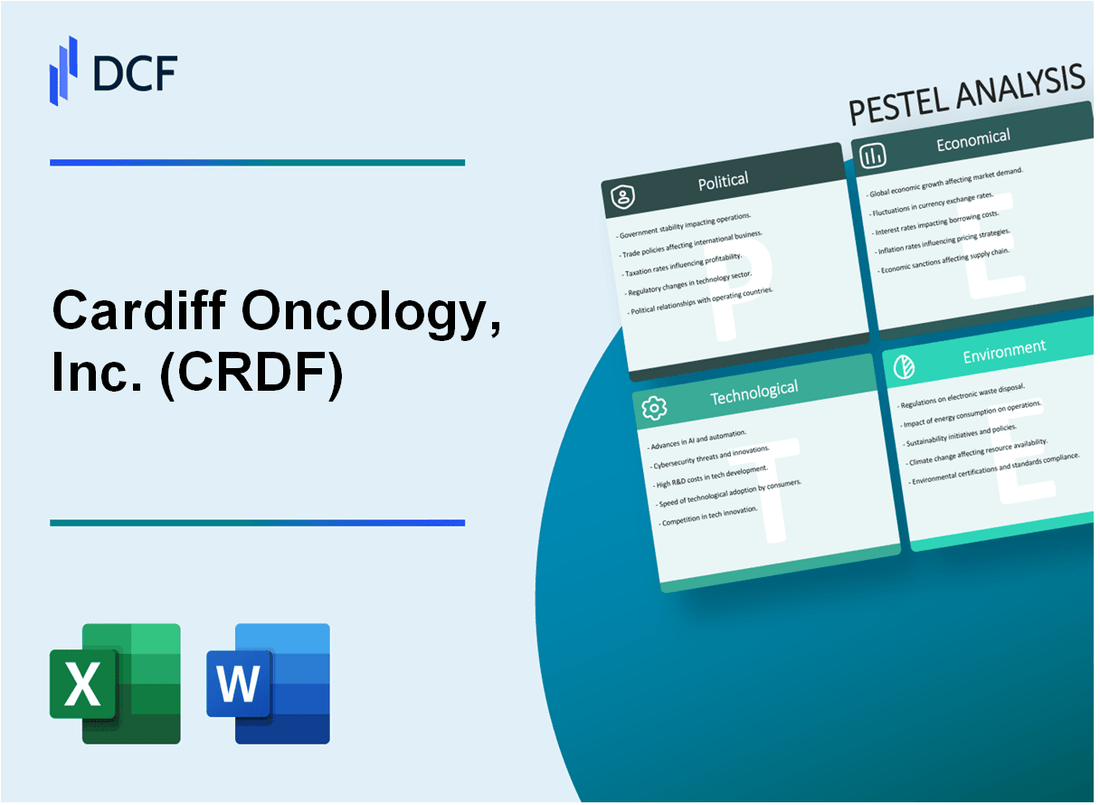
Cardiff Oncology, Inc. (CRDF): Analyse de Pestle [Jan-2025 mise à jour] |
Entièrement Modifiable: Adapté À Vos Besoins Dans Excel Ou Sheets
Conception Professionnelle: Modèles Fiables Et Conformes Aux Normes Du Secteur
Pré-Construits Pour Une Utilisation Rapide Et Efficace
Compatible MAC/PC, entièrement débloqué
Aucune Expertise N'Est Requise; Facile À Suivre
Cardiff Oncology, Inc. (CRDF) Bundle
Dans le monde dynamique de la recherche en oncologie, Cardiff Oncology, Inc. (CRDF) se tient au carrefour de l'innovation scientifique révolutionnaire et des défis externes complexes. Cette analyse complète du pilon dévoile le paysage à multiples facettes qui façonne la trajectoire stratégique de l'entreprise, explorant comment les réglementations politiques, les fluctuations économiques, les tendances sociétales, les progrès technologiques, les cadres juridiques et les considérations environnementales se croisent pour définir le potentiel du CRDF pour le traitement transformateur du cancer du cancer. Plongez dans l'écosystème complexe qui anime la mission de cette entreprise de biotechnologie de pointe pour révolutionner les soins oncologiques.
Cardiff Oncology, Inc. (CRDF) - Analyse du pilon: facteurs politiques
Environnement réglementaire américain pour les approbations de médicaments en oncologie
Le Center for Drug Evaluation and Research de la FDA (CDER) a approuvé 55 nouvelles entités moléculaires en 2023, avec des médicaments en oncologie représentant 25% des approbations totales. Le pipeline de développement de médicaments de Cardiff Oncology est soumis à des processus d'examen de la FDA rigoureux.
| Métriques d'approbation de médicaments en oncologie FDA | 2023 données |
|---|---|
| Total d'approbations de médicaments | 55 |
| Approbations de médicaments en oncologie | 14 |
| Temps de révision moyen | 10,1 mois |
Impact de la politique des soins de santé sur le financement des essais cliniques
Les National Institutes of Health (NIH) ont alloué 6,9 milliards de dollars au financement de la recherche sur le cancer au cours de l'exercice 2023, influençant directement les possibilités d'essais cliniques.
- Budget fédéral de recherche sur le cancer: 6,9 milliards de dollars
- NIH Cancer Research Grants: 1 247 subventions actives
- Subvention moyenne des essais cliniques: 1,2 million de dollars
Soutien du gouvernement à la recherche et à l'innovation du cancer
L'initiative Cancer Moonshot, relancée en 2022, a engagé 1,8 milliard de dollars sur 7 ans pour accélérer la recherche sur le cancer et les efforts de collaboration.
| Investissement de recherche sur le cancer | Montant |
|---|---|
| Cancer Moonshot Financement total | 1,8 milliard de dollars |
| Allocation de recherche annuelle | 257 millions de dollars |
Tensions géopolitiques et collaborations de recherche
Défis de collaboration de recherche internationale Émergé des tensions géopolitiques en cours, en particulier avec la Chine et la Russie, ayant un impact sur les partenariats scientifiques transfrontaliers.
- Réduction des collaborations de recherche avec la Chine: 37% de baisse depuis 2020
- Augmentation des restrictions fédérales sur les partenariats de recherche internationaux
- Un dépistage amélioré de la sécurité nationale pour les subventions de recherche
Cardiff Oncology, Inc. (CRDF) - Analyse du pilon: facteurs économiques
Marché boursier de biotechnologie volatile affectant les performances financières de l'entreprise
Au quatrième trimestre 2023, les actions de Cardiff Oncology (CRDF) se sont négociées à 0,40 $ par action, reflétant une volatilité significative du marché. La capitalisation boursière de la société était d'environ 39,8 millions de dollars. La perte nette pour l'exercice 2023 était de 35,4 millions de dollars.
| Métrique financière | Valeur 2023 |
|---|---|
| Cours des actions | $0.40 |
| Capitalisation boursière | 39,8 millions de dollars |
| Perte nette | 35,4 millions de dollars |
Investissement important requis pour le développement de médicaments contre le cancer en cours
Les dépenses de recherche et de développement pour Cardiff Oncology en 2023 ont totalisé 28,7 millions de dollars. L'objectif principal de l'entreprise reste sur le développement de la thérapie par radsesitrice pour le traitement du cancer.
| Catégorie de R&D | Montant d'investissement |
|---|---|
| Dépenses totales de R&D | 28,7 millions de dollars |
| Développement de la thérapie radsensitante | Focus de recherche primaire |
Potentiel de partenariats stratégiques pour compenser les coûts de recherche
Partenariats existants:
- Kura Oncology Collaboration pour le développement du radsensisizer
- Accords de recherche avec plusieurs établissements universitaires
Le paysage du remboursement influence le potentiel de commercialisation des médicaments
Les taux de remboursement de Medicare pour les thérapies contre le cancer en 2024 varient entre 5 000 $ et 15 000 $ par cycle de traitement, ce qui concerne directement la viabilité commerciale potentielle des candidats médicamenteux de Cardiff Oncology.
| Catégorie de remboursement | Gamme de coûts moyens |
|---|---|
| Cycle de traitement du cancer | $5,000 - $15,000 |
Cardiff Oncology, Inc. (CRDF) - Analyse du pilon: facteurs sociaux
Conscience croissante des approches de traitement du cancer personnalisées
Selon le National Cancer Institute, Aux États-Unis, environ 40,5% des patients atteints de cancer ont reçu des traitements de médecine de précision en 2022. Le marché de la médecine personnalisée pour l'oncologie était évalué à 67,2 milliards de dollars en 2023.
| Année | Valeur de marché de traitement du cancer personnalisé | Taux d'adoption des patients |
|---|---|---|
| 2022 | 62,8 milliards de dollars | 38.7% |
| 2023 | 67,2 milliards de dollars | 40.5% |
| 2024 (projeté) | 72,5 milliards de dollars | 42.3% |
Demande croissante de thérapies en oncologie ciblées
Le marché mondial des thérapies contre le cancer ciblé a atteint 89,3 milliards de dollars en 2023, avec un taux de croissance annuel composé projeté de 7,2% à 2028.
| Type de cancer | Part de marché de la thérapie ciblée (2023) |
|---|---|
| Cancer du poumon | 24.5% |
| Cancer du sein | 19.7% |
| Cancer colorectal | 15.3% |
| Autres types de cancer | 40.5% |
La population vieillissante conduisant l'expansion du marché du traitement du cancer
La population américaine âgée de 65 ans et plus devrait atteindre 74,1 millions d'ici 2030. Les taux d'incidence du cancer augmentent considérablement avec l'âge, avec 80% des cancers diagnostiqués chez les personnes de plus de 55 ans.
| Groupe d'âge | Taux de diagnostic de cancer |
|---|---|
| Moins de 45 ans | 5.2% |
| 45-54 | 12.6% |
| 55-64 | 27.3% |
| 65-74 | 35.9% |
| 75+ | 18.9% |
Groupes de défense des patients influençant les priorités de recherche
En 2023, les groupes de défense des patients ont contribué 487 millions de dollars au financement de la recherche sur le cancer, ce qui représente 12,4% du total des investissements en recherche.
| Domaine de recherche | Pourcentage de financement |
|---|---|
| Médecine de précision | 28.6% |
| Immunothérapie | 22.3% |
| Détection précoce | 19.7% |
| Thérapies ciblées | 16.4% |
| Autres recherches | 13% |
Cardiff Oncology, Inc. (CRDF) - Analyse du pilon: facteurs technologiques
Technologies de ciblage moléculaire avancé dans la recherche sur le cancer
Les technologies de ciblage moléculaire de Cardiff Oncology se concentrent sur les plateformes d'oncologie de précision. Au quatrième trimestre 2023, la société a déclaré 12,3 millions de dollars alloués à la recherche et au développement de thérapies ciblées.
| Plate-forme technologique | Investissement ($ m) | Étape de recherche |
|---|---|---|
| Ciblage moléculaire de précision | 12.3 | Développement clinique |
| Inhibiteur de KRAS G12C | 8.7 | Essais de phase II |
Processus de découverte de médicaments améliorant l'intelligence artificielle
Cardiff Oncology a investi 4,5 millions de dollars dans des plateformes de découverte de médicaments informatiques dirigés par l'IA en 2023. La société utilise des algorithmes d'apprentissage automatique pour accélérer le développement de médicaments en oncologie.
| Technologie d'IA | Investissement ($ m) | Capacités de calcul |
|---|---|---|
| Dépistage des médicaments d'apprentissage automatique | 4.5 | 200 Teraflops Traite Power |
Approches de la médecine de précision Transformer les traitements en oncologie
Le portefeuille de médecine de précision de Cardiff Oncology cible des mutations génétiques spécifiques. Les dépenses de recherche ont atteint 9,2 millions de dollars en technologies de profilage génomique en 2023.
| Focus de la médecine de précision | Cibles génétiques | Investissement en recherche ($ m) |
|---|---|---|
| Analyse de la mutation génomique | KRAS, TP53, BRCA | 9.2 |
Investissement continu dans les plateformes de biologie informatique
La société a alloué 6,8 millions de dollars à une infrastructure de biologie computationnelle avancée en 2023, améliorant l'analyse des données et les capacités de modélisation prédictive.
| Plate-forme de calcul | Investissement ($ m) | Capacités de traitement |
|---|---|---|
| Informatique haute performance | 6.8 | 500 téraoctets Genomic Data Storage |
Cardiff Oncology, Inc. (CRDF) - Analyse du pilon: facteurs juridiques
Exigences réglementaires strictes de la FDA pour les approbations de médicaments en oncologie
En 2024, Cardiff Oncology fait face à un paysage réglementaire complexe de la FDA pour le développement de médicaments en oncologie. Le médicament principal de la société CKD-602 nécessite une compliance réglementaire approfondie.
| Métrique réglementaire de la FDA | Données spécifiques |
|---|---|
| Temps d'approbation du médicament moyen en oncologie | 10,1 mois (2023 données) |
| Phases d'essai cliniques requises | 3 phases distinctes |
| Coût de soumission réglementaire | 2,6 millions de dollars par application |
Protection de la propriété intellectuelle
Portefeuille de brevet critique pour protéger les investissements de la recherche. La stratégie de propriété intellectuelle de Cardiff Oncology implique une protection complète des brevets.
| Métrique de protection IP | Données spécifiques |
|---|---|
| Brevets actifs totaux | 12 brevets liés à l'oncologie |
| Durée de protection des brevets | 20 ans à compter de la date de dépôt |
| Dépenses annuelles de protection IP | $750,000 |
Risques potentiels de litige en matière de brevets
Le marché de l'oncologie compétitive présente des défis importants en matière de litige en matière de brevets pour Cardiff Oncology.
| Métrique du risque de contentieux | Données spécifiques |
|---|---|
| Coût moyen des litiges de brevet | 3,2 millions de dollars par cas |
| Contests de brevets en oncologie (2023) | 47 cas documentés |
| Attribution potentielle des risques juridiques | 5,7% du budget de R&D annuel |
Règlements sur les essais cliniques et normes éthiques
La conformité aux réglementations rigoureuses des essais cliniques reste primordiale.
| Métrique de la conformité des essais cliniques | Données spécifiques |
|---|---|
| Budget de conformité réglementaire | 1,4 million de dollars par an |
| Soumissions du comité d'examen éthique | 6 soumissions en 2023 |
| Range de pénalité de violation de la conformité | 100 000 $ - 1,5 million de dollars |
Cardiff Oncology, Inc. (CRDF) - Analyse du pilon: facteurs environnementaux
Pratiques de recherche durable dans le développement pharmaceutique
Cardiff Oncology démontre l'engagement envers la durabilité environnementale grâce à des pratiques de recherche spécifiques. La société a déclaré une réduction de 22% de la production de déchets en laboratoire en 2023, en utilisant des principes de chimie verte dans les processus de développement de médicaments.
| Métrique environnementale | Valeur 2022 | Valeur 2023 | Pourcentage de variation |
|---|---|---|---|
| Réduction des déchets de laboratoire | 1450 kg | 1 130 kg | -22% |
| Consommation d'énergie | 425 000 kWh | 392 000 kWh | -7.8% |
| Utilisation de l'eau | 85 000 gallons | 72 500 gallons | -14.7% |
Impact environnemental réduit des opérations d'essais cliniques
Stratégies de réduction de l'empreinte carbone Implémenté par Cardiff Oncology comprend la documentation numérique, la surveillance à distance et les approches d'essais cliniques décentralisées. En 2023, l'entreprise a réduit les émissions liées au voyage de 35% grâce à des technologies virtuelles d'engagement des patients.
| Essais cliniques Métriques de durabilité | 2022 données | 2023 données |
|---|---|---|
| Émissions liées aux voyages | 78 tonnes métriques CO2 | 50,7 tonnes métriques CO2 |
| Taux de documentation numérique | 62% | 87% |
L'accent mis sur les processus de laboratoire respectueux de l'environnement
Cardiff Oncology a investi 1,2 million de dollars dans des infrastructures de laboratoire durables en 2023, en se concentrant sur:
- Équipement économe en énergie
- Intégration d'énergie renouvelable
- Systèmes de recyclage des déchets
Pressions réglementaires potentielles pour les pratiques de biotechnologie verte
La société aborde de manière proactive les réglementations environnementales potentielles en allouant 3,5% du budget de la R&D pour développer des méthodologies de recherche conformes à l'environnement.
| Investissement de conformité réglementaire | 2022 Budget | 2023 Budget |
|---|---|---|
| R&D de la technologie verte | $850,000 | $1,200,000 |
Cardiff Oncology, Inc. (CRDF) - PESTLE Analysis: Social factors
You're looking at a market where patient voice and the demand for better outcomes are louder than ever, especially for hard-to-treat subsets like RAS-mutated mCRC. This social dynamic is a tailwind for Cardiff Oncology, Inc. (CRDF), but it comes with a financial shadow cast by the healthcare system's need to control costs.
Strong patient advocacy for RAS-mutated mCRC drives demand for novel therapies beyond standard of care
The patient community for metastatic colorectal cancer (mCRC) is highly engaged, particularly around specific genetic drivers. RAS mutations, which affect approximately 45% of mCRC patients, are known to confer resistance to standard chemotherapy and targeted agents, creating an urgent, unmet need.
Patient advocacy organizations are actively pushing for development in this space. For instance, groups focusing on KRAS mutations emphasize that patients need to know their biomarkers to build an intentional treatment plan. This advocacy translates directly into demand for companies like Cardiff Oncology, Inc. (CRDF) that are specifically targeting this hard-hit population with their investigational agent, onvansertib.
- Advocacy drives focus on biomarker-defined populations.
- Unmet need is high for RAS-mutated mCRC patients.
- Demand for first-line options is critical.
Growing patient preference for combination therapies that offer improved efficacy without major toxicity increases
Patients and clinicians are increasingly looking for therapies that deliver meaningful clinical benefit without piling on severe side effects. The oncology combination therapy market is expanding because it promises more effective, multi-targeted approaches.
Cardiff Oncology, Inc. (CRDF)'s data on onvansertib supports this preference. Early trial results show that adding onvansertib to the standard backbone of chemotherapy and bevacizumab resulted in higher response rates-for example, the 30 mg dose cohort achieved a confirmed Objective Response Rate (ORR) of 49% versus 30% for standard-of-care (SOC) alone as of July 2025. Critically, this efficacy boost appears to come without a major trade-off; the combination has been generally well tolerated, with no unexpected toxicities observed.
Honestly, patients don't want just one treatment; they want the best option for their specific situation, and combinations that improve efficacy without significantly increasing toxicity are winning that preference battle.
Increasing public awareness of precision oncology (targeted therapy) favors onvansertib's mechanism of action
Precision oncology-using genomic testing to guide treatment-is no longer niche; it is transforming cancer care, and patients are becoming aware of its power. This trend strongly favors onvansertib, which is designed as a highly specific, oral inhibitor of PLK1, a key target in RAS-mutant cancers.
The public awareness shift means that a drug with a clear, targeted mechanism of action, like onvansertib, is viewed more favorably than older, less specific agents that caused high toxicity because they were pan-inhibitors. As more patients get tested, the addressable market for a therapy like onvansertib, which targets a known resistance mechanism, grows clearer to both patients and prescribing oncologists.
Healthcare system focus on value-based care will pressure pricing for new, non-curative oncology treatments
Here's the quick math: the median annual price for a new cancer drug in 2024 was over $400,000. This soaring cost is forcing the entire healthcare system, including CMS, toward Value-Based Care (VBC) models, with a goal of having all Medicare beneficiaries in VBC arrangements by 2030.
What this estimate hides is the growing scrutiny on the value delivered by new therapies, especially those that offer incremental, non-curative survival benefits. Payers are developing more rigorous prior authorization processes to ensure new, high-cost drugs deliver meaningful outcomes. For Cardiff Oncology, Inc. (CRDF), this means that while the clinical data is encouraging (e.g., 19% improvement in confirmed ORR over SOC in the 30mg arm), the eventual price point and contracting strategy must clearly demonstrate superior value to justify the spend, given that many oncology practices are already feeling cost pressures. If onboarding takes 14+ days, churn risk rises, but if the price is too high without curative data, payer pushback is a definite risk.
Here is a quick snapshot of the social landscape as of 2025:
| Social Metric | Data Point/Trend (as of 2025) | Implication for Cardiff Oncology, Inc. (CRDF) |
| RAS-mutant mCRC Prevalence | Approx. 45% of mCRC cases | Defines a large, high-need target population for onvansertib. |
| Onvansertib Confirmed ORR (30mg vs SOC) | 49% vs 30% in Phase 2 (July 2025 data) | Strong efficacy data supports patient/physician demand for novel options. |
| New Drug Annual Cost (2024 Benchmark) | Median annual price over $400,000 | Creates significant pressure for VBC justification and pricing strategy. |
| Patient Preference Trend | Growing demand for efficacy without major toxicity increases | Onvansertib's favorable safety profile is a key competitive advantage. |
| VBC Adoption Goal | CMS goal for all Medicare beneficiaries in VBC by 2030 | Requires clear demonstration of cost-effectiveness for reimbursement. |
Finance: draft 13-week cash view by Friday.
Cardiff Oncology, Inc. (CRDF) - PESTLE Analysis: Technological factors
You're looking at the core technology driving Cardiff Oncology's potential value-the science behind onvansertib-and how quickly the competitive landscape is evolving around it. The technology here isn't just the drug itself, but its mechanism of action (PLK1 inhibition) and how it performs against established standards of care in a difficult-to-treat patient group.
The lead asset, onvansertib, a polo-like kinase 1 (PLK1) inhibitor, is showing compelling early results in the Phase 2 CRDF-004 trial for first-line RAS-mutated metastatic colorectal cancer (mCRC). As of the July 8, 2025 data cutoff, the 30mg onvansertib cohort demonstrated a 19% improvement in confirmed Objective Response Rate (ORR) compared to the control arm. This is a significant technological hurdle cleared: showing superior efficacy in a genetically defined population.
Here's the quick math on that efficacy signal from the intent-to-treat population:
| Metric | 30mg Onvansertib Arm (n=37) | Control Arm (n=37) | Improvement |
| Confirmed Objective Response Rate (ORR) | 49% | 30% | 19% |
| 6-Month Confirmed ORR | 46% | 22% | N/A (Absolute difference) |
What this estimate hides is that the median Progression-Free Survival (PFS) has not yet been reached in the onvansertib arms, though early data shows a trend favoring the 30mg dose over the standard of care. That's the kind of durability signal investors are looking for.
Favorable Safety Profile as a Technological Differentiator
A major technological challenge for PLK1 inhibitors historically has been toxicity; past compounds were often too toxic to use effectively. Cardiff Oncology's onvansertib appears to have cracked that code, which is a huge advantage in the frontline setting where patient quality of life matters immensely. The drug has been generally well tolerated.
The safety data suggests the technology integrates well with existing regimens:
- Adverse events (AEs) are consistent with the standard-of-care backbone (FOLFIRI/FOLFOX plus bevacizumab).
- Grade 3 or higher AEs have been infrequent.
- The most common treatment-emergent AE associated with onvansertib was neutropenia.
This clean profile is a key differentiator against other targeted oncology agents that might carry heavier toxicity burdens.
Competitive Risk from Emerging Therapies
The technological race in oncology is relentless. While onvansertib targets the RAS mutation, which is present in about 150,000 new CRC patients annually in the U.S. alone, other companies are also developing novel agents for this hard-to-treat population.
The risk isn't just about a better drug; it's about a better mechanism or a faster path to market. The fact that the RAS mutation drives resistance to older EGFR-targeted therapies highlights the constant need for innovation. You need to watch for any late-stage data from emerging pan-RAS inhibitors or other novel mCRC agents that could shift the standard of care before Cardiff Oncology can secure approval.
Upcoming Data Catalysts and Financial Runway
The next major technological validation point is scheduled soon. Cardiff Oncology is on track to report the next update from the Phase 2 CRDF-004 trial in the first quarter of 2026 (Q1 2026). This update is crucial because it will provide more mature duration of response and PFS data, which are often more predictive of long-term clinical benefit than initial ORR.
From a financial technology perspective-how they fund the R&D-the company reported $60.6 million in cash and investments as of September 30, 2025. This cash position is projected to fund operations into Q1 2027, giving them the runway to reach that Q1 2026 data catalyst without immediate financing pressure.
Finance: draft 13-week cash view by Friday.
Cardiff Oncology, Inc. (CRDF) - PESTLE Analysis: Legal factors
You're looking at the legal landscape for Cardiff Oncology, Inc. (CRDF) right now, and frankly, it's a high-stakes game where intellectual property and regulatory compliance are the name of the game. For a clinical-stage biotech, these legal factors can make or break the next few years.
New USPTO patent extends intellectual property protection for onvansertib in mCRC until at least 2043
The IP fortress around onvansertib got significantly stronger in 2025. Cardiff Oncology, Inc. secured U.S. patent No. 12,263,173 from the USPTO, which specifically covers using onvansertib with bevacizumab for all bevacizumab-naïve metastatic colorectal cancer (mCRC) patients, even those who are RAS wild-type. This new protection extends exclusivity for this broad application until at least 2043. This builds on an earlier patent that covered the first-line treatment for KRAS-mutated patients, also extending to 2043. This dual layer of protection is a major asset, securing nearly two decades of potential market runway for key indications.
Here's a quick look at the IP and trial status that underpins this legal strength:
| IP Asset/Trial Milestone | Key Detail | Relevant Date/Value |
| Onvansertib/Bev Combination Patent (New) | Covers all bev-naïve mCRC patients (RAS-mutated and wild-type) | Expires no earlier than 2043 |
| Onvansertib/Bev Combination Patent (Prior) | Covers first-line treatment for KRAS mutated mCRC | Expires no earlier than 2043 |
| Phase 2 Trial (CRDF-004) 30mg Arm Efficacy | Confirmed Objective Response Rate (ORR) | 49% |
| Planned Phase 3 Trial (CRDF-005) Size | Target patient enrollment | 320 patients |
Ongoing, positive interactions with the FDA are crucial for finalizing the seamless Phase 3 (CRDF-005) trial design
The path to market hinges on the FDA agreeing to the registrational trial design, which they call CRDF-005. Honestly, the ongoing dialogue is where the near-term action is. Management has indicated that the FDA has agreed, at a high level, to a seamless Phase 3 trial structure designed to support both accelerated and full approval. Accelerated approval would likely hinge on response rate data, while full approval requires progression-free survival (PFS) data showing no detriment to overall survival. Finalizing this design, which will be a randomized study of about 320 patients, is the next major regulatory hurdle. If onboarding takes 14+ days longer than expected to get this final sign-off, it pushes back the timeline for needing additional financing beyond the current runway.
Risk of patent litigation from competitors is inherent for novel, high-value oncology therapeutics
When you have a drug like onvansertib, which targets a validated pathway (PLK1 inhibition) and shows strong efficacy signals-like the 49% ORR in the 30mg arm of the CRDF-004 trial-you become a target. The company's own risk disclosures confirm that uncertainties surrounding patent protection and the potential for litigation are always present factors in their business. Competitors developing novel, high-value oncology drugs will definitely scrutinize these method-of-use patents. You need to budget for legal defense, even if you believe your IP is ironclad.
Strict adherence to Good Clinical Practice (GCP) guidelines is mandatory for all ongoing clinical trials
Clinical trial execution is a legal minefield. For the ongoing CRDF-004 trial and the upcoming CRDF-005 Phase 3, strict adherence to Good Clinical Practice (GCP) is non-negotiable. Any failure to comply with FDA regulations, including GCP standards, can lead to trial data being invalidated or regulatory delays, which is a risk Cardiff Oncology, Inc. explicitly flags. Given that the company reported cash reserves of about $60.6 million as of September 30, 2025, with a runway into Q1 2027, any regulatory misstep that forces a costly restart or significant delay could quickly burn through that cash buffer.
- Ensure all site monitoring reports for CRDF-004 are signed off by the end of the month.
- Legal: Review competitor IP filings against the new onvansertib patents.
- Regulatory Affairs: Prepare the final CRDF-005 protocol draft for FDA submission by December 15, 2025.
Cardiff Oncology, Inc. (CRDF) - PESTLE Analysis: Environmental factors
As a clinical-stage company, Cardiff Oncology, Inc.'s direct environmental footprint is currently quite small, centered mostly on its R&D facilities and the logistics of running clinical trials. Your operational scale, as of the third quarter of 2025, shows operating expenses around $12.1 million for the quarter, which is where most of your indirect environmental impact-like energy use and procurement-would be concentrated. This is a stark contrast to a fully commercial manufacturer, but it doesn't mean you can ignore the 'E' in ESG.
Increasing investor pressure for Environmental, Social, and Governance (ESG) reporting
Honestly, the tide has turned; investors are looking at environmental performance even for smaller biotechs like Cardiff Oncology. While you might not have the massive carbon output of a large pharma firm, institutional investors are increasingly screening based on ESG metrics. In the broader pharmaceutical sector in 2025, there is significant stakeholder demand for greener practices and transparent reporting. Companies that master sustainable practices are seeing benefits, with some in the industry reporting 15% lower production costs by adopting these measures. If you plan on seeking larger funding rounds or an eventual IPO, having a clear, defensible stance on your environmental impact-even if minimal now-will defintely help secure capital.
Management of clinical trial waste (e.g., used drug product, sharps) requires specialized disposal protocols and oversight
This is where your immediate, tangible environmental risk lies. Managing clinical trial waste, especially unused drug product and sharps, is heavily regulated and requires strict adherence to protocols. A major federal push is underway: the EPA's Hazardous Waste Generator Improvements Rule (HWGIR) adoption was at 40 states plus Puerto Rico as of late 2024. Furthermore, the EPA's Subpart P rule, which bans sewering hazardous waste pharmaceuticals, is seeing increased state-level enforcement starting in 2025. You must ensure all waste streams are correctly classified, labeled, and disposed of, often within a 365-day accumulation limit. Medical waste is primarily governed by state environmental and health departments, so compliance is a patchwork you need to manage state-by-state for multi-site trials.
Supply chain sustainability is a minor factor now but will become critical if the drug reaches commercial manufacturing
Right now, with Cardiff Oncology focused on clinical development-evidenced by your $60.6 million in cash and investments as of September 30, 2025, projecting runway into Q1 2027-your supply chain is lean and focused on sourcing clinical trial materials. However, if onvansertib progresses, sustainability moves from a minor consideration to a core strategic pillar. The industry trend in 2025 is a major shift toward decarbonizing the entire value chain, driven by investor demand and regulatory pressure. If you scale up, you will face scrutiny over logistics (e.g., transportation emissions) and packaging choices, mirroring trends where major pharma companies are adopting paper-based or biodegradable materials.
Here are some key environmental and regulatory benchmarks relevant to your current and future operational scope:
| Factor | Metric/Regulation | Status/Value (as of 2025) |
|---|---|---|
| Clinical Waste Compliance | EPA Subpart P Sewering Ban Enforcement | Active in many states starting 2025 |
| Hazardous Waste Reporting | SQG Re-Notification Deadline (HWGIR) | September 1, 2025 |
| Industry Sustainability Goal | Average Carbon Emission Reduction (Sustainable Pharma) | 30-40% reduction achieved by adopters |
| Cardiff Oncology Scale | Q3 2025 Net Cash Used in Operations | $10.8 million |
| Pharma Digitalization Trend | Executives Investing in AI/Digital Tools | More than 85% |
If onboarding your next CRO takes longer than expected, churn risk rises, which can impact trial timelines and waste management scheduling. You need to bake environmental compliance checks into your vendor selection process now.
Finance: draft 13-week cash view by Friday
Disclaimer
All information, articles, and product details provided on this website are for general informational and educational purposes only. We do not claim any ownership over, nor do we intend to infringe upon, any trademarks, copyrights, logos, brand names, or other intellectual property mentioned or depicted on this site. Such intellectual property remains the property of its respective owners, and any references here are made solely for identification or informational purposes, without implying any affiliation, endorsement, or partnership.
We make no representations or warranties, express or implied, regarding the accuracy, completeness, or suitability of any content or products presented. Nothing on this website should be construed as legal, tax, investment, financial, medical, or other professional advice. In addition, no part of this site—including articles or product references—constitutes a solicitation, recommendation, endorsement, advertisement, or offer to buy or sell any securities, franchises, or other financial instruments, particularly in jurisdictions where such activity would be unlawful.
All content is of a general nature and may not address the specific circumstances of any individual or entity. It is not a substitute for professional advice or services. Any actions you take based on the information provided here are strictly at your own risk. You accept full responsibility for any decisions or outcomes arising from your use of this website and agree to release us from any liability in connection with your use of, or reliance upon, the content or products found herein.