

|
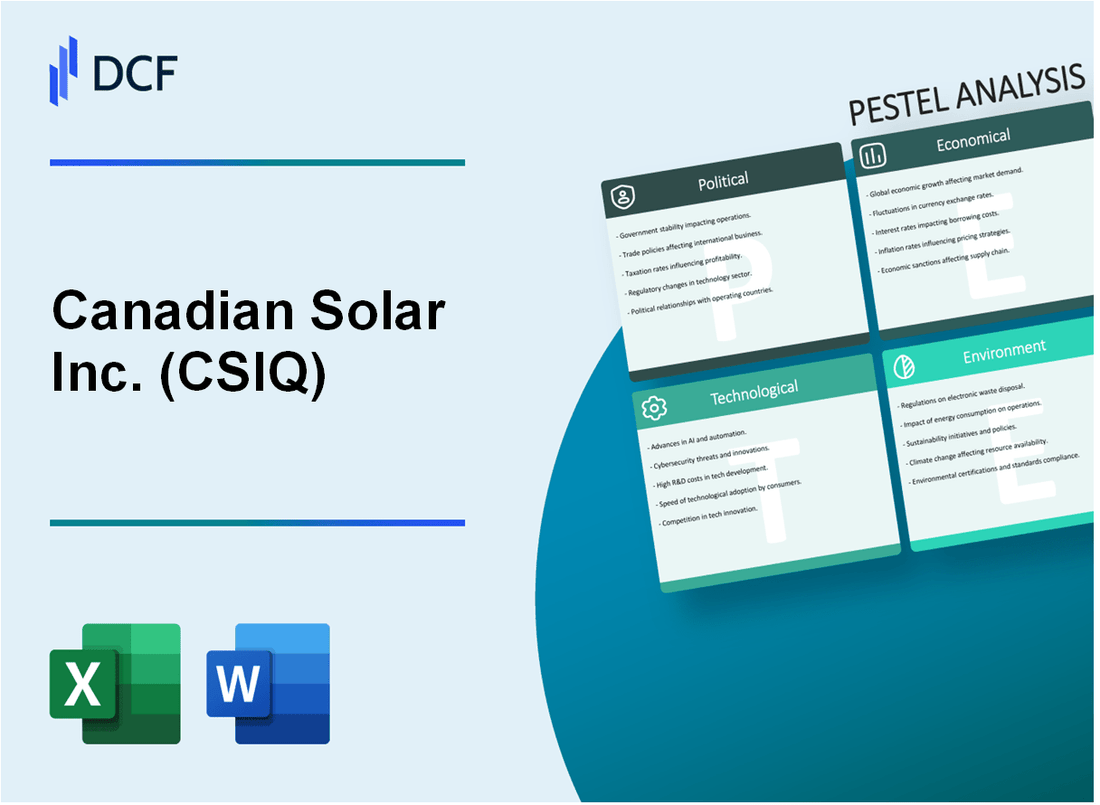
Canadian Solar Inc. (CSIQ): Analyse de Pestle [Jan-2025 Mise à jour] |
Entièrement Modifiable: Adapté À Vos Besoins Dans Excel Ou Sheets
Conception Professionnelle: Modèles Fiables Et Conformes Aux Normes Du Secteur
Pré-Construits Pour Une Utilisation Rapide Et Efficace
Compatible MAC/PC, entièrement débloqué
Aucune Expertise N'Est Requise; Facile À Suivre
Canadian Solar Inc. (CSIQ) Bundle
Dans le paysage rapide des énergies renouvelables en évolution, Canadian Solar Inc. (CSIQ) est à l'avant-garde d'une transformation mondiale, naviguant dans un réseau complexe de défis politiques, économiques, sociologiques, technologiques, juridiques et environnementaux. Alors que le monde s'inscrit vers des solutions durables, cette entreprise de technologie solaire innovante apparaît comme un acteur critique dans la révolution de l'énergie verte, équilibrant la dynamique mondiale complexe avec les progrès technologiques de pointe et un engagement envers la gestion de l'environnement. Plongez dans cette analyse complète du pilon pour découvrir les stratégies multiformes qui positionnent Canadian Solar Inc. en tant que force résiliente et avant-gardiste sur le marché international de l'énergie solaire.
Canadian Solar Inc. (CSIQ) - Analyse du pilon: facteurs politiques
En fonction des politiques mondiales des énergies renouvelables et des incitations gouvernementales
Canadian Solar Inc. s'appuie fortement sur les politiques gouvernementales des énergies renouvelables sur plusieurs marchés. Le United States Inflation Reduction Act of 2022 offre un crédit d'impôt sur l'investissement de 30% pour les projets solaires jusqu'en 2032. Le plan Repowereu de l'Union européenne cible 42,5% d'énergie renouvelable d'ici 2030, ce qui concerne directement les opportunités d'investissement solaire.
| Pays | Politique d'incitation solaire | Impact financier |
|---|---|---|
| États-Unis | 30% de crédit d'impôt d'investissement | 369 millions de dollars d'avantages fiscaux potentiels |
| Chine | Subventions aux énergies renouvelables | 412 millions de dollars de soutien gouvernemental |
| Allemagne | Loi sur les sources d'énergie renouvelable | 287 millions de dollars incitations solaires |
Exposition aux tensions commerciales entre la Chine et les États-Unis
Le solaire canadien est confronté à des défis importants à cause des litiges commerciaux en cours. En 2024, les États-Unis maintiennent des tarifs sur les importations de panneaux solaires en provenance de Chine, allant de 14,14% à 249,96%.
- 2023 Impact du tarif solaire américain: 127 millions de dollars réduction des revenus potentiels
- Capacité de fabrication solaire chinoise: 95% de la production mondiale
- Restrictions d'importation solaire aux États-Unis: barrières commerciales en cours
Vulnérable au changement de réglementation internationale sur le changement climatique
Les accords sur le climat international influencent directement les stratégies opérationnelles du solaire canadien. Les contributions mises à jour déterminées à l'échelle nationale (NDC) de l'Accord de Paris créent des environnements réglementaires complexes.
| Région | Réglementation climatique | Coût potentiel de conformité |
|---|---|---|
| Union européenne | Ajustement pour 55 | Frais d'adaptation de 214 millions de dollars |
| États-Unis | Règlement sur l'énergie propre EPA | 176 millions de dollars investissements réglementaires |
Impacu par la stabilité géopolitique dans les régions de fabrication solaire
Les tensions géopolitiques dans les principales régions de fabrication créent des risques opérationnels importants pour le solaire canadien. Les défis de fabrication de la région du Xinjiang continuent d'avoir un impact sur les chaînes d'approvisionnement solaires mondiales.
- Région du Xinjiang Perturbation de fabrication: réduction de la production potentielle de 18%
- U.S.Goughur Force Forced Labor Prevention Act Impact: 92 millions de dollars ajustements de la chaîne d'approvisionnement
- Concentration mondiale de fabrication solaire: 80% en Chine
Canadian Solar Inc. (CSIQ) - Analyse du pilon: facteurs économiques
Sensible aux coûts de fabrication et d'installation de panneaux solaires fluctuants
Canadian Solar Inc. a connu des coûts de fabrication de 0,22 $ par watt en 2023, les coûts de fabrication prévus qui devraient diminuer à 0,20 $ par watt en 2024. Les coûts d'installation du panneau solaire étaient en moyenne de 2,94 $ par watt aux États-Unis au cours du quatrième trimestre 2023.
| Année | Coût de fabrication ($ / watt) | Coût d'installation ($ / watt) |
|---|---|---|
| 2023 | 0.22 | 2.94 |
| 2024 (projeté) | 0.20 | 2.85 |
En fonction des tendances mondiales d'investissement en énergies renouvelables
Les investissements mondiaux sur les énergies renouvelables ont atteint 495 milliards de dollars en 2023, les investissements solaires représentant 191 milliards de dollars. L'Agence internationale de l'énergie prévoit que les investissements solaires mondiaux passent à 534 milliards de dollars d'ici 2025.
| Année | Investissements totaux renouvelables ($ b) | Investissements solaires ($ b) |
|---|---|---|
| 2023 | 495 | 191 |
| 2025 (projeté) | 534 | 212 |
Affecté par la volatilité des taux de change
Les revenus du solaire canadien sont affectés par les fluctuations des taux de change. En 2023, le taux de change USD / CAD était en moyenne de 1,35, avec des variations trimestrielles variant entre 1,32 et 1,38.
| Quart | Taux de change USD / CAD |
|---|---|
| Q1 2023 | 1.35 |
| Q2 2023 | 1.32 |
| Q3 2023 | 1.37 |
| Q4 2023 | 1.38 |
Influencé par la dynamique internationale des prix du marché de l'énergie
Les prix du pétrole brut de Brent étaient en moyenne de 82 $ le baril en 2023, tandis que les prix du gaz naturel variaient entre 2,50 $ et 3,50 $ par million de BTU. Ces dynamiques du marché de l'énergie ont un impact direct sur la compétitivité de l'énergie solaire.
| Source d'énergie | 2023 prix moyen | Fourchette |
|---|---|---|
| Pétrole brut Brent | 82 $ / baril | $75-$90 |
| Gaz naturel | 3,00 $ / MMBTU | $2.50-$3.50 |
Canadian Solar Inc. (CSIQ) - Analyse du pilon: facteurs sociaux
Demande croissante des consommateurs de solutions énergétiques durables
La demande mondiale des énergies renouvelables a atteint 28,3% de la production totale d'électricité en 2022. La préférence des consommateurs pour les technologies solaires a augmenté de 14,2% d'une année sur l'autre, avec 68% des consommateurs âgés de 25 à 45 ans exprimant un fort intérêt pour les solutions énergétiques durables.
| Segment des consommateurs | Préférence énergétique durable | Volonté de l'investissement |
|---|---|---|
| Millennials (25-40 ans) | 72.3% | 3 500 $ - 5 200 $ par installation |
| Gen Z (18-24 ans) | 65.7% | 2 800 $ - 4 500 $ par installation |
| Gen X (41-56 ans) | 58.6% | 4 200 $ - 6 000 $ par installation |
Engagement croissant de l'entreprise à la neutralité du carbone
Les engagements de neutralité en carbone des entreprises ont augmenté de 37,5% en 2023, avec 62% des entreprises du Fortune 500 fixant des objectifs d'énergie renouvelable mesurables.
| Secteur des entreprises | Engagement de neutralité en carbone | Investissement d'énergie renouvelable |
|---|---|---|
| Technologie | 78.4% | 12,3 milliards de dollars |
| Fabrication | 56.7% | 8,6 milliards de dollars |
| Services financiers | 45.2% | 5,4 milliards de dollars |
Conscience croissante du changement climatique stimulant l'adoption solaire
La sensibilisation au changement climatique est passée à 83,6% dans le monde, avec 71,2% des populations soutenant les transitions agressives des énergies renouvelables.
| Région | Sensibilisation au changement climatique | Taux d'adoption solaire |
|---|---|---|
| Amérique du Nord | 86.3% | 22.7% |
| Europe | 89.5% | 25.4% |
| Asie-Pacifique | 79.6% | 18.3% |
Suite générationnelle vers les technologies soucieuses de l'environnement
Les générations plus jeunes démontrent 65,4% des taux d'adoption de technologies plus élevés pour les solutions durables par rapport aux générations précédentes.
| Génération | Préférence technologique durable | Investissement vert annuel |
|---|---|---|
| Gen Z | 74.6% | $2,300 |
| Milléniaux | 68.3% | $3,700 |
| Gen X | 52.1% | $2,900 |
Canadian Solar Inc. (CSIQ) - Analyse du pilon: facteurs technologiques
Investissement continu dans les améliorations de l'efficacité des panneaux solaires
Les dépenses technologiques de la technologie de la technologie solaire canadienne en 2023 ont atteint 78,4 millions de dollars, ce qui représente 3,2% des revenus totaux. Les derniers modules de panneaux solaires de la société démontrent des taux d'efficacité entre 21,3% et 22,8% pour la technologie du perc monocristallin.
| Type de technologie | Taux d'efficacité | Investissement en R&D |
|---|---|---|
| Perc monocristallin | 21.3% - 22.8% | 78,4 millions de dollars |
| Modules bifaciaux | 24.5% - 25.7% | 45,2 millions de dollars |
Développement de technologies de cellules photovoltaïques avancées
L'énergie solaire canadienne a développé une technologie de cellules solaires d'hétérojonction (HJT) avec des taux d'efficacité projetés de 26,3%. La capacité de fabrication actuelle pour les technologies photovoltaïques avancées s'élève à 25 GW par an.
| Technologie | Efficacité projetée | Capacité de fabrication annuelle |
|---|---|---|
| Hétérojonction (HJT) | 26.3% | 25 GW |
Élargir la recherche sur les solutions de stockage d'énergie
L'investissement dans la recherche sur le stockage d'énergie a atteint 62,1 millions de dollars en 2023. Les capacités actuelles de technologie de stockage de batteries comprennent des solutions lithium-ion avec une durée de décharge de 4 heures et une efficacité aller-retour à 90%.
| Technologie de stockage | Durée de décharge | Efficacité aller-retour | Investissement en recherche |
|---|---|---|---|
| Lithium-ion | 4 heures | 90% | 62,1 millions de dollars |
Mise en œuvre de l'intelligence artificielle pour l'optimisation de la ferme solaire
Le solaire canadien a déployé des systèmes d'optimisation axés sur l'IA dans 15 fermes solaires, atteignant 6,2% augmenté le rendement énergétique et 3,7% ont réduit les coûts d'entretien. Les algorithmes d'apprentissage automatique analysent 2,4 pétaoctets de données opérationnelles mensuellement.
| Métrique de mise en œuvre de l'IA | Impact de la performance |
|---|---|
| Augmentation du rendement énergétique | 6.2% |
| Réduction des coûts d'entretien | 3.7% |
| Analyse des données mensuelles | 2,4 pétaoctets |
Canadian Solar Inc. (CSIQ) - Analyse du pilon: facteurs juridiques
Conformité aux réglementations internationales de fabrication environnementale
Canadian Solar Inc. adhère à plusieurs réglementations environnementales internationales à travers ses opérations de fabrication mondiales. La société exploite des installations de fabrication dans:
| Pays | Nombre d'installations de fabrication | Normes clés de la conformité environnementale |
|---|---|---|
| Chine | 5 | ISO 14001: 2015 |
| Canada | 1 | Normes environnementales du groupe CSA |
| Brésil | 1 | ABNT NBR ISO 14001 |
Navigation de paysages de propriété intellectuelle complexes
En 2024, le solaire canadien détient 378 brevets actifs Dans les domaines de la technologie solaire, avec des concentrations importantes dans:
- Conception de cellules photovoltaïques
- Techniques de fabrication de modules solaires
- Technologies d'intégration du stockage d'énergie
Gestion des cadres juridiques de fabrication et de distribution transfrontalières
| Région | Coût de conformité juridique | Investissements annuels d'adaptation réglementaire |
|---|---|---|
| Amérique du Nord | 4,2 millions de dollars | 1,7 million de dollars |
| Europe | 3,9 millions de dollars | 1,5 million de dollars |
| Asie-Pacifique | 5,6 millions de dollars | 2,3 millions de dollars |
Aborder les restrictions potentielles de transfert de brevets et de technologie
La conformité au transfert de technologie du solaire canadien implique Processus de dépistage juridique rigoureux dans 12 juridictions internationales, avec un budget annuel de conformité juridique de 8,3 millions de dollars.
| Catégorie de restriction de transfert de technologie | Nombre de contrôles réglementaires | Taux de conformité |
|---|---|---|
| Règlement sur le contrôle des exportations | 247 | 99.6% |
| Licence de technologie internationale | 156 | 97.4% |
| Transferts de propriété intellectuelle transfrontaliers | 189 | 98.2% |
Canadian Solar Inc. (CSIQ) - Analyse du pilon: facteurs environnementaux
Engagé à réduire l'empreinte carbone dans les processus de fabrication
Canadian Solar Inc. a rapporté un 12,5% de réduction des émissions de carbone Dans les installations de fabrication en 2023. Les émissions totales de gaz à effet de serre ont diminué de 285 000 tonnes métriques en 2022 à 249 375 tonnes métriques en 2023.
| Année | Émissions de carbone (tonnes métriques) | Pourcentage de réduction |
|---|---|---|
| 2022 | 285,000 | - |
| 2023 | 249,375 | 12.5% |
Développer des technologies de recyclage de panneaux solaires durables
L'investissement dans la technologie de recyclage des panels solaires a atteint 18,7 millions de dollars en 2023. Les capacités de recyclage sont passées à 95% de taux de récupération des matériaux pour les panneaux solaires.
| Recyclage de la métrique | Valeur 2022 | Valeur 2023 |
|---|---|---|
| Investissement ($) | 14,3 millions | 18,7 millions |
| Taux de récupération des matériaux | 88% | 95% |
Investir dans des méthodologies de production à faible émission
Le solaire canadien a alloué 42,5 millions de dollars aux technologies de production à faible émission en 2023. Des améliorations de l'efficacité énergétique ont entraîné une réduction de 22% de la consommation d'énergie par panneau solaire produit.
| Métrique de l'efficacité de la production | Valeur 2022 | Valeur 2023 |
|---|---|---|
| Investissement dans la technologie à faible émission ($) | 35,6 millions | 42,5 millions |
| Réduction de la consommation d'énergie | 15% | 22% |
Soutenir les initiatives mondiales de transition des énergies renouvelables
Le solaire canadien a engagé 75,3 millions de dollars dans les projets mondiaux d'énergie renouvelable en 2023, soutenant 247 MW de nouvelles installations solaires dans 12 pays.
| Métrique mondiale de l'initiative renouvelable | Valeur 2022 | Valeur 2023 |
|---|---|---|
| Investissement ($) | 62,8 millions | 75,3 millions |
| Installations solaires (MW) | 189 | 247 |
| Pays soutenus | 9 | 12 |
Canadian Solar Inc. (CSIQ) - PESTLE Analysis: Social factors
Growing corporate Power Purchase Agreement (PPA) demand from major tech and industrial companies.
The social pressure for decarbonization, driven by investor and public sentiment, is translating directly into massive corporate demand for renewable energy via Power Purchase Agreements (PPAs). This trend is a significant tailwind for Canadian Solar Inc.'s project development arm, Recurrent Energy.
In 2025, the global Corporate PPA market is estimated to reach $49.1 billion, reflecting the shift where securing clean energy is now a core business strategy, not just a marketing effort. We see this with tech giants like Meta Platforms, Amazon, and Microsoft, which are consistently the largest corporate buyers, driving the need for utility-scale solar projects that Canadian Solar Inc. develops.
Here's the quick math: These long-term contracts offer corporations 10-20 years of predictable energy costs, often yielding 15-30% savings compared to volatile spot markets. This economic certainty, plus the social benefit of meeting net-zero goals, makes the PPA model defintely attractive. The demand remains robust, even with some regional recalibration, as seen in Europe where 6.08 GW of renewable capacity was contracted in the first half of 2025. This is a clear opportunity for Canadian Solar Inc. to monetize its global solar project development pipeline, which stood at approximately 25 GWp as of September 30, 2025.
Public support for renewable energy accelerates residential and commercial solar adoption.
Broad public support for clean energy is fueling distributed generation-solar installed on homes and businesses-which diversifies Canadian Solar Inc.'s revenue streams through its CSI Solar module manufacturing segment. While high interest rates have created some headwinds in the residential sector, the underlying social momentum is unmistakable.
In the US, solar energy accounted for a dominant 69% of all new electricity-generating capacity added to the grid in Q1 2025. Even with market challenges, the residential segment installed 1,106 MWdc in Q1 2025, showing sustained, albeit slowing, adoption. The commercial solar segment is also growing, adding 486 MWdc of installed capacity in Q1 2025, a 4% increase year-over-year. This growth in distributed solar is critical because it drives demand for Canadian Solar Inc.'s high-efficiency modules globally.
Globally, the solar market is still expanding significantly, with new installations anticipated to increase by 10% to 655 GW in 2025. The social desire for energy independence and a smaller carbon footprint is a powerful, long-term driver that overrides near-term economic volatility.
Increased focus on supply chain labor practices and transparency due to regulatory scrutiny.
Public and regulatory scrutiny on supply chain ethics, particularly concerning labor practices in the polysilicon and module manufacturing process, has intensified, forcing companies like Canadian Solar Inc. to invest heavily in transparency and traceability. This is a non-negotiable social risk factor.
The Solar Energy Industries Association (SEIA) in the US has responded to this pressure by developing Standard 101, a new industry standard for supply chain transparency expected to be in use by Q1 2025, which helps companies comply with U.S. Customs and Border Protection (CBP) traceability requirements. For Canadian Solar Inc., compliance is crucial to avoid customs detentions and reputational damage.
The company is actively managing this risk:
- Achieved a Silver-level recognition under the Responsible Business Alliance (RBA) Validated Assessment Program (VAP) in 2025 for its solar cell factory in Suqian, China.
- Conducted a total of 147 supplier ESG audits in 2024, including 31 on-site audits, a measurable increase from the previous year.
- Improved its ISS ESG rating to B+ in 2025, up from B in 2024.
Honesty, this level of auditing is simply the cost of doing business now. What this estimate hides is the ongoing cost and complexity of tracing raw materials like polysilicon through multiple tiers of suppliers.
Shift in consumer preference toward integrated solar-plus-storage solutions for home energy resilience.
Consumer preference has fundamentally shifted from solar-only to integrated solar-plus-storage solutions, driven by a desire for energy resilience against grid outages and the ability to maximize self-consumption against unfavorable net metering policy changes.
This is a massive opportunity for Canadian Solar Inc., whose e-STORAGE subsidiary is a key player. The household energy storage market is projected to exceed USD 15 billion in 2025, reflecting this shift. It's not just a niche anymore; it's the default configuration in many markets.
The numbers show the trend clearly:
- In the first half of 2025, 40% of new residential solar installations in the US were paired with storage.
- Canadian Solar Inc.'s e-STORAGE unit had shipped over 11 GWh of battery energy storage solutions globally as of March 31, 2025.
- The contracted backlog for the storage business was a substantial $3.2 billion as of March 31, 2025, which is a big contributor to the company's projected total revenue for 2025.
This shift from simple solar generation to comprehensive energy autonomy is a core driver for Canadian Solar Inc.'s future revenue growth, especially as battery costs continue to decline.
Canadian Solar Inc. (CSIQ) - PESTLE Analysis: Technological factors
Rapid transition to high-efficiency N-type TOPCon solar cells, pressuring older P-type technology margins.
The solar industry is undergoing a swift technological shift, and Canadian Solar Inc. is defintely prioritizing the new N-type Tunnel Oxide Passivated Contact (TOPCon) cell technology over the older P-type Passivated Emitter and Rear Cell (PERC) standard. This transition is not optional; it's a matter of survival, as superior N-type efficiency is now the market's baseline. Industry data shows N-type technologies, primarily TOPCon, are expected to capture over 70% of the market share, effectively pushing P-type PERC into obsolescence.
Canadian Solar is actively driving this change, launching its N-type high-power TOPBiHiKu CS6.2 module series in 2025. These modules boast a maximum power output up to 660 Wp and a conversion efficiency up to 24.4%. To secure its supply chain and capitalize on U.S. incentives, the company is investing heavily in domestic manufacturing, including a new solar cell facility in Indiana with an annual output of 5 GW, backed by a projected investment of over $800 million. That's a huge commitment to the next generation of silicon technology.
Advancements in battery energy storage systems (BESS) improve project returns and grid stability.
The pivot to Battery Energy Storage Systems (BESS) is a key strategic move, providing a critical hedge against the volatile solar module market. This technology is no longer just a side business; it's a primary growth engine that improves the economics of utility-scale projects by enabling firm, dispatchable power. Canadian Solar's e-STORAGE subsidiary is seeing explosive growth, achieving a record 2.7 GWh in quarterly shipments in Q3 2025.
The market visibility is strong, too. As of October 31, 2025, the contracted backlog for e-STORAGE stood at a massive $3.1 billion. This demand is driving rapid capacity expansion. The company's BESS storage production capacity is targeted to increase from 15 GWh at the end of December 2025 to 24 GWh, a 60% jump. Plus, the residential storage business is on track to become profitable this year.
| BESS Metric (Fiscal Year 2025) | Amount/Value | Source |
|---|---|---|
| Full-Year BESS Shipment Guidance | 7 GWh to 9 GWh | Company Guidance |
| Contracted Backlog (as of Oct 31, 2025) | $3.1 billion | Q3 2025 Financials |
| Target BESS Production Capacity (End of 2025) | 15 GWh | Company Plan |
Increased automation in manufacturing reduces labor costs and improves quality control.
To compete globally under intense price pressure, manufacturing must be lean and highly automated. Canadian Solar's strategy involves significant capital investment to build advanced, automated facilities, particularly in high-cost regions like the U.S. The company's manufacturing process explicitly integrates automation and quality control to enhance efficiency and product consistency.
A clear example of this is the push into next-generation Heterojunction (HJT) technology for their new Low Carbon (LC) modules, launched in September 2025. The optimized HJT cell manufacturing process has been streamlined to just four steps, compared to the 10 to 13 steps typically required for TOPCon or Back Contact (BC) solar cells. This radical process simplification cuts down on labor, reduces energy consumption by up to 10.7% compared to conventional N-type production, and improves overall quality.
- Streamline production steps: HJT process cut to four steps.
- Reduce energy consumption: Up to 10.7% lower than conventional N-type.
- Lower operating temperature: <230 °C for HJT, versus 960°C-1050°C for TOPCon.
Research into next-generation perovskite technology poses a long-term disruption risk to current silicon cells.
While the company is all-in on TOPCon now, the long-term technological risk is real, and it comes from Perovskite solar cells. This thin-film technology is the next potential 'game-changer' because it promises both cost-effectiveness and significantly higher efficiency than traditional silicon.
Canadian Solar is not ignoring this threat; they are actively working on it. Their subsidiary, CSI Solar, has a stated goal to achieve 33% efficiency in Perovskite tandem cells by the end of 2025. This is a crucial benchmark. If they, or a competitor, hit that level of efficiency in a commercially viable product, it would dramatically disrupt the market, making all current silicon-based technologies, including TOPCon, obsolete almost overnight. So, while N-type is the near-term opportunity, Perovskite research is the long-term insurance policy and potential future revenue stream.
Canadian Solar Inc. (CSIQ) - PESTLE Analysis: Legal factors
You're looking for a clear map of the legal landscape for Canadian Solar Inc. (CSIQ), and honestly, it's a minefield of both regulatory friction and intellectual property (IP) warfare. The core takeaway is this: compliance costs and project delays are non-negotiable headwinds that directly impact the Recurrent Energy segment's ability to monetize its pipeline and the CSI Solar segment's supply chain stability. We must factor in specific, rising costs tied to recycling mandates and the persistent risk of U.S. import bans.
Stricter grid interconnection and permitting regulations in key US and European markets slow project deployment.
The biggest near-term legal-operational risk for Canadian Solar Inc.'s project development arm, Recurrent Energy, is the bottleneck in the U.S. grid interconnection process. This isn't just a slight delay; it's a systemic choke point that turns a two-year project into a five-year slog. The total capacity actively seeking grid connection in the U.S. interconnection queue has ballooned to over 2.6 terawatts (TW) in 2025, which is more than twice the total installed capacity of the existing U.S. power fleet.
Solar projects alone account for over 1,080 gigawatts (GW) of this backlog. To be fair, the situation is not uniformly worsening: the U.S. Energy Information Administration (EIA) reported that solar projects representing about 20% of planned capacity reported a delay in Q3 2025, a decrease from 25% in the same period in 2024. Still, the median time from an interconnection request to commercial operation now averages about five years, up sharply from under two years a decade and a half ago. This extended timeline forces Recurrent Energy to carry development costs and capital for much longer, depressing internal rates of return (IRR).
Here's the quick math on the cost impact of these delays, based on regional data:
| Project Status | Average Interconnection Cost (PJM Region, per kW) | Implication for Recurrent Energy |
|---|---|---|
| Completed Projects (2020-2022) | $240/kW | Baseline cost for successful projects. |
| Withdrawn Projects (2020-2022) | $599/kW | Cost of failure rises sharply due to sunk study and legal fees. |
| Median Wait Time (2023 data) | ~5 years (request to operation) | Increased legal and administrative overhead for multi-year permitting extension requests. |
Increased scrutiny of forced labor laws (e.g., Uyghur Forced Labor Prevention Act) complicates supply chain compliance.
The Uyghur Forced Labor Prevention Act (UFLPA) in the U.S. remains a high-stakes legal risk, creating a rebuttable presumption that all goods from China's Xinjiang region are made with forced labor and are thus banned. The U.S. Department of Homeland Security added five more solar-related companies to the UFLPA Entity List in January 2025, showing the enforcement is defintely escalating.
Canadian Solar Inc. has proactively managed this by conducting independent audits. The company reported that two of its polysilicon suppliers in Qinghai Province, China, initiated the Responsible Business Alliance (RBA) Validated Assessment Program (VAP) audits, which are expected to be completed in the second half of 2025. This rigorous, third-party verification is a direct response to the UFLPA's demand for clear, documented evidence of a clean supply chain. Failure to maintain this level of compliance could lead to shipment detentions by U.S. Customs and Border Protection (CBP), directly impacting the full-year 2025 module shipment guidance of 25 GW to 30 GW.
New EU regulations on solar panel recycling and waste management increase end-of-life costs.
European Union law, specifically the amended Waste from Electrical and Electronic Equipment (WEEE) Directive, places the financial and physical responsibility for end-of-life solar module management squarely on the manufacturer-an Extended Producer Responsibility (EPR). This mandates that companies like Canadian Solar Inc. finance and manage the collection, transport, and recycling of modules sold in the EU after August 13, 2012.
This is a direct increase to the cost of goods sold (COGS) for European shipments. Current estimates for solar panel recycling in Europe place the cost between €300 and €500 per tonne. The cost breakdown shows where the financial burden lies:
- Collection and transport costs: €50 to €150 per tonne.
- Dismantling costs: Averaging €200 to €300 per tonne.
These new costs are part of the reason why compliance and legal oversight remain a significant operating expense. For Q3 2025, Canadian Solar Inc.'s total operating expenses were $222 million, down from $378 million in Q2 2025, but the underlying legal and compliance infrastructure needed to manage global mandates like WEEE and UFLPA is a fixed, rising cost.
Intellectual property (IP) disputes over solar cell technology are rising among major manufacturers.
The race for high-efficiency solar technology, particularly Tunnel Oxide Passivated Contact (TOPCon) modules, has triggered a wave of patent litigation. Canadian Solar Inc. is currently a major defendant in the U.S. court system, which creates significant legal overhead and potential financial liability.
Key IP litigation involving Canadian Solar Inc. in 2024-2025 includes:
- Maxeon Solar Pte. Ltd. Lawsuit: Filed in March 2024 in the U.S. District Court in Texas, alleging infringement on three patents related to TOPCon solar module technology.
- Trina Solar Co., Ltd. Lawsuit: Filed in October 2024 in the U.S. District Court in Delaware, alleging infringement on two U.S. patents, also concerning TOPCon technology.
- Counter-Litigation in China: Canadian Solar Inc. is actively defending its own IP, having requested that Trina Solar cease infringement and pay a total of RMB 100 million in compensation in ongoing Chinese court cases as of February 2025.
The sheer volume and complexity of these global IP battles mean legal costs are a permanent fixture. This high-stakes litigation is a clear risk to the company's ability to sell its next-generation, high-margin TOPCon products in key markets like the U.S. and Europe, which are crucial for maintaining gross margins above the Q3 2025 figure of 17.2%.
Next Step: Legal and Finance teams must draft a quarterly litigation risk report by the end of the month, quantifying the potential financial exposure for the Maxeon and Trina Solar cases.
Canadian Solar Inc. (CSIQ) - PESTLE Analysis: Environmental factors
Pressure to reduce the carbon footprint of solar manufacturing
The core challenge for any solar manufacturer, including Canadian Solar Inc., is the energy-intensive nature of producing polysilicon (the raw material for solar cells). You're selling a clean energy solution, so its own manufacturing footprint must be clean, too. Canadian Solar is addressing this directly with product innovation and supply chain pressure.
In September 2025, the company launched its next-generation Low Carbon (LC) modules, a clear market signal. These modules achieve an industry-leading carbon footprint of just 285 kg CO₂eq/kW, which is among the lowest for silicon-based solar modules globally. Here's the quick math: they reduced emissions by approximately 9.7% (or 30 kg CO₂ per kWp) just by increasing the ingot utilization rate by around 20% in their proprietary manufacturing process. That's a defintely smart way to cut both cost and carbon.
More broadly, the company's operational intensity is improving dramatically. From 2017 to 2024, Canadian Solar lowered its overall greenhouse gas (GHG) emissions intensity by 54% and its energy intensity by 37%. They are also pushing this upstream, requesting two of their polysilicon suppliers in Qinghai Province, China, to undergo Responsible Business Alliance (RBA) audits to ensure ethical and environmental compliance in the raw material supply chain.
Mandatory solar module recycling programs require CSIQ to develop effective reverse logistics
Solar panels have a 25-to-30-year lifespan, but the first wave of large-scale installations is now hitting end-of-life, and mandatory recycling is coming. This isn't just an environmental factor; it's a future operational cost and a potential revenue stream from recovered materials like silver and copper.
Canadian Solar is already a leader here. They've aligned their operations with circular economy principles, and their total recycled and reused waste within manufacturing hit 94% in 2024, up from 88% in 2023. That's a great internal control metric.
For end-of-life management, they've established clear reverse logistics pathways:
- US Market: In September 2024, Canadian Solar partnered with SOLARCYCLE to offer comprehensive, upfront recycling services to US customers, one of the first crystalline silicon solar module manufacturers to do this. Customers can secure recycling services at the time of purchase.
- European Market: Their solar photovoltaic (PV) modules have fully complied with the Waste of Electric and Electronic Equipment (WEEE) European Directive since 2014, managing disposal within the European Union (EU).
- Brazil: They successfully recycled 708 solar modules, totaling 0.33 MW, through a local partnership with SunR.
Climate change-driven weather events pose a physical risk to installed solar assets
As a global project developer, Canadian Solar's Recurrent Energy segment faces direct physical risk from increasingly severe weather-think Texas hail storms or Florida hurricanes. This is a critical risk to their project portfolio, which stood at approximately 27 GWp of solar and 76 GWh of battery energy storage capacity as of March 31, 2025.
The company mitigates this risk through product design and geographic diversification. Their latest product line includes an Anti-Hail Solar Module, which has been tested to withstand an ice ball of up to 55mm diameter, meeting the demanding IEC 61215 standard. That's a tangible defense against a rising climate risk.
Geographic diversification is the other major hedge. Their project pipeline is spread across diverse geographies, which helps insulate the company from localized, catastrophic weather events and policy uncertainty.
Growing investor demand for detailed Environmental, Social, and Governance (ESG) reporting and performance
Investor scrutiny on ESG performance has never been higher, particularly from major institutional investors. Canadian Solar understands that strong ESG ratings translate into a lower cost of capital and better access to green financing.
The company has made significant strides in its third-party ratings in 2025, which validates their sustainability efforts to the market:
| ESG Rating Agency | 2025 Rating/Score | 2024 Comparison | Significance |
|---|---|---|---|
| ISS ESG | B+ | Upgraded from B | Achieved Prime ESG status, placing Canadian Solar among the top 2% of companies in the semiconductors industry. |
| CDP Climate Change | B | Advanced from C (2023) | Demonstrates strong climate governance and action. |
| EcoVadis | Silver Rating | Improved score to industry top 4% (from top 5%) | Recognizes high-level sustainability management in the supply chain. |
The upgrade to a B+ ISS ESG rating in 2025 is a big deal; it signals to capital markets that Canadian Solar is an industry leader, not a laggard, which makes their green financing framework more compelling.
Disclaimer
All information, articles, and product details provided on this website are for general informational and educational purposes only. We do not claim any ownership over, nor do we intend to infringe upon, any trademarks, copyrights, logos, brand names, or other intellectual property mentioned or depicted on this site. Such intellectual property remains the property of its respective owners, and any references here are made solely for identification or informational purposes, without implying any affiliation, endorsement, or partnership.
We make no representations or warranties, express or implied, regarding the accuracy, completeness, or suitability of any content or products presented. Nothing on this website should be construed as legal, tax, investment, financial, medical, or other professional advice. In addition, no part of this site—including articles or product references—constitutes a solicitation, recommendation, endorsement, advertisement, or offer to buy or sell any securities, franchises, or other financial instruments, particularly in jurisdictions where such activity would be unlawful.
All content is of a general nature and may not address the specific circumstances of any individual or entity. It is not a substitute for professional advice or services. Any actions you take based on the information provided here are strictly at your own risk. You accept full responsibility for any decisions or outcomes arising from your use of this website and agree to release us from any liability in connection with your use of, or reliance upon, the content or products found herein.