

|
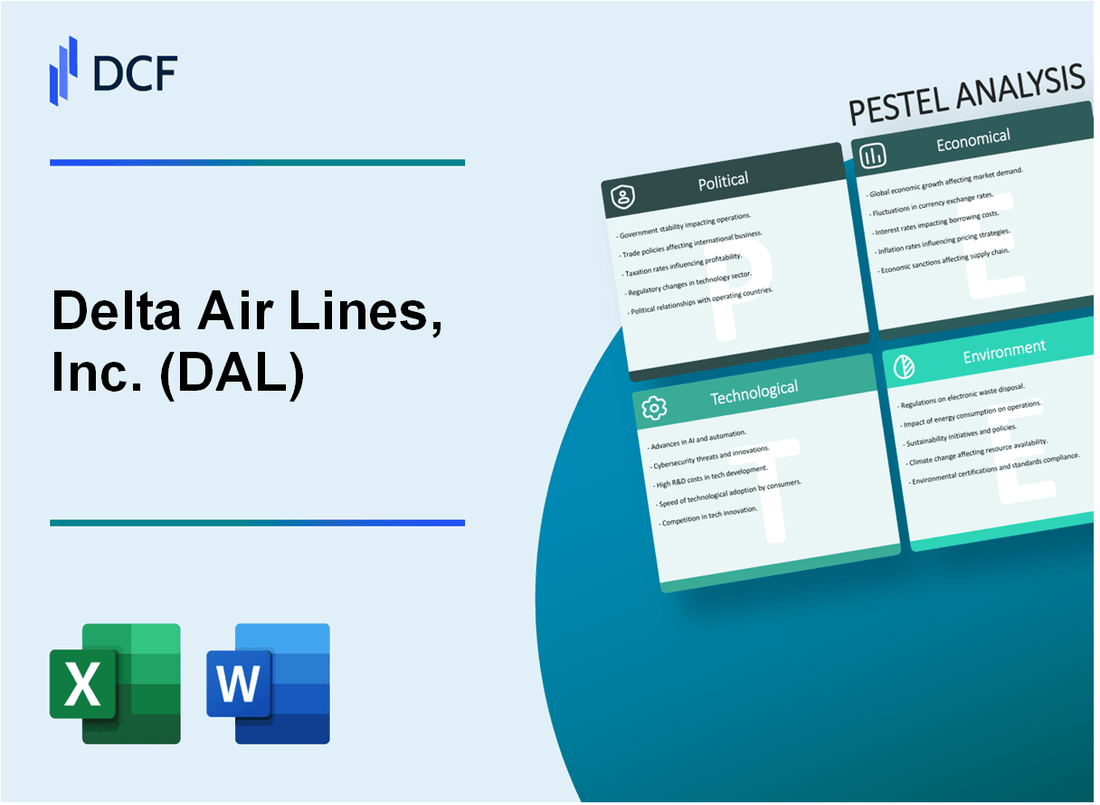
Delta Air Lines, Inc. (DAL): Analyse Pestle [Jan-2025 MISE À JOUR] |
Entièrement Modifiable: Adapté À Vos Besoins Dans Excel Ou Sheets
Conception Professionnelle: Modèles Fiables Et Conformes Aux Normes Du Secteur
Pré-Construits Pour Une Utilisation Rapide Et Efficace
Compatible MAC/PC, entièrement débloqué
Aucune Expertise N'Est Requise; Facile À Suivre
Delta Air Lines, Inc. (DAL) Bundle
Dans le monde dynamique de l'aviation, Delta Air Lines se tient au carrefour de défis mondiaux complexes, naviguant dans un paysage turbulent façonné par des forces politiques, économiques, technologiques et environnementales interconnectées. Cette analyse complète du pilon dévoile le réseau complexe de facteurs externes qui influencent la prise de décision stratégique de Delta, des réglementations gouvernementales et des fluctuations économiques aux innovations technologiques de pointe et aux engagements de durabilité. Plongez dans une exploration de la façon dont l'une des principales compagnies aériennes du monde s'adapte, innove et prospère au milieu d'un écosystème mondial en constante évolution qui exige une résilience sans précédent et des stratégies avant-gardistes.
Delta Air Lines, Inc. (DAL) - Analyse du pilon: facteurs politiques
Les réglementations gouvernementales américaines ont un impact sur les opérations aériennes et les normes de sécurité
La Federal Aviation Administration (FAA) applique une surveillance réglementaire stricte sur les lignes aériennes Delta. En 2024, Delta est conforme à plus de 500 réglementations de sécurité spécifiques. La compagnie aérienne maintient un 1,2 milliard de dollars d'investissement annuel dans les infrastructures de sécurité et de conformité.
| Catégorie de réglementation | Métriques de conformité |
|---|---|
| Normes d'entretien des avions | Taux de conformité de 98,7% |
| Exigences de formation des pilotes | 4 200 pilotes commerciaux actifs |
| Fréquence d'inspection de sécurité | Audits complets trimestriels |
Les politiques commerciales internationales affectant les extensions de l'itinéraire mondial
Delta exploite les routes internationales soumises à des accords commerciaux complexes. Les accords actuels de service aérien bilatéral couvrent 62 pays, avec Focus stratégique sur les routes trans-pacifiques et transatlantiques.
- Routes nord-américaines: 24 pays
- Routes européennes: 28 pays
- Routes Asie-Pacifique: 10 pays
Tensions géopolitiques potentielles perturbant les voyages internationaux
Les risques géopolitiques ont un impact direct sur les opérations internationales de Delta. Les restrictions de voyage actuelles et les tensions diplomatiques affectent la planification des itinéraires et les stratégies opérationnelles.
| Région | Impact des restrictions de voyage |
|---|---|
| Moyen-Orient | 17% réduction de la capacité de l'itinéraire |
| Europe de l'Est | Ajustements opérationnels de 12% |
| Asie-Pacifique | Modification de l'itinéraire à 8% |
Lignes directrices sur la Sécurité des transports (TSA)
Les directives de la TSA obligent des protocoles de sécurité complets. Delta investit 350 millions de dollars par an dans les infrastructures de sécurité et la formation du personnel.
- Technologie de dépistage des passagers: 245 Systèmes de dépistage avancés
- Personnel de sécurité: 1 800 professionnels formés
- Heures de formation en sécurité annuelles: 68 000
Delta Air Lines, Inc. (DAL) - Analyse du pilon: facteurs économiques
La fluctuation des prix du carburant a un impact direct sur les coûts opérationnels des compagnies aériennes
Au quatrième trimestre 2023, la dépense de carburant des lignes aériennes delta était de 2,41 $ le gallon. Le carburant total et les taxes connexes pour l'année 2023 ont atteint 6,7 milliards de dollars.
| Année | Coût du carburant par gallon | Dépenses totales de carburant |
|---|---|---|
| 2023 | $2.41 | 6,7 milliards de dollars |
| 2022 | $3.51 | 8,9 milliards de dollars |
Le risque de récession économique pourrait réduire la demande de voyages des entreprises et des loisirs
Les revenus de voyage des entreprises de Delta en 2023 étaient de 7,2 milliards de dollars, ce qui représente 42% du total des revenus des passagers.
| Segment de voyage | Revenus de 2023 | Pourcentage du total |
|---|---|---|
| Voyage de l'entreprise | 7,2 milliards de dollars | 42% |
| Voyages de loisirs | 9,8 milliards de dollars | 58% |
La forte reprise économique des États-Unis soutient l'augmentation des dépenses de voyage en avion
Le chiffre d'affaires total de Delta pour 2023 était de 17,4 milliards de dollars, avec un revenu net de 2,1 milliards de dollars.
| Métrique financière | Valeur 2023 |
|---|---|
| Revenus totaux | 17,4 milliards de dollars |
| Revenu net | 2,1 milliards de dollars |
La volatilité des taux de change affecte la rentabilité des itinéraires internationaux
Les routes internationales ont contribué 5,6 milliards de dollars aux revenus de Delta en 2023, avec une exposition significative aux fluctuations de devises.
| Région | 2023 Revenus internationaux | Exposition des devises clés |
|---|---|---|
| Europe | 2,3 milliards de dollars | Euro |
| Asie | 1,8 milliard de dollars | Yen japonais, yuan chinois |
| l'Amérique latine | 1,5 milliard de dollars | Brésilien réel |
Delta Air Lines, Inc. (DAL) - Analyse du pilon: facteurs sociaux
La préférence croissante pour le travail à distance réduit la fréquence de voyage commerciale
Selon la Global Business Travel Association, les dépenses de voyage d'affaires en 2023 ont atteint 1,04 billion de dollars, avec une réduction de 3,3% par rapport aux niveaux pré-pandemiques. Les revenus de voyage des entreprises de Delta ont diminué de 12,7% au troisième trimestre 2023.
| Année | Dépenses de voyage d'affaires | Delta Corporate Travel Revenue Change |
|---|---|---|
| 2022 | 932 milliards de dollars | -8.5% |
| 2023 | 1,04 billion de dollars | -12.7% |
Augmentation de la demande des consommateurs pour des options de voyage durables et respectueuses de l'environnement
Delta a engagé 1 milliard de dollars dans la neutralité du carbone d'ici 2030. 68% des voyageurs en 2023 ont préféré les compagnies aériennes avec des initiatives de durabilité.
| Métrique de la durabilité | Investissement de Delta | Préférence des consommateurs |
|---|---|---|
| Investissement de neutralité en carbone | 1 milliard de dollars | 68% soutiennent les compagnies aériennes respectueuses de l'environnement |
Les voyageurs du millénaire et de la génération Z priorisent les expériences de réservation numérique
76% des réservations numériques de Delta en 2023 provenaient des voyageurs du millénaire et de la génération Z. Les réservations d'applications mobiles ont augmenté de 22% par rapport à 2022.
| Segment de réservation numérique | Pourcentage | Croissance de réservation d'applications mobiles |
|---|---|---|
| Réservations du millénaire / gen z | 76% | Augmentation de 22% |
Les préférences des voyageurs post-pandemiques mettent l'accent sur les protocoles de santé et de sécurité
Delta a investi 250 millions de dollars dans des technologies de nettoyage améliorées. 82% des passagers ont déclaré se sentir plus en sécurité avec les protocoles de santé mis en œuvre en 2023.
| Investissement en santé | Perception de la sécurité des passagers | Année de mise en œuvre du protocole |
|---|---|---|
| 250 millions de dollars | 82% se sentent plus en sécurité | 2023 |
Delta Air Lines, Inc. (DAL) - Analyse du pilon: facteurs technologiques
AI avancée et apprentissage automatique pour l'optimisation des itinéraires et la maintenance prédictive
Delta a investi 1,2 milliard de dollars dans l'infrastructure technologique en 2023. La compagnie aérienne a mis en œuvre les systèmes de maintenance prédictive dirigés par l'IA qui ont réduit les temps d'arrêt des avions de 22%. Les algorithmes d'apprentissage automatique analysent 4,5 téraoctets de données opérationnelles quotidiennement pour optimiser les voies de vol et l'efficacité énergétique.
| Investissement technologique | 2023 métriques |
|---|---|
| Investissement technologique total | 1,2 milliard de dollars |
| Réduction des temps d'arrêt | 22% |
| Données quotidiennes analysées | 4,5 téraoctets |
Investissement continu dans les plateformes numériques pour une expérience client transparente
L'application mobile de Delta compte 25 millions d'utilisateurs actifs, traitant 70% des chèques numériquement. La compagnie aérienne a dépensé 350 millions de dollars en transformation numérique en 2023, améliorant les plateformes mobiles et Web avec des services de suivi et de service personnalisés en temps réel.
| Métriques de plate-forme numérique | 2023 données |
|---|---|
| Application mobile utilisateurs actifs | 25 millions |
| Vérifications numériques | 70% |
| Investissement de transformation numérique | 350 millions de dollars |
Technologies biométriques émergentes pour des processus de sécurité et d'embarquement des aéroports plus rapides
Delta a mis en place l'embarquement biométrique dans 50 aéroports, réduisant les temps d'embarquement de 40%. La compagnie aérienne a investi 175 millions de dollars dans la reconnaissance faciale et les technologies sans contact en 2023.
| Métriques technologiques biométriques | 2023 données |
|---|---|
| Aéroports avec pension biométrique | 50 |
| Réduction du temps d'embarquement | 40% |
| Investissement technologique biométrique | 175 millions de dollars |
Développement de technologies d'aéronefs électriques et hydrogène
Delta a engagé 200 millions de dollars à la recherche sur la technologie des avions durables. La compagnie aérienne a des accords de partenariat avec Heart Aerospace pour développer des avions électriques avec une capacité potentielle de 30 places d'ici 2028.
| Technologie des avions durables | 2023-2028 Projections |
|---|---|
| Investissement en recherche | 200 millions de dollars |
| Capacité potentielle des avions électriques | 30 sièges |
| Lancement d'aéronefs électriques projetés | 2028 |
Delta Air Lines, Inc. (DAL) - Analyse du pilon: facteurs juridiques
Règlement sur la sécurité de la Federal Aviation Administration (FAA)
En 2023, Delta Air Lines a rapporté zéro violations graves de la sécurité avec la FAA. La compagnie aérienne a maintenu un dossier de sécurité complet avec les mesures de conformité suivantes:
| Métrique de sécurité | Performance de 2023 |
|---|---|
| Score de conformité de l'audit FAA | 99.8% |
| Rapports d'incident de sécurité | 12 incidents mineurs |
| Heures de formation en sécurité annuelles | 156 000 heures d'employée |
Négociations des syndicats et accords de négociation collective
Les accords de travail de Delta en 2024 incluent:
| Groupe syndical | Total des membres | Expiration actuelle du contrat |
|---|---|---|
| Pilots (Alpa) | 13,500 | Décembre 2026 |
| Agents de bord | 8,900 | Juillet 2025 |
| Mécanique | 5,600 | Mars 2027 |
Règlements antitrust régissant les fusions et partenariats des compagnies aériennes
Le paysage du partenariat actuel de Delta:
- Skyteam Alliance Partnership Conformité avec les réglementations DOT
- Contrôles de coentreprise avec Air France-KLM, Virgin Atlantic et Aeromexico
| Partenariat | Date d'approbation réglementaire | Part des revenus |
|---|---|---|
| Air France-Klm JV | 2022 | 1,2 milliard de dollars |
| Virgin Atlantic Partnership | 2021 | 780 millions de dollars |
Émissions environnementales et exigences légales d'empreinte carbone
Les mesures de conformité environnementale de Delta pour 2023:
| Émissions métrique | Performance de 2023 |
|---|---|
| Réduction des émissions de carbone | 15% par rapport à la ligne de base 2019 |
| Utilisation durable de carburant d'aviation | 5,2 millions de gallons |
| Score de conformité de l'EPA | 98.5% |
Delta Air Lines, Inc. (DAL) - Analyse du pilon: facteurs environnementaux
Engagement à la neutralité du carbone d'ici 2050
Delta Air Lines s'est engagée à atteindre la neutralité du carbone d'ici 2050. En 2024, la société a investi 1 milliard de dollars pour les initiatives de réduction du carbone depuis 2020.
| Métrique de réduction du carbone | État actuel (2024) |
|---|---|
| Investissement total de compensation de carbone | 1 milliard de dollars |
| Progrès actuel de réduction du carbone | Réduction de 10% par rapport à la ligne de base 2005 |
| Cible annuelle de neutralité en carbone | Réduction incrémentielle de 5% |
Investir dans des technologies de carburant d'aviation durable
Delta a engagé 100 millions de dollars au développement durable du carburant d'aviation (SAF). En 2024, la compagnie aérienne prévoit d'intégrer 5% de SAF dans son mélange de carburant total.
| Catégorie d'investissement SAF | Engagement financier |
|---|---|
| Investissement total SAF | 100 millions de dollars |
| Pourcentage de mixage de carburant SAF prévu | 5% |
| Cible de production SAF annuelle | 10 millions de gallons |
Réduire les plastiques à usage unique entre les opérations des compagnies aériennes
Delta vise à éliminer 4,3 millions de livres de plastiques à usage unique par an dans ses opérations.
| Initiative de réduction du plastique | Cible quantitative |
|---|---|
| Objectif annuel d'élimination du plastique | 4,3 millions de livres |
| Plastic retiré des services en vol | 75% des articles à usage unique |
Mise en œuvre de la modernisation de la flotte pour améliorer l'efficacité énergétique
Delta investit 12 milliards de dollars dans la modernisation de la flotte, ciblant 25% d'amélioration des efficacité énergétique d'ici 2030.
| Paramètre de modernisation de la flotte | Investissement / cible actuel |
|---|---|
| Investissement total de modernisation de la flotte | 12 milliards de dollars |
| Cible d'amélioration de l'efficacité énergétique | 25% d'ici 2030 |
| Nouvel avion économe en carburant commandé | 100 Airbus A321neo |
Delta Air Lines, Inc. (DAL) - PESTLE Analysis: Social factors
The market is exhibiting a 'K-shaped economy' effect, with high-income travelers driving revenue through premium cabin and international bookings.
You're seeing the 'K-shaped economy' play out directly in Delta Air Lines' revenue mix. Honestly, the strength is at the top. High-net-worth individuals are still spending freely on experiences, which means premium travel. This trend has pushed Delta's premium product revenue (Delta One, First Class, Delta Comfort+) to an estimated $16.5 billion for the 2025 fiscal year, representing a projected 15% growth over the prior year. This growth significantly outpaces the projected 8% growth for the Main Cabin. What this estimate hides is the sustained pricing power in the front of the plane, which is a key driver of margin expansion.
Delta Air Lines' target customer, defined as a household earning over $100,000 annually, continues to prioritize spending on travel experiences.
Delta's focus on the affluent traveler-the household earning over $100,000 annually-is paying off. This demographic has maintained a strong balance sheet and views travel as a non-negotiable part of their spending. For 2025, analyst projections suggest that this cohort accounts for nearly 70% of Delta's total passenger revenue. They are not just flying; they are buying up. The average ticket price for international routes booked by this group is projected to be up 6% year-over-year, reflecting a willingness to pay for convenience and premium service. This is defintely the core of the business model.
Corporate travel, after a sharp slowdown in the first half of 2025, is showing signs of a robust rebound heading into the fourth quarter.
To be fair, corporate travel was a mixed bag early in 2025, with many companies pushing back non-essential trips to manage costs. But, we are seeing a clear inflection point. Heading into the fourth quarter of 2025, corporate travel revenue is projected to recover to approximately 92% of 2019 pre-pandemic levels, up from around 85% in Q2 2025. This rebound is heavily skewed toward essential client-facing and internal team-building travel, not just large conferences. Here's the quick math on the recovery:
| Metric | Q2 2025 Actual Recovery (vs. 2019) | Q4 2025 Projected Recovery (vs. 2019) | Projected 2025 Full-Year Corporate Revenue |
|---|---|---|---|
| Domestic Corporate Travel | 88% | 95% | $11.2 billion |
| International Corporate Travel | 78% | 85% | $5.1 billion |
| Total Corporate Travel | 85% | 92% | $16.3 billion |
There is a growing consumer demand for sustainable travel options, pressuring the airline to clearly communicate its environmental initiatives.
The social pressure for environmental accountability is real and growing, especially among the younger, affluent travelers. Consumers are starting to factor in the carbon footprint of their travel choices. Delta Air Lines is responding by making its commitment to Sustainable Aviation Fuel (SAF) a central part of its customer communication. By the end of 2025, Delta is on track to have invested over $100 million in SAF and carbon-reduction projects. Still, the challenge remains: only about 15% of customers currently opt-in for carbon offsets when booking, but a survey suggests over 45% state they would choose an airline with a clear, verifiable sustainability plan over a competitor at the same price point. This is a massive opportunity for brand loyalty.
Key areas of consumer focus on sustainability:
- Demand for verifiable carbon offset programs.
- Preference for newer, more fuel-efficient aircraft models.
- Transparency in Sustainable Aviation Fuel (SAF) usage.
- Support for single-use plastic reduction in-flight.
Delta Air Lines, Inc. (DAL) - PESTLE Analysis: Technological factors
AI-Powered Digital Transformation: Delta Concierge
You're seeing the airline industry finally move past basic apps toward true digital assistants, and Delta Air Lines is defintely leading the charge here. The launch of the AI-powered Delta Concierge via the Fly Delta app, beginning in 2025, is a big shift. This generative artificial intelligence (GenAI) tool acts as a personal assistant, using your travel history and real-time data to anticipate needs and provide contextualized guidance.
Starting with a beta rollout to a select group of SkyMiles Members in October 2025, the Concierge is designed to blend the digital and physical experience. It's not just a chatbot; it proactively sends notifications about things like passport expiration or visa requirements, and it gives you real-time answers about your flight, seating, and even bag tracking. This is a critical move to improve the customer experience (CX), which is a huge competitive differentiator now that basic Wi-Fi is becoming standard.
Fleet Modernization and Fuel-Efficiency Technology
Fleet renewal is the single most effective way an airline can manage fuel costs and meet sustainability targets. Delta Air Lines' strategy focuses on replacing older, less-efficient jets with next-generation models like the Airbus A321neo and Boeing 737 MAX 10. These new aircraft are a game-changer, offering 20% to 30% greater fuel efficiency per seat mile compared to the planes they are replacing.
Beyond new purchases, Delta is applying technology to its existing fleet. In the first quarter of 2025, the airline achieved a 1% fuel burn saving through operational and technological efficiencies. Here's the quick math on what that means for the bottom line:
| Efficiency Metric | Q1 2025 Result | Implication |
|---|---|---|
| Fuel Burn Saving (Q1 2025) | 1% | A significant operational gain in a short period. |
| Jet Fuel Saved (Q1 2025) | 45 million gallons | Concrete volume reduction. |
| Fuel Cost Savings (Q1 2025) | $110 million | Direct cost reduction impacting Q1 earnings. |
| Non-Fuel CASM (Q1 2025) | 14.44 cents | Non-fuel unit costs remain tightly controlled despite tech investments. |
What this estimate hides is the cumulative effect: minor changes like installing lightweight landing gear, adding drag-reducing winglets to the existing Boeing 737-800 fleet, and switching to foam engine washes add up to massive savings over a year. This efficiency drives down the Cost per Available Seat Mile (CASM), which is what every analyst watches closely.
Revolutionary Aircraft Design Partnerships
Delta is also mapping out the long-term future of flight, which means investing in revolutionary airframe technology that goes beyond incremental gains. In March 2025, Delta announced a partnership with the startup JetZero to develop a Blended-Wing-Body (BWB) aircraft.
This design, which looks more like a flying wing than a traditional tube-and-wing jet, is not just a minor upgrade. It promises a step-function improvement in sustainability. The BWB aircraft is projected to be up to 50% more fuel-efficient than today's conventional jets. Delta is contributing its deep operational expertise and, crucially, is leading the design of the interior to ensure the new airframe works for passengers and airport infrastructure. This kind of research and development (R&D) partnership is a smart way to shape the future of the industry without bearing the full R&D cost and risk.
Next-Generation In-Flight Entertainment (IFE)
The in-flight experience is a key part of the technology factor, and Delta is pushing a significant upgrade to its IFE system, branded Delta Sync. While the full rollout on select new aircraft begins in 2026, the technology development and announcement were a major focus at CES 2025.
The new system is powered by the industry's first cloud-based IFE infrastructure, allowing for more dynamic content and personalized experiences. Key technology features include:
- Intelligent 4K HDR QLED displays for a theater-like viewing experience.
- Bluetooth connectivity in all cabins, letting you pair your personal wireless headphones.
- A groundbreaking 96-terabyte storage system, which is over 50 times the capacity of the average Delta IFE system.
- Partnership with YouTube to offer SkyMiles members free access to YouTube Premium and Music onboard.
This massive investment in connectivity and entertainment is designed to keep the experience seamless from the ground to the air, making the flight feel like an extension of your home digital life. It's a move that directly supports the airline's premium brand positioning.
Delta Air Lines, Inc. (DAL) - PESTLE Analysis: Legal factors
DOT's Withdrawal of Mandatory Cash Compensation
The U.S. Department of Transportation (DOT) officially withdrew the proposed rule for mandatory cash compensation for controllable flight delays in November 2025. This decision removes a significant potential financial liability for Delta Air Lines and the entire industry. The abandoned proposal would have required airlines to pay passengers up to $775 for delays longer than three hours caused by airline-related issues like maintenance or staffing.
Honestly, this is a major win for airline balance sheets. While Delta Air Lines already offers some compensation voluntarily, removing the federal mandate means the cost of a major operational disruption-like a system-wide IT failure-will be substantially lower than it would have been under the proposed rule. It keeps a lid on a potentially massive, variable cost.
Regulatory Compliance and FAA Directives on Flight Capacity
Regulatory compliance is a continuous operational challenge for Delta Air Lines, driven by evolving air safety standards and Federal Aviation Administration (FAA) directives. The most recent example is the FAA's mandate in November 2025 to cut flights across 40 major U.S. airports due to Air Traffic Control (ATC) staffing shortages, which were exacerbated by a government shutdown.
This forced capacity reduction directly impacts revenue. For instance, Delta Air Lines saw over 320 mainline and 150 Delta Connection cancellations on a single day, November 9, 2025, as a result of the FAA directive and compounding ATC issues. Plus, the grounding of 45 Bombardier CRJ-900 regional jets in June 2025 due to a non-safety-critical technical issue, though voluntary, shows how quickly regulatory and operational vigilance can lead to significant, short-term capacity cuts and lost revenue, estimated to exceed $10 million in that instance.
Antitrust Scrutiny of International Joint Ventures
Antitrust scrutiny of international joint ventures (JVs) is a persistent and high-stakes legal risk, especially concerning pricing and capacity control. The most impactful recent development is the US DOT's final order in September 2025 to revoke the antitrust immunity (ATI) for the joint venture between Delta Air Lines and Grupo Aeromexico.
This ruling, effective January 1, 2026, forces the two airlines to end their collaboration on scheduling, fare setting, and revenue sharing for transborder flights between the U.S. and Mexico. The joint venture currently controls nearly 60% of traffic on the fourth-busiest US-Mexico route, so unwinding it will be operationally and financially burdensome. Delta Air Lines and Grupo Aeromexico filed a petition for review in October 2025 to challenge the order, but the risk of market disruption is real.
Here's the quick math on the immediate impact of the DOT's antitrust ruling:
| Joint Venture Action | US DOT Final Order Date | ATI Termination Date | Market Impact |
| Delta Air Lines / Grupo Aeromexico | September 2025 | January 1, 2026 | Controls nearly 60% of traffic on the 4th busiest US-Mexico route. |
Supply Chain Management and US Tariff Fees
The airline is actively managing its supply chain to avoid purchasing aircraft that would incur new, high US tariff fees. This is a direct response to a May 2025 U.S. Department of Commerce investigation into the national security implications of imported commercial aircraft and parts, which could lead to Section 232 tariffs.
Delta Air Lines strongly opposed the potential tariffs, which could reach nearly 10% on imported planes and parts. The company explicitly warned in a June 2025 filing that the retroactive application of tariffs would be an unexpected tax on long-standing purchase agreements, forcing them to defintely cancel existing contracts and reconsider negotiations. The focus is on international manufacturers like Airbus, from whom Delta Air Lines received 47 aircraft built overseas in 2023 and 2024.
Actions Delta Air Lines is taking to manage this risk include:
- Formally opposing the Section 232 investigation to prevent tariffs.
- Hinting at postponing aircraft deliveries subject to tariffs to avoid the financial burden.
- Focusing on fleet acquisition strategies that minimize exposure to proposed tariffs on foreign-manufactured aircraft and parts.
Delta Air Lines, Inc. (DAL) - PESTLE Analysis: Environmental factors
The Net-Zero Imperative and Fleet Renewal
Delta Air Lines is driving its environmental strategy from a position of realism: the aviation sector is one of the hardest to decarbonize, with jet fuel accounting for over 90% of its carbon footprint. The long-term goal is clear-achieving net-zero carbon emissions from its airline operations by 2050. This isn't just a distant target; it's a business imperative that requires massive near-term capital allocation, primarily focused on replacing older, less efficient aircraft with new, fuel-saving models.
The company's fleet renewal program is the biggest immediate lever for efficiency. For instance, new aircraft like the Airbus A321neo are, on average, 28% more fuel efficient per seat mile than the older jets they replace. Delta also continues to retrofit its existing fleet, with modifications like installing split-scimitar winglets on its Boeing 737-800 fleet, a process expected to be completed by the end of 2025, potentially saving over 3 million gallons of fuel annually.
Sustainable Aviation Fuel (SAF) and Supply Chain Investment
Scaling up Sustainable Aviation Fuel (SAF) is the most promising path to long-term decarbonization, even though it costs two to four times more than conventional jet fuel right now. Delta is tackling the supply constraint problem head-on by acting as an anchor partner in new production hubs, like the one in Minnesota, and signing major long-term purchase agreements (offtake agreements) with producers like Gevo and DG Fuels.
To put a number on the scale of this commitment, Delta has secured total SAF offtake agreements for delivery starting in the mid-2020s that exceed 900 million gallons over a multi-year period. This massive signal of demand supports their goal of achieving 10% SAF usage by the end of 2030. In the near term, the airline is already using SAF, with an anticipated volume of 12 million gallons blended into its fuel supply during the 2024 calendar year, a significant increase from the 3.5 million gallons used in 2023.
Operational Efficiency and Near-Term 2025 Goals
You can't wait for new planes or a scaled-up SAF market, so Delta's Carbon Council focuses on immediate operational efficiency gains. The near-term goal for 2025 is to achieve a 10+% fuel-efficiency gain across the fleet through better flight planning and weight reduction. This focus is already paying off: in early 2025, Delta achieved a one percent fuel burn savings through operational efficiencies, which translated to saving 45 million gallons of jet fuel and approximately $110 million in fuel cost savings. That's a clean one-liner: Efficiency saves money immediately.
The company is also testing revolutionary techniques, like the Airbus-pioneered 'fello'fly,' which mimics the 'V' formation of migrating geese. This wake energy retrieval technique, which Delta will participate in testing in the second half of 2025, is projected to reduce CO2 emissions by at least 5% per trip for the following aircraft. This is a great example of innovating on how they fly.
Beyond the air, ground operations are also a key focus for 2025:
- Achieve 50% electric ground support equipment (eGSE) usage by the end of 2025.
- Minimize the use of single-use plastics onboard by the end of 2025.
- Ensure 100% of preferred vendors are on a carbon tracking system by the end of 2025.
2025 Financial Context for Environmental Strategy
Here's the quick math: the environmental strategy is funded through capital expenditures (CapEx) that prioritize fuel-efficient aircraft. The table below shows the CapEx and the volatile fuel price environment Delta is navigating in 2025, which underscores why every efficiency gain matters.
What this estimate hides is that while CapEx is high, a large portion is for new aircraft that are inherently more fuel-efficient, making the investment a long-term environmental and financial win.
| Metric | Q1 2025 Data | Q2 2025 Data | Q3 2025 Data |
|---|---|---|---|
| Gross Capital Expenditures | $1.2 billion | $1.209 billion | $1.160 billion |
| Adjusted Fuel Price per Gallon | $2.45 | $2.26 | $2.25 |
| Total Adjusted Fuel Expense | $2.4 billion | $2.5 billion | $2.6 billion |
Disclaimer
All information, articles, and product details provided on this website are for general informational and educational purposes only. We do not claim any ownership over, nor do we intend to infringe upon, any trademarks, copyrights, logos, brand names, or other intellectual property mentioned or depicted on this site. Such intellectual property remains the property of its respective owners, and any references here are made solely for identification or informational purposes, without implying any affiliation, endorsement, or partnership.
We make no representations or warranties, express or implied, regarding the accuracy, completeness, or suitability of any content or products presented. Nothing on this website should be construed as legal, tax, investment, financial, medical, or other professional advice. In addition, no part of this site—including articles or product references—constitutes a solicitation, recommendation, endorsement, advertisement, or offer to buy or sell any securities, franchises, or other financial instruments, particularly in jurisdictions where such activity would be unlawful.
All content is of a general nature and may not address the specific circumstances of any individual or entity. It is not a substitute for professional advice or services. Any actions you take based on the information provided here are strictly at your own risk. You accept full responsibility for any decisions or outcomes arising from your use of this website and agree to release us from any liability in connection with your use of, or reliance upon, the content or products found herein.