

|
Découvrez les services financiers (DFS): Analyse SWOT [Jan-2025 Mise à jour] |
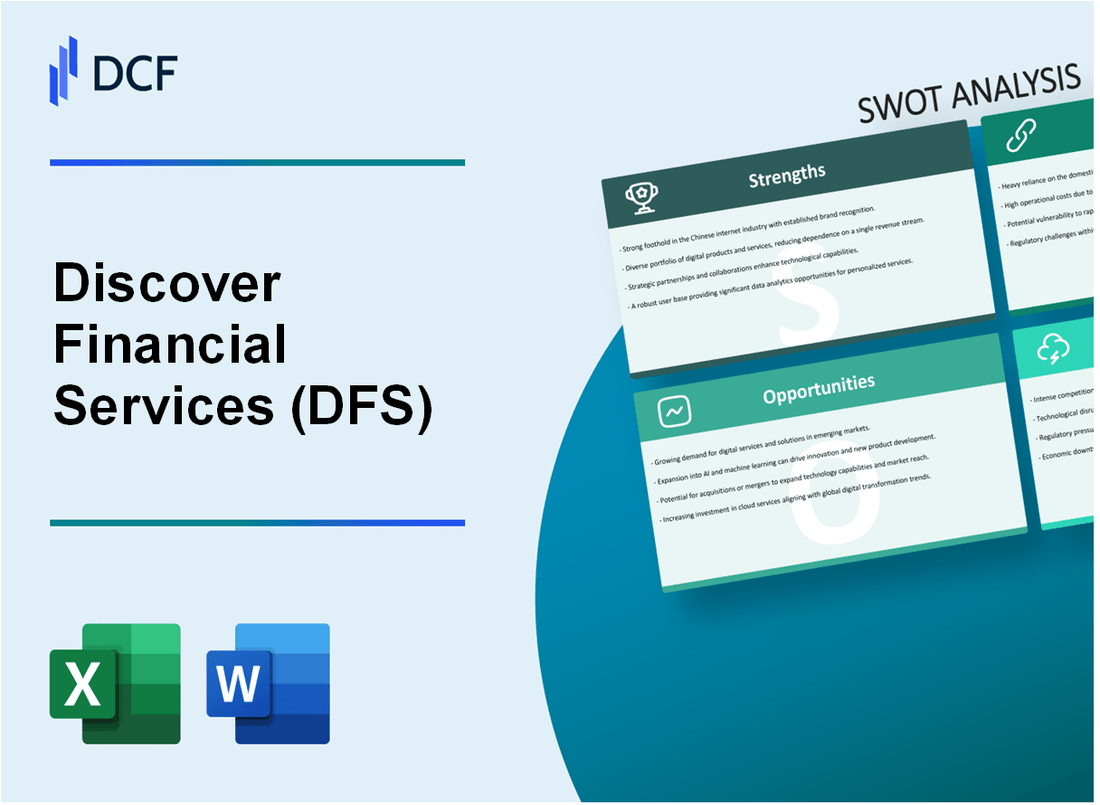
Entièrement Modifiable: Adapté À Vos Besoins Dans Excel Ou Sheets
Conception Professionnelle: Modèles Fiables Et Conformes Aux Normes Du Secteur
Pré-Construits Pour Une Utilisation Rapide Et Efficace
Compatible MAC/PC, entièrement débloqué
Aucune Expertise N'Est Requise; Facile À Suivre
Discover Financial Services (DFS) Bundle
Dans le monde dynamique des services financiers, Discover Financial Services (DFS) se trouve à un carrefour critique de l'innovation, de la concurrence et de la transformation stratégique. As digital banking continues to reshape the financial landscape, this comprehensive SWOT analysis unveils the intricate strengths, vulnerabilities, potential growth pathways, and challenges facing Discover in 2024. Whether you're an investor, financial enthusiast, or curious consumer, this deep dive into Le positionnement concurrentiel de DFS offre des informations sans précédent sur la façon dont cette puissance financière navigue sur un marché de plus en plus complexe et axé sur la technologie.
Découvrez les services financiers (DFS) - Analyse SWOT: Forces
Solide reconnaissance de la marque sur le marché des cartes de crédit et des services financiers
Discover s'est classé 3e parmi les marques de cartes de crédit aux États-Unis en 2023, avec une part de marché de 8,4%. Total Discover Cartes de crédit en circulation: 69,4 millions au troisième trimestre 2023.
| Métrique de la marque | Valeur |
|---|---|
| Cartes de crédit totales émises | 69,4 millions |
| Part de marché | 8.4% |
| Classement de marque | 3e aux États-Unis |
Plateforme bancaire numérique robuste avec application mobile conviviale
L'application bancaire mobile de Discover compte 5,2 millions d'utilisateurs mensuels actifs en 2023. Évaluation de l'application: 4,7 / 5 sur iOS et 4,5 / 5 sur les plates-formes Android.
Satisfaction et fidélité des clients élevés dans le segment des cartes de crédit
Taux de rétention de la clientèle pour Discover Credit Cards: 87,3% en 2023. Score de promoteur net (NPS): 68, nettement supérieur à la moyenne de l'industrie.
| Métrique de fidélisation de la clientèle | Valeur |
|---|---|
| Taux de rétention de la clientèle | 87.3% |
| Score de promoteur net | 68 |
Rentabilité cohérente et stabilité financière
Points forts de la performance financière pour 2023:
- Revenu total: 12,3 milliards de dollars
- Revenu net: 3,6 milliards de dollars
- Retour des capitaux propres (ROE): 26,7%
- Bénéfice par action: 14,22 $
Excellentes stratégies de gestion des risques de crédit
Mesures de risque de crédit pour 2023:
- Taux de charge net: 2,1%
- Provision de perte de prêt: 1,8 milliard de dollars
- Score de qualité du portefeuille de crédit: 92/100
| Métrique de risque de crédit | Valeur |
|---|---|
| Taux de redevance net | 2.1% |
| Disposition de perte de prêt | 1,8 milliard de dollars |
Découvrez les services financiers (DFS) - Analyse SWOT: faiblesses
Présence internationale limitée
Depuis 2024, les services financiers découvrent génère 98.7% de ses revenus exclusivement sur le marché américain. Les revenus internationaux ne représentent que 1.3% du total des bénéfices de l'entreprise.
| Répartition des revenus géographiques | Pourcentage |
|---|---|
| Revenus des États-Unis | 98.7% |
| Revenus internationaux | 1.3% |
Portefeuille de produits relativement plus petit
Discover Offres 4 produits financiers primaires par rapport à la moyenne des grandes banques de 8-12 gammes de produits:
- Cartes de crédit
- Prêts personnels
- Prêts étudiants
- Comptes d'épargne en ligne
Dépendance plus élevée à l'égard du modèle commercial des cartes de crédit
Les revenus de la carte de crédit représentent 76.4% du total des revenus de Discover en 2024, indiquant un risque important de concentration du modèle d'entreprise.
| Source de revenus | Pourcentage |
|---|---|
| Revenus de carte de crédit | 76.4% |
| Autres services financiers | 23.6% |
Réseau de succursale physique limité
Découvrir maintient 0 succursales bancaires physiques, opérant exclusivement via des plateformes numériques et en ligne. Banques concurrentes moyennes 1 200-1,500 branches physiques.
Vulnérabilité aux ralentissements économiques
Taux de remise des cartes de crédit de Discover pendant l'incertitude économique atteint 3.85% en 2023, par rapport à la moyenne de l'industrie de 2.6%.
| Métrique | Découvrir financier | Moyenne de l'industrie |
|---|---|---|
| Taux de facturation de la carte de crédit | 3.85% | 2.6% |
Découvrez les services financiers (DFS) - Analyse SWOT: Opportunités
Paiement numérique croissant et extension du marché fintech
Le marché mondial des paiements numériques était évalué à 68,61 milliards de dollars en 2022 et devrait atteindre 218,75 milliards de dollars d'ici 2030, avec un TCAC de 21,4%. Découvrir les services financiers peut tirer parti de cette croissance rapide du marché.
| Métrique du marché du paiement numérique | Valeur 2022 | 2030 valeur projetée | TCAC |
|---|---|---|---|
| Marché mondial des paiements numériques | 68,61 milliards de dollars | 218,75 milliards de dollars | 21.4% |
Potentiel pour développer des solutions de technologie financière innovantes
Discover peut investir dans des zones de fintech émergentes avec un potentiel significatif:
- Services de conseil financier axés sur l'IA
- Plates-formes de transaction basées sur la blockchain
- Technologies de cybersécurité avancées
Demande croissante de services financiers personnalisés
76% des consommateurs s'attendent à des expériences financières personnalisées, présentant une opportunité importante pour découvrir pour différencier ses services.
| Métrique de personnalisation | Pourcentage |
|---|---|
| Les consommateurs s'attendent à des services financiers personnalisés | 76% |
Croissance potentielle de part de marché dans les segments de prêts étudiants et personnels
Le marché américain des prêts personnels était évalué à 222 milliards de dollars en 2022, avec une croissance prévue à 305 milliards de dollars d'ici 2028.
| Métrique du marché du prêt | Valeur 2022 | 2028 Valeur projetée |
|---|---|---|
| Marché des prêts personnels américains | 222 milliards de dollars | 305 milliards de dollars |
Extension des offres de programme de cashback et de récompenses
Le marché mondial des programmes de fidélité devrait atteindre 201,85 milliards de dollars d'ici 2028, augmentant à un TCAC de 13,2%.
| Métrique du marché des programmes de fidélité | 2028 Valeur projetée | TCAC |
|---|---|---|
| Marché mondial des programmes de fidélité | 201,85 milliards de dollars | 13.2% |
Découvrez les services financiers (DFS) - Analyse SWOT: menaces
Concurrence intense des grandes banques et des sociétés de fintech émergentes
Au quatrième trimestre 2023, le paysage concurrentiel des cartes de crédit et des services financiers révèle:
| Concurrent | Part de marché | Comptes de carte de crédit |
|---|---|---|
| JPMorgan Chase | 22.3% | 149 millions |
| American Express | 17.6% | 121 millions |
| Découvrez les services financiers | 9.8% | 67 millions |
Augmentation des risques de cybersécurité et des violations potentielles de données
Statistiques des menaces de cybersécurité pour les services financiers en 2023:
- Coût moyen d'une violation de données: 4,45 millions de dollars
- Le secteur des services financiers a connu 18,6% de tous les incidents de cybersécurité
- 75% des institutions financières ont déclaré au moins une cyberattaque en 2023
Changements réglementaires potentiels dans l'industrie des services financiers
Coûts de conformité réglementaire pour les institutions financières en 2023:
| Zone de réglementation | Coût de conformité estimé |
|---|---|
| Protection des consommateurs | 1,2 milliard de dollars |
| Anti-blanchiment | 1,7 milliard de dollars |
| Règlements sur la confidentialité des données | 980 millions de dollars |
L'incertitude économique et les impacts potentiels de récession
Indicateurs économiques affectant les services financiers:
- Croissance du PIB américain prévue pour 2024: 1,4%
- Taux de défaut de crédit à la consommation: 2,3%
- Taux de chômage: 3,7%
Augmentation des taux d'intérêt affectant les comportements d'emprunt et de crédit des consommateurs
Données du marché des taux d'intérêt et du crédit pour 2023-2024:
| Métrique | Valeur |
|---|---|
| Taux de fonds fédéraux | 5.33% |
| Taux d'intérêt moyen de la carte de crédit | 22.75% |
| Taux de croissance du crédit aux consommateurs | 4.1% |
Discover Financial Services (DFS) - SWOT Analysis: Opportunities
Capital One acquisition creates a massive, diversified U.S. card issuer.
The May 2025 completion of the $35.3 billion all-stock acquisition by Capital One Financial Corporation (Capital One) is the single largest opportunity for the former Discover Financial Services (DFS) business. This merger creates a financial services powerhouse, immediately becoming the largest credit card issuer in the United States by outstanding balances, which sum to over $250 billion. The combined entity now serves a franchise of over 100 million customers, a scale that fundamentally changes its competitive position against behemoths like JPMorgan Chase and Bank of America.
The strategic rationale is clear: eliminate a competitor, gain a rare payments network, and realize massive operational efficiencies. Capital One projects this deal will generate $2.7 billion in pre-tax synergies, which is a significant boost to the bottom line, and expects it to be more than 15% accretive (adding to) to adjusted non-GAAP Earnings Per Share (EPS) by 2027. That's a powerful financial tailwind.
| Metric | Combined Entity Scale (Post-May 2025) | Source |
|---|---|---|
| Acquisition Value | $35.3 billion | Search Result |
| Combined Customer Base | Over 100 million | Search Result |
| Outstanding Credit Card Balances | Over $250 billion | Search Result |
| Total Assets (Capital One, Mar 2025) | $493.6 billion | Search Result |
| Projected Pre-Tax Synergies | $2.7 billion | Search Result |
Cross-sell Discover's high-yield savings products to Capital One's customer base.
The opportunity to cross-sell deposit products is immense. Capital One's total deposits stood at $367.5 billion as of March 31, 2025, and Discover's high-yield savings accounts (HYSAs) have a strong reputation for competitive rates and no fees. This is a defintely a key strategic priority. The combined entity is now the sixth-largest U.S. bank based on customer deposits.
The goal is to migrate Capital One customers, especially those with lower-yielding accounts, into the Discover network's high-yield products. This not only increases the combined company's low-cost funding base but also significantly improves customer stickiness. Plus, Discover's single full-service branch is now augmented by Capital One's network of over 250 branches and 55 cafes, offering a hybrid digital-physical experience that Discover customers didn't have before.
Expand international acceptance leveraging Capital One's scale.
The core value proposition of the acquisition is gaining the Discover payments network. Discover's network already boasts 70 million merchant acceptance points in more than 200 countries and territories globally. The problem was always scale and investment to compete with Visa and Mastercard.
Now, with Capital One's financial muscle, the opportunity is to aggressively invest in expanding that international acceptance. Capital One has stated its intention to transition a portion of its massive credit card portfolio and its entire debit card business onto the Discover network over time. This shift will immediately increase transaction volume on the Discover network, making it more attractive to international merchants and giving the combined company a direct, three-party network advantage over the traditional four-party models, which could lead to lower transaction costs. Capital One's CEO noted that building more international acceptance is a long-term priority.
Grow personal loan market share with increased funding capacity.
Discover Financial Services successfully completed the sale of its private student loan portfolio in 2024, a $10.1 billion divestiture that allows the combined entity to focus resources on more profitable, core consumer lending. The clear opportunity is to ramp up the Personal Loan segment.
In 2024, the Personal Loan segment showed strong momentum, increasing by 5%, with balances growing by $462 million. The U.S. Personal Loans market is valued at $738.6 billion in 2025 and is projected to grow at a Compound Annual Growth Rate (CAGR) of 9.5% through 2034. By leveraging Capital One's nearly $500 billion in total assets and increased funding capacity, the newly formed company can aggressively increase its personal loan origination, targeting Capital One's existing, credit-tested customer base for debt consolidation and major purchases. This is a high-growth, high-margin segment where the combined company's data and funding scale can quickly capture market share.
Discover Financial Services (DFS) - SWOT Analysis: Threats
Significant Regulatory and Integration Risk Post-Merger
The initial threat of the Capital One merger being blocked by U.S. regulators is now a past risk, as the deal officially closed on May 18, 2025, following approvals from the Federal Reserve and the Office of the Comptroller of the Currency (OCC). Still, the threat has morphed into significant post-merger regulatory and integration risk. The approvals came with stringent conditions and major financial penalties that create an immediate drag on the combined entity's resources and focus.
The regulatory actions expose Discover Financial Services to substantial financial and operational risks that Capital One must now absorb and remediate. Here's the quick math on the immediate cost of past compliance issues:
- FDIC-mandated customer restitution of at least $1.225 billion for overcharged customers between 2007 and 2023.
- A Federal Reserve fine of $100 million related to the pricing misclassification issue.
- An additional FDIC fine of $150 million.
These penalties, totaling over $1.475 billion, are a concrete threat to near-term profitability and demand immediate, intensive investment in risk management and compliance programs. The OCC's approval is conditional, requiring Capital One to submit a plan within 120 days of closing to address the root causes of all outstanding enforcement actions. That's a huge, non-negotiable compliance lift.
Rising Credit Card Charge-Off Rates Exceeding 4.5%
A more immediate, macro-level threat is the continued deterioration of consumer credit quality, evidenced by Discover Financial Services' rising credit card net charge-off rate (NCO). This is defintely a core risk in the credit card business. The NCO rate represents the percentage of loan balances the company does not expect to recover and has written off. In the first quarter of 2025, the credit card NCO rate hit 5.47%, a clear jump above the 4.5% threshold and a significant increase from the 5.03% seen in the fourth quarter of 2024.
While the rate slightly improved to 5.04% by April 2025, it remains elevated and signals ongoing pressure on the consumer. This trend is a direct threat to the combined entity's net interest income, forcing higher provisions for credit losses. For context, the total loan balance at the end of Q1 2025 was $117.4 billion, meaning even a small percentage change in charge-offs translates into hundreds of millions in losses. The fact that outstanding debt on cards was growing faster than spending at year-end 2024 suggests that more consumers are struggling to meet their obligations, which will keep charge-off rates high through 2025.
Intense Competition from Large Banks like JPMorgan Chase and Bank of America
Even with the merger, the combined Capital One-Discover entity faces a fiercely competitive U.S. credit card market dominated by entrenched, diversified financial giants. JPMorgan Chase & Co. and Bank of America Corporation leverage massive balance sheets, extensive branch networks, and diverse product offerings that Discover Financial Services, as a standalone entity, could not match.
JPMorgan Chase & Co. remains the top issuer by purchase volume. In 2024, JPMorgan Chase & Co. recorded more than $1.344 trillion in purchase volume, illustrating its sheer scale and market dominance. The top five largest issuers accounted for 69.1% of all spending on credit cards in 2024. This level of concentration means the combined entity must fight for every percentage point of market share against players with superior resources and brand recognition across multiple financial product lines.
| US Credit Card Issuer Ranking (2024 Purchase Volume) | Purchase Volume (Trillions) | Competitive Advantage |
|---|---|---|
| JPMorgan Chase & Co. | >$1.344 trillion | Largest overall bank assets, premium rewards, and vast customer base. |
| American Express Company | $1.168 trillion | Proprietary network, high-spending affluent customer base. |
| Capital One (Pre-Merger) | Not provided | Focus on mid-tier credit and digital-first approach. |
| Bank of America Corporation | Top 5 Issuer | Extensive branch network, integration with wealth management. |
Sustained High Operational and Integration Costs from the Merger Process
The merger's success hinges on realizing projected synergies, but the near-term threat comes from the sustained, and rising, cost of integrating two complex financial institutions. Capital One's management has already been transparent that the integration costs will surpass the original $2.8 billion estimate.
The financial impact is already clear in the 2025 results. Capital One reported a net loss of $4.3 billion in the second quarter of 2025, which was largely attributed to one-time charges related to the acquisition. This loss highlights how quickly integration expenses can erode profitability. For the first six months of 2025, Capital One had already spent approximately $409 million on integration expenses. These costs cover everything from moving Discover Financial Services onto Capital One's technology stack to integrating workforces and enhancing risk management systems to meet regulatory demands. This significant investment is a multi-year journey, and its unpredictable nature poses a continuous threat to the combined company's earnings per share (EPS) in the near to medium term.
Disclaimer
All information, articles, and product details provided on this website are for general informational and educational purposes only. We do not claim any ownership over, nor do we intend to infringe upon, any trademarks, copyrights, logos, brand names, or other intellectual property mentioned or depicted on this site. Such intellectual property remains the property of its respective owners, and any references here are made solely for identification or informational purposes, without implying any affiliation, endorsement, or partnership.
We make no representations or warranties, express or implied, regarding the accuracy, completeness, or suitability of any content or products presented. Nothing on this website should be construed as legal, tax, investment, financial, medical, or other professional advice. In addition, no part of this site—including articles or product references—constitutes a solicitation, recommendation, endorsement, advertisement, or offer to buy or sell any securities, franchises, or other financial instruments, particularly in jurisdictions where such activity would be unlawful.
All content is of a general nature and may not address the specific circumstances of any individual or entity. It is not a substitute for professional advice or services. Any actions you take based on the information provided here are strictly at your own risk. You accept full responsibility for any decisions or outcomes arising from your use of this website and agree to release us from any liability in connection with your use of, or reliance upon, the content or products found herein.