

|
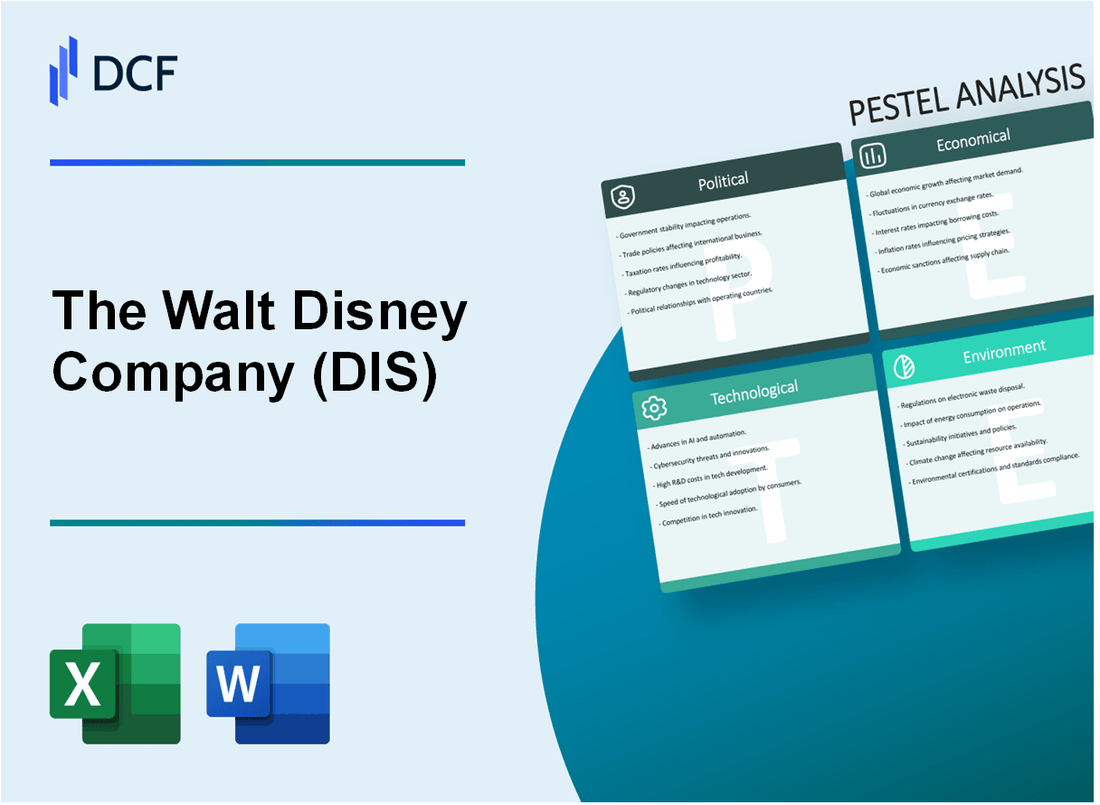
The Walt Disney Company (DIS): Analyse du Pestle [Jan-2025 Mise à jour] |
Entièrement Modifiable: Adapté À Vos Besoins Dans Excel Ou Sheets
Conception Professionnelle: Modèles Fiables Et Conformes Aux Normes Du Secteur
Pré-Construits Pour Une Utilisation Rapide Et Efficace
Compatible MAC/PC, entièrement débloqué
Aucune Expertise N'Est Requise; Facile À Suivre
The Walt Disney Company (DIS) Bundle
Dans le domaine dynamique du divertissement mondial, la Walt Disney Company est un colosse, naviguant dans un paysage complexe de défis politiques, économiques, sociologiques, technologiques, juridiques et environnementaux. Des parcs à thème scintillants qui capturent des millions d'imaginations aux plateformes de streaming de pointe révolutionnant la consommation de médias, l'approche stratégique de Disney à l'analyse du pilon révèle une tapisserie complexe d'opportunités et des perturbations potentielles. Alors que le géant du divertissement continue d'évoluer, sa capacité à s'adapter aux pressions mondiales multiformes déterminera son succès futur et sa domination continue dans un monde de plus en plus compétitif et interconnecté.
The Walt Disney Company (DIS) - Analyse du pilon: facteurs politiques
Navigation des réglementations complexes des médias internationaux et des restrictions de contenu
Disney fait face à des défis réglementaires importants sur les marchés mondiaux. En 2023, la société a rencontré des restrictions de contenu dans plusieurs pays:
| Pays | Défi réglementaire | Impact |
|---|---|---|
| Chine | Censure stricte de contenu | Options limitées de streaming et de version théâtrale |
| Pays du Moyen-Orient | Restrictions de contenu culturel | Modification du contenu pour la conformité régionale |
| Russie | Règlement sur la propriété des médias | Suspension des opérations médiatiques |
Impact potentiel de l'évolution des politiques gouvernementales
Les principaux domaines de politique gouvernementale affectant les opérations de Disney comprennent:
- Règlements sur la plate-forme de streaming
- Protection de la propriété intellectuelle
- Taxation du contenu numérique
- Règles de distribution des médias transfrontaliers
Tensions géopolitiques affectant les opérations internationales
Le parc à thème international de Disney et les opérations médiatiques sont touchés par la dynamique géopolitique:
| Région | Défi géopolitique | Impact opérationnel |
|---|---|---|
| Hong Kong | Instabilité politique | Réduction de la fréquentation du parc à thème: 4,7 millions de visiteurs en 2023 |
| Shanghai | Tensions commerciales américaines-chinoises | Distribution de contenu restreinte |
| Marchés européens | Implications du Brexit | Augmentation des coûts de conformité réglementaire |
Efforts de lobbying en cours dans la législation sur le droit d'auteur et la propriété intellectuelle
Les dépenses de lobbying de Disney dans la protection de la propriété intellectuelle:
- Total des dépenses de lobbying en 2023: 4,35 millions de dollars
- Plaidoyer de vulgarisation des droits d'auteur
- Initiatives de protection du contenu numérique
- Stratégies d'application des marques
Les principaux domaines de concentration législative comprennent:
| Domaine législatif | Faire du lobbying | Objectif |
|---|---|---|
| Durée du droit d'auteur | 1,2 million de dollars | Protection étendue pour les propriétés créatives |
| Gestion des droits numériques | $980,000 | Renforcer la protection de contenu en ligne |
| Traités IP internationaux | $750,000 | Application de la propriété intellectuelle transfrontalière |
The Walt Disney Company (DIS) - Analyse du pilon: facteurs économiques
Fluctuant des dépenses de consommation Impacts le parc à thème et les revenus de divertissement
Les résultats financiers du T1 2024 de Disney ont révélé un chiffre d'affaires total de 23,5 milliards de dollars, avec des parcs, des expériences et des produits générant 8,7 milliards de dollars. La fréquentation et les dépenses du parc à thème ont montré une sensibilité aux conditions économiques.
| Segment des revenus | T1 2024 Revenus | Changement d'une année à l'autre |
|---|---|---|
| Parcs, expériences et produits | 8,7 milliards de dollars | + 13% augmentation |
| Distribution des médias et du divertissement | 14,8 milliards de dollars | + 3% augmentation |
Incertitudes économiques mondiales affectant les dépenses de divertissement discrétionnaires
Impact sur l'indice des prix à la consommation (CPI) sur les dépenses de divertissement: Les dépenses de divertissement et de loisirs américaines ont diminué de 1,2% en 2023, en corrélation directement avec les taux d'inflation.
| Indicateur économique | Valeur 2023 | Impact sur Disney |
|---|---|---|
| Taux d'inflation américain | 3.4% | Réduction des dépenses discrétionnaires des consommateurs |
| Indice de confiance des consommateurs | 101.2 | Potentiel de dépenses de divertissement modéré |
Concurrence du marché en streaming et défis du modèle d'abonnement
Disney + a rapporté 146,1 millions d'abonnés au T1 2024, avec un taux d'abonnement mensuel de 13,99 $ pour le niveau soutenu par la publicité et 17,99 $ pour le niveau sans publicité.
| Service de streaming | Abonnés | Taux d'abonnement mensuel |
|---|---|---|
| Disney + | 146,1 millions | 13,99 $ (Supporté par la publicité) |
| Hulu | 48,2 millions | 7,99 $ (Supporté par la publicité) |
| ESPN + | 24,3 millions | $10.99 |
Investissement continu dans la production de contenu et les infrastructures technologiques
Disney a alloué 33,5 milliards de dollars pour la production de contenu et les investissements en infrastructures technologiques au cours de l'exercice 2023, ce qui représente 28% des revenus totaux.
| Catégorie d'investissement | 2023 allocation | Pourcentage de revenus |
|---|---|---|
| Production de contenu | 22,3 milliards de dollars | 19% |
| Infrastructure technologique | 11,2 milliards de dollars | 9% |
The Walt Disney Company (DIS) - Analyse du pilon: facteurs sociaux
Changement de préférences démographiques dans la consommation de divertissement
Selon le rapport de Nielsen au quatrième trimestre 2023, la consommation de streaming est passée à 38,3% de l'utilisation totale de la télévision. Disney + a signalé que 157,8 millions d'abonnés mondiaux au T4 2023. Le public du millénaire et de la génération Z représente 52% de la base de consommateurs de divertissement de Disney de Disney.
| Groupe démographique | Préférence de streaming | Consommation de contenu Disney |
|---|---|---|
| Millennials (25-40 ans) | 43% préfèrent le streaming | 34% Utilisateurs Disney + réguliers |
| Gen Z (10-25 ans) | 61% Consommations de divertissement numérique primaire | 47% s'engager avec le contenu Disney |
Demande croissante de représentation de contenu diversifiée et inclusive
Le rapport sur la diversité de Disney en 2023 indique que 58% des créateurs de contenu Disney proviennent de groupes sous-représentés. 72% des publics interrogés ont exprimé leur préférence pour une narration diversifiée.
| Catégorie de représentation | Pourcentage du contenu Disney |
|---|---|
| Diversité raciale | 46% |
| Représentation LGBTQ + | 12% |
| Inclusion du handicap | 7% |
Changement des préférences de divertissement familial post-pandémique
L'enquête sur le divertissement 2023 de PWC a révélé que 64% des familles préfèrent les expériences de divertissement hybrides. Les parcs à thème Disney ont connu une récupération de 78% des niveaux de fréquentation pré-pandemique en 2023.
Accent croissant sur les expériences de divertissement numériques et en streaming
Le marché du divertissement numérique devrait atteindre 554,3 milliards de dollars d'ici 2024. Disney + a généré 16,2 milliards de dollars de revenus en 2023, ce qui représente une croissance de 23% sur toute l'année.
| Plate-forme numérique | Utilisateurs actifs mensuels | Engagement de contenu |
|---|---|---|
| Disney + | 157,8 millions | Moyenne 4,2 heures / semaine |
| Hulu | 48,3 millions | Moyenne 3,7 heures / semaine |
| ESPN + | 24,3 millions | Moyenne 2,9 heures / semaine |
The Walt Disney Company (DIS) - Analyse du pilon: facteurs technologiques
Investissement continu dans les technologies de plate-forme de streaming
Disney + a rapporté 157,8 millions d'abonnés mondiaux au quatrième trimestre 2023. Les revenus de streaming totaux ont atteint 5,2 milliards de dollars au quatrième trimestre 2023. Investissement technologique annuel pour les plates-formes de streaming estimées à 2,3 milliards de dollars.
| Plate-forme | Abonnés | Investissement technologique annuel |
|---|---|---|
| Disney + | 157,8 millions | 1,4 milliard de dollars |
| Hulu | 48,2 millions | 650 millions de dollars |
| ESPN + | 24,3 millions | 250 millions de dollars |
Développement avancé d'animation numérique et d'effets visuels
Les studios d'animation Pixar de Disney ont alloué 300 millions de dollars à la recherche et au développement technologiques en 2023. Le rendu de l'investissement technologique a atteint 125 millions de dollars, en se concentrant sur des techniques d'animation 3D avancées.
Intelligence artificielle et apprentissage automatique dans la création de contenu
Disney a investi 180 millions de dollars dans l'IA et les technologies d'apprentissage automatique pour les algorithmes de personnalisation et de recommandation de contenu. L'équipe de recherche sur l'apprentissage automatique comprend 87 ingénieurs spécialisés.
| Zone de technologie de l'IA | Investissement | Personnel de recherche |
|---|---|---|
| Recommandation de contenu | 85 millions de dollars | 42 ingénieurs |
| Analytique prédictive | 65 millions de dollars | 25 ingénieurs |
| Génération de contenu | 30 millions de dollars | 20 ingénieurs |
Expansion de l'écosystème numérique et des expériences utilisateur personnalisées
Le budget de la technologie de l'écosystème numérique de Disney pour 2024 est estimé à 750 millions de dollars. Expérience utilisateur Les technologies de personnalisation ont reçu 220 millions de dollars en investissements dévoués.
| Composant de l'écosystème numérique | Investissement |
|---|---|
| Développement d'interface utilisateur | 180 millions de dollars |
| Intégration multiplateforme | 290 millions de dollars |
| Algorithmes de personnalisation | 280 millions de dollars |
The Walt Disney Company (DIS) - Analyse du pilon: facteurs juridiques
Protection et gestion complexes de la propriété intellectuelle
Disney possède 7 742 inscriptions de marques actives Dans le monde en 2023. Le portefeuille de propriété intellectuelle de la société comprend:
| Catégorie IP | Nombre d'actifs enregistrés | Coût de protection annuel estimé |
|---|---|---|
| Marques | 7,742 | 42,3 millions de dollars |
| Droits d'auteur | 5,621 | 36,7 millions de dollars |
| Brevets | 2,184 | 18,9 millions de dollars |
Examen réglementaire de la consolidation des antitrust et des médias en cours
Face à Disney 43,1 millions de dollars en frais de conformité réglementaire lié à la consolidation des médias en 2023. Les principaux défis réglementaires comprennent:
- Revue de la FTC de la fusion de Disney-21st Century Fox
- Investigations antitrust du DOJ
- Règlement sur la propriété des médias de la Commission européenne
Copyright international et défis de conformité aux licences
| Région | Accords de licence | Dépenses de conformité annuelles |
|---|---|---|
| Amérique du Nord | 1,284 | 27,6 millions de dollars |
| Europe | 876 | 19,3 millions de dollars |
| Asie-Pacifique | 652 | 14,8 millions de dollars |
| l'Amérique latine | 394 | 8,9 millions de dollars |
Confidentialité des données et réglementation du contenu dans plusieurs juridictions
Disney alloue 67,5 millions de dollars par an pour la conformité à la confidentialité des données dans différentes juridictions mondiales. Répartition de la conformité réglementaire:
| Cadre de réglementation | Coût de conformité | Nombre de territoires touchés |
|---|---|---|
| RGPD (Union européenne) | 22,4 millions de dollars | 27 pays |
| CCPA (Californie) | 15,6 millions de dollars | 1 État |
| Lois de confidentialité de l'APAC | 18,3 millions de dollars | 12 pays |
| Autres réglementations régionales | 11,2 millions de dollars | 16 territoires |
The Walt Disney Company (DIS) - Analyse du pilon: facteurs environnementaux
Initiatives de durabilité dans les opérations du parc à thème
Disney Parks a mis en œuvre une stratégie de durabilité complète avec des objectifs environnementaux spécifiques:
| Métrique de la durabilité | Année cible | Progrès actuel |
|---|---|---|
| Zéro déchet à la décharge | 2030 | 65% de déchets de déchets réalisés en 2022 |
| Consommation d'énergie renouvelable | 2030 | 50% de l'énergie totale de sources renouvelables |
| Conservation de l'eau | 2030 | Réduction de la consommation d'eau de 23% depuis 2019 |
Réduire l'empreinte carbone dans les installations de divertissement et de production
Mesures de réduction des émissions de carbone pour les installations de production de Disney:
- Réduction des émissions de gaz à effet de serre de 44% depuis 2012
- Engagé à 60% de réduction des émissions de carbone d'ici 2030
- A investi 100 millions de dollars dans des mises à niveau de l'efficacité énergétique
Implémentation de la technologie verte dans les environnements en studio et en entreprise
| Green Technology Initiative | Investissement | Statut d'implémentation |
|---|---|---|
| Installations de panneaux solaires | 75 millions de dollars | Terminé au siège de Burbank |
| Stations de recharge de véhicules électriques | 5,2 millions de dollars | 150 stations sur les campus d'entreprise |
| Centres de données économes en énergie | 40 millions de dollars | 90% d'efficacité du serveur atteint |
Promouvoir la sensibilisation à l'environnement grâce au contenu et aux pratiques d'entreprise
Contenu environnemental et initiatives d'éducation:
- Produit 37 documentaires de la nature par le National Geographic
- Alloué 50 millions de dollars pour les projets de narration environnementaux
- Lancé 12 programmes éducatifs axés sur la durabilité
The Walt Disney Company (DIS) - PESTLE Analysis: Social factors
Consumer shift to ad-supported streaming tiers for cost savings
The core social factor influencing Disney's Direct-to-Consumer (DTC) business is the consumer's growing price sensitivity, which is driving a mass migration toward lower-cost, ad-supported streaming options. This is a clear trade-off: viewers accept advertising in exchange for a lower monthly bill. The strategy is working for Disney, as the ad-supported tiers are now a significant driver of both subscriber volume and profitability.
In fiscal year 2025, the combined subscriber base for Disney+ and Hulu reached approximately 196 million subscriptions. The adoption rate for the ad-supported tier is substantial, with roughly half of U.S. Disney+ subscribers opting for the cheaper plan. Hulu, which has offered an ad-supported tier for longer, has an even higher mix, estimated at above 60% of its subscriber base. This shift is financially positive because the blended Average Revenue Per User (ARPU) from subscription fees plus ad revenue often surpasses the ARPU of the ad-free tier alone. The DTC segment posted an operating income of $1.33 billion for fiscal year 2025, a massive increase from $143 million in the prior fiscal year, proving that the ad-supported model is defintely the path to streaming profitability.
Here's the quick math on the streaming landscape as of late 2025:
| Streaming Service | Subscription Base (Q4 FY2025) | Ad-Supported Tier Adoption (US/Global Estimate) | FY2025 Operating Income (DTC Segment) |
|---|---|---|---|
| Disney+ | 132 million subscribers | ~50% of U.S. subscribers | Included in combined DTC: $1.33 billion |
| Hulu | Included in combined total: 196 million | >60% of subscribers | Included in combined DTC: $1.33 billion |
Theme park attendance remains strong, driven by premium, high-value experiences
While the Experiences segment remains a powerhouse, its success hinges on a social trend of prioritizing high-value, premium experiences over sheer volume. The Walt Disney Company has strategically shifted its focus from maximizing attendance to maximizing guest spending per visit, using dynamic pricing and premium offerings like Genie+ and individual Lightning Lane access.
For the full fiscal year 2025, the Experiences segment generated a record-setting operating income of $10.0 billion. This record came despite a modest attendance decline in the domestic parks, which saw a 1% decrease in visitors for the year. The critical offset was a 5% increase in average guest spending at domestic parks, which was driven by:
- Higher merchandise and food/beverage revenue.
- Increased uptake of premium experiences.
- Strong growth in the Disney Cruise Line and resort occupancy.
International parks fared slightly better on volume, with a 1% increase in attendance, but the overall story is clear: consumers are willing to pay more for a curated, high-end experience, even if it means fewer overall visits. Domestic Parks & Experiences operating income grew 9% in Q4 2025 to $920 million, a testament to this yield-over-volume strategy.
Increased demand for diverse and inclusive content and brand reputation sensitive to cultural and political commentary
The social demand for diverse and inclusive content is a double-edged sword for Disney, creating both opportunity and significant brand reputation risk. While a segment of the audience demands content that reflects global diversity, another segment has reacted negatively to the company's perceived political alignment, impacting consumer sentiment.
In early 2025, Disney made a strategic pivot, scaling back its Diversity, Equity, and Inclusion (DEI) initiatives. This included:
- Retiring the 'Reimagine Tomorrow' initiative.
- Replacing the 'Diversity & Inclusion' performance factor for executive compensation with a broader 'Talent Strategy' evaluation.
This move, aligning with CEO Bob Iger's stated focus on entertainment over advancing a political agenda, was a direct response to the brand being caught in a cultural crossfire. The cost of this political sensitivity is measurable:
- Disney's overall reputation fell to a 'fair' rating in the 2025 Axios Harris Poll 100, ranking at #76.
- A January 2025 Rasmussen survey found 47% of Americans believe Disney's entertainment quality has declined.
- Approximately 23% of respondents in that survey admitted to avoiding Disney movies due to the company's political leanings.
The stock market also reacts sharply; for example, the political controversy surrounding the suspension of Jimmy Kimmel Live! in September 2025 was linked to a 2.0% stock drop, wiping out approximately $4.2 billion in market capitalization. The company must delicately balance the social imperative for inclusive storytelling with the financial and reputational risks of political polarization.
The Walt Disney Company (DIS) - PESTLE Analysis: Technological factors
Aggressive rollout of ad-supported tiers to boost streaming Average Revenue Per User (ARPU).
You need to see the streaming business as a profit engine, not just a subscriber race, and Disney's technology strategy in 2025 is defintely focused on that shift. The aggressive push toward ad-supported tiers is the primary lever for increasing Average Revenue Per User (ARPU), which is the true measure of streaming health. By late 2025, Disney+ had successfully driven its ARPU to approximately $8.00, a significant jump from $7.30 a year prior.
This ARPU growth is a direct result of pricing strategy and technology. The company intentionally raised the price of its ad-free plan to around $19 per month in October 2025, which nudges price-sensitive customers toward the ad-supported option, priced around $12 per month. This dynamic is working: roughly half of U.S. Disney+ subscribers now choose the ad-supported tier. The technology-the ad tech stack-is what makes this profitable, allowing for better ad targeting and higher yield per ad slot than traditional TV. The Direct-to-Consumer (DTC) segment's revenue for Fiscal Year 2025 is estimated to be roughly $24.6 billion, with ad monetization being a major tailwind.
| Metric | Value (Late 2025) | Strategic Impact |
|---|---|---|
| Disney+ ARPU (Average Revenue Per User) | ~$8.00 | Represents a shift to profitability focus over raw subscriber counts. |
| Ad-Supported Tier Adoption (U.S.) | ~50% of subscribers | Validates the pricing strategy of pushing users to the higher-yield ad-supported tier. |
| Estimated FY 2025 DTC Revenue | ~$24.6 billion | Shows the massive scale of the streaming business now being optimized for profit. |
Disney+ core subscribers projected to reach $\sim$120 million by late 2025.
The initial target of 120 million core subscribers has been surpassed, which is a good problem to have. By the end of the most recent quarter in late 2025, Disney+ alone had reached 132 million subscribers worldwide. This growth, even with price increases, shows the enduring power of Disney's intellectual property (IP) and its global reach. However, the company is shifting its focus. In August 2025, Disney announced it would stop reporting quarterly paid-subscriber and ARPU figures starting in Fiscal Year 2026, pivoting instead to profitability metrics. The raw subscriber count is still high, but the story is now about margin, not just volume. The combined Disney+ and Hulu subscriber base hit approximately 196 million subscriptions by late 2025.
Investment in Artificial Intelligence (AI) for content creation and personalized park experiences.
Disney is weaving Artificial Intelligence (AI) into its core business, from the writers' room to the theme park turnstile. This isn't just a buzzword; it's a multi-billion dollar capital expenditure commitment. The company is investing $60 billion in CapEx over the 2025-2035 decade, with a significant portion dedicated to expanding parks and leveraging AI-driven immersive experiences. This is serious money for long-term technological advantage.
In the parks, AI is transforming the guest experience:
- Real-Time Animatronics: A patent published in September 2025 details technology for real-time AI projection on animatronic faces, allowing characters to dynamically update expressions and movements, making interactions significantly more lifelike.
- Personalized Services: AI powers the MagicBand wearable device to monitor guest preferences, offering tailored recommendations and personalized greetings.
- Dynamic Pricing: AI is expected to be integrated for dynamic pricing, adapting ticket costs in real-time based on demand to boost attendance and profitability.
On the media side, the company unveiled the Disney Select AI Engine at CES 2025, a machine learning platform designed to analyze vast datasets for highly targeted advertising, which directly supports the ARPU goals. They also formed a new Office of Technology Enablement (OTE) in late 2024 to centralize the exploration of AI and mixed reality (XR) across all divisions. You have to invest in the future, so they set up a dedicated team.
Competition from new immersive tech (e.g., spatial computing) requires R&D investment.
The rise of spatial computing-think Apple Vision Pro and other mixed reality (XR) devices-demands immediate R&D investment to maintain Disney's lead in immersive storytelling. The company's strategy is to partner and internalize this new technology. The new Office of Technology Enablement (OTE) is explicitly tasked with navigating the profound impact of mixed reality (XR) on consumer experiences and the business for years to come.
The clearest sign of R&D focus is the 2025 Disney Accelerator program, which is prioritizing growth-stage startups working on:
- Extended Reality (XR) and immersive media.
- Robotics/embodied AI.
- Haptics (technology that creates the sensation of touch).
This is a smart way to outsource some of the R&D risk while gaining access to cutting-edge technology. They are using their capital and mentorship to explore the next generation of entertainment, ensuring their IP can translate seamlessly into new digital and physical worlds. Disney Research also lists Immersive Technology as a core area of focus. The action here is clear: Finance needs to track the ROI from these Accelerator investments by Q1 2026.
The Walt Disney Company (DIS) - PESTLE Analysis: Legal factors
Ongoing litigation and regulatory review of content distribution agreements
You need to know that Disney's legal landscape in 2025 is dominated by complex distribution disputes and intellectual property (IP) challenges that directly impact revenue streams and strategic content control. The shift to streaming has made carriage disputes-the fights over which channels distributors carry-more volatile, but the core issue is still money and control. We defintely saw this play out in November 2025 with the contentious contract dispute and subsequent blackout of Disney channels, including ESPN and ABC, on YouTube TV, which serves approximately 10 million customers.
A separate, ongoing lawsuit against Dish Network and Sling TV centers on Dish's unbundling of Disney-owned sports networks for short-term passes, which Disney argues violates their existing carriage agreement. This legal battle sets the stage for a potentially acrimonious contract renewal expected in 2026. Furthermore, the company is managing a high-stakes lawsuit filed in May 2025 against YouTube over the poaching of a key distribution executive, arguing that the executive's intimate knowledge of licensing terms could expose Disney to unfavorable terms in its next YouTube TV deal. If Disney loses the injunction in this case, industry analysts project its annual licensing revenue could drop by $200-300 million.
On the regulatory front, the Federal Communications Commission (FCC) launched an investigation in March 2025 into The Walt Disney Company and its subsidiary ABC television network. The inquiry focuses on whether their employment practices align with the FCC's equal employment opportunity regulations, specifically scrutinizing the company's Diversity, Equity, and Inclusion (DEI) policies.
Stricter global data privacy laws (e.g., GDPR, CCPA) increase compliance costs
Global data privacy laws are not just a compliance headache; they are a measurable cost. Disney faced a significant penalty in September 2025 for a violation of the Children's Online Privacy Protection Act (COPPA) Rule, which governs the collection of data from children under 13.
The company agreed to pay a civil penalty of $10 million to the Federal Trade Commission (FTC) and the Department of Justice to settle allegations that it failed to properly label videos on over 1,250 of its YouTube channels as 'Made for Kids.' This mislabeling allowed YouTube to collect personal data from young viewers for targeted advertising without verifiable parental consent. The settlement mandates Disney implement a rigorous new program to review all videos for audience classification, which translates directly into higher operational and compliance costs.
This single, concrete fine shows the financial risk of non-compliance, even on third-party platforms. The costs of adhering to the European Union's General Data Protection Regulation (GDPR) and the California Consumer Privacy Act (CCPA) are continuous, requiring dedicated legal, IT, and auditing teams to manage global consumer data rights like the right to erasure and data portability.
Union negotiations and labor disputes impacting production and park operations
Labor relations remain a dynamic and costly legal factor, directly impacting the stability of Disney's Parks and production pipelines. The company's strategy is to maintain operational continuity, often through preemptive agreements or legal challenges to strikes.
In the Parks division, a strike was narrowly avoided in July 2024 when a tentative agreement was reached with the Disney Workers Rising coalition, representing approximately 14,000 Disneyland Resort workers. The new three-year contract immediately boosted the minimum wage to $24 this year, a measurable increase in labor expenses. Meanwhile, in October 2025, an independent arbitrator ruled against a planned strike by food service workers at EPCOT's Italy Pavilion, ensuring park operations were not disrupted.
The production side also saw significant changes in 2025, with Walt Disney Animation Studios production management workers ratifying their first-ever union contract in March 2025. This landmark agreement secured substantial minimum wage increases for the unit's lowest-paid workers: production coordinators saw a 35% increase, production supervisors a 29% increase, and production managers a 24% increase.
| Labor Group | Status (2025) | Key Financial/Operational Impact |
|---|---|---|
| Disneyland Resort Workers (14,000 employees) | New 3-year contract ratified (July 2024) | Minimum wage increased to $24, avoiding a strike. |
| WDAS Production Management Workers | First Union Contract ratified (March 2025) | Minimum wage increases up to 35% for production coordinators. |
| EPCOT Food Service Workers (Patina Group) | Strike blocked by arbitrator (October 2025) | Prevented a history-making strike and park disruption. |
Copyright and intellectual property protection for legacy and new franchises
Protecting IP is the bedrock of Disney's business model, and in 2025, the legal focus has expanded to new technologies and the commercial use of public domain characters. The company's legal team is actively defending its IP on multiple fronts, incurring significant legal costs but also securing its future revenue streams.
The most significant new legal front is Generative AI. In June 2025, Disney, in a joint action with Universal Pictures, filed a landmark copyright lawsuit against the AI image generator Midjourney. The core allegation is that the AI was illicitly trained on Disney's copyrighted film library, allowing it to generate unauthorized images of iconic characters like Darth Vader and Elsa. This lawsuit is setting a critical precedent for IP protection in the age of artificial intelligence.
For legacy characters, the expiration of the Steamboat Willie copyright in 2024 forced a strategic pivot. In July 2025, Disney filed a trademark infringement lawsuit against a jewelry company over its 'Mickey 1928 Collection,' arguing that the use of the early Mickey Mouse imagery infringes on Disney's active trademarks and could mislead consumers. The company is using trademark law to keep the mouse in the house.
Other IP disputes include:
- A September 2025 ruling by the Ninth Circuit, which found Disney guilty of using unlicensed visual effects technology (MOVA Contour) for the live-action Beauty and the Beast.
- A successful defense in a Moana copyright infringement lawsuit, which led Disney to file a motion seeking $5.7 million in attorney fees to deter future frivolous claims.
- A February 2025 patent infringement lawsuit by InterDigital, Inc. covering Disney+, Hulu, and ESPN+ streaming technology, which has already resulted in a streaming patent injunction against Disney in a German court.
The Walt Disney Company (DIS) - PESTLE Analysis: Environmental factors
Commitment to achieve net-zero emissions by 2030 across direct operations.
The Walt Disney Company's commitment to environmental stewardship is a strategic pillar, not just a public relations effort. Your focus should be on the firm, science-based targets (SBTi-validated) set for 2030. Specifically, Disney commits to achieving net-zero greenhouse gas (GHG) emissions for its direct operations (Scope 1 and 2) by the end of 2030. This isn't just a net-zero ambition; it's backed by a hard target to cut absolute Scope 1 and 2 emissions by 46.2% from a 2019 baseline. That is a significant, measurable reduction that impacts capital expenditure planning for the entire Experiences segment.
To hit this, Disney is aggressively pursuing 100% zero-carbon electricity for all global direct operations by 2030. For example, the Walt Disney World Resort is increasing its renewable energy consumption up to 40% of its total power use with new solar facilities, including two 75-megawatt arrays in collaboration with local utilities. This is a defintely material shift in utility expense and operational risk management.
Increased shareholder and consumer pressure on ESG reporting transparency.
Shareholder and consumer pressure around Environmental, Social, and Governance (ESG) issues is intensifying, creating a real risk-reward dynamic. Disney acknowledged in its 10-K filing that public perception of its positions on 'matters of public interest' can 'differ widely' and threaten profitability. This is the core tension for a media company with a global brand.
While the company has a comprehensive ESG framework, transparency remains a challenge. For instance, The Walt Disney Company's climate reporting received a transparency score of only 33.3% as of late 2024 from one independent tracker, indicating a need for more complete and verified public disclosures. At the March 2025 Annual Meeting, shareholders rejected a proposal to report on how retirement plan investments are protected from high-carbon companies, which signals an ongoing debate about the balance between fiduciary duty and climate risk disclosure in proxy season.
Sustainable sourcing and waste reduction initiatives in theme parks and resorts.
The Experiences segment-Parks, Experiences and Products-is the most visible part of Disney's environmental impact, and it's where the most concrete operational changes are happening. The goal is to achieve zero waste to landfill for all wholly owned and operated parks, resorts, and the Disney Cruise Line by 2030.
The near-term focus for 2025 is the elimination of single-use plastics on all cruise ships. Plus, the company continues to scale up its food waste programs. In 2022, the latest reported figures show that food waste from Walt Disney World Resort resulted in 30 million pounds of composted material, with the Disney Harvest program gathering 220 thousand pounds of excess prepared food for distribution. On the sourcing side, over 200 different plush products now use at least 50% recycled materials, driving a shift toward the 2030 goal of 100% sustainable content for branded retail textiles.
Climate change risks impacting park operations (e.g., extreme weather).
The physical risks of climate change pose a direct threat to the core profitability of the Experiences segment, especially in Florida and California. Extreme weather events like hurricanes, floods, and wildfires can cause service disruptions and cancelled cruise itineraries, directly hitting revenue. This is a material operational risk you must factor into your valuation models.
Disney manages this through its Enterprise Risk Management function and risk financing strategies, including self-insurance and commercial insurance. However, the cost of these strategies will only increase as climate events become more frequent and severe. The operational impact is clear: a multi-day closure of Walt Disney World Resort due to a Category 4 hurricane can easily translate into a loss of tens of millions of dollars in park revenue and associated resort/hotel bookings.
Here is a quick summary of the key environmental targets and their associated metrics:
| Environmental Target (FY2030) | Specific Metric/Commitment | FY2025 Context/Progress |
|---|---|---|
| Net-Zero Emissions (Scope 1 & 2) | Absolute GHG Reduction | 46.2% reduction from FY2019 baseline |
| Zero-Carbon Electricity | Sourcing/Production Goal | 100% zero-carbon electricity globally |
| Waste Reduction | Zero Waste to Landfill | Target for all owned parks, resorts, and cruise lines |
| Sustainable Sourcing | Recycled Content in Products | Over 200 plush products made with $\ge$50% recycled materials |
What this estimate hides is the volatility of the box office; a single flop can skew your studio division numbers fast. Anyway, the focus for you should be on the streaming subscriber growth and the Parks segment's resilience.
Next step: Portfolio managers should model the impact of a 10% miss on the $\sim$$7.5$ billion cost savings target by end of next week.
Disclaimer
All information, articles, and product details provided on this website are for general informational and educational purposes only. We do not claim any ownership over, nor do we intend to infringe upon, any trademarks, copyrights, logos, brand names, or other intellectual property mentioned or depicted on this site. Such intellectual property remains the property of its respective owners, and any references here are made solely for identification or informational purposes, without implying any affiliation, endorsement, or partnership.
We make no representations or warranties, express or implied, regarding the accuracy, completeness, or suitability of any content or products presented. Nothing on this website should be construed as legal, tax, investment, financial, medical, or other professional advice. In addition, no part of this site—including articles or product references—constitutes a solicitation, recommendation, endorsement, advertisement, or offer to buy or sell any securities, franchises, or other financial instruments, particularly in jurisdictions where such activity would be unlawful.
All content is of a general nature and may not address the specific circumstances of any individual or entity. It is not a substitute for professional advice or services. Any actions you take based on the information provided here are strictly at your own risk. You accept full responsibility for any decisions or outcomes arising from your use of this website and agree to release us from any liability in connection with your use of, or reliance upon, the content or products found herein.