

|
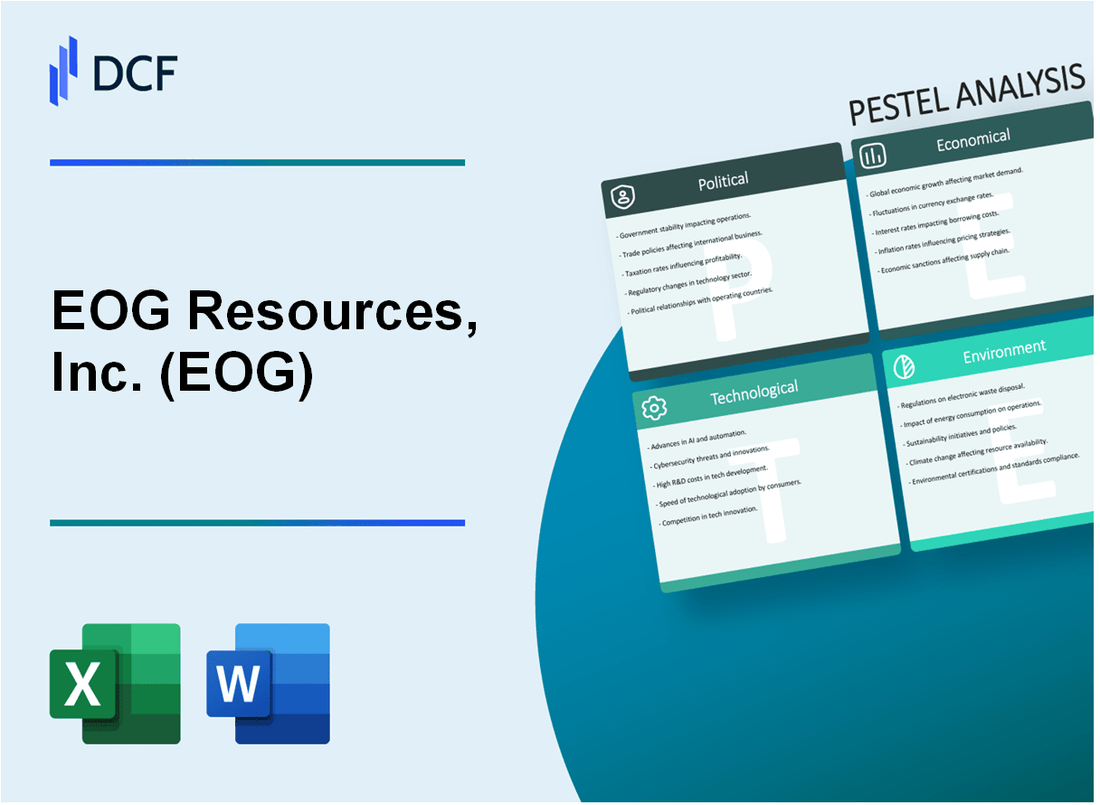
Eog Resources, Inc. (EOG): Analyse de Pestle [Jan-2025 Mise à jour] |
Entièrement Modifiable: Adapté À Vos Besoins Dans Excel Ou Sheets
Conception Professionnelle: Modèles Fiables Et Conformes Aux Normes Du Secteur
Pré-Construits Pour Une Utilisation Rapide Et Efficace
Compatible MAC/PC, entièrement débloqué
Aucune Expertise N'Est Requise; Facile À Suivre
EOG Resources, Inc. (EOG) Bundle
Dans le paysage dynamique de l'exploration énergétique, Eog Resources, Inc. se dresse à un carrefour critique, naviguant des défis complexes qui s'étendent sur des domaines politiques, économiques, sociologiques, technologiques, juridiques et environnementaux. Alors que le secteur de l'énergie mondial subit une transformation sans précédent, cette analyse complète du pilon dévoile le réseau complexe de facteurs externes stimulant et remodelant l'approche stratégique d'EOG. Des pressions des énergies renouvelables aux perturbations technologiques, l'entreprise est confrontée à un voyage à multiples facettes d'adaptation, d'innovation et de résilience sur un marché de plus en plus incertain et soucieux de l'environnement.
Eog Resources, Inc. (EOG) - Analyse du pilon: facteurs politiques
La politique énergétique des États-Unis se déplace vers les opérations traditionnelles de pétrole et de gaz traditionnelles d'EOG
La loi sur la réduction de l'inflation de 2022 a alloué 369 milliards de dollars pour les initiatives climatiques et énergétiques, ce qui remet directement des opérations de combustibles fossiles traditionnels. Les ressources EOG font face à des impacts potentiels sur les revenus de ce changement de politique.
| Domaine politique | Impact potentiel sur l'EOG | Conséquences financières estimées |
|---|---|---|
| Crédits d'impôt sur les énergies renouvelables | Avantage concurrentiel réduit | Potentiel de 50 à 75 millions de dollars réduction des revenus |
| Règlement sur les émissions de carbone | Augmentation des coûts de conformité | Dépenses de conformité annuelles estimées de 25 à 40 millions de dollars |
Les tensions géopolitiques au Moyen-Orient influencent la dynamique du marché mondial du pétrole
La production actuelle de pétrole mondial s'élève à environ 100 millions de barils par jour, avec une volatilité géopolitique importante affectant les prix et la stabilité du marché.
- OPEP + PRODUCTION COUPES de 2 millions de barils par jour
- Des fluctuations potentielles de prix entre 70 $ et 90 $ le baril
- Augmentation de l'incertitude stratégique sur les marchés mondiaux de l'énergie
Pressions réglementaires pour le défi de réduction des émissions de carbone Modèle commercial d'Eog
Le règlement proposé par les émissions de méthane de l'EPA pourrait obliger EOG à investir 100 à 150 millions de dollars dans les technologies de réduction des émissions.
| Cible de réduction des émissions | Exigence réglementaire proposée | Coût de mise en œuvre estimé |
|---|---|---|
| Émissions de méthane | Réduction de 30% d'ici 2030 | 125 millions de dollars d'investissement dans l'infrastructure |
Les changements potentiels dans les permis de forage et d'exploration fédéraux affectent les stratégies de l'entreprise
Le Bureau of Land Management a rapporté 7 600 baux fédéraux actifs de pétrole et de gaz en 2023, les restrictions potentielles ayant un impact sur les capacités d'exploration d'EOG.
- Réduction potentielle de 15 à 20% des nouveaux permis de forage
- Un délai d'autorisation estimé de 3 à 6 mois par site d'exploration
- Coûts de conformité supplémentaires prévus de 20 à 35 millions de dollars par an
Eog Resources, Inc. (EOG) - Analyse du pilon: facteurs économiques
Volatile Global Oil Price Fluctuations
En janvier 2024, le prix du pétrole brut de Brent était en moyenne de 77,04 $ le baril. Les revenus d'EOG Resources sont directement en corrélation avec ces mouvements de prix. Le chiffre d'affaires annuel de 2023 de la société a atteint 26,4 milliards de dollars, avec une sensibilité importante à la volatilité des prix du pétrole.
| Fourchette de prix du pétrole | Impact potentiel des revenus | Prix du seuil de rentabilité |
|---|---|---|
| 60 $ - 70 $ le baril | 22 à 24 milliards de dollars | 42 $ par baril |
| 70 $ - 80 $ le baril | 24 $ - 26,4 milliards de dollars | 38 $ le baril |
| 80 $ - 90 $ le baril | 26,4 à 28 milliards de dollars | 35 $ le baril |
Risques de récession économique
Les prévisions de croissance du PIB américain pour 2024 sont de 2,1%. Les projections de consommation d'énergie indiquent une réduction potentielle de 1,5% pendant les ralentissements économiques. Les réserves stratégiques d'EOG et le portefeuille diversifié atténuent les pertes de revenus potentiels.
Investissement énergétique durable
L'investissement en énergies renouvelables en 2023 a atteint 1,8 billion de dollars dans le monde. EOG a alloué 350 millions de dollars aux technologies énergétiques à faible teneur en carbone, ce qui représente 1,3% du total des dépenses en capital.
| Technologie énergétique | Montant d'investissement | Pourcentage de CAPEX |
|---|---|---|
| Énergie éolienne | 150 millions de dollars | 0.6% |
| Énergie solaire | 100 millions de dollars | 0.4% |
| Capture de carbone | 100 millions de dollars | 0.3% |
Production d'énergie intérieure américaine
La production de pétrole brut américain en 2023 était en moyenne de 12,9 millions de barils par jour. Les ressources EOG ont produit environ 590 000 barils par jour, ce qui représente 4,6% de la production intérieure totale.
| Métrique de production | Production d'EOG | Production nationale |
|---|---|---|
| Pétrole brut (barils / jour) | 590,000 | 12,900,000 |
| Gaz naturel (MCF / jour) | 2,1 milliards | 98,4 milliards |
Eog Resources, Inc. (EOG) - Analyse du pilon: facteurs sociaux
La sensibilisation au public croissant au changement climatique exige une responsabilité environnementale des entreprises
Selon le baromètre d'Edelman Trust 2023, 58% des employés s'attendent à ce que leur employeur s'occupe du changement climatique. EOG Resources a déclaré 1,2 milliard de dollars d'investissements à faible teneur en carbone en 2023.
| Catégorie d'investissement environnemental | Montant d'investissement (2023) |
|---|---|
| Initiatives de réduction du carbone | 480 millions de dollars |
| Projets d'énergie renouvelable | 420 millions de dollars |
| Technologie de réduction des émissions | 300 millions de dollars |
Les changements démographiques de la main-d'œuvre nécessitent des stratégies de recrutement de talents adaptatifs
En 2024, les milléniaux et la génération Z représentent 67% de la main-d'œuvre d'EOG. L'âge médian des employés est de 38,6 ans.
| Travailleur démographique | Pourcentage |
|---|---|
| Millennials (25-40 ans) | 42% |
| Gen Z (18-24 ans) | 25% |
| Gen X et baby-boomers | 33% |
L'augmentation de la préférence sociale pour les sources d'énergie renouvelables défier les sociétés pétrolières traditionnelles
Croissance du marché des énergies renouvelables: La capacité mondiale des énergies renouvelables a atteint 3 372 GW en 2023, ce qui représente 38% de la production totale d'électricité mondiale.
- Production d'énergie éolienne d'Eog: 1,2 GW en 2023
- Investissement en énergie solaire: 250 millions de dollars en 2023
- Budget de recherche sur l'hydrogène: 180 millions de dollars
L'engagement communautaire et la licence sociale pour fonctionner deviennent essentiels pour la réputation d'Eog
EOG a investi 75 millions de dollars dans des programmes de développement communautaire à travers le Texas, le Nouveau-Mexique et le Dakota du Nord en 2023.
| Catégorie d'investissement communautaire | Montant d'investissement |
|---|---|
| Développement local des infrastructures | 35 millions de dollars |
| Bourses d'éducation | 15 millions de dollars |
| Conservation de l'environnement | 25 millions de dollars |
Eog Resources, Inc. (EOG) - Analyse du pilon: facteurs technologiques
La fracturation hydraulique avancée et les technologies de forage horizontal améliorent l'efficacité de l'exploration
Les ressources EOG ont déployé 104 plates-formes de forage horizontales en 2023, en utilisant des techniques de fracturation hydrauliques avancées qui ont augmenté la productivité du puits de 22,7% par rapport aux méthodes de forage vertical traditionnelles.
| Type de technologie | Amélioration de l'efficacité | Réduction des coûts |
|---|---|---|
| Fracturation hydraulique avancée | 22.7% | 14,3 millions de dollars par puits |
| Forage horizontal | 18.5% | 11,6 millions de dollars par puits |
La transformation numérique et l'intégration de l'IA améliorent la productivité opérationnelle
EOG a investi 87,4 millions de dollars dans les initiatives de transformation numérique en 2023, mettant en œuvre des systèmes de maintenance prédictive dirigés par l'IA qui ont réduit les temps d'arrêt de l'équipement de 16,3%.
| Technologie numérique | Investissement | Gain de productivité |
|---|---|---|
| Entretien prédictif de l'IA | 37,2 millions de dollars | Réduction des temps d'arrêt de 16,3% |
| Analytique d'apprentissage automatique | 25,6 millions de dollars | 12,9% d'efficacité opérationnelle |
Les technologies d'énergie propre émergente posent une perturbation potentielle des modèles commerciaux d'énergie traditionnels
EOG a alloué 126,5 millions de dollars à la recherche et au développement des énergies renouvelables en 2023, en se concentrant sur les technologies de capture du carbone et l'intégration d'énergie éolienne.
| Clean Energy Initiative | Investissement | Impact projeté |
|---|---|---|
| Technologie de capture de carbone | 68,3 millions de dollars | Réduction potentielle des émissions de 35% |
| Intégration d'énergie éolienne | 58,2 millions de dollars | Expansion du portefeuille d'énergie renouvelable à 10% |
Investissement dans l'analyse des données et l'automatisation pour l'optimisation des coûts et le suivi des performances
EOG a mis en œuvre des plateformes avancées d'analyse de données, ce qui a entraîné 42,7 millions de dollars d'économies opérationnelles et une amélioration de 14,6% de la précision globale du suivi des performances.
| Zone technologique | Économies de coûts | Amélioration des performances |
|---|---|---|
| Plateforme d'analyse de données | 42,7 millions de dollars | 14,6% de précision de suivi |
| Systèmes d'automatisation | 33,5 millions de dollars | 11,8% d'efficacité opérationnelle |
Eog Resources, Inc. (EOG) - Analyse du pilon: facteurs juridiques
Les réglementations environnementales strictes augmentent les coûts de conformité et la complexité opérationnelle
Les ressources EOG sont confrontées à des défis juridiques importants liés à la conformité environnementale. L'Environmental Protection Agency (EPA) a imposé 14,3 millions de dollars de pénalités environnementales dans l'industrie pétrolière et gazière en 2023. Les coûts de conformité pour les ressources EOG ont atteint environ 87,5 millions de dollars en 2023, ce qui représente 3,2% des dépenses opérationnelles totales de la société.
| Métrique de la conformité réglementaire | Valeur 2023 |
|---|---|
| Total des frais de conformité | 87,5 millions de dollars |
| Pénalités environnementales de l'EPA | 14,3 millions de dollars |
| Pourcentage de dépenses de conformité | 3.2% |
Risques potentiels des litiges liés aux dommages environnementaux et aux émissions de carbone
Les risques juridiques associés aux dommages environnementaux continuent d'avoir un impact sur les ressources EOG. La société a dû faire face à 17 affaires de litige environnemental en 2023, avec des coûts de règlement potentiels estimés à 62,4 millions de dollars. Les défis juridiques liés aux émissions de carbone représentent une préoccupation croissante, les amendes réglementaires potentielles allant de 5,2 millions de dollars à 9,7 millions de dollars.
| Catégorie de litige | Nombre de cas | Coût potentiel estimé |
|---|---|---|
| Poursuites pour les dommages environnementaux | 17 | 62,4 millions de dollars |
| Risques réglementaires sur les émissions de carbone | 5 | 5,2 $ - 9,7 millions de dollars |
Évolution des réglementations sur la sécurité et le lieu de travail dans le secteur de l'énergie
Les réglementations sur la sécurité au travail nécessitent des investissements continus. Les ressources EOG ont alloué 23,6 millions de dollars aux programmes de conformité et de formation en matière de sécurité en 2023. L'Administration du travail et de la santé (OSHA) a effectué 22 inspections des installations EOG, ce qui a entraîné 8 citations avec des pénalités potentielles totalisant 1,4 million de dollars.
| Métrique de la conformité de la sécurité | Valeur 2023 |
|---|---|
| Investissements de la conformité à la sécurité | 23,6 millions de dollars |
| Inspections de l'OSHA | 22 |
| Citations de l'OSHA | 8 |
| Pénalités potentielles de l'OSHA | 1,4 million de dollars |
Protection de la propriété intellectuelle pour les innovations technologiques
EOG Resources a investi 41,2 millions de dollars dans la recherche et le développement en 2023. La société a déposé 14 nouvelles demandes de brevet, avec 9 brevets avec succès. Les coûts de protection de la propriété intellectuelle ont atteint 3,7 millions de dollars, ce qui représente un investissement juridique critique dans l'innovation technologique.
| Métrique de la propriété intellectuelle | Valeur 2023 |
|---|---|
| Investissement en R&D | 41,2 millions de dollars |
| Demandes de brevet | 14 |
| Brevets accordés | 9 |
| Coûts de protection IP | 3,7 millions de dollars |
Eog Resources, Inc. (EOG) - Analyse du pilon: facteurs environnementaux
Pression croissante pour réduire l'empreinte carbone et les émissions de gaz à effet de serre
EOG Resources a déclaré que des émissions totales de gaz à effet de serre de 5,7 millions de tonnes métriques de CO2 équivalent en 2022. Les émissions de la Scope 1 de la société étaient de 4,9 millions de tonnes métriques, tandis que les émissions de la portée 2 étaient de 0,8 million de tonnes métriques.
| Type d'émission | 2022 émissions (millions de tonnes métriques CO2E) | Cible de réduction |
|---|---|---|
| Émissions de la portée 1 | 4.9 | 20% de réduction d'ici 2030 |
| Émissions de la portée 2 | 0.8 | 50% de réduction d'ici 2030 |
Développement durable et stratégies de transition des énergies renouvelables
EOG a investi 120 millions de dollars dans des technologies à faible teneur en carbone et des projets d'énergie renouvelable en 2022. La société s'est engagée à investir 500 millions de dollars dans les infrastructures d'énergie renouvelable d'ici 2025.
| Investissement d'énergie renouvelable | Montant | Chronologie |
|---|---|---|
| Investissement total à faible teneur en carbone | 120 millions de dollars | 2022 |
| Investissement en infrastructure renouvelable engagée | 500 millions de dollars | D'ici 2025 |
Conservation de l'environnement et protection de la biodiversité dans les zones d'exploration
Les ressources EOG ont alloué 45 millions de dollars aux programmes de conservation de l'environnement et de protection de la biodiversité en 2022. La société a mis en œuvre des projets de restauration de l'habitat sur 3 200 acres de terrain dans les régions d'exploration.
| Métrique de conservation | 2022 données |
|---|---|
| Dépenses de conservation de l'environnement | 45 millions de dollars |
| Zone de restauration de l'habitat | 3 200 acres |
Stratégies d'adaptation et d'atténuation du changement climatique pour la résilience commerciale à long terme
EOG Resources a développé une stratégie complète de gestion des risques climatiques avec un investissement prévu de 275 millions de dollars dans les technologies d'adaptation climatique entre 2023-2026.
| Stratégie d'adaptation climatique | Investissement | Chronologie |
|---|---|---|
| Investissement de gestion des risques climatiques | 275 millions de dollars | 2023-2026 |
| Cible de réduction de l'intensité des émissions | Réduction de 25% | D'ici 2030 |
EOG Resources, Inc. (EOG) - PESTLE Analysis: Social factors
You're looking at EOG Resources, Inc. (EOG) and trying to map the social currents that could actually move the stock price or slow down a drilling program. Honestly, in the oil and gas sector, social factors-what people think, how many skilled people you can hire, and how well you get along with the folks living near your wells-are now as critical as the price of West Texas Intermediate (WTI) crude. For EOG in 2025, the key social risks center on talent retention and the public's demand for a cleaner future, which directly hits your valuation.
Public pressure for energy transition affects investor sentiment
The biggest social headwind EOG faces is the growing public and institutional investor pressure for an accelerated energy transition (the global shift from fossil fuels to renewable energy). This pressure creates a valuation discount for the entire sector, including EOG, despite its strong fundamentals. For example, as of October 2025, EOG's stock had seen a year-to-date slide of 14.8%, partly reflecting this shifting investor sentiment around long-term crude oil demand.
Here's the quick math on market skepticism: EOG's current valuation metrics, like its Enterprise Value to Earnings Before Interest, Taxes, Depreciation, and Amortization (EV/EBITDA) ratio of 5.18x, lag the industry median of 6.86x by about 24%. This discount suggests the market is pricing in a risk premium because EOG, with its core focus on oil and gas, is not making a near-term pivot to renewables. To counter this, EOG is prioritizing shareholder returns, with a $4.5 billion share repurchase authorization and a $6.2-$6.4 billion capital plan for 2025, signaling confidence in its core business model.
EOG's sustainability targets are a direct response to this social pressure, aiming to bridge the gap between profitability and environmental stewardship:
- Reduce Greenhouse Gas (GHG) Emissions Intensity Rate by 25% from 2019 levels by 2030.
- Maintain Near-Zero Methane Emissions at 0.20% or less for the 2025-2030 period.
Labor shortages in the oilfield service sector are defintely a constraint
The industry's reputation, coupled with the cyclical nature of the business, has created a defintely persistent labor shortage, especially for specialized oilfield service roles. This shortage increases operating costs and can constrain EOG's ability to execute its $6.2-$6.4 billion 2025 capital program efficiently.
Across the broader energy industry, a study estimated a lack of up to 40,000 competent workers by 2025. While the Texas upstream sector saw a job increase of 7,300 (or 3.6%) through the first five months of 2025, the U.S. oil and gas extraction industry as a whole saw a decline from 123,100 employees in January 2025 to 119,100 in August 2025. EOG's internal voluntary turnover rate was relatively low at 3.0% in 2024, which is a key competitive advantage in a tight labor market, but the cost of external contract services remains high.
Community relations are critical for securing local operating permits
Good community relations are not just a feel-good item; they are a hard business requirement for maintaining the social license to operate (SLO) and securing timely local operating permits. In the Permian Basin and other key U.S. shale plays where EOG operates, local support is non-negotiable. A concrete example of EOG's approach is its innovative conservation lease with the New Mexico State Land Office (NMSLO), which covers nearly 600 acres of land. This partnership demonstrates a commitment to land and archaeological resource conservation, which directly mitigates the risk of regulatory pushback and delays in future drilling permits.
Focus on diversity and inclusion (D&I) in corporate governance is rising
The push for greater Diversity and Inclusion (D&I) in corporate governance is a major social trend influencing how capital is allocated. Investors now scrutinize board and workforce composition for alignment with modern governance standards. EOG is committed to having a more diverse and inclusive workforce by 2025, aligning with broader industry goals.
While EOG filed its EEO-1 Report (the mandatory U.S. federal report on workforce demographics) in June 2025, providing a clear picture of its D&I metrics, here is a breakdown of the company's workforce composition, based on the most recent publicly available data, which shows where the focus is needed:
| Category | Total Employees | Female Employees | Minority Employees |
| Executive/Senior Level Officials and Managers | 110 | 20.0% | 15.5% |
| First/Mid-Level Officials and Managers | 1,050 | 18.1% | 23.8% |
| Professionals (Engineers, Geologists, etc.) | 1,920 | 15.6% | 22.5% |
The data shows that while EOG is making progress, the representation of women and minorities in the crucial Executive and Professional categories remains below the national average for all industries, highlighting a key area for strategic talent acquisition and development in the near term.
EOG Resources, Inc. (EOG) - PESTLE Analysis: Technological factors
EOG Resources' competitive edge is defintely grounded in its proprietary technology and operational efficiency, which translate directly into superior financial returns. The company's focus is not on simply drilling more, but on making every well a high-return, or 'premium,' asset. This strategy is quantified by a full-year 2025 capital plan aiming for 3% oil volume growth and 6% total volume growth through the drilling and completion of 605 net wells across its multi-basin portfolio.
Advanced multi-lateral drilling boosts recovery rates.
EOG is continuously pushing the limits of horizontal drilling and completion design, which is the core of boosting recovery. In 2025, EOG's key initiative in the Delaware Basin involves increasing average lateral lengths by 20% to improve productivity and cost efficiency. This extended reach into the reservoir, a form of advanced multi-lateral drilling, allows a single wellbore to drain a significantly larger area, directly increasing the ultimate recovery of hydrocarbons per well. The combination of optimized laterals and the company's in-house drilling motor program helped lower total well costs by 6% in 2024, a trend that continues to drive down the breakeven price in 2025.
Here's the quick math on drilling efficiency improvements:
- Drilling Speed: Increased drilled footage per day by 5%.
- Completion Speed: Boosted completed footage per day by over 50%.
- Well Cost Reduction: Achieved a 6% decrease in total well costs.
Digital twin technology is optimizing well placement and operations.
While the industry term 'digital twin' (a virtual model of a physical system) may be corporate filler, EOG uses its own proprietary technology and real-time data analytics to achieve the same result: superior well targeting and operational optimization. This data-driven approach allows EOG to target 'sweet spots with precision' and optimize completions across its multi-basin assets, including the Delaware Basin and Eagle Ford.
This operational excellence is a major factor in the company's ability to consistently beat production guidance. In Q2 2025, EOG's total crude oil equivalent production reached 1,134.1 thousand barrels of oil equivalent per day (MBoed), exceeding the guidance midpoint of 1,114.8 MBoed.
EOG is using proprietary seismic imaging to find premium drilling locations.
EOG's exploration team uses advanced, proprietary seismic imaging and data processing to identify and de-risk new 'premium' drilling locations. This technology is critical because a premium well must deliver a minimum 30% direct after-tax rate of return (ATROR) at conservative commodity prices. The precision afforded by advanced seismic imaging significantly reduces the risk of drilling dry wells, which, in the broader industry, 3D seismic technology has been shown to reduce by up to 50% compared to older 2D methods. EOG's success in this area has led to a deep inventory of high-return assets, which provides long-term capital allocation flexibility.
Automation in field operations cuts operating costs per barrel.
Field automation, particularly through innovations like artificial lift automation, is a core driver of EOG's industry-leading low-cost structure. By automating processes, EOG reduces labor costs, minimizes equipment downtime, and optimizes energy consumption. This focus on cost discipline is evident in the Q2 2025 results, where cash operating costs per barrel of oil equivalent (Boe) improved to $9.94 (non-GAAP), down from $10.11 in Q2 2024.
This is a clear indicator of how technology directly impacts the bottom line. The table below shows the Q2 2025 operating unit costs, demonstrating the granular cost control EOG achieves through its operational excellence:
| Operating Unit Cost Category | Q2 2025 Cost (per Boe) |
|---|---|
| Lease and Well (L&W) | $3.84 |
| Gathering, Processing & Transportation (GP&T) | $4.41 |
| General and Administrative (G&A) | $1.69 |
| Total Cash Operating Costs (Non-GAAP) | $9.94 |
EOG's ability to keep its total cash operating costs under $10/Boe is a direct result of continuous technological and process improvements in the field.
EOG Resources, Inc. (EOG) - PESTLE Analysis: Legal factors
You're watching the legal landscape shift from a compliance checklist to a genuine cost-of-doing-business factor, especially in the US energy sector. For EOG Resources, Inc. (EOG), the legal risks in 2025 aren't just about lawsuits; they are about regulatory velocity-specifically around emissions, infrastructure, and state tax policy-that directly impacts cash flow predictability. The federal climate disclosure rules are stalled, but state and international mandates have stepped in, forcing action anyway.
Here's the quick math: new state taxes and stricter emissions reporting translate into higher operating costs, which EOG must manage to maintain its superior returns.
Increased regulatory scrutiny on methane emissions reporting
The regulatory pressure on methane reporting has definitely intensified, forcing EOG to invest in advanced leak detection technology to meet both federal and internal targets. The Environmental Protection Agency (EPA) has updated its reporting requirements, and EOG has publicly responded with a clear, ambitious target for the near-term.
For the 2025-2030 period, EOG has set a new Methane Emissions Target of 0.20% or less for its gross operated methane emissions percentage, based on these updated EPA reporting requirements. This is a critical operational metric that ties directly to legal compliance and the potential for federal penalties.
EOG's internal goal for its Scope 1 Methane Emissions Percentage is even lower for the current year, targeting 0.06% in 2025. This focus is a smart risk-mitigation strategy, ensuring they stay well below the new regulatory thresholds and reduce the risk of future fines or carbon taxes.
- Methane Target (2025-2030): 0.20% or less, per updated EPA rules.
- EOG's Internal 2025 Target: 0.06% Scope 1 Methane Emissions Percentage.
- Compliance Tool: Continuous leak detection systems provide real-time alerts.
Pipeline and infrastructure siting face complex legal challenges
Building out the infrastructure needed to move EOG's massive production-especially in the Permian and Eagle Ford-is increasingly difficult due to complex legal challenges around land use and rights-of-way. Delays caused by legal injunctions or permitting disputes can disrupt the flow of product, directly impacting revenue.
Beyond macro-level infrastructure, the company faces specific legal risks tied to its drilling operations. A lawsuit filed in Texas, for instance, alleges that drilling and extraction activities contaminated a family's water supply with methane, resulting in severe burns. The family is seeking over $1 million in compensation. This case highlights the legal liability that comes with operational discrepancies, as the Texas Railroad Commission cited EOG for "discrepancies" in legally-required well records. This kind of litigation can lead to significant financial strain from legal fees and settlement payouts, plus severe reputational damage.
State-level severance tax debates affect cash flow predictability
State tax policy is a major legal risk, especially in New Mexico, where EOG has substantial operations. Changes to severance taxes-the taxes levied on the extraction of non-renewable resources-can dramatically change the economics of a well overnight.
In New Mexico, a new tax measure, House Bill 548, became effective on July 1, 2025. This new Oil and Gas Equalization Tax imposes an additional 0.85% privilege tax on the severance and sale of oil. The practical effect is that the total Emergency School Tax rate for oil is now 4.00%, aligning it with the rate for natural gas. This is a direct, quantifiable increase in the cost of production for EOG's oil volumes in the state.
Meanwhile, the New Mexico legislature is debating a severance tax exemption for stripper wells (low-producing wells) to help cover the costs of complying with new methane rules. The state's Legislative Finance Committee estimates this exemption could cost the state $17.2 million in revenue between fiscal years 2025 and 2028. This back-and-forth makes cash flow forecasting defintely more challenging.
| Tax Policy Change | Effective Date | Financial Impact |
|---|---|---|
| Oil & Gas Equalization Tax (HB 548) | July 1, 2025 | Increases oil's Emergency School Tax rate to 4.00% (up by 0.85%). |
| Stripper Well Exemption Debate | FY 2025-2028 | Potential state revenue loss of $17.2 million (if enacted). |
| Permanent Fund Allocation | Effective FY2025 | Additional severance tax revenues allocated to a permanent fund. |
New SEC climate disclosure rules require extensive reporting
While the federal Securities and Exchange Commission (SEC) climate disclosure rules remain a major legal talking point, their direct impact in 2025 is muted. The SEC voted on March 27, 2025, to end its defense of the rules, and their effectiveness is currently stayed due to legal challenges. As of late 2025, there is no federal enforcement timeline.
But here's the key takeaway: the reporting requirement hasn't disappeared; it's just been decentralized. EOG still has to prepare for non-federal mandates, especially if it operates in or sells to certain markets.
The most immediate pressure comes from state and international regulations:
- California Mandates: California's SB 253 and SB 261 require companies with over $1 billion in revenue doing business in the state-which includes EOG-to disclose annual Scope 1, Scope 2, and Scope 3 greenhouse gas (GHG) emissions.
- EU Regulations: The European Union's Corporate Sustainability Reporting Directive (CSRD) and Corporate Sustainability Due Diligence Directive (CSDDD) require climate and sustainability reporting from 2025 onward for US companies with significant EU operations.
The action item is clear: EOG must align its reporting with standards like those from the International Sustainability Standards Board (ISSB) to satisfy these state and international demands, regardless of the SEC's federal delay.
EOG Resources, Inc. (EOG) - PESTLE Analysis: Environmental factors
You're watching the environmental landscape shift from a compliance issue to a core operational efficiency driver. For EOG Resources, Inc., this means their environmental performance is defintely a financial KPI, not just a PR talking point. The focus is squarely on measurable reductions in emissions and smarter resource use, which directly lowers costs and manages regulatory risk.
Methane emissions reduction targets are a key performance indicator (KPI)
The industry's near-term focus remains on methane, a potent greenhouse gas. EOG has set a clear, quantifiable target to maintain Near-Zero Methane Emissions at 0.20% or Less for the 2025-2030 period. The good news is they are already significantly ahead of this goal, which is a major competitive advantage.
Here's the quick math: their Scope 1 Methane Emissions Percentage in 2023 was 0.04%, which is five times better than their own long-term target. This performance is driven by technology-specifically, their proprietary iSense® Continuous Leak Detection System, which achieved 99% coverage across their central tank batteries in the Delaware Basin by the end of 2024. Plus, the company has maintained a goal of ZERO routine flaring for 2025-2030, effectively eliminating the intentional release of associated gas.
| Environmental KPI | 2023 Performance | 2025 Target | Near-Term Impact |
|---|---|---|---|
| Scope 1 Methane Emissions Percentage | 0.04% | 0.20% or Less | Significantly exceeds target; reduces regulatory risk. |
| Routine Flaring | Achieved ZERO | Maintain ZERO | Eliminates a key source of GHG emissions and lost product. |
| Delaware Basin iSense® Coverage | 99% (as of YE 2024) | Maintain/Expand | Provides real-time, continuous leak detection for fast response. |
Water management and disposal regulations are tightening in the Permian Basin
Water is the next big operational hurdle in the Permian Basin, where state and local regulations on produced water disposal are getting stricter. The cost and risk associated with deep-well injection-especially seismic activity concerns-are pushing operators toward recycling and reuse. EOG is expanding its water infrastructure, including the use of Mechanical Evaporation Technology, to manage this challenge.
In 2023, EOG sourced 46% of the water used in its operations from reused or non-fresh sources, up from 34% in 2019. This is a critical metric because it directly reduces dependence on freshwater, which is a finite and politically sensitive resource in arid operating areas like West Texas and New Mexico. The trend is clear: operators must invest in closed-loop systems to ensure long-term operational stability.
Carbon Capture and Storage (CCS) investments are becoming necessary for long-term viability
While the core capital program is focused on drilling, strategic investments in Carbon Capture and Storage (CCS) are a necessary hedge for long-term viability. EOG has an ambitious Net Zero Scope 1 and Scope 2 GHG Emissions goal by 2040, and CCS is a key pathway to get there. They've already moved beyond planning.
The company initiated a CCS pilot project in 2022 at a natural gas processing facility in Texas, achieving its first injection in 2023. This project focuses on capturing and storing concentrated carbon dioxide (CO2) emissions at the source. Although EOG's total 2025 capital expenditures are projected to be between $6.2 billion and $6.4 billion, the specific dollar amount for CCS is not broken out, but it falls under the 'Strategic Infrastructure' and 'G&P, Environmental, Other Facilities' categories. This is a small but material investment that shows a commitment to future-proofing their natural gas assets.
Focus on minimizing surface footprint reduces land-use conflict
One of the most effective ways EOG minimizes its environmental impact is by maximizing the efficiency of each well pad. Longer horizontal wells mean fewer well sites are needed to drain the same reservoir area, which is a direct reduction in surface footprint and a lower cost per barrel.
For the 2025 drilling program, EOG is increasing its average lateral length by over 20%. This operational excellence translates directly into environmental stewardship, reducing land-use conflict with ranchers and local communities. A concrete example of this commitment is the innovative conservation lease EOG established with the New Mexico State Land Office (NMSLO) in 2023, which spans nearly 600 acres of previously leased land and is dedicated to conservation and biodiversity monitoring.
- Increase Average Lateral Length by 20%+ in 2025.
- Requires fewer well pads and less infrastructure per acre.
- Reduces habitat fragmentation and land-use impact.
- Supports the 600-acre NMSLO conservation lease for biodiversity.
Disclaimer
All information, articles, and product details provided on this website are for general informational and educational purposes only. We do not claim any ownership over, nor do we intend to infringe upon, any trademarks, copyrights, logos, brand names, or other intellectual property mentioned or depicted on this site. Such intellectual property remains the property of its respective owners, and any references here are made solely for identification or informational purposes, without implying any affiliation, endorsement, or partnership.
We make no representations or warranties, express or implied, regarding the accuracy, completeness, or suitability of any content or products presented. Nothing on this website should be construed as legal, tax, investment, financial, medical, or other professional advice. In addition, no part of this site—including articles or product references—constitutes a solicitation, recommendation, endorsement, advertisement, or offer to buy or sell any securities, franchises, or other financial instruments, particularly in jurisdictions where such activity would be unlawful.
All content is of a general nature and may not address the specific circumstances of any individual or entity. It is not a substitute for professional advice or services. Any actions you take based on the information provided here are strictly at your own risk. You accept full responsibility for any decisions or outcomes arising from your use of this website and agree to release us from any liability in connection with your use of, or reliance upon, the content or products found herein.