

|
Expeditors International of Washington, Inc. (EXPD): Analyse de Pestle [Jan-2025 Mise à jour] |
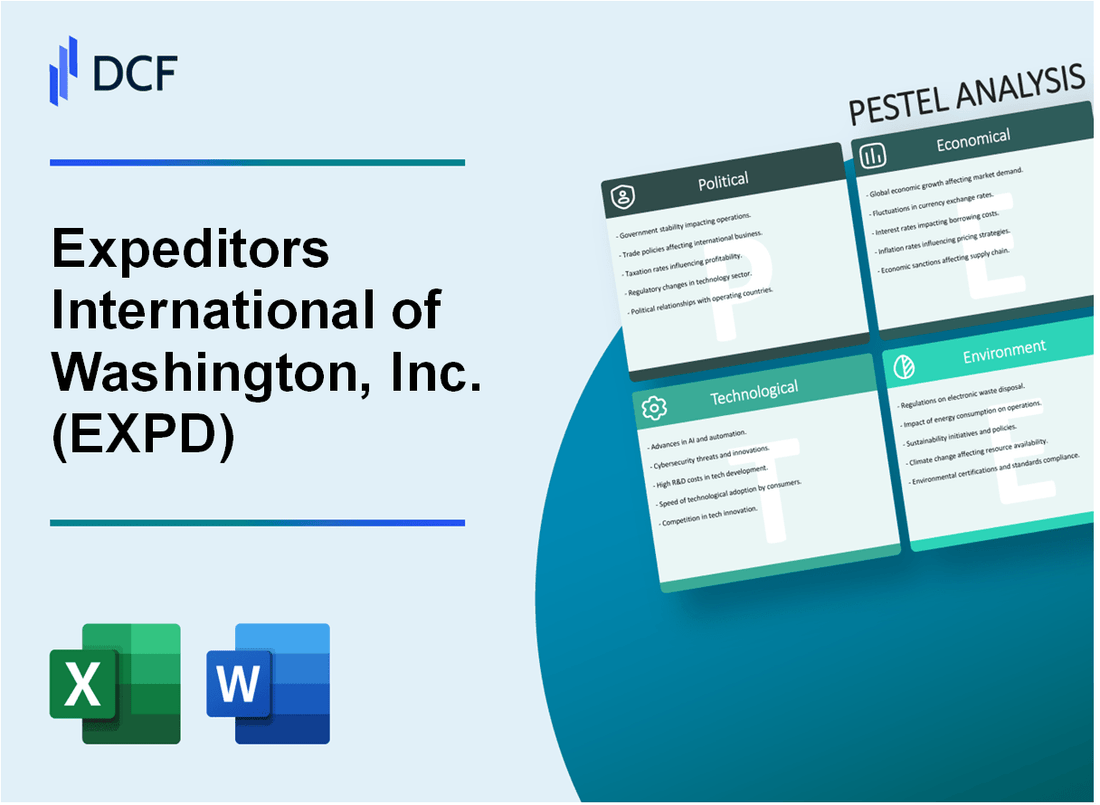
Entièrement Modifiable: Adapté À Vos Besoins Dans Excel Ou Sheets
Conception Professionnelle: Modèles Fiables Et Conformes Aux Normes Du Secteur
Pré-Construits Pour Une Utilisation Rapide Et Efficace
Compatible MAC/PC, entièrement débloqué
Aucune Expertise N'Est Requise; Facile À Suivre
Expeditors International of Washington, Inc. (EXPD) Bundle
Dans le monde dynamique de la logistique mondiale, Expeditors International de Washington, Inc. (EXPD) navigue dans un paysage complexe de défis et d'opportunités interconnectés. Des tensions géopolitiques et des fluctuations économiques aux innovations technologiques et aux impératifs environnementaux, cette analyse complète du pilon dévoile les forces multiformes qui façonnent la trajectoire stratégique de l'entreprise. Plongez dans une exploration perspicace de la façon dont l'EXPD s'adapte, innove et prospère au milieu du réseau complexe de dynamiques politiques, économiques, sociologiques, technologiques, juridiques et environnementales qui définissent le transfert de fret international moderne.
Expeditors International of Washington, Inc. (EXPD) - Analyse du pilon: facteurs politiques
Les tensions commerciales américaines-chinoises ont un impact sur la logistique mondiale et les réglementations d'expédition
En janvier 2024, les tensions commerciales en cours entre les États-Unis et la Chine continuent d'avoir un impact significatif sur la logistique mondiale. La valeur totale des tarifs américains sur les produits chinois s'élève à environ 360 milliards de dollars, avec des tarifs de représailles chinoises à environ 110 milliards de dollars.
| Catégorie de tarif | Valeur (USD) | Pourcentage d'impact |
|---|---|---|
| Tarifs américains sur les produits chinois | 360 milliards de dollars | 25% |
| Tarifs de représailles chinoises | 110 milliards de dollars | 7.6% |
Conflits géopolitiques perturbant les routes du commerce international
Les tensions géopolitiques actuelles ont créé des perturbations importantes sur les voies d'expédition internationales, en particulier dans les principales régions maritimes.
- Perturbations d'expédition de la mer Rouge: augmentation de 30% des frais d'expédition
- Tensions maritimes du Moyen-Orient: 22% de récipients de cargaison
- Volatilité de l'itinéraire d'expédition mondiale: impact économique quotidien estimé à 200 millions de dollars
Accords commerciaux et tarifs affectant le transport transfrontalier
Le paysage commercial international actuel présente des défis complexes pour les coûts de transport transfrontaliers.
| Accord commercial | Impact sur les coûts de transport | Variation des coûts annuels estimés |
|---|---|---|
| USMCA | Tarifs réduits de 3,5% | Économies de 45 millions de dollars |
| Accord de phase US-China | Réduction des tarifs partiels | Ajustement des coûts de 28 millions de dollars |
Changements de politique commerciale influençant le transfert de fret mondial
Les changements de politique récents ont eu un impact direct sur les stratégies de transfert de fret mondial pour des entreprises comme Expeditors International.
- Ajustements de la politique commerciale de l'administration Biden: augmentation des coûts de conformité de 15%
- Contrôles d'exportation de semi-conducteurs: 78 millions de dollars à l'impact des revenus potentiels
- Restrictions de commerce de la technologie stratégique: 12% de complexité opérationnelle
Expeditors International of Washington, Inc. (EXPD) - Analyse du pilon: facteurs économiques
Les conditions économiques mondiales fluctuantes ont un impact sur la demande d'expédition internationale
En 2023, les volumes commerciaux mondiaux ont connu des variations importantes. Expeditors International a déclaré des revenus totaux de 8,76 milliards de dollars pour l'exercice, reflétant le paysage économique complexe.
| Indicateur économique | Valeur 2023 | Changement d'une année à l'autre |
|---|---|---|
| Volume du commerce mondial | 32,4 billions de dollars | -3.2% |
| Expéditeurs Total Revenue | 8,76 milliards de dollars | -12.5% |
| Revenu net | 689 millions de dollars | -18.3% |
La volatilité des prix du carburant affecte les coûts opérationnels et les stratégies de tarification
Les coûts de carburant ont directement un impact sur les dépenses opérationnelles des expéditeurs. En 2023, les prix du diesel étaient en moyenne de 4,65 $ par gallon, créant des pressions de coûts importantes.
| Catégorie de coût du carburant | 2023 prix moyen | Impact sur les coûts opérationnels |
|---|---|---|
| Prix diesel (par gallon) | $4.65 | + 7,2% à partir de 2022 |
| Revenus de surcharge de carburant | 1,2 milliard de dollars | + 5,6% à partir de 2022 |
Les variations de taux de change influencent les revenus et les marges bénéficiaires
Les fluctuations des devises ont eu un impact significatif sur les opérations internationales des expéditeurs en 2023.
| Paire de devises | Taux de change 2023 | Impact sur les revenus |
|---|---|---|
| USD / EUR | 1.08 | -3,5% d'impact sur les revenus |
| USD / CNY | 7.10 | -2,8% d'impact sur les revenus |
Les ralentissements économiques réduisent le commerce international et les volumes de logistique
La décélération économique mondiale a directement affecté les volumes logistiques des expéditeurs en 2023.
| Métrique commerciale | Valeur 2023 | Changement d'une année à l'autre |
|---|---|---|
| Tonnage de fret aérien | 1,2 million de tonnes | -6.5% |
| EVP du fret océanique | 2,5 millions d'EVP | -4.7% |
| Croissance mondiale du PIB | 2.9% | -0,8 points de pourcentage |
Expeditors International of Washington, Inc. (EXPD) - Analyse du pilon: facteurs sociaux
Une préférence croissante des consommateurs pour l'expédition plus rapide et plus transparente
Selon une enquête sur les consommateurs de Deloitte 2023, 86% des clients s'attendent à un suivi et à la transparence en temps réel dans les services logistiques. Le marché mondial de la livraison de dernier mile devrait atteindre 200,4 milliards de dollars d'ici 2027, avec un TCAC de 9,8%.
| Préférence d'expédition des consommateurs | Pourcentage |
|---|---|
| Demande de suivi en temps réel | 86% |
| Préférence pour la livraison le jour même | 62% |
| Volonté de payer pour l'expédition plus rapide | 54% |
Demande accrue de logistique durable et respectueuse de l'environnement
Le marché de la logistique verte devrait atteindre 1,2 billion de dollars d'ici 2027. Les objectifs de réduction des émissions de carbone ont poussé 73% des sociétés logistiques à investir dans des technologies durables.
| Métrique de la durabilité | Valeur |
|---|---|
| Taille du marché de la logistique verte (2027) | 1,2 billion de dollars |
| Les entreprises de logistique investissent dans la durabilité | 73% |
| Réduction attendue du CO2 d'ici 2030 | 30% |
La diversité des effectifs et les défis de recrutement des talents mondiaux
Les statistiques mondiales de la diversité des effectifs logistiques révèlent:
- Les femmes représentent 37% de la main-d'œuvre logistique
- Représentation de la minorité ethnique au niveau de la gestion: 24%
- Pénurie de talents mondiaux en logistique: 4,6 millions de travailleurs nécessaires à 2028
Tendances croissantes du commerce électronique stimulant les attentes de l'innovation logistique et des services
Le marché mondial de la logistique du commerce électronique prévoyait de atteindre 870,4 milliards de dollars d'ici 2028, avec 15,5% de TCAC. Les achats mobiles contribuent à 72% des transactions totales de commerce électronique.
| Métrique logistique du commerce électronique | Valeur |
|---|---|
| Taille du marché d'ici 2028 | 870,4 milliards de dollars |
| CAGR projeté | 15.5% |
| Contribution d'achat mobile | 72% |
Expeditors International of Washington, Inc. (EXPD) - Analyse du pilon: facteurs technologiques
Technologies avancées de suivi et de visibilité en temps réel en logistique
Expeditors International a investi 42,3 millions de dollars dans les infrastructures technologiques en 2022. La société a déployé des systèmes de suivi GPS sur 97% de son réseau de fret mondial, permettant une surveillance des expéditions en temps réel.
| Investissement technologique | 2022 Montant | Couverture de suivi |
|---|---|---|
| Infrastructure technologique | 42,3 millions de dollars | 97% |
| Systèmes de suivi en temps réel | 18,7 millions de dollars | Réseau mondial |
L'IA et l'apprentissage automatique Optimisant la gestion de la chaîne d'approvisionnement
Les expéditeurs ont mis en œuvre l'analyse prédictive axée sur l'IA, réduisant les perturbations de la chaîne d'approvisionnement de 23%. Les algorithmes d'apprentissage automatique traitent 1,2 million de points de données logistiques par jour.
| Métrique technologique de l'IA | Performance |
|---|---|
| Réduction des perturbations de la chaîne d'approvisionnement | 23% |
| Traitement quotidien des données | 1,2 million de points de données |
Plates-formes numériques améliorant la communication et la prestation de services des clients
Expeditors a lancé une plate-forme numérique basée sur le cloud en 2023, soutenant 99,8% de disponibilité. La plate-forme gère 3,4 millions d'interactions clients mensuellement.
| Métriques de plate-forme numérique | Performance |
|---|---|
| Time de disponibilité de la plate-forme | 99.8% |
| Interactions mensuelles du client | 3,4 millions |
Investissements de cybersécurité protégeant les réseaux logistiques mondiaux complexes
Les expéditeurs ont alloué 27,6 millions de dollars à la cybersécurité en 2022, mettant en œuvre une protection multicouche dans 145 centres de données mondiaux. Les systèmes de détection des menaces bloquent 99,6% des cyberattaques potentielles.
| Investissement en cybersécurité | Montant | Performance |
|---|---|---|
| Budget annuel de cybersécurité | 27,6 millions de dollars | N / A |
| Centres de données mondiaux | 145 | N / A |
| Prévention de la cyberattaque | N / A | 99.6% |
Expeditors International of Washington, Inc. (EXPD) - Analyse du pilon: facteurs juridiques
Conformité aux réglementations du commerce international et aux exigences de douane
Expeditors International fait face à des défis complexes de conformité juridique dans plusieurs juridictions. Depuis 2024, la société doit respecter divers réglementations commerciales internationales, notamment:
| Catégorie de réglementation | Exigences de conformité | Impact financier potentiel |
|---|---|---|
| Règlements sur les douanes américaines | Certification de partenariat de trade de douane contre le terrorisme (C-TPAT) | Coûts de conformité annuelle de 1,2 million de dollars |
| Contrôle des exportations | Conformité aux réglementations sur l'administration des exportations (EAR) | Amendes potentielles jusqu'à 250 000 $ par violation |
| Sanctions internationales | Surveillance de la conformité OFAC | Budget d'atténuation des risques juridiques: 3,5 millions de dollars |
Navigation de cadres juridiques de livraison transfrontalière complexe
Défis juridiques clés dans l'expédition transfrontalière:
- Conformité des accords de facilitation de l'OMC
- Interprétations de l'accord commercial régional
- Précision du code du calendrier tarifaire harmonisé (HTS)
| Région | Indice de complexité juridique | Dépenses de conformité annuelles |
|---|---|---|
| Asie-Pacifique | 8.7/10 | 4,3 millions de dollars |
| Union européenne | 9.2/10 | 5,1 millions de dollars |
| Amérique du Nord | 7.5/10 | 3,8 millions de dollars |
Protection de la propriété intellectuelle dans les opérations logistiques mondiales
Expeditors International met en œuvre des stratégies de protection IP robustes à travers les opérations mondiales.
| Mesure de protection IP | Coût de la mise en œuvre | Efficacité d'atténuation des risques |
|---|---|---|
| Protection logicielle logistique propriétaire | 2,7 millions de dollars | 92% d'efficacité |
| Protocoles de protection des secrètes | 1,5 million de dollars | Taux de protection de 88% |
Considérations de gestion des risques et de responsabilité dans le fret international
Métriques de gestion des risques de responsabilité:
| Catégorie de risque | Couverture d'assurance annuelle | Fréquence de réclamation |
|---|---|---|
| Responsabilité du transport de fret | 250 millions de dollars | 0,03% du total des expéditions |
| Réclamations sur les dommages causés par le fret | 100 millions de dollars | 0,02% du total des expéditions |
| Risques de violation de la conformité | 50 millions de dollars | 0,01% du total des opérations |
Expeditors International of Washington, Inc. (EXPD) - Analyse du pilon: facteurs environnementaux
Stratégies de réduction des émissions de carbone dans le transport mondial
Expeditors International s'est engagé à réduire les émissions de carbone de 30% dans son réseau de transport mondial d'ici 2030. L'empreinte carbone actuelle de la société s'élève à 1,2 million de tonnes métriques de CO2 par an.
| Cible de réduction des émissions | Année de base | Pourcentage de réduction | Année cible |
|---|---|---|---|
| Émissions mondiales de transport | 2020 | 30% | 2030 |
Investissements dans la logistique durable et la technologie verte
En 2023, Expeditors a investi 45,7 millions de dollars dans la technologie verte et les infrastructures logistiques durables.
| Investissement technologique | Montant | Domaine de mise au point |
|---|---|---|
| Flotte de véhicules électriques | 18,2 millions de dollars | Véhicules de livraison de dernier mile |
| Logiciel avancé d'optimisation des routes | 12,5 millions de dollars | Optimisation d'efficacité énergétique |
| Infrastructure d'énergie renouvelable | 15 millions de dollars | Systèmes d'énergie d'entrepôt et d'installation |
S'adapter aux réglementations environnementales plus strictes dans l'expédition
Expeditors a alloué 23,6 millions de dollars pour garantir la conformité à la réglementation environnementale de l'Organisation maritime internationale (IMO) 2023.
| Zone de conformité réglementaire | Investissement | Métrique de conformité |
|---|---|---|
| Transition de carburant à faible teneur | 12,3 millions de dollars | Besoin de contenu à 0,5% de soufre |
| Systèmes de surveillance des émissions de navires | 7,8 millions de dollars | Suivi du carbone en temps réel |
| Recherche de carburant alternative | 3,5 millions de dollars | Potentiel d'hydrogène et de biocarburant |
Implémentation de solutions d'emballage et de transport respectueuses de l'environnement
Expeditors a réduit l'emballage en plastique à usage unique de 42% et mis en œuvre des solutions d'emballage recyclables dans 68% de ses opérations mondiales.
| Emballage Métrique de la durabilité | Performance actuelle | Cible |
|---|---|---|
| Réduction du plastique à usage unique | 42% | 75% d'ici 2025 |
| Adoption des emballages recyclables | 68% | 90% d'ici 2026 |
| Matériaux d'emballage biodégradables | 25% | 50% d'ici 2027 |
Expeditors International of Washington, Inc. (EXPD) - PESTLE Analysis: Social factors
E-commerce growth still demands faster, more complex final-mile logistics.
You already know that e-commerce is the engine driving modern logistics, but the sheer scale of the US market in 2025 is staggering. It's valued at over $1.4 trillion this year, and that massive volume is putting intense pressure on the supply chain to be faster and more granular. The US E-commerce Logistics Market alone is estimated to be worth $150.86 billion in 2025, with the global e-commerce logistics sector projected to grow at a Compound Annual Growth Rate (CAGR) of 18.9% through 2035. This isn't just about moving big containers; it's about the final mile, which is the most complex and expensive part of the process.
The demand for speed is non-negotiable now. About 85% of shoppers expect free delivery, and the rise of fast-fashion and direct-to-consumer (DTC) brands means Expeditors International of Washington, Inc. (EXPD) and its clients face a huge reverse logistics challenge. Fashion returns, for instance, average a staggering 30-35%, which means the logistics network has to be just as efficient moving goods back as it is moving them out. Cross-border e-commerce is also accelerating, with logistics demand expected to increase by 24.7% annually in that segment. That's a huge opportunity, but it requires sophisticated customs brokerage and a defintely more agile network.
Labor shortages persist, particularly for truck drivers and warehouse staff.
Honestly, the labor crunch is the biggest near-term risk for the entire logistics sector, and it's not getting better. The US trucking industry is facing a shortage of over 80,000 drivers in 2025, a figure that has been consistently in the 60,000-82,000 range. Here's the quick math: nearly 25% of current semi-truck drivers are expected to retire over the next five years, and the inflow of new, qualified drivers just isn't keeping up with that attrition. This shortage directly increases transportation costs and creates bottlenecks for EXPD's domestic freight forwarding services.
The problem extends into the warehouse. The physical nature of the work, coupled with high turnover, means that 45% of US freight businesses cite a lack of qualified applicants as their biggest recruitment challenge. This is why you see massive investment in automation. To mitigate this, companies are rapidly deploying technology:
- Warehouse robotics: Used by 86% of freight businesses to address workforce issues.
- Routing optimization software: Used to improve efficiency, with an 87% satisfaction rating.
- Digital freight matching: Helps fill capacity gaps, with an 89% satisfaction rating.
Consumer and client preference for ethical sourcing and supply chain transparency rises.
Social consciousness has moved from a marketing footnote to a core operational mandate. Consumers are actively rewarding companies that can prove their supply chain is clean and ethical. For example, survey data shows that 70% of consumers are willing to pay more for products with verified sustainable and ethical sourcing. Some reports even indicate Americans are willing to pay up to 12% more for sustainable products. This isn't just about a label; it's about end-to-end visibility, which is where a global freight forwarder like EXPD can differentiate itself.
The market for green logistics is now a major revenue stream, projected to reach $546.4 billion by 2025. This trend means clients are demanding more than just on-time delivery; they want data on carbon emissions and labor practices. About 38% of consumers prefer environmentally responsible shipping options, and carbon-neutral shipping solutions are growing at a rate of 27% annually. This forces EXPD to invest in advanced tracking and reporting systems to provide the level of transparency clients now require to meet their own ESG (Environmental, Social, and Governance) commitments.
Shifting work-from-home models affect commercial real estate logistics needs.
The work-from-home (WFH) trend has fundamentally re-written the map for commercial real estate, but not in the way most people think. While traditional urban office space is suffering-the national office vacancy rate is at a high of 20.1%, with San Francisco hitting 32.5%-the logistics real estate sector (warehouses and fulfillment centers) is booming.
The shift to e-commerce, accelerated by WFH consumer habits, means retail now requires roughly three times the logistics space compared to traditional brick-and-mortar retail. As a result, the US is projected to need an additional 250 to 350 million square feet of industrial space over the next five years just to keep up with e-commerce growth. This is a huge opportunity for EXPD's warehousing and distribution services, as the demand shifts from centralized city offices to decentralized, hyper-local fulfillment hubs in suburban and exurban areas.
| Social Trend Driver (2025) | Key Metric / Value | Implication for EXPD's Operations |
|---|---|---|
| US E-commerce Market Size | Over $1.4 trillion | Sustained high volume and demand for air/ocean freight (EXPD Q1 2025 air tonnage up 9%). |
| US Truck Driver Shortage | Over 80,000 drivers | Increased domestic transportation costs and pressure to invest in route optimization/digital freight. |
| Consumer Willingness to Pay for Ethics | Up to 12% more for sustainable products | Demand for verifiable ethical sourcing and transparency services is now a competitive edge. |
| Industrial Space Demand (5-Year Need) | Additional 250 to 350 million sq. ft. | Strong tailwind for EXPD's warehousing/distribution services in key logistics hubs. |
Finance: Assess the capital expenditure required for compliance technology and automation to mitigate the labor and transparency risks by the end of the quarter.
Expeditors International of Washington, Inc. (EXPD) - PESTLE Analysis: Technological factors
Investment in AI-driven route optimization and predictive analytics is crucial for margin.
The biggest near-term opportunity for Expeditors International is extracting margin from its massive data footprint, and that means leaning hard into Artificial Intelligence (AI) and predictive analytics. You can see the company is already benefiting from these investments in its AI infrastructure, which is a necessary step to maintain efficiency in a volatile market. By applying AI-driven algorithms to optimize shipping routes, Expeditors can cut down on fuel consumption and reduce operational costs, which is key for its asset-light model.
This isn't just about saving a few dollars on gas. Industry data from 2025 shows that predictive routing can reduce late deliveries by up to 25%, directly improving customer service and reliability. Plus, using machine learning to integrate historical data with real-time variables like port congestion and weather allows for demand forecasts with over 90% accuracy, letting the company secure capacity at better rates. That's how you drive efficiency and boost profitability in this business.
Digitalization of customs brokerage reduces manual errors but requires large IT spend.
Expeditors' customs brokerage and compliance segment is a core strength, backed by a global team of over 3,000 customs experts. However, the increasing complexity of global trade-like new Harmonized System (HS) code implementations in 2025 and shifting tariffs-means that manual processes are a massive risk for errors, delays, and fines. The solution is digitalization, which is a major capital expenditure (CapEx) item.
Digital platforms can cut average customs clearance times by as much as 50%, but that requires a large, continuous IT spend on systems integration and automation. Here's the quick math: Expeditors reported a Q1 2025 operating expense of $1.358 million for Information Systems alone. That number is a floor, not a ceiling, for the ongoing cost of maintaining a competitive, error-free digital customs platform. You must keep investing to stay ahead of the regulatory curve.
Blockchain adoption for secure documentation and cargo tracking is still slow.
While the hype around blockchain for supply chain transparency has been around for years, its full-scale adoption for secure documentation and cargo tracking is still a multi-year slog for a global freight forwarder like Expeditors. The logistics and transportation segment accounts for the largest market share of the blockchain in supply chain market in 2025, which is valued at $4.1 billion.
The technology is clearly gaining traction-46% of North American supply chain firms are either adopting or planning to adopt blockchain solutions-but the challenge lies in getting all stakeholders (shippers, carriers, banks, and customs) onto a single, interoperable distributed ledger (DLT). Right now, most of the focus in this $4.1 billion market is on tracking and tracing, which is projected to hold a 36.2% market share of blockchain in logistics revenue in 2025. For Expeditors, the slow pace is a cost-saver in the short term, but it's a competitive risk in the long run.
- Blockchain in Logistics Market Size (2025): $4.1 billion
- North American Supply Chain Firms Adopting/Planning Blockchain: 46%
- Market Share for Tracking & Tracing (2025): 36.2%
Cybersecurity defense against sophisticated supply chain attacks is a major cost center.
Cybersecurity is no longer an IT expense; it's a core operational risk and a major cost center. The logistics industry is a prime target for sophisticated supply chain attacks, and Expeditors is making significant investments to protect its integrated information management system. The scale of the threat is staggering: cybercrime is projected to cost businesses globally $10.5 trillion annually by 2025.
You can't afford to defintely skimp here. Global cybersecurity spending is expected to reach approximately $213 billion in 2025, a clear indicator of the rising cost of defense. For a company like Expeditors, this defense includes everything from network hardening to employee training, and it is a non-discretionary, recurring cost. The table below outlines the dual nature of the technology landscape: the cost of defense versus the efficiency gains of offense.
| Technology Initiative | 2025 Financial/Operational Impact | Strategic Action |
|---|---|---|
| AI Route Optimization | Up to 25% reduction in late deliveries | Offense: Margin improvement and service differentiation. |
| Customs Digitalization | Potential 50% cut in clearance times | Defense/Offense: Error reduction and high-margin service growth. |
| Information Systems OpEx (Q1 2025) | $1.358 million | Defense: Baseline cost for maintaining core network and security. |
| Cybercrime Global Cost (2025) | $10.5 trillion annually | Defense: Requires continuous, significant investment to mitigate risk. |
Expeditors International of Washington, Inc. (EXPD) - PESTLE Analysis: Legal factors
You need to understand that the legal landscape for a non-asset-based freight forwarder like Expeditors International of Washington, Inc. is less about owning ships and planes, and more about managing the liability and compliance risk of every single transaction. Your core business, customs brokerage, which generated roughly half of consolidated gross profit in 1Q25, is a direct function of regulatory compliance. The legal risks in 2025 are not theoretical; they are hitting the industry with quantifiable costs and fines.
Stricter enforcement of antitrust laws in the freight forwarding space
The freight forwarding industry remains a target for antitrust scrutiny globally, and this is a persistent risk that hits the bottom line hard. While the major, decades-old price-fixing cases are largely settled, the focus has shifted to new forms of collusion, especially those enabled by digital platforms and data sharing.
The ongoing, massive freight forwarding antitrust class action in the U.S. continues to underscore the risk, with recent settlements in the industry surpassing $200 million. This isn't just a historical footnote; it sets a high-water mark for potential damages in future litigation. The Competition and Markets Authority (CMA) and the U.S. Department of Justice (DOJ) are prioritizing cartels and anticompetitive labor practices in 2025, which means your internal compliance protocols must be defintely airtight. One clean one-liner: Never underestimate the cost of a class action lawsuit.
For Expeditors International, the risk isn't just fines; it's the cost of litigation and the reputational damage that can erode customer trust, especially when your Q3 2025 Revenues were $2.9 billion. The core of the risk is the intricate web of carrier and customer relationships you manage.
New data privacy regulations (e.g., global GDPR extensions) complicate data handling
As a global logistics provider, Expeditors International handles an enormous volume of personal and commercially sensitive data across dozens of jurisdictions, each with its own General Data Protection Regulation (GDPR) equivalent. This complexity is a massive compliance headache, plus it's expensive. For U.S. businesses, spending on data privacy and protection compliance increased by a staggering 71% year-over-year in 2025, reflecting the new reality.
Expeditors International has a Data Protection Officer and a global privacy policy, which is the right structure, but the operational cost of maintaining this is rising exponentially. Here's the quick math on the potential impact of a data breach, which explains why the compliance budget is soaring:
| Risk Metric | Quantifiable Financial Impact | Regulatory Basis |
|---|---|---|
| Compliance Cost (Large Enterprise) | Exceeds $10,000,000 annually | Cost of legal, training, and security tools for GDPR and equivalents |
| Maximum GDPR Fine | Up to €20 million or 4% of annual global turnover, whichever is higher | EU GDPR Article 83(5) |
| U.S. Compliance Budget Increase (2025) | 71% year-over-year increase | Industry-wide average for U.S. organizations addressing new regulations |
The key action here is continuous investment in your Tradeflow Trade Management systems to ensure data segregation and compliance by design, especially as new regulations emerge in Asia and the Americas.
International shipping liability conventions (like the Hague-Visby Rules) are under review
The Hague-Visby Rules govern carrier liability for loss or damage to cargo shipped under a bill of lading, and they are the bedrock of maritime law. While the rules themselves are old, their application and interpretation are being actively reviewed and codified in national laws in 2025, which creates legal uncertainty for a forwarder acting as a non-vessel-operating common carrier (NVOCC).
For example, new national legislation in 2025 continues to clarify the liability limits, which are based on Special Drawing Rights (SDRs)-an international reserve asset. The current liability limits you are working with are typically:
- Limit per package or unit: 666.67 SDR
- Limit per kilogram: 2 SDR per kilogram of gross weight of the goods lost or damaged
The risk for Expeditors International is not the limit itself, but the increasing complexity in determining whether you are acting as an agent (low liability) or a principal (higher liability) in a multimodal shipment, especially as the industry moves toward more complex digital bills of lading. Any ambiguity means higher legal exposure.
Compliance costs for new IMO 2025 emissions standards are rising defintely
The International Maritime Organization (IMO) has introduced stricter emissions standards for 2025, which is a massive legal factor for the entire logistics chain. While Expeditors International does not own the vessels, your customers will look to you to manage the resulting costs and compliance documentation from the carriers. This is a pass-through cost, but it still impacts your competitive pricing and service offering.
The financial impact on the shipping lines, and thus on your buy rates, is staggering:
- Industry-wide annual compliance costs are projected to reach $20-30 billion by 2030.
- The European Union Emissions Trading System (EU ETS) now requires shipping companies to surrender 70% of their verified 2025 emissions allowances, up from 40%.
- Non-compliance with the EU ETS carries a fine of €100 per excess ton of CO₂ emitted.
You need to ensure your contracts with carriers and customers clearly allocate the responsibility for these new environmental surcharges and the associated administrative burden. Your ability to accurately track and report these costs will be a competitive advantage, or a significant legal liability if handled poorly.
Finance: Draft a 13-week cash view by Friday to model the impact of a 15% increase in ocean freight surcharges due to IMO 2025 compliance.
Expeditors International of Washington, Inc. (EXPD) - PESTLE Analysis: Environmental factors
Pressure to Meet Net-Zero Targets Drives Demand for Sustainable Aviation Fuel (SAF)
The global push for net-zero emissions is fundamentally changing the air freight market, creating both a cost challenge and a service opportunity for a non-asset-based provider like Expeditors International of Washington, Inc. (EXPD). The International Air Transport Association (IATA) has set a target to double global Sustainable Aviation Fuel (SAF) production to 2 million tonnes (2.5 billion liters) by 2025. Despite this growth, SAF will still account for only 0.7% of total aviation fuel use in 2025, which means supply remains critically constrained. This scarcity, plus the complex production process, makes SAF approximately five times more expensive than conventional jet fuel. To be fair, the biggest lever EXPD has is its technology and customs expertise, but they need to use it to manage the political and environmental risks. Your next step should be to have Finance draft a 13-week cash view by Friday, specifically modeling the impact of a 15% rise in bunker fuel costs.
This high cost is a direct pass-through risk, as the acceleration of SAF adoption is projected to add $4.4 billion globally to the aviation fuel bill in 2025. EXPD's role is shifting from simply booking space to facilitating carbon reduction through its professional services, offering customers the option of 'insetting' by purchasing SAF. This is a necessary service, but it requires constant monitoring of carrier performance and the volatile SAF market.
Clients Demand Measurable Carbon Footprint Reporting for All Shipments
Client demand for granular, verifiable Scope 3 emissions data-emissions from the value chain, which is the bulk of EXPD's impact-is no longer a 'nice-to-have' but a contractual requirement. Large shippers, especially those with their own net-zero commitments, need this data to meet their own regulatory and stakeholder reporting obligations. EXPD addresses this by providing emissions data using the ISO 14083 compliant Global Logistics Emissions Council (GLEC) Framework and the EcoTransIT software tool. This reporting is available free of charge for all EXPD-managed air, ocean, and overland shipments.
EXPD has also productized this need into consulting services, which is smart. They offer a Carbon Dashboard for logistics emissions analytics across a customer's full network and a Carbon Diagnostics service to assess supply chains and identify reduction opportunities. This focus on data-driven solutions helps clients advance their decarbonization efforts and manage their Scope 3 emissions related to logistics.
Increased Costs from Carbon Taxes and Emissions Trading Schemes in Europe
The expansion of the European Union's Emissions Trading System (ETS) into the maritime sector is the single most significant near-term regulatory cost risk for ocean freight. For the 2025 fiscal year, the compliance obligation for shipping companies will jump from 40% to 70% of their verified greenhouse gas (GHG) emissions. This cost is immediately passed on to freight forwarders like EXPD via carrier surcharges.
Carriers are warning that these ETS surcharges could nearly double under the 2025 regulations. Based on the European Union Allowance (EUA) price of approximately EUR 79 as of late 2023, the cost could add an estimated EUR 240 per tonne of fuel burned for carriers. This cost escalation is a critical factor in European trade lane profitability and requires diligent cost management and transparent client communication from EXPD. The table below illustrates the phase-in of this direct tax on carbon emissions:
| Fiscal Year | ETS Compliance Obligation (Percentage of Verified GHG Emissions) | Estimated Impact on Carrier Surcharges |
|---|---|---|
| 2024 | 40% | Baseline Surcharge |
| 2025 | 70% | Surcharge expected to nearly double from 2024 levels |
| 2026 and beyond | 100% | Full cost integration |
Extreme Weather Events Disrupt Port Operations and Inland Transportation Networks
The 'Era of Extremes' means climate-related disruptions are a constant, not an outlier. Analysts identified climate-related disruptions as the top supply chain risk for 2024, with a 100% likelihood of impact. This directly impacts EXPD's ability to execute on contracted services, leading to costly delays, rerouting, and insurance hikes.
In the U.S. alone, the country experienced 24 climate disasters over $1 billion each in the first 10 months of 2024. Internationally, more than 76% of European shippers reported supply chain disruption throughout 2024. Specific, costly disruptions include:
- The Panama Canal drought which, by early 2024, had limited daily vessel transits to a low of 18 per day, creating massive bottlenecks and forcing shippers to reroute.
- Hurricane Isla in the U.S. Gulf Coast, which inflicted over $12 billion in damages and caused an 18% decline in crude oil and LNG exports from affected ports in 2024.
- Canadian wildfires in 2024, which temporarily shut down major railways and highways, delaying shipments of lumber and minerals by an average of 10 days.
These events increase price volatility and demand for EXPD's core competency: finding alternative, flexible routes when primary networks fail. They force a shift in strategy toward building 'anti-fragile' supply chains.
Disclaimer
All information, articles, and product details provided on this website are for general informational and educational purposes only. We do not claim any ownership over, nor do we intend to infringe upon, any trademarks, copyrights, logos, brand names, or other intellectual property mentioned or depicted on this site. Such intellectual property remains the property of its respective owners, and any references here are made solely for identification or informational purposes, without implying any affiliation, endorsement, or partnership.
We make no representations or warranties, express or implied, regarding the accuracy, completeness, or suitability of any content or products presented. Nothing on this website should be construed as legal, tax, investment, financial, medical, or other professional advice. In addition, no part of this site—including articles or product references—constitutes a solicitation, recommendation, endorsement, advertisement, or offer to buy or sell any securities, franchises, or other financial instruments, particularly in jurisdictions where such activity would be unlawful.
All content is of a general nature and may not address the specific circumstances of any individual or entity. It is not a substitute for professional advice or services. Any actions you take based on the information provided here are strictly at your own risk. You accept full responsibility for any decisions or outcomes arising from your use of this website and agree to release us from any liability in connection with your use of, or reliance upon, the content or products found herein.