
|
Freshpet, Inc. (FRPT): Analyse du Pestle [Jan-2025 MISE À JOUR] |
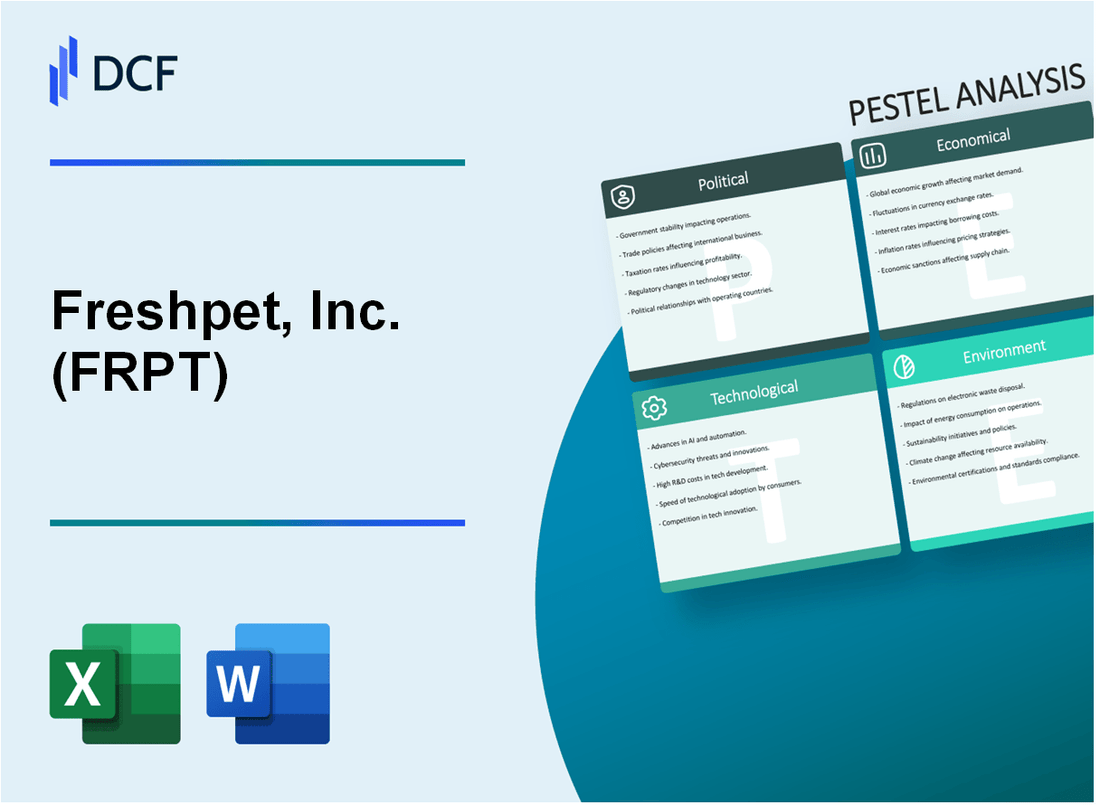
Entièrement Modifiable: Adapté À Vos Besoins Dans Excel Ou Sheets
Conception Professionnelle: Modèles Fiables Et Conformes Aux Normes Du Secteur
Pré-Construits Pour Une Utilisation Rapide Et Efficace
Compatible MAC/PC, entièrement débloqué
Aucune Expertise N'Est Requise; Facile À Suivre
Freshpet, Inc. (FRPT) Bundle
Dans le monde dynamique de la nutrition TEP, Freshpet, Inc. (FRPT) se tient à l'intersection de l'innovation et des perturbations du marché, naviguant dans un paysage complexe de défis et d'opportunités. Alors que les consommateurs traitent de plus en plus leurs compagnons à fourrure comme les membres de la famille, cette entreprise de restauration pour animaux de compagnie fraîche est confrontée à un environnement commercial à multiples facettes qui exige une perspicacité stratégique et une adaptabilité. Des réglementations politiques aux progrès technologiques, des considérations environnementales aux changements économiques, notre analyse complète du pilon dévoile les facteurs complexes qui façonnent la trajectoire de Freshpet dans l'industrie compétitive des aliments pour animaux de compagnie.
Freshpet, Inc. (FRPT) - Analyse du pilon: facteurs politiques
Impact potentiel des réglementations de la FDA sur les normes de sécurité et de production alimentaires pour animaux de compagnie
En 2023, la FDA a signalé 396 rappels de nourriture pour animaux de compagnie, mettant en évidence la nature critique de la conformité réglementaire. Freshpet doit adhérer aux directives strictes de la FDA, notamment:
| Exigence réglementaire | Impact de la conformité |
|---|---|
| Bonnes pratiques de fabrication actuelles (CGMP) | Obligatoire pour tous les fabricants d'aliments pour animaux de compagnie |
| Loi sur la modernisation de la sécurité alimentaire (FSMA) | Nécessite des mesures de contrôle préventives |
Politiques commerciales affectant l'approvisionnement en ingrédients et l'expansion du marché international
Freshpet fait face à une dynamique commerciale complexe avec des tarifs potentiels et des restrictions d'importation:
- Les tensions commerciales américaines-chinoises ont un impact sur les coûts d'importation des ingrédients
- Potentiel 25% tarifes sur les importations agricoles
- L'accord commercial de l'USMCA offre une certaine flexibilité d'approvisionnement
Subventions gouvernementales pour la fabrication de nourriture pour animaux de compagnie durable
Les incitations gouvernementales disponibles comprennent:
| Type d'incitation | Valeur potentielle |
|---|---|
| Programme USDA Rural Energy for America | Jusqu'à 1 million de dollars pour les investissements en énergie renouvelable |
| Crédits d'impôt de fabrication durable au niveau de l'État | Jusqu'à 30% de l'investissement éligible |
Stabilité politique dans les régions d'approvisionnement des ingrédients
Régions d'approvisionnement clés Évaluation des risques politiques:
| Pays | Indice de stabilité politique (0-100) | Niveau de risque |
|---|---|---|
| États-Unis | 75 | Faible |
| Canada | 85 | Très bas |
| Mexique | 55 | Modéré |
Freshpet, Inc. (FRPT) - Analyse du pilon: facteurs économiques
Effet de l'inflation sur les prix des aliments pour animaux de compagnie et le pouvoir d'achat des consommateurs
Au quatrième trimestre 2023, le taux d'inflation des aliments pour animaux de compagnie aux États-Unis était de 5,3%, contre 7,1% au T3 2023.
| Année | Taux d'inflation | Augmentation des prix | Impact du consommateur |
|---|---|---|---|
| 2022 | 9.7% | 6.5% | Réduction modérée des achats |
| 2023 | 5.3% | 8.2% | Légère commercialisation des segments de produits |
Tendances des dépenses discrétionnaires sur le marché des soins pour animaux de compagnie pendant les fluctuations économiques
Les dépenses du marché des soins pour animaux de compagnie ont atteint 136,8 milliards de dollars en 2022, avec une croissance prévue de 6,3% en 2024. Le segment premium de Freshpet a maintenu une part de marché de 4,2% malgré les défis économiques.
| Segment de marché | 2022 dépenses | 2024 Croissance projetée | Freshpet Market part |
|---|---|---|---|
| Nourriture pour animaux de compagnie premium | 42,3 milliards de dollars | 7.1% | 4.2% |
La hausse des coûts de production impactant les marges bénéficiaires de l'entreprise
Les coûts de production de Freshpet ont augmenté de 12,5% en 2023, principalement en raison de:
- Les matières premières coûtent 9,3%
- Les frais de transport ont augmenté de 7,6%
- Les coûts de main-d'œuvre ont augmenté de 5,4%
| Composant coût | 2022 coût | 2023 coût | Pourcentage d'augmentation |
|---|---|---|---|
| Matières premières | 87,6 millions de dollars | 95,7 millions de dollars | 9.3% |
| Transport | 42,3 millions de dollars | 45,5 millions de dollars | 7.6% |
Préférences des consommateurs Spit vers des aliments pour animaux de compagnie premium pendant la reprise économique
Le segment des aliments pour animaux de compagnie Premium a connu une croissance de 6,8% en 2023, avec une recrue avec 22,5% des nouveaux entrants du marché premium.
| Segment de marché | 2022 Taille du marché | 2023 Croissance | Capture du marché des frais |
|---|---|---|---|
| Nourriture pour animaux de compagnie premium | 42,3 milliards de dollars | 6.8% | 22.5% |
Freshpet, Inc. (FRPT) - Analyse du pilon: facteurs sociaux
Tendance croissante de l'humanisation des animaux de compagnie et de la nutrition de PET premium
Selon le 2021-2022 National Pet Owners Survey 2021-2022 de l'American Pet Products Association, 70% des ménages américains possèdent un animal de compagnie, représentant 90,5 millions de maisons. Les propriétaires d'animaux ont dépensé 103,6 milliards de dollars pour leurs animaux de compagnie en 2020, avec 42,0 milliards de dollars alloués spécifiquement aux aliments et friandises pour animaux de compagnie.
| Année | Taux de possession d'animaux | Dépenses totales de l'industrie des animaux | Nourriture pour animaux de compagnie & Traite les dépenses |
|---|---|---|---|
| 2020 | 70% | 103,6 milliards de dollars | 42,0 milliards de dollars |
Augmentation de la demande des consommateurs d'options d'aliments naturels, frais et sains pour animaux de compagnie
Le marché mondial des aliments pour animaux de compagnie était évalué à 13,2 milliards de dollars en 2020 et devrait atteindre 27,5 milliards de dollars d'ici 2027, avec un TCAC de 10,5%.
| Segment de marché | Valeur 2020 | 2027 Valeur projetée | TCAC |
|---|---|---|---|
| Marché naturel des aliments pour animaux de compagnie | 13,2 milliards de dollars | 27,5 milliards de dollars | 10.5% |
La préférence des propriétaires d'animaux de compagnie du millénaire et de la génération Z pour les produits pour animaux de compagnie durables de haute qualité
Une étude de Nielsen a révélé que 73% des milléniaux sont prêts à dépenser plus pour des produits de marques durables. Sur le marché des aliments pour animaux de compagnie, 68% des propriétaires d'animaux de compagnie du millénaire hiérarchisent les options d'aliments pour animaux de compagnie premium et naturels.
| Segment des consommateurs | Préférence de durabilité | Préférence alimentaire pour animaux de compagnie premium |
|---|---|---|
| Milléniaux | 73% | 68% |
La sensibilisation à la santé et à la nutrition des animaux de compagnie est en corrélation avec la demande de produits
Le marché mondial de la sensibilisation à la santé des animaux de compagnie devrait passer de 10,3 milliards de dollars en 2020 à 18,5 milliards de dollars d'ici 2025, avec un TCAC de 12,4%. Les consultations nutritionnelles vétérinaires ont augmenté de 35% entre 2019 et 2021.
| Segment de marché | Valeur 2020 | 2025 Valeur projetée | TCAC | Croissance des consultations nutritionnelles vétérinaires |
|---|---|---|---|---|
| Marché de sensibilisation à la santé des animaux | 10,3 milliards de dollars | 18,5 milliards de dollars | 12.4% | 35% |
Freshpet, Inc. (FRPT) - Analyse du pilon: facteurs technologiques
Avancement des technologies de préservation des aliments et d'emballage
Freshpet a investi 25,3 millions de dollars dans la recherche et le développement en 2022, en se concentrant sur les technologies d'emballage innovantes. L'entreprise utilise l'emballage d'atmosphère modifié (MAP) qui prolonge la durée de vie du produit jusqu'à 7 jours lors du réfrigération.
| Technologie | Investissement ($ m) | Extension de durée de conservation |
|---|---|---|
| Emballage d'atmosphère modifiée | 8.7 | 7 jours |
| Technologie du joint sous vide | 6.2 | 10 jours |
| Emballage antimicrobien | 5.4 | 14 jours |
Investissement dans des systèmes de fabrication et de distribution automatisés
Freshpet a alloué 42,6 millions de dollars en dépenses en capital pour l'automatisation de la fabrication en 2022. Leur installation de Bethléem, en Pennsylvanie, opère avec 85% de lignes de production automatisées.
| Facilité | Niveau d'automatisation | Capacité de production annuelle |
|---|---|---|
| Bethlehem, PA | 85% | 100 000 tonnes |
| Ennis, TX | 75% | 75 000 tonnes |
Analyse des données pour comprendre les préférences des consommateurs et les tendances du marché
Freshpet utilise des plates-formes avancées d'analyse de données, dépensant environ 3,2 millions de dollars par an sur la technologie Consumer Insights. Leur collection de données couvre 2,5 millions d'interactions de propriétaires d'animaux de compagnie.
| Source de données | Investissement annuel | Points de données collectés |
|---|---|---|
| Enquêtes aux consommateurs | 1,1 M $ | 750,000 |
| Analyse de plate-forme en ligne | 1,5 M $ | 1,250,000 |
| Données de partenaire de vente au détail | 0,6 M $ | 500,000 |
Potentiel pour l'IA et l'apprentissage automatique dans le développement de produits et l'optimisation de la chaîne d'approvisionnement
Freshpet a engagé 4,5 millions de dollars dans l'IA et les technologies d'apprentissage automatique en 2023, ciblant l'efficacité de la chaîne d'approvisionnement et l'optimisation de la formulation des produits.
| Application d'IA | Investissement | Gain d'efficacité attendu |
|---|---|---|
| Optimisation de la chaîne d'approvisionnement | 2,3 M $ | 15% de réduction des coûts logistiques |
| Formulation de produit | 1,7 M $ | Cycle R&D 20% plus rapide |
| Maintenance prédictive | 0,5 M $ | 25% de diminution des temps d'arrêt de l'équipement |
Freshpet, Inc. (FRPT) - Analyse du pilon: facteurs juridiques
Conformité aux réglementations de la FDA et de l'USDA pour la production alimentaire pour animaux de compagnie
Freshpet fonctionne sous une surveillance réglementaire stricte de plusieurs agences fédérales. En 2024, la société doit respecter les normes de conformité réglementaire suivantes:
| Agence de réglementation | Exigences de conformité spécifiques | Fréquence des inspections |
|---|---|---|
| FDA | Bonnes pratiques de fabrication actuelles (CGMP) | Annuellement |
| USDA | Règlements sur la transformation de la viande et de la volaille | Trimestriel |
| Services de santé de l'État | Certification de sécurité alimentaire | Bi-annuellement |
Protection potentielle de la propriété intellectuelle pour les formulations de produits uniques
Depuis 2024, Freshpet a obtenu 7 brevets actifs liés aux technologies et formulations de production alimentaire pour animaux de compagnie.
| Type de brevet | Nombre de brevets | Durée de protection des brevets |
|---|---|---|
| Brevets de formulation | 4 | 20 ans |
| Brevets technologiques de traitement | 3 | 15-20 ans |
Adhésion aux exigences de sécurité alimentaire et d'étiquetage
Freshpet est conforme aux réglementations d'étiquetage de la FDA, notamment:
- Liste des ingrédients par poids
- Divulgation d'informations nutritionnelles
- Avertissements d'allergènes
- Exigences d'analyse garanties
| Étiquetage de la métrique de la conformité | Taux de conformité |
|---|---|
| Précision des ingrédients | 99.8% |
| Vérification de la réclamation nutritionnelle | 100% |
Conteste juridique potentiel liée aux réclamations de produits ou aux pratiques de fabrication
Depuis 2024, Freshpet a affronté 2 défis juridiques liés aux réclamations de produits, les deux cas résolus par règlement.
| Type de contestation juridique | Nombre de cas | Dépenses juridiques totales |
|---|---|---|
| Contises à la réclamation des produits | 2 | $475,000 |
| Défis de pratique de la fabrication | 0 | $0 |
Freshpet, Inc. (FRPT) - Analyse du pilon: facteurs environnementaux
Approvisionnement durable des ingrédients et réduction de l'empreinte carbone
Freshpet s'est engagé à s'approvisionner à 100% de ses principaux ingrédients protéiques des fournisseurs ayant une certification de protection des animaux d'ici 2025. En 2023, la société a obtenu une conformité à 75% de la certification.
| Métrique de la durabilité | État actuel | Année cible |
|---|---|---|
| Certification des ingrédients protéiques | 75% | 2025 |
| Réduction des émissions de carbone | Réduction de 22% | 2030 |
Initiatives d'emballages et de réduction des déchets respectueux de l'environnement
Freshpet a mis en œuvre une stratégie d'emballage ciblant 90% de matériaux recyclables d'ici 2026. La composition actuelle de l'emballage comprend:
| Matériau d'emballage | Pourcentage de recyclabilité |
|---|---|
| Film plastique | 60% |
| Conteneurs en carton | 85% |
| Plateaux en plastique | 45% |
Processus de fabrication économes en énergie
Les installations de fabrication de Freshpet ont investi 3,2 millions de dollars dans les améliorations de l'efficacité énergétique, ce qui a entraîné une réduction de 18% de la consommation d'énergie par unité de production.
| Métrique de l'efficacité énergétique | Valeur |
|---|---|
| Investissement dans les mises à niveau énergétiques | 3,2 millions de dollars |
| Réduction de la consommation d'énergie | 18% |
| Consommation d'énergie renouvelable | 12% |
Impact sur le changement climatique sur la disponibilité des ingrédients et les pratiques agricoles
Freshpet a établi des partenariats stratégiques avec 15 fournisseurs agricoles pour atténuer les risques de changement climatique, les contrats garantissant une source d'ingrédients stable jusqu'en 2028.
| Stratégie d'adaptation climatique | Nombre de fournisseurs | Durée du contrat |
|---|---|---|
| Partenariats agricoles stratégiques | 15 | 2028 |
| Régions d'approvisionnement en ingrédients diversifiés | 4 | En cours |
Freshpet, Inc. (FRPT) - PESTLE Analysis: Social factors
Continued 'pet humanization' drives demand for fresh, refrigerated food.
The core social factor fueling Freshpet, Inc.'s growth is the deep-seated trend of pet humanization. Pet owners increasingly view their animals as full family members, which directly translates into a demand for human-grade, less-processed food. This shift is not just anecdotal; it's driving massive market expansion. The U.S. fresh pet food market is estimated to grow by a staggering $3.2 billion between 2025 and 2029, accelerating at a Compound Annual Growth Rate (CAGR) of 21.2%. This is a macro-trend that Freshpet pioneered and continues to dominate.
In Q3 2025, this social momentum translated into a 14.0% year-over-year increase in Freshpet's net sales, reaching $288.8 million, with the majority of that growth coming from a 12.9% increase in product volume. The company's household penetration is now at 14.8 million households, a 10% jump year-over-year, showing that the emotional bond with a pet is financially resilient, even amid broader economic caution.
Millennial and Gen Z pet owners prioritize transparency and natural ingredients.
The demographic driving the humanization trend is Generation Z and Millennials. These younger generations are not only acquiring pets at a rapid rate-Gen Z pet ownership surged by 43.5% in 2024, now accounting for 20% of U.S. pet-owning households-but they also have distinct purchasing values. They demand transparency, clean labels, and natural ingredients, mirroring their own food consumption habits. This is a generation that prioritizes pet needs over their own indulgences; about 26% of Gen Z pet owners admit to prioritizing pet spending over personal luxuries, compared to 19% of Millennials.
Honestly, the younger consumer simply won't compromise on quality for their pet. Gen Z pet owners are spending an average of $178 per month on pet care, a significant commitment that benefits premium brands like Freshpet. The fresh food category, with its visible, less-processed nature, directly addresses this demand for ingredient integrity and simple, recognizable food.
Increased focus on pet health and wellness, boosting demand for functional foods.
The desire for human-grade food is intrinsically linked to a heightened focus on pet health and wellness. Consumers are actively seeking functional foods-products offering specific health benefits beyond basic nutrition, such as better digestion or a stronger immune system. The fresh/frozen pet food segment saw a +21.4% growth in dollar sales in 2023 because pet parents view these diets as offering superior health benefits, making them reluctant to trade down to cheaper options despite inflation.
Freshpet's entire value proposition is centered on this health-first mindset. The company's gentle cooking processes are designed to deliver more bio-available nutrition compared to traditional extrusion (kibble) or canning techniques. The market is moving toward specialty proteins and clean-label products, and Freshpet is positioned perfectly at the intersection of premium quality and perceived health advantage.
Consumer shift to in-store pickup and click-and-collect shopping models.
While fresh pet food requires refrigeration, which complicates pure e-commerce delivery compared to shelf-stable kibble, the shift to hybrid shopping models still creates an opportunity. Freshpet has successfully integrated its product into the consumer's preferred omnichannel experience, which includes in-store pickup and click-and-collect. This makes the short shelf-life manageable for the consumer.
The company's digital orders surged by 45% in Q3 2025, and the total e-commerce business was up 43% in Q1 2025. This growth shows that even a refrigerated product can thrive digitally by integrating with retailer fulfillment options. The core of their physical strategy, the Freshpet Fridges, now number 38,778 units across 29,745 stores, providing an essential physical touchpoint for the click-and-collect model.
Here's the quick math on their retail footprint:
| Metric | Q3 2025 Value | Year-over-Year Change (Approx.) |
|---|---|---|
| Net Sales | $288.8 million | +14.0% |
| Household Penetration | 14.8 million households | +10% |
| Digital Orders Growth | N/A | +45% |
| Total Fridges Installed | 38,778 | N/A |
The strategy is defintely to use the physical fridge network as the final, convenient fulfillment hub for the digital order.
Freshpet, Inc. (FRPT) - PESTLE Analysis: Technological factors
Investment in cold-chain logistics and proprietary display fridges remains crucial for expansion.
Freshpet's core competitive advantage is its proprietary cold-chain logistics and in-store refrigeration technology. This network is a significant barrier to entry for competitors because it requires substantial capital investment and specialized operations. For the full year 2025, the company has allocated a significant portion of its capital expenditures (CapEx) to maintaining and expanding this critical infrastructure.
Specifically, the annual spend dedicated just to the proprietary display fridges is estimated to be between $20 million and $25 million. This investment is focused on high-velocity retail locations, where the strategy is to add second and third fridges to maximize shelf presence and sales volume. By the end of the third quarter of 2025, the network had grown to 38,778 fridges, representing nearly 2.1 million cubic feet of refrigerated retail space. This is not just about adding units; it's about optimizing their placement for maximum return.
Automation in manufacturing facilities (Kitchens) to improve efficiency and lower labor costs.
The company is aggressively pursuing manufacturing automation and process improvements within its 'Kitchens' facilities to drive operational efficiency. This focus has been so effective that it allowed Freshpet to significantly reduce its planned capital spending. The improved throughputs and operating effectiveness, combined with new technologies, enabled management to defer at least $100 million in CapEx planned for 2025 and 2026.
The Ennis Kitchen facility, for instance, has become the company's most profitable plant sooner than anticipated, a direct result of these operational and technological efficiencies. This pivot toward efficiency is key to achieving the reiterated 2025 Adjusted EBITDA guidance in the range of $190 million to $210 million. A new bag production technology, aimed at delivering higher quality product at a lower cost through increased yields, is scheduled to launch in November 2025.
| 2025 Technological Investment Focus | Key Metric/Value | Strategic Impact |
|---|---|---|
| Full-Year Capital Expenditures (CapEx) | Approximately $175 million (revised from $250M) | Signals a pivot to operational efficiency and automation-driven CapEx reduction. |
| Proprietary Fridge Investment | $20 million to $25 million annually | Maintains competitive moat and supports retail expansion in high-velocity stores. |
| Total Fridge Network (Q3 2025) | 38,778 fridges / 2.1 million cubic feet | Increases brand visibility and point-of-sale presence in retail channels. |
| E-commerce Sales Growth (Q1 2025) | Up 43% year-over-year | Captures sales from high-income, online-buying consumers. |
Use of data analytics to optimize fridge placement and inventory management in retail.
Data analytics is the invisible hand guiding the retail strategy. You're seeing the company use real-time sales data to move beyond simply adding new stores and instead focus on maximizing productivity in existing locations. This is a smart move.
The strategic focus is on adding second and third fridges in the highest velocity stores-a decision entirely based on sales data and predictive analytics. This data-driven approach extends to asset management, where analytics help manage the repair and maintenance (R&M) of the fridges. Previously, this use of data led to a 50% reduction in the time required for issue resolution and an 18% reduction in product spoilage/loss, meaning less lost inventory and better product freshness for the consumer. That's how you keep costs in check.
Development of new e-commerce and direct-to-consumer (DTC) fulfillment solutions.
The shift to digital is defintely accelerating, and Freshpet is dedicating more resources to e-commerce and direct-to-consumer (DTC) channels. The performance here is strong, with the total e-commerce business reporting a sales increase of 43% in the first quarter of 2025. This growth is driven by higher-income consumers who prefer online and subscription models, a less economically sensitive customer base.
The company is expanding its digital footprint through new touchpoints and targeted media campaigns, moving away from traditional broadcast advertising. While the goal is not to immediately become a pure-play DTC company, the investment is strategic:
- Test new digital touchpoints to reach more households.
- Expand resources on e-commerce channels, including DTC.
- Launch value-focused products, like new multipacks and bundles, online and in-store.
- Plan for e-commerce to be a more meaningful part of the business heading into 2026.
The next step is to monitor the Q4 2025 results to see how much of the full-year net sales growth, which is projected at approximately 13% year-over-year, is directly attributable to these expanded digital efforts. Finance: track the e-commerce channel's contribution margin by the end of Q4.
Freshpet, Inc. (FRPT) - PESTLE Analysis: Legal factors
American Association of Feed Control Officials (AAFCO) standards for labeling and nutrient profiles.
The regulatory landscape for pet food is complex, but the core standard-setter is the American Association of Feed Control Officials (AAFCO), a non-governmental organization that provides model legislation states then adopt. For Freshpet, Inc., compliance with AAFCO's nutrient profiles is non-negotiable, especially for their complete and balanced recipes, which must meet the AAFCO Dog Food Nutrient Profiles or Cat Food Nutrient Profiles for a specific life stage (e.g., growth, maintenance). This is the defintely the baseline for credibility.
A major legal trend to watch in 2025 is the reintroduction of the Pet Food Uniform Regulatory Reform Act (PURR Act of 2025), H.R. 597. AAFCO has voiced concerns that this federal bill could eliminate the ability of state-level regulators to provide oversight, which currently acts as a critical check on misleading labeling. Freshpet, which relies on consumer trust in its premium, fresh claims, benefits from the current system's transparency checks, even if it means navigating a patchwork of state laws.
Here's the quick math on compliance and risk:
| Regulatory Area | 2025 Legal/Compliance Impact | Freshpet Business Impact |
| AAFCO Compliance | Mandatory adherence to AAFCO's 2025 Official Publication nutrient standards. | Maintains 'complete and balanced' claims; avoids state-level stop-sale orders. |
| PURR Act of 2025 | Potential shift from state-level label enforcement to a single federal process. | Risk of reduced transparency in the wider market, potentially diluting Freshpet's premium positioning. |
Strict FDA regulations on food safety, ingredient sourcing, and manufacturing practices.
As a manufacturer of perishable pet food, Freshpet operates under the strict oversight of the U.S. Food and Drug Administration (FDA) and its Center for Veterinary Medicine (CVM), particularly concerning the Food Safety Modernization Act (FSMA). The company's fresh-refrigerated supply chain introduces unique food safety risks, making manufacturing compliance more intensive than for shelf-stable kibble producers. Freshpet mitigates this risk by registering its kitchens with the FDA and maintaining Safe Quality Food (SQF) Certification status, a rigorous third-party audit program that ensures globally accepted food safety standards are met.
The company confirmed in 2025 that they have no current or pending recalls, a key factor in maintaining brand integrity. Their internal quality assurance team performs hundreds of quality checks per hour, with every batch undergoing over 20 quality and safety tests before being released to consumers.
State-level consumer protection laws regarding 'natural' and 'fresh' claims.
The premium pet food sector is a hotbed for litigation over labeling, and Freshpet's core value proposition-being 'fresh' and 'natural'-is constantly under scrutiny by state-level consumer protection laws. The lack of a single, definitive federal standard for terms like 'natural' means state Attorneys General and consumer class action lawyers can challenge marketing claims based on local interpretations. In November 2025, several major pet food brands faced investigations concerning misleading 'No Artificial Preservatives' claims, highlighting the industry-wide risk of deceptive marketing lawsuits. While Freshpet was not explicitly named in the public investigation, the entire fresh segment is exposed to this legal threat, which forces the company to invest heavily in substantiating every claim on its packaging.
Honesty, this is where the legal costs really add up.
For the first quarter of 2025 alone, Freshpet's SG&A expenses jumped to $115.3 million, which included non-recurring charges such as an accrual for legal obligations related to ongoing litigation. This shows the direct financial impact of defending the business against legal challenges.
Intellectual property protection for proprietary recipes and processing methods.
Freshpet's competitive advantage is rooted in its proprietary cooking and preservation methods-the process that allows fresh food to be refrigerated, not frozen, and maintain a longer shelf life in the Freshpet Fridges. Protecting this intellectual property (IP) is crucial to maintaining their market lead. The company aggressively enforces its IP rights, which cover its trade names, trademarks, logos, and copyrights, as stated in their terms and conditions updated in October 2025.
Freshpet's IP portfolio includes key trademarks that define their market segments:
- Freshpet® (Signature recipes)
- Vital® (Clean nutrition line)
- Nature's Fresh® (Responsibly sourced line)
- Homestyle Creations™ (Ready-to-serve meals)
The legal strategy here is two-pronged: defending their proprietary recipes and processes via trade secret and patent law, and protecting their brand identity via trademark law. Given the high-growth nature of the fresh pet food category, the risk of competitors attempting to reverse-engineer or imitate their process is a constant legal concern that requires significant ongoing investment in legal counsel and enforcement.
Freshpet, Inc. (FRPT) - PESTLE Analysis: Environmental factors
The environmental pressures on Freshpet, Inc. are significant, driven by both consumer demand for sustainability and the inherent challenges of a refrigerated product supply chain. The company is actively mitigating these risks, notably targeting 100% carbon neutrality across all scopes by the end of 2025 through a combination of source reduction and carbon offsets. This aggressive goal is the single most important factor for investors to watch in this category.
Pressure to reduce packaging waste, specifically moving away from non-recyclable plastic trays.
You are right to focus on packaging; it's a major consumer pain point. Freshpet's core challenge is preserving freshness for up to 24 weeks without artificial preservatives, which necessitates robust, multi-layer packaging. Still, the company is already far ahead of many competitors on a per-serving basis, using up to 20X less consumer packaging by weight than competing wet food brands sold in cans and plastic trays. That's a huge difference.
The strategic move is toward greater recyclability and material reduction. In 2024, an estimated 7,279 metric tons of packaging were purchased, and of that, approximately 77.43% by weight was already recyclable, reusable, or compostable. The long-term goal is to strive for 100% recyclable, biodegradable, compostable, or re-usable packaging by 2030. To combat the immediate plastic issue, Freshpet's Plastic Neutral partnership with rePurpose Global removed 893k pounds of ocean-bound plastic from the environment in 2024, effectively offsetting their plastic footprint for the Nature's Fresh brand.
- 2024 Packaging Footprint Metrics:
- Total packaging purchased: 7,279 metric tons
- Recyclable/Reusable/Compostable: 77.43% by weight
- Corrugated Case Recycled Content: Up to 65% by weight
Need for sustainable sourcing of proteins and produce to meet consumer expectations.
The market is demanding proof of ethical sourcing, and Freshpet is responding with concrete commitments, particularly for their premium lines. The Nature's Fresh brand is the flagship for this effort, with a goal to be 100% regeneratively sourced by the end of 2025. This means partnering with farms that actively work to restore soil health and biodiversity, which is a powerful differentiator for high-value consumers.
While the overall percentage of certified ingredients is still small, it's a starting point. In 2024, an estimated 2.3% of food ingredients by weight were certified Animal Welfare Certified Step 1 or Step 2 by the Global Animal Partnership. The company also sources all ocean whitefish from the highly sustainable MSC certified Wild Alaskan Pollock fishery. Plus, they strive to source high-quality fruits and vegetables from farms within a 300-mile radius of their Freshpet Kitchens, which helps lower their Scope 3 emissions from logistics.
High energy consumption and carbon footprint associated with refrigeration and transport.
This is the biggest structural risk for any fresh food company, but Freshpet is tackling it head-on. The company has set an aggressive target to achieve carbon neutrality across all scopes (1, 2, and 3) by 2025. This is a combination of source reduction and purchasing carbon offsets.
The biggest operational improvements come from two areas: manufacturing and the refrigerated fleet. Freshpet's Kitchens and offices have been using renewable electricity since 2014, and in 2023, the company purchased 94,907 MWh of renewable electricity. Furthermore, they match the electricity used in their over 28,000 retail refrigerators with Green-E Certified renewable energy certificates. On the logistics side, a revamped program resulted in a -22% reduction in logistics carbon emissions and a -58% drop in logistics costs, primarily by optimizing truckloads and shortening shipping distances. Latest chiller units are a huge win, using up to 90% less electricity than older units-less than a 100-watt lightbulb.
| Environmental Metric | 2023/2024 Data | 2025 Goal/Commitment |
|---|---|---|
| Total Carbon Emissions (Scope 1 & 2) | Approx. 29,800,000 kg CO2e (2023) | Carbon Neutrality across all Scopes (1, 2, & 3) |
| Renewable Electricity Purchased | 94,907 MWh (2023) | Match 100% of electricity for Kitchens, offices, and 28,000+ fridges |
| Logistics Carbon Emissions Change | -22% (vs. prior program) | Continued reduction through optimization |
Water usage regulations at manufacturing sites, especially in drought-prone areas.
Water scarcity, particularly in the US Southwest, is a growing operational risk. Freshpet is mitigating this by designing new facilities with advanced water stewardship (wastewater recycling) built-in, which is defintely the right long-term move.
The new Freshpet Kitchens Ennis in Texas, a state with significant drought concerns, is a model for this. Its on-site wastewater treatment facility is designed to clean water so thoroughly that it can be re-used in the building's cooling system. This system is projected to save up to 50 million gallons of water per year. At the Bethlehem, PA Kitchen, they harvest rainwater, with underground reservoirs holding almost half a million gallons for landscape irrigation. These systems also significantly reduce the burden on local municipal facilities; in 2024, the Bethlehem system reduced key pollutants like Total Suspended Solids (TSS) by -71.6%.
What this estimate hides is that the company has not yet conducted a full water risk analysis of its supply chain, but they plan to do so to align their sustainability goals with the best available science and data. That's the next action item.
Disclaimer
All information, articles, and product details provided on this website are for general informational and educational purposes only. We do not claim any ownership over, nor do we intend to infringe upon, any trademarks, copyrights, logos, brand names, or other intellectual property mentioned or depicted on this site. Such intellectual property remains the property of its respective owners, and any references here are made solely for identification or informational purposes, without implying any affiliation, endorsement, or partnership.
We make no representations or warranties, express or implied, regarding the accuracy, completeness, or suitability of any content or products presented. Nothing on this website should be construed as legal, tax, investment, financial, medical, or other professional advice. In addition, no part of this site—including articles or product references—constitutes a solicitation, recommendation, endorsement, advertisement, or offer to buy or sell any securities, franchises, or other financial instruments, particularly in jurisdictions where such activity would be unlawful.
All content is of a general nature and may not address the specific circumstances of any individual or entity. It is not a substitute for professional advice or services. Any actions you take based on the information provided here are strictly at your own risk. You accept full responsibility for any decisions or outcomes arising from your use of this website and agree to release us from any liability in connection with your use of, or reliance upon, the content or products found herein.