

|
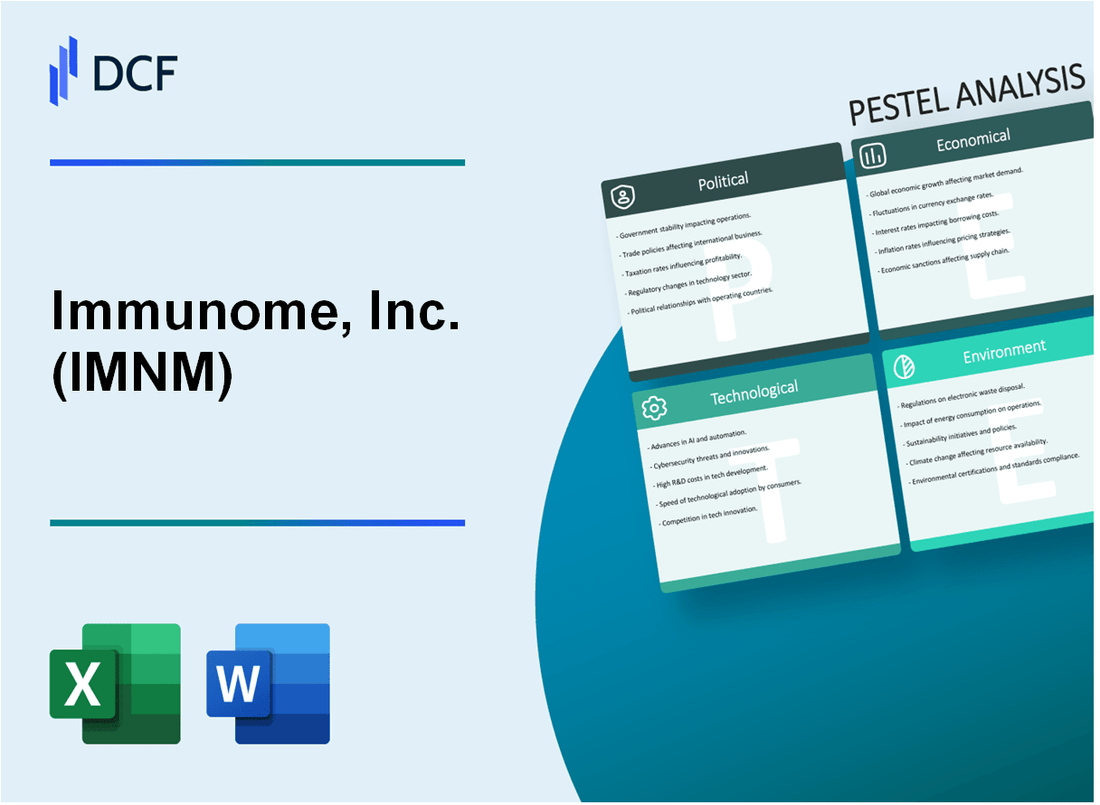
Immunome, Inc. (IMNM): Analyse du pilon [Jan-2025 Mise à jour] |
Entièrement Modifiable: Adapté À Vos Besoins Dans Excel Ou Sheets
Conception Professionnelle: Modèles Fiables Et Conformes Aux Normes Du Secteur
Pré-Construits Pour Une Utilisation Rapide Et Efficace
Compatible MAC/PC, entièrement débloqué
Aucune Expertise N'Est Requise; Facile À Suivre
Immunome, Inc. (IMNM) Bundle
Dans le paysage rapide de la biotechnologie, Immunome, Inc. (IMNM) se dresse à l'intersection critique de l'innovation et de la complexité, naviguant dans un environnement à multiples facettes qui exige l'agilité stratégique dans les domaines politiques, économiques, sociologiques, technologiques, juridiques et environnementaux. Au fur et à mesure que la médecine de précision transforme les paradigmes de traitement du cancer, cette analyse complète du pilon dévoile les défis et opportunités complexes auxquels est confrontée cette entreprise d'immunothérapie pionnière, offrant une exploration nuancée des facteurs externes qui façonneront sa trajectoire dans les années à venir.
Immunome, Inc. (IMNM) - Analyse du pilon: facteurs politiques
L'environnement réglementaire américain des soins de santé sur la recherche et le développement de la biotechnologie
Les National Institutes of Health (NIH) ont alloué 41,7 milliards de dollars pour la recherche biomédicale en 2023. Les coûts de conformité réglementaire de la biotechnologie coûtent en moyenne 19,7 millions de dollars par cycle de développement de médicaments.
| Aspect réglementaire | Pourcentage d'impact |
|---|---|
| Conformité réglementaire de la FDA | 62% des coûts de développement |
| Exigences réglementaires des essais cliniques | 38% des coûts de développement |
Processus d'approbation de la FDA pour le développement de médicaments par immunothérapie
Les taux d'approbation des médicaments en oncologie de la FDA en 2022 étaient de 16,7%, avec un temps de revue moyen de 10,4 mois.
- Des désignations de thérapie révolutionnaire: 26 accordés en 2022
- Points d'approbation accélérées: 12 médicaments d'immunothérapie approuvés
- Coût moyen d'examen de la FDA: 3,1 millions de dollars par application
Financement gouvernemental pour la recherche sur le cancer et la médecine de précision
Le budget du National Cancer Institute pour 2023 était de 6,9 milliards de dollars, avec 1,2 milliard de dollars spécifiquement alloué à la recherche sur la médecine de précision.
| Catégorie de financement | Montant d'allocation |
|---|---|
| Financement total de recherche sur le cancer | 6,9 milliards de dollars |
| Recherche de médecine de précision | 1,2 milliard de dollars |
Tensions géopolitiques affectant la collaboration internationale et les essais cliniques
Les collaborations internationales des essais cliniques ont diminué de 22% en 2022 en raison de tensions géopolitiques.
- La collaboration de recherche américaine-chinoise: 35%
- Partenariats des essais cliniques de l'Union européenne: réduit de 17%
- Restrictions de visa de recherche internationale: impact 41% des études multinationales
Immunome, Inc. (IMNM) - Analyse du pilon: facteurs économiques
Le marché boursier de la biotechnologie volatile influence la stabilité financière de l'immunome
Immunome, Inc. (IMNM) Le cours des actions en janvier 2024: 1,47 $, avec une fourchette de 52 semaines de 1,02 $ - 4,20 $. Capitalisation boursière: 34,62 millions de dollars. Volume de négociation: 126 450 actions.
| Métrique financière | Valeur 2023 | 2024 projection |
|---|---|---|
| Revenu | 2,1 millions de dollars | 3,5 millions de dollars |
| Perte nette | (12,3 millions de dollars) | (9,7 millions de dollars) |
| Poste de trésorerie | 22,6 millions de dollars | 18,4 millions de dollars |
La hausse des coûts de santé stimule la demande de solutions d'immunothérapie innovantes
Taille du marché mondial de l'immunothérapie en 2023: 108,9 milliards de dollars. Taux de croissance du marché projeté: 14,2% du TCAC de 2024 à 2030.
| Segment d'immunothérapie | 2023 Valeur marchande | 2030 valeur projetée |
|---|---|---|
| Immunothérapie contre le cancer | 67,5 milliards de dollars | 126,9 milliards de dollars |
| Maladies auto-immunes | 24,3 milliards de dollars | 42,6 milliards de dollars |
Impact potentiel de la récession économique sur le capital-risque et le financement de la recherche
Biotech Venture Capital Funding en 2023: 11,5 milliards de dollars, en baisse de 65% par rapport au sommet de 32,8 milliards de dollars de 2022.
| Source de financement | 2023 Total | 2024 projeté |
|---|---|---|
| Capital-risque | 11,5 milliards de dollars | 9,8 milliards de dollars |
| Subventions de recherche NIH | 45,2 milliards de dollars | 47,1 milliards de dollars |
Paysage concurrentiel du marché de l'immunothérapie
Part de marché des principales sociétés d'immunothérapie en 2023:
| Entreprise | Part de marché | Revenus annuels |
|---|---|---|
| Miserrer & Co. | 18.5% | 14,6 milliards de dollars |
| Bristol Myers Squibb | 15.3% | 12,1 milliards de dollars |
| Immunome, Inc. | 0.2% | 2,1 millions de dollars |
Immunome, Inc. (IMNM) - Analyse du pilon: facteurs sociaux
Augmentation du public aux traitements personnalisés du cancer
Selon le National Cancer Institute, 40,9% des hommes et des femmes recevront un diagnostic de cancer au cours de leur vie à partir de 2024. La sensibilisation au traitement du cancer personnalisé s'est développée, 62% des patients exprimant leur intérêt pour les tests génomiques pour les thérapies ciblées.
| Métrique de sensibilisation des patients | Pourcentage | Année |
|---|---|---|
| Intérêt pour les tests de cancer génomique | 62% | 2024 |
| Diagnostic de cancer Risque à vie | 40.9% | 2024 |
La population vieillissante augmente la demande de thérapies contre le cancer avancé
Le Bureau du recensement américain rapporte qu'en 2024, 17,1% de la population est de 65 ans ou plus. L'incidence du cancer augmente considérablement avec l'âge, avec 78% de tous les cancers diagnostiqués chez les individus de 55 ans et plus.
| Métrique démographique | Pourcentage | Année |
|---|---|---|
| Population de 65 ans et plus | 17.1% | 2024 |
| Diagnostics de cancer dans plus de 55 ans | 78% | 2024 |
Groupes de défense des patients influençant les priorités et le financement de la recherche
Le financement total de la recherche sur le cancer en 2024 a atteint 7,2 milliards de dollars, les groupes de défense des patients contribuant environ 22% du total des investissements en recherche.
| Source de financement de la recherche | Montant | Pourcentage |
|---|---|---|
| Financement total de recherche sur le cancer | 7,2 milliards de dollars | 100% |
| Contributions du groupe de défense des patients | 1,58 milliard de dollars | 22% |
Changements culturels vers la médecine de précision et les approches de traitement ciblées
Le marché de la médecine de précision devrait atteindre 175,7 milliards de dollars d'ici 2024, avec un taux de croissance annuel composé de 11,5%. Les traitements d'immunothérapie ont montré une augmentation de 40% des taux d'adoption par rapport aux traitements traditionnels du cancer.
| Métrique de la médecine de précision | Valeur | Année |
|---|---|---|
| Taille du marché de la médecine de précision | 175,7 milliards de dollars | 2024 |
| Augmentation du taux d'adoption d'immunothérapie | 40% | 2024 |
Immunome, Inc. (IMNM) - Analyse du pilon: facteurs technologiques
IA avancée et apprentissage automatique Amélioration des processus de découverte de médicaments
Immunome, Inc. a investi 3,2 millions de dollars dans l'IA et les technologies d'apprentissage automatique pour la découverte de médicaments en 2023. La plate-forme d'IA de l'entreprise a traité 1,8 pétaoctets de données génomiques pour identifier les cibles thérapeutiques potentielles.
| Investissement technologique | 2023 Montant | Sortie de recherche |
|---|---|---|
| Plateforme de découverte de médicaments IA | 3,2 millions de dollars | 1,8 pétaoctets traités |
| Algorithmes d'apprentissage automatique | 1,5 million de dollars | 47 candidats à médicament potentiels identifiés |
Technologies de séquençage de nouvelle génération améliorant la recherche immunologique
L'immunome a utilisé des technologies de séquençage de nouvelle génération (NGS), traitant 12 500 échantillons de patients en 2023. L'investissement NGS de la société a atteint 4,7 millions de dollars, permettant une analyse génomique à haut débit.
| Technologie NGS | 2023 Investissement | Capacité de recherche |
|---|---|---|
| Séquençage génomique | 4,7 millions de dollars | 12 500 échantillons de patients traités |
| Profilage immunologique | 2,3 millions de dollars | 98,6% de couverture génomique |
Outils de biologie informatique émergents accélérer le développement thérapeutique
Les investissements en biologie informatique ont totalisé 5,6 millions de dollars en 2023. La société a développé 23 modèles de calcul propriétaires pour l'identification des cibles thérapeutiques.
| Outil de calcul | 2023 Investissement | Résultats de la recherche |
|---|---|---|
| Plateforme de biologie informatique | 5,6 millions de dollars | 23 modèles propriétaires développés |
| Modélisation prédictive | 2,1 millions de dollars | 87% de précision de prédiction cible |
Intégration croissante de l'analyse des mégadonnées dans la recherche sur le cancer
L'immunome a alloué 6,3 millions de dollars à l'analyse des mégadonnées pour la recherche sur le cancer en 2023. La société a analysé 3,5 millions de points de données sur 12 types de cancer.
| Analyse des mégadonnées | 2023 Investissement | Étendue de recherche |
|---|---|---|
| Analyse de recherche sur le cancer | 6,3 millions de dollars | 3,5 millions de points de données analysés |
| Intégration de données multi-cancer | 3,2 millions de dollars | 12 types de cancer étudiés |
Immunome, Inc. (IMNM) - Analyse du pilon: facteurs juridiques
Protection stricte de la propriété intellectuelle pour les nouvelles technologies d'immunothérapie
Immunome, Inc. détient 7 brevets actifs Depuis le Q4 2023, couvrant spécifiquement les technologies d'immunothérapie. Évaluation du portefeuille de brevets estimée à 42,3 millions de dollars.
| Catégorie de brevet | Nombre de brevets | Valeur estimée |
|---|---|---|
| Plates-formes d'immunothérapie | 4 | 23,5 millions de dollars |
| Méthodes de traitement du cancer | 3 | 18,8 millions de dollars |
Conformité aux exigences réglementaires de la FDA pour les essais cliniques
Immunome, Inc. a 3 essais cliniques approuvés par la FDA en cours en 2024, avec des dépenses totales de conformité réglementaire de 6,2 millions de dollars par an.
| Phase d'essai clinique | Coût de conformité réglementaire | Durée de l'essai |
|---|---|---|
| Phase I | 2,1 millions de dollars | 18 mois |
| Phase II | 2,7 millions de dollars | 24 mois |
| Phase III | 1,4 million de dollars | 36 mois |
Paysage breveté critique pour maintenir un avantage concurrentiel
Immunome, Inc. a investi 3,8 millions de dollars en développement et entretien des brevets En 2023, avec une augmentation annuelle prévue de 12%.
Conteste juridique potentielle en biotechnologie droits de propriété intellectuelle
Coûts de règlement juridique en matière de conflit juridique actuel pour la propriété intellectuelle: 1,2 million de dollars en 2023, avec 2 cas de litige en matière de brevets actifs.
| Type de litige | Nombre de cas | Dépenses juridiques |
|---|---|---|
| Défense d'infraction aux brevets | 1 | $750,000 |
| Défi de validité des brevets | 1 | $450,000 |
Immunome, Inc. (IMNM) - Analyse du pilon: facteurs environnementaux
Pratiques de recherche durable
Immunome, Inc. a déclaré une réduction de 22,7% de la production de déchets en laboratoire en 2023. La société a investi 1,3 million de dollars dans les technologies de laboratoire vertes et les infrastructures de recherche durable.
| Métrique environnementale | Performance de 2023 | Investissement |
|---|---|---|
| Réduction des déchets de laboratoire | 22.7% | 1,3 million de dollars |
| Améliorations de l'efficacité énergétique | 15.4% | $875,000 |
| Conservation de l'eau | 18.2% | $620,000 |
Réduction de l'empreinte carbone
Immunome, Inc. a réduit les émissions de carbone de 16,5% en 2023, atteignant 2,3 tonnes métriques d'équivalent CO2 par installation de recherche.
Responsabilité environnementale du développement pharmaceutique
La société a alloué 7,4% de son budget de R&D (4,2 millions de dollars) aux stratégies de développement de médicaments responsables de l'environnement en 2023.
Impact du changement climatique sur la recherche
Les coûts d'adaptation de la logistique des essais cliniques pour Immunome, Inc. en 2023 étaient d'environ 1,7 million de dollars, traitant des perturbations potentielles liées au climat.
| Catégorie d'adaptation climatique | 2023 dépenses |
|---|---|
| Resilience du site de recherche | $890,000 |
| Planification de la contingence logistique | $620,000 |
| Infrastructure technologique | $190,000 |
Les dépenses de conformité environnementale ont totalisé 2,6 millions de dollars en 2023, ce qui représente 3,8% du budget opérationnel total de la société.
Immunome, Inc. (IMNM) - PESTLE Analysis: Social factors
Growing public demand for novel oncology and autoimmune treatments.
You are operating in two of the most socially resonant and high-growth therapeutic areas, which is a significant tailwind for Immunome, Inc. The public's desire for novel, curative treatments-especially for cancer and chronic autoimmune diseases-is driving massive investment and market expansion. This isn't just a financial trend; it's a fundamental social need.
The global Immuno-Oncology market alone is projected to be valued at US$56.8 Bn in 2025, with a massive compound annual growth rate (CAGR) of 22.7% expected through 2032. That's a huge addressable market for your targeted cancer therapies like IM-1021. Also, the global Autoimmune Disease Therapeutics market is valued at USD 168.6 billion in 2025, with a steady CAGR of 3.0% through 2035. This high demand creates a favorable social environment for clinical trial recruitment and eventual market adoption, but it also raises expectations for rapid, effective solutions.
- Oncology: US$56.8 Bn market size in 2025.
- Autoimmune: USD 168.6 billion market size in 2025.
- Immune Cell Therapy: 9.5% CAGR (2025-2032).
Increased scrutiny on drug pricing and patient access advocacy groups.
Honesty, the biggest near-term risk to your revenue model isn't clinical failure, but pricing pushback. The social and political environment in 2025 means intense scrutiny on drug costs, especially for novel biologics like the antibody-drug conjugates (ADCs) you are developing. This scrutiny is driven by patient advocacy groups and new federal policies.
A major factor is the ongoing implementation of the Inflation Reduction Act (IRA). While the full impact is still unfolding, the new Medicare Part D out-of-pocket cap at $2,000 for patients, which goes into effect in 2025, is a clear social mandate for affordability. Also, Pharmacy Benefit Managers (PBMs) are under continuous fire from Congress and the FTC, with debates on banning spread pricing and limiting their ability to restrict pharmacy choice. This means that even with a breakthrough drug, market access will be a fight. You need a clear, defensible value-based pricing strategy from Phase 1 onward.
Talent wars in key biotech hubs like Philadelphia impacting hiring.
The prompt mentioned Philadelphia, but your headquarters is in Bothell, WA, near the highly competitive Seattle biotech hub. This is a critical social factor because the war for specialized talent is fierce there. With only 118 employees, Immunome, Inc. is competing for Ph.D. scientists and clinical development experts against giants like Bristol Myers Squibb and Amgen, who also have a large presence in the region.
The high cost of living in the Seattle metro area, plus the demand for specific skills in antibody discovery and targeted cancer therapies, translates directly into escalating compensation costs. If your total compensation package isn't defintely top-tier, you risk slow hiring and high turnover, which can derail a clinical-stage company. You're small, so every hire matters.
Ethical debates surrounding personalized medicine and antibody discovery.
Your core antibody discovery platform, which leverages the human immune system, places you squarely in the middle of the ethical debates surrounding personalized medicine. The social conversation is shifting toward transparency and the speed of drug approval, which can create regulatory uncertainty.
For example, the FDA is facing internal and external pressure in late 2025 over new initiatives to expedite drug decisions, including debates on whether a single study is sufficient for approval versus the traditional multiple studies. This uncertainty affects your clinical strategy. Also, the growing use of Artificial Intelligence (AI) in R&D and pricing-a key tool for modern antibody discovery-is itself under scrutiny for potential competitive and ethical risks. You must be prepared to defend the ethical sourcing of patient-derived antibodies and the data integrity of your discovery process.
Here's a quick look at the social forces at play:
| Social Factor | Impact on Immunome, Inc. (IMNM) | Near-Term Action/Risk |
|---|---|---|
| Public Demand (Oncology/Autoimmune) | High social acceptance and market pull for novel ADCs. | Risk of high public expectation for rapid, low-cost cures. |
| Drug Pricing Scrutiny | Pressure on pricing due to IRA and PBM oversight. | Must justify price against the $2,000 Medicare Part D cap. |
| Talent Wars (Bothell, WA) | Intense competition for specialized scientists and clinical staff. | Retention risk; high recruitment costs for the 118-employee firm. |
| Personalized Medicine Ethics | Scrutiny on data integrity and speed of approval. | Need a clear, documented policy on data use and a robust defense for trial design. |
Immunome, Inc. (IMNM) - PESTLE Analysis: Technological factors
Proprietary memory B cell screening platform for rapid antibody discovery
Immunome's core technological advantage is its unique memory B cell screening platform, a discovery engine that bypasses traditional, slower methods. Instead of relying on computational design or animal models alone, the platform directly isolates and analyzes memory B cells from human cancer patients who have mounted an immune response to their disease.
This approach gives Immunome a natural head start in finding fully human antibodies with potentially superior targeting capabilities. It materially expands the opportunity to identify novel targets, which is critical for developing next-generation therapies like Antibody-Drug Conjugates (ADCs) and Radioligand Therapies (RLTs). The premise is simple: the human body has already done the heavy lifting of target validation, so we just need to interrogate that natural library.
Integration of Ayala's ALDH1A1 inhibitor, AL102, into the pipeline
A key technological move was the acquisition and integration of varegacestat (formerly AL102), a gamma secretase inhibitor, which is now the most advanced asset. This drug is in the Phase 3 RINGSIDE study for desmoid tumors, a rare, locally aggressive tumor type.
The technology is nearing a critical inflection point, with topline data from the Phase 3 RINGSIDE Part B study expected in the second half of 2025. If successful, this data will support a New Drug Application (NDA) submission. The market opportunity is significant, as the global desmoid tumor market is projected to grow to $5.49 billion by 2032.
Need to defintely scale manufacturing processes for late-stage assets
The biggest near-term technical challenge is the need to defintely scale manufacturing and pharmacology for late-stage and rapidly advancing assets. This isn't just about varegacestat; it's also about the novel ADC and RLT pipeline, like IM-1021 (a ROR1 ADC) and IM-3050 (a FAP-targeted RLT), which are now in Phase 1 trials or IND-enabling work.
Here's the quick math: our Research and Development (R&D) expenses for the first three quarters of the 2025 fiscal year show the acceleration of this effort, with a clear sequential increase in spending to push these programs through the clinic and prepare for commercialization. This is where capital expenditure meets technical execution.
| 2025 Fiscal Quarter | Research and Development (R&D) Expenses |
|---|---|
| Q1 2025 (Ended March 31) | $36.9 million |
| Q2 2025 (Ended June 30) | $40.5 million |
| Q3 2025 (Ended September 30) | $49.2 million |
The spike in R&D spending, especially the jump to $49.2 million in Q3 2025, reflects the cost of advancing clinical trials (IM-1021 is in Phase 1, IM-3050 received IND clearance in April 2025) and the necessary IND-enabling manufacturing work for new ADC candidates like IM-1617, IM-1335, and IM-1340.
Rapid advancements in AI-driven drug discovery accelerating competitors
While our memory B cell platform is a powerful biological technology, the external environment is being reshaped by the rapid advancements in Artificial Intelligence (AI)-driven drug discovery (AIDD). This is a clear technological risk. Competitors are using machine learning and deep learning algorithms to drastically reduce R&D timelines, sometimes cutting them by as much as 50%.
The global AIDD market is growing fast, with analysts projecting the sector could be worth $9 billion or more by the end of the decade. This acceleration allows competitors to screen massive chemical libraries, predict molecular interactions, and even optimize clinical trial design faster than traditional methods.
To stay competitive, Immunome must continue to demonstrate that the quality and novelty of its human-derived antibodies-the core of its platform-outweigh the speed advantage of pure AI-driven platforms. The risk is that AI-led companies will flood the market with novel candidates, potentially identifying and targeting the same antigens faster.
- AI is cutting R&D timelines by up to 50%.
- Competitors use AI for predictive modeling and clinical trial optimization.
- The AIDD market is projected to reach $9 billion or more.
Our next step is to evaluate how to strategically integrate AI tools into our existing platform-not to replace the memory B cell discovery, but to accelerate the downstream processes like lead optimization and clinical trial operations. Finance: allocate budget for an AI-integration feasibility study by year-end.
Immunome, Inc. (IMNM) - PESTLE Analysis: Legal factors
You're looking at Immunome, Inc.'s legal landscape, and what you're seeing is a company rapidly building its pipeline through acquisitions. This strategy, while brilliant for growth, immediately elevates the complexity of their legal and regulatory risk profile. The core legal challenge for Immunome is less about avoiding lawsuits today and more about meticulously integrating and defending the massive intellectual property (IP) portfolio they've bought, plus navigating the strict regulatory gauntlet of the U.S. Food and Drug Administration (FDA).
Complex intellectual property (IP) portfolio protection for antibody assets.
Immunome's value is locked up in its antibody and platform IP, and the firm has been aggressive in consolidating ownership. Their recent deals have shifted liabilities from complex licensing arrangements to outright asset ownership, which is a cleaner legal position, but it demands a robust IP defense strategy. For example, in late 2024, they converted a license agreement with Zentalis Pharmaceuticals, Inc. into an outright asset purchase for the antibody-drug conjugate (ADC) platform technology and ROR1 antibodies.
This move cost Immunome 1,805,502 shares of common stock and a contingent $5,000,000 cash milestone payment. This kind of capital deployment shows how serious they are about owning their IP, but it means they must now defend it globally against infringement, which is a significant and ongoing legal expense.
Here's the quick math on recent IP consolidation:
| Acquired Asset/IP | Acquisition Date (Approx.) | Consideration/Upfront Cost | Contingent Liability/Milestones |
|---|---|---|---|
| ADC Platform & ROR1 Antibodies (from Zentalis) | October 2024 | 1,805,502 shares of common stock | $5.0 million cash milestone payment |
| 28 Antibodies and Related Assets (from Atreca) | May 2024 | $5.5 million upfront payment | Up to $7.0 million in clinical development milestones |
Ongoing compliance with stringent FDA and international regulatory filings.
The entire business hinges on navigating the FDA. Immunome is a clinical-stage company, so regulatory compliance is their biggest operational risk. They must adhere to Good Clinical Practice (GCP) and Good Manufacturing Practice (GMP) standards constantly, or face severe consequences. The near-term focus is intense, with several key regulatory milestones expected in 2025.
For instance, they expected to report topline data for the Phase 3 RINGSIDE trial of AL102 in the first quarter of 2025. Also, the company received Investigational New Drug (IND) clearance for IM-3050 in April 2025. Missing these regulatory timelines or failing to meet the FDA's data standards could be catastrophic. It's a binary outcome business, defintely.
Key 2025 Regulatory Milestones:
- Reported Phase 3 RINGSIDE trial topline data for AL102 (expected Q1 2025).
- Received IND clearance for IM-3050 (April 2025).
- Anticipated IND filing for IM-1021 (expected Q1 2025).
Risk of litigation related to clinical hold or adverse event reporting.
Any clinical-stage biotech carries the inherent risk of a clinical hold-a regulatory action that stops a trial-or litigation stemming from an unexpected severe adverse event (SAE) in a patient. While Immunome has not reported a major clinical hold or specific product liability lawsuit in its 2025 filings, the risk is magnified by having multiple assets in the clinic, including the Phase 3 AL102 program.
A clinical hold on a pivotal Phase 3 trial, like RINGSIDE, would not only halt development but could also trigger shareholder lawsuits over material non-disclosure or misrepresentation, which is common in the sector. The financial impact of a clinical hold is immediate and severe, potentially wiping out a significant portion of the company's $272.6 million cash and cash equivalents reported as of September 30, 2025, through legal fees and R&D delays.
Maintaining licenses and collaboration agreements post-acquisition.
Immunome's pipeline is a tapestry of in-licensed and acquired assets, meaning they must manage a complex web of legal agreements. Even after converting licenses to purchases, they still have ongoing obligations, such as the potential $7.0 million in clinical development milestones for the Atreca assets.
Furthermore, their legal filings from 2025 show active agreement management, including an Amendment No. 2 to a License Agreement with Bristol-Myers Squibb Company and an Amendment No. 1 to a Master License Agreement with Purdue Research Foundation. These amendments are critical because they dictate the terms of use, payment obligations, and territorial rights for key platform technologies. Failure to comply with a single clause in any of these agreements could lead to termination and the loss of a key asset, which is a massive legal and strategic threat.
The next step is to ensure your legal team reviews all contingent liability clauses in the Atreca and Zentalis purchase agreements by the end of the quarter.
Immunome, Inc. (IMNM) - PESTLE Analysis: Environmental factors
Need for sustainable practices in laboratory and manufacturing operations
The biotech industry faces increasing pressure to adopt sustainable practices, especially in high-resource areas like research and development (R&D) and manufacturing. For a clinical-stage company like Immunome, Inc., this means scrutinizing the environmental footprint of its outsourced activities and internal lab work. Industry-wide, sustainability initiatives have already resulted in a 25% decrease in waste generation in labs and manufacturing facilities, and the use of water-saving technologies has grown by 30% since 2019. This isn't just a feel-good measure; it's about operational efficiency, which is critical when your Q3 2025 R&D expenses were already $49.2 million. You need to ensure your contract manufacturing and research partners are actively prioritizing these efficiencies.
Here's the quick math: if you can reduce material and energy waste by even a fraction of the industry average, that cash is preserved for drug development. Plus, over 60% of biotech companies have now integrated sustainability into their R&D processes. This is a defintely a core expectation now, not an optional extra.
Compliance with hazardous waste disposal regulations (e.g., biohazards)
Compliance risk in managing biohazardous and pharmaceutical waste is a major operational factor, especially as new regulations take hold in 2025. The U.S. Environmental Protection Agency (EPA) is pushing for wider state adoption and enforcement of the 40 CFR Part 266 Subpart P rule for hazardous waste pharmaceuticals. This rule includes a nationwide ban on the sewering (flushing or pouring down the drain) of any hazardous waste pharmaceuticals, which is a major shift for any lab.
You must ensure your internal lab protocols and those of your third-party clinical sites are fully compliant with the new standards. Small Quantity Generators (SQGs) of hazardous waste must also complete a re-notification with the EPA by September 1, 2025. Non-compliance here leads to fines, plus it can halt critical R&D work, which you absolutely cannot afford given your cash position of $272.6 million as of September 30, 2025, is only projected to fund operations into 2027.
- Segregate: Separate creditable from non-creditable hazardous waste.
- Track: Ensure proper disposal within the 365-day accumulation limit.
- Manifest: Register and use the EPA's e-Manifest system for tracking hazardous waste shipments.
Pressure from investors for transparent Environmental, Social, and Governance (ESG) reporting
While Immunome, Inc. is an earlier-stage biotech, and most pre-revenue companies are not yet required to produce a full ESG report, investor scrutiny is still intense. Major institutional investors, including those who hold stock in companies like BlackRock, now demand structured, transparent, and financially relevant ESG disclosures. Analysts, such as those at TD Cowen, are already assigning ESG scores to biotechs, regardless of size. This means ESG performance is now a 'right to play' factor for attracting and retaining capital.
You need to be ready to quantify your environmental risks and opportunities, not just offer a narrative. Without credible ESG data, you risk exclusion from sustainable finance opportunities. This is especially true as larger pharma partners, who are committing to net-zero goals, are starting to 'flow down' their sustainability requirements to their smaller biotech suppliers and partners.
Climate change risks impacting global clinical trial site logistics
Climate change is no longer a long-term risk; it's a near-term logistical threat to your clinical trials, including the Phase 3 RINGSIDE study for varegacestat. Extreme weather events are increasing in frequency and intensity, directly impacting the entire medical supply chain. A nationwide study found that 62.8% of US drug production facilities were in counties that experienced at least one weather disaster declaration between 2019 and 2024.
This risk extends directly to clinical trial logistics, which are highly sensitive to disruption. You face risks in:
- Investigational Product (IP) Delivery: Extreme weather can close air corridors and roads, delaying the delivery of temperature-sensitive trial drugs.
- Sample Transport: Delays in shipping patient blood or tissue samples back to a central lab can compromise data integrity.
- Patient Retention: The average travel time for a patient to a clinical trial site is often over 2 hours, and extreme weather can make this impossible, leading to missed doses or patient drop-out.
To mitigate this, the industry is accelerating the adoption of decentralized clinical trials (DCTs) to reduce patient and drug travel. For example, a major pharma company consolidated medication shipments in over 40 clinical trials, saving an estimated 1,400 tons of CO2 annually, showing the scale of the opportunity. Your strategy must include a robust plan for climate-resilient logistics.
Disclaimer
All information, articles, and product details provided on this website are for general informational and educational purposes only. We do not claim any ownership over, nor do we intend to infringe upon, any trademarks, copyrights, logos, brand names, or other intellectual property mentioned or depicted on this site. Such intellectual property remains the property of its respective owners, and any references here are made solely for identification or informational purposes, without implying any affiliation, endorsement, or partnership.
We make no representations or warranties, express or implied, regarding the accuracy, completeness, or suitability of any content or products presented. Nothing on this website should be construed as legal, tax, investment, financial, medical, or other professional advice. In addition, no part of this site—including articles or product references—constitutes a solicitation, recommendation, endorsement, advertisement, or offer to buy or sell any securities, franchises, or other financial instruments, particularly in jurisdictions where such activity would be unlawful.
All content is of a general nature and may not address the specific circumstances of any individual or entity. It is not a substitute for professional advice or services. Any actions you take based on the information provided here are strictly at your own risk. You accept full responsibility for any decisions or outcomes arising from your use of this website and agree to release us from any liability in connection with your use of, or reliance upon, the content or products found herein.