

|
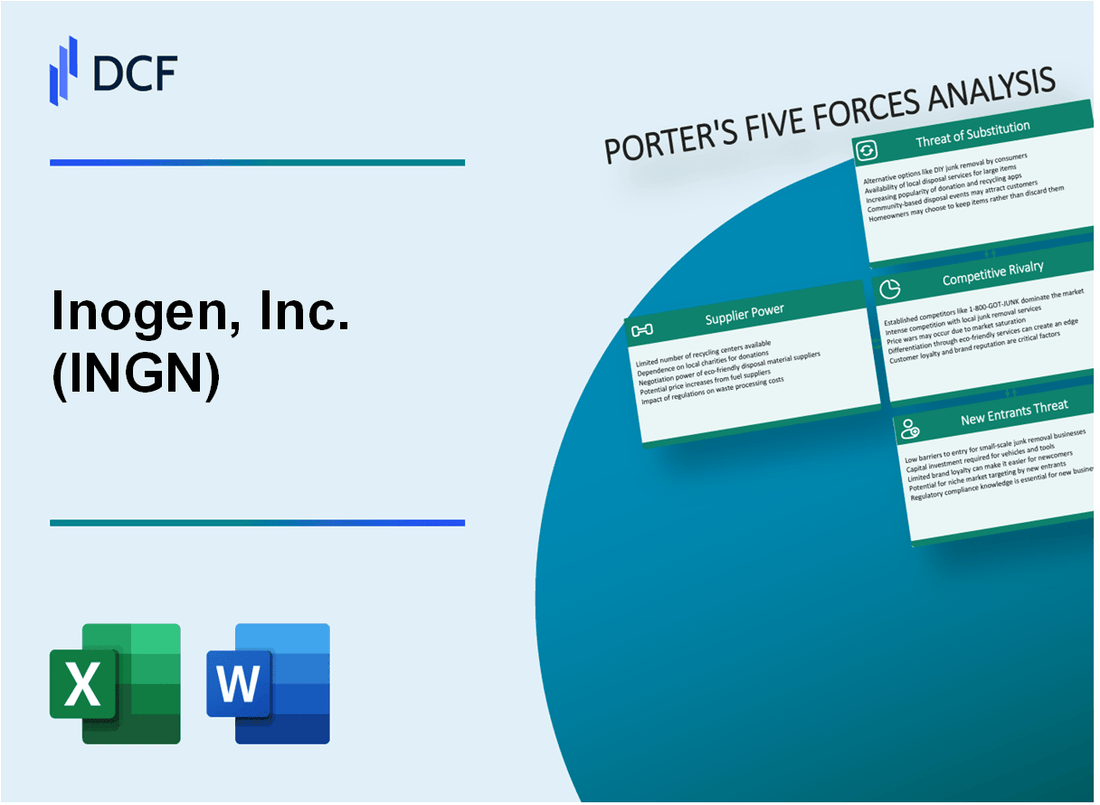
Inogen, Inc. (INGN): 5 Analyse des forces [Jan-2025 MISE À JOUR] |
Entièrement Modifiable: Adapté À Vos Besoins Dans Excel Ou Sheets
Conception Professionnelle: Modèles Fiables Et Conformes Aux Normes Du Secteur
Pré-Construits Pour Une Utilisation Rapide Et Efficace
Compatible MAC/PC, entièrement débloqué
Aucune Expertise N'Est Requise; Facile À Suivre
Inogen, Inc. (INGN) Bundle
Dans le monde dynamique de la technologie médicale, Inogen, Inc. se dresse au carrefour de l'innovation et de la concurrence du marché, naviguant dans un paysage complexe de défis et d'opportunités. En disséquant le cadre des cinq forces de Michael Porter, nous révélons la dynamique complexe qui façonne le positionnement stratégique d'Inogène sur le marché portable du concentrateur d'oxygène. De l'équilibre délicat des relations avec les fournisseurs aux pressions concurrentielles intenses, cette analyse offre un aperçu complet des facteurs critiques stimulant les performances commerciales d'Inogène en 2024, fournissant des informations qui vont au-delà des observations de marché au niveau de la surface.
Inogen, Inc. (INGN) - Porter's Five Forces: Bargaining Power des fournisseurs
Nombre limité de fabricants de composants de qualité médicale spécialisés
En 2024, Inogen repose sur un pool restreint de fabricants de composants de qualité médicale spécialisés. Environ 3 à 4 fournisseurs clés dominent le marché des composants critiques pour la production de concentrateur d'oxygène.
| Catégorie des fournisseurs | Nombre de fournisseurs | Concentration du marché |
|---|---|---|
| Composants électroniques de qualité médicale | 4 | 87% de part de marché |
| Systèmes de filtration d'oxygène de précision | 3 | Part de marché de 92% |
Haute dépendance sur les matières premières spécifiques
La production de concentrateurs d'oxygène d'Inogène nécessite des matières premières spécialisées avec des sources alternatives limitées.
- Métaux de terres rares utilisées dans les composants électroniques: 2-3 fournisseurs mondiaux primaires
- Alloys en aluminium de haute pureté: 4 grands fabricants du monde entier
- Polymères spécialisés de qualité médicale: 3 fabricants mondiaux primaires
Contraintes de chaîne d'approvisionnement pour les composants électroniques avancés
Les défis de la chaîne d'approvisionnement des composants électroniques persistent en 2024:
| Type de composant | Contrainte d'offre annuelle | Volatilité des prix |
|---|---|---|
| Microprocesseurs | 15-20% de pénurie | 12 à 18% Fluctuation des prix |
| Capteurs de précision | 10-15% de limitation de l'offre | 8 à 12% de variation des prix |
Coûts de commutation des fournisseurs
Les exigences réglementaires des dispositifs médicaux créent des barrières de commutation des fournisseurs modérés:
- Processus de certification de la FDA: 12-18 mois moyen
- Documentation de la conformité: 75 000 $ - 150 000 $ par transition du fournisseur
- Test d'assurance qualité: période de validation typique de 6 à 9 mois
Inogen, Inc. (INGN) - Porter's Five Forces: Bargaining Power of Clients
Fournisseurs de soins de santé et options d'oxygénothérapie
Au quatrième trimestre 2023, le marché mondial des concentrateurs portables en oxygène était évalué à 2,1 milliards de dollars. Inogen fait face à la concurrence des principaux fabricants, notamment:
| Concurrent | Part de marché | Gamme de produits |
|---|---|---|
| Philips Respironics | 22.5% | 5 modèles de concentrateur d'oxygène portable |
| ResMed | 18.3% | 3 modèles de concentrateur d'oxygène portable |
| Ingénie | 15.7% | 4 modèles de concentrateur d'oxygène portable |
Sensibilité aux prix sur le marché des équipements médicaux
Les prix moyens des concentrateurs d'oxygène portables varient de 2 000 $ à 3 500 $. Les facteurs de tarification clés comprennent:
- Durée de la durée de vie de la batterie
- Poids et portabilité
- Débit d'oxygène
- Niveau de bruit
Demande de marché du concentrateur d'oxygène portable
Statistiques de croissance du marché pour les concentrateurs d'oxygène portables:
| Année | Taille du marché | Taux de croissance annuel composé |
|---|---|---|
| 2022 | 1,8 milliard de dollars | 8.5% |
| 2023 | 2,1 milliards de dollars | 9.2% |
| 2024 (projeté) | 2,4 milliards de dollars | 9.5% |
Polices de remboursement de l'assurance
Taux de remboursement de Medicare pour les concentrateurs d'oxygène en 2024:
- Taux de location mensuel: 179,48 $
- Prix d'achat: 679,54 $
- Coût moyen du patient patient: 85 $ - 250 $
Inogen, Inc. (INGN) - Five Forces de Porter: rivalité compétitive
Paysage des concurrents directs
En 2024, Inogen fait face à la concurrence directe de:
- Resmed (CAP boursière: 36,47 milliards de dollars en janvier 2024)
- Philips Respironics (Revenu du segment des soins respiratoires: 2,7 milliards de dollars en 2022)
- Concepts O2 (entreprise privée, part de marché d'environ 5 à 7%)
Analyse du marché concurrentiel
| Concurrent | Part de marché | Revenus (2023) | Gamme de produits |
|---|---|---|---|
| Ingénie | 22% | 396,7 millions de dollars | Concentrateurs d'oxygène portables |
| ResMed | 28% | 3,2 milliards de dollars | Dispositifs respiratoires |
| Philips Respironics | 18% | 2,7 milliards de dollars | Solutions d'oxygénothérapie |
Dynamique de la concentration du marché
Caractéristiques du marché du concentrateur d'oxygène portable:
- Taille totale du marché: 2,8 milliards de dollars en 2023
- CAGR projeté: 8,5% de 2024 à 2030
- Nombre d'acteurs importants: 6-8 entreprises
- Indice de concentration du marché: modéré (HHI: 1 200-1,500)
Exigences d'innovation technologique
Pourcentages d'investissement en R&D pour les principaux concurrents:
| Entreprise | Investissement en R&D (%) | Lancements de nouveaux produits (2023) |
|---|---|---|
| Ingénie | 7.2% | 3 nouveaux modèles |
| ResMed | 8.5% | 4 nouveaux modèles |
| Philips Respironics | 6.9% | 2 nouveaux modèles |
Inogen, Inc. (INGN) - Five Forces de Porter: menace de substituts
Méthodes d'administration d'oxygène alternatives
La taille du marché des systèmes d'oxygène liquide était de 2,1 milliards de dollars en 2022, avec un TCAC projeté de 7,3% de 2023 à 2030. Inogen fait face à la concurrence directe des technologies d'oxygène liquide qui offrent d'autres solutions d'administration d'oxygène.
| Méthode d'administration d'oxygène | Part de marché | Coût moyen |
|---|---|---|
| Systèmes de liquide à oxygène | 32% | $1,500-$2,500 |
| Concentrateurs d'oxygène portables | 45% | $2,000-$3,500 |
| Réservoirs d'oxygène traditionnels | 23% | $800-$1,500 |
Technologies de réservoirs d'oxygène traditionnels
Les technologies traditionnelles de réservoirs d'oxygène représentent toujours 23% du marché des dispositifs respiratoires, avec des ventes annuelles d'environ 1,2 milliard de dollars en 2023.
- Les systèmes d'oxygène à base de cylindres restent répandus en milieu à domicile et à l'hôpital
- Durée de vie moyenne des réservoirs d'oxygène traditionnels: 3-5 ans
- Le coût de remplacement varie de 200 $ à 500 $ par réservoir
Solutions émergentes de télésanté et de surveillance à distance
Le marché de la surveillance respiratoire de la télésanté devrait atteindre 5,4 milliards de dollars d'ici 2026, avec un TCAC de 22,7% de 2021-2026.
| Technologie de télésanté | Pénétration du marché | Taux de croissance annuel |
|---|---|---|
| Surveillance respiratoire à distance | 18% | 15.3% |
| Systèmes de gestion de l'oxygène numérique | 12% | 19.6% |
Avansions potentielles dans les technologies de traitement respiratoire
Le marché mondial des dispositifs respiratoires prévoyait de 36,3 milliards de dollars d'ici 2027, avec des technologies innovantes contestant les méthodes traditionnelles d'administration d'oxygène.
- Marché des dispositifs de concentration d'oxygène portable: 450 millions de dollars en 2023
- Les systèmes de surveillance respiratoire intégrés AI ont augmenté à 17,5% par an
- Investissements de recherche sur la livraison d'oxygène basée sur la nanotechnologie: 280 millions de dollars en 2022
Inogen, Inc. (INGN) - Five Forces de Porter: menace de nouveaux entrants
Barrières réglementaires dans la fabrication de dispositifs médicaux
En 2024, le secteur de la fabrication de dispositifs médicaux nécessite une compliance réglementaire approfondie. La FDA a reçu 19 168 soumissions de dispositifs médicaux en 2022, avec un temps d'examen moyen de 177 jours pour 510 (k) dégagement.
| Métrique réglementaire | Valeur |
|---|---|
| Soumissions de périphériques de la FDA (2022) | 19,168 |
| Temps de révision de la FDA moyen | 177 jours |
| Taux de réussite de l'approbation | 68% |
Exigences d'investissement en capital
La R&D des dispositifs médicaux exige des ressources financières substantielles. Les dépenses en R&D d'Inogen en 2023 étaient de 24,3 millions de dollars, ce qui représente 11,2% de ses revenus totaux.
- Investissement moyen de R&D pour les sociétés de dispositifs médicaux: 15 à 30 millions de dollars par an
- Cycle de développement des produits typique: 3-5 ans
- Capital initial estimé requis: 5 à 10 millions de dollars
Complexité d'approbation de la FDA
La FDA classe les dispositifs médicaux en trois catégories de risques, les concentrateurs d'oxygène tombant généralement sous la classe II, nécessitant 510 (k) Notification préalable.
| Classification de l'appareil FDA | Complexité d'approbation |
|---|---|
| Appareils de classe I | Faible risque (510 exemplaires) |
| Appareils de classe II | Risque modéré (510 (k) requis) |
| Appareils de classe III | Risque élevé (approbation préalable) |
Protection de la propriété intellectuelle
Inogen détient 87 brevets actifs en 2023, créant des obstacles importants pour les participants au marché potentiels.
Défis de réputation de la marque
La part de marché d'Inogen dans les concentrateurs d'oxygène portable est d'environ 35%, avec un chiffre d'affaires annuel de 217,4 millions de dollars en 2023.
| Métrique de performance du marché | Valeur |
|---|---|
| Part de marché | 35% |
| Revenus annuels (2023) | 217,4 millions de dollars |
| Nombre de brevets actifs | 87 |
Inogen, Inc. (INGN) - Porter's Five Forces: Competitive rivalry
You're looking at a market where Inogen, Inc. is fighting hard for every dollar, which is typical for a sector with high rivalry. The Portable Oxygen Concentrator (POC) market reached a size of \$2.01 billion in 2025.
Inogen, Inc. is projecting its full-year 2025 revenue to land between \$354 million and \$357 million, reflecting about 6% growth at the midpoint compared to 2024 revenue. This growth is happening while the company navigates intense competition.
The major players you need to watch are ResMed, CAIRE Inc. (Chart Industries), Invacare, and Drive DeVilbiss Healthcare. This group is constantly jockeying for position, and Inogen, Inc. is making strategic shifts to keep pace, evidenced by its Q3 2025 revenue mix. For instance, in Q3 2025, Inogen, Inc.'s total revenue was \$92.4 million, with international B2B sales at \$38.4 million (41.6% of the total) leading the charge, while domestic Direct-to-Consumer sales were only \$15.8 million (17.1%).
Competition centers on the core product attributes that matter most to ambulatory patients. You see this fight play out in the specs:
- Device size and weight are critical for active users.
- Battery life dictates freedom away from an outlet.
- Oxygen output must meet prescribed therapeutic needs.
Take the Inogen Rove 4, for example. It is positioned as ultra-lightweight at 2.9 pounds with its standard battery, offering Pulse Dose settings from 1 to 5, and battery life up to 10 hours on the extended pack. However, competitors offer different value propositions, especially around flow type, which is a key differentiator for patients with higher needs.
Here's a quick look at how the Rove 4 stacks up against a competitor offering continuous flow, which Inogen's pulse-only models cannot match:
| Feature | Inogen Rove 4 | OxLife Independence |
| Weight (Standard Battery) | 2.9 lbs | 16.7 lbs (with cart system) |
| Flow Type | Pulse Dose, settings 1-5 | Pulse Dose (settings 0.5-6) and Continuous Flow (0.5-3 LPM) |
| Max Standard Battery Life (Setting 1) | Up to 5 hours | Up to 5.75 hours per battery (dual option available) |
The competitive field was definitely reshuffled following Philips Respironics' exit from the U.S. market in 2024. Providers noted that with one less major manufacturer, 'Less competition always impacts pricing,' and there was concern that concentrators would become 'harder to come by.' This vacuum intensified the race for market share, forcing companies like Inogen, Inc. and Drive DeVilbiss Healthcare to accelerate production scale-ups to capture the vacated demand.
The intensity is also reflected in strategic moves. In January 2025, Inogen, Inc. announced a strategic partnership and investment with China's Yuwell Medical, indicating a focus on international expansion to drive growth where domestic DTC sales have been soft. This move is a direct action to secure a stronger competitive footing globally.
Finance: draft 13-week cash view by Friday.
Inogen, Inc. (INGN) - Porter's Five Forces: Threat of substitutes
You're looking at the landscape of alternatives to Inogen, Inc.'s core portable oxygen concentrator (POC) business, and it's a mixed bag of established, lower-cost options and new, strategically targeted competition. The threat of substitutes here is significant because oxygen delivery is a mature medical necessity, not a novel technology.
Traditional oxygen tanks, both compressed gas and liquid oxygen, definitely remain a functional, lower-cost substitute, especially for patients less concerned with mobility. Honestly, tanks have a much lower initial price point. While new portable oxygen concentrators typically start around $2,000 for a new device, tanks are cost-effective upfront. The trade-off, of course, is the recurring expense; having full tanks delivered can run a patient several hundred dollars per month, which adds up real fast. Also, tanks are bulky, with weights ranging from 3-50+ lbs, severely limiting patient independence.
For non-ambulatory patients, Stationary Oxygen Concentrators (SOCs) are the default substitute, and this is where Inogen, Inc. is making a direct move. As of June 2025, Inogen launched the Voxi 5 SOC, developed in collaboration with Yuwell Medical. This move acknowledges that the existing SOC market is massive. CEO Kevin Smith noted on the Q3 2025 earnings call that among the long-term oxygen therapy (LTOT) population, nearly 100%-or over 90% certainly-already utilize an SOC. Inogen's POCs are currently used by only about 23% of that population, so the Voxi 5 is designed to capture a much larger segment by offering a 'value-driven solution for price-sensitive customers.' The Voxi 5 delivers 1-5 L/min of quiet, continuous flow oxygen.
New respiratory care technologies are also starting to shift patient preference, even if the financial numbers aren't fully quantified yet. We see a clear industry trend toward embedding connectivity. Inogen, Inc. already has the Inogen Connect solution, which lets providers track data like oxygen purity and battery run time. When you layer in integrated telehealth and remote monitoring capabilities across the entire device ecosystem, it increases the 'stickiness' of a provider's chosen platform, potentially pulling patients away from non-connected, traditional substitutes.
Patient preference for mobility is the primary driver for POC demand, but you can't ignore the budget reality. The high initial cost of a premium POC can definitely push buyers toward cheaper, less portable substitutes like tanks or even a basic SOC if they don't require daily travel. Here's a quick math comparison of the forces at play:
| Feature | Traditional Tanks (Gas/Liquid) | Stationary Oxygen Concentrators (SOCs) | Inogen POCs (General) |
| Initial Purchase Cost | Lower upfront | Varies; Voxi 5 targets 'affordability' | Starts around $2,000 |
| Ongoing Cost | Higher (Refills: potentially several hundred dollars per month) | Lower (Electricity) | Lower (Electricity/Battery replacement) |
| Mobility/Weight | Limited; Bulky (3-50+ lbs) | Low; Room-to-room mobility via casters (Voxi 5) | Excellent; Lightweight (2-10 lbs) |
| Supply Reliability | Finite; Requires regular refills/exchanges | Unlimited (from ambient air) | Unlimited (from ambient air, battery dependent) |
| Market Penetration (LTOT Population) | High (Base for SOCs) | Over 90% have an SOC | Used by 23% of LTOT population |
The fact that Inogen, Inc. reported rental revenue decreased 4.4% to $13.3 million in Q3 2025 suggests that even within their own installed base, the economics of renting versus owning/substituting are shifting. The company is clearly trying to convert users from the finite-supply model to the unlimited-supply concentrator model, whether stationary or portable.
Inogen, Inc. (INGN) - Porter's Five Forces: Threat of new entrants
You're looking at the barriers that keep new players from easily jumping into the portable oxygen concentrator (POC) market where Inogen, Inc. operates. Honestly, the hurdles here are substantial, built on regulation, deep pockets for development, and entrenched relationships.
Significant regulatory barriers exist, requiring FDA 510(k) clearance or PMA for new medical devices.
Getting a new device like a POC through the Food and Drug Administration (FDA) is a major capital sink. For a Class II device, which most POCs fall under, you're looking at the 510(k) clearance pathway, demonstrating substantial equivalence to an existing device. If a new entrant has a truly novel technology without a clear predicate, they might face the more onerous Premarket Approval (PMA) route, which is a different beast entirely. The FDA user fees alone for fiscal year 2025 show the initial commitment required.
| Regulatory Action | Estimated Total Cost (Excluding Internal/Testing) | FDA User Fee (FY 2025 Standard) | Typical Timeline (FDA Goal) |
|---|---|---|---|
| 510(k) Clearance (Class II) | $\mathbf{\$50 K-\$200 K+}$ (Total project cost $\mathbf{\$2 M-\$30 M}$) | $\mathbf{\$24,335}$ | $\mathbf{90}$ FDA days (average clearance $\approx \mathbf{125}$ days) |
| PMA Application (Class III) | $\approx \mathbf{\$500 K-\$5 M+}$ | $\mathbf{\$579,272}$ | $\mathbf{180}$ FDA days |
What this estimate hides is the cost of required testing and the time spent waiting for responses to Additional Information (AI) requests, which definitely extends the timeline past the FDA's goal.
High capital investment is needed for R&D in miniaturization, battery density, and patented pulse-dose technology.
Developing a competitive POC requires continuous, heavy investment in the core technology that makes Inogen, Inc. devices appealing-namely, making them lighter and extending battery life while maintaining effective oxygen delivery via pulse-dose technology. You can see the scale of Inogen, Inc.'s ongoing operational spending, which includes these R&D efforts. For instance, Inogen, Inc.'s total operating expense in the third quarter of 2025 was $\mathbf{\$48.4}$ million. To put that in perspective for a new entrant, Inogen, Inc.'s operating expense in the first quarter of 2025 was $\mathbf{\$44.0}$ million.
- Inogen, Inc. focuses R&D on flow settings, noise reduction, and wireless connectivity.
- The U.S. oxygen concentrator market is projected to reach $\mathbf{\$3.09}$ billion by 2033.
- Inogen, Inc. launched the Rove 4 Portable Oxygen Concentrator in October 2024, utilizing patented pulse-dose Intelligent Delivery Technology.
Established distribution networks (HME, B2B) are difficult for a new entrant to replicate quickly.
Inogen, Inc. has built relationships across various channels, which is critical for market penetration, especially in the B2B space. A new company can't just appear and instantly secure the same level of access to Home Medical Equipment (HME) providers or large institutional buyers. Inogen, Inc.'s revenue in the third quarter of 2025 was $\mathbf{\$92.4}$ million, with growth specifically driven by international and domestic business-to-business customers. This shows the importance of those established B2B relationships. Still, Inogen, Inc. also maintains a direct-to-consumer sales method, which is another complex, expensive network to build from scratch.
- Inogen, Inc.'s full-year 2024 revenue was $\mathbf{\$335.71}$ million.
- B2B sales are a key driver of Inogen, Inc.'s mid-single-digit revenue growth in 2025.
- Replicating Inogen, Inc.'s established direct-to-consumer infrastructure requires significant marketing spend.
Intellectual property (IP) and patents on core technology create a strong barrier to entry.
The patent portfolio acts as a moat around Inogen, Inc.'s core innovations, particularly the miniaturization and pulse-dose delivery systems. A new entrant faces the risk of infringement litigation, which is costly and time-consuming, even if they believe their design is distinct. Inogen, Inc. has noted that certain U.S. patents directed towards the Inogen One G4 and Inogen at Home stationary oxygen concentrator expire in $\mathbf{2031}$ or later, which is a strong deterrent. Furthermore, Inogen, Inc. has a history of defending its IP, such as settling a patent dispute in February 2021 related to an acquisition that cost $\mathbf{\$70.4}$ million in 2019.
| Product Line | Example Patent Expiry/Status | Relevant Patent Number Examples |
|---|---|---|
| Inogen One G4/G5 | Patents expiring $\mathbf{2031}$ or later | $\mathbf{10,869,986}$; $\mathbf{11,686,415}$ |
| Inogen At Home | Patents expiring $\mathbf{2031}$ or later | $\mathbf{10,004,869}$; $\mathbf{10,869,986}$ |
| General IP Defense | Active litigation/settlements | Settlement with Breathe Technologies (2021) |
You see the complexity in the sheer number of patents listed for older models like the Inogen One G3, showing a deep history of IP protection.
Disclaimer
All information, articles, and product details provided on this website are for general informational and educational purposes only. We do not claim any ownership over, nor do we intend to infringe upon, any trademarks, copyrights, logos, brand names, or other intellectual property mentioned or depicted on this site. Such intellectual property remains the property of its respective owners, and any references here are made solely for identification or informational purposes, without implying any affiliation, endorsement, or partnership.
We make no representations or warranties, express or implied, regarding the accuracy, completeness, or suitability of any content or products presented. Nothing on this website should be construed as legal, tax, investment, financial, medical, or other professional advice. In addition, no part of this site—including articles or product references—constitutes a solicitation, recommendation, endorsement, advertisement, or offer to buy or sell any securities, franchises, or other financial instruments, particularly in jurisdictions where such activity would be unlawful.
All content is of a general nature and may not address the specific circumstances of any individual or entity. It is not a substitute for professional advice or services. Any actions you take based on the information provided here are strictly at your own risk. You accept full responsibility for any decisions or outcomes arising from your use of this website and agree to release us from any liability in connection with your use of, or reliance upon, the content or products found herein.