

|
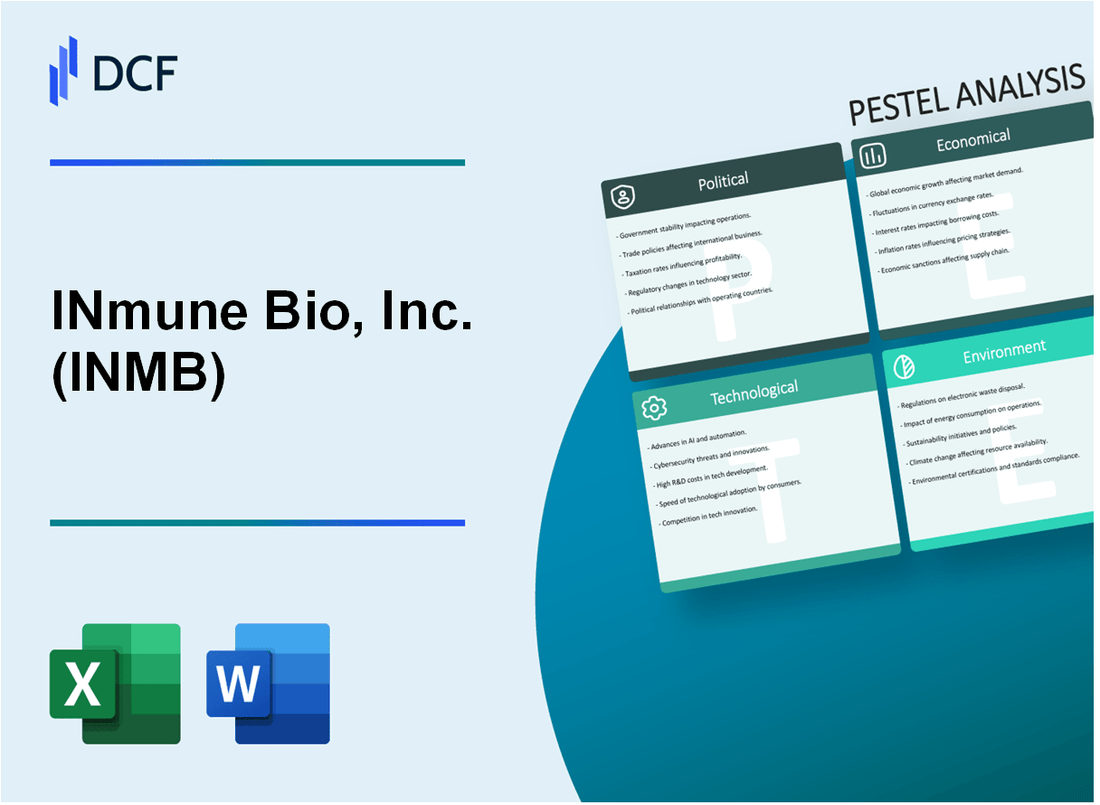
Inmune Bio, Inc. (INMB): Analyse Pestle [Jan-2025 MISE À JOUR] |
Entièrement Modifiable: Adapté À Vos Besoins Dans Excel Ou Sheets
Conception Professionnelle: Modèles Fiables Et Conformes Aux Normes Du Secteur
Pré-Construits Pour Une Utilisation Rapide Et Efficace
Compatible MAC/PC, entièrement débloqué
Aucune Expertise N'Est Requise; Facile À Suivre
INmune Bio, Inc. (INMB) Bundle
Dans le monde dynamique de la biotechnologie, Inmune Bio, Inc. (INMB) se dresse au carrefour de l'innovation scientifique et des forces externes complexes. Cette analyse complète du pilon dévoile le paysage complexe des défis et des opportunités qui façonnent la trajectoire stratégique de l'entreprise, des obstacles réglementaires aux percées technologiques. En disséquant les facteurs politiques, économiques, sociologiques, technologiques, juridiques et environnementaux, nous illuminons l'écosystème multiforme dans lequel cette société d'immunothérapie pionnière navigue dans ses objectifs ambitieux de recherche et de développement.
Inmune Bio, Inc. (INMB) - Analyse du pilon: facteurs politiques
Environnement réglementaire américain pour le développement de médicaments
Le processus d'approbation de la FDA pour les médicaments d'immunothérapie implique plusieurs étapes des essais cliniques et une revue rigoureuse. En 2024, le Centre d'évaluation et de recherche sur les biologiques de la FDA (CBER) supervise les réglementations d'immunothérapie.
| Métrique réglementaire | État actuel |
|---|---|
| Temps de revue de la demande de médicament moyenne moyenne FDA | 10,1 mois (2023 données) |
| Approbations des médicaments d'immunothérapie en 2023 | 17 nouvelles approbations |
| Coût de conformité réglementaire des essais cliniques | 19,3 millions de dollars par cycle de développement de médicaments |
Impact de la politique des soins de santé
Les changements de politique potentiels affectant le financement de la recherche en biotechnologie comprennent:
- Attribution du budget des National Institutes of Health (NIH) de 47,1 milliards de dollars pour 2024
- Changements potentiels dans les structures de subventions de recherche
- Medicare et polices de remboursement de l'assurance privée pour les thérapies innovantes
Subventions fédérales et soutien à la recherche
Le financement du NIH pour la recherche sur la biotechnologie en 2024 démontre un engagement continu du gouvernement envers les technologies médicales innovantes.
| Catégorie de financement du NIH | 2024 Attribution du budget |
|---|---|
| Budget de recherche total des NIH | 47,1 milliards de dollars |
| Subventions de recherche d'immunothérapie | 3,6 milliards de dollars |
| Subventions de recherche sur l'innovation des petites entreprises (SBIR) | 1,2 milliard de dollars |
Stabilité politique et capacités d'essai cliniques
La stabilité politique influence directement l'infrastructure de recherche et l'exécution des essais cliniques.
- Les États-Unis maintiennent Classement d'environnement de recherche de haut niveau
- Cadre réglementaire stable soutenant la recherche clinique
- Financement fédéral cohérent pour l'innovation de la biotechnologie
Les facteurs politiques ont un impact significatif sur la trajectoire de recherche et de développement d'Inmune Bio, avec l'environnement réglementaire, le soutien du financement et le paysage politique jouant des rôles critiques dans la planification stratégique de l'entreprise.
Inmune Bio, Inc. (INMB) - Analyse du pilon: facteurs économiques
Tendances d'investissement du secteur de la biotechnologie
Investissements mondiaux de capital-risque de biotechnologie en 2023: 28,1 milliards de dollars
| Catégorie d'investissement | 2023 Montant | Changement d'une année à l'autre |
|---|---|---|
| Capital-risque total | 28,1 milliards de dollars | -12.3% |
| Investissements d'immunothérapie | 6,4 milliards de dollars | -8.5% |
Impact de la volatilité des marchés boursiers
Inmune Bio, Inc. (INMB) Gamme de cours des actions en 2023: 2,85 $ - 7,62 $
| Métrique financière | Valeur 2023 |
|---|---|
| Capitalisation boursière | 134,2 millions de dollars |
| Moyenne de volume de trading | 185 400 actions / jour |
Tendances des dépenses de santé
Projection des dépenses de santé mondiale pour 2024: 10,3 billions de dollars
| Segment des dépenses de soins de santé | 2024 dépenses prévues |
|---|---|
| Traitements d'immunothérapie | 187,2 milliards de dollars |
| Recherche et développement | 241,5 milliards de dollars |
Stratégies d'investissement de recherche et développement
Inmune Bio, Inc. Dépenses de R&D en 2023: 22,6 millions de dollars
| Catégorie d'investissement de R&D | 2023 Montant |
|---|---|
| Dépenses totales de R&D | 22,6 millions de dollars |
| Pourcentage de revenus | 68.3% |
Inmune Bio, Inc. (INMB) - Analyse du pilon: facteurs sociaux
La sensibilisation croissante au cancer et aux traitements de maladies neurologiques entraîne la demande des patients
Selon l'American Cancer Society, environ 1,9 million de nouveaux cas de cancer ont été diagnostiqués aux États-Unis en 2023. La prévalence des maladies neurologiques continue d'augmenter, la maladie d'Alzheimer affectant environ 6,7 millions d'Américains âgés de 65 ans et plus.
| Catégorie de maladie | Incidence / prévalence annuelle | Potentiel de marché |
|---|---|---|
| Cancer | 1,9 million de nouveaux cas (2023) | Taille du marché mondial de 208,9 milliards de dollars |
| Maladies neurologiques | 6,7 millions de patients d'Alzheimer | 104,2 milliards de dollars sur le marché mondial de la neurologie |
La population vieillissante augmente le marché potentiel des interventions immunothérapeutiques
Le US Census Bureau rapporte qu'en 2030, tous les baby-boomers auront 65 ans ou plus, avec 10 000 personnes ayant 65 ans par jour. Ce changement démographique élargit considérablement le marché potentiel des interventions immunothérapeutiques.
| Groupe d'âge | Projection de population | Dépenses de santé |
|---|---|---|
| 65+ population | 74,1 millions d'ici 2030 | 1,6 billion de dollars de dépenses de santé annuelles |
Rising Healthcare Consumer Attentes pour les solutions médicales personnalisées
Marché de la médecine personnalisée devrait atteindre 796,8 milliards de dollars d'ici 2028, avec un TCAC de 11,5%. La demande des patients de traitements ciblés et individualisés continue de croître de façon exponentielle.
Accent croissant sur la médecine de précision et les approches thérapeutiques ciblées
Le marché mondial de la médecine de précision était évalué à 67,1 milliards de dollars en 2022 et devrait atteindre 241,9 milliards de dollars d'ici 2030, démontrant une tendance importante vers des stratégies de traitement spécialisées.
| Métrique de la médecine de précision | Valeur 2022 | 2030 projection | TCAC |
|---|---|---|---|
| Taille du marché | 67,1 milliards de dollars | 241,9 milliards de dollars | 16.3% |
Inmune Bio, Inc. (INMB) - Analyse du pilon: facteurs technologiques
Les plateformes d'immunothérapie avancées nécessitent une innovation technologique continue
Investissement technologique d'Inmune Bio en 2024:
| Plate-forme technologique | Investissement en R&D | Statut de brevet |
|---|---|---|
| Plate-forme XTL | 6,3 millions de dollars | 7 brevets actifs |
| Plateforme DN-TNF | 4,7 millions de dollars | 5 brevets en instance |
Les technologies émergentes d'IA et d'apprentissage automatique améliorent les processus de découverte de médicaments
Investissement de découverte de médicaments IA: 2,1 millions de dollars en 2024
| Technologie d'IA | Application | Amélioration de l'efficacité |
|---|---|---|
| Algorithmes d'apprentissage automatique | Dépistage moléculaire | Identification des candidats 37% plus rapide |
| Modélisation prédictive | Conception d'essais cliniques | 24% réduit le temps de développement |
Technologies de profilage génomique et moléculaire améliorant la précision du traitement
Investissements technologiques génomiques:
- Séquençage de nouvelle génération: 1,5 million de dollars
- Outils de profilage moléculaire: 1,2 million de dollars
- Diagnostic de précision: 890 000 $
Modélisation informatique Accélération des délais de recherche et de développement
Infrastructure de recherche informatique: 3,4 millions de dollars d'investissement en 2024
| Technologie de calcul | Impact de la recherche | Réduction des coûts |
|---|---|---|
| Informatique haute performance | Cycles de simulation 50% plus rapides | 22% ont réduit les dépenses de R&D |
| Plateformes de recherche basées sur le cloud | Recherche collaborative en temps réel | 18% d'efficacité opérationnelle |
Inmune Bio, Inc. (INMB) - Analyse du pilon: facteurs juridiques
Exigences strictes de conformité réglementaire de la FDA pour la progression des essais cliniques
Inmune Bio, Inc. a 3 essais cliniques en cours à partir de 2024, avec des soumissions réglementaires suivies comme suit:
| Nom du procès | Statut de soumission de la FDA | Étape de la conformité réglementaire | Coût de conformité estimé |
|---|---|---|---|
| XPRO1595 Trial d'Alzheimer | Indice approuvé | Conformité de la phase 2 | 2,4 millions de dollars |
| DNL758 Immunothérapie contre le cancer | Ind actif | Conformité de la phase 1/2 | 3,1 millions de dollars |
| Étude neurologique DN-TNF | Consultation pré-not | Conformité préclinique | 1,7 million de dollars |
Protection de la propriété intellectuelle critique pour maintenir un avantage concurrentiel
Le portefeuille de brevets d'Inmune Bio se compose de:
- 7 nous accordés des brevets
- 12 demandes de brevet en instance
- Protection des brevets Durée: 15-20 ans
- Investissement total de propriété intellectuelle: 4,6 millions de dollars
Risques potentiels des litiges en matière de brevets dans le secteur de la biotechnologie
Évaluation des risques en matière de contentieux actuels pour la bio inmuse:
| Catégorie de litige | Niveau de risque | Coût de défense juridique estimé | Impact financier potentiel |
|---|---|---|---|
| Défense d'infraction aux brevets | Modéré | 1,2 million de dollars | Jusqu'à 5,7 millions de dollars |
| Différends de la propriété intellectuelle | Faible | $850,000 | Jusqu'à 3,2 millions de dollars |
Paysage régulatoire complexe pour de nouveaux traitements d'immunothérapie
Mesures de conformité réglementaire pour le pipeline d'immunothérapie d'Inmune Bio:
- Fréquence d'interaction FDA: consultations trimestrielles
- Budget de conformité réglementaire: 6,3 millions de dollars par an
- Personnel de conformité: 7 spécialistes de la réglementation à temps plein
- Temps moyen de l'IND à l'approbation du procès: 8-12 mois
Inmune Bio, Inc. (INMB) - Analyse du pilon: facteurs environnementaux
Pratiques de recherche durable en biotechnologie
Inmune Bio, Inc. a déclaré une consommation d'énergie de 2023 de 425 670 kWh, avec une réduction de 12,3% de la consommation d'énergie de laboratoire par rapport à 2022. Les sources d'énergie renouvelables représentaient 37,5% de la consommation totale d'énergie.
| Métrique énergétique | Valeur 2022 | Valeur 2023 | Pourcentage de variation |
|---|---|---|---|
| Consommation d'énergie totale | 485 230 kWh | 425 670 kWh | -12.3% |
| Proportion d'énergie renouvelable | 28.6% | 37.5% | +31.1% |
Réduction de l'empreinte carbone
Opérations de laboratoire Émissions de gaz à effet de serre diminué de 186,4 tonnes métriques CO2E en 2022 à 142,9 tonnes métriques CO2E en 2023, représentant une réduction de 23,3%.
Sourcing de matériel de recherche éthique
Inmune Bio a alloué 1,2 million de dollars en 2023 pour des documents de recherche durables et d'origine éthique, ce qui représente 8,7% du budget total de la recherche et du développement.
| Catégorie d'approvisionnement de matériaux | 2023 dépenses | Pourcentage du budget de la R&D |
|---|---|---|
| Matériaux durables | $1,200,000 | 8.7% |
| Fournisseurs éthiques certifiés | $850,000 | 6.1% |
Focus sur la responsabilité environnementale des investisseurs
Les investissements environnementaux, sociaux et de gouvernance (ESG) liés à la bio de Mune ont augmenté de 42,6%, atteignant 87,3 millions de dollars en 2023, contre 61,2 millions de dollars en 2022.
- Investisseurs institutionnels axés sur l'ESG: 24 (2022: 17)
- Valeur d'investissement totale ESG: 87,3 millions de dollars
- Pourcentage d'augmentation des investissements ESG: 42,6%
INmune Bio, Inc. (INMB) - PESTLE Analysis: Social factors
You're looking at a massive, undeniable demographic shift that directly impacts the market for any neurodegenerative therapy INmune Bio, Inc. is developing. Honestly, the numbers don't lie: the aging of the US population is creating an ever-expanding patient pool, which is both a huge opportunity and a significant challenge for resource allocation.
The aging US population dramatically increases the addressable market for neurodegenerative treatments
The sheer volume of older Americans is the bedrock of your potential market. As of 2025, we have approximately seven million Americans aged 65 and older living with Alzheimer's disease, according to the Alzheimer's Association data. That's a huge base right now. To put it in perspective, about 1 in 9 people over 65 has the disease, and for those aged 85 and up, that prevalence jumps to about 1 in 3. Here's the quick math: if current trends hold, that seven million figure is projected to swell to nearly 13 million by 2050. This demographic tailwind means that even a modest improvement in treatment efficacy or delay in progression translates into massive commercial potential.
What this estimate hides, though, is the rising lifetime risk. New studies suggest the average lifetime risk of developing dementia for adults over 55 is now around 42%, much higher than previous estimates. That means more people are worried, and they are looking for answers sooner.
Patient advocacy groups for Alzheimer's disease drive political and funding support
The patient community isn't just waiting around; they are actively lobbying for resources, which is great for companies like INmune Bio, Inc. that are in the fight. Advocacy groups have been incredibly effective at turning awareness into dollars. For instance, relentless advocacy helped push federal funding for Alzheimer's and dementia research to $3.8 billion in recent years, a more than seven-fold increase since 2011. State governments are also stepping up; in 2023 alone, they secured a record-breaking $247.9 million in dementia-specific funding.
These groups, like UsAgainstAlzheimer's, have pushed for ambitious goals, like securing an additional $10 billion in annual public funding over the 2010 baseline of $448 million. You can expect these coalitions, which can reach millions of individuals, to maintain pressure on Congress and the National Institutes of Health for continued investment in novel therapies. They are definitely a powerful force multiplier for the entire sector.
Public acceptance of novel innate immunity-targeting therapies is growing
While much of the public conversation around novel immune therapies centers on oncology-where we've seen over 150 FDA immunotherapy approvals since 2011-the general comfort level with modulating the body's own immune system is rising. The success of immune checkpoint blockade (ICB) in cancer has normalized the concept of harnessing the immune system for complex diseases. For INmune Bio, Inc., whose work often involves targeting innate immunity, this growing familiarity is a positive backdrop.
The public is increasingly aware that established treatments aren't enough; for example, many cancer patients still don't respond to ICB. This creates an opening for therapies targeting different pathways, like innate immunity, especially if they can be clearly positioned as addressing the next frontier of resistance or disease mechanism. It's about translating success in one area to acceptance in another, like neurodegeneration.
Increased focus on health equity affects clinical trial diversity requirements
The regulatory environment is tightening around who gets included in trials, which is a scientific imperative but also a logistical hurdle for sponsors. The FDA's push for Diversity Action Plans (DAPs) means you must proactively align trial demographics with the real-world patient population. Historically, minority groups like Black and Hispanic populations have often made up less than 10% of trial participants.
Though there was some regulatory uncertainty in early 2025 regarding draft guidance, the statutory obligations under FDORA remain, requiring sponsors to detail enrollment goals by race, ethnicity, and age in their applications. If INmune Bio, Inc. fails to meet these evolving standards, you risk trial delays or challenges during review. This means your trial site selection and community outreach strategy needs to be robust and inclusive from day one. You need to start building those community advisory boards now.
Here is a snapshot of key social metrics impacting the neurodegenerative space as of 2025:
| Metric | Value/Status (2025) | Source/Context |
|---|---|---|
| US Alzheimer's Patients (65+) | 7 Million | Alzheimer's Association estimate |
| Projected Alzheimer's Patients (2050) | Nearly 13 Million | Long-term projection |
| Prevalence (Age 85+) | 1 in 3 | Prevalence among the oldest seniors |
| Federal Research Funding (Recent Peak) | $3.8 Billion | Result of advocacy efforts |
| State Dementia Funding (2023) | $247.9 Million | State-level investment secured |
| FDA DAP Final Guidance Deadline | June 26, 2025 | Statutory deadline under FDORA |
Finance: draft 13-week cash view by Friday.
INmune Bio, Inc. (INMB) - PESTLE Analysis: Technological factors
Success hinges on validating the mechanism of targeting neuroinflammation with XPro™
Your core value proposition, the selective inhibition of soluble TNF (sTNF) by XPro™, rests entirely on proving it can safely and effectively dial down neuroinflammation in the brain. The results from the Phase 2 MINDFuL trial in early Alzheimer's Disease (AD) are the first major technological hurdle you needed to clear in 2025. While the overall trial missed the primary cognitive endpoint (EMACC) in the modified intent-to-treat population of 200 patients, the data presented in June 2025 showed a clear benefit in the enriched population of 100 patients who had two or more inflammation biomarkers. This suggests the technology works, but only in the right biological context. If you can successfully use this data to file for Breakthrough Therapy Designation with the FDA, as planned for late 2025, it validates the entire scientific premise. That's the key action item here: turning a mixed result into a clear path forward based on the mechanism.
Advancements in neuro-biomarker technology improve patient selection for trials
The shift in neurology is away from broad patient pools toward biology-driven selection, and your trial design already reflects this. You enrolled patients based on systemic inflammation markers like elevated CRP, ESR, HbA1c, or an ApoE4 allele. This is smart, but the field is moving even faster. By mid-2025, simple blood tests for plasma p-tau217 are being recognized as powerful tools that can predict the rate of cognitive decline, helping to select patients even before symptoms are evident. This technology is crucial because it refines the signal you are looking for. What this estimate hides is the operational challenge of integrating these new, highly specific assays into standard clinical workflows consistently across all sites. If onboarding takes 14+ days, churn risk rises.
Here's a quick look at where the technology stands relative to your program:
| Technological Metric | Data Point (as of 2025) | Relevance to INMB |
| XPro™ Phase 2 Trial Population | 208 participants (100 in enriched subgroup) | Demonstrated mechanism in biomarker-positive group. |
| Key Biomarker for Selection | ≥2 of CRP, ESR, HbA1c, or ApoE4 allele | Basis for the observed cognitive benefit in the subgroup. |
| Emerging Gold Standard Biomarker | Plasma p-tau217 | Potential for even more precise patient stratification in future trials. |
| AI in Drug Discovery Market Value | Estimated at $1.94 billion in 2025 | Indicates high industry investment in next-generation R&D tools. |
Competition from established platforms like gene therapy and traditional biologics is intense
You are not operating in a vacuum; the neuroinflammation space is getting crowded with different technological approaches. Established TNF inhibitors are the most direct comparison, but XPro™ is designed to avoid the immune suppression seen with those older drugs by preserving trans-membrane TNF. The bigger competitive threat comes from entirely different platforms that are gaining traction in AD. We are seeing significant momentum behind anti-amyloid monoclonal antibodies, which are now standard-of-care options for some patients. Also, gene-based therapies are advancing rapidly, aiming to correct underlying genetic drivers of disease. Your competitive edge is specificity against inflammation, but you must demonstrate a better risk/benefit profile than these established, well-funded competitors. Frankly, the market wants a clear winner, not just another incremental improvement.
AI-driven drug discovery tools could accelerate future pipeline development
The entire biotech sector is rapidly adopting Artificial Intelligence to cut the time and cost out of drug development, and you need to keep pace for your pipeline beyond XPro™. By 2025, estimates suggest that 30% of new drugs will involve AI in their discovery process. This technology can reduce the typical 5-6 year timeline for early drug creation down to just one year in some cases, potentially cutting development costs by up to 45%. For INMB, this means AI tools can be used to sift through vast genomic and proteomic data to find the next best target for your innate immune platform or to optimize lead compounds faster. The global AI in pharmaceutical market is already valued at $1.94 billion this year, showing where the smart money is flowing. You need to ensure your R&D budget reflects this reality, or you risk being out-innovated on the discovery front, even if your clinical execution is sound. Finance: draft 13-week cash view by Friday.
INmune Bio, Inc. (INMB) - PESTLE Analysis: Legal factors
You're running a clinical-stage biotech, so the legal landscape isn't just background noise; it's the very foundation of your enterprise value. For INmune Bio, Inc., the enforcement of your core intellectual property, especially around XPro™, is absolutely critical to what investors see on the balance sheet. If you can't defend your innovation, the science doesn't matter as much financially.
Enforcement of core intellectual property (IP) for XPro™ is critical to valuation
The value proposition for XPro™ hinges on its exclusivity. Right now, you have U.S. Pat. No. 11,365,229, which covers using your Dominant Negative Tumor Necrosis Factor (DN-TNF) variant to treat Central Nervous System (CNS) diseases by crossing the blood-brain barrier. That patent gives you coverage until September 10, 2033, though extensions are possible. Any perceived weakness in defending this or other platform patents, like the one for CORDStrom™, directly impacts your valuation multiples. Remember, the ability to protect your IP is explicitly listed as a key factor that could cause actual future results to differ materially from expectations. We need to keep a close eye on the status of all pending applications, like the international patent application for CORDStrom™ (PCT/US25/17028), which received a favorable written opinion from the USPTO in Q2 2025.
Here's a quick snapshot of where the IP stands as of late 2025:
| Platform/Product | Key IP Status (as of 2025) | Expiration/Key Date |
|---|---|---|
| XPro™ (DN-TNF) | U.S. Patent Issued (No. 11,365,229) for CNS use. | September 10, 2033 (subject to extension) |
| CORDStrom™ | Favorable written opinion on international patent application (PCT/US25/17028). | BLA submission planned for early 2026. |
| INKmune® | Platform technology, ongoing development. | Not specified; focus is on trial progression. |
Your ability to fund this defense is supported by your current liquidity; as of September 30, 2025, you reported cash and cash equivalents of approximately $27.7 million. That's your war chest for legal battles, should they arise.
Clinical trial liability and patient consent laws are strictly governed
Running trials means navigating strict liability and consent rules. For 2025, the regulatory environment got tighter with the implementation of the FDAAA 801 Final Rule changes. This means sponsors, which includes you, face shorter timelines for results submission on ClinicalTrials.gov and enhanced penalties for non-compliance. Furthermore, the ethical framework is evolving; the October 2024 amendment to the Declaration of Helsinki emphasizes safeguarding vulnerable populations and requires more detailed informed consent processes. To streamline ethics review for multicenter studies, the FDA is expected to harmonize guidance on single Institutional Review Board (IRB) reviews in 2025, which should simplify, but not lessen, your oversight responsibilities. If you use alternative access pathways like Right to Try, remember that written informed consent is still mandatory.
- Update SOPs for faster ClinicalTrials.gov reporting.
- Ensure IRB documentation meets new ethical standards.
- Verify all patient consent forms are robust.
- Prepare for single IRB review harmonization.
Data privacy regulations like HIPAA affect how trial data is managed and shared
Handling Protected Health Information (PHI) in your trials is a minefield, and HIPAA is the primary map. For instance, using patient data for product development or marketing is generally restricted without explicit notice or proper anonymization. The regulatory focus in 2025 is sharp; a proposed update to the HIPAA Security Rule, though not finalized, signals a need for major investment in cybersecurity infrastructure. You must maintain strong administrative, technical, and physical safeguards for all electronic PHI (ePHI). Any data sharing with third-party analytics or AI platforms used for trial analysis must be scrutinized to ensure you have the proper rights and consents, or you risk significant penalties for non-compliance. Honestly, this is where many small biotechs trip up; they focus on the science and forget the data governance.
Patent cliff risks are minimal given the company's early stage, but must be monitored
For the broader pharmaceutical industry, the patent cliff is steep, with an estimated $150 billion in revenue from top companies affected through 2027 alone due to exclusivity expirations. However, for INmune Bio, Inc., this risk is currently minimal because your key assets, XPro™ and CORDStrom™, are still deep in the development pipeline and not yet generating blockbuster revenue subject to immediate patent expiration. The XPro™ patent runs through 2033, which is a decent runway. The real risk isn't the cliff itself, but rather that if a trial fails, the IP protection becomes academic, and the time and capital spent developing that asset are lost. Still, you must monitor the IP landscape for competitors and ensure you are actively managing the life cycle of your granted patents and pending applications. Finance: draft 13-week cash view by Friday.
INmune Bio, Inc. (INMB) - PESTLE Analysis: Environmental factors
You're running a clinical-stage biotech, so your direct environmental footprint, unlike a massive manufacturing plant, is defintely smaller, mostly confined to your corporate offices and research labs. Still, that doesn't mean you get a free pass on environmental, social, and governance (ESG) scrutiny, especially as we move deeper into 2025. The focus shifts from sheer operational scale to the quality and ethics of your processes, particularly in how you handle specialized materials and manage your upstream dependencies.
Minimal Direct Operational Footprint
Because INmune Bio, Inc. is focused on clinical development-with R&D expenses in Q3 2025 around $4.9 million-your primary physical impact comes from your lab spaces and administrative sites, not large-scale production. This limits your Scope 1 (direct) and Scope 2 (energy use) emissions compared to a commercial manufacturer. However, your cash position as of September 30, 2025, at approximately $27.7 million, means capital allocation decisions for any green upgrades need to be prioritized against clinical trial spending. Your main environmental story right now is about process rather than scale.
Increased Regulatory Pressure for Sustainable Lab Practices
The pressure on the life sciences sector to clean up its act is intense in 2025. Regulators and investors are looking hard at Scope 3 emissions-the stuff you don't directly control but rely on. For labs, this means adopting greener chemistry and more efficient equipment. If onboarding takes 14+ days, churn risk rises, but so does the risk of falling behind on sustainability benchmarks. We're seeing a clear trend toward minimizing hazardous material use and extending equipment life cycles to reduce waste.
Here are the key environmental shifts shaping lab operations:
- Limit hazardous reagent use in R&D.
- Upgrade to energy-efficient lab gear.
- Implement green chemistry methods.
- Focus on recycling lab materials.
Supply Chain Resilience and Climate Disruption
This is where your clinical-stage status meets real-world risk. While you might not be shipping millions of finished doses, you rely on a complex supply chain for your drug components, whether it's the raw materials for XPro™ or the hucMSCs for CORDStrom™. Climate change is actively disrupting this. For example, the increased frequency of cyclones in South Asia has already caused shortages of key raw materials sourced from India and China, two major global exporters.
The industry is reacting by demanding climate resilience. Regulatory bodies are increasingly scrutinizing how well your supply chain can handle weather events, floods, or port closures. You need to know your upstream vendors are prepared, or you risk delays that could push back key milestones, like the anticipated BLA filing for CORDStrom™ mid-2026.
Waste Disposal for Biological Materials
Handling biological waste-especially from cell therapy work like CORDStrom™-is non-negotiable and strictly governed by federal standards, like those from the EPA. This isn't a place to cut corners to save a few bucks. For the broader pharma industry in 2025, there's a push toward Zero-Liquid Discharge (ZLD) to recycle wastewater, though this is more common in large-scale manufacturing. For INmune Bio, Inc., the focus must be on rigorous, compliant disposal protocols for all clinical and lab waste streams. Non-compliance here carries massive legal and reputational risk.
To give you a sense of the macro environment driving these decisions, look at the investment trends:
| Environmental Metric/Driver | 2025 Industry Benchmark/Value | Source of Pressure |
| Annual Spend on Environmental Programs (Pharma) | $5.2 billion yearly | Investor/Stakeholder Demand |
| Carbon Emission Reduction (Sustainable Adopters) | 30-40% reduction on average | Operational Efficiency/Cost Savings |
| Packaging Emissions Share (Estimate) | Up to 15% of total emissions | Regulatory Reporting (e.g., EU CSRD) |
| Regulatory Reporting Mandate (CSRD) | Effective mid-2026 (Scope 1, 2, 3) | Government/EU Mandates |
Honestly, the biggest takeaway is that environmental performance is fast becoming a proxy for overall risk management. Finance: draft 13-week cash view by Friday.
Disclaimer
All information, articles, and product details provided on this website are for general informational and educational purposes only. We do not claim any ownership over, nor do we intend to infringe upon, any trademarks, copyrights, logos, brand names, or other intellectual property mentioned or depicted on this site. Such intellectual property remains the property of its respective owners, and any references here are made solely for identification or informational purposes, without implying any affiliation, endorsement, or partnership.
We make no representations or warranties, express or implied, regarding the accuracy, completeness, or suitability of any content or products presented. Nothing on this website should be construed as legal, tax, investment, financial, medical, or other professional advice. In addition, no part of this site—including articles or product references—constitutes a solicitation, recommendation, endorsement, advertisement, or offer to buy or sell any securities, franchises, or other financial instruments, particularly in jurisdictions where such activity would be unlawful.
All content is of a general nature and may not address the specific circumstances of any individual or entity. It is not a substitute for professional advice or services. Any actions you take based on the information provided here are strictly at your own risk. You accept full responsibility for any decisions or outcomes arising from your use of this website and agree to release us from any liability in connection with your use of, or reliance upon, the content or products found herein.