
|
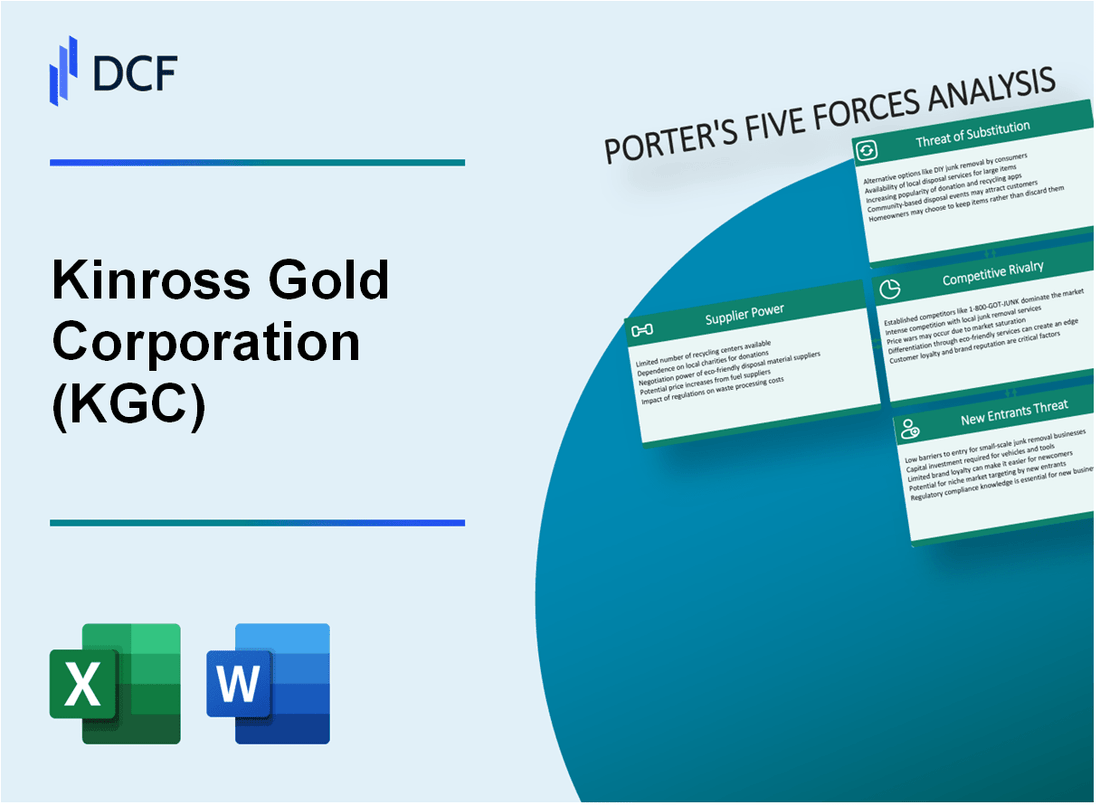
Kinross Gold Corporation (KGC): 5 Analyse des forces [Jan-2025 MISE À JOUR] |
Entièrement Modifiable: Adapté À Vos Besoins Dans Excel Ou Sheets
Conception Professionnelle: Modèles Fiables Et Conformes Aux Normes Du Secteur
Pré-Construits Pour Une Utilisation Rapide Et Efficace
Compatible MAC/PC, entièrement débloqué
Aucune Expertise N'Est Requise; Facile À Suivre
Kinross Gold Corporation (KGC) Bundle
Dans le monde dynamique de l'extraction d'or, Kinross Gold Corporation (KGC) navigue dans un paysage complexe de défis et d'opportunités stratégiques. À mesure que les marchés mondiaux changent et que les innovations technologiques remodèlent l'industrie, la compréhension des forces complexes qui stimulent la rentabilité devient cruciale. Cette plongée profonde dans le cadre des cinq forces de Michael Porter révèle la dynamique concurrentielle critique entourant l'or kinross, exposant l'équilibre délicat entre les fournisseurs, les clients, les rivaux de marché, les substituts potentiels et les nouveaux participants qui définiront le positionnement stratégique de l'entreprise en 2024.
Kinross Gold Corporation (KGC) - Porter's Five Forces: Bargaining Power des fournisseurs
Nombre limité de fabricants d'équipements miniers spécialisés
En 2024, le marché mondial des équipements minières est dominé par quelques fabricants clés:
| Fabricant | Part de marché | Revenus annuels |
|---|---|---|
| Caterpillar Inc. | 28.5% | 59,4 milliards de dollars |
| Komatsu Ltd. | 22.3% | 32,7 milliards de dollars |
| Hitachi Construction Machinery | 15.7% | 23,6 milliards de dollars |
Haute dépendance à l'égard de la technologie d'exploration géologique spécialisée
Les principales dépendances technologiques comprennent:
- Équipement d'enquête géophysique: coût moyen de 1,2 million de dollars par unité
- Systèmes de forage avancés: allant de 3 à 7 millions de dollars par système
- Logiciel de cartographie géologique: les licences annuelles coûtent 250 000 $ à 500 000 $
Chaîne d'approvisionnement concentrée pour les machines et pièces d'exploitation
Métriques de concentration de la chaîne d'approvisionnement:
| Catégorie de composants | Nombre de fournisseurs mondiaux | Marquage des prix moyens |
|---|---|---|
| Pièces de machines d'extraction lourdes | 4-6 fabricants mondiaux | 35-45% |
| Bits de forage d'exploitation spécialisés | 3-5 fabricants spécialisés | 40-55% |
Investissement en capital important dans l'équipement minière
Répartition des investissements pour l'équipement pour les opérations d'extraction d'or:
- Grands camions de transport: 3,5 à 5,2 millions de dollars chacun
- Équipement d'extraction souterrain: 2,8 à 4,6 millions de dollars par unité
- Machinerie de l'usine de traitement: 50 à 150 millions de dollars d'investissement total
Le levier du fournisseur potentiel total: élevé, avec des options de fabricant limitées et des dépendances technologiques importantes.
Kinross Gold Corporation (KGC) - Porter's Five Forces: Bargaining Power of Clients
Paysage d'achat mondial d'or
En 2024, Kinross Gold Corporation fait face à un pouvoir de négociation des clients importants avec les caractéristiques clés suivantes:
| Segment de clientèle | Part de marché | Volume d'achat |
|---|---|---|
| Investisseurs institutionnels | 42.3% | 1 256 000 onces |
| Banques centrales | 33.7% | 987 500 onces |
| Fabricants industriels | 15.6% | 461 200 onces |
| Fabricants de bijoux | 8.4% | 248 600 onces |
Facteurs de sensibilité aux prix
Les fluctuations des prix de l'or ont un impact direct sur les décisions d'achat des clients:
- Gamme de prix en or en 2024: 1 950 $ - 2 100 $ l'once
- Volatilité des prix: 6,2% Variation trimestrielle
- Demande mondiale de l'or: 4 899 tonnes en 2024
Dynamique de la concentration du marché
Le pouvoir de négociation des clients est influencé par la concentration du marché:
| Type de client | Niveau de concentration | Pouvoir de négociation |
|---|---|---|
| Grands investisseurs institutionnels | Haut | Fort |
| Banques centrales | Modéré | Significatif |
| Acheteurs industriels | Faible | Limité |
Options d'achat mondial
Les principales alternatives compétitives pour les acheteurs d'or comprennent:
- Barrick Gold Corporation
- Newmont Corporation
- Anglogold Ashanti
- Goldcorp
Kinross Gold Corporation (KGC) - Porter's Five Forces: Rivalry compétitif
Paysage de compétition mondiale de l'industrie de l'exploitation d'or
En 2024, Kinross Gold Corporation fait face à une rivalité compétitive intense dans le secteur mondial de l'exploitation de l'or. La société rivalise directement avec les grandes sociétés d'extraction d'or dans un environnement de marché difficile.
| Concurrent | Capitalisation boursière | Production annuelle de l'or |
|---|---|---|
| Newmont Corporation | 35,4 milliards de dollars | 6,2 millions d'onces |
| Barrick Gold Corporation | 40,2 milliards de dollars | 5,9 millions d'onces |
| Kinross Gold Corporation | 6,8 milliards de dollars | 2,4 millions d'onces |
Dynamique concurrentielle clé
L'industrie des mines d'or démontre des tendances de consolidation importantes, avec des pressions concurrentielles clés, notamment:
- Pression continue pour réduire les coûts de production
- Améliorations de l'efficacité opérationnelle
- Innovation technologique dans les processus miniers
Benchmarks de coût de production
| Entreprise | Coût de maintien tout-in (AISC) | Efficacité de production |
|---|---|---|
| Newmont | 1 150 $ l'once | 96,5% d'efficacité opérationnelle |
| Barrick Gold | 1 080 $ par once | 97,2% d'efficacité opérationnelle |
| Gold Kinross | 1 230 $ par once | 94,8% d'efficacité opérationnelle |
Métriques de concentration du marché
Les 5 meilleures sociétés d'extraction d'or contrôlent environ 35% de la production mondiale d'or, indiquant un marché modérément concentré avec des pressions concurrentielles importantes.
- Les 3 meilleures entreprises représentent 22% de la production mondiale d'or
- Marché restant fragmenté parmi les sociétés minières de niveau intermédiaire et junior
Kinross Gold Corporation (KGC) - Five Forces de Porter: menace de substituts
Options d'investissement alternatives
Prix du marché en argent en janvier 2024: 23,70 $ l'once. Bitcoin Prix: 42 375 $. Prix Ethereum: 2 315 $.
| Alternative d'investissement | Valeur marchande 2024 | Performance annuelle |
|---|---|---|
| Argent | 23,70 $ / oz | +7.2% |
| Bitcoin | $42,375 | +155.3% |
| Ethereum | $2,315 | +81.6% |
Instruments financiers
SPDR GOLD GORES (GLD) Actif net: 55,2 milliards de dollars. Actifs Ishares Gold Trust (IAU): 26,7 milliards de dollars.
- Gold ETF Total Global Actifs: 237 milliards de dollars
- Ratio de dépenses moyennes: 0,25-0,50%
- Volume de trading quotidien: 12 à 15 millions d'actions
Investissements en énergie renouvelable
Investissement mondial sur les énergies renouvelables en 2023: 495 milliards de dollars. Évaluation du secteur solaire: 220 milliards de dollars.
| Secteur renouvelable | 2023 Investissement | Taux de croissance |
|---|---|---|
| Solaire | 220 milliards de dollars | 12.5% |
| Vent | 168 milliards de dollars | 9.3% |
| Hydrogène | 37 milliards de dollars | 22.7% |
Actifs numériques
Capitalisation boursière de la crypto-monnaie: 1,7 billion de dollars. Valeur marchande du NFT: 41 milliards de dollars.
- Investissement technologique de la blockchain: 16,3 milliards de dollars
- Plates-formes de produits de base tokenisés: 47 plates-formes actives
- Volume de trading de jetons d'or numérique: 2,4 milliards de dollars par mois
Kinross Gold Corporation (KGC) - Five Forces de Porter: menace de nouveaux entrants
Exigences de capital élevé pour les opérations d'extraction d'or
Les dépenses en capital initiales de Kinross Gold Corporation pour un nouveau projet minier se situent de 500 millions de dollars à 1,2 milliard de dollars. Les coûts d'exploration et de développement pour une seule mine d'or peuvent dépasser 750 millions de dollars. Les coûts de démarrage moyen pour les opérations d'extraction d'or en 2024 sont d'environ 850 millions de dollars.
| Catégorie des besoins en capital | Plage de coûts estimés |
|---|---|
| Phase d'exploration | 100 à 250 millions de dollars |
| Développement | 500 à 750 millions de dollars |
| Investissement en infrastructure | 150 à 300 millions de dollars |
Environnement réglementaire complexe pour l'exploration minière
Les coûts de conformité réglementaire pour les nouveaux participants à l'extraction d'or en moyenne 50 à 75 millions de dollars par an. Les processus de permis environnementaux peuvent prendre 3 à 7 ans et coûter environ 25 à 40 millions de dollars.
- Coûts d'évaluation de l'impact environnemental: 10 à 15 millions de dollars
- Temps de traitement de l'approbation réglementaire: 36-84 mois
- Frais de documentation de conformité: 5 à 8 millions de dollars par an
Exigences d'expertise technique importantes
L'investissement en expertise technique pour les opérations d'extraction d'or nécessite environ 30 à 50 millions de dollars de personnel spécialisé et de formation. Les coûts d'expertise géologique varient de 5 à 10 millions de dollars par projet.
| Catégorie d'expertise technique | Investissement annuel |
|---|---|
| Spécialistes géologiques | 5-10 millions de dollars |
| Ingénierie minière | 15-25 millions de dollars |
| Formation technique | 10-15 millions de dollars |
Réserves d'or accessibles limitées
Les réserves mondiales d'or éprouvées et probables sont estimées à 57 000 tonnes métriques. Les emplacements géologiques de premier ordre accessibles ne représentent que 15 à 20% du total des réserves mondiales. Les nouveaux taux de découverte des dépôts d'or sont tombés à 2 à 3% par an.
- Réserves mondiales d'or: 57 000 tonnes métriques
- Emplacements de choix accessibles: 8 550-11 400 tonnes métriques
- Taux de découverte annuelle du nouveau dépôt: 2,3%
Kinross Gold Corporation (KGC) - Porter's Five Forces: Competitive rivalry
You're looking at the competitive landscape for Kinross Gold Corporation (KGC) in late 2025, and honestly, the rivalry is fierce. This isn't a sleepy industry; it's a battle among giants for market share, operational efficiency, and, most critically, resource longevity. The competition is defined by scale, cost discipline, and the race to secure the best deposits.
Intense rivalry with senior producers like Newmont and Barrick Mining.
Kinross Gold Corporation is definitely in the top tier, but it doesn't dominate. You see this when you line up the 2025 production targets against the other majors. Kinross Gold Corporation is maintaining a full-year production guidance of 2.0 million Au eq. oz. for 2025. That puts them firmly in the conversation, but look at the competition:
- Newmont Corporation projects production from its core Tier 1 portfolio at 5.6 million ounces for 2025.
- Barrick Mining is on track to produce over 4.2 million ounces of gold in 2025.
This means Kinross Gold Corporation is competing for investor mindshare and operational excellence against companies with production profiles roughly two to three times its size. It's a constant pressure to perform flawlessly.
Kinross targets 2.0 million Au eq. oz. production, maintaining a top-tier, but not dominant, position.
The commitment to 2.0 million Au eq. oz. production is a multi-year view, reaffirmed for 2026 and 2027 as well. This stability is key for a company of this size, but it requires consistent execution across a geographically diverse portfolio, from Paracatu to Tasiast. In Q2 2025, Kinross Gold Corporation delivered 512,574 gold equivalent ounces. While this is strong, it shows the day-to-day variability inherent in mining that rivals with larger, more diversified portfolios might absorb more easily.
High fixed operating costs pressure companies to maximize production volume.
The cost structure in gold mining means that once you start the mill, you need to run it hard to spread those fixed costs. Kinross Gold Corporation's 2025 guidance sets the All-in Sustaining Cost (AISC) at $1,500 per ounce. Even with strong realized gold prices, the underlying cost base is a constant focus. For instance, in Q3 2025, the production cost of sales per equivalent ounce sold was $1,150, which was an 18% increase compared to the same period in 2024, driven by factors like accounting changes and inflation. This upward creep in unit costs means that any dip in production volume, like the slight decrease seen in Q2 2025 attributable production versus Q2 2024, immediately pressures margins.
Here's a quick look at how Kinross Gold Corporation's cost profile stacks up against the majors based on their latest reported figures or guidance:
| Metric (2025 Est. or Latest Reported) | Kinross Gold Corporation (KGC) | Newmont Corporation (NEM) | Barrick Mining |
|---|---|---|---|
| Full-Year Production Guidance (Au eq. oz.) | 2.0 million | 5.6 million (Core Tier 1) | Over 4.2 million |
| All-in Sustaining Cost (AISC) Guidance/Reported ($/oz) | $1,500 (Guidance) | $1,566 (Q2 Reported) | $1,460 - $1,560 (Guidance Range) |
| Cost of Sales / Cash Cost Guidance ($/oz) | $1,120 (Guidance) | Not explicitly stated for full year, Q2 CAS was $1,215/oz | Not explicitly stated for full year, Q2 Cash Cost up 17% YoY |
| Total Liquidity (as of mid-2025) | $2.8 billion | Ended 2024 with $7.7 billion liquidity | Robust balance sheet with 17.5% net margin |
Industry consolidation, with majors actively acquiring tier-1 assets, heightens competition for reserves.
The scarcity of world-class deposits forces competition into the mergers and acquisitions (M&A) space. You know how hard it is to find a new mine; the data shows that discovery rates for major gold deposits (over 5 million ounces) have declined 70% since 2000. This scarcity makes existing, high-quality assets-the so-called Tier 1 assets-incredibly valuable acquisition targets for the majors like Newmont and Barrick.
This dynamic creates a few clear pressures for Kinross Gold Corporation:
- Acquisition Currency: Majors use their appreciated equity to buy reserves, transforming paper gains into tangible resource additions.
- Geographic Clustering: Consolidation is accelerating in key areas like West Africa, creating operational clusters that can drive synergies for the acquirers.
- Regulatory Tailwinds: The reclassification of physical gold as a Tier 1 asset under Basel III rules, effective July 1, 2025, is expected to boost institutional demand, making the underlying assets even more desirable.
- Organic Growth Pressure: With majors focusing on their core Tier 1 portfolios, Kinross Gold Corporation must ensure its own pipeline, like the work at Great Bear or Bald Mountain, delivers on schedule to avoid being outpaced in long-term reserve replacement.
If onboarding takes 14+ days, churn risk rises. Kinross Gold Corporation must aggressively manage its own exploration and development to compete with the M&A firepower of its larger rivals. Finance: draft 13-week cash view by Friday.
Kinross Gold Corporation (KGC) - Porter's Five Forces: Threat of substitutes
When you look at Kinross Gold Corporation's business, the threat of substitution for its primary product-gold-is structurally quite low for its core demand drivers. Gold isn't like a soda brand where you can easily switch to a competitor; its value proposition is unique, especially in times of market stress. For instance, in the third quarter of 2025, the average market price for gold was $3,457 per ounce based on the LBMA Gold Price PM benchmark, and Kinross Gold realized an average of $3,460 per ounce for its sales during that period. This high price environment suggests that demand, even at elevated costs, remains inelastic for its primary end-uses.
Direct substitution for gold's role as a store of value or in high-end jewelry is difficult. However, we must consider indirect substitutes, which compete for investor capital. These are primarily other precious metals and safe-haven financial assets. Silver, for example, is an indirect substitute, though its market dynamics are different. Kinross Gold's own reporting shows that for Q3 2025, the conversion ratio for gold equivalent ounces (Au eq. oz.) was 87.73:1 compared to silver. This wide ratio suggests silver is not a perfect, easily interchangeable substitute for gold in investor portfolios, especially when geopolitical tensions are high.
The competition from financial assets, particularly US Treasuries, is usually more pronounced when yields are high, as that represents a higher opportunity cost for holding non-yielding gold. You saw the 10-year Treasury yield peak above 4% in late October 2025, which typically pressures gold. Still, the fact that spot gold reached an all-time high of $3,673.95 per ounce in September 2025 shows that the appeal of gold as a hedge overwhelmed the yield attraction of bonds.
Here's a quick snapshot of the financial context framing this substitution threat as of late 2025:
| Metric | Value/Amount | Period/Context |
| KGC Realized Gold Price | $3,460 per ounce | Q3 2025 Average |
| Spot Gold High | $3,673.95 per ounce | September 2025 |
| KGC Attributable AISC | $1,622 per Au eq. oz. sold | Q3 2025 |
| KGC Operating Margin | $2,310 per Au eq. oz. sold | Q3 2025 |
| Gold/Silver Conversion Ratio | 87.73:1 | Q3 2025 |
| 10-Year Treasury Yield Peak | 4.026% | October 2025 |
| KGC Net Cash Position | $485 million | September 30, 2025 |
Geopolitical risks defintely favor Kinross Gold Corporation, actively reducing the substitution threat from other safe-haven assets. The narrative around gold in 2025 was heavily influenced by ongoing global tensions, trade issues, and economic policy uncertainty, which drove investors toward the metal. When uncertainty spikes, capital flows to perceived safety, and gold remains the ultimate non-sovereign hedge. This environment means that even if the US Federal Reserve continues its easing cycle, with benchmark rates potentially heading toward 2.75 per cent-3.00 per cent by the end of 2026, the fear premium on gold keeps substitutes at bay.
The market's willingness to accept high gold prices, even with rising operational costs, reinforces this low substitution threat. Kinross Gold's strong Q3 2025 performance, with an operating cash flow of $1,024.1 million and a net cash position of $485 million, shows the company is well-positioned to weather any minor shifts in investor preference.
Key factors suppressing the threat of substitution include:
- Gold breaching $3,000/oz in March 2025 due to trade tensions.
- Strong central bank buying activity throughout 2024 and 2025.
- High realized prices, such as Kinross's $3,460/oz in Q3 2025, signaling robust demand.
- The persistent nature of geopolitical turmoil in Europe and the Middle East.
Kinross Gold Corporation (KGC) - Porter's Five Forces: Threat of new entrants
You're looking at the barriers Kinross Gold Corporation faces when new competitors try to muscle into the gold mining space. Honestly, the threat of new entrants is structurally very low, primarily due to the sheer scale of investment and the difficulty in finding world-class deposits today.
The capital intensity alone is a massive deterrent. For Kinross Gold Corporation, the attributable capital expenditures forecast for 2025 is set at $1.150 billion (or $1,150 million). Think about that number; a new entrant needs to secure financing for exploration, permitting, and construction that rivals the annual spending budget of an established major just to get a single, large-scale project off the ground. This high CapEx requirement filters out almost everyone right away.
Also, the regulatory environment acts as a significant gatekeeper. While I don't have a universal timeline for every jurisdiction, the industry is grappling with increasing resource nationalism, with nations like Mali and Burkina Faso tightening tax regulations and increasing local ownership stakes. Furthermore, regulatory scrutiny is raising the bar for any major transaction or project development. These hurdles add years and immense, non-recoverable cost to any greenfield project.
The geological reality presents the next major barrier. The scarcity of new, large, high-grade gold discoveries, what we call tier-1 assets, is a defining feature of the current market. An analysis noted a considerable decline in the size and number of significant new gold discoveries over the last decade. While the Wangu field discovery in China, confirmed in early 2025, is an exception with a grade of 138 grams per ton compared to the global average of 8 grams per ton, such finds are anomalies, not the norm.
This scarcity means existing producers control the lion's share of known, viable reserves. The market remains dominated by established players who have already de-risked their assets. For context, in Q2 2025, Newmont Corporation reported production of 1,478,000 oz, and Agnico Eagle Mines Ltd reported 866,000 oz. A new entrant needs a discovery of this magnitude just to compete on scale, which is increasingly rare.
Here's a quick look at how Kinross Gold Corporation's 2025 guidance stacks up against the output of the current top producers, showing the scale a new entrant must overcome:
| Metric/Company | Kinross Gold Corporation (KGC) 2025 Guidance | Top Tier 1 Producer (Q2 2025 Production) |
| Attributable Capital Expenditure | $1.150 billion | N/A (Not directly comparable to a single new entrant) |
| All-In Sustaining Cost (Guidance) | Near $1,500 per ounce | N/A (Cost data varies by operation) |
| Projected Annual Production (Attributable) | Exceed 2 million ounces | Newmont: 1,478,000 oz (Q2 2025) |
| Exploration Focus (Industry Trend) | Shift towards brownfield opportunities | Agnico Eagle: 866,000 oz (Q2 2025) |
The industry trend confirms this difficulty. Grassroots exploration, which is where new entrants typically start, made up only 20% of the US$5.5b spent on exploration in the gold sector, with majors focusing on brownfield opportunities.
The barriers to entry for Kinross Gold Corporation's business can be summarized by these key structural challenges:
- - Very high capital intensity; Kinross Gold Corporation's $1.150 billion CapEx shows the barrier to entry.
- - Significant regulatory hurdles and lengthy permitting processes due to rising resource nationalism.
- - Scarcity of new, large, high-grade gold discoveries (tier-1 assets) is a major barrier, with only five major discoveries since 2020.
- - Existing producers control most known, viable reserves, evidenced by Q2 2025 production figures from leaders like Newmont Corporation (1,478,000 oz).
Finance: draft sensitivity analysis on CapEx threshold for new entrants by next Tuesday.
Disclaimer
All information, articles, and product details provided on this website are for general informational and educational purposes only. We do not claim any ownership over, nor do we intend to infringe upon, any trademarks, copyrights, logos, brand names, or other intellectual property mentioned or depicted on this site. Such intellectual property remains the property of its respective owners, and any references here are made solely for identification or informational purposes, without implying any affiliation, endorsement, or partnership.
We make no representations or warranties, express or implied, regarding the accuracy, completeness, or suitability of any content or products presented. Nothing on this website should be construed as legal, tax, investment, financial, medical, or other professional advice. In addition, no part of this site—including articles or product references—constitutes a solicitation, recommendation, endorsement, advertisement, or offer to buy or sell any securities, franchises, or other financial instruments, particularly in jurisdictions where such activity would be unlawful.
All content is of a general nature and may not address the specific circumstances of any individual or entity. It is not a substitute for professional advice or services. Any actions you take based on the information provided here are strictly at your own risk. You accept full responsibility for any decisions or outcomes arising from your use of this website and agree to release us from any liability in connection with your use of, or reliance upon, the content or products found herein.