

|
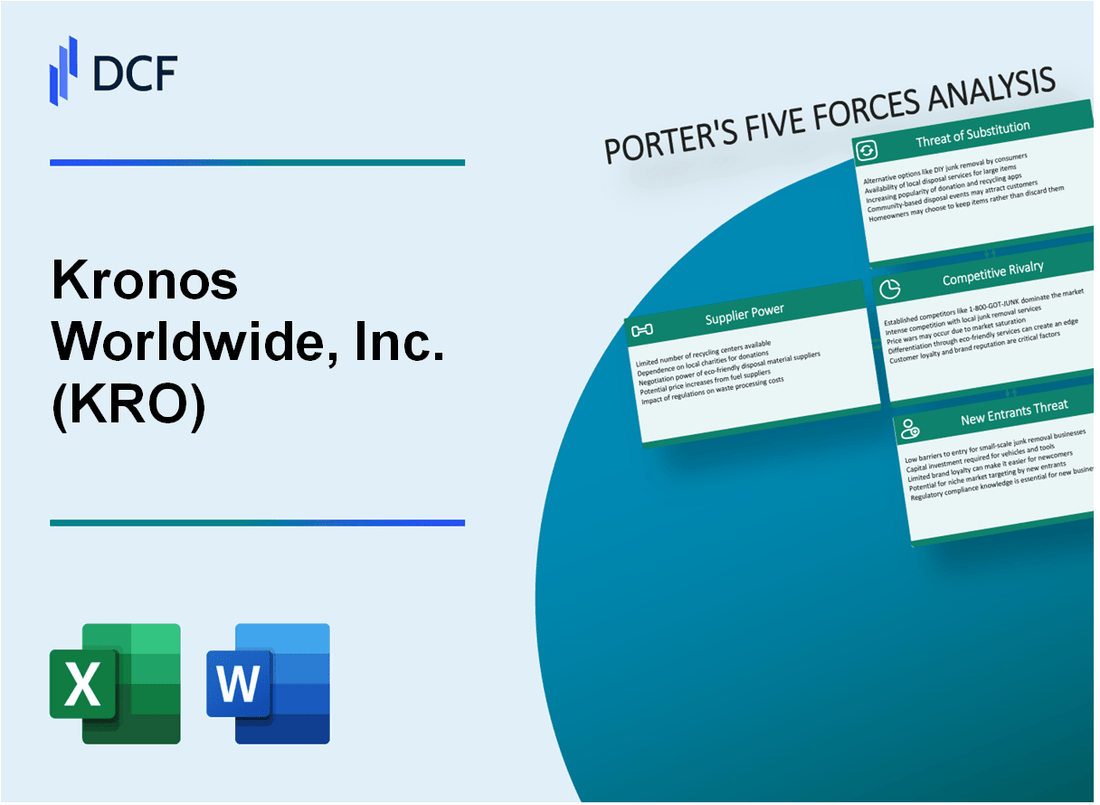
Kronos Worldwide, Inc. (KRO): 5 Forces Analysis [Jan-2025 Mis à jour] |
Entièrement Modifiable: Adapté À Vos Besoins Dans Excel Ou Sheets
Conception Professionnelle: Modèles Fiables Et Conformes Aux Normes Du Secteur
Pré-Construits Pour Une Utilisation Rapide Et Efficace
Compatible MAC/PC, entièrement débloqué
Aucune Expertise N'Est Requise; Facile À Suivre
Kronos Worldwide, Inc. (KRO) Bundle
Plongez dans le paysage stratégique de Kronos Worldwide, Inc. (KRO), où la dynamique complexe de l'industrie du dioxyde de titane révèle une interaction complexe des forces du marché. En tant qu'acteur critique dans un marché mondial hautement compétitif, KRO navigue sur un terrain difficile façonné par des fournisseurs de matières premières limitées, des clients sensibles aux prix, des rivalités intenses, des alternatives technologiques émergentes et de formidables obstacles à l'entrée du marché. Cette analyse dévoile les défis et opportunités stratégiques qui définissent le positionnement concurrentiel de l'entreprise en 2024, offrant un aperçu des facteurs critiques qui stimuleront son succès futur sur le marché mondial des pigments.
Kronos Worldwide, Inc. (KRO) - Porter's Five Forces: Bargaining Power des fournisseurs
Nombre limité de fournisseurs de matières premières de dioxyde de titane spécialisés
En 2024, le marché mondial des matières premières du dioxyde de titane est caractérisé par un paysage de fournisseur concentré:
| Top fournisseurs de matières premières en dioxyde de titane | Part de marché mondial |
|---|---|
| Iluka Resources Limited | 22.3% |
| Rio Tinto | 18.7% |
| Tronox Holdings | 15.6% |
| Autres fournisseurs | 43.4% |
Investissement élevé en capital pour la production de matières premières
Exigences en matière de dépenses en capital pour la production de dioxyde de titane:
- Facilité de production de dioxyde de titane vert typique: 500 $ à 750 millions de dollars d'investissement initial
- Capital de maintenance annuel moyen: 50 millions de dollars
- Coûts de recherche et de développement: 25 à 40 millions de dollars par an
Coûts importants d'énergie et de produits chimiques
| Catégorie de coût d'entrée | 2024 Prix moyen | Changement d'une année à l'autre |
|---|---|---|
| Acide sulfurique | 180 $ par tonne métrique | +5.2% |
| Gaz naturel | 4,75 $ par MMBTU | +3.8% |
| Électricité | 0,0725 $ par kWh | +4.1% |
Perturbations potentielles de la chaîne d'approvisionnement sur les marchés mondiaux
Facteurs de risque mondiaux de la chaîne d'approvisionnement en matières premières de dioxyde de titane:
- Les tensions géopolitiques ayant un impact sur les principales régions productrices de minéraux
- Les coûts de transport augmentaient de 7,3% en 2024
- Risque de perturbation de la chaîne d'approvisionnement mondiale estimée: 22,5%
Kronos Worldwide, Inc. (KRO) - Porter's Five Forces: Bargaining Power of Clients
Clientèle concentré
En 2024, Kronos Worldwide, Inc. dessert environ 80% de ses ventes de dioxyde de titane aux industries de peinture, de revêtements et de plastiques. Les 5 principaux clients représentent 42,6% des revenus totaux de l'entreprise.
| Segment de l'industrie | Concentration du client | Impact sur les revenus |
|---|---|---|
| Industrie de la peinture | 35% | 287,4 millions de dollars |
| Industrie des revêtements | 25% | 205,3 millions de dollars |
| Industrie des plastiques | 20% | 164,2 millions de dollars |
Sensibilité aux prix
Le prix du dioxyde de titane montre une sensibilité importante au prix du client, avec Élasticité-prix d'environ 0,75. Les fluctuations moyennes des prix de 10% peuvent avoir un impact sur la demande de 7,5%.
Capacités de commutation des fournisseurs
Les clients ont des capacités de commutation modérées entre les producteurs de dioxyde de titane:
- Coût de commutation moyen: 125 000 $ par chaîne de production
- Temps de qualification typique: 4-6 mois
- Producteurs alternatifs de dioxyde de titane: 6-8 fabricants mondiaux
Spécifications de qualité et de performance
Les exigences techniques influencent considérablement la sélection des fournisseurs. Les mesures de performance clés comprennent:
| Paramètre de performance | Seuil critique |
|---|---|
| Indice de blancheur | 98.5+ |
| Cohérence de la taille des particules | ± 0,05 microns |
| Niveau de pureté | 99.8% |
Kronos Worldwide, Inc. (KRO) - Five Forces de Porter: rivalité compétitive
Paysage compétitif mondial
En 2024, le marché mondial du dioxyde de titane comprend les principaux fabricants suivants:
| Entreprise | Part de marché (%) | Capacité de production annuelle (tonnes métriques) |
|---|---|---|
| Chimiores | 17.5 | 1,200,000 |
| Tronox | 15.3 | 1,050,000 |
| Chasseur | 12.7 | 850,000 |
| Kronos dans le monde | 8.6 | 650,000 |
Caractéristiques de la concurrence du marché
L'intensité concurrentielle sur le marché du dioxyde de titane est caractérisée par:
- Prix moyen par tonne métrique: 2 350 $
- Taille du marché mondial: 19,4 milliards de dollars en 2024
- Taux de croissance annuel composé (TCAC): 3,7%
Métriques d'innovation technologique
Investissement en innovation par des concurrents clés:
| Entreprise | Dépenses de R&D ($) | Brevets déposés (2023) |
|---|---|---|
| Chimiores | 127,500,000 | 43 |
| Tronox | 98,300,000 | 37 |
| Kronos dans le monde | 62,700,000 | 22 |
Concentration du marché
Métriques de concentration pour le marché du dioxyde de titane:
- Herfindahl-Hirschman Index (HHI): 1 250
- Top 4 des fabricants partage de marché: 53,1%
- Nombre de concurrents mondiaux importants: 8
Kronos Worldwide, Inc. (KRO) - Five Forces de Porter: menace de substituts
Technologies pigmentaires alternatives émergentes
Selon l'étude sur le marché mondial des pigments, les technologies de pigment alternatives devraient atteindre 10,5 milliards de dollars d'ici 2027, avec un TCAC de 4,2%.
| Technologie pigmentaire alternative | Part de marché (%) | Taux de croissance |
|---|---|---|
| Pigments organiques | 37.5% | 5.1% |
| Pigments synthétiques inorganiques | 28.3% | 3.9% |
| Pigments nano-échelle | 12.7% | 6.5% |
Développement potentiel de matériaux synthétiques avancés
Le marché avancé des matériaux synthétiques est estimé à 85,3 milliards de dollars en 2023, avec un impact de substitution potentiel sur les technologies de pigment traditionnelles.
- Pigments synthétiques à base de polymère: 42% de pénétration du marché
- Alternatives basées sur la céramique: 18% de potentiel du marché
- Pigments de matériaux composites: 22% de part de marché émergente
Intérêt croissant pour les alternatives de pigments durables et respectueuses de l'environnement
Le marché des pigments durables devrait atteindre 6,2 milliards de dollars d'ici 2026, avec un taux de croissance annuel de 7,3%.
| Type de pigment respectueux de l'environnement | Valeur marchande ($) | Réduction de l'impact environnemental |
|---|---|---|
| Pigments à base de bio | 2,4 milliards | Réduction de 65% de CO2 |
| Matériaux de pigment recyclés | 1,7 milliard | 50% de réduction des déchets |
Recherche sur des solutions nano-échelle et pigmentaires organiques
L'investissement en recherche en nano-pigment a atteint 350 millions de dollars en 2023, avec une croissance du marché prévu de 9,6%.
- Marché du dioxyde de nano-titane: 2,1 milliards de dollars
- Dépenses de R&D pigmentaires biologiques: 275 millions de dollars
- Demandes avancées de brevet pigmentaire: 187 en 2022
Kronos Worldwide, Inc. (KRO) - Five Forces de Porter: Menace de nouveaux entrants
Dépenses en capital élevées pour les installations de production de dioxyde de titane
La production de dioxyde de titane de Kronos Worldwide nécessite un investissement initial substantiel. En 2024, les dépenses en capital estimées pour une nouvelle installation de production de dioxyde de titane se situent entre 500 millions de dollars et 750 millions de dollars.
| Composant d'investissement en capital | Coût estimé |
|---|---|
| Acquisition de terres | 50-75 millions de dollars |
| Équipement de fabrication | 300 à 450 millions de dollars |
| Développement des infrastructures | 100 à 150 millions de dollars |
| Systèmes de conformité environnementale | 50-75 millions de dollars |
Exigences de technologie de fabrication complexe
Les obstacles à l'expertise technique comprennent:
- Processus de production de chlorure et de sulfate spécialisés
- Technologies de séparation et de purification avancées
- Exigence minimale d'expertise technique de plus de 10 ans en génie chimique
Règlements environnementales strictes
Les coûts de conformité environnementale représentent des obstacles à l'entrée du marché importants. Les dépenses de conformité réglementaire varient généralement de 25 à 40 millions de dollars par an pour les nouveaux fabricants de dioxyde de titane.
Économies d'échelle établies
Les fabricants existants comme Kronos Worldwide présentent des avantages de coûts importants:
- Volume de production: 1,2 million de tonnes métriques par an
- Coût de production par unité: 1 200 $ - 1 500 $ par tonne métrique
- Réduction des coûts des frais généraux: 22-30% par rapport aux nouveaux entrants potentiels
| Barrière de marché | Pourcentage d'impact |
|---|---|
| Exigence d'investissement en capital | 65% |
| Complexité technique | 20% |
| Règlements environnementaux | 10% |
| Économies d'échelle établies | 5% |
Kronos Worldwide, Inc. (KRO) - Porter's Five Forces: Competitive rivalry
Rivalry is intense among a few large global players, including Tronox, Chemours, and Huntsman.
The global titanium dioxide ($\text{TiO}_2$) market size was estimated at USD 22.5 billion in 2025. Global $\text{TiO}_2$ production capacity as of 2024 stood at approximately 9.93 million metric tonnes. Key multinational producers include The Chemours Company, Tronox Holdings Plc, Venator Materials Plc, Kronos Worldwide, Inc., and Huntsman International LLC.
The industry is suffering from overcapacity, which drives down pricing and segment profit.
| Metric | Q3 2025 | Q3 2024 |
|---|---|---|
| Kronos Worldwide, Inc. $\text{TiO}_2$ Segment Profit (Loss) | (\$15.3 million loss) | \$43.4 million profit |
| Kronos Worldwide, Inc. Net Sales | \$456.9 million | Approximately \$486.1 million (Implied from 6% drop) |
| Average $\text{TiO}_2$ Selling Prices (YoY Change) | Down 7% | N/A |
| Unabsorbed Fixed Production Costs | \$27 million | N/A |
For the first nine months of 2025, Kronos Worldwide, Inc.'s $\text{TiO}_2$ segment profit was \$37.2 million, a decrease from \$107.9 million in the first nine months of 2024. In China, rutile $\text{TiO}_2$ transactions fell as low as 13,000 yuan/mt by July 2025.
Kronos Worldwide, Inc.'s $\text{TiO}_2$ segment recorded a \$15.3 million loss in Q3 2025.
Competitors are consolidating, with large players like Kronos Worldwide, Inc. acquiring production capacity, such as the full ownership of Louisiana Pigment Company.
- Kronos Worldwide, Inc. acquired the remaining 50% interest in Louisiana Pigment Company, L.P. (LPC) effective July 16, 2024.
- The upfront cash payment for the acquisition was \$185 million, subject to working capital adjustments.
- A potential earn-out payment of up to \$15 million is based on aggregate consolidated net income before interest expense, income taxes, and depreciation and amortization expense (EBITDA) for calendar years 2025 and 2026.
- The LPC facility has a current estimated annual production capacity of 156,000 metric tons.
- Tariffs imposed by the European Union on Chinese $\text{TiO}_2$ exports ranged from 14.4%-39.7%.
Kronos Worldwide, Inc. (KRO) - Porter's Five Forces: Threat of substitutes
You're looking at the substitution threat for Kronos Worldwide, Inc. (KRO), and honestly, the core product, titanium dioxide ($\text{TiO}_2$), is pretty sticky. The reality is that no single product can completely replace $\text{TiO}_2$'s unique opacity and brightness across most of its applications. This pigment has the highest refractive index of any white pigment or filler/extender known, giving it superior hiding power, which is why more than 90% of standardized color palettes contain it.
Still, formulators absolutely look for ways to manage costs, especially when $\text{TiO}_2$ prices are volatile. We see partial substitutes, often called extenders, being used to cut formulation costs while trying to maintain quality. These functional extenders modify the refractive index or optimize particle spacing. For instance, precipitated barium sulfate, also known as blanc fixe, is known to offer a replacement of 5-15% of the $\text{TiO}_2$ content. Furthermore, synthetic hollow-sphere opacifiers, like certain opaque polymers, can enable effective hiding power with a reduced $\text{TiO}_2$ content of up to 25% in a formulation, though some specific products suggest a replacement guideline of up to 5%.
Here's a quick look at the common partial substitutes and their typical substitution range:
| Substitute Type | Example Material | Typical $\text{TiO}_2$ Replacement Range |
| Functional Extender/Spacer | Precipitated Barium Sulfate | 5-15% |
| Hollow-Sphere Pigment | Hollow Latex Spheres | Up to 5% (Specific Polymer) |
| Fine Filler/Extender | Calcined Kaolin | Used for spacing and trapping air |
When you look at high-performance, high-end applications, the substitution threat drops significantly. Automotive paints, for example, have much stricter requirements for durability and color consistency. These demanding specs limit how much a formulator can swap out the premium characteristics of $\text{TiO}_2$ for a cheaper alternative. The paint industry, which accounts for 55% of global $\text{TiO}_2$ consumption, is sensitive to this split between commodity and performance grades.
The incentive to use extenders definitely ramps up when $\text{TiO}_2$ prices are high. You saw this dynamic play out when prices were at cycle peaks, though in the first nine months of 2025, Kronos Worldwide, Inc.'s average $\text{TiO}_2$ selling prices actually declined 2% year-over-year. However, the market remains acutely aware of the potential for cost spikes; for context, in Q2 2025, rutile $\text{TiO}_2$ transactions were seen as low as 13,000 yuan/mt, showing the competitive pressure that can drive prices down, but also showing the floor is subject to market forces. Formulators keep these substitution strategies ready because of the historical price cyclicality. When prices are high, they use these tools to manage costs, which can lead to demand destruction, as noted by industry executives in past cycles.
The key takeaways on substitution readiness for Kronos Worldwide, Inc. are:
- No single product matches $\text{TiO}_2$'s opacity and brightness.
- Partial substitution up to 25% is technologically possible in some formulations.
- Precipitated barium sulfate allows for 5-15% replacement.
- High-end applications like automotive paints resist substitution.
- Customer hesitancy to build inventories in 2025 shows price sensitivity is a constant concern.
Kronos Worldwide, Inc. (KRO) - Porter's Five Forces: Threat of new entrants
You're looking at the barriers to entry in the titanium dioxide ($\text{TiO}_2$) market, and honestly, the picture for a new competitor is pretty daunting. Building a new facility isn't like setting up a small software company; this is heavy industry with massive upfront costs.
Barriers are very high due to the capital-intensive nature of building a new $\text{TiO}_2$ plant.
The sheer investment required is a major deterrent. For instance, a planned mid-to-large scale $\text{TiO}_2$ plant in India, targeting a 33,000 metric tonne per annum (MTPA) capacity, was associated with a capital expenditure (Capex) of approximately INR 400 crores, including acquisition costs for an initial phase. Remember, this is just for one facility. Furthermore, getting a new greenfield facility operational isn't quick; it typically requires 3 to 5 years for construction and commissioning.
Production requires complex technology (Chloride or Sulfate process) and significant technical expertise.
New entrants must choose between the established sulfate process and the more modern chloride process, and each demands specific know-how. The chloride process, which generally produces superior rutile-grade $\text{TiO}_2$, demands a higher capital investment and has higher requirements to the qualification of the staff. Conversely, the sulfate process, often a batch process, requires more man power. Mastering the chemistry and engineering to maintain consistent quality across different grades is a deep, hard-won skill set.
Strict environmental regulations and permitting processes add substantial cost and time hurdles.
Compliance is a huge, non-negotiable expense. Stringent environmental rules mean new facilities must budget for costly waste management systems upfront. The permitting timeline itself adds to the delay risk; for example, expanding a chloride-process plant can take 18 to 24 months just to navigate the specialized reactor technology and environmental permitting complexities. While the U.S. Environmental Protection Agency (EPA) issued guidance in late 2025 to provide clarity on New Source Review (NSR) preconstruction permitting, cutting down on deadlines for non-emissions related construction activities, the overall regulatory burden remains significant. On the other hand, in the EU, the Critical Raw Materials Act is creating a supportive environment, aiming for at least 10% domestic $\text{TiO}_2$ production by 2030, which could mean fast-track permitting for strategic projects there.
Established producers benefit from scale and proprietary process knowledge for over 50 different pigment grades.
Incumbents like Kronos Worldwide, Inc. benefit from decades of operational experience and massive scale. Kronos Worldwide, Inc.'s current annual production capacity is approximately 550,000 metric tonnes $\text{TiO}_2$. This scale allows for cost efficiencies; vertically integrated producers, which Kronos Worldwide, Inc. is, can realize 20-25% cost advantages through optimized processes and inventory management. Also, they don't just make one product; Kronos Worldwide, Inc. offers a wide portfolio, with at least 32 distinct product grades available for specific applications across coatings, inks, plastics, and pharma/cosmetics. This breadth of specialized product knowledge and established supply chains is defintely hard for a newcomer to match.
Here's a quick look at how the technology choice impacts resource needs:
| Process Type | Relative Staff Requirement | Typical Construction/Expansion Lag | Raw Material Flexibility |
|---|---|---|---|
| Chloride Process | Higher qualification needed | New Greenfield: 3-5 years; Expansion: 18-24 months | Less flexible; generally requires higher-grade feedstocks like rutile |
| Sulfate Process | More man power necessary | Not explicitly stated, but generally slower due to batch nature | Wider range of raw material, especially Ilmenite |
The ability to serve niche markets with specific product attributes is another barrier:
- Kronos Worldwide, Inc. offers grades like KRONOS 2310 for automotive finishes with very high weathering performance.
- They have a special rutile grade, KRONOS 2044, for matt architectural paints and inks.
- For plastics, KRONOS 2220 is a market leader for the PVC profile industry, meeting exacting demands for material handling and weather resistance.
- The company also benefits from controlling a key raw material source via its own ilmenite mine in Hauge i Dalane, Norway.
It's a high-stakes, high-entry-cost game, plain and simple.
Disclaimer
All information, articles, and product details provided on this website are for general informational and educational purposes only. We do not claim any ownership over, nor do we intend to infringe upon, any trademarks, copyrights, logos, brand names, or other intellectual property mentioned or depicted on this site. Such intellectual property remains the property of its respective owners, and any references here are made solely for identification or informational purposes, without implying any affiliation, endorsement, or partnership.
We make no representations or warranties, express or implied, regarding the accuracy, completeness, or suitability of any content or products presented. Nothing on this website should be construed as legal, tax, investment, financial, medical, or other professional advice. In addition, no part of this site—including articles or product references—constitutes a solicitation, recommendation, endorsement, advertisement, or offer to buy or sell any securities, franchises, or other financial instruments, particularly in jurisdictions where such activity would be unlawful.
All content is of a general nature and may not address the specific circumstances of any individual or entity. It is not a substitute for professional advice or services. Any actions you take based on the information provided here are strictly at your own risk. You accept full responsibility for any decisions or outcomes arising from your use of this website and agree to release us from any liability in connection with your use of, or reliance upon, the content or products found herein.