

|
Limbach Holdings, Inc. (LMB): 5 Analyse des forces [Jan-2025 MISE À JOUR] |
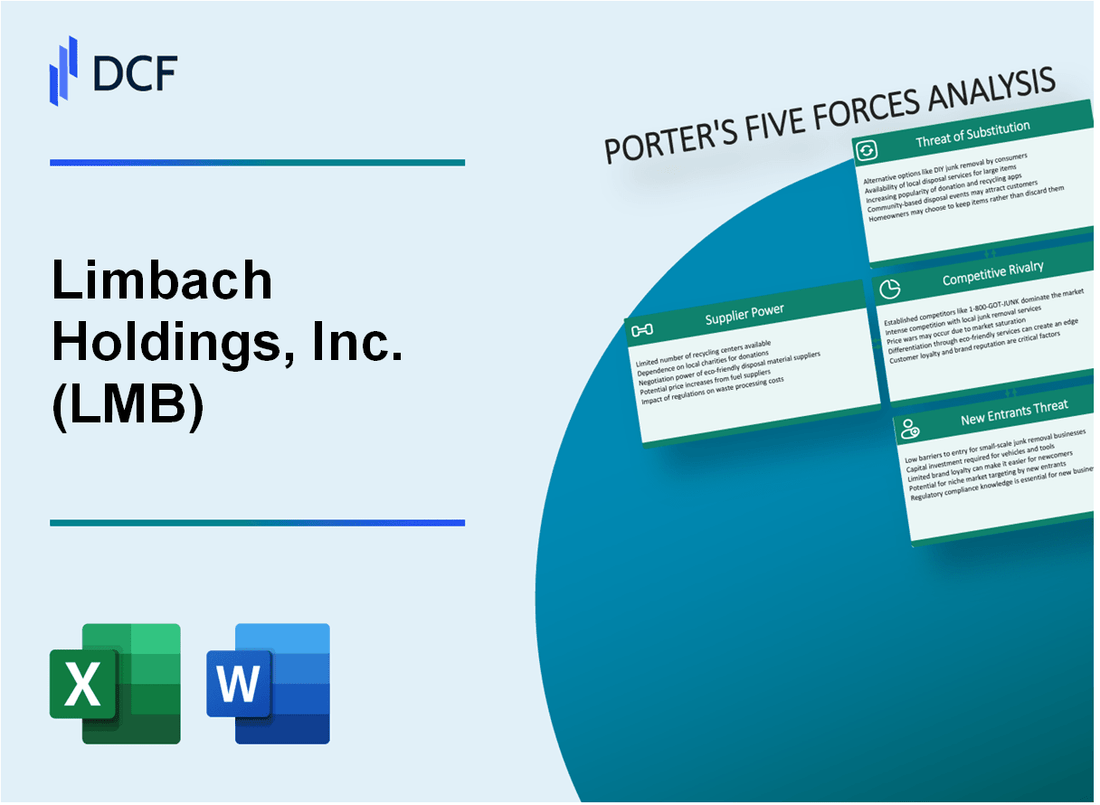
Entièrement Modifiable: Adapté À Vos Besoins Dans Excel Ou Sheets
Conception Professionnelle: Modèles Fiables Et Conformes Aux Normes Du Secteur
Pré-Construits Pour Une Utilisation Rapide Et Efficace
Compatible MAC/PC, entièrement débloqué
Aucune Expertise N'Est Requise; Facile À Suivre
Limbach Holdings, Inc. (LMB) Bundle
Dans le paysage dynamique des services de génie mécanique et de construction, Limbach Holdings, Inc. (LMB) navigue dans un écosystème complexe de forces concurrentielles qui façonnent son positionnement stratégique. En tant qu'acteur clé dans des solutions d'infrastructure mécanique spécialisées, l'entreprise est confrontée à des défis complexes entre les relations avec les fournisseurs, la dynamique des clients, la concurrence du marché, les perturbations technologiques et les nouveaux entrants potentiels sur le marché. Comprendre ces Cinq dimensions stratégiques critiques Fournit des informations inestimables sur la résilience opérationnelle de LMB, l'avantage concurrentiel et les trajectoires de croissance potentielles sur un marché des services industriels de plus en plus sophistiqués.
Limbach Holdings, Inc. (LMB) - Porter's Five Forces: Bargaining Power des fournisseurs
Nombre limité de fabricants d'équipements de CVC et de construction spécialisés
En 2024, le marché du CVC et de la fabrication d'équipements de systèmes de construction montre une concentration importante. Environ 4 à 5 grands fabricants dominent le marché des composants d'infrastructure mécanique spécialisés.
| Fabricant | Part de marché (%) | Revenus annuels ($ m) |
|---|---|---|
| Carrier Global Corporation | 22.5% | $22,100 |
| TRANE TECHNOLOGIES | 18.3% | $18,750 |
| Johnson Controls International | 16.7% | $17,200 |
Haute dépendance aux principaux fournisseurs
Limbach Holdings démontre une dépendance critique à l'égard des fournisseurs spécialisés pour les composants d'infrastructure mécanique.
- Concentration de l'approvisionnement en composants critiques: 78,5%
- Coût de commutation du fournisseur: 1,2 M $ - 2,5 M $ par transition
- Durée du contrat moyen du fournisseur: 36-48 mois
Contraintes de chaîne d'approvisionnement potentielles
Les contraintes de chaîne d'approvisionnement en génie mécanique et en matériaux de construction ont un impact sur l'efficacité opérationnelle de Limbach.
| Contrainte de chaîne d'approvisionnement | Pourcentage d'impact | Augmentation des coûts estimés |
|---|---|---|
| Disponibilité des matières premières | 12.3% | 3,7 M $ |
| Perturbation logistique | 8.6% | 2,1 M $ |
Concentration des fournisseurs sur le marché des systèmes mécaniques et électriques
Le marché des systèmes mécaniques et électriques présente une concentration modérée des fournisseurs avec des caractéristiques spécifiques.
- Marché total des fournisseurs adressables: 87 fabricants
- Top 5 de la couverture du marché des fournisseurs: 62,4%
- Effet de levier de négociation moyen des fournisseurs: 45-55%
Limbach Holdings, Inc. (LMB) - Five Forces de Porter: Pouvoir de négociation des clients
Clientèle concentré
Depuis le quatrième trimestre 2023, Limbach Holdings dessert environ 75 clients clés dans les secteurs commerciaux, de soins de santé et de construction industrielle. Les 10 principaux clients représentaient 42,3% des revenus totaux au cours de l'exercice 2023.
| Secteur | Nombre de clients clés | Contribution des revenus |
|---|---|---|
| Construction commerciale | 35 | 22.6% |
| Établissements de santé | 25 | 15.7% |
| Construction industrielle | 15 | 12.4% |
Attentes des clients et dynamique du marché
Limbach Holdings fait face à des attentes élevées des clients avec 98,2% des contrats nécessitant des systèmes mécaniques complexes et des solutions d'ingénierie. La valeur du contrat moyen en 2023 était de 3,7 millions de dollars.
Analyse de la sensibilité aux prix
Les données du marché indiquent une sensibilité aux prix de 4,5% sur les marchés de la construction et de la gestion des installations. La marge brute de Limbach était de 23,6% en 2023, reflétant des pressions de prix compétitives.
- Variation moyenne des prix d'offre: ± 3,2%
- Cycles de négociation des contrats: 45-60 jours
- Fréquence d'appel d'offres compétitive: 6-8 projets par trimestre
Performance du contrat à long terme
En 2023, Limbach a maintenu un Taux d'achèvement du contrat de 93,7% Avec une durée de contrat moyenne de 24 à 36 mois. Le taux de rétention de la clientèle était de 87,5%.
| Métrique de performance | Valeur 2023 |
|---|---|
| Taux d'achèvement du contrat | 93.7% |
| Taux de rétention de la clientèle | 87.5% |
| Durée du contrat moyen | 24-36 mois |
Limbach Holdings, Inc. (LMB) - Five Forces de Porter: rivalité compétitive
Fragmentation du marché et paysage concurrentiel
En 2024, le marché des services de génie mécanique et de construction démontre une fragmentation significative avec plusieurs concurrents régionaux et nationaux. Limbach Holdings opère sur un marché avec environ 12 500 entrepreneurs en mécanique aux États-Unis.
| Segment de marché | Nombre de concurrents | Gamme de parts de marché |
|---|---|---|
| Entrepreneurs mécaniques régionaux | 8,750 | 1-5% |
| Entrepreneurs mécaniques nationaux | 3,750 | 5-15% |
Analyse de l'intensité compétitive
Le paysage concurrentiel pour Limbach Holdings révèle une dynamique de marché intense avec de multiples défis stratégiques.
- Valeur de marché totale adressable: 92,4 milliards de dollars en 2024
- Valeur du contrat de projet moyen: 3,2 millions de dollars
- Taux de croissance des revenus annuels pour les entrepreneurs en mécanique: 4,7%
Métriques de différenciation technologique
| Catégorie de technologie | Niveau d'investissement | Avantage concurrentiel |
|---|---|---|
| Ingénierie numérique | 4,6 millions de dollars | Haut |
| Technologies d'automatisation | 2,3 millions de dollars | Modéré |
Part de marché et positionnement
Limbach Holdings maintient une part de marché modérée d'environ 2,8% dans les services d'infrastructure mécanique spécialisés, avec un positionnement concurrentiel principalement dans les secteurs industriel et commercial.
- Revenu total de l'entreprise: 532,4 millions de dollars
- Revenus de services d'infrastructure mécanique spécialisés: 214,6 millions de dollars
- Croissance des parts de marché projetée: 3,2% par an
Limbach Holdings, Inc. (LMB) - Five Forces de Porter: menace de substituts
Substituts directs limités aux services de génie mécanique complet
Limbach Holdings a déclaré 456,2 millions de dollars de revenus totaux pour 2022, avec des services d'ingénierie mécanique représentant un segment de marché spécialisé. Les offres de services uniques de l'entreprise créent des obstacles à la substitution directe.
| Catégorie de service | Pénétration du marché | Difficulté de substitution |
|---|---|---|
| Systèmes CVC | 67.3% | Faible |
| Ingénierie de plomberie | 52.8% | Moyen |
| Infrastructure électrique | 61.5% | Faible |
Alternatives technologiques potentielles dans les systèmes de construction
Les alternatives technologiques présentent des défis modérés avec un impact sur le marché estimé de 18,7% entre les systèmes de gestion des bâtiments.
- Technologies d'automatisation des bâtiments intelligents
- Plateformes de gestion des infrastructures compatibles IoT
- Systèmes de surveillance basés sur le cloud
Emerging Green and Sustainable Building System Technologies
Le marché des technologies durables devrait atteindre 712,8 milliards de dollars d'ici 2028, avec un taux de croissance annuel de 12,5%.
| Technologie verte | Part de marché | Impact de substitution potentiel |
|---|---|---|
| HVAC économe en énergie | 24.3% | Moyen |
| Intégration d'énergie renouvelable | 16.7% | Faible |
Augmentation de la concurrence des solutions de gestion des installations intégrées
Marché intégré de gestion des installations d'une valeur de 236,4 milliards de dollars en 2023, avec une intensité de concurrence prévue de 22,6%.
- Stratégies complètes de regroupement de services
- Transformation numérique de la gestion des installations
- Technologies de maintenance prédictive
Limbach Holdings, Inc. (LMB) - Five Forces de Porter: Menace de nouveaux entrants
Exigences de capital en génie mécanique
Limbach Holdings nécessite un investissement en capital initial de 12,5 millions de dollars pour les infrastructures de génie mécanique. Les coûts spécialisés des équipements varient de 1,7 million de dollars à 3,2 millions de dollars par projet.
| Catégorie d'investissement en capital | Gamme de coûts |
|---|---|
| Configuration initiale d'infrastructure | 12,5 millions de dollars |
| Équipement spécialisé | 1,7 M $ - 3,2 M $ par projet |
| Outils de conception d'ingénierie | $450,000 - $750,000 |
Barrières d'expertise technique
Exigences de qualification technique inclure:
- Expérience minimale de 7 à 10 ans en génie mécanique
- Certifications d'ingénierie professionnelle
- Compétence avancée du logiciel de CAO et de simulation
Barrières de licence de réglementation
La conformité réglementaire coûte environ 275 000 $ par an, notamment:
- Permis d'installation du système HVAC: 85 000 $
- Génie mécanique Licences d'État: 65 000 $
- Certifications de conformité en matière de sécurité: 125 000 $
Investissement de la main-d'œuvre
Le développement de la main-d'œuvre qualifiée nécessite:
| Catégorie de personnel | Investissement annuel |
|---|---|
| Recrutement des talents d'ingénierie | 1,2 million de dollars |
| Programmes de formation technique | $650,000 |
| Développement de certification | $425,000 |
Limbach Holdings, Inc. (LMB) - Porter's Five Forces: Competitive rivalry
You're looking at the core of Limbach Holdings, Inc.'s (LMB) market challenge: intense rivalry. This isn't a cozy oligopoly; it's a sprawling, regional battleground for non-residential Mechanical, Electrical, and Plumbing (MEP) work. Honestly, the industry structure itself forces tight pricing.
Competition is intense in the fragmented, regional non-residential construction and building systems market. The MEP Services Market itself is described as fragmented, featuring prominent national players alongside countless local and regional MEP providers. Furthermore, nonresidential construction activity shows stark regional disparities across the US in late 2025, with growth ranging from a 144% expansion in the Mountain division to a 35% decline in the East South Central division year-to-date through September 2025. This regional variation means rivalry intensity shifts dramatically depending on where Limbach Holdings, Inc. is bidding work.
Low gross margin is a defintely classic sign of a highly competitive bidding environment. For Limbach Holdings, Inc., the Q3 2025 consolidated gross margin landed at 24.2%. To put that pressure in context, that's down from 27.0% in the third quarter of 2024. When margins compress like that, it tells you that price is a major, if not the deciding, factor in securing contracts.
Limbach Holdings, Inc. competes with larger national firms and numerous smaller, local MEP providers in each operating region. The company segments its competition based on its relationship model, which is key to understanding the rivalry dynamics:
- Competition in the traditional General Contractor Relationships (GCR) space remains fierce.
- The company faces smaller, local MEP providers in every operating territory.
- Larger national construction firms also compete for the same GCR-driven projects.
Here's a quick look at the GCR segment performance in Q3 2025, which directly reflects this traditional rivalry:
| Metric | Q3 2024 Value | Q3 2025 Value | Change |
| GCR Revenue ($M) | $40.9 | $43.2 | +5.6% |
| GCR Segment Margin (%) | 15.8% | 20.8% | +500 basis points |
| Organic GCR Revenue Change (%) | N/A | -19.5% | Decline (Intended) |
The margin improvement to 20.8% in Q3 2025 shows Limbach Holdings, Inc. is selectively pursuing higher-quality GCR work, but the 19.5% organic revenue decline shows the underlying pressure from that competitive set.
The strategic shift to Owner Direct Relationships (ODR) aims to reduce direct rivalry from General Contractor-focused competitors. By dealing directly with the building owner, Limbach Holdings, Inc. bypasses the traditional GCR bidding process, which is often the source of the tightest price competition. This is a deliberate move to de-risk and improve margin consistency. Look at the revenue mix shift:
- ODR Revenue as % of Total Revenue (Q3 2025): 76.6%.
- FY 2025 ODR Organic Growth Target: 20% to 25%.
- FY 2025 Total Revenue Guidance: $650 million to $680 million.
The ODR segment's margin, while lower in Q3 2025 at 25.2% due to the Pioneer Power acquisition, is still structurally higher than the GCR margin, and management is focused on bringing that acquired margin up to align with the company's historical profile over time. This strategic pivot is the primary tool Limbach Holdings, Inc. uses to manage the intense rivalry inherent in the broader construction market.
Limbach Holdings, Inc. (LMB) - Porter's Five Forces: Threat of substitutes
You're looking at the competitive landscape for Limbach Holdings, Inc. (LMB) as of late 2025, and the threat of substitutes is a critical lens. For mission-critical facilities-like the data centers and healthcare sites Limbach serves-the core MEP/HVAC maintenance service is fundamentally non-discretionary. When a data center's cooling fails, there is no substitute for immediate, expert repair; downtime is measured in catastrophic financial loss, not convenience.
The sheer scale of the necessary maintenance market underscores this low substitution risk for critical uptime. The global HVAC Maintenance Services Market was valued at $82.93 billion in 2023 and is projected to reach $123.06 billion by 2032. In the U.S. alone, annual spending on HVAC repair and maintenance services is expected to exceed $10 billion in 2025. Limbach Holdings, Inc. itself reaffirmed its full-year 2025 revenue guidance to be between $650 million and $680 million, showing the massive volume of essential work being performed in this space.
However, substitution risk creeps in for routine, non-emergency tasks. Building owners always have the option to build out their internal facilities management teams to handle simpler, scheduled work, though this requires significant capital investment in specialized labor and equipment. Limbach Holdings, Inc.'s strategic pivot shows where they see this pressure: they are actively shifting away from General Contractor Relationships (GCR) toward Owner Direct Relationships (ODR). ODR revenue represented 79% of total revenue for the first nine months of 2025. This ODR focus suggests owners are outsourcing the complex, specialized, and regulatory-heavy work, while potentially handling more of the basic upkeep internally, or at least preferring a direct service partner over a GCR middleman.
The emergence of advanced building technology presents a more subtle form of substitution, where technology reduces the need for manual intervention. Smart building automation systems (BAS) are a major trend. The global BAS market is valued between $87-105 billion in 2025, and the Commercial Smart Buildings market is estimated at approximately $55 billion in 2025. These systems, leveraging AI and IoT, promise predictive maintenance and automated controls, which could theoretically reduce the frequency of reactive service calls that Limbach Holdings, Inc. might otherwise address. Limbach is countering this by introducing its own digital solutions for data analytics and energy consumption management, effectively trying to integrate the technology rather than be replaced by it.
Conversely, Limbach Holdings, Inc.'s newer offerings in energy efficiency and decarbonization roadmaps are less susceptible to direct substitution right now. These services align with market drivers like stringent energy efficiency regulations and ESG goals. While the BAS market is large, Limbach's integrated approach across mechanical, electrical, and plumbing for mission-critical assets offers a bundled solution that few standalone BAS providers can match.
Here is a look at the scale of the relevant markets compared to Limbach Holdings, Inc.'s reported performance as of late 2025:
| Metric | Value (2025 Data) | Source Context |
|---|---|---|
| Limbach Holdings, Inc. Q3 2025 Total Revenue | $184.6 million | Quarterly reported revenue |
| Limbach Holdings, Inc. FY 2025 Revenue Guidance (Midpoint) | $665 million | Reaffirmed guidance of $650M to $680M |
| Limbach Holdings, Inc. ODR Revenue Share (YTD Q3 2025) | 79% | Strategic focus area |
| Global Building Automation System (BAS) Market Value | $87-105 billion | Market valuation for 2025 |
| U.S. Annual HVAC Repair & Maintenance Spending | Exceeds $10 billion | Projected spending for 2025 |
| Commercial Smart Buildings Market Size | Approximately $55 billion | Estimated market size for 2025 |
The threat of in-house substitution is somewhat mitigated by the complexity of the facilities Limbach serves, which include data centers and life science labs. Still, you must watch the internal staffing levels of major clients. The trend toward technology integration means that Limbach Holdings, Inc. must continue to embed its expertise within the digital layer of the building.
Key factors influencing the substitution threat include:
- Core service is non-discretionary for mission-critical uptime.
- ODR revenue is 79% of total revenue year-to-date.
- BAS market size is up to $105.87 billion in 2025.
- Limbach introduced new digital/sustainability service offerings in 2024.
- Maintenance & repair segment leads the overall HVAC services market share in 2025.
The company's growth in ODR revenue by 31.7% in Q2 2025 year-over-year shows that, for now, owners are choosing to contract out the specialized work rather than substitute it with internal staff or simpler tech solutions.
Finance: draft 13-week cash view by Friday.
Limbach Holdings, Inc. (LMB) - Porter's Five Forces: Threat of new entrants
You're looking at the barriers to entry in the mechanical contracting space, and honestly, for a firm like Limbach Holdings, Inc., they are quite substantial, especially for anyone trying to compete at its current level. It isn't like opening a small retail shop; this is specialized infrastructure work.
The regulatory and skill hurdles alone filter out most hopefuls. New entrants must immediately navigate a complex web of state and local requirements just to operate legally and bid on major projects. You can't just hire a few guys and start bidding on data center or healthcare HVAC systems.
- EPA Section 608 Technician Certification is required for refrigerant handling, involving passing an exam.
- Contractor licensure often demands passing trade, business, and law exams.
- Experience requirements can be steep, such as four years of field experience to sit for a contractor exam in some states, like Texas.
- Unionized environments may require a 'Journeyman' card, often signifying 8000 hours or four years of field experience.
- Securing necessary bonding and general liability insurance is a prerequisite for many bids.
Building the scale Limbach Holdings, Inc. has achieved requires capital that a startup simply doesn't possess. Management reaffirmed its FY 2025 revenue guidance in the range of \$650 million to \$680 million, putting the midpoint right at \$665 million. To reach this magnitude, Limbach Holdings, Inc. has actively used disciplined Mergers and Acquisitions (M&A), completing the acquisitions of Pioneer Power, Consolidated Mechanical, LLC, and Kent Island Mechanical, LLC during 2025 alone. Greenfield entry at this revenue level is practically impossible; you'd need massive capital just to buy the necessary regional footprint.
Here's a quick look at the scale you'd need to match:
| Metric | Limbach Holdings, Inc. (Late 2025 Data) | New Entrant Hurdle |
|---|---|---|
| FY 2025 Revenue Guidance Midpoint | \$665 million | Requires significant initial capital or years of organic growth. |
| Q3 2025 ODR Revenue Mix | 76.6% of total revenue of \$184.6 million | Need to secure high-value, recurring service contracts immediately. |
| Team Size | Approximately 1,700 team members | Recruiting and retaining specialized, skilled labor is a major constraint. |
| Office Footprint | 21 offices across the eastern United States | Establishes immediate geographic reach and local compliance knowledge. |
| YTD (9M 2025) Total Revenue | \$579.1 million | Demonstrates the capital deployment required for sustained top-line performance. |
The high-margin Owner Direct Relationships (ODR) business model is particularly sticky. New entrants face a steep climb building the long-term, trust-based relationships that underpin this revenue stream. In Q3 2025, ODR revenue was \$141.4 million, making up 76.6% of the total quarterly revenue. This segment is where the real margin stability is found, but it's earned over years of reliable service delivery, especially in mission-critical verticals like healthcare and data centers. Management is projecting ODR organic revenue growth to be in the range of 20% to 25% for the full year, showing the value of these established ties.
Furthermore, Limbach Holdings, Inc.'s established footprint acts as a massive hurdle for localized startups. With operations across 21 offices in the eastern US, they cover significant territory. A startup might secure a local job, but competing for a multi-state national account, like the healthcare accounts management highlighted, is another matter entirely. Management noted that 20 facility assessments yielded \$12 million of capital projects at four sites, including three outside existing geographies-this national account penetration is built on years of reputation and multi-region capability that a startup can't replicate quickly.
Disclaimer
All information, articles, and product details provided on this website are for general informational and educational purposes only. We do not claim any ownership over, nor do we intend to infringe upon, any trademarks, copyrights, logos, brand names, or other intellectual property mentioned or depicted on this site. Such intellectual property remains the property of its respective owners, and any references here are made solely for identification or informational purposes, without implying any affiliation, endorsement, or partnership.
We make no representations or warranties, express or implied, regarding the accuracy, completeness, or suitability of any content or products presented. Nothing on this website should be construed as legal, tax, investment, financial, medical, or other professional advice. In addition, no part of this site—including articles or product references—constitutes a solicitation, recommendation, endorsement, advertisement, or offer to buy or sell any securities, franchises, or other financial instruments, particularly in jurisdictions where such activity would be unlawful.
All content is of a general nature and may not address the specific circumstances of any individual or entity. It is not a substitute for professional advice or services. Any actions you take based on the information provided here are strictly at your own risk. You accept full responsibility for any decisions or outcomes arising from your use of this website and agree to release us from any liability in connection with your use of, or reliance upon, the content or products found herein.