

|
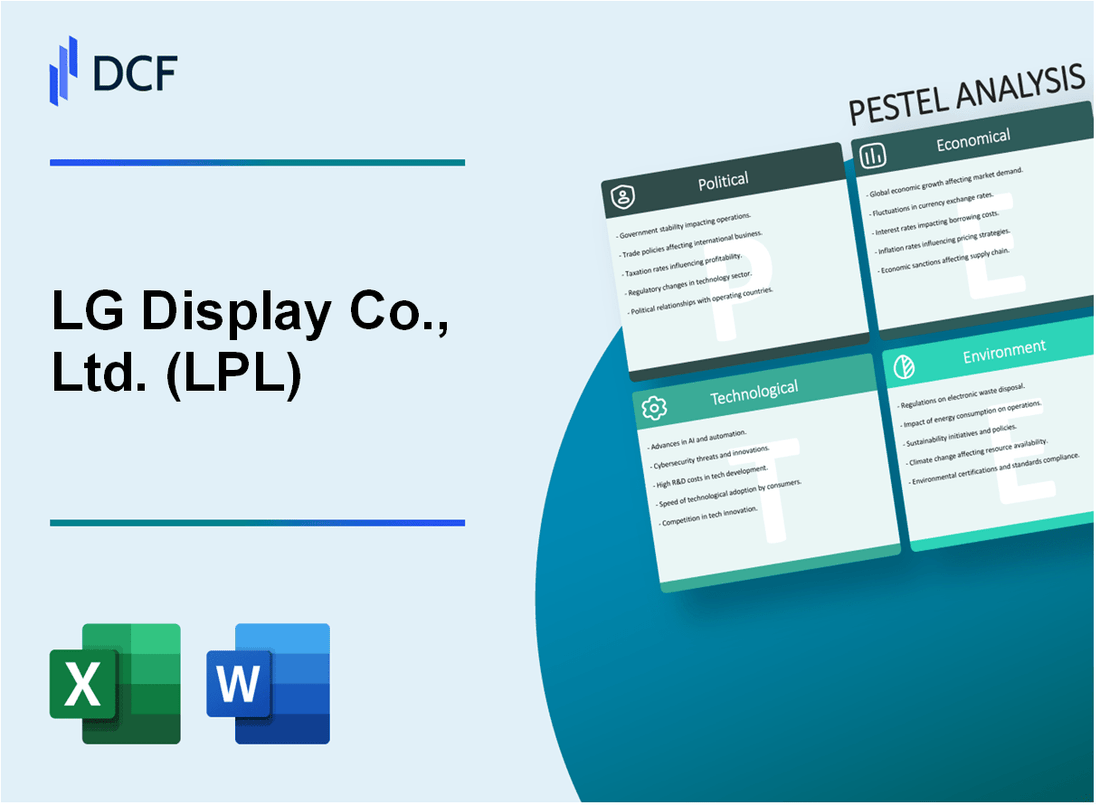
LG Display Co., Ltd. (LPL): Analyse de Pestle [Jan-2025 MISE À JOUR] |
Entièrement Modifiable: Adapté À Vos Besoins Dans Excel Ou Sheets
Conception Professionnelle: Modèles Fiables Et Conformes Aux Normes Du Secteur
Pré-Construits Pour Une Utilisation Rapide Et Efficace
Compatible MAC/PC, entièrement débloqué
Aucune Expertise N'Est Requise; Facile À Suivre
LG Display Co., Ltd. (LPL) Bundle
Dans le monde dynamique de la technologie d'affichage, LG Display Co., Ltd. se dresse à la carrefour de l'innovation et des défis mondiaux, naviguant dans un paysage complexe de progrès technologique, de volatilité économique et de responsabilité environnementale. Cette analyse complète du pilon dévoile le réseau complexe de facteurs qui façonnent la trajectoire stratégique de l'entreprise, des tensions géopolitiques et de la concurrence du marché aux développements technologiques de pointe et aux initiatives de durabilité. Plongez dans une exploration illuminante de la façon dont l'écran LG se positionne pour prospérer dans un écosystème commercial mondial de plus en plus interconnecté et rapide.
LG Display Co., Ltd. (LPL) - Analyse du pilon: facteurs politiques
Support du gouvernement sud-coréen pour la technologie d'affichage
Le gouvernement sud-coréen attribué ₩ 1,73 billion (environ 1,3 milliard de dollars) en 2023 pour le semi-conducteur et le développement de la technologie à travers le ministère du commerce, de l'industrie et de l'énergie.
| Initiative du gouvernement | Montant du financement | Année |
|---|---|---|
| Afficher la technologie R&D Support | ₩ 1,73 billion | 2023 |
| Incitations de la technologie verte | ₩ 500 milliards | 2023 |
Impact des tensions géopolitiques
Les tensions commerciales entre la Corée du Sud et la Chine ont entraîné des perturbations potentielles de la chaîne d'approvisionnement, avec environ 35% de la fabrication de LG Display potentiellement affectée par les contraintes géopolitiques.
- Restrictions d'importation en Chine sur les composants d'affichage: Impact potentiel de 15 à 20%
- Tarifs tarifaires potentiels en matière de technologies: 7-12%
Incitations de la technologie verte du gouvernement
Les incitations de fabrication verte du gouvernement sud-coréen pour 2024 comprennent les déductions fiscales 30% pour les processus de fabrication durables et ₩ 300 milliards dans les subventions directes pour le développement technologique respectueux de l'environnement.
Restrictions commerciales et opérations commerciales internationales
| Type de restriction commerciale | Impact potentiel | Coût estimé |
|---|---|---|
| Contrôles d'exportation semi-conducteurs américains | Perturbation potentielle de la chaîne d'approvisionnement | 150 à 250 millions de dollars |
| Restrictions d'importation de la technologie chinoise | Limitations de fabrication | 100 à 180 millions de dollars |
Les restrictions commerciales actuelles pourraient potentiellement avoir un impact 40-45% des capacités de fabrication et d'exportation internationales de LG Display.
LG Display Co., Ltd. (LPL) - Analyse du pilon: facteurs économiques
Marché du panneau d'affichage mondial volatil
La part de marché de LG Display dans l'industrie mondiale des panneaux d'affichage au T4 2023: 16,7%. Paysage concurrentiel avec des rivaux clés:
| Fabricant | Part de marché (%) | Revenus (milliards USD) |
|---|---|---|
| Affichage Samsung | 23.5% | 24.3 |
| Affichage LG | 16.7% | 17.2 |
| Technologie BOE | 14.2% | 15.6 |
Investissement de la recherche et du développement
LG Afficher les dépenses de R&D en 2023: 1,84 milliard de dollars, représentant 10,7% des revenus totaux.
Impact de taux de change
Impact financier des fluctuations des devises en 2023:
- Volatilité du taux de change USD / KRW: ± 6,3%
- Perte de revenus due au taux de change: 412 millions de dollars
- Ratio de couverture: 45,7%
Ralentissement économique sur les marchés clés
Performance du marché dans les secteurs critiques:
| Segment de marché | Fenue des revenus (%) | Envois d'unité (millions) |
|---|---|---|
| Affichages du smartphone | -12.4% | 287 |
| Affichages de télévision | -8.6% | 215 |
| Surveiller les affichages | -5.2% | 93 |
LG Display Co., Ltd. (LPL) - Analyse du pilon: facteurs sociaux
Augmentation de la demande des consommateurs pour les technologies d'affichage haute résolution et éconergétiques
La taille du marché mondial de l'affichage a atteint 178,7 milliards de dollars en 2023, avec une croissance projetée à 256,3 milliards de dollars d'ici 2028. La préférence des consommateurs pour les écrans 4K et 8K a augmenté de 37% en 2023.
| Résolution d'affichage | Part de marché 2023 | Taux de croissance annuel |
|---|---|---|
| Affichages 4K | 52.4% | 18.6% |
| Affichages 8K | 8.7% | 24.3% |
Défis de la main-d'œuvre avec la population vieillissante et les compétences dans le secteur de la technologie
L'âge moyen des effectifs technologiques de la Corée du Sud est de 42,6 ans. Pénurie de compétences technologiques estimée à 45 000 professionnels des industries des semi-conducteurs et des expositions.
| Groupe d'âge | Pourcentage de la main-d'œuvre technologique |
|---|---|
| 25-34 ans | 29.3% |
| 35 à 44 ans | 33.7% |
| 45-54 ans | 25.6% |
Préférence croissante des consommateurs pour les écrans d'affichage plus grands et plus sophistiqués
Le marché de l'écran à grand écran (55 pouces et plus) a augmenté de 42,5% en 2023. La pénétration de la télévision intelligente a atteint 68% sur les marchés développés.
| Taille d'écran | Demande du marché 2023 |
|---|---|
| 55-65 pouces | 37.2% |
| 65-75 pouces | 28.6% |
| Plus de 75 pouces | 16.9% |
Vers les technologies de travail à distance et de communication numérique
L'adoption des travaux à distance est passée à 32,6% dans le monde en 2023. La demande de technologie d'affichage pour les configurations du bureau à domicile a augmenté de 47,3%.
| Plate-forme de communication numérique | Croissance des utilisateurs 2023 |
|---|---|
| Vidéoconférence | 38.7% |
| Espaces de travail collaboratifs | 29.4% |
| Outils de collaboration à distance | 33.9% |
LG Display Co., Ltd. (LPL) - Analyse du pilon: facteurs technologiques
Innovation continue dans les technologies d'affichage OLED et flexibles
LG Display a investi 3,3 milliards de dollars en R&D en 2023, en se concentrant sur les technologies d'affichage avancées. La société détient 8 200 brevets mondiaux liés à l'affichage à partir de 2024.
| Technologie | Investissement (2023) | Dénombrement des brevets |
|---|---|---|
| Technologie OLED | 1,6 milliard de dollars | 3 750 brevets |
| Affichage flexible | 1,1 milliard de dollars | 2 450 brevets |
Investissement lourd dans la recherche d'affichage de nouvelle génération
L'affichage LG a alloué 2,5 milliards de dollars spécifiquement pour le développement d'écran transparent et roulable en 2023-2024.
| Domaine de recherche | Montant d'investissement | Entrée du marché attendu |
|---|---|---|
| OLED transparent | 1,2 milliard de dollars | 2025 |
| Affichages roulables | 1,3 milliard de dollars | 2026 |
Tendances émergentes dans les systèmes d'affichage automobile
LG Display a obtenu 4,7 milliards de dollars de contrats d'affichage automobile pour 2024, avec 42 constructeurs automobiles mondiaux En tant que clients.
| Type d'affichage automobile | Part de marché | Projection des revenus |
|---|---|---|
| Affichages en tête-à-tête | 28% | 1,6 milliard de dollars |
| Affichages de la console centrale | 35% | 2,1 milliards de dollars |
Processus de fabrication avancés
Affichage LG implémenté Optimisation de la fabrication dirigée par l'IA, réduisant les coûts de production de 17% et augmentant les taux de rendement à 94,6% en 2023.
| Métrique manufacturière | 2022 Performance | Performance de 2023 |
|---|---|---|
| Réduction des coûts de production | 8% | 17% |
| Taux de rendement | 89.3% | 94.6% |
LG Display Co., Ltd. (LPL) - Analyse du pilon: facteurs juridiques
Règlements strictes sur la propriété intellectuelle dans le secteur de la technologie d'affichage
LG Display a déposé 7 203 brevets en Corée du Sud et 12 541 brevets internationaux en 2023. La société a investi 1,24 milliard de dollars en recherche et développement, en se concentrant sur la protection de ses innovations sur la technologie d'affichage.
| Catégorie de brevet | Nombre de brevets | Couverture géographique |
|---|---|---|
| Technologie OLED | 3,456 | Corée du Sud, États-Unis, Chine, Japon |
| Technologie LCD | 4,102 | Corée du Sud, Union européenne, Taïwan |
| Affichage à points quantiques | 1,645 | Protection mondiale des brevets |
Conformité aux normes internationales environnementales et de fabrication
L'affichage LG est conforme à ISO 14001: 2015 Normes de gestion environnementale et maintient les certifications dans 6 emplacements de fabrication dans le monde. La société a investi 78,5 millions de dollars dans des processus de fabrication durables.
| Certification | Niveau de conformité | Investissement annuel |
|---|---|---|
| ISO 14001 | Compliance à 100% | 78,5 millions de dollars |
| Norme ROHS | Compliance complète | 45,2 millions de dollars |
| Règlement sur les weee | Compliance complète | 32,7 millions de dollars |
Des litiges potentiels de brevets avec des concurrents de technologie d'affichage mondiale
En 2023, LG Display a été impliqué dans 12 cas de litige en cours en cours avec des concurrents, les dépenses juridiques totales atteignant 43,6 millions de dollars.
| Concurrent | Nombre de litiges | Frais juridiques estimés |
|---|---|---|
| Affichage Samsung | 5 cas | 18,3 millions de dollars |
| Technologie BOE | 3 cas | 12,5 millions de dollars |
| Entreprise tranchante | 4 cas | 12,8 millions de dollars |
Règlements sur la confidentialité et la protection des données sur plusieurs marchés internationaux
L'affichage LG alloue 22,7 millions de dollars par an pour la conformité à la protection des données sur 15 marchés internationaux, adhérant au RGPD, au CCPA et aux réglementations locales de protection des données.
| Région | Règlement de conformité | Investissement annuel de conformité |
|---|---|---|
| Union européenne | RGPD | 8,6 millions de dollars |
| États-Unis | CCPA | 6,3 millions de dollars |
| Asie-Pacifique | Lois locales de protection des données | 7,8 millions de dollars |
LG Display Co., Ltd. (LPL) - Analyse du pilon: facteurs environnementaux
Engagement à réduire les émissions de carbone et les pratiques de fabrication durables
L'affichage LG s'est engagé à réduire les émissions de carbone de 50% d'ici 2030 par rapport aux niveaux de référence 2018. La société cible la neutralité du carbone d'ici 2050.
| Cible de réduction du carbone | Année | Pourcentage |
|---|---|---|
| Année de base | 2018 | 100% |
| Cible de réduction | 2030 | 50% |
| Objectif de neutralité au carbone | 2050 | 0% |
Investissement dans les technologies de production respectueuses de l'environnement et les énergies renouvelables
LG Display a investi 1,2 billion de KRW dans la technologie verte et les infrastructures d'énergie renouvelable entre 2020-2023.
| Catégorie d'investissement | Montant (KRW) | Pourcentage de l'investissement total |
|---|---|---|
| Infrastructure d'énergie renouvelable | 600 milliards | 50% |
| Technologies de production respectueuses de l'environnement | 400 milliards | 33.3% |
| Mises à niveau de l'efficacité énergétique | 200 milliards | 16.7% |
Initiatives d'économie circulaire pour la gestion des déchets électroniques
LG affiche Recyclé 85 000 tonnes métriques de déchets électroniques en 2022, ce qui représente une augmentation de 22% par rapport à 2021.
| Année | Déchets électroniques recyclés (tonnes métriques) | Croissance d'une année à l'autre |
|---|---|---|
| 2021 | 70,000 | - |
| 2022 | 85,000 | 22% |
Conformité aux réglementations environnementales mondiales et aux normes technologiques vertes
L'affichage LG maintient des certifications sur 12 normes environnementales internationales, notamment ISO 14001 et Energy Star.
| Certification | Année obtenue | Période de validité |
|---|---|---|
| ISO 14001 | 2015 | 2024 |
| Star de l'énergie | 2018 | 2025 |
| Certification LEED | 2020 | 2026 |
LG Display Co., Ltd. (LPL) - PESTLE Analysis: Social factors
You need to see the social landscape not just as a consumer trend report, but as a map of where your biggest revenue opportunities and compliance risks lie. For LG Display, the 2025 narrative is a clear pivot toward premium, energy-efficient displays, but this is balanced by persistent scrutiny on the manufacturing labor model.
Growing consumer preference for premium, energy-efficient OLED displays in high-end devices.
The market is defintely moving past simple size and resolution; consumers are now prioritizing energy efficiency and a better viewing experience in high-end purchases. LG Display is capitalizing on this with its 4th-generation OLED technology. Their new panels, introduced in early 2025, deliver a maximum brightness of up to 4,000 nits, which is a significant 33% increase over the previous generation.
Crucially, this performance boost comes with better sustainability metrics. The 65-inch panels show around 20% greater energy efficiency, directly addressing rising utility costs and consumer environmental consciousness. This focus is also visible in manufacturing, where the company anticipates reducing plastic consumption in OLED TV production by approximately 16,000 tons in 2025 compared to an equivalent number of LCD TVs. This isn't just good PR; it's a competitive edge in a market where the OLED segment already held the largest share by technology in 2024.
Increasing public scrutiny on labor practices in large-scale manufacturing facilities.
While LG Display is making a clear move toward a more profitable, OLED-centric business, the transition involves significant workforce restructuring that draws public and labor attention. The company has been implementing consecutive voluntary retirement programs for both production and office staff, including one for office workers in October 2025, offering severance pay equivalent to up to 36 months' worth of salary.
This 'workforce optimization' is a necessary step to achieve an anticipated full-year operating profit of around 800 billion Korean won in 2025, but it creates a social risk. We saw this risk materialize in late 2024 with protests from over 500 workers at the Guangzhou LCD plant over severance and compensation plans during the facility's sale. The broader South Korean manufacturing sector itself is under pressure, shedding 83,000 jobs in June 2025, which amplifies scrutiny on any large-scale layoffs. You have to manage these transitions with extreme transparency to avoid reputational damage.
Demand for larger-screen, immersive displays drives new market opportunities in gaming and automotive.
The desire for immersive experiences is fueling demand for large-format displays (LFDs) beyond the living room. The global LFD market, which includes digital signage and interactive displays, is projected to grow at a Compound Annual Growth Rate (CAGR) of 11.7% from 2025 to 2030, reaching an estimated value of USD 26.685 billion by 2030. LG Display is well-positioned, with its automotive display business continuing to strengthen its leadership.
The automotive display market, already valued at an estimated USD 15.9 billion in 2023, is a key growth area for premium panels like the 57-inch Pillar-to-Pillar (P2P) Oxide LCD display that won an award at the 2025 SID Display Week. In the consumer segment, the company is also expanding its lineup of high-end products like specialized gaming monitors to capture the eSports and high-refresh-rate market.
| Market Segment | Key 2025 Driver | Growth/Revenue Data (2025/Forecast) |
|---|---|---|
| Large Format Display (LFD) | Immersive Digital Signage, Automotive Integration | Projected CAGR of 11.7% (2025-2030); Market to reach USD 26.685 billion by 2030. |
| Automotive Display | Electric/Autonomous Vehicle Dashboards | Market estimated at USD 15.9 billion (2023), continuous growth expected. |
| High-Resolution IT Panels | Stabilized Work-From-Home/Hybrid Models | Accounted for 37% of LG Display's Q3 2025 revenues. |
Shifting work-from-home trends sustain demand for high-resolution IT panels (laptops, monitors).
The pandemic-era surge in demand for IT panels has stabilized into a permanent, structural increase in the market for high-quality displays. Hybrid work is the new baseline. In the United States, the telework rate in April 2025 was 21.6%, meaning approximately 34.3 million employed people were working from home at least some of the time. Upwork's estimate is even higher, predicting 36.2 million Americans, or 22% of the workforce, will be working remotely by 2025.
This sustained demand for high-resolution monitors and laptops is a core revenue pillar for LG Display. For the third quarter of 2025, panels for IT devices, which include monitors, laptops, and tablet PCs, accounted for a substantial 37% of the company's total revenues. This is a sticky demand for premium products, as remote workers often invest in better equipment to replicate the office setup.
- IT Panels (Laptops, Monitors) comprised 37% of Q3 2025 revenue.
- US telework rate stabilized at 21.6% in April 2025.
- Higher education attainment correlates with a 38.3% telework rate for those with a Bachelor's degree or higher.
The IT panel business is now a critical, high-margin anchor for the company.
LG Display Co., Ltd. (LPL) - PESTLE Analysis: Technological factors
You're looking at LG Display Co., Ltd. (LPL) and trying to figure out if their technology edge is a real moat or just a head start. Honestly, their dominance in large-area Organic Light-Emitting Diode (OLED) is a massive technological barrier for competitors, but this industry demands relentless, costly innovation. The core risk is that today's cutting-edge tech is tomorrow's obsolete factory line, so the R&D spend needs to be constant and strategic. They are defintely making the right moves by shifting capital from old Liquid Crystal Display (LCD) lines into next-generation displays.
Dominance in large-area OLED (WOLED) technology provides a significant market moat.
LG Display's White OLED (WOLED) technology gives them a near-monopoly in the premium large-screen TV market. This isn't just a slight lead; it's a deep technological advantage built over a decade. In the first quarter of 2025, LG Electronics, their primary customer, captured the largest share of the global OLED TV market by volume at 52.1%. More impressively, in the ultra-large TV segment (80 inches and above), LG's dominance was even stronger, commanding a 63.6% share. Their latest innovation, the 4th-generation OLED, uses a proprietary Primary RGB Tandem structure to hit a peak brightness of 4,000 nits, a huge leap in performance. That kind of performance gap is tough to close quickly. To capitalize, the company is increasing its WOLED TV panel production by 20% compared to 2023 levels.
Heavy R&D investment in next-generation technologies like MicroLED and transparent displays.
The company is not resting on its WOLED laurels. They know the future is beyond current TV panels, so they are pouring money into R&D. Their cumulative research and development costs for the third quarter of 2025 totaled 1.6686 trillion won. The industry expects their full-year 2025 R&D spending to be around 2 trillion won. Plus, in June 2025, the board approved an additional 1.26 trillion won (about $920 million) capital expenditure for next-generation OLED technologies to be spent through mid-2027. That's a serious commitment. This investment is fueling a push into high-growth areas like automotive displays and specialty products.
Here's a quick look at their next-gen focus areas in 2025:
- Automotive Displays: Developing stretchable and slidable panels for futuristic car interiors.
- Transparent OLED: Showcasing a massive 380-inch Transparent OLED display in a commercial district in Tokyo.
- MicroLED: Unveiling a 22-inch Zero Bezel Micro LED display, a technology aimed at commercial and high-end signage markets.
Rapid obsolescence cycle of older LCD manufacturing lines requires constant retooling.
The speed of technological change is brutal; it forces you to kill off profitable, but aging, lines. The competitive pressure from Chinese manufacturers like BOE and TCL CSOT, who can produce LCD panels cheaper, made the LCD TV business unsustainable for LG Display. They had to pivot completely. This is the clearest example of the obsolescence cycle in action: the company officially sold its last remaining LCD TV panel factory in Guangzhou, China, to TCL CSOT in April 2025 for approximately 10.8 billion yuan (around $1.47 billion USD). The proceeds from that sale are now being strategically funneled into the new OLED investments. It was a necessary, painful move. The money has to follow the technology, period.
High barrier to entry for new competitors in the complex, patent-heavy OLED manufacturing process.
The OLED manufacturing process, especially for large-area panels, is incredibly complex and requires a massive intellectual property (IP) portfolio. This is their ultimate defense. LG Display is a leader in the stacked OLED patent field, which is critical for high-brightness, long-life panels. As of the latest data, they lead with 348 patents in stacked OLED, representing 25.2% of all publicly disclosed patents in that category. They also have 502 patent citations, which is a strong indicator of the quality and foundational nature of their IP. They are not afraid to defend this moat, either; in 2025, they filed a patent infringement lawsuit against a competitor, Tianma, over mobile LCD and OLED panels. This patent wall is a huge capital and time sink for any new entrant.
| Key Technological Metric | LG Display (LPL) Data (2025 Fiscal Year / Latest) | Strategic Implication |
|---|---|---|
| Q3 2025 Cumulative R&D Cost | 1.6686 trillion won | Sustained, high investment to maintain technology lead. |
| New OLED Investment (2025-2027) | 1.26 trillion won (approx. $920 million) | Targeted capital expenditure to secure future OLED market dominance. |
| Large OLED TV Market Share (Q1 2025, Volume) | 52.1% | Clear market leadership and strong pricing power in the premium segment. |
| Stacked OLED Patent Count | 348 patents (25.2% of total) | High barrier to entry due to proprietary, foundational manufacturing IP. |
| LCD TV Factory Sale Proceeds (2025) | Approx. $1.47 billion USD | Successful exit from obsolete technology, freeing up capital for OLED reinvestment. |
LG Display Co., Ltd. (LPL) - PESTLE Analysis: Legal factors
Complex international patent litigation, particularly concerning OLED and panel structure technologies.
You need to see intellectual property (IP) as a core asset, and for LG Display Co., Ltd. (LPL), that means constant, expensive legal defense. The display industry is defintely a patent minefield, especially around advanced Organic Light-Emitting Diode (OLED) and panel structure innovations. The near-term risk is high, but so is the potential for IP monetization.
In a proactive move to protect its technology, LG Display filed a patent infringement lawsuit in the U.S. District Court for the Eastern District of Texas in June 2025 against China's Tianma Microelectronics. The suit alleges infringement on seven of its patents, covering both mobile Liquid-Crystal Display (LCD) and OLED panel technologies, specifically those involving touch integration. This is a clear signal that the company is prepared to spend capital to defend its proprietary technology.
Also, in a rare strategic alignment, LG Display transferred 70 U.S. patents related to In-Plane Switching (IPS) LCD technology to rival Samsung Display in July 2025. This move monetizes legacy LCD assets while reinforcing a collective South Korean defense against foreign competitors in the broader display market.
Here's the quick math on potential litigation costs, using a recent comparable case:
| Legal Action Type | Date | Technology Focus | Financial Impact Example |
|---|---|---|---|
| Patent Infringement Verdict (LG Electronics) | July 2023 | NextGen TV (ATSC 3.0) | $1,684,469 (Reasonable Royalty) |
| Patent Lawsuit Filed (LPL) | June 2025 | OLED/LCD Touch Integration | Undetermined; significant legal expense |
| Patent Transfer (LPL to Samsung Display) | July 2025 | IPS LCD Technology | Monetization of legacy assets |
Adherence to stringent global data privacy regulations (e.g., GDPR) for smart display components.
The rise of smart displays means LG Display is processing more consumer data, which immediately triggers compliance risks under global regulations like the European Union's General Data Protection Regulation (GDPR). The risk isn't just for the final product (like a smart TV), but for the components and associated software LPL supplies.
While there is no public record of a specific 2025 GDPR fine against LG Display Co., Ltd., the financial exposure is massive. Total cumulative GDPR fines reached approximately €5.88 billion by January 2025, showing regulators are serious. For a Tier 2 violation, the penalty can be up to €20 million, or 4% of the firm's global annual revenue from the preceding fiscal year, whichever is higher. That's a huge number.
The compliance focus areas for LPL's smart display components are clear:
- Ensure data minimization and a clear data retention policy.
- Obtain explicit, granular consent for data processing on all smart features.
- Conduct a Transfer Impact Assessment (TIA) for any EU data moved outside the bloc.
Compliance with anti-dumping and countervailing duty investigations in key export markets like the US.
Global trade policy volatility is a major headwind, especially with the U.S. imposing broad reciprocal tariffs in 2025. While LG Display stated in its Q1 2025 earnings call that its direct exports of panels to the U.S. are minimal, the tariffs impact its primary customers-the set manufacturers-and its own supply chain.
The tariffs create a complex cost structure for LPL's global operations:
- South Korea Exports: The U.S. imposed a broad-based 25% tariff on South Korean exports in April 2025, later adjusted to a 15% country-specific tariff rate effective August 7, 2025, following trade negotiations.
- Vietnam Operations: The U.S. initially imposed a 46% countervailing duty on Vietnam in April 2025, which was reduced to a 20% import tariff as of July 8, 2025. LG Display has significant manufacturing capacity in Vietnam, making this rate a direct cost factor for products not covered by specific anti-dumping investigations.
- Raw Material Costs: South Korean exports of epoxy resins-a key raw material for printed circuit boards (PCBs) used in displays-face Indian anti-dumping duties ranging from $274 to $557 per ton in 2025, which is a tangible increase in the cost of goods sold for its South Asian market.
South Korean labor laws and industrial safety standards require defintely careful compliance.
As a major employer in South Korea, LG Display must navigate an increasingly strict domestic labor and safety environment. The financial impact of non-compliance has risen sharply in 2025, especially concerning wage payments and industrial safety.
From a wage perspective, the national minimum wage increased to ₩10,030 per hour starting January 1, 2025. More critically, new amendments to the Labor Standards Act, effective October 23, 2025, now apply a 20% annual interest on delayed wage payments to current employees, not just those who have left the company. This substantially increases the financial risk of payroll errors or delays.
Compliance with the Serious Accident Punishment Act (SAPA) remains a top priority. SAPA holds executives personally liable for serious industrial accidents, which is a massive operational and legal risk for a company running large-scale, complex manufacturing facilities.
LG Display Co., Ltd. (LPL) - PESTLE Analysis: Environmental factors
Pressure from investors and customers to achieve carbon neutrality goals by 2050.
You're seeing a clear shift in capital markets where ESG (Environmental, Social, and Governance) performance is no longer a footnote, but a fundamental business imperative. LG Display is defintely feeling this, as their 2025 TCFD Report (Task Force on Climate-Related Financial Disclosures) lists a 'Reputation' risk-the possibility of negative evaluations from investors and consumers if ESG management is neglected. This pressure is concrete.
In response, LG Display has a firm commitment to achieving carbon neutrality by 2050, a goal declared in April 2023. Their roadmap is aggressive: a targeted reduction of direct and indirect greenhouse gas (GHG) emissions (Scope 1 and Scope 2) by 53% by 2030 and 67% by 2040, all compared to 2018 levels. As of last year (2024), they already reduced emissions by 43% from the 2018 baseline. That's a strong start.
To be fair, achieving this means a massive energy transition. As of 2024, LG Display sourced 39% of its total electricity consumption from renewable energy, but the final push to 100% by 2050 will require sustained, heavy investment.
High energy and water consumption in panel fabrication requires significant sustainability investment.
Display panel fabrication is inherently resource-intensive; it uses a lot of energy and a staggering amount of water. This reality forces LG Display to commit substantial capital to operational efficiency just to maintain compliance and meet customer demands for sustainability.
The parent organization, LG Group, plans to invest KRW 1.8 trillion (approximately US$1.3 billion) over five years to achieve net-zero carbon emissions across its subsidiaries, which includes LG Display. This is the cost of doing business in a high-tech, high-volume industry.
LG Display's investment is highly targeted:
- Investing in Plasma Scrubbers to reduce Fluorinated Greenhouse Gas (F-GHG) emissions by 90%.
- Developing technology to reduce Nitrous Oxide (N₂O) emissions by 80% by 2030.
- Focusing on water reuse and efficiency programs to reduce water resource management costs.
Strict regulations on the disposal of chemical byproducts from display manufacturing processes.
The display manufacturing process involves numerous hazardous materials, generating chemical waste and wastewater. The regulatory environment, particularly in South Korea and China where LG Display has major operations, is strict and getting stricter. Compliance isn't optional; it's a critical risk factor.
LG Display manages this through a rigorous, multi-layered system:
- Mandatory pre-examination for all new chemical substances introduced.
- Internal prohibition of 739 types of chemical substances, exceeding legal requirements.
- Installation of advanced anti-pollution equipment and systems for early detection of chemical leaks.
This strict management is necessary because a single environmental breach could lead to operational interruptions, massive fines, and a severe reputation hit. The cost of compliance is high, but the cost of non-compliance is exponentially higher.
Growing market for eco-friendly, low-power consumption displays, favoring OLED technology.
Here's the opportunity side of the environmental equation: the market is actively rewarding energy efficiency. The global OLED display market, which is inherently more power-efficient than traditional LCDs because it doesn't require a separate backlight, was estimated at USD 44.39 billion in 2024 and is projected to grow at a CAGR of 18.0% from 2025 to 2033, reaching USD 191.86 billion by the end of that period. That's a huge tailwind.
LG Display's strategic pivot toward OLED is paying off. Their OLED revenue rose to 56% of total sales in Q2 2025. They are leveraging technological advances to capture this eco-conscious demand:
- New blue phosphorescent OLED technology for IT devices consumes about 15% less power than existing OLED panels.
- Fourth-generation OLED TV panels boost energy efficiency by approximately 20% compared to the previous generation.
This focus is a direct competitive advantage, especially in high-growth segments like automotive displays, where energy efficiency is crucial for electric vehicles (EVs). They are doubling down with a USD 925 million investment plan through mid-2027 to develop advanced OLED technologies.
| Environmental Factor | Metric/Target (2025 Fiscal Year Data) | Strategic Implication |
|---|---|---|
| Carbon Neutrality Goal | Target: 100% by 2050 (from 2018 base) | Long-term capital commitment for energy transition. |
| GHG Emission Reduction | Achieved 43% reduction (as of 2024) | Strong progress, but the remaining 57% will be harder to cut. |
| Renewable Energy Use | 39% of total electricity consumption (as of 2024) | Requires significant increase to meet the 2050 goal. |
| OLED Market Growth (CAGR) | Projected 18.0% from 2025 to 2033 | Major revenue opportunity from eco-friendly, low-power products. |
| OLED Revenue Share | 56% of total sales in Q2 2025 | Validates the shift to a more sustainable, high-margin product mix. |
| Chemical Management | Internal list of 739 types of prohibited substances | Mitigates regulatory and reputational risk from hazardous materials. |
Disclaimer
All information, articles, and product details provided on this website are for general informational and educational purposes only. We do not claim any ownership over, nor do we intend to infringe upon, any trademarks, copyrights, logos, brand names, or other intellectual property mentioned or depicted on this site. Such intellectual property remains the property of its respective owners, and any references here are made solely for identification or informational purposes, without implying any affiliation, endorsement, or partnership.
We make no representations or warranties, express or implied, regarding the accuracy, completeness, or suitability of any content or products presented. Nothing on this website should be construed as legal, tax, investment, financial, medical, or other professional advice. In addition, no part of this site—including articles or product references—constitutes a solicitation, recommendation, endorsement, advertisement, or offer to buy or sell any securities, franchises, or other financial instruments, particularly in jurisdictions where such activity would be unlawful.
All content is of a general nature and may not address the specific circumstances of any individual or entity. It is not a substitute for professional advice or services. Any actions you take based on the information provided here are strictly at your own risk. You accept full responsibility for any decisions or outcomes arising from your use of this website and agree to release us from any liability in connection with your use of, or reliance upon, the content or products found herein.